Calibration of DOI-Capable PET Detector Panels Using Uncollimated Front-Face Irradiation
Pith reviewed 2026-07-03 03:26 UTC · model grok-4.3
The pith
MLP calibration from uncollimated irradiation achieves 2.0 mm DOI resolution in PET detector panels.
A machine-rendered reading of the paper's core claim, the machinery that carries it, and where it could break.
Core claim
The MLP-based approach to DOI calibration using uncollimated irradiation generalizes from three gold-standard calibrated blocks to the full panel, with RMSEs of 0.36-0.61 mm versus gold-standard, and the panel achieves a mean energy resolution of 15.6% and a DOI resolution of 2.0 mm after saturation correction.
What carries the argument
The multilayer perceptron that predicts crystal depth from photopeak location in uncollimated irradiation data, trained on three blocks and applied to the panel.
If this is right
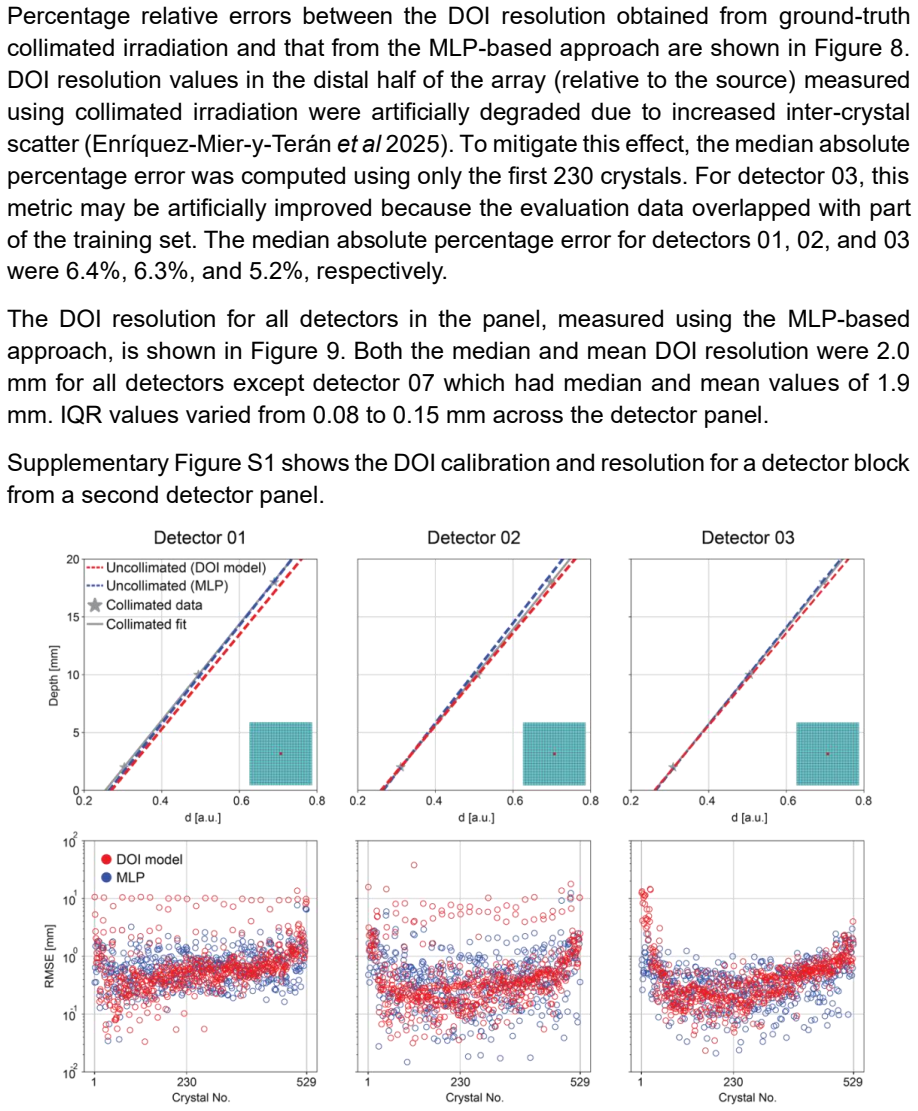
- Uncollimated irradiation yields photopeak-to-depth mappings with median relative RMSE of 1% to collimated second-order polynomial fits.
- The MLP approach outperforms the physics-informed model in DOI resolution estimates.
- The full panel can be calibrated using only a single uniform 511-keV irradiation.
- After saturation correction, the panel has 15.6% mean energy resolution and 2.0 mm DOI resolution.
Where Pith is reading between the lines
- In situ calibration of complete PET systems becomes feasible without collimators or disassembly.
- The approach may generalize to other dual-ended readout scintillator configurations.
- Block-to-block manufacturing variations are apparently small enough for the model to handle.
- Independent validation on panels with different crystal sizes would test the method's robustness.
Load-bearing premise
The photopeak-to-depth mapping learned from three collimated-calibrated blocks will generalize accurately to the remaining blocks in the panel under uncollimated irradiation without additional depth-specific constraints or overfitting.
What would settle it
An independent collimated-beam measurement of DOI resolution on the MLP-calibrated full panel would directly test if the 2.0 mm resolution holds.
Figures


read the original abstract
Objective. Gold-standard depth-of-interaction (DOI) calibration using collimated gamma-ray irradiation is time-consuming and impractical for system-level calibration of detector arrays. This work investigates an efficient DOI and energy calibration method for detector panels using uncollimated irradiation, with gamma rays incident nearly parallel to the crystal depth direction. Approach. The 511-keV photopeak location in a dual-ended readout PET detector block was evaluated as a function of crystal depth using collimated and uncollimated $^{22}$Na irradiation. A $4\times4$ dual-ended readout PET detector panel was then assembled. Three detector blocks were calibrated using the gold-standard method, and two uncollimated-irradiation DOI calibration approaches--a physics-informed model and a multilayer perceptron (MLP)--were compared against it. Finally, the full panel was calibrated for DOI and energy using the MLP-based approach. Main Results. The median relative RMSE between second-order polynomial fits from collimated and uncollimated irradiation was 1%, showing that uncollimated irradiation can provide reliable estimates when accurate DOI calibration parameters are available. Compared with gold-standard DOI calibration, the physics-informed and MLP-based approaches achieved RMSEs of 0.38-0.58 mm and 0.36-0.61 mm, respectively. The MLP-based approach provided better DOI resolution estimates and was therefore used for full-panel calibration. After saturation correction, the panel achieved a mean energy resolution of 15.6% and a DOI resolution of 2.0 mm. Significance. The proposed MLP-based calibration requires only a single uniform 511-keV irradiation, making it simple to implement and suitable for in situ calibration of DOI-capable PET detector arrays.
Editorial analysis
A structured set of objections, weighed in public.
Referee Report
Summary. The paper claims that uncollimated front-face 511-keV irradiation can be used for efficient DOI and energy calibration of dual-ended readout PET detector panels. After showing that uncollimated photopeak-vs-depth data agree with collimated gold-standard data to ~1% relative RMSE on three blocks, the authors compare a physics-informed model (RMSE 0.38-0.58 mm) and an MLP (RMSE 0.36-0.61 mm) against the gold standard, select the MLP, and apply it to calibrate an entire 4×4 panel, obtaining 15.6% mean energy resolution and 2.0 mm DOI resolution after saturation correction.
Significance. If the MLP mapping generalizes, the method would enable practical, in-situ DOI calibration of large detector arrays with only a single uniform irradiation, removing the need for time-consuming collimated scans on every block. The concrete RMSE numbers and direct comparison to an independent gold-standard measurement on the training blocks constitute a clear strength.
major comments (1)
- [Abstract / full-panel results] Abstract and full-panel calibration section: The MLP is trained exclusively on the three collimated-calibrated blocks and then applied to the remaining blocks of the 4×4 panel. No held-out block, cross-validation across blocks, or inter-block variability metric is reported, so the claimed panel-wide DOI resolution of 2.0 mm rests on the untested assumption that the learned photopeak-to-depth mapping transfers without degradation due to block-to-block differences in light yield, optical coupling, or crystal properties.
Simulated Author's Rebuttal
We thank the referee for the constructive review and the recognition of the method's potential significance. The major comment concerns the generalization of the MLP to the full panel without explicit cross-validation. We address this point below and indicate where revisions will be made to strengthen the manuscript.
read point-by-point responses
-
Referee: [Abstract / full-panel results] Abstract and full-panel calibration section: The MLP is trained exclusively on the three collimated-calibrated blocks and then applied to the remaining blocks of the 4×4 panel. No held-out block, cross-validation across blocks, or inter-block variability metric is reported, so the claimed panel-wide DOI resolution of 2.0 mm rests on the untested assumption that the learned photopeak-to-depth mapping transfers without degradation due to block-to-block differences in light yield, optical coupling, or crystal properties.
Authors: We agree that the manuscript does not include held-out block testing or formal cross-validation across the 16 blocks. The three blocks used for gold-standard calibration and MLP training were selected as representative of the panel manufacturing process. The 1% median relative RMSE agreement between collimated and uncollimated photopeak-vs-depth curves on these blocks provides indirect support for consistency, but does not directly quantify transfer to the other 13 blocks. In the revised version we will add (i) a table or figure showing the distribution of uncollimated photopeak positions and energy resolutions across all 16 blocks and (ii) a brief discussion of the assumption of block-to-block similarity, supported by the observed low variability in the uncollimated data. The panel-wide 2.0 mm DOI resolution figure will be qualified accordingly. This is a partial revision that directly responds to the concern without requiring new experiments. revision: partial
Circularity Check
No circularity: empirical validation against independent gold-standard measurements
full rationale
The paper compares two uncollimated calibration approaches (physics-informed model and MLP) to gold-standard collimated irradiation on three blocks, reporting RMSE values of 0.36-0.61 mm. The MLP is then applied to the remaining blocks in the 4x4 panel, with final panel metrics (15.6% energy resolution, 2.0 mm DOI resolution) presented after this step. No equations, self-definitions, or fitted quantities are shown to reduce to the model inputs by construction. The derivation chain consists of experimental comparisons and application of a trained model; the central claims rest on independent collimated reference data rather than tautological renaming or self-referential prediction. Generalization assumptions affect validity but do not constitute circularity per the enumerated patterns.
Axiom & Free-Parameter Ledger
axioms (1)
- domain assumption Photopeak location in dual-ended readout detectors varies systematically with interaction depth.
Reference graph
Works this paper leans on
-
[1]
Allen M S, Scipioni M and Catana C 2024 New Horizons in Brain PET Instrumentation PET Clinics 19 25–36 Bircher C and Shao Y 2012 Use of internal scintillator radioactivity to calibrate DOI function of a PET detector with a dual -ended-scintillator readout: DOI function calibration with internal scintillator radioactivity Med. Phys. 39 777–87 Borghi G, Tab...
work page 2024
-
[2]
Accelerators, Spectrometers, Detectors and Associated Equipment 917 1–8 Kuhl Y, Naunheim S, Schug D, Schulz V and Mueller F 2023 Angular Irradiation Methods for DOI Calibration of Light-Sharing Detectors—A Perspective for PET In-System Calibration IEEE Trans. Radiat. Plasma Med. Sci. 7 673–83 Kyme A Z, Judenhofer M S, Gong K, Bec J, Selfridge A, Du J, Qi ...
work page internal anchor Pith review Pith/arXiv arXiv 2023
discussion (0)
Sign in with ORCID, Apple, or X to comment. Anyone can read and Pith papers without signing in.