Numerical Investigation of Efficient Electron Acceleration at an Unsteady Solar Flare Loop-Top
Pith reviewed 2026-07-03 05:31 UTC · model grok-4.3
The pith
Time-varying loop-top structures in solar flares accelerate electrons more efficiently than steady ones via betatron energization at the edges.
A machine-rendered reading of the paper's core claim, the machinery that carries it, and where it could break.
Core claim
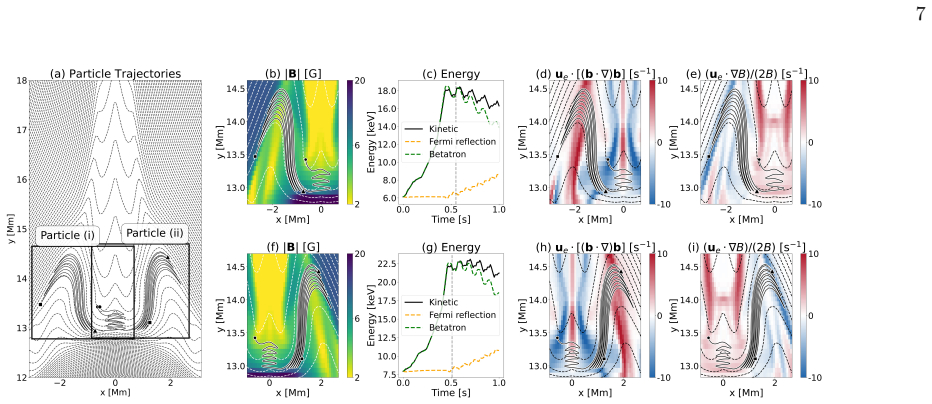
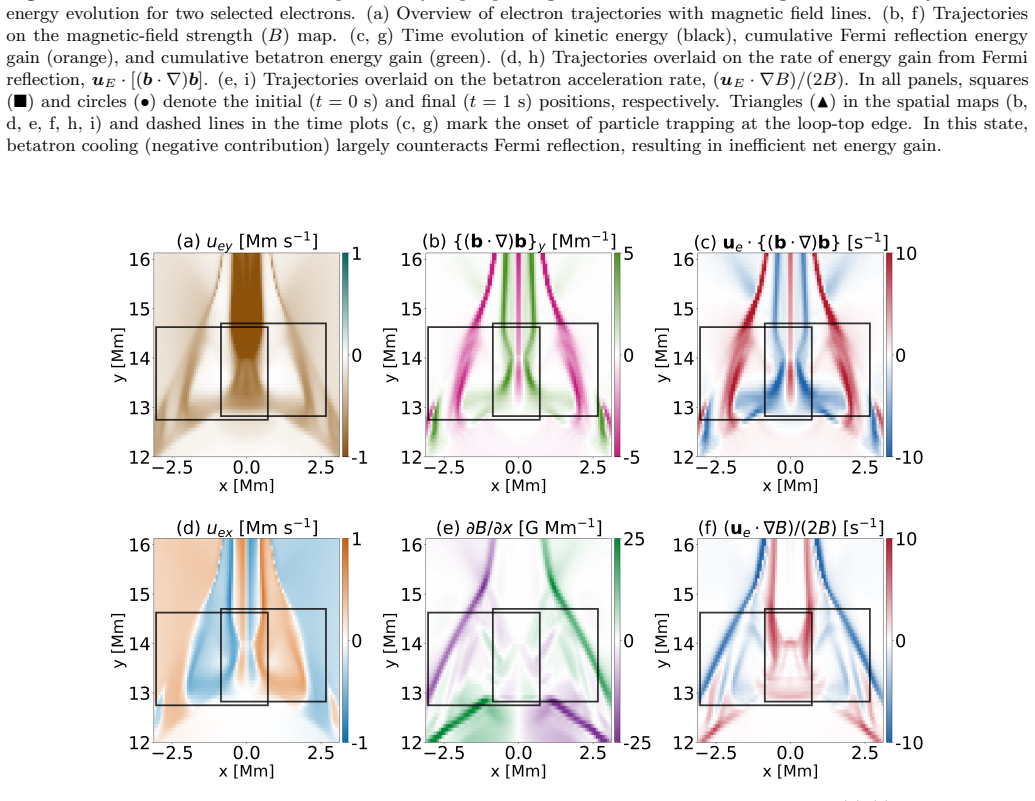
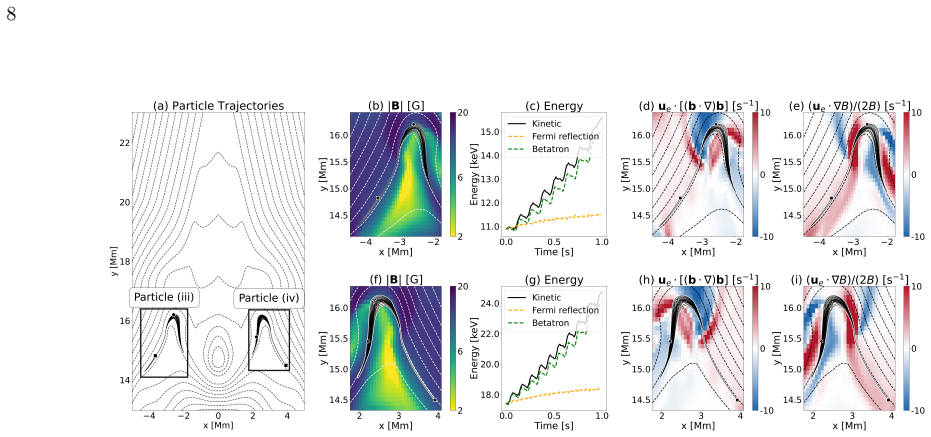
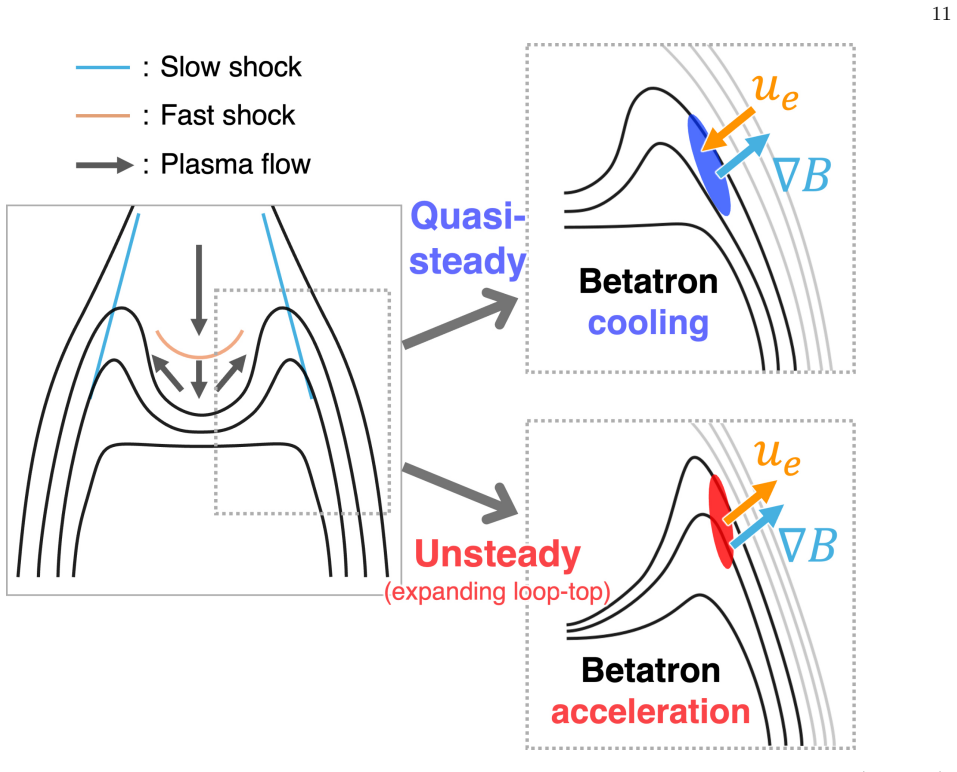
A time-varying loop-top velocity field enhances acceleration efficiency because the betatron mechanism readily accelerates electrons in the compressed magnetic field at the edge, whereas a quasi-steady field suppresses net acceleration through the decelerating effect of betatron cooling; thus acceleration at the loop-top is driven by dynamic events such as plasmoid collisions in addition to static structure.
What carries the argument
The unsteady MHD velocity field at the loop-top, which modulates guiding-center electron motion to produce net betatron acceleration in time-varying compressed B regions.
If this is right
- Electrons gain energy specifically at the loop-top edge when the velocity field varies in time.
- Plasmoid collisions and similar dynamic events contribute to driving the acceleration.
- Processes at the exit point where electrons escape the loop-top affect the overall energization.
- Acceleration models limited to reconnection outflows may understate the role of loop-top dynamics.
Where Pith is reading between the lines
- Flare observations with variable loop-top motions may show higher particle energies than steady cases.
- Simulations adding turbulence or wave effects could test whether the steady-unsteady efficiency gap persists.
- Similar unsteady structures in other reconnection environments might produce comparable acceleration patterns.
Load-bearing premise
The MHD fields combined with guiding-center test-particle motion capture the main energization without other processes such as wave-particle interactions or non-adiabatic effects contributing substantially.
What would settle it
Direct comparison of electron energy gains or spectra from flares with identified steady versus unsteady loop-tops that shows no difference in acceleration efficiency.
Figures
read the original abstract
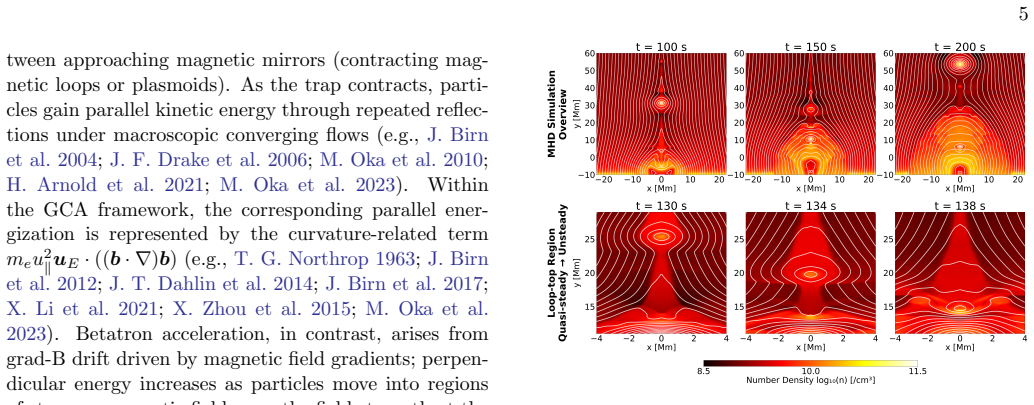
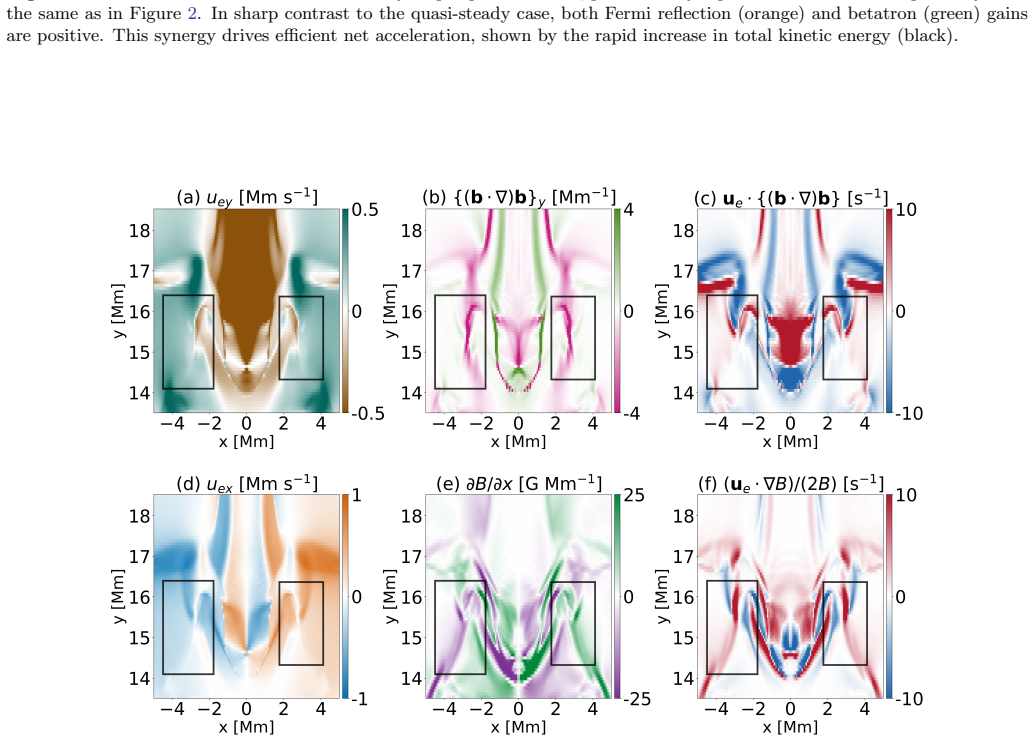
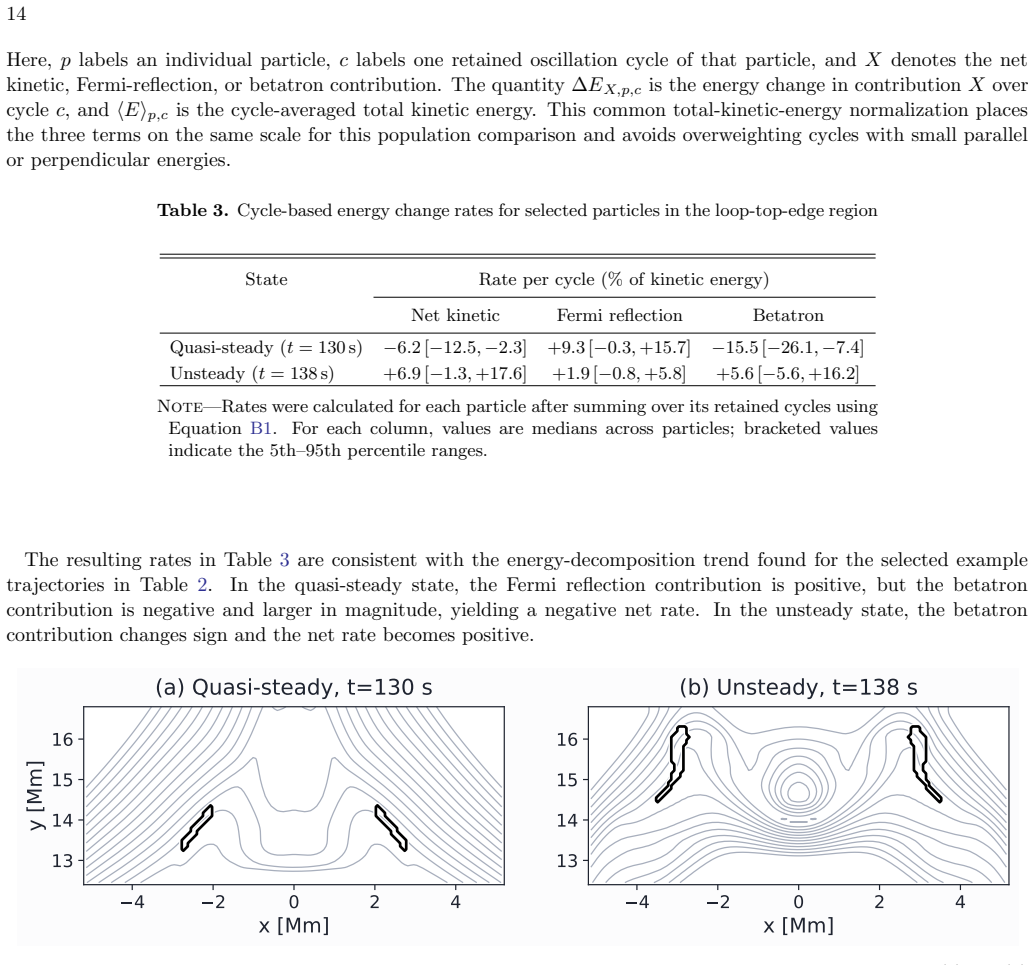
Using magnetohydrodynamic (MHD) fields and guiding-center test-particle calculations, this study investigates how time-dependent loop-top dynamics modulate the adiabatic energization of electrons in a solar flare. Our results indicate that a time-varying loop-top structure enhances acceleration efficiency compared to a quasi-steady one. In the quasi-steady velocity field, the net acceleration is suppressed due to the decelerating effect of betatron cooling. Conversely, in the unsteady velocity field, the betatron mechanism readily accelerates electrons within the compressed magnetic field at the edge of the loop-top. These findings suggest that the acceleration of electrons at the loop-top is driven not only by the static shape of the magnetic structure but also by dynamic events such as plasmoid collisions. While previous studies have primarily focused on acceleration processes within the reconnection outflow, such as at termination shocks or within plasmoids, our research highlights the importance of the acceleration and deceleration processes at the exit point where electrons escape from the loop-top.
Editorial analysis
A structured set of objections, weighed in public.
Referee Report
Summary. The manuscript uses MHD fields combined with guiding-center test-particle calculations to investigate adiabatic electron energization at a solar flare loop-top. It claims that time-varying (unsteady) loop-top structures enhance acceleration efficiency relative to quasi-steady cases, where betatron cooling suppresses net gains; in the unsteady case, betatron acceleration occurs readily in compressed fields at the loop-top edge, driven by dynamic events such as plasmoid collisions. The work argues that acceleration at the loop-top exit point is important in addition to processes in reconnection outflows.
Significance. If the central distinction between unsteady and quasi-steady cases holds under the stated approximations, the result would usefully redirect attention to time-dependent loop-top dynamics as a contributor to flare electron acceleration. The direct numerical experiments (MHD + test particles) constitute a concrete strength that allows falsifiable comparison of the two velocity-field regimes.
major comments (1)
- [Numerical methods / test-particle section] The central claim rests on the guiding-center test-particle results distinguishing unsteady from quasi-steady acceleration. No checks of the adiabaticity ordering (gyroradius ≪ field scale length; temporal variation slow compared with gyroperiod) or cross-validation against full-orbit integration are reported for the rapid compressions and plasmoid collisions at the loop-top edge. This omission is load-bearing because violation of the ordering would render the reported betatron enhancement an artifact of the approximation rather than a physical effect.
minor comments (1)
- [Abstract] Abstract and results sections lack quantitative metrics (e.g., energy spectra, acceleration timescales, efficiency ratios), grid resolution, or error estimates, making it difficult to assess the magnitude and robustness of the claimed enhancement.
Simulated Author's Rebuttal
We thank the referee for their thoughtful review and for highlighting the importance of validating the guiding-center approximation. We address the single major comment below and commit to revisions that strengthen the numerical methods section.
read point-by-point responses
-
Referee: [Numerical methods / test-particle section] The central claim rests on the guiding-center test-particle results distinguishing unsteady from quasi-steady acceleration. No checks of the adiabaticity ordering (gyroradius ≪ field scale length; temporal variation slow compared with gyroperiod) or cross-validation against full-orbit integration are reported for the rapid compressions and plasmoid collisions at the loop-top edge. This omission is load-bearing because violation of the ordering would render the reported betatron enhancement an artifact of the approximation rather than a physical effect.
Authors: We agree that explicit verification of the adiabaticity ordering is necessary to support the central claim. In the revised manuscript we will add a dedicated subsection (and associated figure) that quantifies, for representative electron energies and locations including the loop-top edge during plasmoid collisions, (i) the ratio of gyroradius to local magnetic-field gradient scale length and (ii) the ratio of the MHD temporal variation timescale to the gyroperiod. We will also integrate a statistically meaningful subset of trajectories with the full Lorentz-force equations and directly compare the resulting energy spectra and spatial distributions with the guiding-center results; any discrepancies will be reported. These additions will be placed in the numerical-methods section so that readers can assess the validity of the approximation under the specific conditions of the unsteady runs. revision: yes
Circularity Check
No circularity; results from direct numerical experiments
full rationale
The paper performs MHD simulations of quasi-steady versus unsteady loop-top flows, then integrates guiding-center test particles in the resulting time-dependent fields. The reported efficiency difference follows directly from comparing the computed particle energy gains in the two cases; no parameters are fitted to observations and re-used as predictions, no equations are defined in terms of their own outputs, and no load-bearing claims rest on self-citations. The derivation chain is therefore self-contained.
Axiom & Free-Parameter Ledger
Reference graph
Works this paper leans on
-
[1]
2025, Publications of the Astronomical Society of Japan, doi: 10.1093/pasj/psaf123
Akutagawa, K., Imada, S., & Shoda, M. 2025, Publications of the Astronomical Society of Japan, doi: 10.1093/pasj/psaf123
-
[2]
2021, Physical Review Letters, 126, 135101, doi: 10.1103/PhysRevLett.126.135101
Arnold, H., Drake, J., Swisdak, M., et al. 2021, Physical Review Letters, 126, 135101, doi: 10.1103/PhysRevLett.126.135101
-
[3]
2004, The Astrophysical Journal, 605, L77, doi: 10.1086/420768
Asai, A., Yokoyama, T., Shimojo, M., & Shibata, K. 2004, The Astrophysical Journal, 605, L77, doi: 10.1086/420768
-
[4]
Aschwanden, M. J. 2002, Space Science Reviews, 101, 1, doi: 10.1023/A:1019712124366
-
[5]
Ashfield, W., Polito, V., Yu, S., Collier, H., & Hayes, L. A. 2024, The Astrophysical Journal, 973, 96, doi: 10.3847/1538-4357/ad64ca
-
[6]
2002, Astronomy and Astrophysics, 384, 273, doi: 10.1051/0004-6361:20011735
Aurass, H., Vrˇ snak, B., & Mann, G. 2002, Astronomy and Astrophysics, 384, 273, doi: 10.1051/0004-6361:20011735
-
[7]
2024, MNRAS, 529, 2399, doi: 10.1093/mnras/stae723
Bacchini, F., Ruan, W., & Keppens, R. 2024, MNRAS, 529, 2399, doi: 10.1093/mnras/stae723
-
[8]
Benz, A. O. 2017, Living Reviews in Solar Physics, 14, 2, doi: 10.1007/s41116-016-0004-3
-
[9]
Birn, J., Artemyev, A. V., Baker, D. N., et al. 2012, Space Science Reviews, 173, 49, doi: 10.1007/s11214-012-9874-4
-
[10]
2017, The Astrophysical Journal, 848, 116, doi: 10.3847/1538-4357/aa8ad4
Birn, J., Battaglia, M., Fletcher, L., Hesse, M., & Neukirch, T. 2017, The Astrophysical Journal, 848, 116, doi: 10.3847/1538-4357/aa8ad4
-
[11]
Birn, J., Thomsen, M. F., & Hesse, M. 2004, Physics of Plasmas, 11, 1825, doi: 10.1063/1.1704641
-
[12]
2016, Solar Physics, 291, 1385, doi: 10.1007/s11207-016-0915-0
Borissov, A., Neukirch, T., & Threlfall, J. 2016, Solar Physics, 291, 1385, doi: 10.1007/s11207-016-0915-0
-
[13]
Cai, Q., Shen, C., Raymond, J. C., et al. 2019, Monthly Notices of the Royal Astronomical Society, 489, 3183, doi: 10.1093/mnras/stz2167
-
[14]
Che, H., & Zank, G. P. 2019, Journal of Physics: Conference Series, 1332, 012003, doi: 10.1088/1742-6596/1332/1/012003
-
[15]
Che, H., & Zank, G. P. 2020, The Astrophysical Journal, 889, 11, doi: 10.3847/1538-4357/ab5d3b
-
[16]
Chen, B., Bastian, T. S., Shen, C., et al. 2015, Science, doi: 10.1126/science.aac8467
-
[17]
2024, The Astrophysical Journal, 971, 85, doi: 10.3847/1538-4357/ad531a
Chen, B., Kong, X., Yu, S., et al. 2024, The Astrophysical Journal, 971, 85, doi: 10.3847/1538-4357/ad531a
-
[18]
Dahlin, J. T., Drake, J. F., & Swisdak, M. 2014, Physics of Plasmas, 21, 092304, doi: 10.1063/1.4894484
-
[19]
Dahlin, J. T., Drake, J. F., & Swisdak, M. 2017, Physics of Plasmas, 24, 092110, doi: 10.1063/1.4986211
-
[20]
2002, Journal of Computational Physics, 175, 645, doi: 10.1006/jcph.2001.6961
Dedner, A., Kemm, F., Kr¨ oner, D., et al. 2002, Journal of Computational Physics, 175, 645, doi: 10.1006/jcph.2001.6961
-
[21]
F., Swisdak, M., Che, H., & Shay, M
Drake, J. F., Swisdak, M., Che, H., & Shay, M. A. 2006, Nature, 443, 553, doi: 10.1038/nature05116
-
[22]
Druett, M., Ruan, W., & Keppens, R. 2024, Astronomy and Astrophysics, 684, A171, doi: 10.1051/0004-6361/202347600 Eradat Oskoui, S., & Neukirch, T. 2014, Astronomy and Astrophysics, 567, A131, doi: 10.1051/0004-6361/201423886 Eradat Oskoui, S., Neukirch, T., & Grady, K. J. 2014, Astronomy and Astrophysics, 563, A73, doi: 10.1051/0004-6361/201322519
-
[23]
1949, Physical Review, 75, 1169, doi: 10.1103/PhysRev.75.1169
Fermi, E. 1949, Physical Review, 75, 1169, doi: 10.1103/PhysRev.75.1169
-
[24]
2024, Annual Review of Astronomy and Astrophysics, 62, 437, doi: 10.1146/annurev-astro-052920-010547
Fletcher, L. 2024, Annual Review of Astronomy and Astrophysics, 62, 437, doi: 10.1146/annurev-astro-052920-010547
-
[25]
French, R. J., Hayes, L. A., Kazachenko, M. D., et al. 2024, The Astrophysical Journal, 977, 207, doi: 10.3847/1538-4357/ad8ed1
-
[26]
2005, The Astrophysical Journal, 635, 636, doi: 10.1086/497366
Giuliani, P., Neukirch, T., & Wood, P. 2005, The Astrophysical Journal, 635, 636, doi: 10.1086/497366
-
[27]
Gordovskyy, M., Browning, P., & Pinto, R. F. 2019, Advances in Space Research, 63, 1453, doi: 10.1016/j.asr.2018.09.024
-
[28]
Grady, K. J., & Neukirch, T. 2009, Astronomy and Astrophysics, 508, 1461, doi: 10.1051/0004-6361/200913230
-
[29]
J., Neukirch, T., & Giuliani, P
Grady, K. J., Neukirch, T., & Giuliani, P. 2012, Astronomy and Astrophysics, 546, A85, doi: 10.1051/0004-6361/201218914
-
[30]
Haahr, M., Gudiksen, B. V., & Nordlund, ˚A. 2025, Astronomy and Astrophysics, 696, A191, doi: 10.1051/0004-6361/202452117
-
[31]
Jameson, A. 2017, AIAA Journal, 55, 1487, doi: 10.2514/1.J055493 Jel´ ınek, P., Karlick´ y, M., Van Doorsselaere, T., & B´ arta, M. 2017, ApJ, 847, 98, doi: 10.3847/1538-4357/aa88a6
-
[32]
2017, ApJ, 845, 12, doi: 10.3847/1538-4357/aa7d59 Karlick´ y, M., & B´ arta, M
Kaneko, T., & Yokoyama, T. 2017, ApJ, 845, 12, doi: 10.3847/1538-4357/aa7d59 Karlick´ y, M., & B´ arta, M. 2006, The Astrophysical Journal, 647, 1472, doi: 10.1086/505460
-
[33]
2020, The Astrophysical Journal, 905, L16, doi: 10.3847/2041-8213/abcbf5
Kong, X., Guo, F., Shen, C., et al. 2020, The Astrophysical Journal, 905, L16, doi: 10.3847/2041-8213/abcbf5
-
[34]
2025, Frontiers in Astronomy and Space Sciences, 11, 1510579, doi: 10.3389/fspas.2024.1510579
Kong, X., Ning, H., & Chen, Y. 2025, Frontiers in Astronomy and Space Sciences, 11, 1510579, doi: 10.3389/fspas.2024.1510579
-
[35]
2019, The Astrophysical Journal, 887, L37, doi: 10.3847/2041-8213/ab5f67
Kong, X., Guo, F., Shen, C., et al. 2019, The Astrophysical Journal, 887, L37, doi: 10.3847/2041-8213/ab5f67
-
[36]
2022, The Astrophysical Journal Letters, 941, L22, doi: 10.3847/2041-8213/aca65c 16
Kong, X., Chen, B., Guo, F., et al. 2022, The Astrophysical Journal Letters, 941, L22, doi: 10.3847/2041-8213/aca65c 16
-
[37]
Kumar, P., Karpen, J. T., & Dahlin, J. T. 2025, The Astrophysical Journal, 980, 158, doi: 10.3847/1538-4357/ada293
-
[38]
2021, Physics of Plasmas, 28, 052905, doi: 10.1063/5.0047644
Li, X., Guo, F., & Liu, Y.-H. 2021, Physics of Plasmas, 28, 052905, doi: 10.1063/5.0047644
-
[39]
2013, The Astrophysical Journal, 767, 168, doi: 10.1088/0004-637X/767/2/168
Liu, W., Chen, Q., & Petrosian, V. 2013, The Astrophysical Journal, 767, 168, doi: 10.1088/0004-637X/767/2/168
-
[40]
1994, Nature, 371, 495, doi: 10.1038/371495a0
Masuda, S., Kosugi, T., Hara, H., Tsuneta, S., & Ogawara, Y. 1994, Nature, 371, 495, doi: 10.1038/371495a0
-
[41]
McLaughlin, J. A., Nakariakov, V. M., Dominique, M., Jel´ ınek, P., & Takasao, S. 2018, Space Science Reviews, 214, 45, doi: 10.1007/s11214-018-0478-5
-
[42]
Comparison of environmental trends in H I gas mass fraction and specific star formation rate
Meyer, C. D., Balsara, D. S., & Aslam, T. D. 2012, MNRAS, 422, 2102, doi: 10.1111/j.1365-2966.2012.20744.x
-
[43]
Meyer, C. D., Balsara, D. S., & Aslam, T. D. 2014, Journal of Computational Physics, 257, 594, doi: 10.1016/j.jcp.2013.08.021
-
[44]
2025, Monthly Notices of the Royal Astronomical Society, 536, 609, doi: 10.1093/mnras/stae2668
Mowbray, K., Neukirch, T., & Threlfall, J. 2025, Monthly Notices of the Royal Astronomical Society, 536, 609, doi: 10.1093/mnras/stae2668
-
[45]
M., Foullon, C., Verwichte, E., & Young, N
Nakariakov, V. M., Foullon, C., Verwichte, E., & Young, N. P. 2006, Astronomy and Astrophysics, 452, 343, doi: 10.1051/0004-6361:20054608
-
[46]
2014, The Astrophysical Journal, 787, 125, doi: 10.1088/0004-637X/787/2/125
Narukage, N., Shimojo, M., & Sakao, T. 2014, The Astrophysical Journal, 787, 125, doi: 10.1088/0004-637X/787/2/125
-
[47]
2015, The Astrophysical Journal, 799, 126, doi: 10.1088/0004-637X/799/2/126
Nishizuka, N., Karlick´ y, M., Janvier, M., & B´ arta, M. 2015, The Astrophysical Journal, 799, 126, doi: 10.1088/0004-637X/799/2/126
-
[48]
Northrop, T. G. 1963, Reviews of Geophysics and Space Physics, 1, 283, doi: 10.1029/RG001i003p00283
-
[49]
2010, The Astrophysical Journal, 714, 915, doi: 10.1088/0004-637X/714/1/915
Shinohara, I. 2010, The Astrophysical Journal, 714, 915, doi: 10.1088/0004-637X/714/1/915
-
[50]
2023, Space Science Reviews, 219, 75, doi: 10.1007/s11214-023-01011-8
Oka, M., Birn, J., Egedal, J., et al. 2023, Space Science Reviews, 219, 75, doi: 10.1007/s11214-023-01011-8
-
[51]
2012, Space Science Reviews, 173, 535, doi: 10.1007/s11214-012-9900-6
Petrosian, V. 2012, Space Science Reviews, 173, 535, doi: 10.1007/s11214-012-9900-6
-
[52]
Petrosian, V., Donaghy, T. Q., & McTiernan, J. M. 2002, The Astrophysical Journal, 569, 459, doi: 10.1086/339240
-
[53]
Priest, E. R., & Forbes, T. G. 2002, Astronomy and Astrophysics Review, 10, 313, doi: 10.1007/s001590100013
-
[54]
K., Polito, V., Chen, B., et al
Reeves, K. K., Polito, V., Chen, B., et al. 2020, The Astrophysical Journal, 905, 165, doi: 10.3847/1538-4357/abc4e0
-
[55]
2014, ApJ, 789, 132, doi: 10.1088/0004-637X/789/2/132
Rempel, M. 2014, ApJ, 789, 132, doi: 10.1088/0004-637X/789/2/132
-
[56]
2018, ApJS, 235, 21, doi: 10.3847/1538-4365/aab114
Ripperda, B., Bacchini, F., Teunissen, J., et al. 2018, ApJS, 235, 21, doi: 10.3847/1538-4365/aab114
-
[57]
2023, ApJ, 947, 67, doi: 10.3847/1538-4357/ac9b4e
Ruan, W., Yan, L., & Keppens, R. 2023, ApJ, 947, 67, doi: 10.3847/1538-4357/ac9b4e
-
[58]
Sharma, P., & Hammett, G. W. 2007, Journal of Computational Physics, 227, 123, doi: 10.1016/j.jcp.2007.07.026
-
[59]
Shen, C., Chen, B., Reeves, K. K., et al. 2022, Nature Astronomy, 6, 317, doi: 10.1038/s41550-021-01570-2
-
[60]
1995, The Astrophysical Journal, 451, L83, doi: 10.1086/309688
Shibata, K., Masuda, S., Shimojo, M., et al. 1995, The Astrophysical Journal, 451, L83, doi: 10.1086/309688
-
[61]
Shibata, K., Takasao, S., & Reeves, K. K. 2023, The Astrophysical Journal, 943, 106, doi: 10.3847/1538-4357/acaa9c
-
[62]
Somov, B. V., & Kosugi, T. 1997, The Astrophysical Journal, 485, 859, doi: 10.1086/304449
-
[63]
1968, SIAM Journal on Numerical Analysis, 5, 506, doi: 10.1137/0705041
Strang, G. 1968, SIAM Journal on Numerical Analysis, 5, 506, doi: 10.1137/0705041
-
[64]
2016, The Astrophysical Journal, 828, 103, doi: 10.3847/0004-637X/828/2/103
Takasao, S., Asai, A., Isobe, H., & Shibata, K. 2016, The Astrophysical Journal, 828, 103, doi: 10.3847/0004-637X/828/2/103
-
[65]
2015, The Astrophysical Journal, 805, 135, doi: 10.1088/0004-637X/805/2/135
Takasao, S., Matsumoto, T., Nakamura, N., & Shibata, K. 2015, The Astrophysical Journal, 805, 135, doi: 10.1088/0004-637X/805/2/135
-
[66]
Takasao, S., & Shibata, K. 2016, The Astrophysical Journal, 823, 150, doi: 10.3847/0004-637X/823/2/150 V¨ ogler, A., Shelyag, S., Sch¨ ussler, M., et al. 2005, A&A, 429, 335, doi: 10.1051/0004-6361:20041507
-
[67]
2022, ApJL, 931, L32, doi: 10.3847/2041-8213/ac715a
Wang, Y., Cheng, X., Ren, Z., & Ding, M. 2022, ApJL, 931, L32, doi: 10.3847/2041-8213/ac715a
-
[68]
2022, Monthly Notices of the Royal Astronomical Society, 509, 406, doi: 10.1093/mnras/stab2954
Xie, X., Mei, Z., Shen, C., et al. 2022, Monthly Notices of the Royal Astronomical Society, 509, 406, doi: 10.1093/mnras/stab2954
-
[69]
Xie, X., Shen, C., Reeves, K. K., et al. 2025, The Astrophysical Journal, 984, L27, doi: 10.3847/2041-8213/adc91b
-
[70]
2020, The Astrophysical Journal, 897, 64, doi: 10.3847/1538-4357/ab93b5
Ye, J., Cai, Q., Shen, C., et al. 2020, The Astrophysical Journal, 897, 64, doi: 10.3847/1538-4357/ab93b5
-
[71]
Yu, S., Chen, B., Reeves, K. K., et al. 2020, The Astrophysical Journal, 900, 17, doi: 10.3847/1538-4357/aba8a6
-
[72]
2014, The Astrophysical Journal, 797, 28, doi: 10.1088/0004-637X/797/1/28
Khabarova, O. 2014, The Astrophysical Journal, 797, 28, doi: 10.1088/0004-637X/797/1/28
-
[73]
Zharkova, V. V., Arzner, K., Benz, A. O., et al. 2011, Space Science Reviews, 159, 357, doi: 10.1007/s11214-011-9803-y
-
[74]
2015, The Astrophysical Journal, 815, 6, doi: 10.1088/0004-637X/815/1/6 17 Øyre, E
Zhou, X., B¨ uchner, J., B´ arta, M., Gan, W., & Liu, S. 2015, The Astrophysical Journal, 815, 6, doi: 10.1088/0004-637X/815/1/6 17 Øyre, E. S., Gudiksen, B. V., & Fletcher, L. 2025, Astronomy and Astrophysics, 703, A97, doi: 10.1051/0004-6361/202555424
discussion (0)
Sign in with ORCID, Apple, or X to comment. Anyone can read and Pith papers without signing in.