From Subgroups to Population Composition: A Transportability Approach to Effect Heterogeneity
Pith reviewed 2026-07-03 08:19 UTC · model grok-4.3
The pith
Transportability methods estimate how shifts in effect modifier prevalence alter population-level exposure effects.
A machine-rendered reading of the paper's core claim, the machinery that carries it, and where it could break.
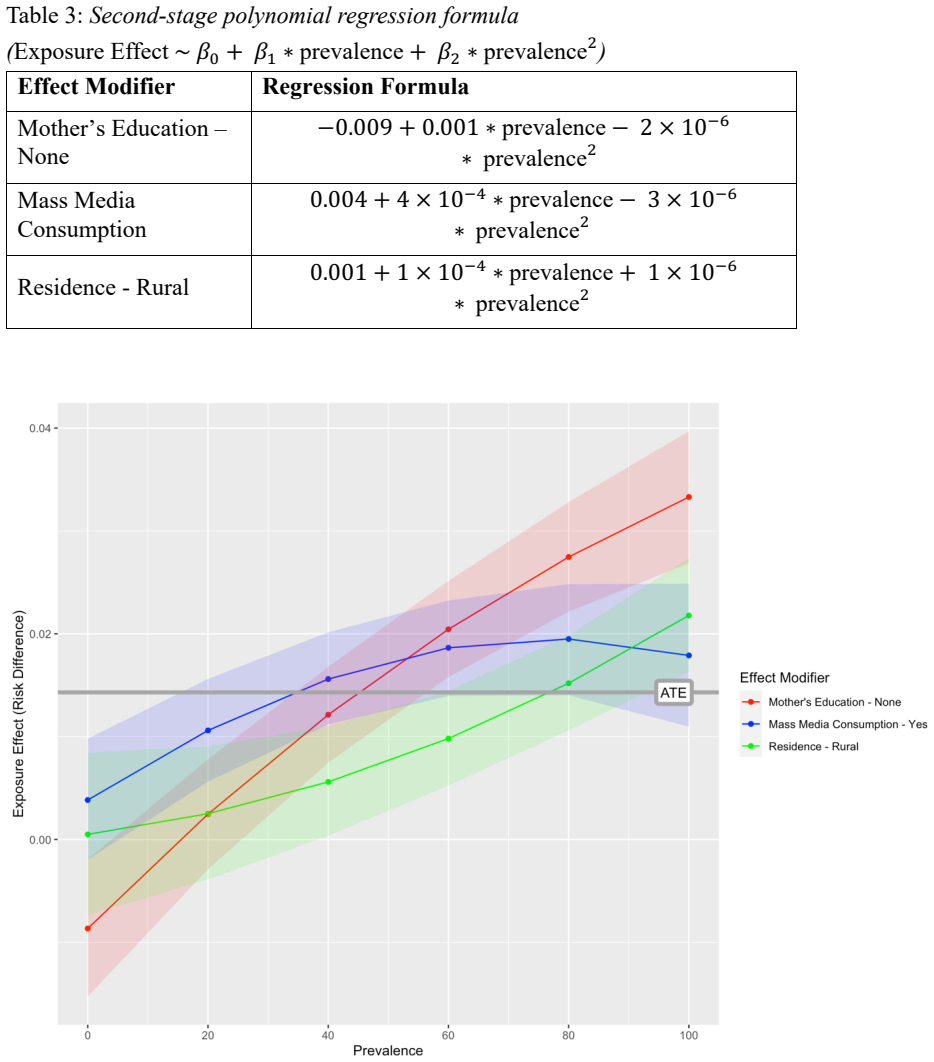
Core claim
The central claim is that the population-level exposure effect surface can be expressed as a function of effect-modifier prevalences; by transporting estimates to a grid of hypothetical populations that vary those prevalences and then regressing the transported effects on the prevalence values, one obtains both the marginal change in the population effect per unit change in prevalence and a ranking of modifiers by the strength of their association with differential vulnerability.
What carries the argument
Transportability estimation of exposure effects in hypothetical populations defined solely by altered prevalences of selected effect modifiers, followed by regression of those estimates on the prevalence values to recover the effect surface.
If this is right
- Quantifies the change in the overall population exposure effect that would result from a specified increase in any given effect-modifier prevalence.
- Produces a ranking of effect estimates across multiple modifiers and prevalence levels to highlight population characteristics most tied to differential vulnerability.
- Yields two practical outputs usable in cost-benefit or intervention-prioritization settings without requiring new parametric subgroup models.
- Demonstrates the workflow on Demographic and Health Surveys data for drought effects on child stunting and supplies a Shiny app for reuse.
Where Pith is reading between the lines
- The same machinery could be applied to continuous rather than binary modifiers by transporting to a range of mean values instead of prevalence points.
- If the effect surface is estimated jointly over several modifiers, the approach would automatically capture interactions between composition changes.
- Policy simulations could feed the estimated surface into demographic projection models to forecast how future population shifts would alter average exposure effects.
Load-bearing premise
Transportability assumptions remain valid when the only difference between the observed and hypothetical populations is the prevalence of the chosen effect modifiers, and that all relevant confounders and modifiers have already been correctly identified.
What would settle it
Collect data from a real population whose prevalences of the studied effect modifiers match one of the hypothetical scenarios and compare the directly observed exposure effect against the effect predicted by the transportability step; a large discrepancy would falsify the claim.
Figures
read the original abstract
Identifying heterogeneous populations across which exposure effects vary is essential for transportability applications, cost-benefit analyses, and intervention prioritization. Traditional methods for heterogeneity analyses rely on parametric regression with prespecified subgroups, which may fail to capture complex patterns of effect modification. While recent data-adaptive methods improve high-dimensional heterogeneous effect prediction, they add methodological complexity to analyses and may offer limited insight into key drivers of heterogeneity. In this paper, we propose a novel, conceptual approach for heterogeneity analyses that considers how exposure effects would differ in populations with different compositions by modeling the population-level effect surface as a function of the distribution of effect modifiers. The approach consists of three steps: i) selecting confounders and effect modifiers based on prior knowledge (or alternatively using data-adaptive methods to learn effect modifiers), ii) estimating exposure effects in hypothetical populations with different effect modifier prevalences using transportability methods, and iii) modeling the estimated effects as a function of prevalence values. This approach provides two types of outputs: estimation of the change in the population-level exposure effects attributable to increases in effect modifier prevalence and ranking of effect estimates across multiple effect modifiers and prevalences to identify population characteristics most strongly associated with differential vulnerability. We demonstrate the approach using Demographic and Health Surveys data to examine heterogeneous effects of drought on child stunting and provide a Shiny application to implement this approach in any setting.
Editorial analysis
A structured set of objections, weighed in public.
Referee Report
Summary. The manuscript proposes a three-step conceptual approach to effect heterogeneity: (i) select confounders and effect modifiers based on prior knowledge or data-adaptive methods, (ii) estimate exposure effects in hypothetical populations with altered effect-modifier prevalences via transportability methods, and (iii) model the resulting effects as a function of prevalence values. The procedure is claimed to yield two outputs—quantitative estimates of how population-level exposure effects change with modifier prevalence and rankings of modifiers/prevalences by strength of association with differential vulnerability—and is illustrated with a DHS application to drought effects on child stunting together with a Shiny implementation tool.
Significance. If the transportability assumptions hold, the framework offers a direct link between subgroup-level effect modification and population-composition effects that could inform cost-benefit analyses and intervention targeting; the provision of a Shiny app is a concrete strength for usability and reproducibility.
major comments (2)
- [Abstract (step ii)] Abstract, step ii: the claim that transportability methods identify exposure effects under modified marginal prevalences of selected modifiers is load-bearing for both outputs, yet the manuscript supplies no formal identification result establishing the required conditions on measured confounders, positivity, and transportability of the conditional outcome law.
- [DHS demonstration] DHS demonstration: the reported changes in population effects and the subsequent modifier rankings rest on the assumption that the chosen variables capture all relevant confounding and heterogeneity; no sensitivity analyses for unmeasured confounding or positivity violations are described, which directly affects the reliability of the ranking output.
Simulated Author's Rebuttal
We thank the referee for the constructive and detailed comments. We address each major comment point by point below. We agree that both points identify areas where the manuscript can be strengthened and plan to revise accordingly.
read point-by-point responses
-
Referee: [Abstract (step ii)] Abstract, step ii: the claim that transportability methods identify exposure effects under modified marginal prevalences of selected modifiers is load-bearing for both outputs, yet the manuscript supplies no formal identification result establishing the required conditions on measured confounders, positivity, and transportability of the conditional outcome law.
Authors: We acknowledge that the manuscript does not present an explicit formal identification theorem tailored to the modified-prevalence setting. The approach relies on standard transportability assumptions (consistency, positivity, and conditional exchangeability given the selected confounders), but we agree that deriving and stating the identification result for the population-level effect surface as a function of modifier prevalences would make the claims more rigorous. In the revision we will add a dedicated identification section that establishes the required conditions on the measured confounders, positivity, and transportability of the conditional outcome law under altered marginal prevalences of the effect modifiers. revision: yes
-
Referee: [DHS demonstration] DHS demonstration: the reported changes in population effects and the subsequent modifier rankings rest on the assumption that the chosen variables capture all relevant confounding and heterogeneity; no sensitivity analyses for unmeasured confounding or positivity violations are described, which directly affects the reliability of the ranking output.
Authors: We agree that the lack of sensitivity analyses limits the strength of the empirical illustration. The DHS example is presented as a demonstration of the conceptual approach rather than a definitive causal analysis. In the revised manuscript we will add a limitations subsection that discusses the maintained assumptions and include sensitivity analyses (e.g., varying the confounder set and simple bounding exercises for unmeasured confounding) to assess robustness of the reported effect changes and modifier rankings. revision: yes
Circularity Check
No circularity: method applies external transportability to hypothetical prevalences
full rationale
The three-step procedure selects modifiers via prior knowledge or data-adaptive methods (step i), applies standard transportability (standardization/reweighting) to estimate effects under altered prevalences (step ii), then models the resulting surface (step iii). None of these steps defines the target quantity in terms of a fitted parameter from the same data, nor relies on a self-citation chain for identification. The paper invokes transportability as an external tool whose validity rests on measured confounders and positivity, not on any internal construction that reduces to the inputs by definition. This is the most common honest finding for a methodological proposal that delegates identification to established external methods.
Axiom & Free-Parameter Ledger
axioms (2)
- domain assumption Transportability assumptions hold when moving to hypothetical populations that differ only in effect-modifier prevalences
- domain assumption Confounders and effect modifiers can be validly selected from prior knowledge or data-adaptive procedures
Reference graph
Works this paper leans on
-
[1]
From Subgroups to Population Composition: A Transportability Approach to Effect Heterogeneity Authors: Michael Cheung1,2, Candus Shi1, Kara E Rudolph3, Valérie Garès4, Caroline A Thompson5, Tarik Benmarhnia1,6 Author Affiliations 1Scripps Institution of Oceanography, University of California San Diego, La Jolla, CA, USA 2Francis I. Proctor Foundation and ...
2013
-
[2]
In the last decade, some methods have been proposed to improve heterogeneous exposure effect prediction accuracy through a variety of nonparametric techniques
– manual specification of effect modifiers, relevant covariates, and the model form often ignores the complex, high-dimensional heterogeneous relationships that are more realistic in real-world data. In the last decade, some methods have been proposed to improve heterogeneous exposure effect prediction accuracy through a variety of nonparametric technique...
2023
-
[3]
In section 2, we first briefly discuss the notation and assumptions used throughout the paper, followed by a detailed description of the approach
as a user-friendly alternative for researchers to implement the approach in their own work (https://github.com/benmarhnia-lab/heterogeneity_resampling_approach). In section 2, we first briefly discuss the notation and assumptions used throughout the paper, followed by a detailed description of the approach. In section 3, we demonstrate its application in ...
2023
-
[4]
These include, but are not limited to, fertility, mortality, diseases, nutrition, and health-seeking behavior
and their children under 5 years of age in low- and middle-income countries (LMIC). These include, but are not limited to, fertility, mortality, diseases, nutrition, and health-seeking behavior. More details regarding the data are provided in the appendix. For our analysis, we selected drought as the exposure and stunted child growth as the outcome. There...
2019
-
[5]
rank effect measures across multiple effect modifiers to identify which characteristics are most strongly associated with differential vulnerability across the population distribution. These functions go beyond the binary descriptions of conventional heterogeneity subgroup analyses and have implications for intervention assessment and prioritization in ex...
2022
-
[6]
The timing of growth faltering has important implications for observational analyses of the underlying determinants of nutrition outcomes. PLOS ONE 13, e0195904. https://doi.org/10.1371/journal.pone.0195904 Arthur, S.S., Nyide, B., Soura, A.B., Kahn, K., Weston, M., Sankoh, O.,
-
[7]
Tackling malnutrition: a systematic review of 15-year research evidence from INDEPTH health and demographic surveillance systems. Glob. Health Action 8, 28298. https://doi.org/10.3402/gha.v8.28298 Bang, H., Robins, J.M.,
-
[8]
Doubly Robust Estimation in Missing Data and Causal Inference Models. Biometrics 61, 962–973. https://doi.org/10.1111/j.1541-0420.2005.00377.x Bargagli-Stoffi, F.J., Cadei, R., Lee, K., Dominici, F.,
-
[9]
Causal Rule Ensemble: Interpretable Discovery and Inference of Heterogeneous Treatment Effects. https://doi.org/10.48550/arXiv.2009.09036 Belesova, K., Agabiirwe, C.N., Zou, M., Phalkey, R., Wilkinson, P.,
-
[10]
Drought exposure as a risk factor for child undernutrition in low- and middle-income countries: A systematic review and assessment of empirical evidence. Environ. Int. 131, 104973. https://doi.org/10.1016/j.envint.2019.104973 Black, R.E., Victora, C.G., Walker, S.P., Bhutta, Z.A., Christian, P., De Onis, M., Ezzati, M., Grantham-McGregor, S., Katz, J., Ma...
-
[11]
Maternal and child undernutrition and overweight in low-income and middle-income countries. The Lancet 382, 427–451. https://doi.org/10.1016/S0140-6736(13)60937-X Chang, W., Cheng, J., Allaire, J., Sievert, C., Schloerke, B., Xie, Y., Allen, J., McPherson, J., Dipert, A., Borges, B.,
-
[12]
shiny: Web Application Framework for R. https://doi.org/10.32614/CRAN.package.shiny Chernozhukov, V., Hansen, C., Kallus, N., Spindler, M., Syrgkanis, V.,
-
[13]
https://doi.org/10.48550/arXiv.2403.02467 Cheung, M., Dimitrova, A., Benmarhnia, T.,
Applied Causal Inference Powered by ML and AI. https://doi.org/10.48550/arXiv.2403.02467 Cheung, M., Dimitrova, A., Benmarhnia, T.,
-
[14]
An overview of modern machine learning methods for effect measure modification analyses in high-dimensional settings. SSM - Popul. Health 29, 101764. https://doi.org/10.1016/j.ssmph.2025.101764 Cole, S.R., Hernan, M.A.,
-
[15]
Constructing Inverse Probability Weights for Marginal Structural Models. Am. J. Epidemiol. 168, 656–664. https://doi.org/10.1093/aje/kwn164 Cooper, M.W., Brown, M.E., Hochrainer-Stigler, S., Pflug, G., McCallum, I., Fritz, S., Silva, J., Zvoleff, A.,
-
[16]
Mapping the effects of drought on child stunting. Proc. Natl. Acad. Sci. 116, 17219–17224. https://doi.org/10.1073/pnas.1905228116 De Onis, M.,
-
[17]
(Eds.), Nutrition and Health in a Developing World
Child Growth and Development, in: De Pee, S., Taren, D., Bloem, M.W. (Eds.), Nutrition and Health in a Developing World. Springer International Publishing, Cham, pp. 119–141. https://doi.org/10.1007/978-3-319-43739-2_6 Degtiar, I., Rose, S.,
-
[18]
A Review of Generalizability and Transportability. Annu. Rev. Stat. Its Appl. 10, 501–524. https://doi.org/10.1146/annurev-statistics-042522-103837 Dorie, V., Hill, J., Shalit, U., Scott, M., Cervone, D.,
-
[19]
https://doi.org/10.1214/18-STS667 Greenland, S.,
-
[20]
https://doi.org/10.1097/01.EDE.0000042804.12056.6C Harris, I., Osborn, T.J., Jones, P., Lister, D.,
Quantifying Biases in Causal Models: Classical Confounding vs Collider-Stratification Bias: Epidemiology 14, 300–306. https://doi.org/10.1097/01.EDE.0000042804.12056.6C Harris, I., Osborn, T.J., Jones, P., Lister, D.,
-
[21]
https://doi.org/10.1038/s41597-020-0453-3 Hines, O.J., Diaz-Ordaz, K., Vansteelandt, S.,
-
[22]
Variable importance measures for heterogeneous treatment effects. Biometrics 81, ujaf140. https://doi.org/10.1093/biomtc/ujaf140 Inoue, K., Watson, K.E., Kondo, N., Horwich, T., Hsu, W., Bui, A.A.T., Duru, O.K.,
-
[23]
Association of Intensive Blood Pressure Control and Living Arrangement on Cardiovascular Outcomes by Race: Post Hoc Analysis of SPRINT Randomized Clinical Trial. JAMA Netw. Open 5, e222037. https://doi.org/10.1001/jamanetworkopen.2022.2037 Josey, K.P., Berkowitz, S.A., Ghosh, D., Raghavan, S.,
-
[24]
Transporting experimental results with entropy balancing. Stat. Med. 40, 4310–4326. https://doi.org/10.1002/sim.9031 Josey, K.P., Yang, F., Ghosh, D., Raghavan, S.,
-
[25]
A calibration approach to transportability and data‐fusion with observational data. Stat. Med. 41, 4511–4531. https://doi.org/10.1002/sim.9523 Kaufman, J.S., MacLehose, R.F.,
-
[26]
https://doi.org/10.1002/cncr.28359 Kennedy, E.H.,
Which of these things is not like the others? Cancer 119, 4216–4222. https://doi.org/10.1002/cncr.28359 Kennedy, E.H.,
-
[27]
https://doi.org/10.1214/23-EJS2157 Künzel, S.R., Sekhon, J.S., Bickel, P.J., Yu, B.,
-
[28]
Metalearners for estimating heterogeneous treatment effects using machine learning. Proc. Natl. Acad. Sci. 116, 4156–4165. https://doi.org/10.1073/pnas.1804597116 Lee, D., Yang, S., Dong, L., Wang, X., Zeng, D., Cai, J.,
-
[29]
Improving Trial Generalizability Using Observational Studies. Biometrics 79, 1213–1225. https://doi.org/10.1111/biom.13609 Levels and Trends in Child Malnutrition Child Malnutrition: Key Findings of the 2023 Edition, 1st ed. ed,
-
[30]
Glob. Biogeochem. Cycles 22, 2007GB002947. https://doi.org/10.1029/2007GB002947 Moreno-Betancur, M., Koplin, J.J., Ponsonby, A.-L., Lynch, J., Carlin, J.B.,
-
[31]
Measuring the impact of differences in risk factor distributions on cross-population differences in disease occurrence: a causal approach. Int. J. Epidemiol. 47, 217–225. https://doi.org/10.1093/ije/dyx194 Nianogo, R.A., O’Neill, S., Inoue, K.,
-
[32]
Generalized framework for identifying meaningful heterogenous treatment effects in observational studies: A parametric data-adaptive G-computation approach. Stat. Methods Med. Res. 34, 648–662. https://doi.org/10.1177/09622802251316969 Nie, X., Wager, S.,
-
[33]
Quasi-oracle estimation of heterogeneous treatment effects. Biometrika 108, 299–319. https://doi.org/10.1093/biomet/asaa076 Poveda, N.E., Hartwig, F.P., Victora, C.G., Adair, L.S., Barros, F.C., Bhargava, S.K., Horta, B.L., Lee, N.R., Martorell, R., Mazariegos, M., Menezes, A.M.B., Norris, S.A., Richter, L.M., Sachdev, H.S., Stein, A., Wehrmeister, F.C., ...
-
[34]
Patterns of Growth in Childhood in Relation to Adult Schooling Attainment and Intelligence Quotient in 6 Birth Cohorts in Low- and Middle-Income Countries: Evidence from the Consortium of Health-Oriented Research in Transitioning Societies (COHORTS). J. Nutr. 151, 2342–2352. https://doi.org/10.1093/jn/nxab096 Prendergast, A.J., Humphrey, J.H.,
-
[35]
The stunting syndrome in developing countries. Paediatr. Int. Child Health 34, 250–265. https://doi.org/10.1179/2046905514Y.0000000158 R Core Team,
-
[36]
Rudolph, K.E., Díaz, I., 2022a
R: A Language and Environment for Statistical Computing. Rudolph, K.E., Díaz, I., 2022a. Efficiently transporting causal direct and indirect effects to new populations under intermediate confounding and with multiple mediators. Biostatistics 23, 789–806. https://doi.org/10.1093/biostatistics/kxaa057 Rudolph, K.E., Díaz, I., 2022b. When the Ends do not Jus...
-
[37]
Composition or Context: Using Transportability to Understand Drivers of Site Differences in a Large-scale Housing Experiment. Epidemiology 29, 199–206. https://doi.org/10.1097/EDE.0000000000000774 Rudolph, K.E., Van Der Laan, M.J.,
-
[38]
Robust Estimation of Encouragement Design Intervention Effects Transported Across Sites. J. R. Stat. Soc. Ser. B Stat. Methodol. 79, 1509–1525. https://doi.org/10.1111/rssb.12213 Rutstein, S.O.,
-
[39]
Crop planting dates: an analysis of global patterns. Glob. Ecol. Biogeogr. 19, 607–620. https://doi.org/10.1111/j.1466-8238.2010.00551.x VanderWeele, T.J., Luedtke, A.R., Van Der Laan, M.J., Kessler, R.C.,
-
[40]
Selecting Optimal Subgroups for Treatment Using Many Covariates. Epidemiology 30, 334–341. https://doi.org/10.1097/EDE.0000000000000991 Victora, C.G., Adair, L., Fall, C., Hallal, P.C., Martorell, R., Richter, L., Sachdev, H.S.,
-
[41]
Maternal and child undernutrition: consequences for adult health and human capital. The Lancet 371, 340–357. https://doi.org/10.1016/S0140-6736(07)61692-4 Wang, T., Keil, A.P., Kim, S., Wyss, R., Htoo, P.T., Funk, M.J., Buse, J.B., Kosorok, M.R., Stürmer, T.,
-
[42]
Iterative Causal Forest: A Novel Algorithm for Subgroup Identification. Am. J. Epidemiol. 193, 764–776. https://doi.org/10.1093/aje/kwad219 Westreich, D., Edwards, J.K., Lesko, C.R., Stuart, E., Cole, S.R.,
-
[43]
Transportability of Trial Results Using Inverse Odds of Sampling Weights. Am. J. Epidemiol. 186, 1010–1014. https://doi.org/10.1093/aje/kwx164 World Health Organization,
-
[44]
Selective Inference for Effect Modification Via the Lasso. J. R. Stat. Soc. Ser. B Stat. Methodol. 84, 382–413. https://doi.org/10.1111/rssb.12483 Tables and Figures Table 1: Descriptive statistics Stunted Child Growth Variable Overall, N = 345,4991 Not Stunted, N = 212190 (61%)1 Stunted, N = 133309 (39%)1 Exposure Drought 50,310 (15%) 30,034 (14%) 20,276...
-
[45]
The surveys also include detailed socioeconomic information, such as household assets, urban or rural places of residence, and type of occupation, among other information
and their children and cover a wide range of health-related issues, including fertility, mortality, diseases, nutrition, and health-seeking behavior. The surveys also include detailed socioeconomic information, such as household assets, urban or rural places of residence, and type of occupation, among other information. A two-stage cluster sampling proces...
2000
-
[46]
Following standard practice, droughts are defined as crop-growing period SPEI values below -1
and crop calendar information (Sacks et al., 2010). Following standard practice, droughts are defined as crop-growing period SPEI values below -1. We focus on exposure to agricultural droughts during the infancy period (the first 12 months of life) since this is a period when most growth faltering is shown to occur (Alderman and Headey, 2018). The degree ...
2010
discussion (0)
Sign in with ORCID, Apple, or X to comment. Anyone can read and Pith papers without signing in.