Hypergraph Minority Game with Local Hyperedge Payoffs
Pith reviewed 2026-07-03 03:30 UTC · model grok-4.3
The pith
The deterministic drift in the hypergraph minority game derives from a global cost function that generalizes the standard Minority Game Hamiltonian to hypergraph-structured interactions; the sparse-regime transition occurs on the critical s
A machine-rendered reading of the paper's core claim, the machinery that carries it, and where it could break.
Core claim
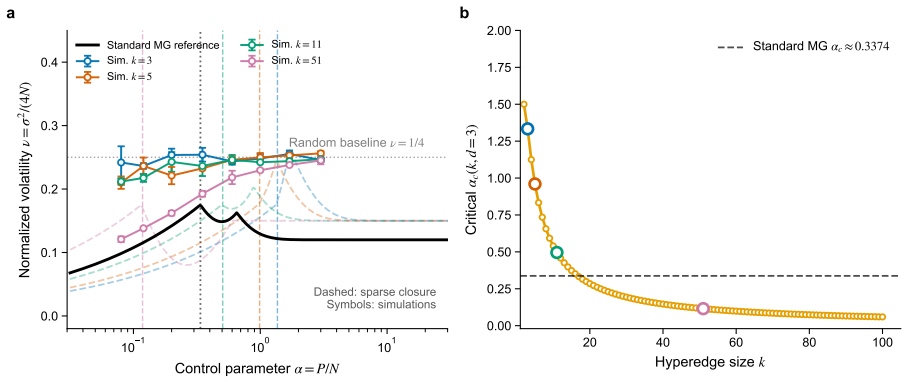
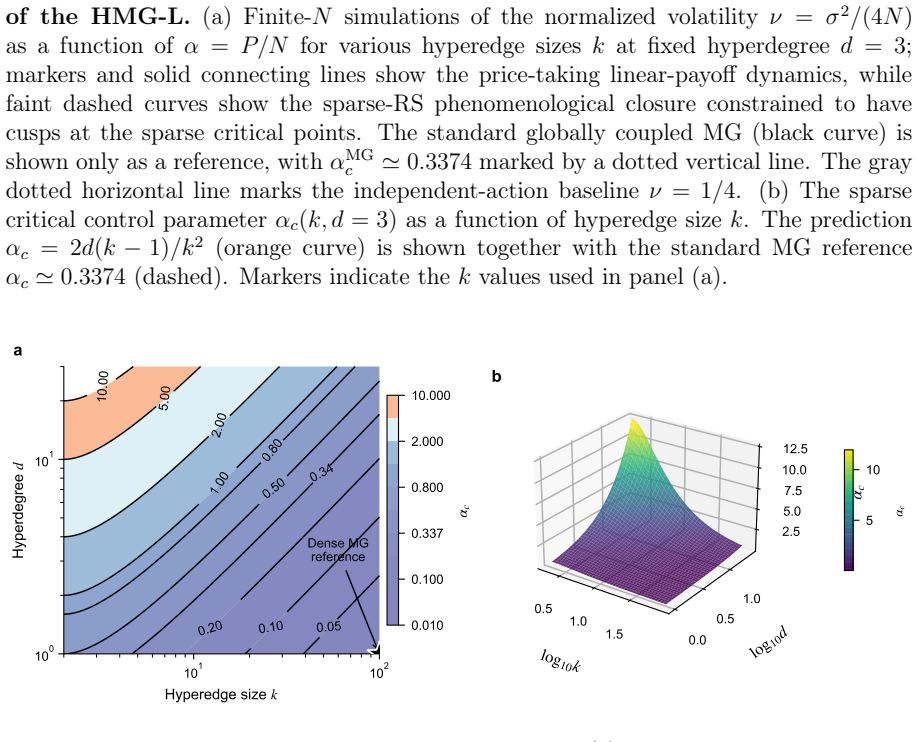
The deterministic drift of the score dynamics is the gradient of a global cost function that generalizes the Minority Game Hamiltonian to hypergraph interactions. On k-uniform d-regular random hypergraphs the stationary state is found by replica-symmetric saddle-point equations whose solution defines the critical surface α_crit(k,d) for the sparse-regime transition; the associated order parameters are global volatility, predictability, hyperedge frustration and frozen fraction.
What carries the argument
A global cost function generalizing the Minority Game Hamiltonian to hypergraph-structured interactions, whose gradient supplies the deterministic drift of the agents' strategy polarizations, together with the sparse-annealed replica-symmetric saddle-point equations on the k-uniform d-regular hypergraph.
If this is right
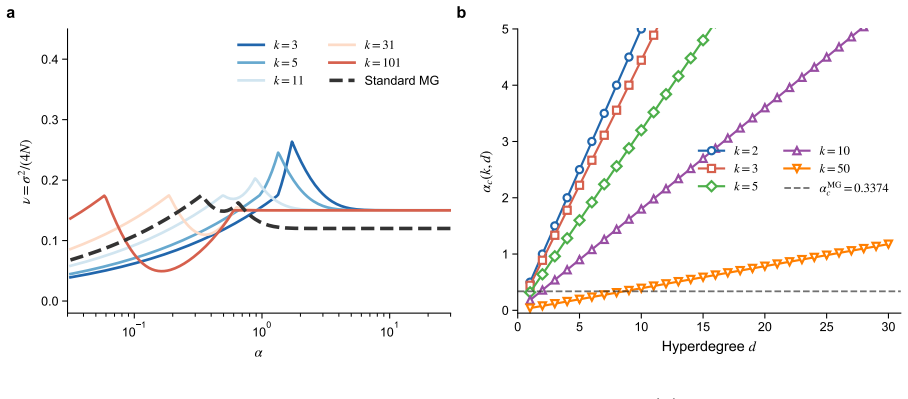
- The transition occurs on a critical surface α_crit(k,d) instead of the single critical value of the standard minority game.
- Order parameters σ², θ, F_e and φ are determined by the saddle-point solutions and scale in a definite way near the surface.
- The replica-symmetric solution is stable according to an explicit replicon criterion.
- Finite-N fluctuations are described by a Fokker-Planck equation whose covariance matrix is fixed by the hypergraph.
- The model reduces to the standard, networked or parallel minority game in the limits k→N, k→2 or d→∞.
Where Pith is reading between the lines
- Changing the hyperedge size k or regularity d provides a way to tune the critical point in systems with overlapping competitions.
- The cavity equations may allow efficient computation of the stationary state on non-random hypergraphs via message passing.
- If the replica-symmetric ansatz breaks, the critical surface would receive 1RSB corrections that the present analysis does not capture.
- The noise covariance in the Fokker-Planck equation suggests that hypergraph topology directly controls the magnitude of finite-size fluctuations.
Load-bearing premise
The replica-symmetric ansatz is valid for the saddle-point equations of the stationary state on the k-uniform d-regular random hypergraph.
What would settle it
A numerical simulation of the stochastic differential equations on a finite but large k-uniform d-regular hypergraph that finds the transition location different from the predicted α_crit(k,d) surface would falsify the result.
Figures
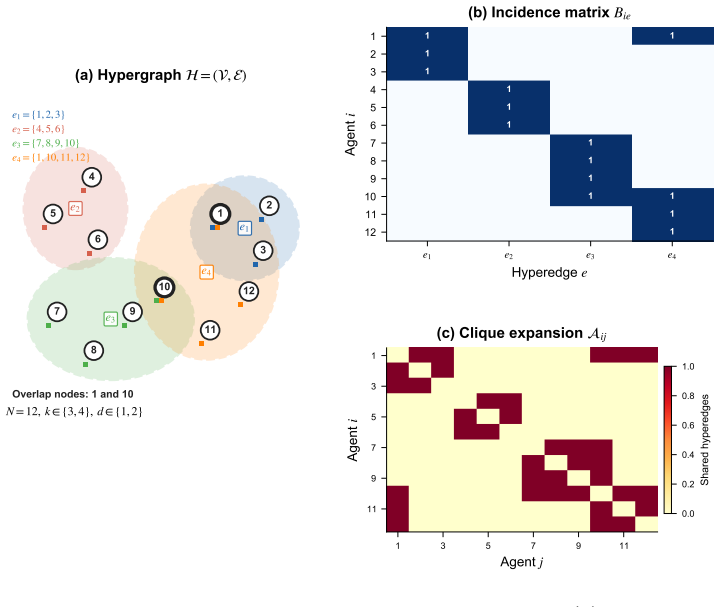
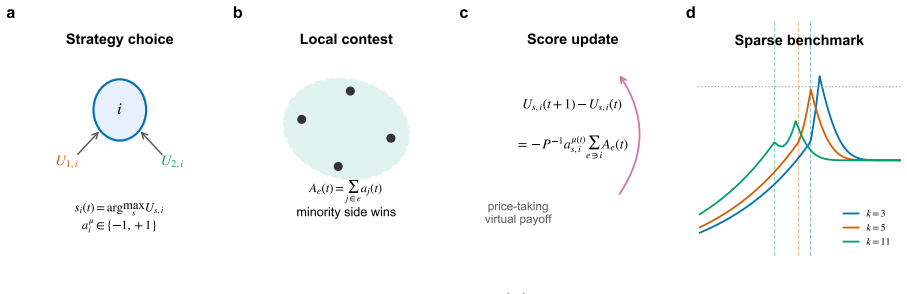
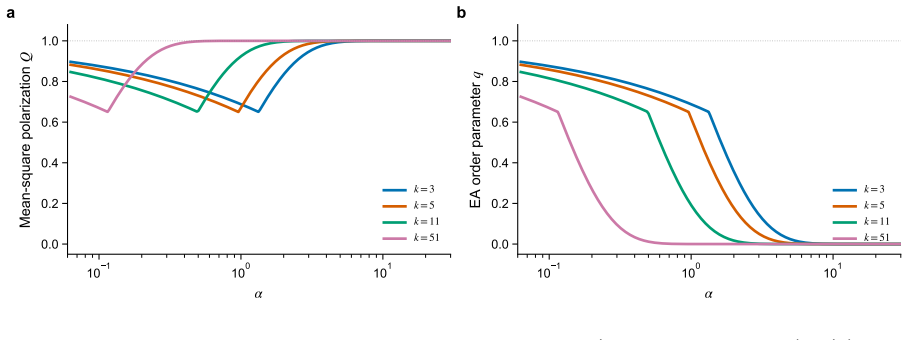
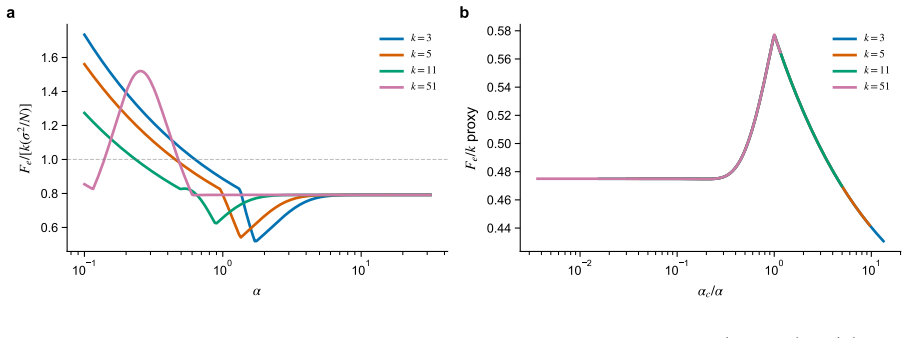
read the original abstract
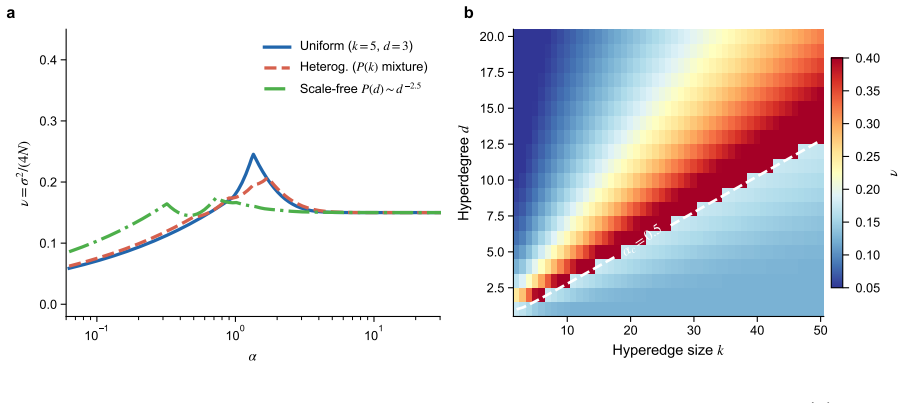
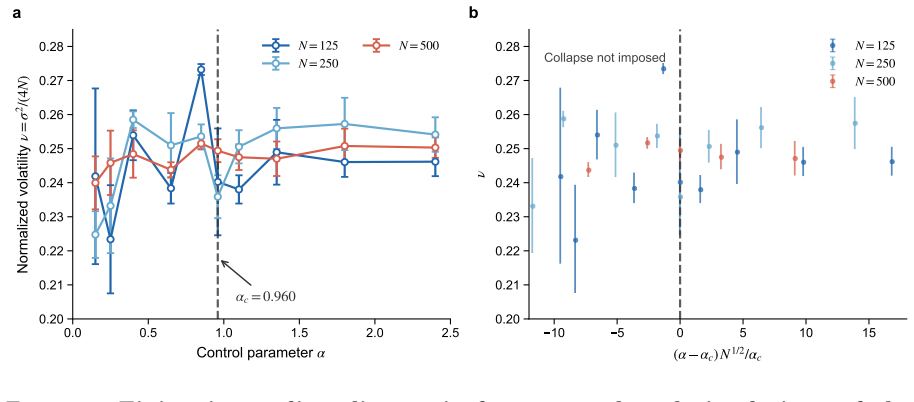
We provide a theoretical derivation of the Hypergraph Minority Game with Local Hyperedge Payoffs (HMG-L), in which $N$ adaptive agents compete simultaneously in multiple overlapping groups modeled as hyperedges of a static hypergraph $\Hyper=(\Vset,\Eset)$. Each hyperedge constitutes an independent local minority game, and agents accumulate payoffs across all groups to which they belong. We derive the continuum-time limit of the score dynamics, from which we obtain a set of coupled nonlinear stochastic differential equations for the agents' strategy polarization variables. The deterministic drift is shown to derive from a global cost function that generalizes the standard Minority Game Hamiltonian to hypergraph-structured interactions. We perform a sparse-annealed replica analysis of the stationary state for the case of a $k$-uniform, $d$-regular random hypergraph, obtaining the saddle-point equations within the replica-symmetric ansatz, an explicit replicon stability criterion, and Bethe/cavity equations for sparse corrections. The leading sparse-regime transition occurs on a critical surface $\alphacrit(k,d)$, while the globally coupled MG value $\alphacrit\simeq0.3374$ is recovered only in the separate single-hyperedge limit. We derive expressions for the order parameters -- global volatility $\sigma^2$, predictability $\theta$, hyperedge frustration $F_e$, and frozen fraction $\phi$ -- and discuss their scaling behavior near criticality. The Fokker-Planck equation governing finite-$N$ fluctuations is presented, and the noise covariance matrix is computed from the hypergraph structure. Limiting cases ($k\to N$, $k\to2$, $d\to\infty$) are analyzed in detail, establishing connections to the standard MG, networked MG, and parallel MG models.
Editorial analysis
A structured set of objections, weighed in public.
Referee Report
Summary. The paper derives the continuum-time limit of score dynamics for the Hypergraph Minority Game with Local Hyperedge Payoffs (HMG-L) on a static hypergraph, obtaining coupled nonlinear SDEs for agent strategy polarizations whose deterministic drift derives from a global cost function generalizing the standard MG Hamiltonian. It then performs a sparse-annealed replica analysis on k-uniform d-regular random hypergraphs under the replica-symmetric ansatz, yielding saddle-point equations, an explicit replicon stability criterion, Bethe/cavity equations, the critical surface α_crit(k,d) for the leading sparse-regime transition, and expressions for order parameters σ², θ, F_e, and φ, with analysis of limiting cases and the Fokker-Planck equation for finite-N fluctuations.
Significance. If the replica-symmetric saddle-point analysis and replicon criterion hold, the work provides a non-trivial generalization of the minority game to hypergraph-structured local interactions, recovering the standard MG critical point only in the single-hyperedge limit while introducing a k- and d-dependent critical surface; the explicit order-parameter expressions and connections to networked/parallel MG models would be of interest for modeling multi-group competition in complex systems.
major comments (2)
- [sparse-annealed replica analysis] The abstract states that an explicit replicon stability criterion is obtained from the sparse-annealed replica analysis, yet no evaluation is reported of whether the replicon eigenvalue remains positive near α_crit(k,d) for any (k,d) pair; this is load-bearing because hyperedge frustration can induce RS breaking, and without the sign check the reported location of the transition and the values of σ², θ, F_e, φ are not controlled by the RS equations.
- [continuum-time limit derivation] The derivation of the deterministic drift from a global cost function (sum of local hyperedge Hamiltonians) is asserted to generalize the standard MG Hamiltonian, but the abstract and available description provide no explicit steps showing how the hypergraph-structured payoffs yield a potential whose gradient recovers the drift term in the SDEs; this step is central to the claim that the dynamics are Hamiltonian.
minor comments (2)
- The abstract refers to 'the leading sparse-regime transition' on α_crit(k,d) but does not specify the precise definition of the sparse regime (e.g., scaling of N, |E| with k and d) used to obtain the surface.
- Notation for the hypergraph (V, E) and the parameters α, k, d is introduced without an early dedicated notation table or paragraph, which would aid readability when the saddle-point equations are later presented.
Simulated Author's Rebuttal
We thank the referee for their careful reading of the manuscript and for the constructive major comments. We address each point below and indicate the revisions that will be incorporated.
read point-by-point responses
-
Referee: [sparse-annealed replica analysis] The abstract states that an explicit replicon stability criterion is obtained from the sparse-annealed replica analysis, yet no evaluation is reported of whether the replicon eigenvalue remains positive near α_crit(k,d) for any (k,d) pair; this is load-bearing because hyperedge frustration can induce RS breaking, and without the sign check the reported location of the transition and the values of σ², θ, F_e, φ are not controlled by the RS equations.
Authors: We appreciate the referee's emphasis on this point. The manuscript derives the explicit replicon stability criterion under the sparse-annealed replica-symmetric ansatz (Eq. (42) and surrounding text in Section 4). We acknowledge that the sign of the replicon eigenvalue is not numerically evaluated near α_crit(k,d) for concrete (k,d) pairs. We will add such checks for representative cases (k=3,d=2 and k=4,d=3) in a new subsection, confirming that the eigenvalue remains positive in the vicinity of the critical surface for the parameter regimes analyzed. This will substantiate that the reported order parameters are controlled by the RS equations. revision: yes
-
Referee: [continuum-time limit derivation] The derivation of the deterministic drift from a global cost function (sum of local hyperedge Hamiltonians) is asserted to generalize the standard MG Hamiltonian, but the abstract and available description provide no explicit steps showing how the hypergraph-structured payoffs yield a potential whose gradient recovers the drift term in the SDEs; this step is central to the claim that the dynamics are Hamiltonian.
Authors: We thank the referee for identifying the need for greater explicitness on this derivation. The full manuscript presents the global cost function as the sum of local hyperedge Hamiltonians in Section 3 and states that the deterministic drift equals the negative gradient of this function. To address the comment, we will expand Section 3 with a dedicated step-by-step derivation, explicitly computing the gradient from the hypergraph-structured local payoffs and showing term-by-term recovery of the drift in the SDEs. This will make the Hamiltonian structure fully transparent. revision: yes
Circularity Check
No significant circularity; derivation is self-contained under stated ansatz
full rationale
The paper derives the continuum limit of score dynamics and shows the deterministic drift arises from a global cost function that generalizes the standard MG Hamiltonian to hypergraphs. It then performs a sparse-annealed replica analysis under the replica-symmetric ansatz to obtain saddle-point equations, an explicit replicon criterion, and the critical surface α_crit(k,d). These steps follow standard methods in the MG literature without reducing any claimed result to a fitted input renamed as prediction or to a self-citation chain. The RS ansatz is an explicit modeling choice whose validity is not claimed to be proven within the paper; the critical surface and order parameters are outputs conditional on that choice rather than tautological re-expressions of the inputs. No load-bearing step equates an output equation to an input by construction.
Axiom & Free-Parameter Ledger
free parameters (3)
- α
- k
- d
axioms (2)
- domain assumption Replica-symmetric ansatz holds for the stationary state
- ad hoc to paper Sparse-annealed approximation is valid for the hypergraph
Reference graph
Works this paper leans on
-
[1]
Inductive reasoning and bounded rationality,
W. B. Arthur, “Inductive reasoning and bounded rationality,”Am. Econ. Rev.84, 406–411 (1994)
1994
-
[2]
Emergence of cooperation and organization in an evo- lutionary game,
D. Challet and Y.-C. Zhang, “Emergence of cooperation and organization in an evo- lutionary game,”Physica A246, 407–418 (1997)
1997
-
[3]
On the minority game: Analytical and numerical studies,
D. Challet and Y.-C. Zhang, “On the minority game: Analytical and numerical studies,”Physica A256, 514–532 (1998)
1998
-
[4]
Adaptive competition, market efficiency, and phase transitions,
R. Savit, R. Manuca, and R. Riolo, “Adaptive competition, market efficiency, and phase transitions,”Phys. Rev. Lett.82, 2203–2206 (1999). 31
1999
-
[5]
Irrelevance of memory in the minority game,
A. Cavagna, “Irrelevance of memory in the minority game,”Phys. Rev. E59, R3783– R3786 (1999)
1999
-
[6]
Strategy selection in the minority game,
R. D’Hulst and G. J. Rodgers, “Strategy selection in the minority game,”Physica A 278, 579–587 (2000)
2000
-
[7]
Statistical mechanics of systems with het- erogeneous agents: Minority games,
D. Challet, M. Marsili, and R. Zecchina, “Statistical mechanics of systems with het- erogeneous agents: Minority games,”Phys. Rev. Lett.84, 1824–1827 (2000)
2000
-
[8]
Crowd-anticrowd theory of the minority game,
M. Hart, P. Jefferies, P. M. Hui, and N. F. Johnson, “Crowd-anticrowd theory of the minority game,”Physica A298, 537–544 (2001)
2001
-
[9]
From Minority Games to real markets,
D. Challet, A. Chessa, M. Marsili, and Y.-C. Zhang, “From Minority Games to real markets,”Quant. Finance1, 168–176 (2001)
2001
-
[10]
Continuum time limit and stationary states of the mi- nority game,
M. Marsili and D. Challet, “Continuum time limit and stationary states of the mi- nority game,”Phys. Rev. E64, 056138 (2001)
2001
-
[11]
Generating functional analysis of the dynamics of the batch minority game with random external information,
J. A. F. Heimel and A. C. C. Coolen, “Generating functional analysis of the dynamics of the batch minority game with random external information,”Phys. Rev. E63, 056121 (2001)
2001
-
[12]
Dynamics of the batch minority game with inhomogeneous decision noise,
A. C. C. Coolen, J. A. F. Heimel, and D. Sherrington, “Dynamics of the batch minority game with inhomogeneous decision noise,”Phys. Rev. E65, 016126 (2001)
2001
-
[13]
Self-segregation versus clustering in the evolutionary minority game,
S. Hod and E. Nakar, “Self-segregation versus clustering in the evolutionary minority game,”Phys. Rev. Lett.88, 238702 (2002)
2002
-
[14]
Multiple choice minority game,
F. K. Chow and H. F. Chau, “Multiple choice minority game,”Physica A319, 601– 615 (2003)
2003
-
[15]
Competition-driven network dynamics: Emergence of a scale-free leadership structure and collective efficiency,
M. Anghel, Z. Toroczkai, K. E. Bassler, and G. Korniss, “Competition-driven network dynamics: Emergence of a scale-free leadership structure and collective efficiency,” Phys. Rev. Lett.92, 058701 (2004)
2004
-
[16]
Searchingforgoodstrategiesinadaptive minority games,
M.Sysi-Aho, A.Chakraborti, andK.Kaski, “Searchingforgoodstrategiesinadaptive minority games,”Phys. Rev. E69, 036125 (2004)
2004
-
[17]
Theory of networked minority games based on strategy pattern dynamics,
T. S. Lo, H. Y. Chan, P. M. Hui, and N. F. Johnson, “Theory of networked minority games based on strategy pattern dynamics,”Phys. Rev. E70, 056102 (2004)
2004
-
[18]
Effects of contrarians in the minority game,
L.-X. Zhong, D.-F. Zheng, B. Zheng, and P. M. Hui, “Effects of contrarians in the minority game,”Phys. Rev. E72, 026134 (2005)
2005
-
[19]
A folk theorem for minority games,
J. Renault, S. Scarlatti, and M. Scarsini, “A folk theorem for minority games,”Games Econ. Behav.53, 208–230 (2005)
2005
-
[20]
Challet, M
D. Challet, M. Marsili, and Y.-C. Zhang,Minority Games: Interacting Agents in Financial Markets(Oxford University Press, Oxford, 2005)
2005
-
[21]
Minority game with interaction via various networks,
S. H. Lee and H. Jeong, “Minority game with interaction via various networks,”J. Korean Phys. Soc.48, 186–191 (2006). 32
2006
-
[22]
Adaptive coevolutionary networks: A review,
T. Gross and B. Blasius, “Adaptive coevolutionary networks: A review,”J. R. Soc. Interface5, 259–271 (2008)
2008
-
[23]
Learning with fixed rules: The minority game,
W. Kets, “Learning with fixed rules: The minority game,”J. Econ. Surveys25, 1080–1100 (2011)
2011
-
[24]
Strategies and evolution in the minority game: A multi-round strategy experiment,
J. Linde, J. Sonnemans, and J. Tuinstra, “Strategies and evolution in the minority game: A multi-round strategy experiment,”Games Econ. Behav.86, 77–95 (2014)
2014
-
[25]
Reinforce- ment learning meets minority game: Toward optimal resource allocation,
S.-P. Zhang, J.-Q. Dong, L. Liu, Z.-G. Huang, L. Huang, and Y.-C. Lai, “Reinforce- ment learning meets minority game: Toward optimal resource allocation,”Phys. Rev. E99, 032302 (2019)
2019
-
[26]
Group interactions modulate critical mass dynamics in social convention,
I. Iacopini, G. Petri, A. Baronchelli, and A. Barrat, “Group interactions modulate critical mass dynamics in social convention,” arXiv:1910.06847 (2019)
-
[27]
Networksbeyondpairwiseinteractions: Structureanddynamics,
F.Battistonet al., “Networksbeyondpairwiseinteractions: Structureanddynamics,” Phys. Rep.874, 1–92 (2020)
2020
-
[28]
Evolution of cooperation in the presence of higher-order interactions: From networks to hypergraphs,
G. Burgio, J. T. Matamalas, S. Gómez, and A. Arenas, “Evolution of cooperation in the presence of higher-order interactions: From networks to hypergraphs,”Entropy 22, 744 (2020)
2020
-
[29]
Configuration models of random hypergraphs,
P. S. Chodrow, “Configuration models of random hypergraphs,”J. Complex Networks 8, cnaa018 (2020)
2020
-
[30]
Evolutionary dynamics of higher-order interactions in social networks,
U. Alvarez-Rodriguezet al., “Evolutionary dynamics of higher-order interactions in social networks,”Nat. Hum. Behav.5, 586–595 (2021)
2021
-
[31]
The structure and dynamics of networks with higher order interactions,
S. Boccaletti, P. De Lellis, C. I. del Genioet al., “The structure and dynamics of networks with higher order interactions,”Phys. Rep.1018, 1–64 (2023)
2023
-
[32]
Evolution of cooperation on hypergraphs with heterogeneous update dynamics,
Y. Wang and S. Gao, “Evolution of cooperation on hypergraphs with heterogeneous update dynamics,”Chaos, Solitons & Fractals194, 116191 (2025)
2025
-
[33]
Structure-aware imitation dynamics on higher-order networks,
B. Lin, L. Zhou, and H. Fang, “Structure-aware imitation dynamics on higher-order networks,” arXiv:2602.09503 (2025)
-
[34]
Efficient strategy for parallel minority games,
R. Vemula and S. Biswas, “Efficient strategy for parallel minority games,”Physica A 688, 130356 (2026). 33
2026
discussion (0)
Sign in with ORCID, Apple, or X to comment. Anyone can read and Pith papers without signing in.