Evidence for Deconfined Magnetic Order in the Kitaev-J₃ Model
Pith reviewed 2026-07-03 06:17 UTC · model grok-4.3
The pith
In the Kitaev-J3 model, zigzag or antiferromagnetic order can coexist with remnant Z2 topological structure inherited from the Kitaev spin liquid.
A machine-rendered reading of the paper's core claim, the machinery that carries it, and where it could break.
Core claim
The central claim is that deconfined magnetic phases exist in the Kitaev-J3 model in which zigzag or antiferromagnetic order coexists with remnant Z2 topological structure. Optimized variational wave functions retain multiple linearly independent topological sectors on a torus. Visons condense in pairs to produce the order while single visons remain gapped, yielding gapless spinons with multiple Majorana cones.
What carries the argument
Retention of multiple topological sectors by variational wave functions on a torus together with the vison-pair condensation mechanism that generates order without gapping all topological excitations.
If this is right
- Zigzag or antiferromagnetic order can appear while single visons stay gapped.
- The resulting phases contain gapless spinons with multiple Majorana cones.
- These phases supply a microscopic scenario for anomalous longitudinal thermal transport in materials such as Na2Co2TeO6.
- Fractionalized magnetism is possible without requiring a pure spin-liquid state.
Where Pith is reading between the lines
- The same vison-pair mechanism may operate in other Kitaev-magnet extensions that show partial order.
- Spectroscopic or transport signatures of multiple Majorana cones could be searched for in existing ordered Kitaev compounds.
- Numerical studies on other lattice geometries could test whether torus-sector retention remains a reliable diagnostic.
Load-bearing premise
The assumption that multiple retained topological sectors on a torus, together with the vison-pair condensation picture, correctly identify a deconfined ordered phase rather than a conventional ordered state.
What would settle it
Explicit computation of the vison spectrum in the candidate phases on larger tori to check whether single-vison excitations remain gapped while pairs condense.
Figures


read the original abstract
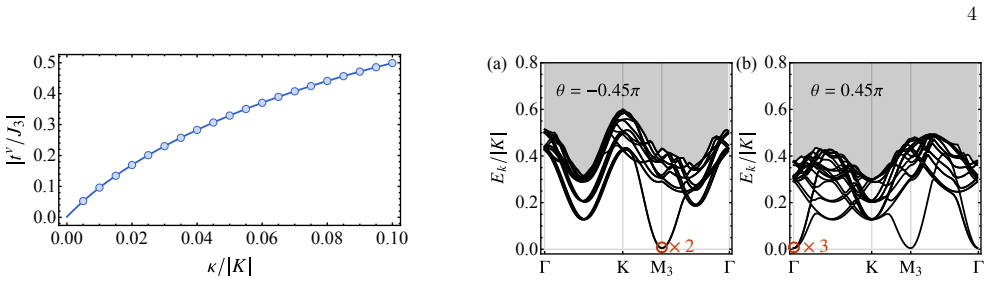
We investigate the Kitaev-$J_3$ honeycomb model using variational Monte Carlo calculations combined with a vison-quasiparticle analysis of the parent Kitaev spin liquid (KSL). We provide evidence for deconfined magnetic phases in which zigzag or antiferromagnetic order coexists with remnant $\mathbb{Z}_2$ topological structure inherited from the KSL. The optimized variational wave functions retain multiple linearly independent topological sectors on a torus, whereas those of conventional ordered phases collapse to a single sector. The vison-quasiparticle analysis shows that magnetic order naturally arises from vison-pair condensation while single visons remain gapped, yielding a microscopic mechanism for magnetic ordering without immediate confinement. The resulting phases further host gapless spinons with multiple Majorana cones, offering a possible microscopic scenario for the anomalous low-temperature longitudinal thermal transport reported in magnetically ordered Kitaev materials such as Na$_2$Co$_2$TeO$_6$. Our results reveal a microscopic route to fractionalized magnetism beyond the conventional dichotomy between magnetic order and spin-liquid behavior.
Editorial analysis
A structured set of objections, weighed in public.
Referee Report
Summary. The manuscript investigates the Kitaev-J3 honeycomb model via variational Monte Carlo (VMC) combined with vison-quasiparticle analysis of the parent Kitaev spin liquid. It claims evidence for deconfined magnetic phases in which zigzag or antiferromagnetic order coexists with remnant Z2 topological structure. The key diagnostics are that optimized VMC wave functions on a torus retain multiple linearly independent topological sectors (whereas conventional ordered phases collapse to one sector) and that magnetic order arises from vison-pair condensation with gapped single visons, yielding gapless spinons with multiple Majorana cones that may explain anomalous thermal transport in materials such as Na2Co2TeO6.
Significance. If the VMC sector-retention diagnostic and vison-condensation mechanism are shown to be robust, the work would supply a concrete microscopic route to fractionalized magnetism that lies outside the conventional ordered-versus-spin-liquid dichotomy and could account for low-temperature longitudinal thermal transport anomalies in Kitaev materials.
major comments (2)
- [Abstract / torus-sector analysis] Abstract and the description of the torus-sector diagnostic: the claim that retention of multiple linearly independent topological sectors distinguishes deconfined magnetic order from conventional order is load-bearing, yet the manuscript provides no quantitative benchmarks (sector overlaps, energy splittings, or explicit comparisons against known conventional ordered models) that would confirm the diagnostic's discriminating power; without these, the signature could arise from ansatz limitations rather than true deconfined order.
- [Vison-quasiparticle analysis] Vison-quasiparticle analysis section: the assertion that magnetic order arises from vison-pair condensation while single visons remain gapped requires explicit numerical evidence (e.g., vison-pair binding energies, single-vison gaps, and convergence with system size or ansatz parameters); the abstract supplies none of these quantities or error estimates.
Simulated Author's Rebuttal
We thank the referee for their detailed and constructive report. We address the two major comments point by point below, indicating where revisions will be made to strengthen the manuscript.
read point-by-point responses
-
Referee: [Abstract / torus-sector analysis] Abstract and the description of the torus-sector diagnostic: the claim that retention of multiple linearly independent topological sectors distinguishes deconfined magnetic order from conventional order is load-bearing, yet the manuscript provides no quantitative benchmarks (sector overlaps, energy splittings, or explicit comparisons against known conventional ordered models) that would confirm the diagnostic's discriminating power; without these, the signature could arise from ansatz limitations rather than true deconfined order.
Authors: We agree that quantitative benchmarks would make the torus-sector diagnostic more convincing. In the revised manuscript we will add explicit comparisons against conventional ordered states (e.g., the antiferromagnetic Heisenberg model on the honeycomb lattice) using the same VMC ansatz, reporting sector overlaps, energy splittings between sectors, and finite-size behavior to demonstrate that the retention of multiple sectors is not an artifact of the variational wave function. revision: yes
-
Referee: [Vison-quasiparticle analysis] Vison-quasiparticle analysis section: the assertion that magnetic order arises from vison-pair condensation while single visons remain gapped requires explicit numerical evidence (e.g., vison-pair binding energies, single-vison gaps, and convergence with system size or ansatz parameters); the abstract supplies none of these quantities or error estimates.
Authors: The vison-quasiparticle analysis is presented in the main text, but we acknowledge that the abstract and the section would benefit from tabulated numerical values. In the revision we will include vison-pair binding energies, single-vison gaps extracted from the parent KSL, finite-size scaling data, and statistical error estimates from the VMC sampling to make the condensation mechanism fully quantitative. revision: yes
Circularity Check
No circularity: numerical VMC evidence stands on explicit sector retention calculations
full rationale
The paper reports variational Monte Carlo results on the Kitaev-J3 model, claiming that optimized wave functions retain multiple topological sectors on the torus while conventional orders collapse to one, together with a vison-pair condensation analysis. This diagnostic is presented as an output of the numerical optimization rather than a self-definitional input, a fitted parameter renamed as a prediction, or a result justified solely by self-citation. No equations or steps in the abstract reduce the central claim to its own inputs by construction; the derivation chain relies on independent numerical sampling and sector counting whose validity is external to the target result.
Axiom & Free-Parameter Ledger
axioms (2)
- domain assumption Variational Monte Carlo wave functions can faithfully represent the ground states of the Kitaev-J3 model.
- domain assumption The vison-quasiparticle analysis developed for the pure Kitaev spin liquid remains applicable once magnetic order appears.
Reference graph
Works this paper leans on
-
[1]
P. A. Lee, N. Nagaosa, and X.-G. Wen, Doping a Mott in- sulator: Physics of high-temperature superconductivity, Rev. Mod. Phys.78, 17 (2006)
work page 2006
-
[2]
Balents, Spin liquids in frustrated magnets, Nature (London)464, 199 (2010)
L. Balents, Spin liquids in frustrated magnets, Nature (London)464, 199 (2010)
work page 2010
-
[3]
L. Savary and L. Balents, Quantum spin liquids: a re- view, Rep. Prog. Phys.80, 016502 (2017)
work page 2017
-
[4]
Y. Zhou, K. Kanoda, and T.-K. Ng, Quantum spin liquid states, Rev. Mod. Phys.89, 025003 (2017)
work page 2017
-
[5]
J. Knolle and R. Moessner, A field guide to spin liquids, Annu. Rev. Condens. Matter Phys.10, 451 (2019)
work page 2019
-
[6]
C. Broholm, R. J. Cava, S. A. Kivelson, D. G. Nocera, M. R. Norman, and T. Senthil, Quantum spin liquids, Science367, eaay0668 (2020)
work page 2020
-
[7]
F. A. Bais and J. K. Slingerland, Condensate-induced transitions between topologically ordered phases, Phys. Rev. B79, 045316 (2009)
work page 2009
-
[8]
T. Neupert, H. He, C. von Keyserlingk, G. Sierra, and B. A. Bernevig, Boson condensation in topologically or- dered quantum liquids, Phys. Rev. B93, 115103 (2016)
work page 2016
-
[9]
F. J. Burnell, Anyon Condensation and Its Applications, Annu. Rev. Condens. Matter Phys.9, 307 (2018)
work page 2018
-
[10]
Hwang, Anyon condensation and confinement transi- tion in a Kitaev spin liquid bilayer, Phys
K. Hwang, Anyon condensation and confinement transi- tion in a Kitaev spin liquid bilayer, Phys. Rev. B109, 134412 (2024)
work page 2024
-
[11]
Z.-X. Liu, Y. Zhou, and T.-K. Ng, Possibility ofS= 1 spin liquids with fermionic spinons on triangular lattices, Phys. Rev. B81, 224417 (2010)
work page 2010
-
[12]
L. Savary and L. Balents, Coulombic Quantum Liquids in Spin-1/2 Pyrochlores, Phys. Rev. Lett.108, 037202 (2012)
work page 2012
-
[13]
T. A. Sedrakyan, L. I. Glazman, and A. Kamenev, Spon- taneous Formation of a Nonuniform Chiral Spin Liquid in a Moat-Band Lattice, Phys. Rev. Lett.114, 037203 (2015)
work page 2015
-
[14]
L. E. Chern and Y. B. Kim, Magnetic Order with Frac- tionalized Excitations in Pyrochlore Magnets with Strong Spin-Orbit Coupling, Sci. Rep.9, 10974 (2019)
work page 2019
-
[15]
R. Samajdar, M. S. Scheurer, S. Chatterjee, H. Guo, C. Xu, and S. Sachdev, Enhanced thermal Hall effect in the square-lattice N´ eel state, Nat. Phys.15, 1290 (2019)
work page 2019
- [16]
-
[17]
Kitaev, Anyons in an exactly solved model and be- yond, Ann
A. Kitaev, Anyons in an exactly solved model and be- yond, Ann. Phys. (N. Y.)321, 2 (2006)
work page 2006
-
[18]
G. Jackeli and G. Khaliullin, Mott insulators in the strong spin-orbit coupling limit: from Heisenberg to a quantum compass and Kitaev models, Phys. Rev. Lett. 102, 017205 (2009)
work page 2009
-
[19]
M. Hermanns, I. Kimchi, and J. Knolle, Physics of the 6 Kitaev model: Fractionalization, dynamic correlations, and material connections, Annu. Rev. Condens. Matter Phys.9, 17 (2018)
work page 2018
- [20]
- [21]
-
[22]
I. Rousochatzakis, N. B. Perkins, Q. Luo, and H.-Y. Kee, Beyond Kitaev physics in strong spin-orbit coupled mag- nets, Rep. Prog. Phys.87, 026502 (2024)
work page 2024
-
[23]
Y. Matsuda, T. Shibauchi, and H.-Y. Kee, Kitaev quan- tum spin liquids, Rev. Mod. Phys.97, 045003 (2025)
work page 2025
-
[24]
A. Banerjee, C. A. Bridges, J.-Q. Yan,et al., Proximate Kitaev quantum spin liquid behaviour in a honeycomb magnet, Nat. Mat.15, 733 (2016)
work page 2016
-
[25]
A. Banerjee, J. Yan, J. Knolle,et al., Neutron Scattering in the Proximate Quantum Spin Liquidα-RuCl 3, Science 356, 1055 (2017)
work page 2017
-
[26]
Y. Kasahara, T. Ohnishi, Y. Mizukami, O. Tanaka, S. Ma, K. Sugii, N. Kurita, H. Tanaka, J. Nasu, Y. Mo- tome, T. Shibauchi, and Y. Matsuda, Majorana Quanti- zation and Half-Integer Thermal Quantum Hall Effect in a Kitaev Spin Liquid, Nature (London)559, 227 (2018)
work page 2018
- [27]
- [28]
- [29]
- [30]
-
[31]
T. Senthil and M. P. A. Fisher,Z 2 gauge theory of electron fractionalization in strongly correlated systems, Phys. Rev. B62, 7850 (2000)
work page 2000
-
[32]
T. Senthil, S. Sachdev, and M. Vojta, Fractionalized Fermi Liquids, Phys. Rev. Lett.90, 216403 (2003)
work page 2003
-
[33]
P. A. Maksimov and A. L. Chernyshev, Rethinking α−RuCl3, Phys. Rev. Res.2, 033011 (2020)
work page 2020
-
[34]
B. H. Kim, S. Sota, T. Shirakawa, S. Yunoki, and Y.- W. Son, Proximate Kitaev system for an intermediate magnetic phase in in-plane magnetic fields, Phys. Rev. B.102, 140402 (2020)
work page 2020
-
[35]
S. K. Choi, R. Coldea, A. N. Kolmogorov,et al., Spin waves and revised crystal structure of honeycomb iridate Na2IrO3, Phys. Rev. Lett.108, 127204 (2012)
work page 2012
- [36]
-
[37]
C. Kim, J. Jeong, G. Lin,et al., Antiferromagnetic Ki- taev interaction in J ef f = 1/2 cobalt honeycomb mate- rials Na3Co2SbO6 and Na2Co2TeO6, J. Phys.: Condens. Matter34, 045802 (2021)
work page 2021
-
[38]
G. Lin, J. Jeong, C. Kim,et al., Field-induced quan- tum spin disordered state in spin-1/2 honeycomb magnet Na2Co2TeO6, Nat. Commun.12, 5559 (2021)
work page 2021
-
[39]
W. Yao, K. Iida, K. Kamazawa, and Y. Li, Excita- tions in the Ordered and Paramagnetic States of Hon- eycomb Magnet Na 2Co2TeO6, Phys. Rev. Lett.129, 147202 (2022)
work page 2022
-
[40]
A. Corticelli, R. Moessner, and P. A. McClarty, Spin- space groups and magnon band topology, Phys. Rev. B 105, 064430 (2022)
work page 2022
- [41]
-
[42]
Z. Xiao, J. Zhao, Y. Li, R. Shindou, and Z.-D. Song, Spin Space Groups: Full Classification and Applications, Phys. Rev. X14, 031037 (2024)
work page 2024
-
[43]
P. Liu, J. Li, J. Han, X. Wan, and Q. Liu, Spin-Group Symmetry in Magnetic Materials with Negligible Spin- Orbit Coupling, Phys. Rev. X12, 021016 (2022)
work page 2022
-
[44]
C. Chen and J. Wang, Dynamical Response of the Ki- taev Spin Liquid under Third-Nearest-Neighbor Heisen- berg Interaction, arXiv:2603.24918 (2026)
-
[45]
See Supplemental Material for details on trial wave func- tions, order-by-disorder analysis, spinon mean-field dis- persions, finite-size criterion for the GSD diagnostic, sta- bility analysis, remarks on entanglement-based diagnos- tics,J 3-induced single-vison and vison-pair hopping pro- cesses, and magnetic order from BVPs condensation
-
[46]
J. G. Rau, P. A. McClarty, and R. Moessner, Pseudo- Goldstone Gaps and Order-by-Quantum Disorder in Frustrated Magnets, Phys. Rev. Lett.121, 237201 (2018)
work page 2018
-
[47]
P. Rao, R. Moessner, and J. Knolle, Proximate quantum spin liquids and Majorana continua in magnetically or- dered Kitaev magnets, arXiv:2604.03099 (2026)
work page internal anchor Pith review Pith/arXiv arXiv 2026
-
[48]
X. G. Wen, Vacuum degeneracy of chiral spin states in compactified space, Phys. Rev. B40, 7387(R) (1989)
work page 1989
-
[49]
X. G. Wen and Q. Niu, Ground-state degeneracy of the fractional quantum Hall states in the presence of a random potential and on high-genus Riemann surfaces, Phys. Rev. B41, 9377 (1990)
work page 1990
-
[50]
Kitaev, Fault-tolerant quantum computation by anyons, Ann
A. Kitaev, Fault-tolerant quantum computation by anyons, Ann. Phys. (N. Y.)303, 2 (2003)
work page 2003
-
[51]
Wen, Symmetry-protected topological phases in noninteracting fermion systems, Phys
X.-G. Wen, Symmetry-protected topological phases in noninteracting fermion systems, Phys. Rev. B85, 085103 (2012)
work page 2012
-
[52]
J. Wang and Z.-X. Liu, Symmetry-protected gapless spin liquids on the strained honeycomb lattice, Phys. Rev. B 102, 094416 (2020)
work page 2020
-
[53]
L.-C. Chen and Z.-X. Liu, Deconfined gapless phases and criticalities in the Shastry-Sutherland antiferromagnet, Phys. Rev. B113, 224440 (2026)
work page 2026
- [54]
- [55]
-
[56]
C. Chen and I. S. Villadiego, Nature of Visons in the Perturbed Ferromagnetic and Antiferromagnetic Kitaev Honeycomb Models, Phys. Rev. B107, 045114 (2023)
work page 2023
-
[57]
C. Chen and I. S. Villadiego, Anyon Polarons as a Win- dow into the Competing Phases of the Kitaev-Gamma- Gamma’ Model, arXiv:2508.21129 (2025)
-
[58]
C. Chen and I. S. Villadiego, Anyon Polarons as a Win- dow into Competing Phases of the Kitaev Honeycomb Model under a Zeeman Field, Phys. Rev. B111, 245140 7 (2025)
work page 2025
-
[59]
J. Wang, B. Normand, and Z.-X. Liu, One Proximate Kitaev Spin Liquid in theK−J−Γ Model on the Honey- comb Lattice, Phys. Rev. Lett.123, 197201 (2019)
work page 2019
- [60]
-
[61]
Q.-R. Zhao and Z.-X. Liu, Thermal Properties and In- stability of a U(1) Spin Liquid on the Triangular Lattice, Phys. Rev. Lett.127, 127205 (2021)
work page 2021
-
[62]
F. Ferrari and F. Becca, Dynamical Structure Factor of theJ 1 −J 2 Heisenberg Model on the Triangular Lattice: Magnons, Spinons, and Gauge Fields, Phys. Rev. X9, 031026 (2019)
work page 2019
-
[63]
Wen, Quantum orders and symmetric spin liquids, Phys
X.-G. Wen, Quantum orders and symmetric spin liquids, Phys. Rev. B65, 165113 (2002)
work page 2002
-
[64]
Y.-Z. You, I. Kimchi, and A. Vishwanath, Doping a spin- orbit Mott insulator: Topological superconductivity from the Kitaev-Heisenberg model and possible application to (Na2/Li2)IrO3, Phys. Rev. B86, 085145 (2012)
work page 2012
-
[65]
J. Wang, Q. Zhao, X. Wang, and Z.-X. Liu, Multinode quantum spin liquids on the honeycomb lattice, Phys. Rev. B102, 144427 (2020)
work page 2020
-
[66]
J. Wang and Z.-X. Liu, Effect of ring-exchange interac- tions in the extended Kitaev honeycomb model, Phys. Rev. B108, 014437 (2023)
work page 2023
-
[67]
J. G. Rau, E. K.-H. Lee, and H.-Y. Kee, Generic Spin Model for the Honeycomb Iridates beyond the Kitaev Limit, Phys. Rev. Lett.112, 077204 (2014)
work page 2014
-
[68]
J. Wang, B. Normand, and Z.-X. Liu, Multinode quan- tum spin liquids in extended Kitaev honeycomb models, npj Quantum Mater.9, 94 (2024)
work page 2024
- [69]
-
[70]
H. Yao and X.-L. Qi, Entanglement Entropy and Entan- glement Spectrum of the Kitaev Model, Phys. Rev. Lett. 105, 080501 (2010)
work page 2010
-
[71]
A. P. Joy and A. Rosch, Dynamics of Visons and Thermal Hall Effect in Perturbed Kitaev Models, Phys. Rev. X12, 041004 (2022). 8 SUPPLEMENTAL MATERIAL A. Construction of trial wave functions The variational Monte Carlo (VMC) approach used here is based on Gutzwiller-projected trial wave functions, which provide a powerful framework for studying strongly co...
work page 2022
-
[72]
(b) Spinon mean-field dispersion in the ZZ ⇤ 1 state at✓=⇡/3, showing twelve Majorana cones
andb2=( 2⇡,2⇡/ p 3), corresponding to the real-space primitive vectors a1=(1/2, p 3/2) anda2=( 1/2, p 3/2). (b) Spinon mean-field dispersion in the ZZ ⇤ 1 state at✓=⇡/3, showing twelve Majorana cones. Here b1=( 2⇡,0) andb2=( 0,2⇡/ p
-
[73]
correspond toa1=( 1,0) and a2=( 0, p 3). (b)��� FIG. S2. Spinon mean-field dispersions in the deconfined magnetic phases. (a) Spinon dispersion in the AFM ∗ atθ=π/3, showing fourteen Majorana cones. The reciprocal lattice vectors areb 1 = (−2π,2π/ √
-
[74]
(b) Spinon mean-field dispersion in the ZZ ∗ 1 at θ=−π/3, showing twelve Majorana cones
andb 2 = (2π,2π/ √ 3), corresponding to the real-space primitive vectorsa 1 = (−1/2, √ 3/2) anda 2 = (1/2, √ 3/2). (b) Spinon mean-field dispersion in the ZZ ∗ 1 at θ=−π/3, showing twelve Majorana cones. Hereb 1 = (2π,0) andb 2 = (0,2π/ √
-
[75]
11 spinons finite overlap with physical spin fluctuations [59]
correspond toa 1 = (1,0) anda 2 = (0, √ 3). 11 spinons finite overlap with physical spin fluctuations [59]. Consequently, spin dynamical structure factor,S(q, ω), is expected to contain a gapless continuum from intra-cone and inter-cone spinon processes, coexisting with gapped magnon-like branches associated with the fluctuation-selected magnetic order. T...
-
[76]
The hopping processes forx- andy-bond BVPs are related by aC 3 rotation. We emphasize that the vanishing single-vison hopping obtained here applies only to the leading-orderJ 3-induced process. It does not exclude higher-order contributions, which may generate a weak single-vison dispersion at larger J3, although such processes are expected to be subleadi...
discussion (0)
Sign in with ORCID, Apple, or X to comment. Anyone can read and Pith papers without signing in.