Subsoil acidity causes long delays in inorganic carbon sequestration by Enhanced Weathering
Pith reviewed 2026-07-03 02:09 UTC · model grok-4.3
The pith
Subsoil acidity delays Enhanced Weathering carbon sequestration by 30-100 years even after topsoil liming.
A machine-rendered reading of the paper's core claim, the machinery that carries it, and where it could break.
Core claim
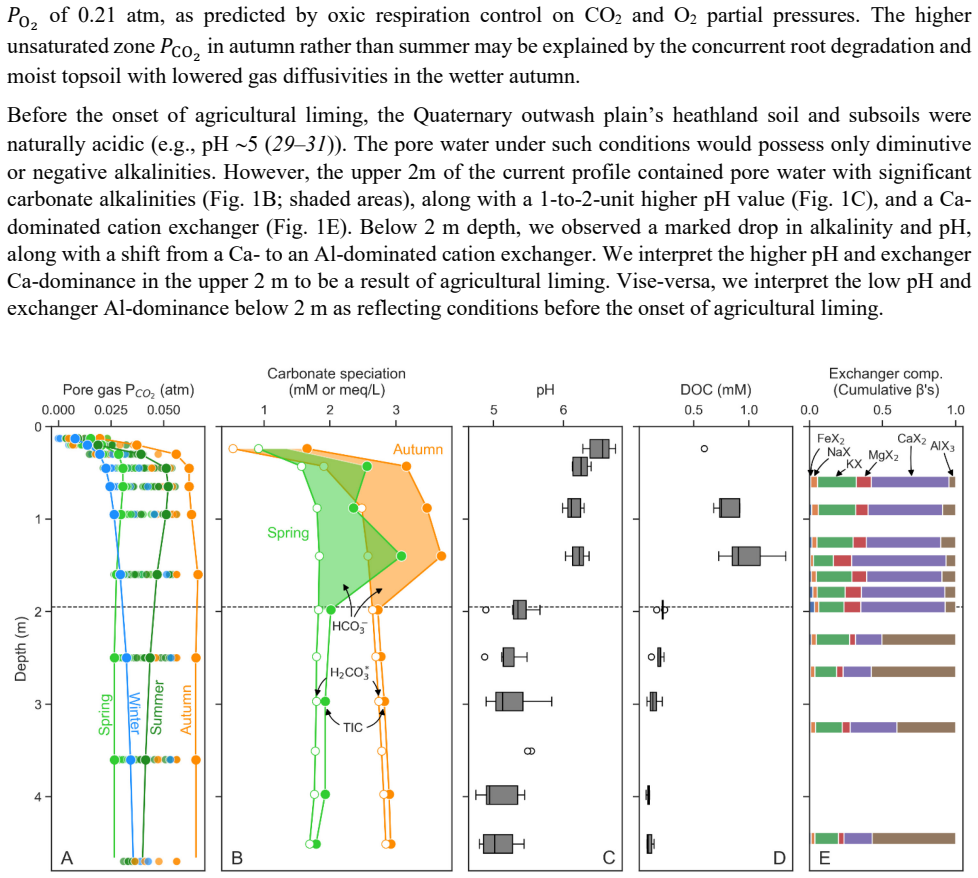
Using century-long agricultural liming of formerly acidic heathland as a proxy for Enhanced Weathering, this study provides empirical evidence of subsoil-imposed delays. Below such limed terrain, we observed a downward-progressing front of topsoil-produced alkalinity that still requires 30-100 years to penetrate the approximately 5 m thick acidic sandy unsaturated zone and reach the groundwater table. Subsoil acidity thus may cause beyond-reasonable delays, prohibiting EW as a viable short-term carbon capture strategy even on topsoils made non-acidic by preceding liming.
What carries the argument
The downward-progressing alkalinity front observed beneath century-long limed sites, used as a proxy to measure the time required for EW-produced alkalinity to traverse acidic subsoil to the water table.
If this is right
- Subsoil acidity imposes delays on inorganic carbon sequestration by EW that exceed those caused by topsoil acidity alone.
- EW cannot serve as a viable short-term carbon capture method on sites with acidic subsoils even after topsoil liming.
- Planning any EW scheme requires assessment of stored acidic cations throughout the top- and subsoil.
- The rate and composition of infiltrating water determine how long the sequestration delay lasts.
Where Pith is reading between the lines
- EW site selection should incorporate full soil-profile acidity mapping to forecast realistic sequestration timelines.
- Regions with deep acidic subsoils may need alternative carbon removal approaches until subsoil conditions are addressed.
- Long-term monitoring of actual EW applications in sandy acidic profiles could directly test the proxy-based delay estimate.
Load-bearing premise
The alkalinity front created by century-long liming will continue moving downward at a comparable rate and composition through the entire 5 m acidic sandy unsaturated zone.
What would settle it
Direct field measurement at comparable limed sites showing the alkalinity front reaching the groundwater table in substantially less than 30 years.
Figures

read the original abstract
While a looming atmospheric CO$_2$ overshoot calls for immediate carbon sequestration, delays associated to Enhanced Weathering (EW) carbon dioxide removal are being investigated. Topsoil acidity is already known to delay EW carbon sequestration, but subsoil acidity remains underexplored. Using century-long agricultural liming of formerly acidic heathland as a proxy for EW, this study provides empirical evidence of subsoil-imposed delays. Below such limed terrain, we observed a downward-progressing front of topsoil-produced alkalinity that still requires 30-100 years to penetrate the approximately 5 m thick acidic sandy unsaturated zone and reach the groundwater table. Subsoil acidity thus may cause beyond-reasonable delays, prohibiting EW as a viable short-term carbon capture strategy even on topsoils made non-acidic by preceding liming. When planning EW schemes, the amounts of stored acidic cations in top- and subsoil, as well as the rate and composition of infiltrating water, controlling the duration of the delay, require careful assessment.
Editorial analysis
A structured set of objections, weighed in public.
Referee Report
Summary. The manuscript uses century-long agricultural liming of formerly acidic heathland as a proxy for enhanced weathering (EW). It reports an observed downward-progressing alkalinity front below limed terrain that is stated to still require 30-100 years to traverse the remaining ~5 m acidic sandy unsaturated zone and reach the groundwater table. The central claim is that subsoil acidity can therefore impose delays that make EW unsuitable as a short-term carbon sequestration strategy, even after topsoil neutralization by liming; the authors recommend assessing stored acidic cations and infiltrating water properties when planning EW.
Significance. If the proxy observations and extrapolation hold, the result would add a subsoil-specific constraint to EW deployment timelines, complementing known topsoil acidity effects. The empirical proxy approach (real-world liming history rather than fitted parameters or purely synthetic models) is a methodological strength that grounds the delay estimate in observable field data.
major comments (2)
- [abstract] Abstract, proxy-use paragraph: the 30-100 year delay estimate for the remaining ~5 m is presented without explicit data on current front position, century-scale average advance velocity, or uncertainty on that velocity. The central claim that subsoil acidity prohibits short-term EW therefore rests on an unquantified extrapolation whose robustness cannot be evaluated from the given information.
- [abstract] Abstract and proxy description: no transport model, sensitivity analysis, or accounting is supplied for depth-dependent changes in cation-exchange capacity, pH buffering capacity, or water flux that could decelerate or accelerate the alkalinity front through the full unsaturated zone. If the front slows, the delay lengthens beyond the stated range; this assumption is load-bearing for the prohibition on short-term viability.
Simulated Author's Rebuttal
We thank the referee for the constructive comments and for recognizing the strength of our empirical proxy approach. We address each major comment below.
read point-by-point responses
-
Referee: [abstract] Abstract, proxy-use paragraph: the 30-100 year delay estimate for the remaining ~5 m is presented without explicit data on current front position, century-scale average advance velocity, or uncertainty on that velocity. The central claim that subsoil acidity prohibits short-term EW therefore rests on an unquantified extrapolation whose robustness cannot be evaluated from the given information.
Authors: We agree that the abstract would benefit from explicit quantification to support the delay range. The full manuscript reports the observed alkalinity front position from soil sampling and derives the century-scale average advance velocity from the known start of liming and the current front depth; uncertainties are estimated from replicate profiles and historical records. In the revision we will add these values and their derivation to the abstract so that the basis of the 30-100 year extrapolation is transparent. revision: yes
-
Referee: [abstract] Abstract and proxy description: no transport model, sensitivity analysis, or accounting is supplied for depth-dependent changes in cation-exchange capacity, pH buffering capacity, or water flux that could decelerate or accelerate the alkalinity front through the full unsaturated zone. If the front slows, the delay lengthens beyond the stated range; this assumption is load-bearing for the prohibition on short-term viability.
Authors: The study is intentionally empirical and uses the observed front progression under actual liming conditions rather than a calibrated transport model; this is the methodological choice highlighted as a strength in the referee summary. We nevertheless recognize that depth-dependent changes in soil properties could alter front velocity. In revision we will add a dedicated paragraph in the discussion that compiles available depth profiles of CEC and pH buffering capacity from the study site, provides a qualitative assessment of how variations in these parameters and in water flux would affect the extrapolation, and states the linear-assumption limitation explicitly. revision: partial
Circularity Check
No circularity: empirical proxy observation with no derivation reducing to inputs
full rationale
The paper presents field observations of an alkalinity front in a limed proxy site as direct evidence for subsoil delays in EW. No equations, fitted parameters, or self-citations are invoked to derive a 'prediction' that collapses back to the input data by construction. The central claim rests on measured proxy behavior extrapolated to EW scenarios, which is an empirical inference rather than a self-referential derivation. The skeptic concern about front velocity assumptions is a question of evidence strength, not circularity under the defined patterns.
Axiom & Free-Parameter Ledger
axioms (1)
- domain assumption Century-long agricultural liming of formerly acidic heathland serves as a valid proxy for the alkalinity front movement expected under enhanced weathering.
Reference graph
Works this paper leans on
-
[1]
J . E. Hansen, P. Kharecha, M. Sato, G. Tselioudis, J. Kelly, S. E. Bauer, R. Ruedy, E. Jeong, Q. Jin, E. R ignot, I. Velicogna, M. R. Schoeberl, K. von Schuckmann, J. Amponsem, J. Cao, A. Keskinen, J. L i, A. Pokela, Global Warming Has Accelerated: Are the United Nations and the Public Well- Informed? Environ. Sci. Policy Sustain. Dev. 67, 6–44 (2025)
work page 2025
-
[2]
D. J . Beerling, E. P. Kantzas, M. R. Lomas, P. Wade, R. M. Eufrasio, P. Renforth, B. Sarkar, M. G. A ndrews, R. H. James, C. R. Pearce, J. F. Mercure, H. Pollitt, P. B. Holden, N. R. Edwards, M. K hanna, L. Koh, S. Quegan, N. F. Pidgeon, I. A. Janssens, J. Hansen, S. A. Banwart, Potential for large-scale CO2 removal via enhanced rock weathering with crop...
work page 2020
-
[3]
L. T . Bach, S. J. Gill, R. E. M. Rickaby, S. Gore, P. Renforth, CO2 Removal With Enhanced W eathering and Ocean Alkalinity Enhancement: Potential Risks and Co-benefits for Marine Pelagic E cosystems. Front. Clim. 1 (2019)
work page 2019
-
[4]
P. S woboda, T. F. Döring, M. Hamer, Remineralizing soils? The agricultural usage of silicate rock pow ders: A review. Sci. Total Environ. 807 (2022)
work page 2022
-
[5]
J. H artmann, A. J. West, P. Renforth, P. Köhler, C. L. De La Rocha, D. A. Wolf-Gladrow, H. H. D ürr, J. Scheffran, Enhanced chemical weathering as a geoengineering strategy to reduce atmospheric carbon dioxide, supply nutrients, and mitigate ocean acidification. Rev. Geophys. 51, 113–149 (2013)
work page 2013
-
[6]
S. C alabrese, B. Wild, M. B. Bertagni, I. C. Bourg, C. White, F. Aburto, G. Cipolla, L. V. Noto, A. Page 12 of 14 Porporato, Nano- to Global-Scale Uncertainties in Terrestrial Enhanced Weathering. Environ. Sci. Technol. 56, 15261–15272 (2022)
work page 2022
-
[7]
D. J . Beerling, E. P. Kantzas, M. R. Lomas, L. L. Taylor, S. Zhang, Y. Kanzaki, R. M. Eufrasio, P. R enforth, J. Mecure, H. Pollitt, P. B. Holden, N. R. Edwards, L. Koh, D. Z. Epihov, A. Wolf, J. E. H ansen, S. A. Banwart, N. F. Pidgeon, C. T. Reinhard, N. J. Planavsky, M. Val Martin, Transforming U S agriculture for carbon removal with enhanced weatheri...
work page 2025
-
[8]
J. C . G. Walker, P. B. Hays, J. F. Kasting, A negative feedback mechanism for the long‐term stabilization of Earth’s surface temperature. J. Geophys. Res. 86, 9776–9782 (1981)
work page 1981
- [9]
-
[10]
F. Wang, F. Zhu, D. Liu, Y. Qu, D. Liu, J. Xie, A. Wang, R. Kang, Z. Quan, Y. Li, X. Chen, G. Li, E . A. H obbie, Y. Fang, Wollastonite powder application increases rice yield and CO2 sequestration in a paddy field in Northeast China. Plant Soil, doi: 10.1007/s11104-024-06570-5 (2024)
-
[11]
A. D. Harley, R. J. Gilkes, Factors influencing the release of plant nutrient elements from silicate rock powders: A geochemical overview. Nutr. Cycl. Agroecosystems 56, 11–36 (2000)
work page 2000
-
[12]
C. Dietzen, R. Harrison, S. Michelsen-Correa, Effectiveness of enhanced mineral weathering as a c arbon sequestration tool and alternative to agricultural lime: An incubation experiment. Int. J. Greenh. Gas Control 74, 251–258 (2018)
work page 2018
-
[13]
S. Fuss, W. F. Lamb, M. W. Callaghan, J. Hilaire, F. Creutzig, T. Amann, T. Beringer, W. De Oliveira Garcia, J. Hartmann, T. Khanna, G. Luderer, G. F. Nemet, J. Rogelj, P. Smith, J. V. Vicente, J. Wi lcox, M. Del Mar Zamora Dominguez, J. C. Minx, Negative emissions - Part 2: Costs, potentials a nd side effects. Environ. Res. Lett. 13 (2018)
work page 2018
-
[14]
M. B. Bertagni, A. Porporato, The Carbon- Capture Efficiency of Natural Water Alkalinization: Implications For Enhanced weathering. Sci. Total Environ. 838, 156524 (2022)
work page 2022
-
[15]
S. K. Hamilton, A. L. Kurzman, C. Arango, L. Jin, G. P. Robertson, Evidence for carbo n s equestration by agricultural liming. Global Biogeochem. Cycles 21, n/a-n/a (2007)
work page 2007
-
[16]
L. Jin, E. L. Williams, K. J. Szramek, L. M. Walter, S. K. Hamilton, Silicate and carbonate mineral weathering in soil profiles developed on Pleistocene glacial drift (Michigan, USA): Mass balances based on soil water geochemistry. Geochim. Cosmochim. Acta 72, 1027–1042 (2008)
work page 2008
-
[17]
Direct evidence of CO 2 drawdown through enhanced w eathering in soils
T. Linke, E. Oelkers, S. Möckel, S. Gislason, “Direct evidence of CO 2 drawdown through enhanced w eathering in soils” in Geochemical Perspectives Letters (European Association of Geochemistry, France, 2023; https://goldschmidtabstracts.info/abstracts/abstractView?doi=10.7185/gold2023.19838)vol. 30, pp. 7– 12
-
[18]
W. J. Knapp, E. I. Stevenson, P. Renforth, P. L. Ascough, A. C. G. Knight, L. Bridgestock, M. J . B ickle, Y. Lin, A. L. Riley, W. M. Mayes, E. T. Tipper, Quantifying CO2 Removal at Enhanced Weathering Sites: a Multiproxy Approach. Environ. Sci. Technol. 57, 9854–9864 (2023)
work page 2023
-
[19]
M. Almaraz, N. L. Bingham, I. O. Holzer, E. K. Geoghegan, H. Goertzen, J. Sohng, B. Z. Hoult on, M ethods for determining the CO2 removal capacity of enhanced weathering in agronomic settings. Front. Clim. 4 (2022)
work page 2022
- [20]
-
[21]
T. Reershemius, M. E. Kelland, J. S. Jordan, I. R. Davis, R. D’Ascanio, B. Kalderon- Asael, D. Asael, T. J. Suhrhoff, D. Z. Epihov, D. J. Beerling, C. T. Reinhard, N. J. Planavsky, Initial Validation of a Soil-Based Mass-Balance Approach for Empirical Monitoring of Enhanced Rock Weathering Rates. Environ. Sci. Technol. 57, 19497–19507 (2023). Page 13 of 14
work page 2023
-
[22]
H . F. M. ten Berge, H. G. van der Meer, J. W. Steenhuizen, P. W. Goedhart, P. Knops, J. Verhagen, O livine weathering in soil, and its effects on growth and nutrient uptake in ryegrass (Lolium perenne L.): A pot experiment. PLoS One 7 (2012)
work page 2012
-
[23]
D. J. Beerling, D. Z. Epihov, I. B. Kantola, M. D. Masters, T. Reershemius, N. J. Planavsky, C. T . R einhard, J. S. Jordan, S. J. Thorne, J. Weber, M. V. Martin, R. P. Freckleton, S. E. Hartley, R. H. James, C. R. Pearce, E. H. DeLucia, S. A. Banwarth, Enhanced weathering in the US Corn Belt delivers carbon removal with agronomic benefits. Proc. Natl. Ac...
work page 2024
-
[24]
Y. Kanzaki, N. J. Planavsky, S. Zhang, J. Jordan, T. J. Suhrhoff, C. T. Reinhard, Soil cation storage is a key control on the carbon removal dynamics of enhanced weathering. Environ. Res. Lett. 20 (2025)
work page 2025
-
[25]
C. Dietzen, M. T. Rosing, Quantification of CO 2 uptake by enhanced weathering of silicate minerals applied to acidic soils. Int. J. Greenh. Gas Control 125, 103872 (2023)
work page 2023
-
[26]
R. Frei, K. M. K. M. Frei, S. Jessen, Shallow retardation of the strontium isotope signal of agricultural liming - implications for isoscapes used in provenance studies. Sci. Total Environ. 706, 135710 (2019)
work page 2019
- [27]
-
[28]
E. J. Reardon, G. B. Allison, P. Fritz, Seasonal Chemical and Isotopic Variations of Soil CO 2 at Trout Creek, Ontario. J. Hydrol. 12, 355–371 (1979)
work page 1979
-
[29]
C. C. Hoffmann, C. Kjaergaard, J. Uusi-Kämppä, H. C. B. Hansen, B. Kronvang, Phosphorus Retention in Riparian Buffers: Review of Their Efficiency. J. Environ. Qual. 38, 1942–1955 (2009)
work page 1942
-
[30]
B. V. Odgaard, P. Rasmussen, Origin and temporal development of macro- scale vegetation patterns i n the cultural landscape of Denmark. J. Ecol. 88, 733–748 (2000)
work page 2000
-
[31]
B. V. Odgaard, The Holocene vegetation history of northern West Jutland, Denmark. Nord. J. Bot. 14, 402–402 (1994)
work page 1994
-
[32]
X. Chen, M. Liu, Z. Xu, H. Wei, Influences of temperature and moisture on abiotic and biotic soil CO2 emission from a subtropical forest. Carbon Balance Manag. 16, 1–8 (2021)
work page 2021
-
[33]
M. A. Chappell, B. E. Porter, C. L. Price, B. A. Pettway, R. D. George, Differential kinetics an d t emperature dependence of abiotic and biotic processes controlling the environmental fate of TNT in simulated marine systems. Mar. Pollut. Bull. 62, 1736–1743 (2011)
work page 2011
-
[34]
E. M. Thaysen, S. Jessen, D. Postma, R. Jakobsen, D. Jacques, P. Ambus, E. Laloy, I. Jakobse n, E ffects of Lime and Concrete Waste on Vadose Zone Carbon Cycling. Vadose Zo. J. 13, 1–11 (2014)
work page 2014
-
[35]
M. B. Bertagni, S. Calabrese, G. Cipolla, L. Valerio Noto, A. M. Porporato, Advancing Enhance d W eathering Modeling in Soils: Systematic Comparison and Validation with Experimental Data. J. Adv. Model. Earth Syst., 1–25 (2024)
work page 2024
-
[36]
N. T. Coleman, E. J. Kamprath, S. B. Weed, “Liming” in Normax, A.G. (Ed.), Advances i n A gronomy. Academic Press (1959; https://agupubs.onlinelibrary.wiley.com/doi/10.1029/WR022i008p01283), pp. 475–522
-
[37]
N. G. Reeve, M. E. Sumner, Amelioration of subsoil acidity in Natal Oxisols by leaching of surface- applied amendments. Agrochemophysica 4, 1–6 (1972)
work page 1972
-
[38]
Inhibition of carbon transfer across the vadose zone by 20th century acid rain
S. Jessen, D. Postma, R. Jakobsen, M. C. Looms, F. Larsen, “Inhibition of carbon transfer across the vadose zone by 20th century acid rain” in Geophysical Research Abstracts (EGU General Assembly 2014, Vienna, 2014; https://meetingorganizer.copernicus.org/EGU2014/EGU2014-6340.pdf and https://presentations.copernicus.org/EGU2014-6340_presentation.pdf)
work page 2014
-
[39]
E. M. Thaysen, D. Jacques, S. Jessen, C. E. Andersen, E. Laloy, P. Ambus, D. Postma, I. Jakobse n, I norganic carbon fluxes across the vadose zone of planted and unplanted soil mesocosms. Page 14 of 14 Biogeosciences 11, 7179–7192 (2014)
work page 2014
-
[40]
Y. Kong, Y. Ma, L. Ding, J. Ma, H. Zhang, Z. Chen, J. Shen, Coagulation behaviors of aluminum salts towards humic acid: Detailed analysis of aluminum speciation and transformation. Sep. Purif. Technol. 259, 118137 (2021)
work page 2021
-
[41]
D. L. Parkhurst, C. a. J. Appelo, Description of Input and Examples for PHREEQC Version 3 — A C omputer Program for Speciation, Batch-Reaction, One-Dimensional Transport, and Inverse Geochemical Calculations (2013)
work page 2013
-
[42]
I. B. Karlsson, T. O. Sonnenborg, K. H. Jensen, J. C. Refsgaard, Historical trends in precipitation an d st ream discharge at the Skjern River catchment, Denmark. Hydrol. Earth Syst. Sci. 18, 595–610 (2014)
work page 2014
-
[43]
Soil acidification: The world story
M. E. Sumner, A. D. Noble, “Soil acidification: The world story” in Handbook of Soil Acidity , Z. R engel, Ed. (Marcel Dekker, New York, 2003), pp. 1–28
work page 2003
-
[44]
N. Moosdorf, P. Renforth, J. Hartmann, Carbon dioxide efficiency of terrestrial enhanced weatheri ng. E nviron. Sci. Technol. 48, 4809–4816 (2014)
work page 2014
- [45]
-
[46]
D. I. Avasiloaiei, M. Calara, P. M. Brezeanu, N. S. Gruda, C. Brezeanu, The Evaluation of Carbo n F arming Strategies in Organic Vegetable Cultivation. Agronomy 13, 1–24 (2023)
work page 2023
-
[47]
K. Kazimierczuk, S. E. Barrows, M. V. Olarte, N. P. Qafoku, Decarbonization of Agriculture: The Greenhouse Gas Impacts and Economics of Existing and Emerging Climate-Smart Practices. ACS Eng. Au 3, 426–442 (2023)
work page 2023
-
[48]
X. Yang, J. Xiong, T. Du, X. Ju, Y. Gan, S. Li, L. Xia, Y. Shen, S. Pacenka, T. S. Steenhuis, K. H. M . S iddique, Diversifying crop rotation increases food production, reduces net greenhouse gas emissions and improves soil health. doi: 10.1038/s41467-023-44464-9 (2024)
-
[49]
K. Paustian, J. Lehmann, S. Ogle, D. Reay, G. P. Robertson, P. Smith, Climate- smart soils. Nature 532, 49–57 (2016)
work page 2016
-
[50]
B. Boincean, D. Dent, Farming the Black Earth (Springer International Publishing, Cham, 2019; http://link.springer.com/10.1007/978-3-030-22533-9). Acknowledgements F or technical and academic assistance, guidance and discussions we thank Pernille Stockmarr, Per Jensen, Christina R. Lynge, Jens Bisgaard, Johan Mølby, Erik Rønn Lange, Bent Hansen, Flemming ...
-
[51]
(1972) Mergelbanerne i Danmark
Guldvang S. (1972) Mergelbanerne i Danmark. Jernbanebladet 11, Nov. 1972, 330-339, cf. Bent Hansen, personal communication, Dec. 2024
work page 1972
-
[52]
Olesen, J. P. (1945) Lidt om Merglingen – før og nu. Hedeselskabets Tidsskrift 15th August 1945, 66(5), 60-69
work page 1945
-
[53]
Sørensen, S. P. (1974) Vestjyllands Mergelforsyning er nu sluttet sammen med DLG . Hedeselskabets Tidsskrift 15th December 1974, 95(12), 234-239
work page 1974
-
[54]
Pedersen, Jens Brink (1995) De danske Kalk - og Mergelselskaber. Kalk og mergel gennem tiderne. 192 pp. De danske Kalk- og Mergelselskaber, Brande, Denmark
work page 1995
-
[55]
Hedeselskabet (1939) Aarsberetning 1938-39 ved Hedeselskabets Direktør C. E. Flensbor g. Hedeselskabets Tidsskrift 15th July 1939, 60(7), 146-187
work page 1939
-
[56]
A ppelo, C. A. J., & Postma, D. (2005). Geochemistry, Groundwater and Pollution (2nd ed.). A. A. Balkema Publishers, Leiden. The Netherlands. 12 Data D ata S1: Data availability statement A t Copenhagen University’s Harvard Dataverse: ht tps://dataverse.harvard.edu/previewurl.xhtml?token=b06af002-e921-472a-bdca-4fe8c0ac19bf ta bles with observational data...
work page 2005
discussion (0)
Sign in with ORCID, Apple, or X to comment. Anyone can read and Pith papers without signing in.