On the algebraic analysis of runtime distribution of probabilistic programs
Pith reviewed 2026-07-03 02:03 UTC · model grok-4.3
The pith
The runtime distribution of generalized constant probability programs is captured by an algebraic generating function whose dominant singularities are algorithmically computable.
A machine-rendered reading of the paper's core claim, the machinery that carries it, and where it could break.
Core claim
The (sub-)probability generating function Δ(z) is an algebraic function representable via the roots of a kernel polynomial associated with the program. Algorithms compute the dominant singularities and exact radius of convergence of Δ(z), yielding exact asymptotic expansions and exponential bounds for its coefficients. The approach is sound for all GCP programs and complete for the single-state subclass.
What carries the argument
The kernel polynomial whose roots represent the algebraic generating function Δ(z) and enable computation of its dominant singularities and radius of convergence.
If this is right
- Exact asymptotic expansions for the probability of terminating in exactly n steps become available.
- Exponential bounds on the tail of the runtime distribution can be derived directly from the radius of convergence.
- The analysis applies to every generalized constant probability program.
- For single-state programs the method succeeds completely whenever the algebraic conditions are satisfied.
Where Pith is reading between the lines
- The same kernel-polynomial representation might be adapted to other stack-based or counter-based probabilistic models.
- Static analysis tools could incorporate the singularity algorithms to predict runtime tails without sampling.
- Direct numerical checks on small single-state programs would confirm whether the computed radius matches observed coefficient growth.
Load-bearing premise
Mild algebraic conditions hold that permit the algorithms to compute the dominant singularities and radius of convergence.
What would settle it
A GCP program for which the algorithmically computed radius of convergence fails to equal the actual growth rate of the runtime probabilities, or for which the derived asymptotic expansion does not match the coefficients.
Figures
read the original abstract
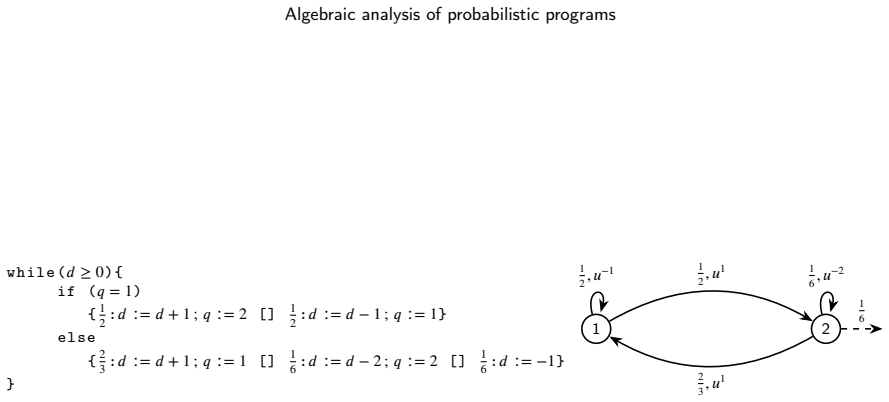
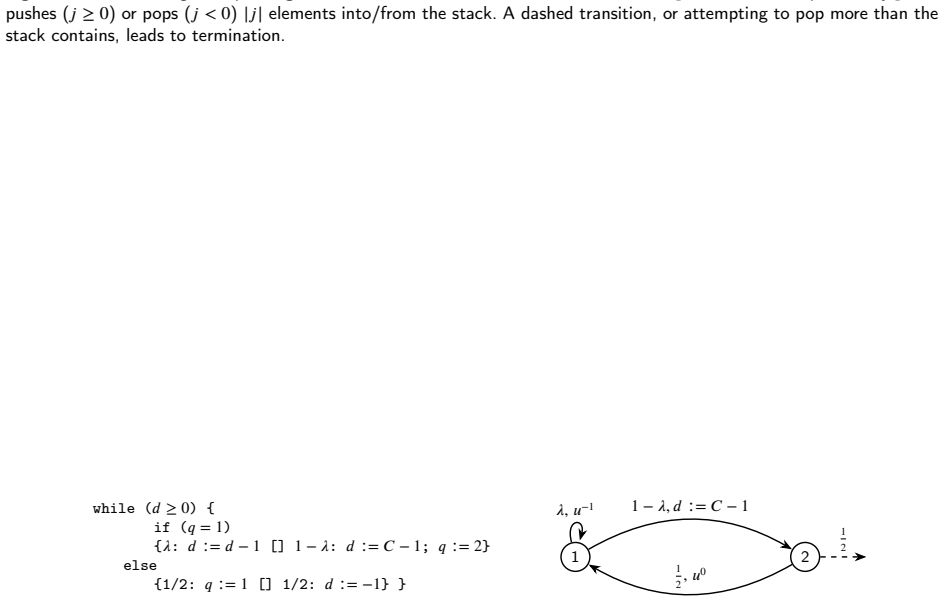
We present an algebraic method for analyzing probabilistic programs with counters and discrete states, Generalized Constant Probability (GCP) programs. We define the operational semantics of GCP in terms of the runs of a type of probabilistic pushdown automata (pPDAs). We characterize the resulting (sub-)probability generating function (pgf) $\Delta(z)$ as an algebraic function, representable via the roots of a kernel polynomial associated with the program. Next, we provide algorithms that, leveraging this information, compute under mild algebraic conditions the dominant singularities and the exact radius of convergence of $\Delta(z)$, leading to an exact asymptotic expansion and to exponential bounds for its coefficients. Our approach is sound for GCP programs and complete for the single-state subclass.
Editorial analysis
A structured set of objections, weighed in public.
Referee Report
Summary. The paper presents an algebraic method for analyzing the runtime distribution of Generalized Constant Probability (GCP) programs, modeled via probabilistic pushdown automata (pPDAs). It characterizes the (sub-)probability generating function Δ(z) as an algebraic function representable via roots of a kernel polynomial, and provides algorithms that compute dominant singularities and the exact radius of convergence under mild algebraic conditions, yielding exact asymptotic expansions and exponential bounds. The approach is claimed to be sound for all GCP programs and complete for the single-state subclass.
Significance. If the central claims hold, the work supplies a rigorous algebraic framework for exact analysis of runtime distributions in probabilistic programs with counters and states. The representation of Δ(z) via kernel polynomials and the use of singularity analysis to obtain precise asymptotics and bounds represent a technical strength, potentially enabling stronger verification results than simulation-based or approximate methods.
major comments (2)
- [Abstract] Abstract, paragraph 3: The algorithms for computing dominant singularities and radius of convergence are qualified as operating 'under mild algebraic conditions,' but these conditions are neither enumerated nor shown to hold automatically for the kernel polynomials arising from the pPDA semantics of arbitrary multi-state GCP programs. This qualification is load-bearing for the soundness claim applying to all GCP programs (as opposed to only the single-state subclass where completeness is asserted).
- [Abstract] Abstract: No derivation details, explicit statement of the kernel polynomial, or counter-example verification is provided for the claimed soundness and completeness results, making it impossible to assess whether the algebraic representation of Δ(z) and the subsequent singularity analysis are free of gaps for general GCP programs.
Simulated Author's Rebuttal
We thank the referee for their careful review and constructive feedback on the abstract's presentation of our results. We address each major comment below and will make targeted revisions to improve clarity without altering the technical claims.
read point-by-point responses
-
Referee: [Abstract] Abstract, paragraph 3: The algorithms for computing dominant singularities and radius of convergence are qualified as operating 'under mild algebraic conditions,' but these conditions are neither enumerated nor shown to hold automatically for the kernel polynomials arising from the pPDA semantics of arbitrary multi-state GCP programs. This qualification is load-bearing for the soundness claim applying to all GCP programs (as opposed to only the single-state subclass where completeness is asserted).
Authors: We agree the abstract is too terse on this point. The mild conditions (irreducibility of the kernel polynomial over Q and positivity of its coefficients) are defined and verified to hold for all GCP programs in Section 3.2 via the constant-probability pPDA semantics; they are not automatic for arbitrary algebraic functions but are proven to follow from the GCP model. Soundness of the singularity analysis therefore applies to the full class, while the decision procedure for extracting the dominant root is complete only for single-state cases (as stated). We will revise the abstract to briefly name these conditions and their provenance. revision: yes
-
Referee: [Abstract] Abstract: No derivation details, explicit statement of the kernel polynomial, or counter-example verification is provided for the claimed soundness and completeness results, making it impossible to assess whether the algebraic representation of Δ(z) and the subsequent singularity analysis are free of gaps for general GCP programs.
Authors: Abstract length precludes full derivations; the explicit kernel polynomial (the determinant of I - P(z) where P encodes the pPDA transitions) and its algebraic representation of Δ(z) appear in Section 3, with the soundness proof in Section 4 and the single-state completeness argument in Section 4.3. Section 5 supplies concrete examples rather than counter-examples. We will add one sentence to the abstract directing readers to the kernel-polynomial construction in the body. revision: yes
Circularity Check
No significant circularity; derivation proceeds from semantics to algebraic characterization to algorithms without self-referential reduction
full rationale
The paper defines GCP program semantics via pPDA runs, derives the sub-probability generating function Δ(z) directly from the transition structure, represents it algebraically via roots of an associated kernel polynomial, and then supplies algorithms that locate dominant singularities and radius of convergence under stated mild algebraic conditions. None of these steps reduces by construction to a fitted parameter, a self-citation chain, or a renaming of the input; the kernel polynomial is obtained from the operational rules rather than presupposed, and the algorithms operate on the resulting algebraic object. The single-state completeness claim is likewise stated as a separate result rather than used to justify the general case. The derivation is therefore self-contained against the external benchmark of the pPDA transition matrix.
Axiom & Free-Parameter Ledger
Reference graph
Works this paper leans on
-
[1]
Lexicographicrankingsupermartingales:An efficientapproachtoterminationof probabilistic programs, in: Proceedings of LICS
Agrawal,P.,Chatterjee, K.,Novotný,P.,2017. Lexicographicrankingsupermartingales:An efficientapproachtoterminationof probabilistic programs, in: Proceedings of LICS
2017
-
[2]
Asinowski, A., Bacher, A., Banderier, C., Gittenberger, B., 2020. Analytic combinatorics of lattice paths with forbidden patterns, the vectorialkernelmethod,andgeneratingfunctionsforpushdownautomata. Algorithmica82,386–428. URL:https://doi.org/10.1007/ s00453-019-00623-3, doi:10.1007/s00453-019-00623-3
-
[3]
Basic analytic combinatorics of directed lattice paths
Banderier, C., Flajolet, P., 2002. Basic analytic combinatorics of directed lattice paths. Theoretical Computer Science 281, 37–80. URL: https://doi.org/10.1016/S0304-3975(02)00007-5, doi:10.1016/S0304-3975(02)00007-5
-
[4]
Foundations of Probabilistic Programming
Barthe, G., Katoen, J.P., Silva, A., 2020. Foundations of Probabilistic Programming. Cambridge University Press. doi:10.1017/ 9781108770750
2020
-
[5]
Bates, D.J., Breiding, P., Chen, T., Hauenstein, J.D., Leykin, A., Sottile, F., 2023. Numerical nonlinear algebra. Bulletin of the American Mathematical Society 60, 357–372. doi:10.1090/bull/1775
-
[6]
Batz, K., Chen, M., Junges, S., Kaminski, B.L., Katoen, J.P., Matheja, C., 2023. Probabilistic program verification via inductive synthesis of inductive invariants, in: Tools and Algorithms for the Construction and Analysis of Systems (TACAS) 2023, LNCS, Springer. pp. 79–101. URL:https://link.springer.com/chapter/10.1007/978-3-031-30820-8_25, doi:10.1007/...
-
[7]
Brázdil,T.,Chatterjee,K.,Kučera,A.,Novotný,P.,Velan,D.,2019. DecidingFastTerminationforProbabilisticVASSwithNondeterminism, in: Automated Technology for Verification and Analysis: 17th International Symposium (ATVA 2019), Springer Nature. pp. 462 – 478. doi:10.1007/978-3-030-31784-3_27
-
[8]
Runtime analysis of probabilistic programs with unbounded recursion
Brázdil, T., Kiefer, S., Kučera, A., Vareková, I.H., 2015. Runtime analysis of probabilistic programs with unbounded recursion. Journal of Computer and System Sciences 81, 288–310. URL:https://doi.org/10.1016/j.jcss.2014.06.005, doi:10.1016/j.jcss.2014. 06.005
-
[9]
Algorithmic analysis of probabilistic programs
Chatterjee, K., Fu, H., Novotný, P., 2021. Algorithmic analysis of probabilistic programs. Communications of the ACM 64, 88–96. URL: https://doi.org/10.1145/3433699, doi:10.1145/3433699
-
[10]
Cox, D.A., Little, J., O’Shea, D., 2025. Ideals, Varieties, and Algorithms: An Introduction to Computational Algebraic Geometry and Commutative Algebra. Undergraduate Texts in Mathematics. 5 ed., Springer. doi:10.1007/978-3-031-91841-4
-
[11]
Polynomialsystems,homotopycontinuation,andapplications
Duff,T.,Regan,M.,2023. Polynomialsystems,homotopycontinuation,andapplications. NoticesoftheAmericanMathematicalSociety70, 151–155. doi:10.1090/noti2592
-
[12]
Quantitative Analysis of Probabilistic Pushdown Automata: Expectations and Variances , in: Panangaden, P
Esparza, J., Kucera, A., Mayr, R., 2005. Quantitative Analysis of Probabilistic Pushdown Automata: Expectations and Variances , in: Panangaden, P. (Ed.), Proceedings of the Twentieth Annual IEEE Symp. on Logic in Computer Science, LICS 2005, IEEE Computer Society Press. pp. 117–126
2005
-
[13]
Probabilistictermination:Soundness,completeness,andcompositionality,in:ProceedingsofPOPL2015
Fioriti,L.M.,Hermanns,H.,2015. Probabilistictermination:Soundness,completeness,andcompositionality,in:ProceedingsofPOPL2015
2015
-
[14]
Plane Algebraic Curves
Fischer, G., 2001. Plane Algebraic Curves. volume 15 ofStudent Mathematical Library. American Mathematical Society
2001
-
[15]
Flajolet, P., Sedgewick, R., 2009. Analytic Combinatorics. Cambridge University Press. URL:https://doi.org/10.1017/ CBO9780511801655, doi:10.1017/CBO9780511801655
-
[16]
Giesl,J.,Giesl,P.,Hark,M.,2019. Computingexpectedruntimesforconstantprobabilityprograms,in:AutomatedDeduction–CADE2019, Lecture Notes in Artificial Intelligence (LNAI), Springer. pp. 269–286. URL:https://doi.org/10.1007/978-3-030-29436-6_16, doi:10.1007/978-3-030-29436-6_16
-
[17]
ComputationofMacaulayconstantsanddegreeboundsforGröbnerbases
Hashemi,A.,Parnian,H.,Seiler,W.M.,2022. ComputationofMacaulayconstantsanddegreeboundsforGröbnerbases. JournalofSymbolic Computation 111, 44–60. doi:10.1016/j.jsc.2021.11.004. :Preprint submitted to Elsevier Page 11 of 21 Algebraic analysis of probabilistic programs
-
[18]
Computingwithd-algebraicpowerseries
vanderHoeven,J.,2019. Computingwithd-algebraicpowerseries. ApplicableAlgebrainEngineering,CommunicationandComputing30, 17–49. doi:10.1007/s00200-018-0358-y
-
[19]
Weakestpreconditionreasoningforexpectedrun-timesofprobabilisticprograms
Kaminski,B.L.,Katoen,J.P.,Matheja,C.,Olmedo,F.,2018. Weakestpreconditionreasoningforexpectedrun-timesofprobabilisticprograms. Journal of the ACM 65, 30:1–30:68. URL:https://doi.org/10.1145/3208102, doi:10.1145/3208102
-
[20]
Probabilistic programming - lecture #10: Conditioning
Katoen, J.P., 2018. Probabilistic programming - lecture #10: Conditioning. Lecture Notes. URL:https://moves.rwth-aachen. de/wp-content/uploads/WS1819/probprog/prob-prog-2018-lec10-handout.pdf. rWTH Aachen University, Lecture Series on Probabilistic Programming
2018
-
[21]
Abstraction, Refinement and Proof for Probabilistic Systems
McIver, A., Morgan, C., 2005. Abstraction, Refinement and Proof for Probabilistic Systems. Monographs in Computer Science, Springer. doi:10.1007/B138392
-
[22]
The probabilistic termination tool amber
Moosbrugger, M., Bartocci, E., Katoen, J., Kovács, L., 2022. The probabilistic termination tool amber. Formal Methods in System Design 61, 90–109. doi:10.1007/s10703-023-00424-z
-
[23]
Moosbrugger, M., Müllner, J., Bartocci, E., Kovács, L., 2025. Polar: An algebraic analyzer for (probabilistic) loops, in: Jansen, N., Junges, S., Kaminski, B.L., Matheja, C., Noll, T., Quatmann, T., Stoelinga, M., Volk, M. (Eds.), Principles of Verification: Cycling the Probabilistic Landscape. Springer, Cham. volume 15260 ofLecture Notes in Computer Scie...
-
[24]
Müllner, J., Moosbrugger, M., Kovács, L., 2024. Strong invariants are hard: On the hardness of strongest polynomial invariants for (probabilistic) programs. Proceedings of the ACM on Programming Languages 8, 882–910. doi:10.1145/3632872
-
[25]
Ngo, V.C., Carbonneaux, Q., Hoffmann, J., 2018. Bounded expectations: Resource analysis for probabilistic programs, in: Proceedings of the 39th ACM SIGPLAN Conference on Programming Language Design and Implementation (PLDI 2018), pp. 496–512. URL: https://doi.org/10.1145/3192366.3192394, doi:10.1145/3192366.3192394
-
[26]
On the Almost-Sure Termination of Probabilistic Counter Programs, in: Piskac, R., Rakamaric, Z
Novozhilov, S., Yang, M., Chen, M., Li, Z., Yin., J., 2025. On the Almost-Sure Termination of Probabilistic Counter Programs, in: Piskac, R., Rakamaric, Z. (eds) Computer Aided Verification. CAV 2025. Lecture Notes in Computer Science., Springer. doi:10.1007/ 978-3-031-98679-6_4
2025
-
[27]
Real and Complex Analysis
Rudin, W., 1974. Real and Complex Analysis. McGraw-Hill Science, Engineering and Mathematics
1974
-
[28]
Walsh, P.G., 2000. A polynomial-time complexity bound for the computation of the singular part of a Puiseux expansion of an algebraic function. Mathematics of Computation 69, 1167–1182. doi:10.1090/S0025-5718-00-01246-1
-
[29]
Wilf, H.S., 2005. Generatingfunctionology. 3 ed., A K Peters / CRC Press. URL:https://www.taylorfrancis.com/books/mono/10. 1201/b10576/generatingfunctionology-herbert-wilf, doi:10.1201/b10576. :Preprint submitted to Elsevier Page 12 of 21 Algebraic analysis of probabilistic programs A. Proofs A.1. Section 3 Proof of Theorem 1.For brevity, write 𝐷𝑑 𝑛 ∶=𝐷 𝑑...
-
[30]
Let us still call𝑢𝑖(𝑧)these analytical continuations defined on𝑊
Because the path𝛾avoids the singularities of𝑢𝑖(𝑧), for each𝑖∈ {1, ..., 𝑐},𝑢 𝑖(𝑧)can be analytically continued along𝛾.Inotherwords,thereisaconnectedopenset𝑊containing𝛾([0,1)),andcontainedin𝐷 𝑅 ⧵(Ξ[𝐾]∪{𝜁}), whereeach𝑢 𝑖(𝑧)admitsasingle-valuedanalyticcontinuation:seee.g.[15,LemmaVII.4].Again,wecanchoose 𝑊so as to avoid points where the denominator of𝑄(𝑧, 𝑢1(...
-
[31]
Moreover, by assumption they coincide in an open subset near𝑧= 0, hence on some initial arc of𝛾contained in𝑊
Both𝑓(𝑧)and𝑄(𝑧, 𝑢 1(𝑧), ..., 𝑢𝑐(𝑧))are defined and analytic on𝑊 ⊇ 𝛾([0,1)). Moreover, by assumption they coincide in an open subset near𝑧= 0, hence on some initial arc of𝛾contained in𝑊. By the identity theorem they coincide on the whole𝑊, in particular 𝑓(𝑧) =𝑄(𝑧, 𝑢 1(𝑧), ..., 𝑢𝑐(𝑧))for𝑧∈𝛾([0,1)). (18)
-
[32]
Since𝜁is in the closure of𝛾([0,1))there is a nonempty arc𝛾((1 −𝜖,1))⊆ 𝑈
Consider now a slit neighborhood𝑈of𝜁, where the slit is taken along a ray not intersecting𝛾. Since𝜁is in the closure of𝛾([0,1))there is a nonempty arc𝛾((1 −𝜖,1))⊆ 𝑈. Consider now the branches̃ 𝑢𝑖(𝑧)of𝐾(𝑧, 𝑢) at𝑧=𝜁defined on𝑈. Then for each𝑖= 1, ..., 𝑐there must exist a branch̃ 𝑢𝑖(𝑧)s.t.𝑢 𝑖(𝑧) =̃ 𝑢𝑖(𝑧)on the arc 𝛾((1 −𝜖,1)): this̃ 𝑢𝑖(𝑧)is the branch at𝑧=𝜁a...
-
[33]
Consider the Puiseux series̃𝑆(𝑧)of 𝐻(𝑧, 𝑢)at𝑧=𝜁which,asabranchdefinedinaslitneighborhoodof𝜁–sameslitas𝑈’sabove–isanalytically connected to𝑓(𝑧), e.g
Let𝐻(𝑧, 𝑢)be the nonzero polynomial of which𝑓(𝑧)is a branch at𝑧= 0. Consider the Puiseux series̃𝑆(𝑧)of 𝐻(𝑧, 𝑢)at𝑧=𝜁which,asabranchdefinedinaslitneighborhoodof𝜁–sameslitas𝑈’sabove–isanalytically connected to𝑓(𝑧), e.g. along𝛾. We can take this slit neighborhood to be𝑈without loss of generality. For sufficiently small𝜖 >0, we have𝛾((1 −𝜖,1))⊆ 𝑈and from (19):...
discussion (0)
Sign in with ORCID, Apple, or X to comment. Anyone can read and Pith papers without signing in.