Mapping Source-Resolved Phase-Noise Transfer in Soliton Microcombs
Reviewed by Pith T0 review T1 audit T2 compute T3 formal T4 kernel 2026-07-03 07:11 UTCgrok-4.3pith:ZU3XTK7Brecord.jsonopen to challenge →
The pith
Raman nonlinearity converts pump phase noise into repetition-rate noise in soliton microcombs without adding new noise sources.
A machine-rendered reading of the paper's core claim, the machinery that carries it, and where it could break.
Core claim
The intracavity dynamics do not merely carry noise but actively partition it. With Raman, the nonlinearity coherently converts pump phase noise from common-mode into repetition-rate noise without introducing an independent noise source, yielding a parabolic linewidth profile with a quiet-point minimum below the pump linewidth. When all noise sources are present, shot noise, ASE, and RIN raise the common-mode floor and shift this minimum toward the pump, setting the achievable noise floor.
What carries the argument
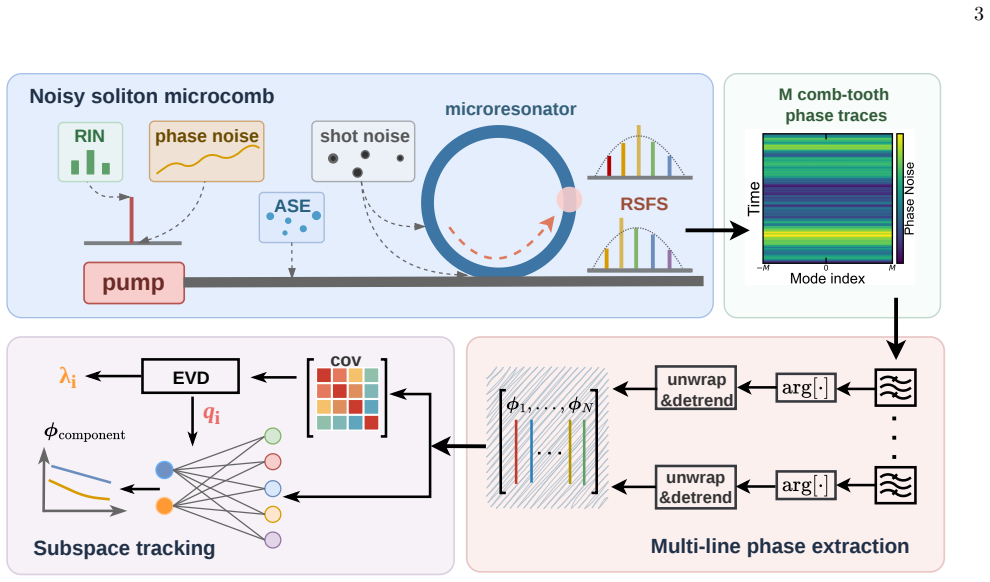
Subspace tracking with multi-source Ikeda-map simulations that isolate each noise source and the Raman nonlinearity by switching them independently.
If this is right
- Pump phase noise remains purely common-mode in the absence of Raman while shot noise and ASE drive repetition-rate noise.
- Raman-induced conversion produces a parabolic linewidth allowing a quiet point below the pump linewidth.
- Shot noise, ASE, and RIN together raise the common-mode floor and move the quiet point closer to the pump.
- The partitioning mechanism supplies a concrete basis for choosing cavity and pump parameters to reach lower noise floors.
Where Pith is reading between the lines
- Cavity design choices that strengthen or weaken the Raman effect could be used to position the quiet point for a target application.
- The same conversion process may appear in other Kerr resonators once similar source-isolation methods are applied.
- Direct measurements of linewidth versus comb line number under controlled pump noise would test the predicted parabolic shape.
Load-bearing premise
The simulations accurately capture the physical system and that turning noise sources on and off separately isolates their true contributions without creating artifacts.
What would settle it
An experiment that records the phase-noise linewidth at multiple comb lines, checks whether the profile becomes parabolic with a minimum quieter than the pump when Raman dominates, and verifies whether added shot noise, ASE, or RIN shifts the minimum toward the pump.
Figures


read the original abstract
Phase noise limits the coherence and stability of soliton microcombs, yet its origin is difficult to trace because multiple noise sources act simultaneously. It is often represented by common-mode and repetition-rate components, but how each physical source contributes to these components remains unclear. We combine subspace tracking with multi-source Ikeda-map simulations, switching each source and the Raman nonlinearity on and off to isolate its contribution. Without Raman, pump phase noise is purely common-mode, while shot noise and amplified spontaneous emission drive the repetition rate noise. With Raman, the nonlinearity coherently converts pump phase noise from common-mode into repetition-rate noise without introducing an independent noise source, yielding a parabolic linewidth profile with a quiet-point minimum below the pump linewidth. When all noise sources are present, shot noise, ASE, and RIN raise the common-mode floor and shift this minimum toward the pump, setting the achievable noise floor. The intracavity dynamics thus do not merely carry noise but actively partition it, providing a mechanistic basis for low-noise microcomb design.
Editorial analysis
A structured set of objections, weighed in public.
Referee Report
Summary. The manuscript claims that subspace tracking combined with multi-source Ikeda-map simulations—by independently toggling each physical noise source (pump phase noise, shot noise, ASE, RIN) and the Raman nonlinearity on and off—isolates their individual contributions to common-mode versus repetition-rate phase noise in soliton microcombs. Without Raman, pump phase noise remains purely common-mode while shot noise and ASE drive repetition-rate noise; with Raman, the nonlinearity coherently converts pump phase noise into repetition-rate noise (without adding an independent source), producing a parabolic linewidth profile with a quiet-point minimum below the pump linewidth. When all sources operate together, shot noise, ASE, and RIN raise the common-mode floor and shift the minimum toward the pump, setting the achievable noise floor. The intracavity dynamics are shown to actively partition noise.
Significance. If the source-switching simulations faithfully isolate contributions without artifacts or omitted interactions, the work supplies a mechanistic account of noise transfer that is useful for low-noise microcomb design in metrology and communications. The explicit demonstration of coherent conversion via Raman (rather than addition of new noise) and the resulting parabolic profile with a sub-pump quiet point are concrete, testable predictions. The simulation framework itself is a strength for source-resolved analysis where experiments struggle to disentangle simultaneous sources.
major comments (2)
- [Abstract and Methods (simulation description)] Abstract and Methods (simulation description): The central claim that Raman coherently converts pump phase noise into repetition-rate noise (yielding the parabolic profile and quiet-point minimum) rests on the multi-source Ikeda-map simulations accurately isolating each contribution via independent on/off switching. No cross-checks against single-source analytical limits, convergence tests in the multi-source regime, or experimental validation are described to confirm that switching introduces neither spurious couplings nor missing back-action.
- [Results (linewidth profiles)] Results (linewidth profiles): The reported shift of the quiet-point minimum and the raised common-mode floor when all sources are active are load-bearing for the final noise-floor claim, yet the abstract provides no quantitative error analysis, fit residuals, or comparison metrics that would allow assessment of whether the partitioning is robust or sensitive to simulation parameters.
minor comments (1)
- [Abstract] The abstract is information-dense; separating the no-Raman and with-Raman cases into distinct sentences would improve readability of the noise-partitioning mechanism.
Simulated Author's Rebuttal
We thank the referee for the thoughtful and constructive report. The comments correctly identify areas where additional documentation of validation procedures would strengthen the presentation of the simulation framework. We address each point below and will revise the manuscript accordingly.
read point-by-point responses
-
Referee: [Abstract and Methods (simulation description)] Abstract and Methods (simulation description): The central claim that Raman coherently converts pump phase noise into repetition-rate noise (yielding the parabolic profile and quiet-point minimum) rests on the multi-source Ikeda-map simulations accurately isolating each contribution via independent on/off switching. No cross-checks against single-source analytical limits, convergence tests in the multi-source regime, or experimental validation are described to confirm that switching introduces neither spurious couplings nor missing back-action.
Authors: We agree that the Methods section should explicitly document the validation steps used to support the source-isolation claims. Although internal checks were performed (comparisons of single-source runs to known analytical limits for common-mode transfer in the absence of Raman, and convergence with respect to integration step size and averaging windows), these were not reported. In the revised manuscript we will add a new subsection to Methods that details: (i) single-source analytical cross-checks, (ii) multi-source convergence tests, and (iii) verification that summed individual contributions reproduce the combined run (confirming absence of spurious couplings). Experimental validation lies outside the scope of this purely numerical study, whose value is precisely the ability to toggle sources independently—an approach difficult to realize in experiment. revision: yes
-
Referee: [Results (linewidth profiles)] Results (linewidth profiles): The reported shift of the quiet-point minimum and the raised common-mode floor when all sources are active are load-bearing for the final noise-floor claim, yet the abstract provides no quantitative error analysis, fit residuals, or comparison metrics that would allow assessment of whether the partitioning is robust or sensitive to simulation parameters.
Authors: The abstract is a concise summary and is not the appropriate location for quantitative error metrics. The shifts of the quiet-point minimum and the elevation of the common-mode floor are shown graphically in the Results figures; however, we acknowledge that explicit error bars, sensitivity tests, and fit statistics would allow readers to judge robustness. In the revised manuscript we will augment the Results section with: (i) standard deviations obtained from an ensemble of independent simulation runs, (ii) a brief sensitivity study varying the Raman gain coefficient and relative noise strengths, and (iii) residuals of the parabolic fits to the repetition-rate linewidth profiles. These additions will directly address the concern about parameter sensitivity. revision: yes
Circularity Check
No circularity: results emerge from independent source toggles in physical model
full rationale
The paper derives its claims about noise partitioning and Raman conversion solely from multi-source Ikeda-map simulations in which each noise source and the Raman term are switched on/off independently. No equation or result is shown to reduce by construction to a fitted parameter, a self-defined quantity, or a prior self-citation; the reported parabolic profiles and quiet-point shifts are direct numerical outputs of the underlying dynamical model. The method is therefore self-contained against external benchmarks and receives the default non-circularity finding.
Axiom & Free-Parameter Ledger
axioms (2)
- domain assumption The Ikeda map accurately models the soliton microcomb dynamics including noise propagation.
- ad hoc to paper Independently activating or deactivating each noise source and the Raman nonlinearity isolates their individual contributions without cross-effects or simulation artifacts.
Reference graph
Works this paper leans on
-
[1]
Yaxin Zhang and Shen Qiao and Linlin Sun and Qi Wu Shi and Wanxia Huang and Ling Li and Ziqiang Yang , journal =. Photoinduced active terahertz metamaterials with nanostructured vanadium dioxide film deposited by sol-gel method , volume =. 2014 , url =
work page 2014
-
[2]
Climate Change 2007: The Physical Science Basis
P Forster and V Ramaswamy and P Artaxo and T Bernsten and R Betts and D Fahey and J Haywood and J Lean and D Lowe and G Myhre and J Nganga and R Prinn and G Raga and M Schulz and R V Dorland , title=. Climate Change 2007: The Physical Science Basis. Contribution of Working Group 1 to the Fourth Assesment Report of Intergovernmental Panel on Climate Change...
work page 2007
-
[3]
Multiphoton plasmon-resonance microscopy , volume =
Dvir Yelin and Dan Oron and Stephan Thiberge and Elisha Moses and Yaron Silberberg , journal =. Multiphoton plasmon-resonance microscopy , volume =. 2003 , url =. doi:10.1364/OE.11.001385 , abstract =
-
[4]
Cluster formation in ferrofluids induced by holographic optical tweezers , volume =
Jan Masajada and Marcin Bacia and S. Cluster formation in ferrofluids induced by holographic optical tweezers , volume =. Opt. Lett. , keywords =. 2013 , url =. doi:10.1364/OL.38.003910 , abstract =
-
[5]
and Shiri, Ron and Acton, Scott D
Dean, Bruce H and Aronstein, David L and Smith, Scott J. and Shiri, Ron and Acton, Scott D. , title =. Space Telescopes and Instrumentation I: Optical, Infrared, and Millimeter , year =. doi:10.1117/12.673569 , url =
-
[6]
Optical frequency combs: Coherently uniting the electromagnetic spectrum , author=. Science , volume=. 2020 , publisher=
work page 2020
-
[7]
Frequency comb spectroscopy , author=. Nature photonics , volume=. 2019 , publisher=
work page 2019
-
[8]
Optical frequency metrology , author=. Nature , volume=. 2002 , publisher=
work page 2002
-
[9]
Tobias J. Kippenberg and Alexander L. Gaeta and Michal Lipson and Michael L. Gorodetsky , title =. Science , volume =. 2018 , doi =
work page 2018
-
[10]
Infrared and optical masers , author=. Physical review , volume=. 1958 , publisher=
work page 1958
-
[11]
IEEE Journal of Quantum Electronics , volume=
Theory of the linewidth of semiconductor lasers , author=. IEEE Journal of Quantum Electronics , volume=. 2003 , publisher=
work page 2003
-
[12]
Researching pointing error effect on laser linewidth tolerance in space coherent optical communication systems , author=. Optics Express , volume=. 2022 , publisher=
work page 2022
-
[13]
Laser ranging: a critical review of unusual techniques for distance measurement , author=. Optical engineering , volume=
-
[14]
Journal of lightwave technology , volume=
Fiber grating sensors , author=. Journal of lightwave technology , volume=
-
[15]
Physical review letters , volume=
Raman self-frequency shift of dissipative Kerr solitons in an optical microresonator , author=. Physical review letters , volume=. 2016 , publisher=
work page 2016
-
[16]
Nonlinear optical phenomena in silicon waveguides: modeling and applications , author=. Optics Express , volume=. 2007 , doi=
work page 2007
-
[17]
Frontiers in Physics , volume=
Narrow-linewidth laser linewidth measurement technology , author=. Frontiers in Physics , volume=. 2021 , publisher=
work page 2021
-
[18]
A sub-40-mHz-linewidth laser based on a silicon single-crystal optical cavity , author=. Nature Photonics , volume=. 2012 , publisher=
work page 2012
-
[19]
Nature communications , volume=
Spiral resonators for on-chip laser frequency stabilization , author=. Nature communications , volume=. 2013 , publisher=
work page 2013
-
[20]
Narrow-linewidth lasing and soliton Kerr microcombs with ordinary laser diodes , author=. Nature Photonics , volume=. 2018 , publisher=
work page 2018
-
[21]
Optics Communications , volume=
Laser linewidth measurements using self-homodyne detection with short delay , author=. Optics Communications , volume=. 1998 , publisher=
work page 1998
-
[22]
Sub-hertz fundamental linewidth photonic integrated Brillouin laser , author=. Nature Photonics , volume=. 2019 , publisher=
work page 2019
-
[23]
Nature communications , volume=
Visible light photonic integrated Brillouin laser , author=. Nature communications , volume=. 2021 , publisher=
work page 2021
-
[24]
Novel method for high resolution measurement of laser output spectrum , author=. Electronics letters , volume=. 1980 , publisher=
work page 1980
-
[25]
Interference fringe mitigation in short-delay self-heterodyne laser phase noise measurements , author=. Optics Express , volume=. 2025 , publisher=
work page 2025
-
[26]
Narrow laser-linewidth measurement using short delay self-heterodyne interferometry , author=. Optics Express , volume=. 2022 , publisher=
work page 2022
-
[27]
Simple approach to the relation between laser frequency noise and laser line shape , author=. Applied optics , volume=. 2010 , publisher=
work page 2010
-
[28]
Advances in Optics and Photonics , volume=
Ultralow-noise mode-locked fiber lasers and frequency combs: principles, status, and applications , author=. Advances in Optics and Photonics , volume=. 2016 , publisher=
work page 2016
-
[29]
Kerr-lens, mode-locked lasers as transfer oscillators for optical frequency measurements , author=. Applied Physics B , volume=. 2002 , publisher=
work page 2002
-
[30]
Optical phase noise and carrier-envelope offset noise of mode-locked lasers , author=. Applied Physics B , volume=. 2006 , publisher=
work page 2006
-
[31]
IEEE Journal of Selected Topics in Quantum Electronics , volume=
Carrier-envelope offset phase-locking with attosecond timing jitter , author=. IEEE Journal of Selected Topics in Quantum Electronics , volume=. 2003 , publisher=
work page 2003
-
[32]
Sideband injection locking in microresonator frequency combs , author=. APL photonics , volume=. 2023 , publisher=
work page 2023
-
[33]
Journal of Lightwave Technology , volume=
Optical frequency division & pulse synchronization using a photonic-crystal microcomb injected chip-scale mode-locked laser , author=. Journal of Lightwave Technology , volume=
-
[34]
45th European Conference on Optical Communication (ECOC 2019) , year=
Optical frequency comb noise characterization using machine learning , author=. 45th European Conference on Optical Communication (ECOC 2019) , year=
work page 2019
-
[35]
Subspace tracking for phase noise source separation in frequency combs , author=. Optics Express , volume=. 2023 , publisher=
work page 2023
-
[36]
Physical Review Letters , volume=
Octave spanning tunable frequency comb from a microresonator , author=. Physical Review Letters , volume=. 2011 , publisher=
work page 2011
-
[37]
Spatial-mode-interaction-induced dispersive waves and their active tuning in microresonators , author=. Optica , volume=. 2016 , publisher=
work page 2016
-
[38]
Resonant EO combs: beyond the standard phase noise model of frequency combs , author=. Optics Express , volume=. 2024 , publisher=
work page 2024
-
[39]
Impact of nonlinear spectral broadening on the phase noise properties of electro-optic frequency combs , author=. Optics Express , volume=. 2026 , doi=
work page 2026
-
[40]
Phase noise characterization of a Cr: ZnS frequency comb using subspace tracking , author=. Optics Letters , volume=. 2025 , publisher=
work page 2025
-
[41]
Optics communications , volume=
Multiple-valued stationary state and its instability of the transmitted light by a ring cavity system , author=. Optics communications , volume=. 1979 , publisher=
work page 1979
-
[42]
Nonlinear Science at the Dawn of the 21st Century , pages=
Nonlinear fiber optics , author=. Nonlinear Science at the Dawn of the 21st Century , pages=. 2000 , publisher=
work page 2000
- [43]
-
[44]
Noise of mode-locked lasers (Part I): numerical model , author=. Applied Physics B , volume=. 2004 , publisher=
work page 2004
-
[45]
Chapter 2 - Pulse propagation in fibers , booktitle =. 2019 , isbn =. doi:https://doi.org/10.1016/B978-0-12-817042-7.00009-9 , url =
-
[46]
Universal relations for coupling of optical power between microresonators and dielectric waveguides , author=. Electronics letters , volume=. 2000 , publisher=
work page 2000
- [47]
-
[48]
Nature Communications , volume=
Optical linewidth of soliton microcombs , author=. Nature Communications , volume=. 2022 , publisher=
work page 2022
-
[49]
Nature communications , volume=
Dispersive-wave induced noise limits in miniature soliton microwave sources , author=. Nature communications , volume=. 2021 , publisher=
work page 2021
-
[50]
Nature communications , volume=
Single-mode dispersive waves and soliton microcomb dynamics , author=. Nature communications , volume=. 2017 , publisher=
work page 2017
-
[51]
Influences of high-order dispersion on temporal and spectral properties of microcavity solitons , author=. Optics Express , volume=. 2018 , publisher=
work page 2018
-
[52]
Advanced characterization techniques of photonic devices with frequency combs , author=
-
[53]
Correlated self-heterodyne method for ultra-low-noise laser linewidth measurements , author=. Optics Express , volume=. 2022 , publisher=
work page 2022
discussion (0)
Sign in with ORCID, Apple, or X to comment. Anyone can read and Pith papers without signing in.