Moment-Based Selection of Multiresponse Linear Mixed-Effects Models
Pith reviewed 2026-07-03 08:04 UTC · model grok-4.3
The pith
MOMENT uses second-order cross-moment identities to select random effects in multiresponse linear mixed models and establishes finite-sample consistency.
A machine-rendered reading of the paper's core claim, the machinery that carries it, and where it could break.
Core claim
MOMENT is a stage-wise moment-based framework that exploits second-order cross-moment identities to select and estimate the random-effects covariance matrix and fixed-effects coefficients. By inducing sparsity through its diagonal under a positive semidefinite constraint, the random-effects selection problem reduces to a smooth constrained convex optimization problem that can be solved efficiently by projected gradient descent. We further establish finite-sample theoretical guarantees for the proposed procedure, including random-effects selection consistency and fixed-effects selection consistency under joint sub-Weibull errors.
What carries the argument
MOMENT framework that exploits second-order cross-moment identities and induces sparsity via the diagonal of the random-effects covariance matrix under a positive semidefinite constraint to enable smooth constrained convex optimization.
If this is right
- Random-effects selection reduces to an efficiently solvable smooth constrained convex optimization problem using projected gradient descent.
- Both random-effects and fixed-effects selection achieve consistency in finite samples under the joint sub-Weibull error condition.
- The method can substantially outperform separate univariate analyses when responses are correlated.
- It yields an interpretable and flexible approach for analyzing multivariate longitudinal data.
Where Pith is reading between the lines
- The convex formulation may remain computationally feasible when the number of responses grows moderately if the positive semidefinite constraint is handled efficiently.
- Alternative tail conditions weaker than joint sub-Weibull could be tested to see whether consistency still holds in practice.
- The stage-wise structure could be combined with existing penalized likelihood approaches to trade off computational speed against statistical efficiency.
Load-bearing premise
The errors follow a joint sub-Weibull distribution to obtain the selection consistency results.
What would settle it
Repeated simulations drawn from error distributions that violate the joint sub-Weibull tail condition in which the procedure fails to achieve random-effects selection consistency.
Figures


read the original abstract
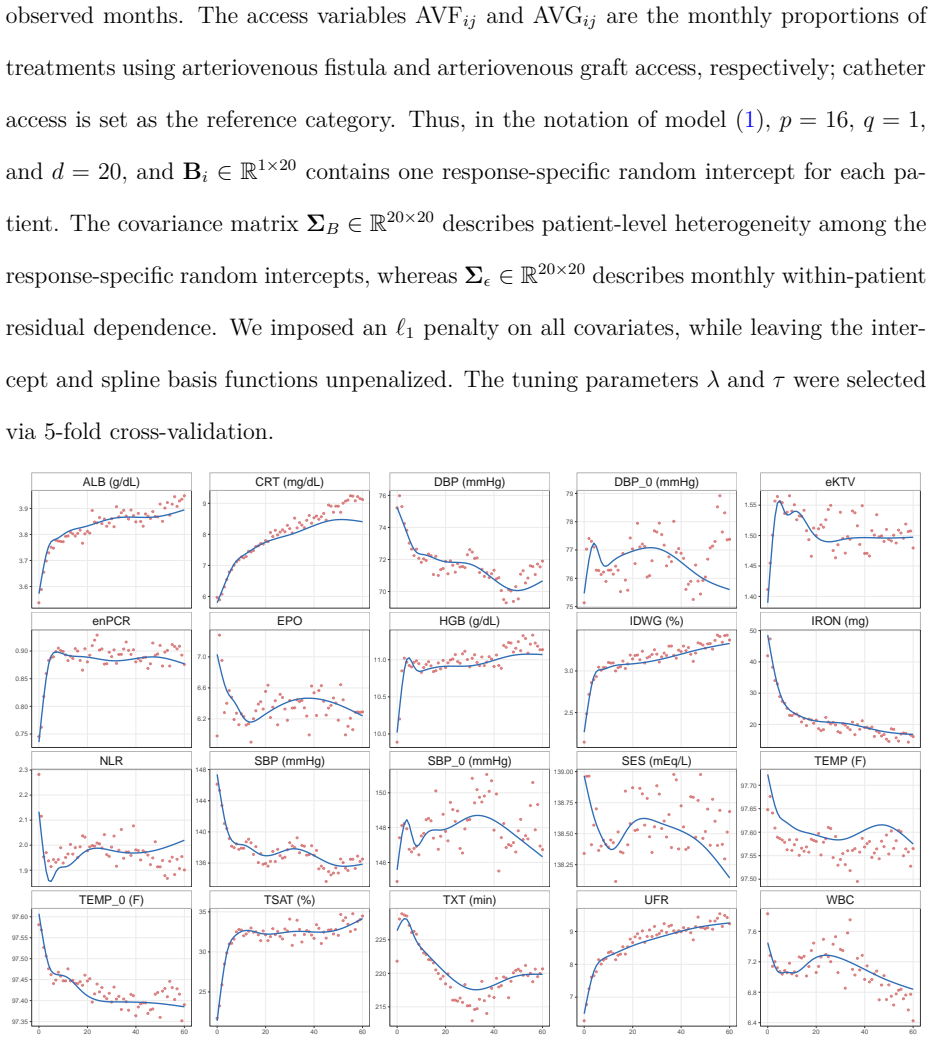
We propose MOMENT (\textbf{MO}ment-Based \textbf{M}ixed-\textbf{E}ffects Selectio\textbf{N} and Es\textbf{T}imation), a stage-wise moment-based framework that exploits second-order cross-moment identities to select and estimate the random-effects covariance matrix and fixed-effects coefficients. By inducing sparsity through its diagonal under a positive semidefinite constraint, the random-effects selection problem reduces to a smooth constrained convex optimization problem that can be solved efficiently by projected gradient descent. We further establish finite-sample theoretical guarantees for the proposed procedure, including random-effects selection consistency and fixed-effects selection consistency under joint sub-Weibull errors. Simulation studies show that MOMENT performs competitively overall and can substantially outperform separate univariate analyses when responses are correlated. An application to the hemodialysis dataset demonstrates that the proposed method yields an interpretable and flexible approach for multivariate longitudinal data.
Editorial analysis
A structured set of objections, weighed in public.
Referee Report
Summary. The manuscript proposes MOMENT, a stage-wise moment-based procedure for simultaneous selection and estimation in multiresponse linear mixed-effects models. It exploits second-order cross-moment identities to reduce random-effects covariance selection to a smooth, PSD-constrained convex program solved by projected gradient descent, while separately handling fixed-effects selection. Finite-sample consistency guarantees are claimed for both random- and fixed-effects selection under a joint sub-Weibull error assumption. Simulations compare performance against univariate analyses and existing methods, and an application to hemodialysis data is included.
Significance. If the stated consistency results hold, the work supplies a computationally efficient, likelihood-free alternative for multivariate longitudinal modeling that directly exploits cross-response dependence. The convex formulation and moment identities are attractive for high-dimensional or non-Gaussian settings, and the reported simulation gains when responses are correlated suggest practical utility beyond separate univariate fits.
minor comments (3)
- The abstract and introduction state that the random-effects problem reduces to a 'smooth constrained convex optimization problem,' but the precise form of the objective (including any penalty or constraint linearization) is not shown until the methods section; adding an early equation reference would improve readability.
- Simulation tables report point estimates of selection accuracy and MSE but do not include standard errors or the number of Monte Carlo replications used to generate the reported values; this makes it difficult to assess whether observed differences are statistically meaningful.
- The sub-Weibull tail condition is invoked for the consistency theorems; a brief remark on whether the same rates can be obtained under weaker moment conditions (e.g., finite fourth moments) would clarify the necessity of the assumption.
Simulated Author's Rebuttal
We thank the referee for their careful summary of the manuscript and for the positive significance assessment. The recommendation for minor revision is noted. No major comments were provided in the report, so we have no specific points requiring point-by-point rebuttal or revision at this stage.
Circularity Check
No significant circularity
full rationale
The derivation begins from second-order cross-moment identities, formulates random-effects selection as a PSD-constrained convex program solved by projected gradient descent, and states finite-sample consistency results under an explicitly external joint sub-Weibull tail condition. None of the load-bearing steps (moment identities to optimization, or consistency proofs) reduce by the paper's own equations to a fitted parameter or self-citation chain; the sub-Weibull assumption is invoked as a sufficient condition rather than derived internally. The procedure is therefore self-contained against external benchmarks.
Axiom & Free-Parameter Ledger
axioms (2)
- domain assumption Errors are jointly sub-Weibull distributed
- domain assumption Second-order cross-moment identities hold and can be exploited for selection
Reference graph
Works this paper leans on
-
[1]
Annals of the Institute of Statistical Mathematics , volume=
New variable selection for linear mixed-effects models , author=. Annals of the Institute of Statistical Mathematics , volume=. 2017 , publisher=
work page 2017
-
[2]
Feature Extraction: Modern Questions and Challenges , pages=
Covariance Selection in the Linear Mixed Effect Model , author=. Feature Extraction: Modern Questions and Challenges , pages=. 2015 , organization=
work page 2015
-
[3]
Journal of the American statistical association , volume=
Functional data analysis for sparse longitudinal data , author=. Journal of the American statistical association , volume=. 2005 , publisher=
work page 2005
-
[4]
Journal of the Royal Statistical Society Series B: Statistical Methodology , volume=
Dimension reduction and coefficient estimation in multivariate linear regression , author=. Journal of the Royal Statistical Society Series B: Statistical Methodology , volume=. 2007 , publisher=
work page 2007
-
[5]
Reduced rank regression via adaptive nuclear norm penalization , author=. Biometrika , volume=. 2013 , publisher=
work page 2013
-
[6]
Multivariate Reduced-rank Regression: Theory, Methods and Applications , author=. 2022 , publisher=
work page 2022
-
[7]
Wiley Interdisciplinary Reviews: Computational Statistics , volume=
Estimation of the error structure in multivariate response linear regression models , author=. Wiley Interdisciplinary Reviews: Computational Statistics , volume=. 2025 , publisher=
work page 2025
-
[8]
The Annals of Statistics , volume=
Support union recovery in high-dimensional multivariate regression , author=. The Annals of Statistics , volume=. 2011 , publisher=
work page 2011
-
[9]
Convex multi-task feature learning , author=. Machine learning , volume=. 2008 , publisher=
work page 2008
-
[10]
Journal of Computational and Graphical Statistics , volume=
Sparse multivariate regression with covariance estimation , author=. Journal of Computational and Graphical Statistics , volume=. 2010 , publisher=
work page 2010
-
[11]
Journal of the American Statistical Association , volume=
Newton—Raphson and EM algorithms for linear mixed-effects models for repeated-measures data , author=. Journal of the American Statistical Association , volume=. 1988 , publisher=
work page 1988
-
[12]
Journal of the Royal Statistical Society: Series B (Methodological) , volume=
Modelling variance heterogeneity: residual maximum likelihood and diagnostics , author=. Journal of the Royal Statistical Society: Series B (Methodological) , volume=. 1993 , publisher=
work page 1993
-
[13]
Linear and generalized linear mixed models and their applications , author=. 2007 , publisher=
work page 2007
-
[14]
Estimating Covariance Matrices at Different Levels in Repeated Measurements , author=. Statistica Sinica , volume=
-
[15]
Covariance regularization by thresholding , year =
Bickel, Peter J and Levina, Elizaveta , journal =. Covariance regularization by thresholding , year =
-
[16]
Regularized estimation of large covariance matrices , volume =
Bickel, Peter J and Levina, Elizaveta , journal =. Regularized estimation of large covariance matrices , volume =
- [17]
-
[18]
Fixed and random effects selection in linear and logistic models , author=. Biometrics , volume=. 2007 , publisher=
work page 2007
-
[19]
Random effects selection in linear mixed models , author=. Biometrics , volume=. 2003 , publisher=
work page 2003
-
[20]
Annals of statistics , volume=
Variable selection in linear mixed effects models , author=. Annals of statistics , volume=
-
[21]
Joint variable selection for fixed and random effects in linear mixed-effects models , author=. Biometrics , volume=. 2010 , publisher=
work page 2010
-
[22]
Statistics and its Interface , volume=
Doubly regularized estimation and selection in linear mixed-effects models for high-dimensional longitudinal data , author=. Statistics and its Interface , volume=
-
[23]
Fixed and random effects selection in mixed effects models , author=. Biometrics , volume=. 2011 , publisher=
work page 2011
-
[24]
glmmpen: High dimensional penalized generalized linear mixed models , author=. The R journal , volume=
-
[25]
Hierarchical selection of fixed and random effects in generalized linear mixed models , author=. Statistica Sinica , pages=. 2017 , publisher=
work page 2017
-
[26]
Journal of the American Statistical Association , volume=
Joint selection in mixed models using regularized PQL , author=. Journal of the American Statistical Association , volume=. 2017 , publisher=
work page 2017
-
[27]
Journal of Computational and Graphical Statistics , volume=
A relaxation approach to feature selection for linear mixed effects models , author=. Journal of Computational and Graphical Statistics , volume=. 2024 , publisher=
work page 2024
-
[28]
Scalable Subset Selection in Linear Mixed Models
Scalable Subset Selection in Linear Mixed Models , author=. arXiv preprint arXiv:2506.20425 , year=
work page internal anchor Pith review Pith/arXiv arXiv
-
[29]
Journal of Multivariate Analysis , volume=
Model selection in linear mixed effect models , author=. Journal of Multivariate Analysis , volume=. 2012 , publisher=
work page 2012
-
[30]
Moment-based method for random effects selection in linear mixed models , author=. Statistica Sinica , volume=
-
[31]
Proceedings of the 25th international conference on Machine learning , pages=
Bolasso: model consistent lasso estimation through the bootstrap , author=. Proceedings of the 25th international conference on Machine learning , pages=
-
[32]
IEEE transactions on information theory , volume=
Sharp thresholds for High-Dimensional and noisy sparsity recovery using _1 -Constrained Quadratic Programming (Lasso) , author=. IEEE transactions on information theory , volume=. 2009 , publisher=
work page 2009
-
[33]
Information and Inference: A Journal of the IMA , volume=
Moving beyond sub-Gaussianity in high-dimensional statistics: Applications in covariance estimation and linear regression , author=. Information and Inference: A Journal of the IMA , volume=. 2022 , publisher=
work page 2022
-
[34]
BMC medical research methodology , volume=
joineRML: a joint model and software package for time-to-event and multivariate longitudinal outcomes , author=. BMC medical research methodology , volume=. 2018 , publisher=
work page 2018
-
[35]
The SANAD study of effectiveness of carbamazepine, gabapentin, lamotrigine, oxcarbazepine, or topiramate for treatment of partial epilepsy: an unblinded randomised controlled trial , author=. The Lancet , volume=. 2007 , publisher=
work page 2007
-
[36]
Quality-of-life outcomes of initiating treatment with standard and newer antiepileptic drugs in adults with new-onset epilepsy: findings from the SANAD trial , author=. Epilepsia , volume=. 2015 , publisher=
work page 2015
-
[37]
arXiv preprint arXiv:2304.08020 , year=
Sparse positive-definite estimation for covariance matrices with repeated measurements , author=. arXiv preprint arXiv:2304.08020 , year=
-
[38]
Journal of computational and Graphical Statistics , volume=
Computational strategies for multivariate linear mixed-effects models with missing values , author=. Journal of computational and Graphical Statistics , volume=. 2002 , publisher=
work page 2002
-
[39]
Multivariate multilevel nonlinear mixed effects models for timber yield predictions , author=. Biometrics , volume=. 2004 , publisher=
work page 2004
- [40]
-
[41]
Journal of Computational and Graphical Statistics , volume=
Fixed and random effects selection by REML and pathwise coordinate optimization , author=. Journal of Computational and Graphical Statistics , volume=. 2013 , publisher=
work page 2013
-
[42]
Proximal algorithms , author=. Foundations and trends. 2014 , publisher=
work page 2014
-
[43]
Mathematical programming , volume=
Gradient methods for minimizing composite functions , author=. Mathematical programming , volume=. 2013 , publisher=
work page 2013
-
[44]
Journal of the Royal Statistical Society Series B: Statistical Methodology , volume=
Regression shrinkage and selection via the lasso , author=. Journal of the Royal Statistical Society Series B: Statistical Methodology , volume=. 1996 , publisher=
work page 1996
-
[45]
Journal of the Royal Statistical Society Series B: Statistical Methodology , volume=
Model selection and estimation in regression with grouped variables , author=. Journal of the Royal Statistical Society Series B: Statistical Methodology , volume=. 2006 , publisher=
work page 2006
-
[46]
Journal of the American statistical Association , volume=
Variable selection via nonconcave penalized likelihood and its oracle properties , author=. Journal of the American statistical Association , volume=. 2001 , publisher=
work page 2001
-
[47]
Annals of Statistics , volume=
Nearly unbiased variable selection under minimax concave penalty , author=. Annals of Statistics , volume=. 2010 , publisher=
work page 2010
-
[48]
Journal of the American statistical association , volume=
The adaptive lasso and its oracle properties , author=. Journal of the American statistical association , volume=. 2006 , publisher=
work page 2006
-
[49]
Random Matrices: Theory and Applications , volume=
Matrix deviation inequality for -p norm , author=. Random Matrices: Theory and Applications , volume=. 2023 , publisher=
work page 2023
-
[50]
Statistics for high-dimensional data: methods, theory and applications , author=. 2011 , publisher=
work page 2011
-
[51]
High-dimensional probability: An introduction with applications in data science , author=. 2018 , publisher=
work page 2018
-
[52]
Nephrology Dialysis Transplantation , volume=
Variation in intravenous iron use internationally and over time: the Dialysis Outcomes and Practice Patterns Study (DOPPS) , author=. Nephrology Dialysis Transplantation , volume=. 2013 , publisher=
work page 2013
-
[53]
Evaluating the effectiveness of IV iron dosing for anemia management in common clinical practice: results from the Dialysis Outcomes and Practice Patterns Study (DOPPS) , author=. BMC nephrology , volume=. 2017 , publisher=
work page 2017
-
[54]
American Journal of Kidney Diseases , volume=
Analytical and biological variation in measures of anemia and iron status in patients treated with maintenance hemodialysis , author=. American Journal of Kidney Diseases , volume=. 2010 , publisher=
work page 2010
-
[55]
Kidney international , volume=
Interdialytic weight gain as a marker of blood pressure, nutrition, and survival in hemodialysis patients , author=. Kidney international , volume=. 2005 , publisher=
work page 2005
-
[56]
Kidney and Blood Pressure Research , volume=
Causes and consequences of interdialytic weight gain , author=. Kidney and Blood Pressure Research , volume=. 2016 , publisher=
work page 2016
discussion (0)
Sign in with ORCID, Apple, or X to comment. Anyone can read and Pith papers without signing in.