Storm Track Self-Reinforcement Through Cloud Radiative Effects
Pith reviewed 2026-07-03 01:37 UTC · model grok-4.3
The pith
Storm-track cloud radiative effects reinforce meridional sea-surface temperature gradients that maintain Southern Hemisphere storm activity.
A machine-rendered reading of the paper's core claim, the machinery that carries it, and where it could break.
Core claim
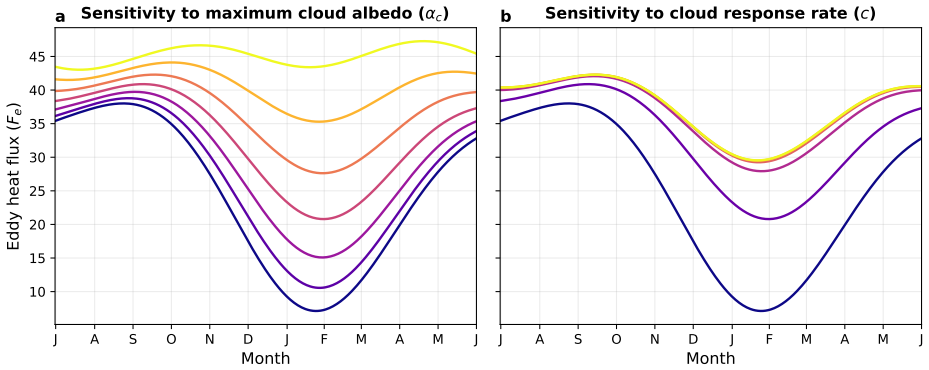
In the Southern Hemisphere, storm activity remains strong even when the summertime insolation gradient nearly vanishes because storm-track cloud radiative effects reinforce meridional sea-surface temperature gradients. Shortwave effects from reflected sunlight by midlatitude clouds strengthen storm activity primarily during late summer and autumn, while longwave effects partly offset this. A theoretical model links storms, clouds, and SST gradients, identifying the maximum attainable cloud albedo and the sensitivity of cloud cover to storm activity as the two emergent properties that control the feedback strength.
What carries the argument
A simple theoretical model that links storms, clouds, and sea-surface temperature gradients through two controlling cloud properties: the maximum attainable cloud albedo and the sensitivity of cloud cover to storm activity.
If this is right
- Shortwave cloud radiative effects reinforce meridional SST gradients and strengthen storm activity in late summer and autumn.
- Longwave cloud radiative effects partly offset the shortwave reinforcement.
- The strength of the feedback is determined by the maximum cloud albedo and the sensitivity of cloud cover to storm activity.
- This mechanism maintains thermal gradients that sustain storm activity when the insolation gradient is weak.
Where Pith is reading between the lines
- Climate models that do not resolve cloud-storm interactions may underestimate the persistence of Southern Hemisphere storm tracks.
- Changes in cloud properties due to warming could alter the strength of this self-reinforcement feedback.
- The same coupling might influence storm track responses in the Northern Hemisphere or under altered orbital conditions.
- Direct measurements of cloud albedo over storm tracks could provide a test of the model's parameters.
Load-bearing premise
Idealized aquaplanet simulations without land, orography, or other real-world features accurately isolate the cloud-radiative feedback on storm tracks and SST gradients occurring in the actual Southern Hemisphere.
What would settle it
Running aquaplanet simulations with cloud radiative effects turned off and checking whether the seasonal cycle of storm activity matches or diverges from satellite observations in the Southern Hemisphere.
Figures


read the original abstract
Traditionally, midlatitude storm tracks are viewed as being driven by meridional temperature gradients maintained by differential solar heating. Yet in the Southern Hemisphere, storm activity remains strong even when the summertime insolation gradient nearly vanishes. Here, we show that storm-track cloud radiative effects play a major role in maintaining the Southern Hemisphere storm activity. Satellite observations reveal that sunlight reflected by midlatitude clouds in early summer creates a substantial meridional gradient in surface heating, despite the nearly uniform summer insolation. Idealized aquaplanet simulations then show that shortwave cloud radiative effects reinforce meridional sea-surface temperature gradients, thereby strengthening storm activity primarily during late summer and autumn, while longwave cloud effects partly offset this response. To interpret these results, we develop a simple theoretical model linking storms, clouds, and sea-surface temperature gradients. The model reproduces the simulated seasonal response and identifies two emergent cloud properties that control the feedback strength: the maximum attainable cloud albedo and the sensitivity of cloud cover to storm activity. Together, these findings indicate that cloud radiative feedbacks are key to maintaining the thermal gradients that sustain storm activity. More broadly, they reveal a strong coupling among storms, clouds, and the ocean spanning distinct spatial and temporal scales.
Editorial analysis
A structured set of objections, weighed in public.
Referee Report
Summary. The paper claims that storm-track cloud radiative effects, particularly shortwave effects, play a major role in maintaining Southern Hemisphere storm activity by reinforcing meridional sea-surface temperature gradients, even when the insolation gradient weakens in summer. This is supported by satellite observations showing cloud-induced surface heating gradients, idealized aquaplanet simulations demonstrating that shortwave cloud effects strengthen storm activity in late summer and autumn (with longwave effects partially offsetting), and a simple theoretical model that reproduces the seasonal response while identifying two controlling emergent cloud properties: maximum attainable cloud albedo and the sensitivity of cloud cover to storm activity.
Significance. If the central claim holds after addressing the noted limitations, the result would be significant for midlatitude dynamics and climate feedbacks. It challenges the traditional view of storm tracks as driven purely by differential solar heating and identifies a self-reinforcing coupling among storms, clouds, and the ocean across scales. The combination of satellite data, aquaplanet experiments, and a reduced theoretical model is a strength, as is the identification of specific emergent parameters that control feedback strength.
major comments (2)
- [aquaplanet simulations section] The idealized aquaplanet simulations omit land, orography, and realistic ocean basins, which can alter storm-track latitude, cloud distributions, and surface heat fluxes. The central claim extrapolates these results to the observed Southern Hemisphere without a direct test of whether the shortwave cloud-radiative reinforcement of SST gradients survives addition of realistic boundary conditions (see the description of the aquaplanet setup and the comparison to satellite observations).
- [theoretical model section] The theoretical model is constructed to reproduce the seasonal response from the same aquaplanet runs and depends on two parameters (maximum attainable cloud albedo and sensitivity of cloud cover to storm activity) whose values are extracted from those runs. This raises a circularity concern: it is unclear whether the model provides an independent explanation or effectively fits the simulation output (see the theoretical model development and its comparison to the simulations).
minor comments (2)
- [theoretical model] Clarify the exact definitions and units of the two emergent cloud properties in the theoretical model to allow independent evaluation.
- [results] Add error estimates or uncertainty ranges for the satellite-derived surface heating gradients and the simulated storm-activity responses.
Simulated Author's Rebuttal
We are grateful to the referee for their positive assessment of the significance of our work and for the detailed comments. We respond to each major comment in turn below.
read point-by-point responses
-
Referee: [aquaplanet simulations section] The idealized aquaplanet simulations omit land, orography, and realistic ocean basins, which can alter storm-track latitude, cloud distributions, and surface heat fluxes. The central claim extrapolates these results to the observed Southern Hemisphere without a direct test of whether the shortwave cloud-radiative reinforcement of SST gradients survives addition of realistic boundary conditions (see the description of the aquaplanet setup and the comparison to satellite observations).
Authors: We agree that the aquaplanet configuration is idealized and does not incorporate land, orography, or realistic ocean basins, which could influence storm-track position and cloud properties. Our strategy is to use this simplified framework to demonstrate the self-reinforcing mechanism in isolation. The comparison with satellite observations serves to link the idealized results to the real Southern Hemisphere. To address the referee's concern, we will add a paragraph in the discussion section acknowledging this limitation and noting that future work with more comprehensive models would be valuable to confirm the robustness of the feedback. revision: partial
-
Referee: [theoretical model section] The theoretical model is constructed to reproduce the seasonal response from the same aquaplanet runs and depends on two parameters (maximum attainable cloud albedo and sensitivity of cloud cover to storm activity) whose values are extracted from those runs. This raises a circularity concern: it is unclear whether the model provides an independent explanation or effectively fits the simulation output (see the theoretical model development and its comparison to the simulations).
Authors: We acknowledge the referee's point regarding potential circularity in the theoretical model. The model parameters are calibrated to the aquaplanet simulations to ensure it captures the essential dynamics of the simulated seasonal cycle. However, the value of the model lies in distilling the complex interactions into a simple framework that identifies the two key cloud properties controlling the feedback strength. This is not intended as an independent validation but as an interpretive tool. In the revision, we will revise the model section to explicitly state its purpose and discuss how the parameters could be constrained by observations in future applications. revision: partial
Circularity Check
Theoretical model reproduces aquaplanet seasonal response via parameters extracted from the same simulations
specific steps
-
fitted input called prediction
[Abstract (theoretical model description)]
"The model reproduces the simulated seasonal response and identifies two emergent cloud properties that control the feedback strength: the maximum attainable cloud albedo and the sensitivity of cloud cover to storm activity."
The two controlling properties are emergent from the aquaplanet simulations, and the model is explicitly constructed to reproduce the seasonal response from those same runs; the reproduction is therefore achieved by fitting the parameters to the simulation outputs rather than deriving them independently.
full rationale
The paper's central interpretive step develops a simple theoretical model that reproduces the simulated seasonal response using two emergent cloud properties (maximum attainable cloud albedo and cloud-cover sensitivity to storm activity) whose values are taken directly from the idealized aquaplanet runs. This makes the reproduction a fit to the input data rather than an independent derivation. The simulations and observations provide separate evidence, but the load-bearing theoretical claim reduces to a fitted reproduction. No self-citation chains or other patterns are present.
Axiom & Free-Parameter Ledger
free parameters (2)
- maximum attainable cloud albedo
- sensitivity of cloud cover to storm activity
axioms (1)
- domain assumption Idealized aquaplanet configuration without continents or orography sufficiently represents the Southern Hemisphere storm-track feedback
Reference graph
Works this paper leans on
-
[1]
Peix´ oto, J. P. & Oort, A. H.Physics of Climate(American Institute of Physics, 1992)
work page 1992
-
[2]
Stephens, G. L. Cloud feedbacks in the climate system: A critical review.J. Climate18,237–273 (2005)
work page 2005
-
[3]
L.Global physical climatology(Newnes, 2015)
Hartmann, D. L.Global physical climatology(Newnes, 2015)
work page 2015
-
[4]
Loeb, N. G., Wielicki, B. A.,et al.Toward optimal closure of the Earth’s top-of-atmosphere radiation budget.Journal of Climate22,748–766 (2009)
work page 2009
-
[5]
Tselioudis, G. & Grise, K. Midlatitude cloud systems.Clouds and Climate: Climate Science’s Greatest Challenge,279 (2020)
work page 2020
-
[6]
Ceppi, P. & Hartmann, D. L. Connections between clouds, radiation, and midlatitude dynamics: A review.Curr. Clim. Change Rep.1,94–102 (2015)
work page 2015
-
[7]
Charney, J. G. The dynamics of long waves in a baroclinic westerly current.J. of Meteo.4,136–162 (1947)
work page 1947
-
[8]
Eady, E. T. Long Waves and Cyclone Waves.Tellus1,33 (Aug. 1949)
work page 1949
-
[9]
Stone, P. H. Baroclinic Adjustment.J. Atmos. Sci.35,561–571 (Apr. 1978)
work page 1978
-
[10]
Hotta, D. & Nakamura, H. On the significance of the sensible heat supply from the ocean in the maintenance of the mean baroclinicity along storm tracks.J. Climate24,3377–3401 (2011)
work page 2011
-
[11]
Shaw, T. A., Barpanda, P. & Donohoe, A. A moist static energy framework for zonal-mean storm-track intensity.J. Atmos. Sci.75,1979–1994 (2018)
work page 1979
-
[12]
Lau, N.-C. & Crane, M. W. A satellite view of the synoptic-scale organization of cloud properties in midlatitude and tropical circulation systems.Mon. Weather Rev.123,1984–2006 (1995)
work page 1984
- [13]
-
[14]
Field, P. R. & Wood, R. Precipitation and cloud structure in midlatitude cyclones.J. Climate20, 233–254 (2007)
work page 2007
-
[15]
Grise, K. M. & Medeiros, B. Understanding the varied influence of midlatitude jet position on clouds and cloud radiative effects in observations and global climate models.J. Climate29,9005–9025 (2016)
work page 2016
-
[16]
Hadas, O., Datseris, G.,et al.The role of baroclinic activity in controlling Earth’s albedo in the present and future climates.Proc. Natl. Acad. Sci. U.S.A.120,e2208778120 (2023)
work page 2023
-
[17]
Blanco, J. E., Caballero, R.,et al.A cloud-controlling factor perspective on the hemispheric asymmetry of extratropical cloud albedo.J. Climate36,1793–1804 (2023)
work page 2023
-
[18]
Tselioudis, G. & Rossow, W. B. Climate feedback implied by observed radiation and precipitation changes with midlatitude storm strength and frequency.Geophys. Res. Lett.33(2006)
work page 2006
-
[19]
Grise, K. M., Medeiros, B., Benedict, J. J. & Olson, J. G. Investigating the influence of cloud radiative effects on the extratropical storm tracks.Geophys. Res. Lett.46,7700–7707 (2019)
work page 2019
-
[20]
Keshtgar, B., Voigt, A., Hoose, C., Riemer, M. & Mayer, B. Cloud-radiative impact on the dynamics and predictability of an idealized extratropical cyclone.Weather Clim. Dynam. Discuss.2022,1–28 (2022)
work page 2022
- [21]
-
[22]
Li, Y., Thompson, D. W. & Bony, S. The influence of atmospheric cloud radiative effects on the large- scale atmospheric circulation.J. Climate28,7263–7278 (2015)
work page 2015
- [23]
-
[24]
Ceppi, P. & Hartmann, D. L. Clouds and the atmospheric circulation response to warming.Journal of Climate29,783–799 (2016)
work page 2016
-
[25]
Stephens, G. L., Li, J.,et al.An update on Earth’s energy balance in light of the latest global obser- vations.Nat. Geo.5,691–696 (2012)
work page 2012
-
[26]
Barsugli, J. J. & Battisti, D. S. The basic effects of atmosphere–ocean thermal coupling on midlatitude variability.J. Atmos. Sci.55,477–493 (1998)
work page 1998
-
[27]
Green, J. S. A. Transfer properties of the large-scale eddies and the general circulation of the atmosphere. Q. J. R. Meteorol. Soc.96,157–185 (Apr. 1970)
work page 1970
-
[28]
K.Atmospheric and oceanic fluid dynamics(Cambridge University Press, 2017)
Vallis, G. K.Atmospheric and oceanic fluid dynamics(Cambridge University Press, 2017)
work page 2017
-
[29]
E., Caballero, R., Sherwood, S
Blanco, J. E., Caballero, R., Sherwood, S. & Alexander, L. Insights into cloud albedo biases from a cloud-controlling factor framework.J. Climate38,563–581 (2025)
work page 2025
-
[30]
Hoskins, B. J. & Valdes, P. J. On the Existence of Storm-Tracks.J. Atmos. Sci.47,1854–1864 (Aug. 1990)
work page 1990
-
[31]
Papritz, L. & Spengler, T. Analysis of the slope of isentropic surfaces and its tendencies over the North Atlantic.Q. J. R. Meteorol. Soc.141,3226–3238 (2015)
work page 2015
-
[32]
Auestad, H., Shibu, A., Ceppi, P. & Woollings, T. The latent heating feedback effect on storm tracks in current and future climates.npj Clim. Atmos. Sci.(2026)
work page 2026
-
[33]
Stevens, B., Satoh, M.,et al.DYAMOND: the DYnamics of the Atmospheric general circulation Mod- eled On Non-hydrostatic Domains.Prog. Earth Planet. Sci.6,61 (2019)
work page 2019
-
[34]
M., Xie, S.-P.,et al.Walker circulation response to extratropical radiative forcing.Sci
Kang, S. M., Xie, S.-P.,et al.Walker circulation response to extratropical radiative forcing.Sci. Adv. 6,eabd3021 (2020)
work page 2020
-
[35]
Hersbach, H., Bell, B.,et al.The ERA-5 global reanalysis.Q. J. R. Meteorol. Soc.146,1999–2049 (2020)
work page 1999
-
[36]
Wielicki, B. A., Barkstrom, B. R., Harrison, E. F., Lee III, R. B., Smith, G. L. & Cooper, J. E. Clouds and the Earth’s Radiant Energy System (CERES): An earth observing system experiment.Bull. Am. Meteor. Soc.77,853–868 (1996). 11
work page 1996
-
[37]
A., Kato, S.,et al.CERES synoptic product: Methodology and validation of surface radiant flux.J
Rutan, D. A., Kato, S.,et al.CERES synoptic product: Methodology and validation of surface radiant flux.J. Atmos. Oceanic Technol.32,1121–1143 (2015)
work page 2015
-
[38]
Danabasoglu, G., Lamarque, J.-F.,et al.The community earth system model version 2 (CESM2).J. Adv. Model. Earth Syst.12,e2019MS001916 (2020)
work page 2020
-
[39]
B., Chen, C.-C.,et al.Description of the NCAR community atmosphere model (CAM 5.0)
Neale, R. B., Chen, C.-C.,et al.Description of the NCAR community atmosphere model (CAM 5.0). NCAR Tech. Note Ncar/tn-486+ STR1,1–12 (2010)
work page 2010
-
[40]
Kang, S. M., Held, I. M., Frierson, D. M. & Zhao, M. The response of the ITCZ to extratropical thermal forcing: Idealized slab-ocean experiments with a GCM.J. Climate21,3521–3532 (2008)
work page 2008
-
[41]
Lorenz, E. N. Available potential energy and the maintenance of the general circulation.Tellus7, 157–167 (1955)
work page 1955
-
[42]
Hadas, O. & Kaspi, Y. Stronger jet, weaker storms: a mechanistic perspective on the Atlantic-Pacific storm paradox.Nat. Commun.(2026)
work page 2026
-
[43]
ERA-5 hourly data on single levels from 1940 to present[Dataset]
Hersbach, H., Bell, B.,et al. ERA-5 hourly data on single levels from 1940 to present[Dataset]. 2023. https://doi.org/10.24381/cds.adbb2d47
-
[44]
NASA Langley Atmospheric Science Data Center.CERES SYN1deg Edition 4.2https : / / ceres - tool.larc.nasa.gov/ord-tool/jsp/SYN1degEd42Selection.jsp. 2025
work page 2025
-
[45]
Earth System Community Modeling Portal (ESCOMP).CESM: The Community Earth System Model https://github.com/ESCOMP/CESM. 2026
work page 2026
-
[46]
Hadas, O.Radiation Files for Cloud-Radiative Effect Perturbation Experiments2026.https://doi. org/10.5281/zenodo.20995134. 12 Supplementary figures a Clear Sky b All Sky 50 0 50 100 W m 2 30 40 50 60Summer Latitude c SW difference NH SH All Sky Clear Sky 0 60 120 180 240 300 360 Surface SW absorption (W m 2) Figure S1:Cloud effect in summer is suppressed ...
discussion (0)
Sign in with ORCID, Apple, or X to comment. Anyone can read and Pith papers without signing in.