Localization and Topological Properties of SU(3) Fermions in non-Abelian Gauge Fields: Color-Orbit Coupling and Color-Flip Fields
Pith reviewed 2026-07-03 02:41 UTC · model grok-4.3
The pith
Non-Abelian gauge fields break Aubry-André self-duality for SU(3) fermions, allowing topological color-insulators to border any mix of localized and extended phases.
A machine-rendered reading of the paper's core claim, the machinery that carries it, and where it could break.
Core claim
Non-Abelian gauge fields via color-orbit and color-flip terms explicitly break the self-duality of the three-color Aubry-André model for SU(3) fermions. This breaking creates mobility edges and permits topological color-insulator phases to neighbor two extended phases, two localized phases, or one extended and one localized phase, in contrast to conventional topological insulators that always border two extended phases.
What carries the argument
Exact mapping of the one-dimensional disorder model to a two-dimensional color Harper model whose fictitious magnetic flux ratio and dimension are controlled by the weak laser beam phase, used to compute the charge-charge Chern number.
If this is right
- Non-Abelian fields can either enhance or hinder color localization depending on their strength and the energy considered.
- Edge states carrying nonzero charge-charge Chern numbers appear inside energy gaps.
- Phase diagrams obtained from exact diagonalization and inverse-participation-ratio scaling separate extended and localized bulk regions.
- Several gapped phases qualify as topological color insulators on the basis of the computed Chern numbers.
Where Pith is reading between the lines
- The ability of these insulators to border localized phases may produce distinct experimental signatures in transport or density measurements that differ from conventional topological insulators.
- Analogous duality-breaking mechanisms could appear in other gauge groups or higher internal dimensions, offering a route to engineer flexible topological phases in quantum simulators.
- Adding weak interactions between the SU(3) fermions could be tested to see whether the mixed neighboring configurations remain stable or are altered by many-body effects.
Load-bearing premise
The exact mapping from the one-dimensional disorder model into a two-dimensional color Harper model with fictitious magnetic flux ratio and dimension controlled by the weak laser beam's phase is valid and permits accurate evaluation of topological invariants.
What would settle it
An experimental or numerical observation that every topological color-insulator phase borders only extended phases and never borders two localized phases would falsify the central claim.
Figures
read the original abstract
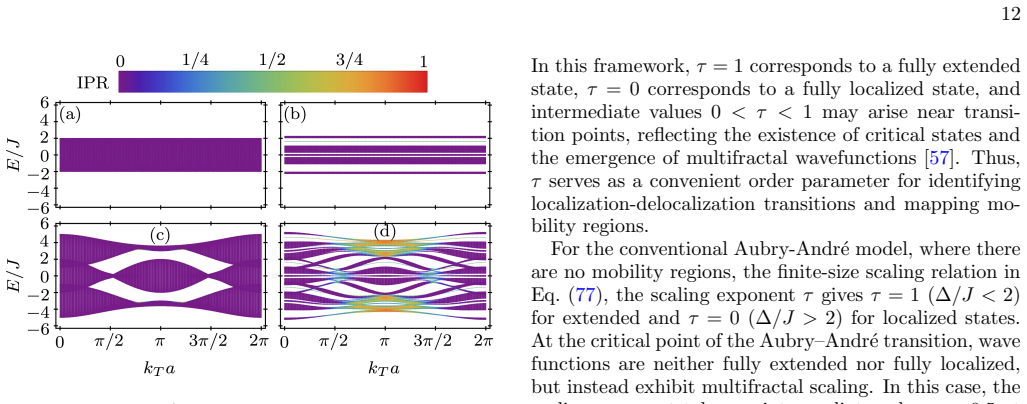
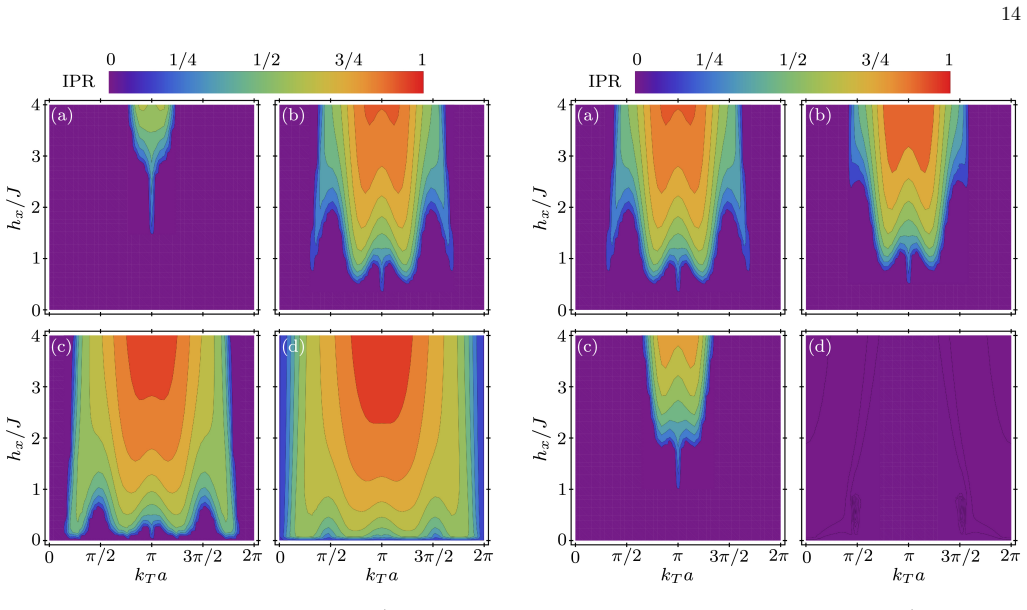
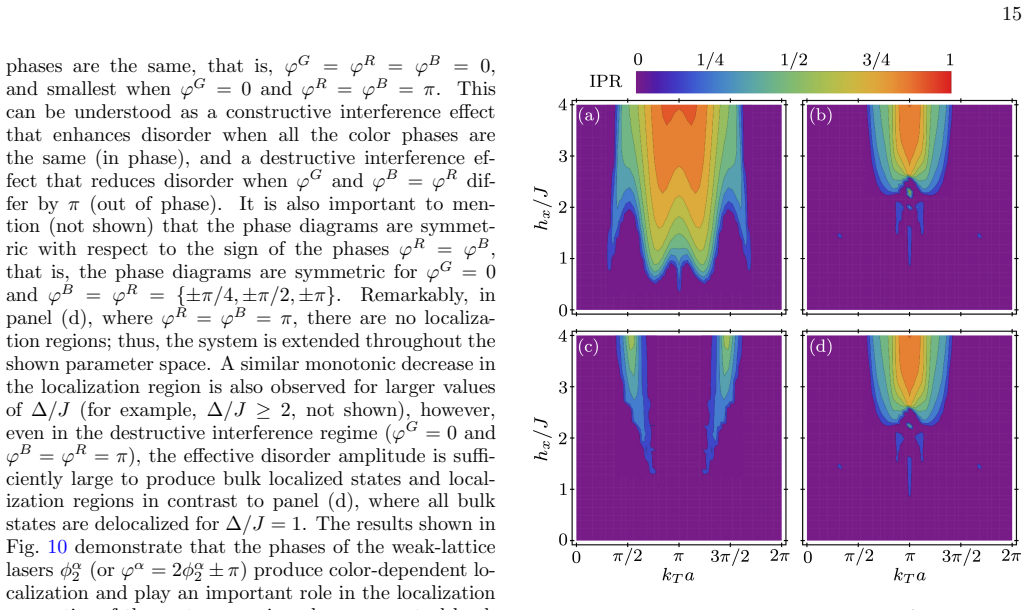
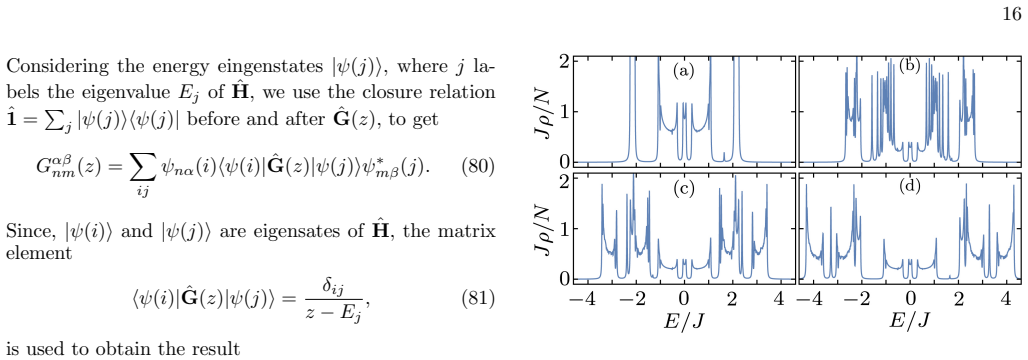
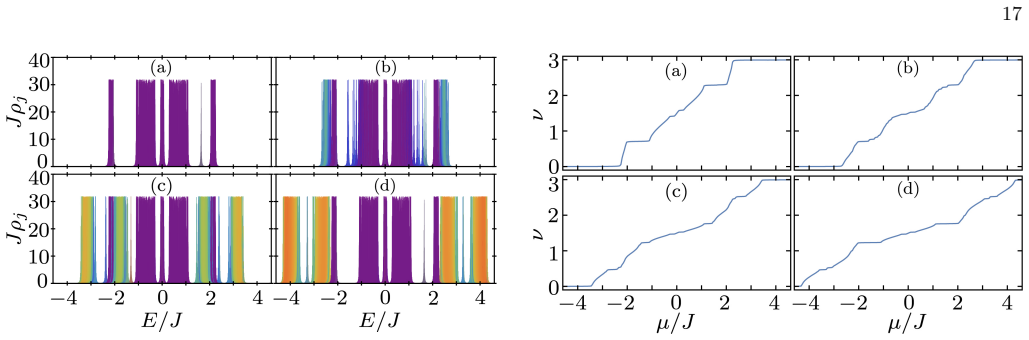
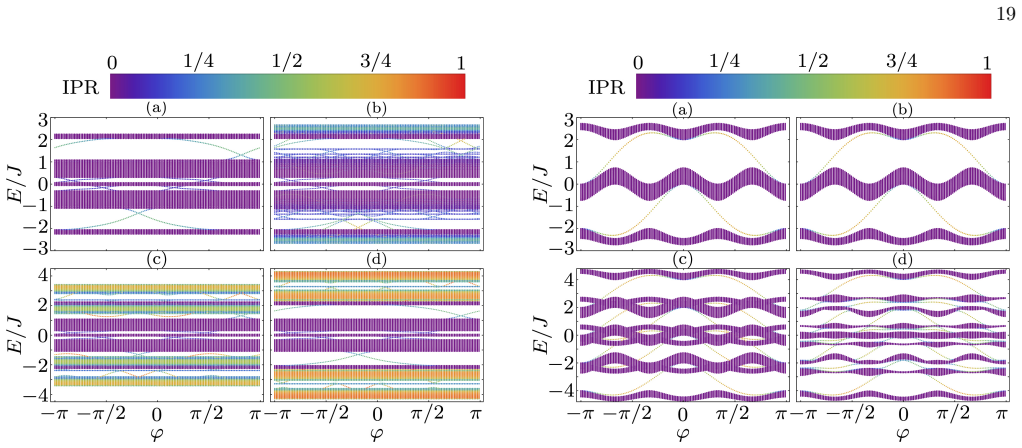
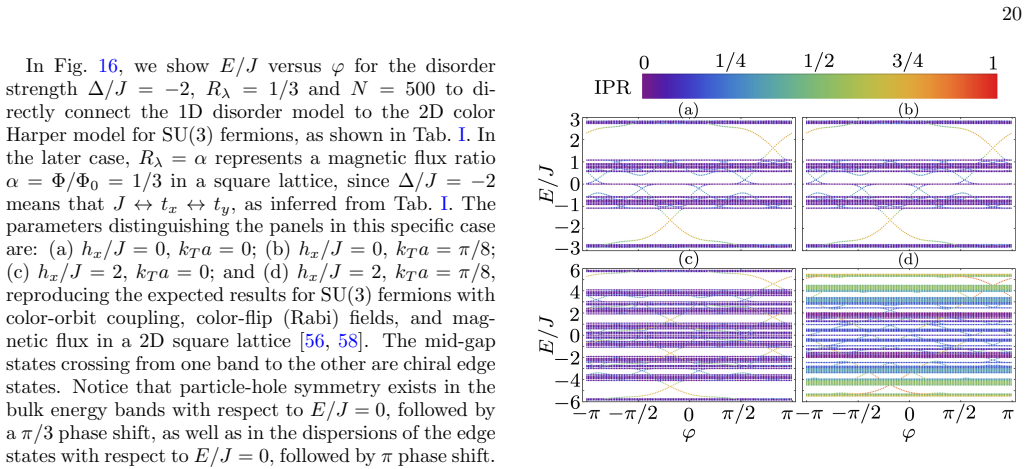
The interplay between disorder, gauge fields, and internal degrees of freedom fundamentally affects localization and topological properties of quantum many-body systems. Motivated by recent experimental realizations of synthetic non-Abelian gauge fields for SU(3) colored fermions, we investigate their localization and topological properties in 1D bichromatic optical lattices consisting of strong and weak laser beams. Describing the non-Abelian gauge field via color-orbit coupling and color-flip (Rabi) fields, we obtain a tight-binding description of trapped SU(3) colored fermions corresponding to a generalized three-color Aubry-Andr\'e model. We show that these fields explicitly break the conventional self-duality of a simple three-color Aubry-Andr\'e system. This duality breaking generates mobility regions across the energy spectrum, demonstrating that non-Abelian fields can either enhance or hinder color localization. Using exact diagonalization, density-of-states evaluations, and finite-size scaling of the inverse participation ratio, we obtain phase diagrams that identify regions of extended or localized bulk states. Furthermore, the color-orbit and Rabi fields induce edge states with topological properties. We develop an exact mapping from our 1D disorder model into a 2D color Harper model with a fictitious magnetic flux ratio and dimension controlled by the weak laser beam's phase. Using this mapping, we evaluate topological invariants, such as the charge-charge Chern number, for edge states emerging in energy gaps, revealing the topological insulating nature of several gapped phases. Lastly, we identify that these topological color-insulator phases can energetically neighbor three configurations: two extended, two localized, or one of each. This sharply contrasts with conventional topological insulators, which always neighbor two extended phases.
Editorial analysis
A structured set of objections, weighed in public.
Referee Report
Summary. The paper examines the effects of non-Abelian gauge fields on the localization and topological properties of SU(3) fermions in 1D bichromatic optical lattices. It models the system as a generalized three-color Aubry-André Hamiltonian with color-orbit coupling and color-flip Rabi fields, which break self-duality and create mobility edges. Using exact diagonalization, density of states, and inverse participation ratio scaling, phase diagrams for extended and localized states are constructed. An exact mapping to a 2D color Harper model is used to compute topological invariants such as the charge-charge Chern number, revealing that topological color-insulator phases can neighbor two extended, two localized, or mixed phases, in contrast to conventional topological insulators.
Significance. If the numerical results and mapping hold, the work demonstrates how non-Abelian fields can both enhance and suppress localization while enabling novel topological phase adjacencies. This could have implications for experiments with synthetic gauge fields in ultracold atoms and provides a framework for studying multi-color topological insulators. The use of an exact mapping and charge-charge Chern number computation is a strength.
major comments (1)
- [Abstract] Abstract (mapping description): The exact mapping from the 1D disorder model to the 2D color Harper model is used to evaluate the charge-charge Chern number. It is unclear whether this construction fully incorporates the duality-breaking color-flip Rabi fields into the 2D Hamiltonian; if the mapping omits their effect, the resulting invariants may not correspond to the actual 1D edge-state topology, weakening the central claim that topological color-insulators can neighbor two localized phases.
minor comments (1)
- The abstract refers to 'finite-size scaling of the inverse participation ratio' without specifying the system sizes, scaling exponents, or how mobility regions are quantitatively identified; adding these details would strengthen the localization analysis.
Simulated Author's Rebuttal
We thank the referee for the careful reading of our manuscript on localization and topological properties of SU(3) fermions in non-Abelian gauge fields. We address the concern about the mapping below.
read point-by-point responses
-
Referee: [Abstract] Abstract (mapping description): The exact mapping from the 1D disorder model to the 2D color Harper model is used to evaluate the charge-charge Chern number. It is unclear whether this construction fully incorporates the duality-breaking color-flip Rabi fields into the 2D Hamiltonian; if the mapping omits their effect, the resulting invariants may not correspond to the actual 1D edge-state topology, weakening the central claim that topological color-insulators can neighbor two localized phases.
Authors: The mapping is exact and fully incorporates the color-flip Rabi fields. These terms appear in the 1D model as off-diagonal color couplings that break self-duality; in the 2D color Harper model they correspond to additional inter-color hoppings whose strength is set by the Rabi amplitude. The fictitious flux and the effective dimension are chosen to reproduce every term of the original 1D Hamiltonian, so the charge-charge Chern numbers computed in the 2D model are identical to the topological invariants of the 1D edge states. This construction is presented in detail in Section IV, where we explicitly verify that the Rabi contribution is retained. Consequently the reported adjacency of topological color-insulator phases to two localized phases remains valid. revision: partial
Circularity Check
No significant circularity; derivation uses independent numerical methods and explicit mapping
full rationale
The paper's central results rest on exact diagonalization of the 1D generalized Aubry-André Hamiltonian, finite-size scaling of the inverse participation ratio, density-of-states calculations, and an explicitly constructed mapping to a 2D color Harper model whose flux and dimension are set by the weak-beam phase. These steps are presented as direct computations from the microscopic Hamiltonian rather than fits or self-referential definitions. No equation reduces a claimed prediction to a fitted parameter by construction, and no load-bearing topological invariant is justified solely by self-citation. The contrast with conventional topological insulators follows from the computed phase diagrams and Chern numbers obtained via the mapping, which remain independent of the target classification.
Axiom & Free-Parameter Ledger
axioms (1)
- domain assumption The system can be described by a tight-binding Hamiltonian with color-orbit and Rabi terms
invented entities (1)
-
color-flip (Rabi) fields
no independent evidence
Reference graph
Works this paper leans on
-
[1]
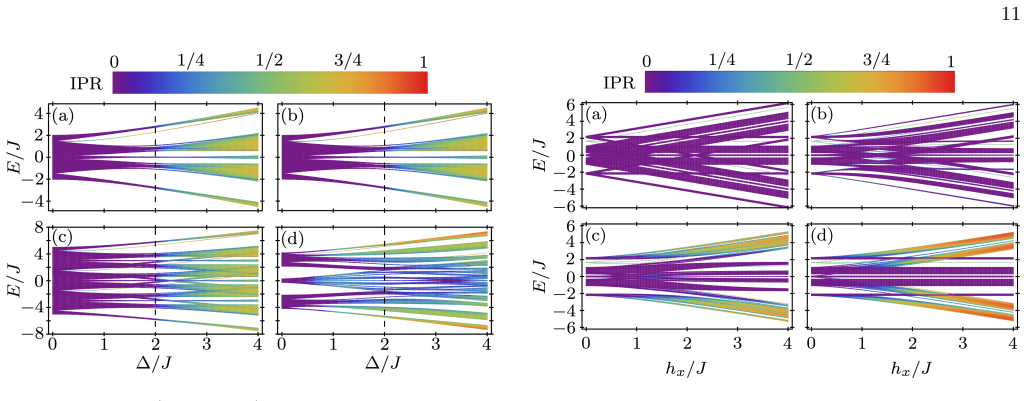
results for ∆/J= 0.5, whereτchanges from 1 to 0 at approximatelyh x/J= 1.5
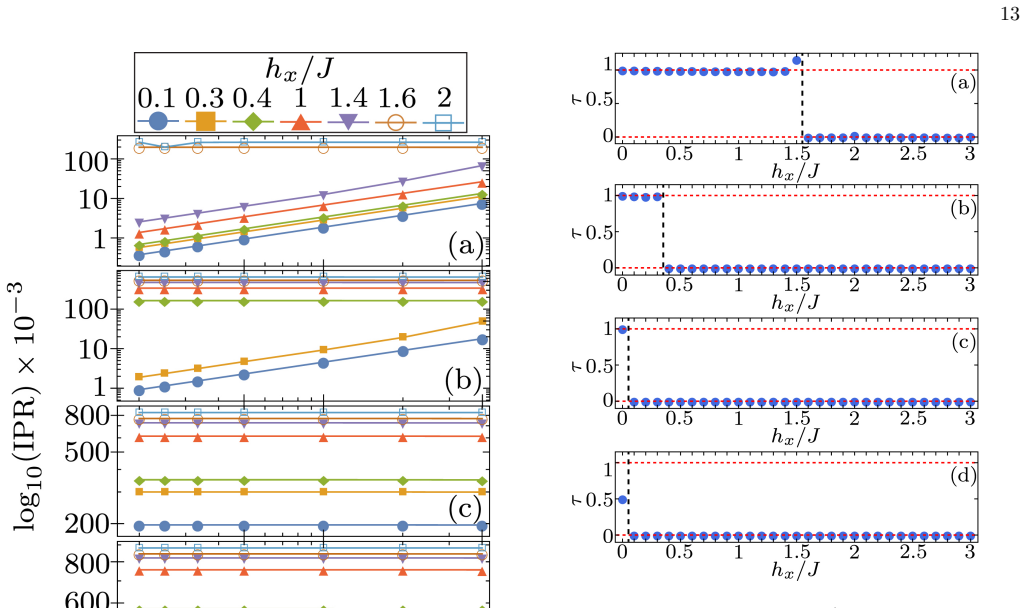
The different lines in each panel correspond toh x/J= {0.1,0.3,0.4,1.0,1.4,1.6,2.0}for IPRs calculated withN= {250,500,1000,2000,3000,4000,5000}. results for ∆/J= 0.5, whereτchanges from 1 to 0 at approximatelyh x/J= 1.5. Panel (b) shows results for ∆/J= 1.0, whereτchanges from 1 to 0 at approximately hx/J= 0.35. Panel (c) shows results for ∆/J= 1.5, wher...
2000
-
[2]
Roushan, C
P. Roushan, C. Neill, J. Tangpanitanon, V. M. Bastidas, A. Megrant, R. Barends, Y. Chen, Z. Chen, B. Chiaro, A. Dunsworth, A. Fowler, B. Foxen, M. Giustina, E. Jef- frey, J. Kelly, E. Lucero, J. Mutus, M. Neeley, C. Quin- tana, D. Sank, A. Vainsencher, J. Wenner, T. White, H. Neven, D. G. Angelakis, and J. Martinis, Spectro- scopic signatures of localizat...
2017
-
[3]
J. F. Karcher, M. Sonner, and A. D. Mirlin, Disorder and interaction in chiral chains: Majoranas versus complex fermions, Phys. Rev. B100, 134207 (2019)
2019
-
[4]
T. S. Sikkenk and L. Fritz, Interplay of disorder and inter- actions in a system of subcritically tilted and anisotropic three-dimensional Weyl fermions, Phys. Rev. B100, 085121 (2019)
2019
-
[5]
Huang and H.-F
K. Huang and H.-F. Meng, Hard-sphere Bose gas in ran- dom external potentials, Phys. Rev. Lett.69, 644 (1992)
1992
-
[6]
Schulte, S
T. Schulte, S. Drenkelforth, J. Kruse, W. Ertmer, J. Arlt, K. Sacha, J. Zakrzewski, and M. Lewenstein, Routes To- wards Anderson-Like Localization of Bose-Einstein Con- densates in Disordered Optical Lattices, Phys. Rev. Lett. 95, 170411 (2005)
2005
-
[7]
Gavish and Y
U. Gavish and Y. Castin, Matter-Wave Localization in Disordered Cold Atom Lattices, Phys. Rev. Lett.95, 020401 (2005)
2005
-
[8]
G. M. Falco, A. Pelster, and R. Graham, Collective os- cillations in trapped Bose-Einstein-condensed gases in the presence of weak disorder, Phys. Rev. A76, 013624 (2007)
2007
-
[9]
Zobay, Condensation temperature of interacting Bose gases with and without disorder, Phys
O. Zobay, Condensation temperature of interacting Bose gases with and without disorder, Phys. Rev. A73, 023616 (2006)
2006
-
[10]
Li and C
H. Li and C. A. R. S´ a de Melo, Evolution from Bardeen–Cooper–Schrieffer to Bose–Einstein condensate superfluidity in the presence of disorder, New Journal of Physics13, 055012 (2011)
2011
-
[11]
Sanchez-Palencia, D
L. Sanchez-Palencia, D. Cl´ ement, P. Lugan, P. Bouyer, G. V. Shlyapnikov, and A. Aspect, Anderson Localiza- tion of Expanding Bose-Einstein Condensates in Random Potentials, Phys. Rev. Lett.98, 210401 (2007)
2007
-
[12]
Roati, C
G. Roati, C. D’Errico, L. Fallani, M. Fattori, C. Fort, M. Zaccanti, G. Modugno, M. Modugno, and M. In- 23 guscio, Anderson localization of a non-interacting Bose– Einstein condensate, Nature453, 895 (2008)
2008
- [13]
-
[14]
Barbosa, M
S. Barbosa, M. Kiefer-Emmanouilidis, F. Lang, J. Koch, and A. Widera, Characterizing localization effects in an ultracold disordered Fermi gas by diffusion analysis, Phys. Rev. Res.6, 033039 (2024)
2024
-
[15]
J. Koch, S. Barbosa, F. Lang, and A. Widera, Stabil- ity and sensitivity of interacting fermionic superfluids to quenched disorder, Nature Communications15, 9292 (2024)
2024
-
[16]
Hebbe Madhusudhana, S
B. Hebbe Madhusudhana, S. Scherg, T. Kohlert, I. Bloch, and M. Aidelsburger, Benchmarking a Novel Efficient Numerical Method for Localized 1D Fermi-Hubbard Sys- tems on a Quantum Simulator, PRX Quantum2, 040325 (2021)
2021
-
[17]
Scherg, T
S. Scherg, T. Kohlert, P. Sala, F. Pollmann, B. Hebbe Madhusudhana, I. Bloch, and M. Aidelsburger, Observing non-ergodicity due to kinetic constraints in tilted Fermi-Hubbard chains, Nature Communications 12, 4490 (2021)
2021
-
[18]
Y. Yue, C. A. R. S´ a de Melo, and I. B. Spielman, En- hanced transport of spin-orbit-coupled Bose gases in dis- ordered potentials, Phys. Rev. A102, 033325 (2020)
2020
-
[19]
Nagler, S
B. Nagler, S. Barbosa, J. Koch, G. Orso, and A. Widera, Observing the loss and revival of long-range phase coher- ence through disorder quenches, PNAS119, e2111078118 (2022)
2022
-
[20]
Y. Bai, A. R. Dardia, T. Shimasaki, and D. M. Weld, Ex- ploring Light-Induced Phases of 2D Materials in a Mod- ulated 1D Quasicrystal, Phys. Rev. X16, 011036 (2026)
2026
-
[21]
Hatsugai, Topological aspects of the quantum Hall effect, Journal of Physics: Condensed Matter9, 2507 (1997)
Y. Hatsugai, Topological aspects of the quantum Hall effect, Journal of Physics: Condensed Matter9, 2507 (1997)
1997
-
[22]
D. J. Thouless, M. Kohmoto, M. P. Nightingale, and M. den Nijs, Quantized Hall Conductance in a Two- Dimensional Periodic Potential, Phys. Rev. Lett.49, 405 (1982)
1982
-
[23]
Kohmoto, Topological invariant and the quantiza- tion of the Hall conductance, Annals of Physics160, 343 (1985)
M. Kohmoto, Topological invariant and the quantiza- tion of the Hall conductance, Annals of Physics160, 343 (1985)
1985
-
[24]
Hatsugai, Chern number and edge states in the integer quantum Hall effect, Phys
Y. Hatsugai, Chern number and edge states in the integer quantum Hall effect, Phys. Rev. Lett.71, 3697 (1993)
1993
-
[25]
C. L. Kane and E. J. Mele,Z 2 Topological Order and the Quantum Spin Hall Effect, Phys. Rev. Lett.95, 146802 (2005)
2005
-
[26]
C. L. Kane and E. J. Mele, Quantum spin hall effect in graphene, Phys. Rev. Lett.95, 226801 (2005)
2005
-
[27]
B. A. Bernevig and S.-C. Zhang, Quantum spin hall ef- fect, Phys. Rev. Lett.96, 106802 (2006)
2006
-
[28]
Y.-J. Lin, R. L. Compton, K. Jim´ enez-Garc´ ıa, J. V. Porto, and I. B. Spielman, Synthetic magnetic fields for ultracold neutral atoms, Nature462, 628 (2009)
2009
-
[29]
Aidelsburger, M
M. Aidelsburger, M. Atala, M. Lohse, J. T. Barreiro, B. Paredes, and I. Bloch, Realization of the Hofstadter Hamiltonian with Ultracold Atoms in Optical Lattices, Phys. Rev. Lett.111, 185301 (2013)
2013
-
[30]
Aidelsburger, M
M. Aidelsburger, M. Lohse, C. Schweizer, M. Atala, J. T. Barreiro, S. Nascimb` ene, N. R. Cooper, I. Bloch, and N. Goldman, Measuring the Chern number of Hofstadter bands with ultracold bosonic atoms, Nature Physics11, 162 (2015)
2015
-
[31]
Y.-J. Lin, K. Jim´ enez-Garc´ ıa, and I. B. Spielman, Spin– orbit-coupled Bose–Einstein condensates, Nature471, 83 (2011)
2011
-
[32]
L. W. Cheuk, A. T. Sommer, Z. Hadzibabic, T. Yefsah, W. S. Bakr, and M. W. Zwierlein, Spin-Injection Spec- troscopy of a Spin-Orbit Coupled Fermi Gas, Phys. Rev. Lett.109, 095302 (2012)
2012
-
[33]
M. H. Yau and C. A. R. S´ a de Melo, Chern-number spec- trum of ultracold fermions in optical lattices tuned inde- pendently via artificial magnetic, Zeeman, and spin-orbit fields, Phys. Rev. A99, 043625 (2019)
2019
-
[34]
Hasan, C
M. Hasan, C. S. Madasu, K. D. Rathod, C. C. Kwong, and D. Wilkowski, Evolution of an ultracold gas in a non- Abelian gauge field: finite temperature effect, Quantum Electronics52, 532 (2022)
2022
-
[35]
Alluf and C
B. Alluf and C. A. R. S´ a de Melo, Duality breaking, mobility edges, and the connection between topologi- cal Aubry-Andr´ e and quantum Hall insulators in atomic wires with fermions, Phys. Rev. A111, 023322 (2025)
2025
-
[36]
Mardonov, M
S. Mardonov, M. Modugno, and E. Y. Sherman, Dynam- ics of Spin-Orbit Coupled Bose-Einstein Condensates in a Random Potential, Phys. Rev. Lett.115, 180402 (2015)
2015
-
[37]
Alluf and C
B. Alluf and C. A. R. S´ a de Melo, Controlling Anderson localization of a Bose-Einstein condensate via spin-orbit coupling and Rabi fields in bichromatic lattices, Phys. Rev. A107, 033312 (2023)
2023
-
[38]
Fukuhara, Y
T. Fukuhara, Y. Takasu, M. Kumakura, and Y. Taka- hashi, Degenerate Fermi Gases of Ytterbium, Phys. Rev. Lett.98, 030401 (2007)
2007
-
[39]
M. A. Cazalilla, A. F. Ho, and M. Ueda, Ultracold gases of ytterbium: ferromagnetism and Mott states in an SU(6) Fermi system, New Journal of Physics11, 103033 (2009)
2009
-
[40]
S. Taie, Y. Takasu, S. Sugawa, R. Yamazaki, T. Tsuji- moto, R. Murakami, and Y. Takahashi, Realization of a SU(2)×SU(6) System of Fermions in a Cold Atomic Gas, Phys. Rev. Lett.105, 190401 (2010)
2010
-
[41]
S. Taie, R. Yamazaki, S. Sugawa, and Y. Takahashi, An SU(6) Mott insulator of an atomic Fermi gas realized by large-spin Pomeranchuk cooling, Nature Physics8, 825 (2012)
2012
-
[42]
Pagano, M
G. Pagano, M. Mancini, G. Cappellini, P. Lombardi, F. Sch¨ afer, H. Hu, X.-J. Liu, J. Catani, C. Sias, M. Ingus- cio, and L. Fallani, A one-dimensional liquid of fermions with tunable spin, Nature Physics10, 198 (2014)
2014
-
[43]
Hofrichter, L
C. Hofrichter, L. Riegger, F. Scazza, M. H¨ ofer, D. R. Fernandes, I. Bloch, and S. F¨ olling, Direct Probing of the Mott Crossover in the SU(N) Fermi-Hubbard Model, Phys. Rev. X6, 021030 (2016)
2016
-
[44]
B. J. DeSalvo, M. Yan, P. G. Mickelson, Y. N. Mar- tinez de Escobar, and T. C. Killian, Degenerate Fermi Gas of 87Sr, Phys. Rev. Lett.105, 030402 (2010)
2010
-
[45]
M. K. Tey, S. Stellmer, R. Grimm, and F. Schreck, Double-degenerate Bose-Fermi mixture of strontium, Phys. Rev. A82, 011608(R) (2010)
2010
-
[46]
Stellmer, R
S. Stellmer, R. Grimm, and F. Schreck, Detection and manipulation of nuclear spin states in fermionic stron- tium, Phys. Rev. A84, 043611 (2011)
2011
-
[47]
Stellmer, F
S. Stellmer, F. Schreck, and T. C. Killian, Degenerate quantum gases of strontium, inAnnual Review of Cold Atoms and Molecules(World Scientific, Singapore, 2014) Chap. 1, pp. 1–80
2014
-
[48]
S. Taie, E. Ibarra-Garc´ ıa-Padilla, N. Nishizawa, 24 Y. Takasu, Y. Kuno, H.-T. Wei, R. T. Scalettar, K. R. A. Hazzard, and Y. Takahashi, Observation of antiferromag- netic correlations in an ultracold SU(N) Hubbard model, Nature Physics18, 1356 (2022)
2022
-
[49]
D. Tusi, L. Franchi, L. F. Livi, K. Baumann, D. B. Orenes, L. Del Re, R. E. Barfknecht, T. Zhou, M. In- guscio, G. Cappellini, M. Capone, J. Catani, and L. Fal- lani, Flavour-selective localization in interacting lattice fermions, Nature Physics18, 1201 (2022)
2022
-
[50]
D. M. Kurkcuoglu and C. A. R. S´ a de Melo, Color super- fluidity of neutral ultracold fermions in the presence of color-flip and color-orbit fields, Phys. Rev. A97, 023632 (2018)
2018
-
[51]
M. H. Yau and C. A. R. S´ a de Melo, Quantum Hall response of SU(3) fermions, Phys. Rev. A106, 053313 (2022)
2022
-
[52]
G. L. Schumacher, J. T. M¨ akinen, Y. Ji, G. G. T. As- sump¸ c˜ ao, J. Chen, S. Huang, F. J. Vivanco, and N. Navon, Observation of anomalous decay of a polarized three-component Fermi gas, Nature Communications17, 174 (2026)
2026
-
[53]
J. Mongkolkiattichai, L. Liu, S. Dasgupta, K. R. A. Haz- zard, and P. Schauss, Quantum gas microscopy of three- flavor Hubbard systems, arXiv:2503.05687 (2025)
-
[54]
C. S. Madasu, C. Mitra, L. Gabardos, K. D. Rathod, T. Zanon-Willette, C. Miniatura, F. Chevy, C. C. Kwong, and D. Wilkowski, Experimental realization of a SU(3) color-orbit coupling in an ultracold gas, Nature Commu- nications16, 8448 (2025)
2025
-
[55]
Zhang and C
X. Zhang and C. A. R. S´ a de Melo, Effects of spin–orbit coupling and Rabi fields in Tomonaga–Luttinger liq- uids: current status and open questions, Comptes Ren- dus Physique26, 483 (2025)
2025
-
[56]
Aubry and G
S. Aubry and G. Andr´ e, Analyticity breaking and Ander- son localization in incommensurate lattices, Ann. Israel Phys. Soc3, 133 (1980)
1980
-
[57]
M. H. Yau and C. A. R. S´ a de Melo, SU(3) vs. SU(2) fermions in optical lattices: Color-Hall vs. spin-Hall topo- logical insulators, Europhysics Letters135, 16001 (2021)
2021
-
[58]
H. Yao, A. Khoudli, L. Bresque, and L. Sanchez- Palencia, Critical Behavior and Fractality in Shallow One-Dimensional Quasiperiodic Potentials, Phys. Rev. Lett.123, 070405 (2019)
2019
-
[59]
M. H. Yau and C. A. R. S´ a de Melo, Eigenspectrum, Chern numbers and phase diagrams of ultracold color- orbit-coupled SU(3) fermions in optical lattices, Phys. Rev. A103, 043302 (2021)
2021
-
[60]
D. R. Hofstadter, Energy levels and wave functions of Bloch electrons in rational and irrational magnetic fields, Phys. Rev. B14, 2239 (1976)
1976
-
[61]
F. H. Claro and G. H. Wannier, Magnetic subband struc- ture of electrons in hexagonal lattices, Phys. Rev. B19, 6068 (1979)
1979
discussion (0)
Sign in with ORCID, Apple, or X to comment. Anyone can read and Pith papers without signing in.