Cadence: Extreme Pipelining with Multiple Concurrent Proposers
Pith reviewed 2026-07-03 05:49 UTC · model grok-4.3
The pith
Cadence achieves short-term censorship resistance and hiding at the fast-path latency of single-leader consensus using extreme pipelining and multiple concurrent proposers.
A machine-rendered reading of the paper's core claim, the machinery that carries it, and where it could break.
Core claim
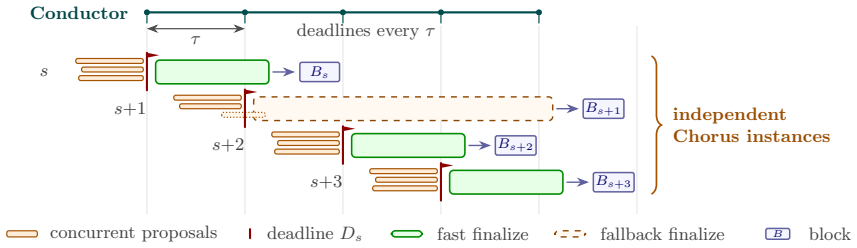
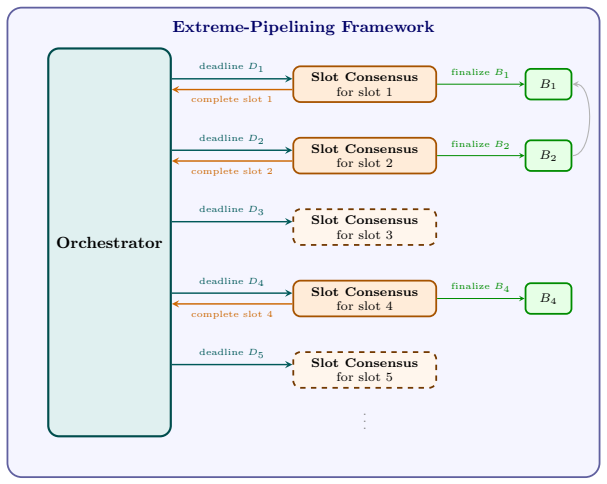
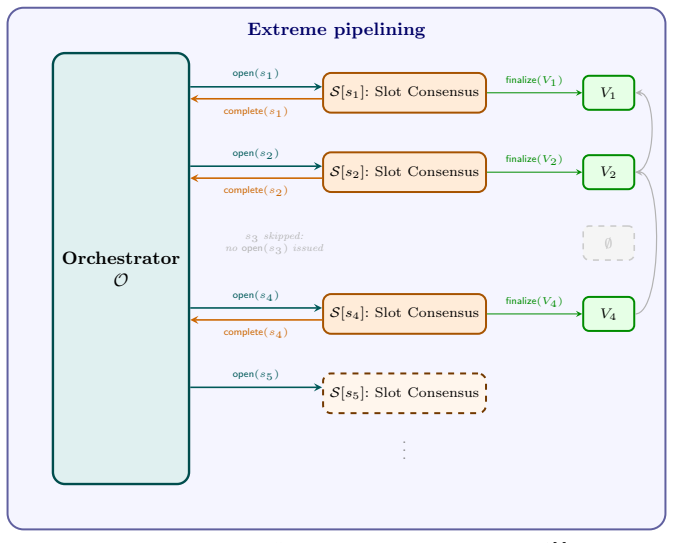
Cadence divides time into equally spaced slots, one block per slot, each finalized in its own consensus instance. Blocks do not build directly on their predecessor, so instances run independently and none waits for an earlier block to finish or propagate. Cadence also removes the single-leader monopoly over transaction inclusion and ordering: under multiple concurrent proposers, several validators propose for each block, and it guarantees that, under synchrony, a transaction a correct proposer includes cannot be censored or deferred, and that no proposer can craft its proposal in reaction to the others. To realize extreme pipelining, the paper introduces a general framework that turns any on
What carries the argument
Extreme pipelining, which decouples block intervals from network latency by running independent consensus instances per slot without predecessor dependencies, combined with the multi-proposer mechanism that enforces short-term censorship resistance and hiding.
If this is right
- Block intervals can be set arbitrarily low because each slot's consensus runs independently without waiting for prior blocks to propagate or finalize.
- Under synchrony, any transaction included by a correct proposer receives short-term protection from censorship or deferral.
- No proposer can observe or react to other proposals when crafting its own, due to the hiding guarantee.
- Fast-path finalization occurs in three communication rounds, with speculative finality one round earlier, at optimal resilience.
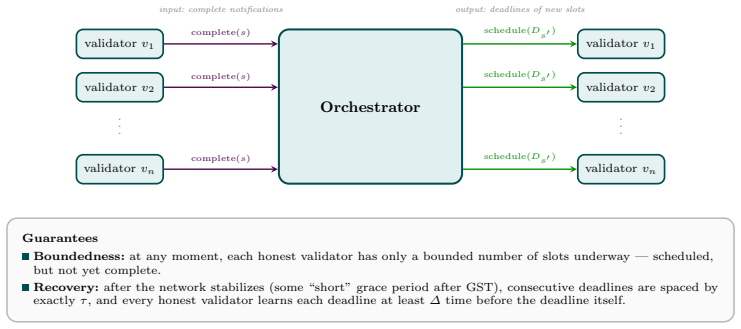
- The orchestrator keeps the number of open slots bounded even when the network is asynchronous.
Where Pith is reading between the lines
- The decoupling of block intervals could support sustained high throughput in validator sets larger than the simulated 200 without proportional latency increases.
- The hiding property might be verified in practice by checking whether proposers can still coordinate reactions in controlled synchronous testbeds.
- Similar frameworks for converting one-shot protocols could extend to other multi-shot settings where independence between instances is required.
- The reported 50 ms average transaction wait time at 100 ms intervals indicates a potential reduction in user-perceived delay compared to leader-based systems.
Load-bearing premise
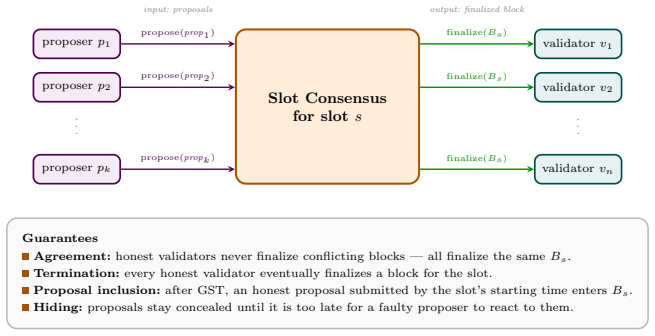
The general framework that converts any one-shot consensus satisfying the slot-consensus specification into a multi-shot protocol preserves independence of instances and does not introduce hidden dependencies or latency that would couple block intervals back to network delays.
What would settle it
An execution under synchrony in which a transaction included by a correct proposer is excluded from the finalized block for that slot, or a measurement showing finalization latency exceeding three rounds on the fast path under partial synchrony with n equals 3f plus 1.
Figures



read the original abstract
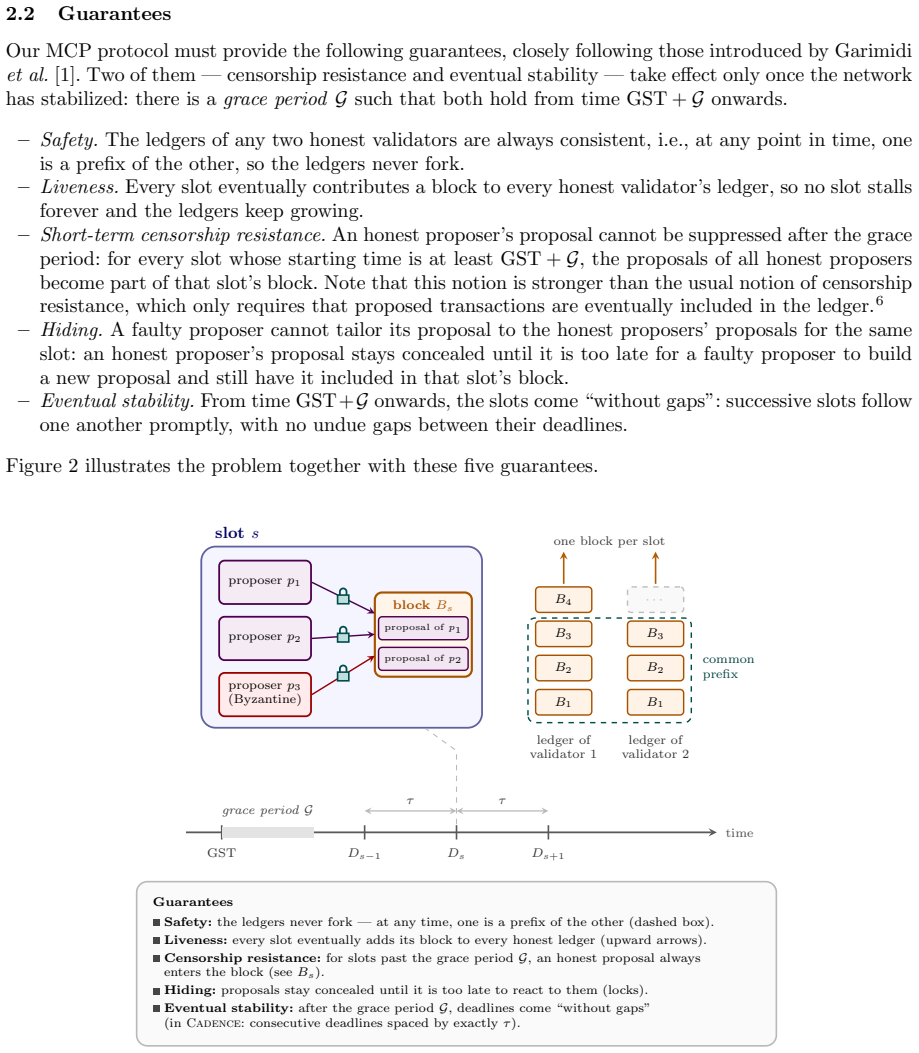
We present Cadence, a Byzantine fault-tolerant multi-proposer consensus protocol with arbitrarily low block intervals, optimal resilience, and optimal fast-path latency. Cadence divides time into equally spaced slots, one block per slot, each finalized in its own consensus instance. Blocks do not build directly on their predecessor, so instances run independently and none waits for an earlier block to finish or propagate; we call this extreme pipelining, decoupling the block interval from network latency. Cadence also removes the single-leader monopoly over transaction inclusion and ordering: under multiple concurrent proposers (MCP), several validators propose for each block, and it guarantees that, under synchrony, a transaction a correct proposer includes cannot be censored or deferred (short-term censorship resistance), and that no proposer can craft its proposal in reaction to the others' (hiding). To realize extreme pipelining, we introduce a general framework that turns any one-shot consensus meeting our slot-consensus specification into a multi-shot protocol. We instantiate it for MCP with two protocols of our own: Chorus, a slot consensus whose fast path finalizes a block in an optimal three rounds, with speculative finality one round earlier, and Conductor, an orchestrator that opens slots at an even cadence, more slowly under asynchrony to keep open slots bounded. To our knowledge, Cadence is the first MCP protocol to provide short-term censorship resistance and hiding at the fast-path latency of single-leader consensus. We prove safety, liveness, censorship resistance, and hiding under partial synchrony with optimal resilience (n = 3f+1). In simulation over Monad's 200 validators with five proposers per slot, finalization averages 219 ms (167 ms to speculative finality); at a 100 ms block interval a transaction waits on average 50 ms to enter a proposal.
Editorial analysis
A structured set of objections, weighed in public.
Referee Report
Summary. The paper presents Cadence, a Byzantine fault-tolerant multi-proposer consensus protocol that achieves arbitrarily low block intervals via extreme pipelining: time is divided into slots with one block per slot, each finalized in an independent consensus instance that does not build directly on its predecessor. It introduces a general framework converting any one-shot consensus meeting a slot-consensus specification into a multi-shot protocol, instantiated via Chorus (three-round fast path with speculative finality) and Conductor (slot orchestrator). Cadence claims short-term censorship resistance and hiding under synchrony, with proofs of safety, liveness, censorship resistance, and hiding under partial synchrony at optimal resilience (n=3f+1). Simulations on 200 validators with five proposers per slot report average finalization of 219 ms (167 ms speculative) and 50 ms average wait at 100 ms intervals.
Significance. If the central claims hold, the work would be significant for distributed consensus, as the first MCP protocol to deliver short-term censorship resistance and hiding at single-leader fast-path latency while decoupling block interval from network latency. The general framework for one-shot to multi-shot conversion, the proofs under partial synchrony, and the reproducible simulation results on a realistic validator count are explicit strengths that would strengthen the contribution if the independence preservation is verified.
major comments (1)
- [Abstract] Abstract (description of the general framework): the claim that the framework 'preserves independence of instances and does not introduce hidden dependencies or latency that would couple block intervals back to network delays' is load-bearing for the extreme pipelining and 'first MCP protocol' claims, yet the abstract provides no slot-consensus specification, conversion steps, or proof sketch; any violation of independence would directly undermine the decoupling from network latency.
Simulated Author's Rebuttal
We thank the referee for their thoughtful review and for highlighting the importance of clearly substantiating the general framework's independence claim in the abstract. We address the major comment below.
read point-by-point responses
-
Referee: [Abstract] Abstract (description of the general framework): the claim that the framework 'preserves independence of instances and does not introduce hidden dependencies or latency that would couple block intervals back to network delays' is load-bearing for the extreme pipelining and 'first MCP protocol' claims, yet the abstract provides no slot-consensus specification, conversion steps, or proof sketch; any violation of independence would directly undermine the decoupling from network latency.
Authors: We agree that the abstract, as a high-level summary, does not include sufficient detail on the slot-consensus specification or conversion steps to fully support the independence claim on its own. The full specification, conversion procedure, and formal proof of independence (showing no hidden dependencies or latency coupling) appear in Sections 3 and 4 of the manuscript. To address this, we will revise the abstract to concisely reference the slot-consensus specification and state that the framework preserves instance independence as proven in the body, thereby strengthening the presentation of the extreme-pipelining contribution without altering the underlying claims. revision: yes
Circularity Check
No circularity; protocol constructed from independent components
full rationale
The paper introduces a general framework to convert one-shot slot-consensus instances into a multi-shot protocol with extreme pipelining, instantiated via Chorus (three-round fast path) and Conductor (slot orchestration). Independence of instances, censorship resistance, and hiding are asserted as design properties of this construction under partial synchrony and n=3f+1, with proofs claimed but not reduced to self-referential equations or prior self-citations in the provided text. No load-bearing step equates a claimed prediction or uniqueness result to its own inputs by construction; external network assumptions and the slot-consensus specification provide the separation. This is the normal case of a self-contained protocol description.
Axiom & Free-Parameter Ledger
axioms (2)
- domain assumption Partial synchrony: after some unknown global stabilization time, messages are delivered within a known bound
- domain assumption Optimal resilience bound n = 3f + 1 with at most f Byzantine faults
Reference graph
Works this paper leans on
-
[1]
Multiple Concurrent Proposers: Why and How.CoRR, abs/2509.23984, 2025
Pranav Garimidi, Joachim Neu, and Max Resnick. Multiple Concurrent Proposers: Why and How.CoRR, abs/2509.23984, 2025
-
[2]
Automated market making and arbitrage profits in the presence of fees
Jason Milionis, Ciamac C Moallemi, and Tim Roughgarden. Automated market making and arbitrage profits in the presence of fees. InInternational Conference on Financial Cryptography and Data Security, pages 159–171. Springer, 2024
2024
-
[3]
Constellation
Anza. Constellation. White Paper v0.9,https://anza.xyz/constellationwhitepaper, March 2026. Ac- cessed: June 2026
2026
-
[4]
Separating agreement from execution for byzantine fault tolerant services
Jian Yin, Jean-Philippe Martin, Arun Venkataramani, Lorenzo Alvisi, and Mike Dahlin. Separating agreement from execution for byzantine fault tolerant services. InProceedings of the Nineteenth ACM Symposium on Operating Systems Principles, SOSP ’03, page 253–267, New York, NY, USA, 2003. Association for Computing Machinery
2003
-
[5]
Sing a song of simplex
Victor Shoup. Sing a song of simplex. In38th International Symposium on Distributed Computing (DISC 2024), volume 319 ofLIPIcs, pages 37:1–37:22, 2024
2024
-
[6]
Impossibility of Distributed Consensus with One Faulty Process.Journal of the ACM (JACM), 32(2):374–382, 1985
Michael J Fischer, Nancy A Lynch, and Michael S Paterson. Impossibility of Distributed Consensus with One Faulty Process.Journal of the ACM (JACM), 32(2):374–382, 1985
1985
-
[7]
A New Broadcast Primitive for BFT Protocols
Manu Drijvers, Tim Gretler, Yotam Harchol, Tobias Klenze, Ognjen Maric, Stefan Neamtu, Yvonne-Anne Pig- nolet, Rostislav Rumenov, Daniel Sharifi, and Victor Shoup. A New Broadcast Primitive for BFT Protocols. CoRR, abs/2410.22080, 2024
-
[8]
Practical Byzantine fault tolerance
Miguel Castro and Barbara Liskov. Practical Byzantine fault tolerance. InProceedings of the Third Symposium on Operating Systems Design and Implementation, OSDI ’99, pages 173–186, Berkeley, CA, USA, 1999. USENIX Association
1999
-
[9]
Reiter, Guy Golan Gueta, and Ittai Abraham
Maofan Yin, Dahlia Malkhi, Michael K. Reiter, Guy Golan Gueta, and Ittai Abraham. Hotstuff: Bft consensus with linearity and responsiveness. InProceedings of the 2019 ACM PODC, PODC ’19, page 347–356, New York, NY, USA, 2019. Association for Computing Machinery
2019
-
[10]
SBFT: a Scalable and Decentralized Trust Infrastructure
Guy Golan-Gueta, Ittai Abraham, Shelly Grossman, Dahlia Malkhi, Benny Pinkas, Michael K. Reiter, Dragos- Adrian Seredinschi, Orr Tamir, and Alin Tomescu. SBFT: a scalable decentralized trust infrastructure for blockchains.CoRR, abs/1804.01626, 2018
work page internal anchor Pith review Pith/arXiv arXiv 2018
-
[11]
Jalalzai, Jianyu Niu, Chen Feng, and Fangyu Gai
Mohammad M. Jalalzai, Jianyu Niu, Chen Feng, and Fangyu Gai. Fast-hotstuff: A fast and robust bft protocol for blockchains.IEEE Trans. Dependable Secur. Comput., 21(4):2478–2493, July 2024
2024
-
[12]
Monadbft: Fast, responsive, fork-resistant streamlined consensus, 2026
Mohammad Mussadiq Jalalzai, Kushal Babel, Jovan Komatovic, Tobias Klenze, Sourav Das, Fatima Elsheimy, Mike Setrin, John Bergschneider, and Babak Gilkalaye. Monadbft: Fast, responsive, fork-resistant streamlined consensus, 2026
2026
-
[13]
Asynchronous verifiable information dispersal
Christian Cachin and Stefano Tessaro. Asynchronous verifiable information dispersal. InProceedings of the 19th International Conference on Distributed Computing, DISC’05, page 503–504, Berlin, Heidelberg, 2005. Springer-Verlag
2005
-
[14]
MIP-10: Deterministic RaptorCast
Category Labs. MIP-10: Deterministic RaptorCast. Monad Improvement Proposals, no. 10, April 2026. Online serial. 25
2026
-
[15]
Good-case latency of byzantine broadcast: a complete categorization
Ittai Abraham, Kartik Nayak, Ling Ren, and Zhuolun Xiang. Good-case latency of byzantine broadcast: a complete categorization. In Avery Miller, Keren Censor-Hillel, and Janne H. Korhonen, editors,PODC ’21: ACM Symposium on Principles of Distributed Computing, Virtual Event, Italy, July 26-30, 2021, pages 331–341. ACM, 2021
2021
-
[16]
Asynchronous execution.https://docs.monad.xyz/monad-arch/consensus/ asynchronous-execution
Monad Foundation. Asynchronous execution.https://docs.monad.xyz/monad-arch/consensus/ asynchronous-execution. Online; accessed 2026-04-30
2026
-
[17]
Monad initial specification proposal.https://category-labs.github.io/ category-research/monad-initial-spec-proposal.pdf
Category Labs. Monad initial specification proposal.https://category-labs.github.io/ category-research/monad-initial-spec-proposal.pdf. Online; accessed 2026-06-07
2026
-
[18]
Time is money: Strategic timing games in proof-of-stake protocols
Caspar Schwarz-Schilling, Fahad Saleh, Thomas Thiery, Jennifer Pan, Nihar Shah, and Barnab´ e Monnot. Time is money: Strategic timing games in proof-of-stake protocols. In5th Conference on Advances in Financial Technologies (AFT 2023), volume 282 ofLeibniz International Proceedings in Informatics (LIPIcs), pages 30:1–30:17. Schloss Dagstuhl – Leibniz-Zent...
2023
-
[19]
Timing games in responsive consensus protocols
Kaya Alpturer, Kushal Babel, and Aditya Saraf. Timing games in responsive consensus protocols. arXiv:2510.25144,https://arxiv.org/abs/2510.25144, 2025
-
[20]
Weighted batched threshold encryption with applications to mempool privacy
Amit Agarwal, Kushal Babel, Sourav Das, Babak Poorebrahim Gilkalaye, Arup Mondal, Benny Pinkas, Peter Rindal, and Aayush Yadav. Weighted batched threshold encryption with applications to mempool privacy. IEEE SP, 2026
2026
-
[21]
Btx: Simple and efficient batch threshold encryption.Cryptology ePrint Archive, 2026
Amit Agarwal, Sourav Das, Babak Poorebrahim Gilkalaye, Peter Rindal, and Victor Shoup. Btx: Simple and efficient batch threshold encryption.Cryptology ePrint Archive, 2026
2026
-
[22]
Beast-mev: Batched threshold encryption with silent setup for mev preven- tion.Cryptology ePrint Archive, 2025
Jan Bormet, Arka Rai Choudhuri, Sebastian Faust, Sanjam Garg, Hussien Othman, Guru-Vamsi Policharla, Ziyan Qu, and Mingyuan Wang. Beast-mev: Batched threshold encryption with silent setup for mev preven- tion.Cryptology ePrint Archive, 2025
2025
-
[23]
On the limits of encrypted mempools
Pranav Garimidi, Joseph Bonneau, and Lioba Heimbach. On the limits of encrypted mempools. a16z Crypto Research, July 2025
2025
-
[24]
Hotstuff-1: Linear consensus with one-phase speculation, 2024
Dakai Kang, Suyash Gupta, Dahlia Malkhi, and Mohammad Sadoghi. Hotstuff-1: Linear consensus with one-phase speculation, 2024
2024
-
[25]
Extended abstract: Hotstuff-2: Optimal two-phase responsive bft
Dahlia Malkhi and Kartik Nayak. Extended abstract: Hotstuff-2: Optimal two-phase responsive bft. Cryp- tology ePrint Archive, Paper 2023/397, 2023.https://eprint.iacr.org/2023/397
2023
-
[26]
Jolteon and ditto: Network-adaptive efficient consensus with asynchronous fallback, 2021
Rati Gelashvili, Lefteris Kokoris-Kogias, Alberto Sonnino, Alexander Spiegelman, and Zhuolun Xiang. Jolteon and ditto: Network-adaptive efficient consensus with asynchronous fallback, 2021
2021
-
[27]
Moonshot: Optimizing chain-based rotating leader bft via optimistic proposals, 2024
Isaac Doidge, Raghavendra Ramesh, Nibesh Shrestha, and Joshua Tobkin. Moonshot: Optimizing chain-based rotating leader bft via optimistic proposals, 2024
2024
-
[28]
Hydrangea++: Enhancing hydrangea with optimistic proposals.https: //supra.com/documents/hydrangea-plus-plus.pdf, 2025
Nibesh Shrestha and Aniket Kate. Hydrangea++: Enhancing hydrangea with optimistic proposals.https: //supra.com/documents/hydrangea-plus-plus.pdf, 2025
2025
-
[29]
Shoal++: High through- put DAG BFT can be fast and robust! In22nd USENIX Symposium on Networked Systems Design and Implementation (NSDI), pages 813–826
Balaji Arun, Zekun Li, Florian Suri-Payer, Sourav Das, and Alexander Spiegelman. Shoal++: High through- put DAG BFT can be fast and robust! In22nd USENIX Symposium on Networked Systems Design and Implementation (NSDI), pages 813–826. USENIX Association, 2025
2025
-
[30]
Raptr: Prefix consensus for robust high-performance bft, 2025
Andrei Tonkikh, Balaji Arun, Zhuolun Xiang, Zekun Li, and Alexander Spiegelman. Raptr: Prefix consensus for robust high-performance bft, 2025
2025
-
[31]
Gatling: Rapid-fire consensus from parallel composition, 2026
Giulia Scaffino, Max Resnick, and Joachim Neu. Gatling: Rapid-fire consensus from parallel composition, 2026
2026
-
[32]
Prefix consensus for censorship resistant BFT, 2026
Zhuolun Xiang, Andrei Tonkikh, and Alexander Spiegelman. Prefix consensus for censorship resistant BFT, 2026
2026
-
[33]
AMP: Arc multi-proposer protocol with bounded inclusion guarantees, 2026
Daniel Cason, Gordon Liao, Sergio Mena, Nenad Miloˇ sevi´ c, Adi Seredinschi, Alessandro Sforzin, Jo˜ ao Sousa, and Preston Vander Vos. AMP: Arc multi-proposer protocol with bounded inclusion guarantees, 2026
2026
-
[34]
Solana alpenglow consensus, increased bandwidth, reduced latency
Quentin Kniep, Kobi Sliwinski, and Roger Wattenhofer. Solana alpenglow consensus, increased bandwidth, reduced latency. 2025
2025
-
[35]
Narwhal and tusk: A dag-based mempool and efficient bft consensus, 2022
George Danezis, Eleftherios Kokoris Kogias, Alberto Sonnino, and Alexander Spiegelman. Narwhal and tusk: A dag-based mempool and efficient bft consensus, 2022
2022
-
[36]
Bullshark: Dag bft protocols made practical
Alexander Spiegelman, Neil Giridharan, Alberto Sonnino, and Lefteris Kokoris-Kogias. Bullshark: Dag bft protocols made practical. InProceedings of the 2022 ACM SIGSAC Conference on Computer and Communi- cations Security, CCS ’22, page 2705–2718, New York, NY, USA, 2022. Association for Computing Machinery
2022
-
[37]
All you need is dag
Idit Keidar, Eleftherios Kokoris-Kogias, Oded Naor, and Alexander Spiegelman. All you need is dag. In Proceedings of the 2021 ACM Symposium on Principles of Distributed Computing, PODC’21, page 165–175, New York, NY, USA, 2021. Association for Computing Machinery
2021
-
[38]
Mysticeti: Reaching the limits of latency with uncertified dags, 2024
Kushal Babel, Andrey Chursin, George Danezis, Anastasios Kichidis, Lefteris Kokoris-Kogias, Arun Koshy, Alberto Sonnino, and Mingwei Tian. Mysticeti: Reaching the limits of latency with uncertified dags, 2024
2024
-
[39]
no proposal
Ran Canetti. Universally Composable Security: A New Paradigm for Cryptographic Protocols. In42nd Annual Symposium on Foundations of Computer Science, FOCS 2001, Las Vegas, Nevada, USA, October 14-17, 2001, pages 136–145. IEEE Computer Society, 2001. 26 Organization of the Appendix This appendix gives the formal treatment underlying the body. It restates t...
2001
discussion (0)
Sign in with ORCID, Apple, or X to comment. Anyone can read and Pith papers without signing in.