Beyond Beamforming: Phase-and-Gain Channel Shaping via Rotatable Antenna Arrays
Pith reviewed 2026-07-03 07:32 UTC · model grok-4.3
The pith
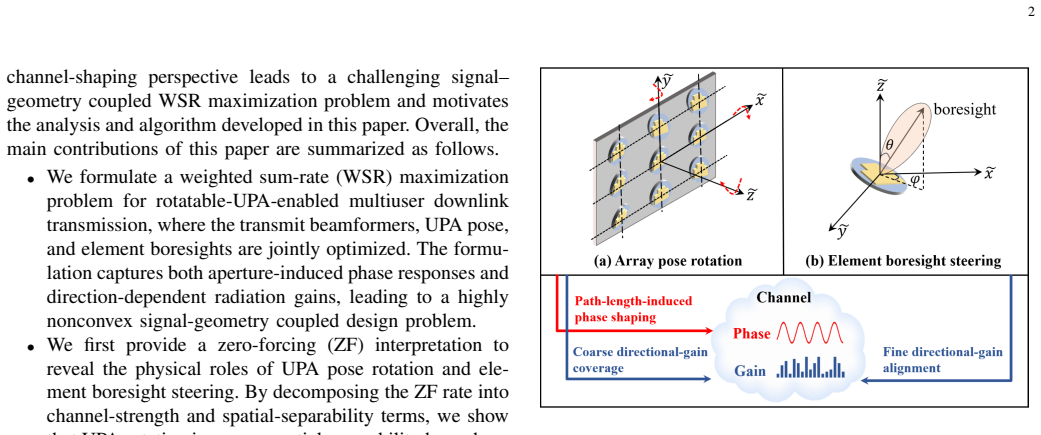
Rotatable antenna arrays reshape multiuser channels by jointly adjusting pose and boresights to improve both phase responses and direction-dependent gains.
A machine-rendered reading of the paper's core claim, the machinery that carries it, and where it could break.
Core claim
Joint optimization of transmit beamformers, array pose, and element boresights under visibility and steering constraints produces phase-and-gain channel shaping whose rate gains arise from simultaneous channel-strength enhancement and spatial-separability improvement, as identified by zero-forcing analysis and confirmed by outperformance over fixed-array, pose-only, and boresight-only benchmarks.
What carries the argument
The joint optimization framework that coordinates beamforming with array-pose adaptation and element-boresight steering, interpreted geometrically via zero-forcing to isolate phase orthogonality gains from gain-alignment gains.
If this is right
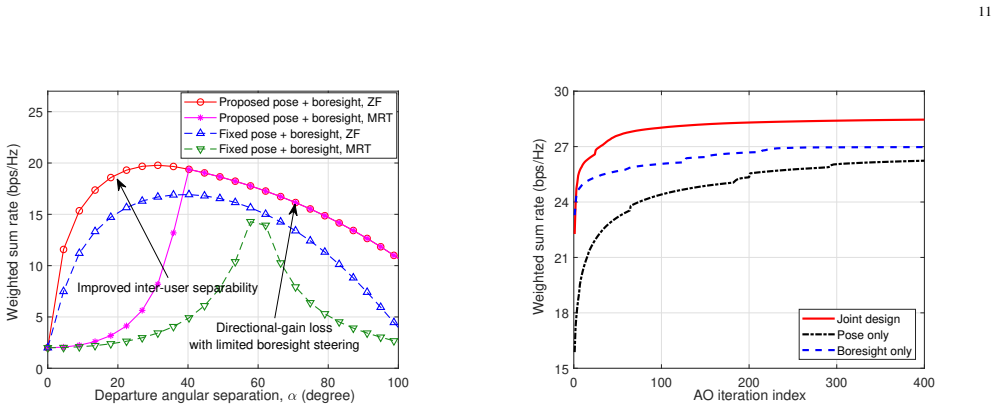
- Array-pose rotation improves inter-user channel orthogonality even when elements are isotropic.
- Directional elements introduce a tradeoff between phase-based spatial separation and boresight-dependent gain alignment.
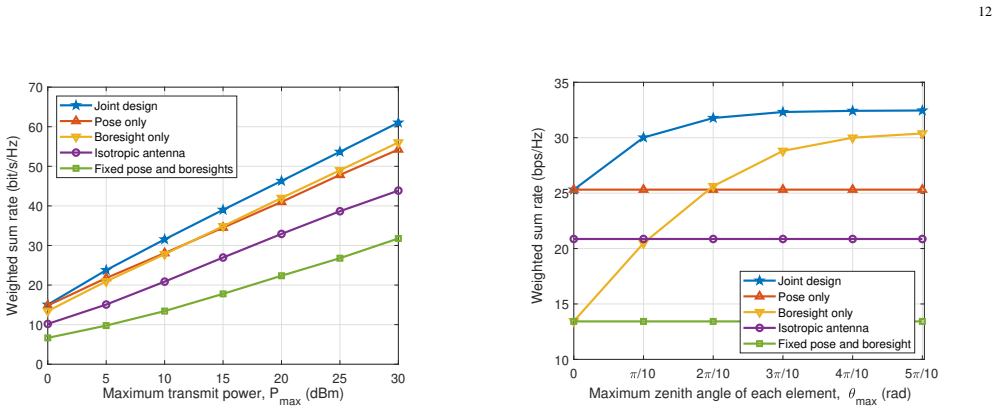
- The joint design produces larger rate gains when element patterns are more directive and when boresight steering is more tightly constrained.
- The proposed method outperforms fixed-array, pose-only, and boresight-only baselines in the evaluated scenarios.
Where Pith is reading between the lines
- Element pattern directivity becomes a co-design variable that amplifies the value of geometric reconfiguration.
- Mechanical constraints on pose and boresight range directly cap the achievable channel shaping, pointing to a hardware-performance tradeoff.
- The separation of phase and gain effects in the zero-forcing view suggests similar geometric levers could be applied in other multiuser settings with movable apertures.
Load-bearing premise
The weighted sum-rate maximization problem admits an efficient solution under the visibility and steering constraints, and the zero-forcing analysis accurately attributes the observed rate gains to the combined phase and gain effects.
What would settle it
A direct comparison of weighted sum rates in a multiuser setup where the joint design fails to exceed the pose-only or boresight-only benchmarks under identical power, visibility, and steering constraints would falsify the claimed benefit of combined phase-and-gain shaping.
Figures



read the original abstract
This paper investigates geometry-reconfigurable transmission for multiuser communication systems enabled by a rotatable antenna array. In contrast to conventional fixed arrays, the proposed architecture jointly exploits array pose adjustment and element-level boresight steering, thereby reshaping both the array-induced phase responses and the direction-dependent channel gains. We formulate a weighted sum-rate maximization problem that jointly optimizes the transmit beamformers, array pose, and element boresights under practical visibility and steering constraints. To reveal the underlying design principles, we first provide a geometric interpretation via zero-forcing analysis, showing that the resulting rates stem from both channel-strength enhancement and spatial-separability improvement. Specifically, array-pose rotation improves inter-user channel orthogonality even with isotropic elements, whereas directional elements introduce a tradeoff between phase-based spatial separation and boresight-dependent gain alignment. Motivated by these insights, we develop an efficient optimization framework that jointly coordinates transmit beamforming, array-pose adaptation, and element-boresight steering to exploit the geometry-induced phase-and-gain channel-shaping capability. Simulation results demonstrate that the proposed joint design outperforms fixed-array, pose-only, and boresight-only benchmarks, with larger gains achieved under more directive element patterns and tighter boresight-steering constraints.
Editorial analysis
A structured set of objections, weighed in public.
Referee Report
Summary. The paper proposes a rotatable antenna array architecture for multiuser downlink systems that jointly optimizes array pose, element boresight directions, and transmit beamformers to maximize weighted sum-rate. It provides a geometric zero-forcing interpretation attributing performance gains to improved channel orthogonality (via pose) and gain alignment (via boresight), develops an efficient optimization framework respecting visibility and steering constraints, and reports simulation results showing the joint design outperforms fixed-array, pose-only, and boresight-only baselines, with larger gains for directive element patterns and tighter steering constraints.
Significance. If the optimization framework converges reliably and the reported gains are reproducible, the work introduces a new geometric degree of freedom for channel shaping that complements conventional beamforming. The zero-forcing geometric analysis offers insight into the distinct roles of phase and gain, which could guide future reconfigurable-antenna designs in interference-limited scenarios. The simulation comparisons against multiple benchmarks strengthen the practical relevance.
major comments (2)
- [§3] §3 (Geometric ZF Analysis): The claim that pose rotation improves inter-user orthogonality even for isotropic elements is central to separating phase and gain effects; the derivation should explicitly show how the effective channel matrix rank or condition number changes with rotation angle under the visibility constraint, as this underpins the rate improvement attribution.
- [§4] §4 (Optimization Framework): The weighted sum-rate problem is non-convex due to the coupled pose, boresight, and beamformer variables; the manuscript must specify the convergence criterion and iteration complexity of the proposed algorithm (e.g., alternating optimization or successive convex approximation) to substantiate the claim of an 'efficient' solution under the steering constraints.
minor comments (2)
- [Table 1] Table 1 (Simulation Parameters): The element pattern directivity values and the range of allowable boresight angles should be listed explicitly to allow reproduction of the reported gain trends.
- [Fig. 3] Fig. 3 (Rate vs. SNR curves): The legend should distinguish the four schemes (joint, fixed, pose-only, boresight-only) more clearly, and error bars or multiple random seeds should be indicated if the curves represent averages.
Simulated Author's Rebuttal
We thank the referee for the constructive comments and the recommendation for minor revision. The suggestions strengthen the clarity of the geometric analysis and the optimization details. We address each major comment below.
read point-by-point responses
-
Referee: [§3] §3 (Geometric ZF Analysis): The claim that pose rotation improves inter-user orthogonality even for isotropic elements is central to separating phase and gain effects; the derivation should explicitly show how the effective channel matrix rank or condition number changes with rotation angle under the visibility constraint, as this underpins the rate improvement attribution.
Authors: We appreciate the referee's emphasis on making the separation of phase and gain effects fully explicit. Section 3 already derives the geometric ZF rates by showing that pose rotation alters the phase terms in the effective channels to improve orthogonality even for isotropic elements. To address the request directly, the revised manuscript will add an explicit derivation of the condition number of the effective channel matrix as a function of rotation angle (under the visibility constraint), confirming the rank preservation and the resulting improvement in spatial separability independent of gain alignment. revision: yes
-
Referee: [§4] §4 (Optimization Framework): The weighted sum-rate problem is non-convex due to the coupled pose, boresight, and beamformer variables; the manuscript must specify the convergence criterion and iteration complexity of the proposed algorithm (e.g., alternating optimization or successive convex approximation) to substantiate the claim of an 'efficient' solution under the steering constraints.
Authors: We agree that additional specification of algorithmic properties is warranted to support the efficiency claim. The framework employs alternating optimization, with beamformers obtained in closed form for fixed geometry and pose/boresight variables updated via successive convex approximation. In the revision we will state the convergence criterion (relative change in the objective below a prescribed threshold) and provide the per-iteration complexity, including the cost of handling the visibility and steering constraints in each subproblem. revision: yes
Circularity Check
No significant circularity detected
full rationale
The paper formulates a weighted sum-rate maximization problem, provides a geometric zero-forcing analysis attributing gains to channel orthogonality and gain alignment, then develops an optimization framework and validates via simulations against fixed-array, pose-only, and boresight-only benchmarks. No quoted equations or steps reduce by construction to fitted inputs, self-definitions, or self-citation chains; the ZF interpretation and benchmark comparisons are presented as independent analysis and empirical checks. The derivation chain remains self-contained with external falsifiability through simulations.
Axiom & Free-Parameter Ledger
Reference graph
Works this paper leans on
-
[1]
Intelligent surfaces empowered wireless network: Recent advances and the road to 6G,
Q. Wuet al., “Intelligent surfaces empowered wireless network: Recent advances and the road to 6G,”Proc. IEEE, vol. 112, no. 7, pp. 724–763, Jul. 2024
work page 2024
-
[2]
A tutorial on extremely large-scale MIMO for 6G: Fundamentals, signal processing, and applications,
Z. Wanget al., “A tutorial on extremely large-scale MIMO for 6G: Fundamentals, signal processing, and applications,”IEEE Commun. Surveys Tut., vol. 26, no. 3, pp. 1560–1605, 2024
work page 2024
-
[3]
A tutorial on near-field XL-MIMO communications toward 6G,
H. Luet al., “A tutorial on near-field XL-MIMO communications toward 6G,”IEEE Commun. Surveys Tut., vol. 26, no. 4, pp. 2213–2257, 2024
work page 2024
-
[4]
Cell-free full-duplex communication—an overview,
D. Galappaththige, M. Mohammadi, H. Q. Ngo, M. Matthaiou, and C. Tellambura, “Cell-free full-duplex communication—an overview,” IEEE Trans. Commun., vol. 73, no. 11, pp. 10 468–10 494, 2025
work page 2025
-
[5]
Towards smart and reconfigurable environment: Intelligent reflecting surface aided wireless network,
Q. Wu and R. Zhang, “Towards smart and reconfigurable environment: Intelligent reflecting surface aided wireless network,”IEEE Commun. Mag., vol. 58, no. 1, pp. 106–112, Jan. 2020
work page 2020
-
[6]
Active RIS vs. passive RIS: Which will prevail in 6G?
Z. Zhanget al., “Active RIS vs. passive RIS: Which will prevail in 6G?” IEEE Trans. Commun., vol. 71, no. 3, pp. 1707–1725, Mar. 2023
work page 2023
-
[7]
IRS-aided multi-cell massive MIMO systems with impairments: SE analysis and optimization,
R. Munagalaet al., “IRS-aided multi-cell massive MIMO systems with impairments: SE analysis and optimization,”IEEE Trans. Commun., vol. 73, no. 7, pp. 5295–5312, Jul. 2025
work page 2025
-
[8]
Q. Wuet al., “Intelligent reflecting surfaces for wireless networks: Deployment architectures, key solutions, and field trials,”IEEE Wireless Commun., vol. 32, no. 6, pp. 141–148, Dec. 2025
work page 2025
-
[9]
W. K. Newet al., “A tutorial on fluid antenna system for 6G networks: Encompassing communication theory, optimization methods and hard- ware designs,”IEEE Commun. Surveys Tut., vol. 27, no. 4, pp. 2325– 2377, 2025
work page 2025
-
[10]
A tutorial on movable antennas for wireless networks,
L. Zhuet al., “A tutorial on movable antennas for wireless networks,” IEEE Commun. Surveys Tut., vol. 28, pp. 3002–3054, 2026
work page 2026
-
[11]
Movable antennas for wireless commu- nication: Opportunities and challenges,
L. Zhu, W. Ma, and R. Zhang, “Movable antennas for wireless commu- nication: Opportunities and challenges,”IEEE Commun. Mag., vol. 62, no. 6, pp. 114–120, Jun. 2024
work page 2024
-
[12]
MIMO capacity characterization for movable antenna systems,
W. Ma, L. Zhu, and R. Zhang, “MIMO capacity characterization for movable antenna systems,”IEEE Trans. Wireless Commun., vol. 23, no. 4, pp. 3392–3407, Apr. 2024
work page 2024
-
[13]
Movable-antenna enhanced multiuser communication via antenna position optimization,
L. Zhu, W. Ma, B. Ning, and R. Zhang, “Movable-antenna enhanced multiuser communication via antenna position optimization,”IEEE Trans. Wireless Commun., vol. 23, no. 7, pp. 7214–7229, 2024
work page 2024
-
[14]
Capacity maximization of uplink with fluid antenna system at both ends,
B. Tanget al., “Capacity maximization of uplink with fluid antenna system at both ends,”IEEE Trans. Wireless Commun., vol. 24, no. 12, pp. 10 580–10 593, 2025
work page 2025
-
[15]
Capacity maximization for fas-assisted multiple access channels,
H. Xuet al., “Capacity maximization for fas-assisted multiple access channels,”IEEE Trans. Commun., vol. 73, no. 7, pp. 4713–4731, 2025
work page 2025
-
[16]
Fluid antenna multiple access with simultaneous non- unique decoding in strong interference channel,
F. R. Ghadiet al., “Fluid antenna multiple access with simultaneous non- unique decoding in strong interference channel,”IEEE Trans. Wireless Commun., vol. 24, no. 12, pp. 10 183–10 195, 2025
work page 2025
-
[17]
Rotatable antenna enabled wireless communication and sensing: Opportunities and challenges,
B. Zhenget al., “Rotatable antenna enabled wireless communication and sensing: Opportunities and challenges,”IEEE Wireless Commun., 2025, early access, doi: 10.1109/MWC.2025.3611919
-
[18]
Rotatable antenna-enabled wireless communication: Modeling and optimization,
B. Zheng, Q. Wu, T. Ma, and R. Zhang, “Rotatable antenna-enabled wireless communication: Modeling and optimization,”IEEE Trans. Commun., vol. 74, pp. 6825–6842, 2026
work page 2026
-
[19]
Rotatable antenna enabled spectrum sharing: Joint antenna orientation and beam- forming design,
X. Peng, Q. Wu, Z. Zheng, W. Chen, Y . Zhu, and Y . Gao, “Rotatable antenna enabled spectrum sharing: Joint antenna orientation and beam- forming design,”IEEE Trans. Wireless Commun., vol. 25, pp. 15 660– 15 674, Apr. 2026
work page 2026
-
[20]
Low-altitude ISAC with rotatable active and passive arrays,
Z. Zhenget al., “Low-altitude ISAC with rotatable active and passive arrays,”IEEE J. Sel. Topics Sig. Process., 2026, early access, doi: 10. 1109/JSTSP.2026.3693227
-
[21]
UA V-aided mmwave massive MIMO broadcasting with rotatable antenna array,
X. Zhang, L. Xiang, J. Wang, and X. Gao, “UA V-aided mmwave massive MIMO broadcasting with rotatable antenna array,”IEEE Trans. V eh. Technol., 2026, early access, doi: 10.1109/TVT.2026.3696498
-
[22]
Rotatable antenna array enabled UA V mmwave massive MIMO communication,
X. Zhanget al., “Rotatable antenna array enabled UA V mmwave massive MIMO communication,”IEEE Trans. Commun., vol. 74, pp. 1219–1236, 2026
work page 2026
-
[23]
Efficient channel estimation for rotatable antenna- enabled wireless communication,
X. Xionget al., “Efficient channel estimation for rotatable antenna- enabled wireless communication,”IEEE Wireless Commun. Lett., vol. 14, no. 11, pp. 3719–3723, Nov. 2025
work page 2025
-
[24]
Joint antenna rotation and IRS beamforming for multi- user uplink communications,
G. Zhanget al., “Joint antenna rotation and IRS beamforming for multi- user uplink communications,”IEEE Wireless Commun. Lett., vol. 15, pp. 3219–3223, 2026
work page 2026
-
[25]
Cell-Free MIMO with Rotatable Antennas: When Macro-Diversity Meets Antenna Directivity
X. Penget al., “Cell-free MIMO with rotatable antennas: When macro- diversity meets antenna directivity,”arXiv preprint: 2601.16543, 2026, doi: https://arxiv.org/abs/2601.16543
work page internal anchor Pith review Pith/arXiv arXiv 2026
-
[26]
C. A. Balanis,Antenna theory: Analysis and design. John Wiley & Sons, 2016
work page 2016
-
[27]
Q. Shi, M. Razaviyayn, Z.-Q. Luo, and C. He, “An iteratively weighted MMSE approach to distributed sum-utility maximization for a MIMO interfering broadcast channel,”IEEE Trans. Sig. Process., vol. 59, no. 9, pp. 4331–4340, Sept. 2011
work page 2011
discussion (0)
Sign in with ORCID, Apple, or X to comment. Anyone can read and Pith papers without signing in.