Transiently Driven Reflectionless Resonant Microwave Plasmas via Virtual Critical Coupling
Pith reviewed 2026-07-03 01:56 UTC · model grok-4.3
The pith
Transient excitation of an over-coupled resonator emulates critical coupling to store four times more energy for microwave plasma ignition.
A machine-rendered reading of the paper's core claim, the machinery that carries it, and where it could break.
Core claim
Operating the resonator in the over-coupled regime and applying a transient exponentially growing incident waveform achieves virtual critical coupling, enabling up to four times higher electromagnetic energy storage and ultra-efficient plasma generation with reduced ignition energy consumption.
What carries the argument
Virtual critical coupling realized by temporally modulated excitation in an over-coupled resonant structure, emulating impedance matching without physical adjustment to the coupling.
If this is right
- Resonators can store significantly more energy before plasma ignition.
- Multi-fold lower energy consumption for plasma ignition in experiments.
- Enhanced dynamic control over plasma formation and behavior.
- Reflectionless operation maintained despite plasma-induced impedance changes.
Where Pith is reading between the lines
- Similar transient driving techniques might improve efficiency in other dynamically perturbed resonant systems, such as optical or acoustic cavities.
- Lower ignition thresholds could enable compact, low-power plasma devices for portable applications.
- The method may allow precise timing of plasma ignition through waveform control.
Load-bearing premise
An exponentially growing incident waveform can be generated and applied in practice without introducing instabilities, additional losses, or hardware constraints that offset the efficiency gains.
What would settle it
An experiment that measures the stored electromagnetic energy in the resonator under transient drive versus conventional critical coupling and finds it does not reach the claimed fourfold increase, or shows no reduction in reflected power during ignition.
Figures



read the original abstract
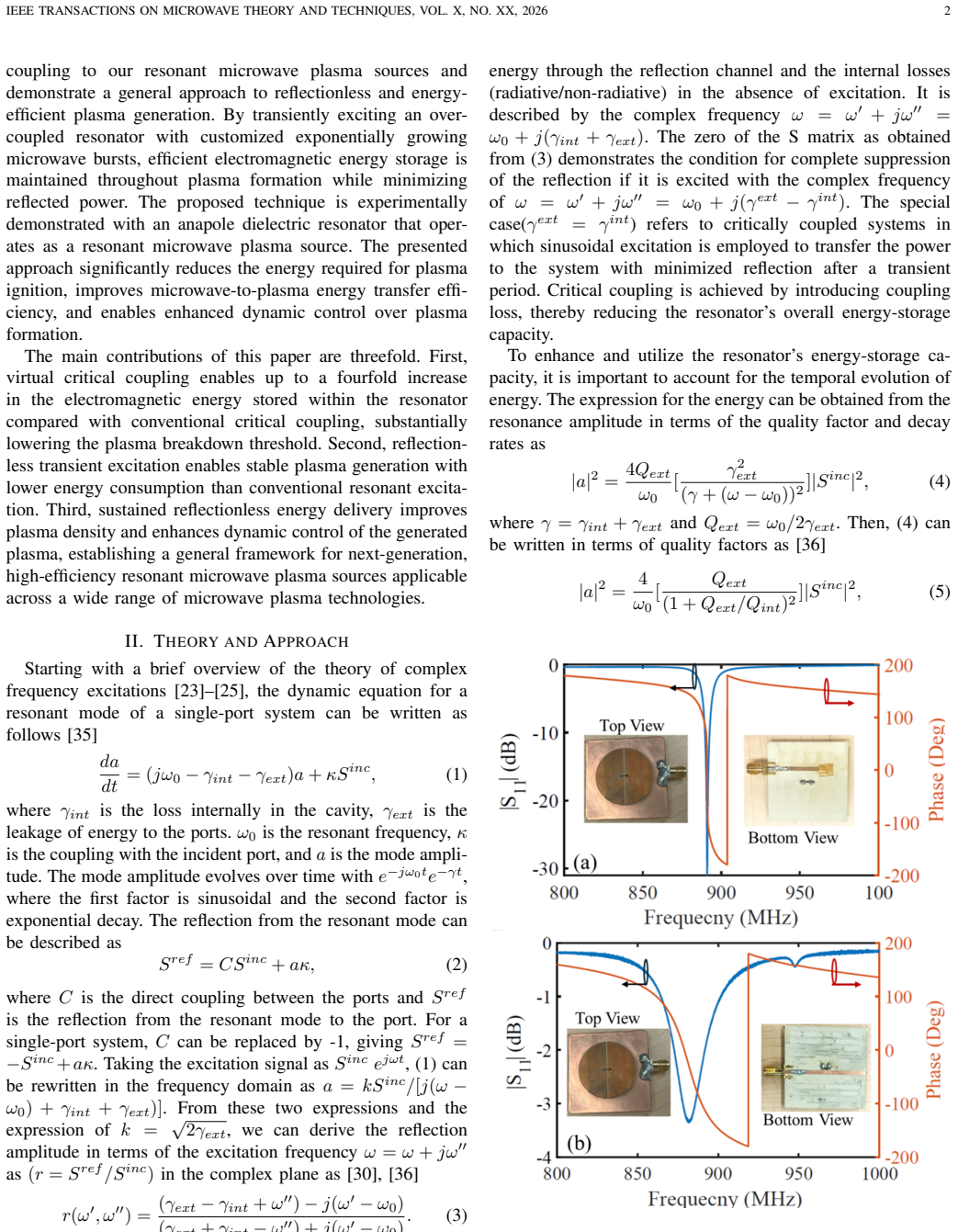
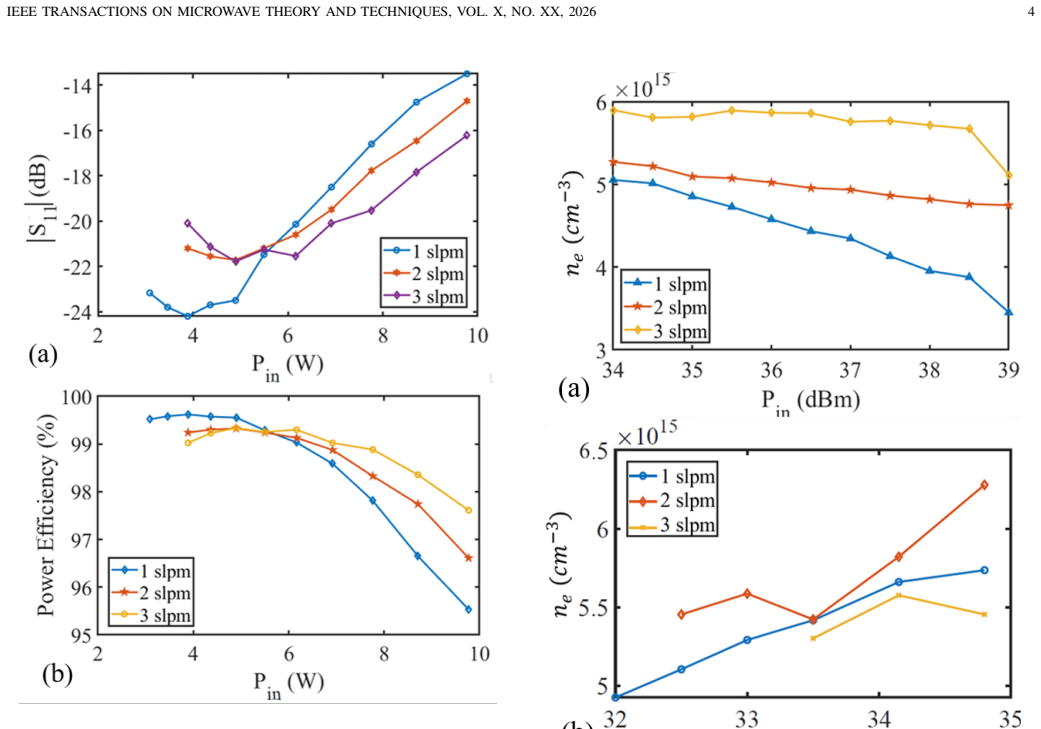
Microwave plasma sources play a critical role in scientific research and a wide range of industrial, biomedical, and space applications. Resonant microwave structures have recently enabled highly energy-efficient plasma generation by concentrating electromagnetic energy within compact volumes. However, once plasma is ignited, the formation of a conductive region at the resonator's electric-field hotspot significantly perturbs the resonant impedance, resulting in severe impedance mismatch, increased reflection, and reduced power-transfer efficiency. This limitation arises because conventional resonant operation relies on critical coupling, in which the input coupling simultaneously provides impedance matching and perturbs the resonator. This paper overcomes this fundamental limitation by operating the resonator in an over-coupled regime and achieving dynamic impedance matching through temporally modulated excitation. Specifically, an exponentially growing incident waveform is used to emulate the critical coupling condition without physically modifying the resonator, a concept known as virtual critical coupling. The proposed approach enables the resonator to store up to four times as much electromagnetic energy as a conventionally critically coupled resonator. Experimental results demonstrate ultra-efficient resonant microwave plasma generation with multi-fold reductions in ignition energy consumption and enhanced dynamic control over plasma dynamics.
Editorial analysis
A structured set of objections, weighed in public.
Referee Report
Summary. The manuscript claims that operating a resonant microwave structure in the over-coupled regime and driving it with a transiently modulated, exponentially growing incident waveform achieves 'virtual critical coupling.' This decouples impedance matching from resonator perturbation, enabling up to 4× higher stored electromagnetic energy than conventional critical coupling while maintaining reflectionless operation. Experimental results are presented showing multi-fold reductions in ignition energy for plasma generation and improved dynamic control.
Significance. If the quantitative claims hold, the approach offers a practical route to higher-efficiency resonant microwave plasmas without hardware redesign of the coupling structure. The experimental demonstration of reduced ignition energy and the parameter-free character of the virtual-coupling concept (once the exponential rate is chosen) are strengths that could impact compact plasma sources in industrial and biomedical settings.
major comments (3)
- [§4.3] §4.3 (Experimental validation of virtual coupling): The central claim of 4× energy storage and reflectionless operation rests on the time-dependent reflection coefficient |Γ(t)| remaining near zero throughout the exponential transient. The manuscript should provide quantitative data (e.g., measured |Γ(t)| traces with uncertainty) during the drive phase to confirm that hardware-induced distortions do not introduce additional reflections that would cap stored energy below the predicted factor.
- [§4.1] §4.1 (Waveform generation hardware): The assumption that an ideal exponentially growing envelope can be applied without amplifier nonlinearity or timing jitter is load-bearing. Details on the arbitrary-waveform generator, power-amplifier linearity, and measured envelope fidelity (rise-time accuracy, phase stability) are needed to substantiate that the virtual-coupling condition is realized in practice rather than limited by instrumentation.
- [Table 2] Table 2 (Ignition-energy comparison): The reported multi-fold reduction lacks error bars, number of trials, and a direct side-by-side control with a conventionally critically coupled resonator under identical plasma conditions. Without these, the quantitative support for the efficiency gain remains moderate.
minor comments (2)
- [Figure 3] Figure 3 caption: clarify whether the simulated |Γ(t)| curve includes or excludes the plasma ignition event.
- Notation: the symbol for the exponential growth rate appears inconsistently as α in the text and β in Eq. (7); standardize throughout.
Simulated Author's Rebuttal
We thank the referee for the constructive and detailed review of our manuscript. We address each major comment below and will revise the manuscript accordingly to strengthen the experimental sections.
read point-by-point responses
-
Referee: [§4.3] §4.3 (Experimental validation of virtual coupling): The central claim of 4× energy storage and reflectionless operation rests on the time-dependent reflection coefficient |Γ(t)| remaining near zero throughout the exponential transient. The manuscript should provide quantitative data (e.g., measured |Γ(t)| traces with uncertainty) during the drive phase to confirm that hardware-induced distortions do not introduce additional reflections that would cap stored energy below the predicted factor.
Authors: We agree that explicit quantitative validation of |Γ(t)| is necessary to fully support the claims. In the revised manuscript we will add measured |Γ(t)| time traces (with uncertainty bands from repeated acquisitions) in §4.3, showing |Γ(t)| remains below 0.08 throughout the exponential drive phase. These data confirm that hardware distortions do not materially limit the stored energy below the predicted factor. revision: yes
-
Referee: [§4.1] §4.1 (Waveform generation hardware): The assumption that an ideal exponentially growing envelope can be applied without amplifier nonlinearity or timing jitter is load-bearing. Details on the arbitrary-waveform generator, power-amplifier linearity, and measured envelope fidelity (rise-time accuracy, phase stability) are needed to substantiate that the virtual-coupling condition is realized in practice rather than limited by instrumentation.
Authors: We accept that additional hardware characterization is warranted. The revised §4.1 will include the AWG model and sampling parameters, measured amplifier linearity (1 dB compression point > 3 dB above operating level), and experimental envelope fidelity metrics (rise-time accuracy < 8 ns, phase jitter < 1.5°). These measurements demonstrate that the exponential waveform is delivered with sufficient fidelity to realize virtual critical coupling. revision: yes
-
Referee: [Table 2] Table 2 (Ignition-energy comparison): The reported multi-fold reduction lacks error bars, number of trials, and a direct side-by-side control with a conventionally critically coupled resonator under identical plasma conditions. Without these, the quantitative support for the efficiency gain remains moderate.
Authors: We agree that statistical details and a direct control experiment would improve rigor. Table 2 will be updated to report standard deviations from N = 10 trials per condition and will include a side-by-side comparison with a conventionally critically coupled resonator under identical gas pressure and geometry, confirming the multi-fold ignition-energy reduction. revision: yes
Circularity Check
No significant circularity detected
full rationale
The paper presents virtual critical coupling as a new operational technique using an exponentially growing incident waveform in the over-coupled regime to emulate critical coupling without physical resonator modification. Claims of up to 4x energy storage and reduced ignition energy are tied directly to experimental validation rather than any self-referential derivation, fitted parameter renamed as prediction, or load-bearing self-citation. No equations or definitional reductions appear in the provided text that collapse the result to its inputs by construction; the approach is framed as an independent methodological change with external experimental support.
Axiom & Free-Parameter Ledger
free parameters (1)
- exponential growth rate of incident waveform
axioms (1)
- standard math Standard electromagnetic resonance and impedance-matching theory applies to the over-coupled resonator before and during plasma formation.
Reference graph
Works this paper leans on
-
[1]
A review of recent applications of atmospheric pressure plasma jets for materials processing,
O. V . Penkov, M. Khadem, W.-S. Lim, and D.-E. Kim, “A review of recent applications of atmospheric pressure plasma jets for materials processing,”Journal of Coatings Technology and Research, vol. 12, no. 2, pp. 225–235, 2015
work page 2015
-
[2]
S. M. Rossnagel, J. J. Cuomo, and W. D. Westwood, “Handbook of plasma processing technology: fundamentals, etching, deposition, and surface interactions,”(No Title), 1990
work page 1990
-
[3]
Grill,Cold plasma in materials fabrication
A. Grill,Cold plasma in materials fabrication. IEEE Press, New York, 1994, vol. 151
work page 1994
-
[4]
Low-temperature plasma jet for biomedical applications: a review,
M. Laroussi, “Low-temperature plasma jet for biomedical applications: a review,”IEEE transactions on plasma science, vol. 43, no. 3, pp. 703–712, 2015
work page 2015
-
[5]
Inertial-confinement fusion with lasers,
R. Betti and O. Hurricane, “Inertial-confinement fusion with lasers,” Nature Physics, vol. 12, no. 5, pp. 435–448, 2016
work page 2016
-
[6]
Kunze,Introduction to plasma spectroscopy
H.-J. Kunze,Introduction to plasma spectroscopy. Springer Science & Business Media, 2009, vol. 56
work page 2009
-
[7]
V . Rakov, “The physics of lightning,”Surveys in Geophysics, vol. 34, no. 6, pp. 701–729, 2013
work page 2013
-
[8]
Industrial applications of atmospheric non-thermal plasma in environmental remediation,
A. Mizuno, “Industrial applications of atmospheric non-thermal plasma in environmental remediation,”Plasma Physics and Controlled Fusion, vol. 49, no. 5A, pp. A1–A15, 2007
work page 2007
-
[9]
A. Martinez de la Ossa, J. Grebenyuk, T. Mehrling, L. Schaper, and J. Osterhoff, “High-quality electron beams from beam-driven plasma ac- celerators¡? format?¿ by wakefield-induced ionization injection,”Phys- ical review letters, vol. 111, no. 24, p. 245003, 2013
work page 2013
-
[10]
A. Semnani, S. O. Macheret, and D. Peroulis, “A high-power widely tunable limiter utilizing an evanescent-mode cavity resonator loaded with a gas discharge tube,”IEEE Transactions on Plasma Science, vol. 44, no. 12, pp. 3271–3280, 2016
work page 2016
-
[11]
Plasma-enabled tuning of a resonant rf circuit,
A. Semnani, D. Peroulis, and S. O. Macheret, “Plasma-enabled tuning of a resonant rf circuit,”IEEE transactions on Plasma Science, vol. 44, no. 8, pp. 1396–1404, 2016. IEEE TRANSACTIONS ON MICROW A VE THEORY AND TECHNIQUES, VOL. X, NO. XX, 2026 7
work page 2016
-
[12]
Cold atmospheric plasma: Sources, processes, and applications,
L. B ´ardos and H. Bar ´ankov´a, “Cold atmospheric plasma: Sources, processes, and applications,”Thin solid films, vol. 518, no. 23, pp. 6705– 6713, 2010
work page 2010
-
[13]
Anapole source based on electric dipole interactions over a low-index dielectric,
M. R. Akram and A. Semnani, “Anapole source based on electric dipole interactions over a low-index dielectric,”Physical Review Applied, vol. 21, no. 5, p. 054051, 2024
work page 2024
-
[14]
——, “Nonradiating resonances: Anapoles enabling highly efficient plasma jets within dielectric structures,”IEEE Transactions on Mi- crowave Theory and Techniques, 2024
work page 2024
-
[15]
Atmospheric pressure 2.45- ghz microwave helium plasma,
A. Gulec, F. Bozduman, and A. M. Hala, “Atmospheric pressure 2.45- ghz microwave helium plasma,”IEEE Transactions on Plasma Science, vol. 43, no. 3, pp. 786–790, 2015
work page 2015
-
[16]
Microwave atmospheric pressure plasma jet generated from substrate integrated waveguide resonator,
C. Zhao, X. Li, D. K. Agrawal, Z. Yan, S. Qi, Y . Liu, T. Ma, Q. Chen, Y . Zhang, C. Wanget al., “Microwave atmospheric pressure plasma jet generated from substrate integrated waveguide resonator,”Plasma Processes Polymers, p. e2200230, 2023
work page 2023
-
[17]
Capacitive-tuned siw evanescent-mode cavity for resonant microwave plasma jets,
K. S. Kabir, K. Singhal, and A. Semnani, “Capacitive-tuned siw evanescent-mode cavity for resonant microwave plasma jets,”IEEE Transactions on Microwave Theory and Techniques, 2025
work page 2025
-
[18]
A highly efficient microwave plasma jet based on evanescent-mode cavity resonator technology,
A. Semnani and K. S. Kabir, “A highly efficient microwave plasma jet based on evanescent-mode cavity resonator technology,”IEEE Trans. Plasma Sci., vol. 50, no. 10, pp. 3516–3524, 2022
work page 2022
-
[19]
An energy-efficient atmospheric plasma jet line enabled by a dielectric microwave anapole source,
M. R. Akram and A. Semnani, “An energy-efficient atmospheric plasma jet line enabled by a dielectric microwave anapole source,”IEEE Transactions on Plasma Science, 2026
work page 2026
-
[20]
T. P. Wangler,RF Linear accelerators. John Wiley & Sons, 2008
work page 2008
-
[21]
High-gradient rf tests of welded x-band accelerating cavities,
V . Dolgashev, L. Faillace, B. Spataro, S. Tantawi, and R. Bonifazi, “High-gradient rf tests of welded x-band accelerating cavities,”Physical Review Accelerators and Beams, vol. 24, no. 8, p. 081002, 2021
work page 2021
-
[22]
T. Tajima and J. M. Dawson, “Laser electron accelerator,”Physical review letters, vol. 43, no. 4, p. 267, 1979
work page 1979
-
[23]
Beyond bounds on light scattering with complex frequency excitations,
S. Kim, S. Lepeshov, A. Krasnok, and A. Al `u, “Beyond bounds on light scattering with complex frequency excitations,”Physical Review Letters, vol. 129, no. 20, p. 203601, 2022
work page 2022
-
[24]
A lossless sink based on complex frequency excitations,
C. Rasmussen, M. I. Rosa, J. Lewton, and M. Ruzzene, “A lossless sink based on complex frequency excitations,”Advanced Science, vol. 10, no. 28, p. 2301811, 2023
work page 2023
-
[25]
Complex-frequency excitations in photonics and wave physics,
S. Kim, A. Krasnok, and A. Al `u, “Complex-frequency excitations in photonics and wave physics,”Science, vol. 387, no. 6741, p. eado4128, 2025
work page 2025
-
[26]
D. K. Kalluri,Electromagnetics of time varying complex media: fre- quency and polarization transformer. CRC Press, 2018
work page 2018
-
[27]
Time reversal of electromagnetic waves,
G. Lerosey, J. de Rosny, A. Tourin, A. Derode, G. Montaldo, and M. Fink, “Time reversal of electromagnetic waves,”Physical review letters, vol. 92, no. 19, p. 193904, 2004
work page 2004
-
[28]
Plasma generation using time reversal of microwaves,
V . Mazi`eres, R. Pascaud, L. Liard, S. Dap, R. Clergereaux, and O. Pascal, “Plasma generation using time reversal of microwaves,”Applied Physics Letters, vol. 115, no. 15, 2019
work page 2019
-
[29]
Space-time plasma-steering source: Control of microwave plasmas in overmoded cavities,
V . Mazi`eres, O. Pascal, R. Pascaud, L. Liard, S. Dap, R. Clergereaux, and J.-P. Boeuf, “Space-time plasma-steering source: Control of microwave plasmas in overmoded cavities,”Physical Review Applied, vol. 16, no. 5, p. 054038, 2021
work page 2021
-
[30]
Experimental demonstration of virtual critical coupling to a single-mode microwave cavity,
T. Delage, O. Pascal, J. Sokoloff, and V . Mazi `eres, “Experimental demonstration of virtual critical coupling to a single-mode microwave cavity,”Journal of Applied Physics, vol. 132, no. 15, 2022
work page 2022
-
[31]
Anomalies in light scattering,
A. Krasnok, D. Baranov, H. Li, M.-A. Miri, F. Monticone, and A. Al ´u, “Anomalies in light scattering,”Advances in Optics and Photonics, vol. 11, no. 4, pp. 892–951, 2019
work page 2019
-
[32]
Efficient excitation and control of integrated photonic circuits with virtual critical coupling,
J. Hinney, S. Kim, G. J. Flatt, I. Datta, A. Al `u, and M. Lipson, “Efficient excitation and control of integrated photonic circuits with virtual critical coupling,”Nature Communications, vol. 15, no. 1, p. 2741, 2024
work page 2024
-
[33]
Plasma ignition via high-power virtual perfect absorption,
T. Delage, J. Sokoloff, O. Pascal, V . Mazi `eres, A. Krasnok, and T. Cal- legari, “Plasma ignition via high-power virtual perfect absorption,”ACS photonics, vol. 10, no. 10, pp. 3781–3788, 2023
work page 2023
-
[34]
A. V . Marini, D. Ramaccia, A. Toscano, and F. Bilotti, “Perfect matching of reactive loads through complex frequencies: From circuital analysis to experiments,”IEEE Transactions on Antennas and Propagation, vol. 70, no. 10, pp. 9641–9651, 2022
work page 2022
-
[35]
Temporal coupled-mode theory for the fano resonance in optical resonators,
S. Fan, W. Suh, and J. D. Joannopoulos, “Temporal coupled-mode theory for the fano resonance in optical resonators,”Journal of the Optical Society of America A, vol. 20, no. 3, pp. 569–572, 2003
work page 2003
-
[36]
Y . Ra’di, A. Krasnok, and A. Al ´u, “Virtual critical coupling,”ACS photonics, vol. 7, no. 6, pp. 1468–1475, 2020
work page 2020
discussion (0)
Sign in with ORCID, Apple, or X to comment. Anyone can read and Pith papers without signing in.