Quantum Limits to Ground-State Cooling of Traveling Hypersound Phonons
Pith reviewed 2026-07-03 06:40 UTC · model grok-4.3
The pith
Quantum backaction and zero-point fluctuations impose limits that prevent ground-state cooling of traveling hypersound phonons.
A machine-rendered reading of the paper's core claim, the machinery that carries it, and where it could break.
Core claim
The steady final phonon occupation in waveguide optomechanical systems based on backward stimulated Brillouin-Mandelstam scattering has not been established in the strong-coupling regime. Displacement spectra of anti-Stokes optical modes and acoustic modes are derived from the Lindblad master equation for tapered chalcogenide photonic crystal fiber. Analysis of the full spectral response shows the system enters the strong-coupling regime via normal-mode splitting and avoided crossings, with the threshold reachable at low pump power even at room temperature in a non-Hermitian framework. The resulting unified analytical expression for final phonon occupation reveals that quantum backaction and
What carries the argument
Unified analytical expression for final phonon occupation derived from the Lindblad master equation in the non-Hermitian framework that tracks normal-mode splitting.
If this is right
- Strong coupling is reachable at relatively low pump power even at room temperature.
- The final phonon occupation receives extra contributions from quantum backaction and zero-point fluctuations.
- Ground-state cooling of traveling phonons is obstructed by these effects in continuum systems.
- New strategies beyond conventional optomechanical cooling are required to reach the quantum ground state of macroscopic phonons.
Where Pith is reading between the lines
- Cooling protocols in similar fiber-based systems would need to include the backaction term when predicting achievable occupation numbers.
- The same expression may bound performance in other traveling-wave platforms that operate near the strong-coupling threshold.
- Varying pump power across the splitting threshold while tracking occupation could isolate the backaction contribution in experiment.
Load-bearing premise
The displacement spectra derived from the Lindblad master equation remain valid and capture the steady-state phonon occupation once normal-mode splitting marks the strong-coupling regime.
What would settle it
Measuring the steady-state phonon occupation in the tapered chalcogenide photonic crystal fiber at pump powers where normal-mode splitting occurs and obtaining a number below the value given by the unified analytical expression would falsify the additional limits.
Figures
read the original abstract
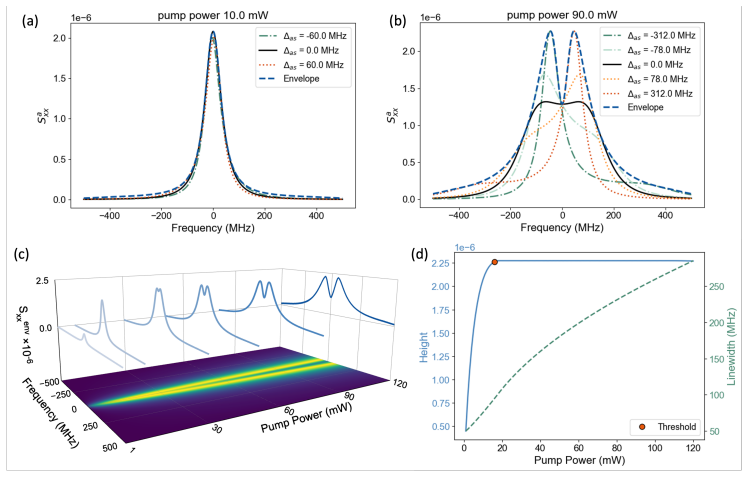
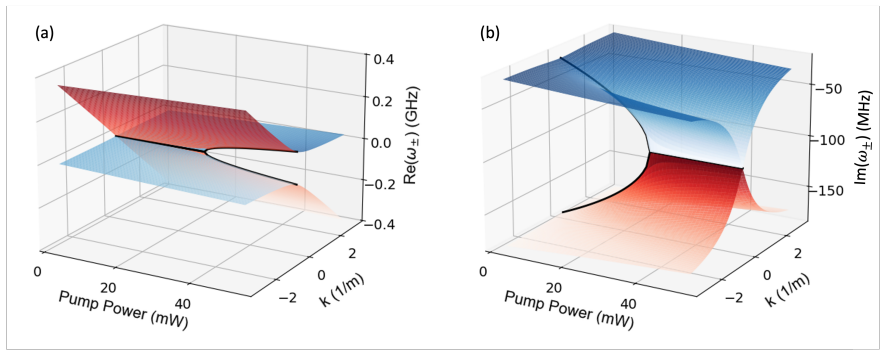
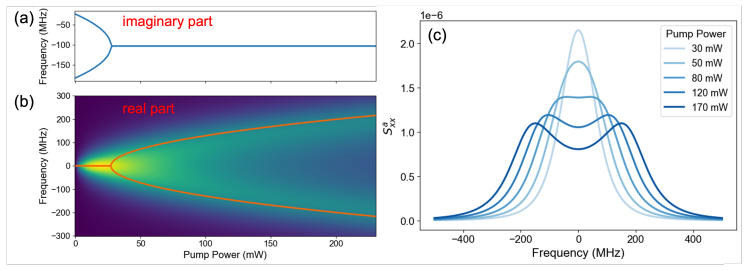
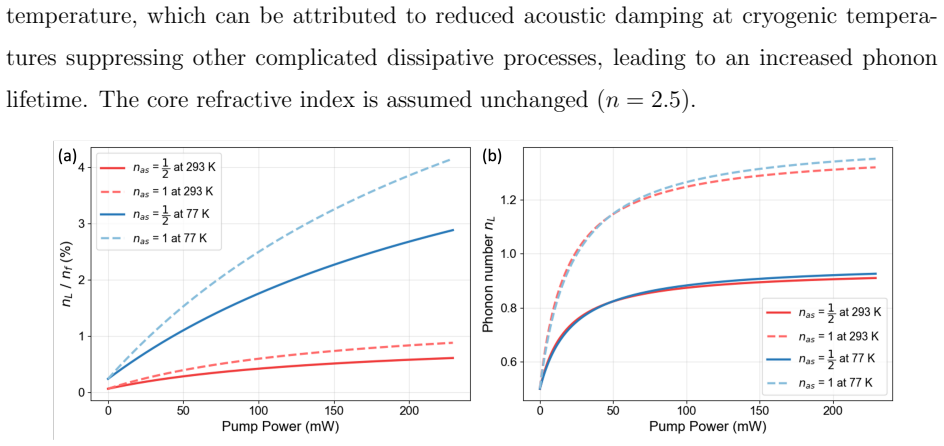
The steady final phonon occupation in waveguide optomechanical systems based on backward stimulated Brillouin-Mandelstam scattering has not been established in the strong-coupling regime. In this work, the displacement spectra of anti-Stokes optical modes and acoustic modes in tapered chalcogenide photonic crystal fiber are derived from the Lindblad (or Gorini-Kossakowski-Sudarshan-Lindblad) master equation. By analyzing the full spectral response, we indicate that the system can enter the strong-coupling regime through the emergence of normal-mode splitting and avoided crossings. Within a non-Hermitian framework, the threshold for strong coupling is identified, showing that it can be achieved at relatively low pump power even at room temperature. Furthermore, we derive a unified analytical expression for the final phonon occupation, revealing that quantum backaction and zero-point fluctuations impose additional fundamental limits that hinder the achievement of ground-state cooling. These results redefine the quantum limits of steady-state cooling in continuum optomechanics, motivating the search for new strategies to access the quantum ground-state of macroscopic phonons.
Editorial analysis
A structured set of objections, weighed in public.
Referee Report
Summary. The paper derives displacement spectra of anti-Stokes optical and acoustic modes from the Lindblad master equation in tapered chalcogenide photonic crystal fiber systems based on backward stimulated Brillouin-Mandelstam scattering. It analyzes the full spectral response to identify entry into the strong-coupling regime via normal-mode splitting and avoided crossings within a non-Hermitian framework (achievable at low pump power even at room temperature), and derives a unified analytical expression for the final phonon occupation, concluding that quantum backaction and zero-point fluctuations impose additional fundamental limits that prevent ground-state cooling of traveling hypersound phonons.
Significance. If the central derivation holds, the work redefines the quantum limits of steady-state cooling in continuum optomechanics by identifying previously unaccounted barriers from backaction and fluctuations, providing a parameter-free analytical expression that could motivate new experimental strategies for macroscopic phonon ground states.
major comments (1)
- [Abstract / spectral response analysis] Abstract and section on spectral response / non-Hermitian threshold: The displacement spectra are obtained from the Lindblad master equation (which assumes Markovian bath and weak-to-intermediate coupling) and asserted to remain valid for computing steady-state phonon occupation after the system enters the strong-coupling regime, where the threshold is located by normal-mode splitting in the separate non-Hermitian framework. No explicit verification or matching is described showing that the Lindblad spectra reproduce the correct occupation once the non-Hermitian eigenvalues exhibit splitting and avoided crossings; this matching is load-bearing for the unified expression and the claimed additional limits.
minor comments (1)
- [Abstract] The claim that strong coupling occurs at 'relatively low pump power even at room temperature' would benefit from a specific numerical threshold or direct comparison to experimental parameters in prior Brillouin optomechanics work.
Simulated Author's Rebuttal
We thank the referee for their detailed and insightful comments on our manuscript. We address the major comment point by point below, providing clarifications and indicating where revisions will be made to improve the presentation and rigor of our analysis.
read point-by-point responses
-
Referee: [Abstract / spectral response analysis] Abstract and section on spectral response / non-Hermitian threshold: The displacement spectra are obtained from the Lindblad master equation (which assumes Markovian bath and weak-to-intermediate coupling) and asserted to remain valid for computing steady-state phonon occupation after the system enters the strong-coupling regime, where the threshold is located by normal-mode splitting in the separate non-Hermitian framework. No explicit verification or matching is described showing that the Lindblad spectra reproduce the correct occupation once the non-Hermitian eigenvalues exhibit splitting and avoided crossings; this matching is load-bearing for the unified expression and the claimed additional limits.
Authors: We appreciate the referee's careful scrutiny of the methodological consistency between the Lindblad master equation approach and the non-Hermitian framework. The displacement spectra, including the steady-state phonon occupation, are computed directly from the Lindblad master equation, which provides the full quantum treatment of the open system dynamics under the Markovian approximation. The normal-mode splitting and avoided crossings are observed in these spectra as the pump power increases, serving as direct evidence of entering the strong-coupling regime within the same model. The non-Hermitian framework is utilized separately to derive an analytical expression for the threshold at which this splitting occurs, based on the effective non-Hermitian Hamiltonian. While we acknowledge that the Lindblad equation is typically derived under weak system-bath coupling, it remains a standard and valid tool for analyzing optomechanical systems even when the coherent optomechanical coupling exceeds the decay rates, as long as the bath correlations decay rapidly. To explicitly address the concern regarding verification, we will revise the manuscript to include a direct comparison in an appendix, showing that the phonon occupation extracted from the Lindblad spectra aligns with the expectations from the non-Hermitian eigenvalues in the strong-coupling regime, thereby supporting the unified analytical expression. revision: yes
Circularity Check
Derivation chain is self-contained with no circular reductions
full rationale
The paper derives displacement spectra and phonon occupation from the Lindblad master equation, identifies strong-coupling threshold via normal-mode splitting in a non-Hermitian framework, and obtains a unified analytical expression for final occupation. No quoted step reduces a prediction to a fitted parameter by construction, renames a known result, or relies on a load-bearing self-citation whose content is unverified. The central claims rest on standard master-equation methods applied to the optomechanical system; the non-Hermitian analysis serves as an auxiliary diagnostic rather than a self-referential justification. This matches the default expectation of no significant circularity.
Axiom & Free-Parameter Ledger
axioms (2)
- domain assumption The system dynamics are captured by the Lindblad (Gorini-Kossakowski-Sudarshan-Lindblad) master equation
- domain assumption Normal-mode splitting and avoided crossings in the non-Hermitian spectrum reliably identify the strong-coupling threshold
Reference graph
Works this paper leans on
-
[1]
C. Whittle, E. D. Hall, S. Dwyer, N. Mavalvala, V. Sudhir, R. Abbott, A. Ananyeva, C. Austin, L. Barsotti, J. Betzwieser,et al., Approaching the motional ground state of a 10-kg object, Science372, 1333 (2021)
work page 2021
-
[2]
S. Gras, H. Yu, W. Yam, D. Martynov, and M. Evans, Audio-band coating thermal noise measurement for advanced LIGO with a multimode optical resonator, Physical Review D95, 022001 (2017)
work page 2017
- [3]
-
[4]
G. Gonz´ alez, Suspensions thermal noise in the LIGO gravitational wave detector, Classical and Quantum Gravity17, 4409 (2000)
work page 2000
-
[5]
J. T. Reilly, S. B. J¨ager, J. Cooper, and M. J. Holland, Fully collective superradiant lasing with vanishing sensitivity to cavity length vibrations, Physical Review Letters136, 143803 (2026)
work page 2026
- [6]
-
[7]
A. D. Ludlow, M. M. Boyd, J. Ye, E. Peik, and P. O. Schmidt, Optical atomic clocks, Reviews of Modern Physics87, 637 (2015)
work page 2015
-
[8]
T. Kessler, C. Hagemann, C. Grebing, T. Legero, U. Sterr, F. Riehle, M. Martin, L. Chen, and J. Ye, A sub-40-mHz-linewidth laser based on a silicon single-crystal optical cavity, Nature 21 Photonics6, 687 (2012)
work page 2012
-
[9]
S. Bize, P. Laurent, M. Abgrall, H. Marion, I. Maksimovic, L. Cacciapuoti, J. Gr¨ unert, C. Vian, F. P. d. Santos, P. Rosenbusch,et al., Cold atom clocks and applications, Journal of Physics B: Atomic, Molecular and Optical physics38, S449 (2005)
work page 2005
-
[10]
M. Odeh, K. Godeneli, E. Li, R. Tangirala, H. Zhou, X. Zhang, Z.-H. Zhang, and A. Sipahigil, Non-markovian dynamics of a superconducting qubit in a phononic bandgap, Nature Physics 21, 406 (2025)
work page 2025
-
[11]
L. Bassman Oftelie, A. De Pasquale, and M. Campisi, Dynamic cooling on contemporary quantum computers, PRX Quantum5, 030309 (2024)
work page 2024
-
[12]
M. Fabrikant, P. Lauria, I. Madjarov, W. Burton, and R. Sutherland, Cooling trapped ions with phonon rapid adiabatic passage, Physical Review X14, 041046 (2024)
work page 2024
-
[13]
J.-J. Feng, B. Wu, and F. Wilczek, Quantum computing by coherent cooling, Physical Review A105, 052601 (2022)
work page 2022
-
[14]
P. Koppinen and I. Maasilta, Phonon cooling of nanomechanical beams with tunnel junctions, Physical Review Letters102, 165502 (2009)
work page 2009
-
[15]
J. Wei, D. Olaya, B. S. Karasik, S. V. Pereverzev, A. V. Sergeev, and M. E. Gershenson, Ultrasensitive hot-electron nanobolometers for terahertz astrophysics, Nature Nanotechnology 3, 496 (2008)
work page 2008
-
[16]
E. Clements, F. W. Knollmann, S. Corsetti, Z. Li, A. Hattori, M. Notaros, R. Swint, T. Sneh, M. E. Kim, A. D. Leu,et al., Sub-doppler cooling of a trapped ion in a phase-stable polarization gradient, Physical Review Letters136, 023201 (2026)
work page 2026
-
[17]
J. D. Teufel, T. Donner, D. Li, J. W. Harlow, M. Allman, K. Cicak, A. J. Sirois, J. D. Whittaker, K. W. Lehnert, and R. W. Simmonds, Sideband cooling of micromechanical motion to the quantum ground state, Nature475, 359 (2011)
work page 2011
-
[18]
R. Riviere, S. Deleglise, S. Weis, E. Gavartin, O. Arcizet, A. Schliesser, and T. J. Kippenberg, Optomechanical sideband cooling of a micromechanical oscillator close to the quantum ground state, Physical Review A83, 063835 (2011)
work page 2011
- [19]
-
[20]
K. M. Birnbaum, A. Boca, R. Miller, A. D. Boozer, T. E. Northup, and H. J. Kimble, Photon blockade in an optical cavity with one trapped atom, Nature436, 87 (2025). 22
work page 2025
-
[21]
H. H. Diamandi, Y. Luo, D. Mason, T. B. Kanmaz, S. Ghosh, M. Pavlovich, T. Yoon, R. Be- hunin, S. Puri, J. G. Harris,et al., Optomechanical control of long-lived bulk acoustic phonons in the quantum regime, Nature Physics21, 1482 (2025)
work page 2025
-
[22]
W. Marshall, C. Simon, R. Penrose, and D. Bouwmeester, Towards quantum superpositions of a mirror, Physical Review Letters91, 130401 (2003)
work page 2003
-
[23]
A. Ferreri, D. E. Bruschi, F. K. Wilhelm, F. Nori, and V. Macr` ı, Phonon-photon conversion as mechanism for cooling and coherence transfer, Physical Review Research6, 023320 (2024)
work page 2024
-
[24]
M. Aspelmeyer, T. J. Kippenberg, and F. Marquardt, Cavity optomechanics, Reviews of Modern Physics86, 1391 (2014)
work page 2014
-
[25]
V. Braginski and A. Manukin, Ponderomotive effects of electromagnetic radiation, Sov. Phys. JETP25, 653 (1967)
work page 1967
- [26]
-
[27]
T. J. Kippenberg and K. J. Vahala, Cavity optomechanics: back-action at the mesoscale, Science321, 1172 (2008)
work page 2008
-
[28]
F. Marquardt, J. P. Chen, A. A. Clerk, and S. Girvin, Quantum theory of cavity-assisted sideband cooling of mechanical motion, Physical Review Letters99, 093902 (2007)
work page 2007
-
[29]
I. Wilson-Rae, N. Nooshi, W. Zwerger, and T. J. Kippenberg, Theory of ground state cooling of a mechanical oscillator using dynamical backaction, Physical Review Letters99, 093901 (2007)
work page 2007
-
[30]
J. M. Dobrindt, I. Wilson-Rae, and T. J. Kippenberg, Parametric normal-mode splitting in cavity optomechanics, Physical Review Letters101, 263602 (2008)
work page 2008
-
[31]
I. Wilson-Rae, N. Nooshi, J. Dobrindt, T. J. Kippenberg, and W. Zwerger, Cavity-assisted backaction cooling of mechanical resonators, New Journal of Physics10, 095007 (2008)
work page 2008
-
[32]
Y.-C. Chen, S. Kim, and G. Bahl, Brillouin cooling in a linear waveguide, New Journal of Physics18, 115004 (2016)
work page 2016
- [33]
-
[34]
N. T. Otterstrom, R. O. Behunin, E. A. Kittlaus, and P. T. Rakich, Optomechanical cooling in a continuous system, Physical Review X8, 041034 (2018)
work page 2018
-
[35]
J. N. Johnson, D. R. Haverkamp, Y.-H. Ou, K. Kieu, N. T. Otterstrom, P. T. Rakich, and 23 R. O. Behunin, Laser cooling of traveling-wave phonons in an optical fiber, Physical Review Applied20, 034047 (2023)
work page 2023
-
[36]
L. Bl´ azquez Mart´ ınez, P. Wiedemann, C. Zhu, A. Geilen, and B. Stiller, Optoacoustic cooling of traveling hypersound waves, Physical Review Letters132, 023603 (2024)
work page 2024
- [37]
-
[38]
R. G. Smith, Optical power handling capacity of low loss optical fibers as determined by stimulated Raman and Brillouin scattering, Applied Optics11, 2489 (1972)
work page 1972
-
[39]
G. P. Agrawal, Nonlinear fiber optics (Elsevier Science, 2013) Chap. 9.2, 5th ed
work page 2013
-
[40]
M.-A. Miri and A. Alu, Exceptional points in optics and photonics, Science363, eaar7709 (2019)
work page 2019
-
[41]
C. Wang, Z. Fu, W. Mao, J. Qie, A. D. Stone, and L. Yang, Non-Hermitian optics and photonics: from classical to quantum, Advances in Optics and Photonics15, 442 (2023)
work page 2023
- [42]
-
[43]
R. El-Ganainy, K. G. Makris, M. Khajavikhan, Z. H. Musslimani, S. Rotter, and D. N. Christodoulides, Non-Hermitian physics and PT symmetry, Nature Physics14, 11 (2018)
work page 2018
- [44]
-
[45]
L. Fischer, L. Bl´ azquez Mart´ ınez, C. Zhu, R. Chenevi` ere, J. Troles, and B. Stiller, Brillouin– Mandelstam scattering-based cooling of traveling acoustic waves from cryogenic temperatures, Optics Letters51, 121 (2025)
work page 2025
-
[46]
H.-P. Breuer and F. Petruccione, The theory of open quantum systems (Oxford University Press, 2002) Chap. 3
work page 2002
-
[47]
F. Nathan and M. S. Rudner, Universal lindblad equation for open quantum systems, Physical Review B102, 115109 (2020)
work page 2020
-
[48]
D. Tomasella, S. Tarrago Velez, S. B. Nielsen, J. Van der Heijden, U. B. Hoff, and U. L. An- dersen, Strong optomechanical coupling at room temperature with a centimeter-scale quartz crystal, Physical Review Applied23, 054024 (2025)
work page 2025
-
[49]
R. Van Laer, R. Baets, and D. Van Thourhout, Unifying Brillouin scattering and cavity optomechanics, Physical Review A93, 053828 (2016). 24
work page 2016
-
[50]
J. Yang, Y. Huang, Y. Wang, L. Chen, and X. Bao, Optical frequency-dependent opposite effective acoustic velocity dispersion in stimulated Brillouin scattering, APL Photonics10 (2025)
work page 2025
-
[51]
G. S. Agarwal and S. S. Jha, Multimode phonon cooling via three-wave parametric interactions with optical fields, Physical Review A88, 013815 (2013). 25
work page 2013
discussion (0)
Sign in with ORCID, Apple, or X to comment. Anyone can read and Pith papers without signing in.