The Road to Identifying the Earliest Radio-Powerful AGN with the SKA
Pith reviewed 2026-07-03 08:33 UTC · model grok-4.3
The pith
The SKAO's fine-frequency sampling from 50 MHz to 15 GHz will identify the substantial population of radio-powerful AGN in the Epoch of Reionization predicted by simulations.
A machine-rendered reading of the paper's core claim, the machinery that carries it, and where it could break.
Core claim
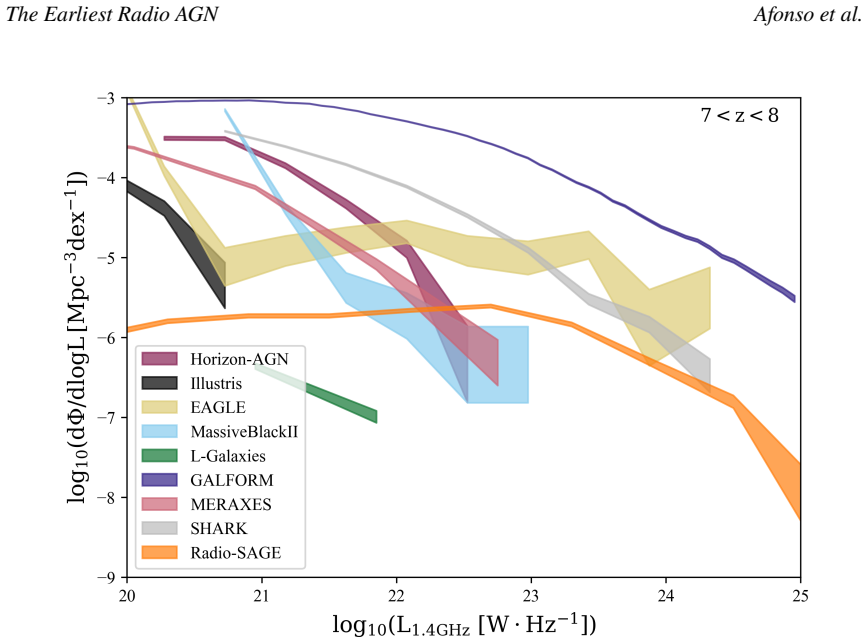
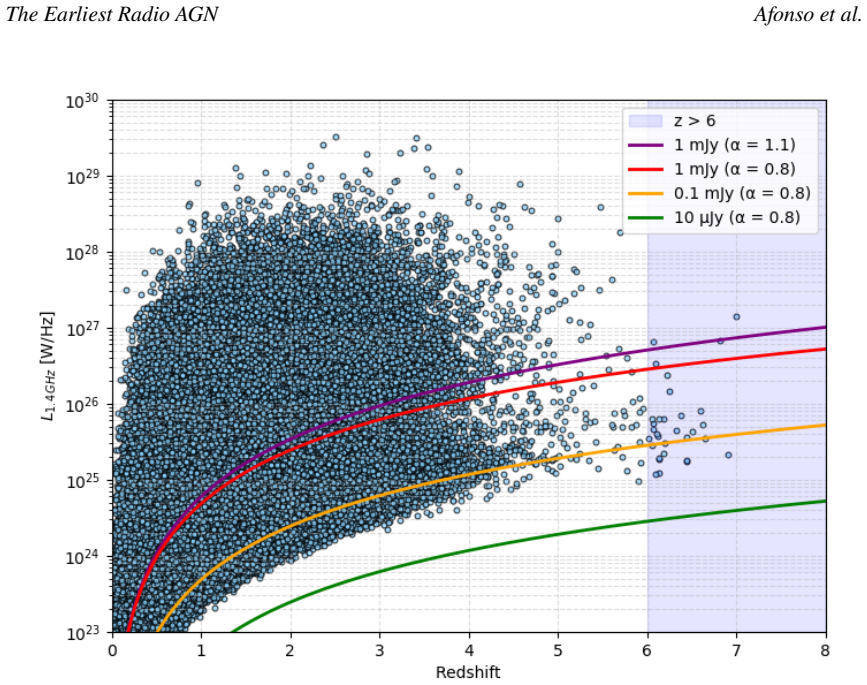
Simulations predict a substantial undetected population of radio-powerful AGN in the Epoch of Reionization, but current surveys are limited by selection biases and incomplete spectral information; the sensitivity and spectral coverage of the SKAO across 50 MHz to 15 GHz will allow fine-frequency sampling that enables identification of these sources through physically motivated radio properties rather than empirical methods.
What carries the argument
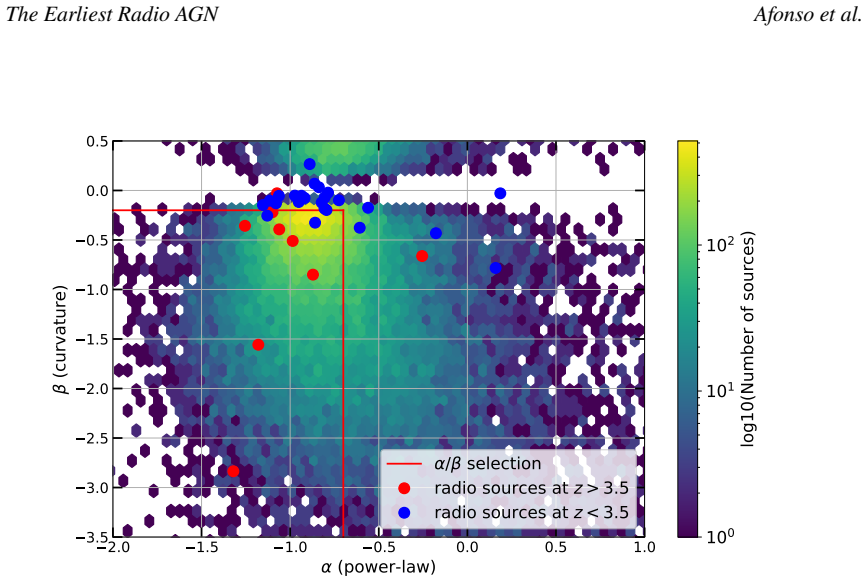
Broadband radio spectral energy distributions combined with spectral curvature, dynamical jet evolution, and radio-only redshift estimation, which together form a selection strategy for high-redshift radio AGN.
If this is right
- Many more radio-powerful AGN at z greater than 6 will become detectable, directly constraining models of early black hole accretion.
- Radio-only redshift estimation will become viable for sources lacking optical or infrared counterparts.
- 21-cm absorption studies against these AGN will probe neutral hydrogen in the Epoch of Reionization.
- The approach replaces traditional empirical selection with one based on physical radio properties such as spectral curvature and jet evolution.
- A large statistical sample of early radio AGN will become available for studying supermassive black hole growth.
Where Pith is reading between the lines
- Successful application could allow radio data alone to map the duty cycle of the earliest AGN feedback without relying on multi-wavelength detections.
- The same spectral sampling might reveal whether radio-loud phases are common even among lower-luminosity black holes at these redshifts.
- Extending the method to lower frequencies or higher redshifts could test whether the predicted population extends further into the cosmic dawn.
- It would provide an independent check on whether the rapid growth of 10^9 solar mass black holes by z approximately 7 requires revisions to seeding or accretion models.
Load-bearing premise
The gap between simulation predictions and the small number of known z greater than 6 radio AGN arises mainly from selection biases and incomplete spectral data rather than from the intrinsic absence of such objects.
What would settle it
A deep SKAO survey across the 50 MHz to 15 GHz range that still finds no significant increase in the number of radio-powerful AGN at z greater than 6 would show the central claim is incorrect.
Figures
read the original abstract
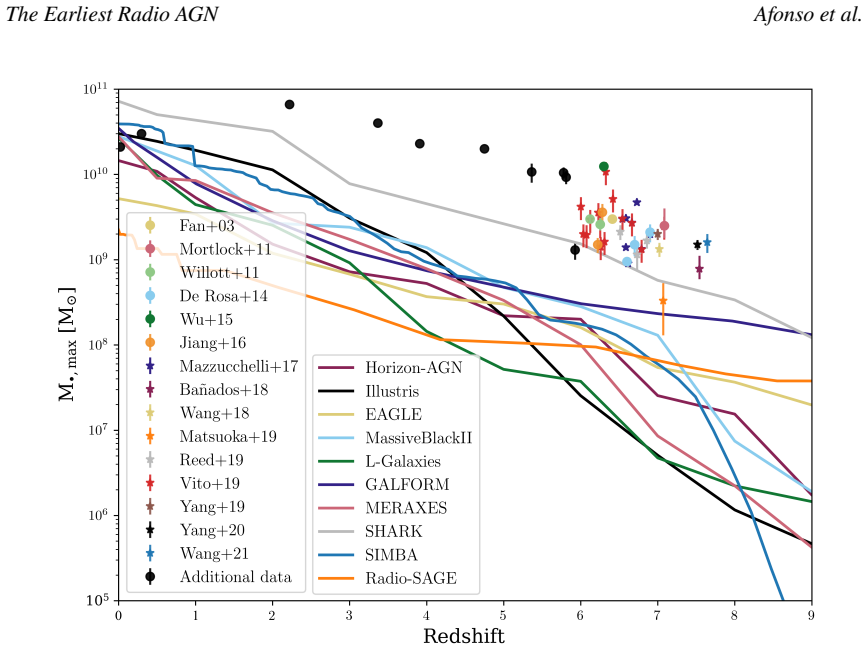
The Epoch of Reionization (EoR) is one of the most pivotal frontiers in modern astrophysics, marking the emergence of the first galaxies, stars, and supermassive black holes (SMBHs). Despite insights from the Atacama Large Millimetre/submillimetre Array and the James Webb Space Telescope, we still struggle to explain how $\sim10^{9}$ M$_\odot$ SMBHs powering luminous active galactic nuclei (AGN) already exist by $z\sim7$. The recent discovery of powerful radio emission from some of these early AGN is notable, offering new constraints on early black-hole accretion and, with the Square Kilometre Array Observatory (SKAO), the prospect of directly probing neutral hydrogen through 21-cm absorption studies. Yet progress remains slow: only a few radio-powerful AGN are known at $z>6$, far fewer than theoretical predictions suggest, raising questions about whether this reflects intrinsic properties or selection biases and incomplete spectral information. In this chapter we synthesise predictions from state-of-the-art hydrodynamical and semi-analytic simulations with observational constraints from SKAO pathfinder facilities. These models suggest the existence of a substantial, still-undetected population of radio-powerful AGN in the EoR, but show that present surveys are limited by selection biases and incomplete radio spectral information. We discuss a physically motivated strategy for identifying high-redshift radio AGN, based on broadband radio spectral energy distributions, spectral curvature, dynamical jet evolution, and radio-only redshift estimation, offering a transformative alternative to traditional empirical approaches. Finally, we justify how the sensitivity and spectral coverage of the SKAO will allow fine-frequency sampling across the 50 MHz - 15 GHz range, revolutionising our ability to identify the earliest radio-powerful AGN and probe the earliest SMBHs.
Editorial analysis
A structured set of objections, weighed in public.
Referee Report
Summary. The manuscript synthesizes predictions from hydrodynamical and semi-analytic simulations with SKAO pathfinder constraints to argue that only a few radio-powerful AGN are known at z>6 because of selection biases and incomplete spectral information, rather than intrinsic rarity. It proposes a physically motivated identification strategy based on broadband radio SEDs, spectral curvature, dynamical jet evolution, and radio-only redshift estimation, and concludes that SKAO's sensitivity and 50 MHz–15 GHz coverage will enable fine-frequency sampling to detect this population and study early SMBHs via 21-cm absorption.
Significance. If the proposed radio-only identification methods are validated, the work supplies a clear observational roadmap that could substantially increase the known sample of EoR radio AGN, complementing JWST and ALMA results on early SMBH growth. The explicit linkage of simulation outputs to concrete SKAO capabilities (frequency sampling, sensitivity) is a constructive contribution to survey strategy planning.
minor comments (3)
- Abstract: the statement that 'only a few radio-powerful AGN are known at z>6' should be accompanied by the precise count and the references used to establish that number.
- The section outlining the identification strategy: a worked example or schematic of how spectral curvature plus radio-only redshift estimation would separate z>6 sources from lower-redshift contaminants would strengthen the presentation.
- Throughout: ensure consistent terminology between 'SKA' in the title and 'SKAO' in the text.
Simulated Author's Rebuttal
We thank the referee for their positive and constructive assessment of the manuscript, including the accurate summary of our synthesis of simulations and pathfinder data, and for recommending minor revision. The significance statement correctly identifies the potential value of the proposed radio-only identification strategy for expanding the sample of EoR radio AGN.
Circularity Check
No significant circularity detected
full rationale
The paper is a synthesis of external hydrodynamical/semi-analytic simulations and SKAO pathfinder data arguing that current low detection rates of z>6 radio AGN reflect selection biases and incomplete spectral coverage rather than intrinsic rarity. The central instrumental claim (fine-frequency sampling across 50 MHz–15 GHz enabling radio-only redshift/SED methods) follows directly from stated SKAO specifications and does not reduce to any fitted parameter, self-citation chain, or ansatz internal to the paper. No load-bearing step equates a prediction to its own input by construction, and all cited models are presented as independent external benchmarks.
Axiom & Free-Parameter Ledger
Reference graph
Works this paper leans on
-
[1]
2019 , eprint=
Anticipated Performance of the Square Kilometre Array -- Phase 1 (SKA1) , author=. 2019 , eprint=
2019
-
[2]
2015 , publisher=
Advancing Astrophysics with the Square Kilometre Array (AASKA14) , author=. 2015 , publisher=
2015
-
[3]
The Dark Energy Survey Data Release 2. , keywords =. doi:10.3847/1538-4365/ac00b3 , archivePrefix =. 2101.05765 , primaryClass =
-
[4]
Identifying the first generation of radio powerful AGN in the Universe with the SKA
Identifying the first generation of radio powerful AGN in the Universe with the SKA. Advancing Astrophysics with the Square Kilometre Array (AASKA14) , year = 2015, month = apr, eid =. doi:10.22323/1.215.0071 , archivePrefix =. 1412.6040 , primaryClass =
work page internal anchor Pith review Pith/arXiv arXiv doi:10.22323/1.215.0071 2015
-
[5]
The first Super Massive Black Holes: indications from models for future observations
The first supermassive black holes: indications from models for future observations. , keywords =. doi:10.1093/mnras/stz551 , archivePrefix =. 1902.07982 , primaryClass =
work page internal anchor Pith review Pith/arXiv arXiv doi:10.1093/mnras/stz551 1902
-
[6]
Nature Communications , keywords =
Evolving parsec-scale radio structure in the most distant blazar known. Nature Communications , keywords =. doi:10.1038/s41467-019-14093-2 , archivePrefix =. 2001.02809 , primaryClass =
-
[7]
Extragalactic Radio Sources , year = 1982, editor =
Evolutionary tracks of extended radio sources. Extragalactic Radio Sources , year = 1982, editor =
1982
-
[8]
Discovery of eight z ~ 6 quasars from Pan-STARRS1
Discovery of Eight z -0.5ex 6 Quasars from Pan-STARRS1. , keywords =. doi:10.1088/0004-6256/148/1/14 , archivePrefix =. 1405.3986 , primaryClass =
work page internal anchor Pith review Pith/arXiv arXiv doi:10.1088/0004-6256/148/1/14
-
[9]
The Pan-STARRS1 Distant z > 5.6 Quasar Survey: More than 100 Quasars within the First Gyr of the Universe. , keywords =. doi:10.3847/0067-0049/227/1/11 , archivePrefix =. 1608.03279 , primaryClass =
work page internal anchor Pith review Pith/arXiv arXiv doi:10.3847/0067-0049/227/1/11
-
[10]
An 800-million-solar-mass black hole in a significantly neutral Universe at redshift 7.5
An 800-million-solar-mass black hole in a significantly neutral Universe at a redshift of 7.5. , keywords =. doi:10.1038/nature25180 , archivePrefix =. 1712.01860 , primaryClass =
work page internal anchor Pith review Pith/arXiv arXiv doi:10.1038/nature25180
-
[11]
The Discovery of a Highly Accreting, Radio-loud Quasar at z = 6.82. , keywords =. doi:10.3847/1538-4357/abe239 , archivePrefix =. 2103.03295 , primaryClass =
-
[12]
Nature Astronomy , year = 2025, month = feb, volume =
A blazar in the epoch of reionization. Nature Astronomy , year = 2025, month = feb, volume =. doi:10.1038/s41550-024-02431-4 , adsurl =
-
[13]
In the Beginning: The First Sources of Light and the Reionization of the Universe
In the beginning: the first sources of light and the reionization of the universe. , keywords =. doi:10.1016/S0370-1573(01)00019-9 , archivePrefix =. astro-ph/0010468 , primaryClass =
work page internal anchor Pith review Pith/arXiv arXiv doi:10.1016/s0370-1573(01)00019-9
-
[14]
Astronomical Data Analysis Software and Systems III , year = 1994, editor =
The VLA's FIRST Survey. Astronomical Data Analysis Software and Systems III , year = 1994, editor =
1994
-
[15]
The first blazar observed at z > 6. , keywords =. doi:10.1051/0004-6361/201937395 , archivePrefix =. 2002.05178 , primaryClass =
-
[16]
I: A semi-analytical model for the evolution of radio galaxies
AGN hosting jets. I: A semi-analytical model for the evolution of radio galaxies. arXiv e-prints , keywords =. doi:10.48550/arXiv.2509.24939 , archivePrefix =. 2509.24939 , primaryClass =
-
[17]
Relativistic jet feedback - II. Relationship to gigahertz peak spectrum and compact steep spectrum radio galaxies. , keywords =. doi:10.1093/mnras/sty070 , archivePrefix =. 1801.06518 , primaryClass =
work page internal anchor Pith review Pith/arXiv arXiv doi:10.1093/mnras/sty070
-
[18]
A new sample of high-redshift radio galaxy candidates
The GLEAMing of the first supermassive black holes: II. A new sample of high-redshift radio galaxy candidates. , keywords =. doi:10.1017/pasa.2022.42 , archivePrefix =. 2204.08490 , primaryClass =
-
[19]
The space density of z>4 blazars
The space density of z > 4 blazars. , keywords =. doi:10.1093/mnras/sty3526 , archivePrefix =. 1901.02910 , primaryClass =
work page internal anchor Pith review Pith/arXiv arXiv doi:10.1093/mnras/sty3526 1901
-
[20]
Obscuration in high-redshift jetted quasi-stellar objects. , keywords =. doi:10.1051/0004-6361/202348561 , archivePrefix =. 2402.01835 , primaryClass =
-
[21]
Extragalactic Peaked-Spectrum Radio Sources at Low Frequencies
Extragalactic Peaked-spectrum Radio Sources at Low Frequencies. , keywords =. doi:10.3847/1538-4357/836/2/174 , archivePrefix =. 1701.02771 , primaryClass =
work page internal anchor Pith review Pith/arXiv arXiv doi:10.3847/1538-4357/836/2/174
-
[22]
Observations of HI 21-cm absorption by the neutral IGM during the epoch of re-ionization with the Square Kilometer Array. , keywords =. doi:10.1016/j.newar.2004.09.027 , archivePrefix =. astro-ph/0409311 , primaryClass =
work page internal anchor Pith review Pith/arXiv arXiv doi:10.1016/j.newar.2004.09.027 2004
-
[23]
Spectroscopic confirmation of two luminous galaxies at a redshift of 14. , keywords =. doi:10.1038/s41586-024-07860-9 , archivePrefix =. 2405.18485 , primaryClass =
-
[24]
The eventful life of a luminous galaxy at z = 14: metal enrichment, feedback, and low gas fraction?. , keywords =. doi:10.1051/0004-6361/202452451 , archivePrefix =. 2409.20533 , primaryClass =
-
[25]
A relationship between AGN jet power and radio power
A Relationship Between AGN Jet Power and Radio Power. , keywords =. doi:10.1088/0004-637X/720/2/1066 , archivePrefix =. 1006.5699 , primaryClass =
work page internal anchor Pith review Pith/arXiv arXiv doi:10.1088/0004-637x/720/2/1066
-
[26]
The Pan-STARRS1 Surveys. arXiv e-prints , keywords =. doi:10.48550/arXiv.1612.05560 , archivePrefix =. 1612.05560 , primaryClass =
work page internal anchor Pith review Pith/arXiv arXiv doi:10.48550/arxiv.1612.05560
-
[27]
High-resolution observations of low-luminosity gigahertz-peaked spectrum and compact steep-spectrum sources. , keywords =. doi:10.1093/mnras/sty564 , archivePrefix =. 1802.09666 , primaryClass =
work page internal anchor Pith review Pith/arXiv arXiv doi:10.1093/mnras/sty564
-
[28]
The NRAO VLA Sky Survey. , keywords =. doi:10.1086/300337 , adsurl =
-
[29]
On the nature of bright compact radio sources at z>4.5
On the nature of bright compact radio sources at z > 4.5. , keywords =. doi:10.1093/mnras/stw2236 , archivePrefix =. 1609.00575 , primaryClass =
work page internal anchor Pith review Pith/arXiv arXiv doi:10.1093/mnras/stw2236
-
[30]
Unveiling faint X-ray AGN populations in the NewAthena era: insights from cosmological simulations. , keywords =. doi:10.1093/mnras/staf993 , archivePrefix =. 2504.10731 , primaryClass =
-
[31]
Semi-Analytic Galaxy Evolution (SAGE): Model Calibration and Basic Results
Semi-Analytic Galaxy Evolution (SAGE): Model Calibration and Basic Results. , keywords =. doi:10.3847/0067-0049/222/2/22 , archivePrefix =. 1601.04709 , primaryClass =
work page internal anchor Pith review Pith/arXiv arXiv doi:10.3847/0067-0049/222/2/22
-
[32]
Spectroscopic confirmation of four metal-poor galaxies at z = 10.3-13.2. Nature Astronomy , keywords =. doi:10.1038/s41550-023-01918-w , archivePrefix =. 2212.04568 , primaryClass =
-
[33]
Simba: Cosmological Simulations with Black Hole Growth and Feedback
SIMBA: Cosmological simulations with black hole growth and feedback. , keywords =. doi:10.1093/mnras/stz937 , archivePrefix =. 1901.10203 , primaryClass =
work page internal anchor Pith review Pith/arXiv arXiv doi:10.1093/mnras/stz937 1901
-
[34]
An ALMA [CII] survey of 27 quasars at z>5.94
An ALMA [C II] Survey of 27 Quasars at z > 5.94. , keywords =. doi:10.3847/1538-4357/aaa5aa , archivePrefix =. 1801.02641 , primaryClass =
work page internal anchor Pith review Pith/arXiv arXiv doi:10.3847/1538-4357/aaa5aa
-
[35]
A Sample of 669 Ultra Steep Spectrum Radio Sources to Find High Redshift Radio Galaxies
A sample of 669 ultra steep spectrum radio sources to find high redshift radio galaxies. , keywords =. doi:10.1051/aas:2000181 , archivePrefix =. astro-ph/0002297 , primaryClass =
work page internal anchor Pith review Pith/arXiv arXiv doi:10.1051/aas:2000181
-
[36]
VLBI observations of the CORALZ sample: young radio sources at low redshift
VLBI observations of the CORALZ sample: young radio sources at low redshift. , keywords =. doi:10.1051/0004-6361/200811145 , archivePrefix =. 0901.2124 , primaryClass =
work page internal anchor Pith review Pith/arXiv arXiv doi:10.1051/0004-6361/200811145
-
[37]
Cold flows and the first quasars
Cold Flows and the First Quasars. , keywords =. doi:10.1088/2041-8205/745/2/L29 , archivePrefix =. 1107.1253 , primaryClass =
work page internal anchor Pith review Pith/arXiv arXiv doi:10.1088/2041-8205/745/2/l29 2041
-
[38]
The evolution of the heaviest supermassive black holes in jetted AGNs. , keywords =. doi:10.1093/mnras/stac364 , archivePrefix =. 2202.03444 , primaryClass =
-
[39]
The abundance of z 10 galaxy candidates in the HUDF using deep JWST NIRCam medium-band imaging. , keywords =. doi:10.1093/mnras/stad471 , archivePrefix =. 2212.10126 , primaryClass =
-
[40]
Rapidly growing black holes and host galaxies in the distant Universe from the Herschel Radio Galaxy Evolution Project. , keywords =. doi:10.1051/0004-6361/201323310 , archivePrefix =. 1404.1080 , primaryClass =
work page internal anchor Pith review Pith/arXiv arXiv doi:10.1051/0004-6361/201323310
-
[41]
The GLEAMing of the first supermassive black holes. , keywords =. doi:10.1017/pasa.2020.6 , archivePrefix =. 2111.08104 , primaryClass =
-
[42]
Dancing in the dark: galactic properties trace spin swings along the cosmic web
Dancing in the dark: galactic properties trace spin swings along the cosmic web. , keywords =. doi:10.1093/mnras/stu1227 , archivePrefix =. 1402.1165 , primaryClass =
work page internal anchor Pith review Pith/arXiv arXiv doi:10.1093/mnras/stu1227
-
[43]
The Messenger , year = 2013, month = dec, volume =
The VISTA Kilo-degree Infrared Galaxy (VIKING) Survey: Bridging the Gap between Low and High Redshift. The Messenger , year = 2013, month = dec, volume =
2013
-
[44]
ALMA confirmation of an obscured hyperluminous radio-loud AGN at z = 6.853 associated with a dusty starburst in the 1.5 deg ^ 2 COSMOS field. , keywords =. doi:10.1093/mnras/stad266 , archivePrefix =. 2206.00018 , primaryClass =
-
[45]
Euclid preparation. I. The Euclid Wide Survey. , keywords =. doi:10.1051/0004-6361/202141938 , archivePrefix =. 2108.01201 , primaryClass =
-
[46]
A Survey of z>5.8 Quasars in the Sloan Digital Sky Survey. I. Discovery of Three New Quasars and the Spatial Density of Luminous Quasars at z -0.5ex 6. , keywords =. doi:10.1086/324111 , archivePrefix =. astro-ph/0108063 , primaryClass =
work page internal anchor Pith review Pith/arXiv arXiv doi:10.1086/324111
-
[47]
A Survey of z>5.7 Quasars in the Sloan Digital Sky Survey. IV. Discovery of Seven Additional Quasars. , keywords =. doi:10.1086/500296 , archivePrefix =. astro-ph/0512080 , primaryClass =
work page internal anchor Pith review Pith/arXiv arXiv doi:10.1086/500296
-
[48]
Quasars and the Intergalactic Medium at Cosmic Dawn. , keywords =. doi:10.1146/annurev-astro-052920-102455 , archivePrefix =. 2212.06907 , primaryClass =
-
[49]
Grand unification of AGN activity in the CDM cosmology. , keywords =. doi:10.1111/j.1365-2966.2010.17427.x , archivePrefix =. 0911.1128 , primaryClass =
-
[50]
L., Bagley, M., Song, M., et al
A Census of the Bright z = 8.5-11 Universe with the Hubble and Spitzer Space Telescopes in the CANDELS Fields. , keywords =. doi:10.3847/1538-4357/ac3aed , archivePrefix =. 2106.13813 , primaryClass =
-
[51]
The Open Journal of Astrophysics , keywords =
The Million Quasars (Milliquas) Catalogue, v8. The Open Journal of Astrophysics , keywords =. doi:10.21105/astro.2308.01505 , archivePrefix =. 2308.01505 , primaryClass =
-
[52]
Radio-loud AGNs at high redshifts and the cosmic microwave background
Radio-loud active galactic nuclei at high redshifts and the cosmic microwave background. , keywords =. doi:10.1093/mnras/stt2394 , archivePrefix =. 1311.7147 , primaryClass =
work page internal anchor Pith review Pith/arXiv arXiv doi:10.1093/mnras/stt2394
-
[53]
SDSS J114657.79+403708.6: the third most distant blazar at z=5.0
SDSS J114657.79+403708.6: the third most distant blazar at z = 5.0. , keywords =. doi:10.1093/mnrasl/slu032 , archivePrefix =. 1402.4804 , primaryClass =
work page internal anchor Pith review Pith/arXiv arXiv doi:10.1093/mnrasl/slu032
-
[54]
Supermassive black holes at high redshift are expected to be obscured by their massive host galaxies' interstellar medium. , keywords =. doi:10.1051/0004-6361/202243708 , archivePrefix =. 2206.03508 , primaryClass =
-
[55]
Low frequency radio properties of the z > 5 quasar population. , keywords =. doi:10.1051/0004-6361/202141722 , archivePrefix =. 2110.06222 , primaryClass =
-
[56]
Discovery of 24 radio-bright quasars at 4.9 z 6.6 using low-frequency radio observations. , keywords =. doi:10.1051/0004-6361/202244763 , archivePrefix =. 2210.01811 , primaryClass =
-
[57]
The evolution of SMBH spin and AGN luminosities for z < 6 within a semi-analytic model of galaxy formation. , keywords =. doi:10.1093/mnras/stz1216 , archivePrefix =. 1806.08370 , primaryClass =
work page internal anchor Pith review Pith/arXiv arXiv doi:10.1093/mnras/stz1216
-
[58]
Co-evolution of massive black holes and their host galaxies at high redshift: discrepancies from six cosmological simulations and the key role of JWST. , keywords =. doi:10.1093/mnras/stac225 , archivePrefix =. 2201.09892 , primaryClass =
-
[59]
Synchrotron and inverse-Compton emission from radio galaxies with non-uniform magnetic field and electron distributions. , keywords =. doi:10.1093/mnras/stt1024 , archivePrefix =. 1306.1640 , primaryClass =
work page internal anchor Pith review Pith/arXiv arXiv doi:10.1093/mnras/stt1024
-
[60]
A simulation-based analytic model of radio galaxies
A simulation-based analytic model of radio galaxies. , keywords =. doi:10.1093/mnras/stx3358 , archivePrefix =. 1801.00667 , primaryClass =
work page internal anchor Pith review Pith/arXiv arXiv doi:10.1093/mnras/stx3358
-
[61]
Radio-loud AGN in the first LoTSS data release. The lifetimes and environmental impact of jet-driven sources. , keywords =. doi:10.1051/0004-6361/201833893 , archivePrefix =. 1811.07943 , primaryClass =
work page internal anchor Pith review Pith/arXiv arXiv doi:10.1051/0004-6361/201833893
-
[62]
Radio galaxies and feedback from AGN jets. , keywords =. doi:10.1016/j.newar.2020.101539 , archivePrefix =. 2003.06137 , primaryClass =
-
[63]
Hardcastle and author2 and author3 and author4 and author5 , title =
Martin J. Hardcastle and author2 and author3 and author4 and author5 , title =. 2026 , publisher =
2026
-
[64]
The onset of star formation 250 million years after the Big Bang. , keywords =. doi:10.1038/s41586-018-0117-z , archivePrefix =. 1805.05966 , primaryClass =
-
[65]
The Coevolution of Galaxies and Supermassive Black Holes: Insights from Surveys of the Contemporary Universe. , keywords =. doi:10.1146/annurev-astro-081913-035722 , archivePrefix =. 1403.4620 , primaryClass =
work page internal anchor Pith review Pith/arXiv arXiv doi:10.1146/annurev-astro-081913-035722
-
[66]
The non-linear dependence of flux on black hole mass and accretion rate in core-dominated jets. , keywords =. doi:10.1046/j.1365-8711.2003.06918.x , archivePrefix =. astro-ph/0305252 , primaryClass =
-
[67]
Galaxy formation in the Planck cosmology - I. Matching the observed evolution of star formation rates, colours and stellar masses. , keywords =. doi:10.1093/mnras/stv705 , archivePrefix =. 1410.0365 , primaryClass =
work page internal anchor Pith review Pith/arXiv arXiv doi:10.1093/mnras/stv705
-
[68]
The Evolutionary Map of the Universe: A new radio atlas for the southern hemisphere sky. , keywords =. doi:10.1017/pasa.2025.10042 , archivePrefix =. 2505.08271 , primaryClass =
-
[69]
X-ray properties of z > 4 blazars. , keywords =. doi:10.1093/mnras/stz2340 , archivePrefix =. 1908.08084 , primaryClass =
-
[70]
Radio detection of VIK J2318 - 3113, the most distant radio-loud quasar (z = 6.44). , keywords =. doi:10.1051/0004-6361/202140362 , archivePrefix =. 2101.11371 , primaryClass =
-
[71]
New radio-loud QSOs at the end of the Re-ionization epoch. , keywords =. doi:10.1093/mnras/stac3668 , archivePrefix =. 2212.06168 , primaryClass =
-
[72]
Multi-wavelength properties of three new radio-powerful z 5.6 quasi-stellar objects discovered from RACS. , keywords =. doi:10.1051/0004-6361/202451376 , archivePrefix =. 2407.04094 , primaryClass =
-
[73]
Selection, identification, and multi-wavelength properties
High-z radio quasars in RACS: I. Selection, identification, and multi-wavelength properties. , keywords =. doi:10.1051/0004-6361/202453650 , archivePrefix =. 2504.10573 , primaryClass =
-
[74]
Detection of an oxygen emission line from a high redshift galaxy in the reionization epoch
Detection of an oxygen emission line from a high-redshift galaxy in the reionization epoch. Science , keywords =. doi:10.1126/science.aaf0714 , archivePrefix =. 1606.04989 , primaryClass =
work page internal anchor Pith review Pith/arXiv arXiv doi:10.1126/science.aaf0714
-
[75]
The MeerKAT International GHz Tiered Extragalactic Exploration (MIGHTEE) Survey
The MeerKAT International GHz Tiered Extragalactic Exploration (MIGHTEE) Survey. MeerKAT Science: On the Pathway to the SKA , year = 2016, month = jan, eid =. doi:10.22323/1.277.0006 , archivePrefix =. 1709.01901 , primaryClass =
work page internal anchor Pith review Pith/arXiv arXiv doi:10.22323/1.277.0006 2016
-
[76]
The origin of the spectral versus dynamical age discrepancy in radio galaxies. arXiv e-prints , keywords =. doi:10.48550/arXiv.2510.16705 , archivePrefix =. 2510.16705 , primaryClass =
-
[77]
A self-similar model for extragalactic radio sources. , keywords =. doi:10.1093/mnras/286.1.215 , adsurl =
-
[78]
CEERS Key Paper. III. The Diversity of Galaxy Structure and Morphology at z = 3-9 with JWST. , keywords =. doi:10.3847/2041-8213/acad01 , archivePrefix =. 2210.14713 , primaryClass =
-
[79]
The MassiveBlack-II Simulation: The Evolution of Halos and Galaxies to z~0
The MassiveBlack-II simulation: the evolution of haloes and galaxies to z 0. , keywords =. doi:10.1093/mnras/stv627 , archivePrefix =. 1402.0888 , primaryClass =
work page internal anchor Pith review Pith/arXiv arXiv doi:10.1093/mnras/stv627
-
[80]
Highlights of Astronomy , keywords =
21 cm radiation: A new probe of fundamental physics. Highlights of Astronomy , keywords =. doi:10.1017/S1743921310009506 , adsurl =
discussion (0)
Sign in with ORCID, Apple, or X to comment. Anyone can read and Pith papers without signing in.