Consensus-Breaking Global Hopf Bifurcation in Memory-Based Multi-Agent Systems
Pith reviewed 2026-07-03 03:46 UTC · model grok-4.3
The pith
Equivariant twisted degree theory classifies symmetric global Hopf bifurcations from consensus to periodic multiconsensus in memory-based multi-agent systems modeled by three classes of delay equations.
A machine-rendered reading of the paper's core claim, the machinery that carries it, and where it could break.
Core claim
Equivariant twisted degree applied to the symmetric delay differential equations of retarded, neutral, and pseudoneutral type yields the first systematic classification of global Hopf bifurcations from a stable consensus equilibrium to periodic multiconsensus orbits. Theoretical results cover the global existence and symmetry classification of these solutions. Numerical integration supplies the stability information on individual branches that the degree alone cannot provide. The same framework accounts for resonant double Hopf bifurcations in the neutral case and their connection to chaotic attractors.
What carries the argument
Equivariant twisted degree theory, which uses group-equivariant topological invariants to detect and classify symmetric periodic solutions bifurcating from equilibria in the delay equations.
If this is right
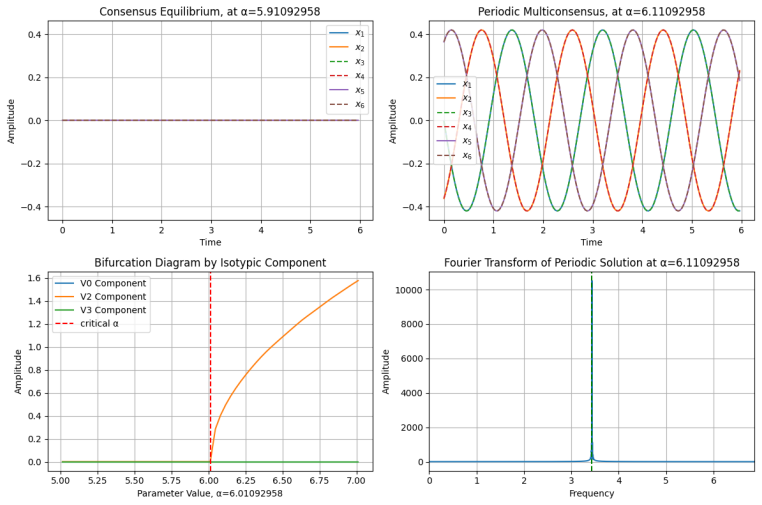
- Memory permits self-organizing agents to move beyond stationary consensus to periodic multiconsensus states.
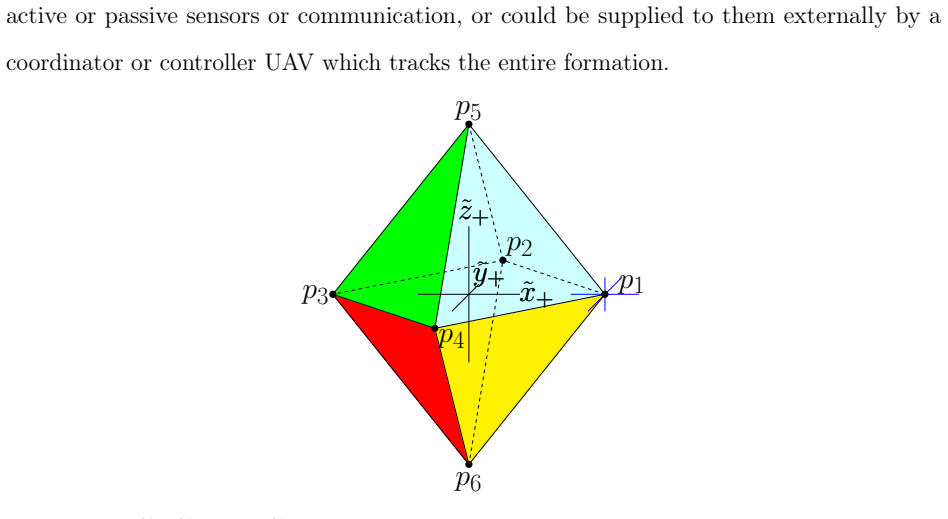
- In UAV formations the agents maintain spatial relationships while executing complex selectable oscillations.
- In networked asset markets memory-based trader strategies produce cycles of bubbles and crashes.
- Resonant double Hopf bifurcations in the neutral system lead to chaos via the Ruelle-Takens-Newhouse route and riddled basins.
Where Pith is reading between the lines
- The newly introduced pseudoneutral class may serve as an analytic bridge for delay systems that mix retarded and neutral features in other application domains.
- Stability data obtained numerically could be used to select control parameters that favor desired oscillation patterns in engineered multi-agent systems.
- The same symmetry-based degree approach could be tested on biological or social networks where memory influences collective rhythmic behavior.
Load-bearing premise
The closed-loop dynamics of the multi-agent systems can be faithfully represented by the three specific classes of delay differential equations whose symmetry properties permit direct application of equivariant twisted degree theory.
What would settle it
A concrete counterexample in which a retarded or neutral delay system exhibits no periodic multiconsensus solutions of the predicted symmetries, despite the equivariant degree calculation indicating their existence, would falsify the classification.
Figures










read the original abstract
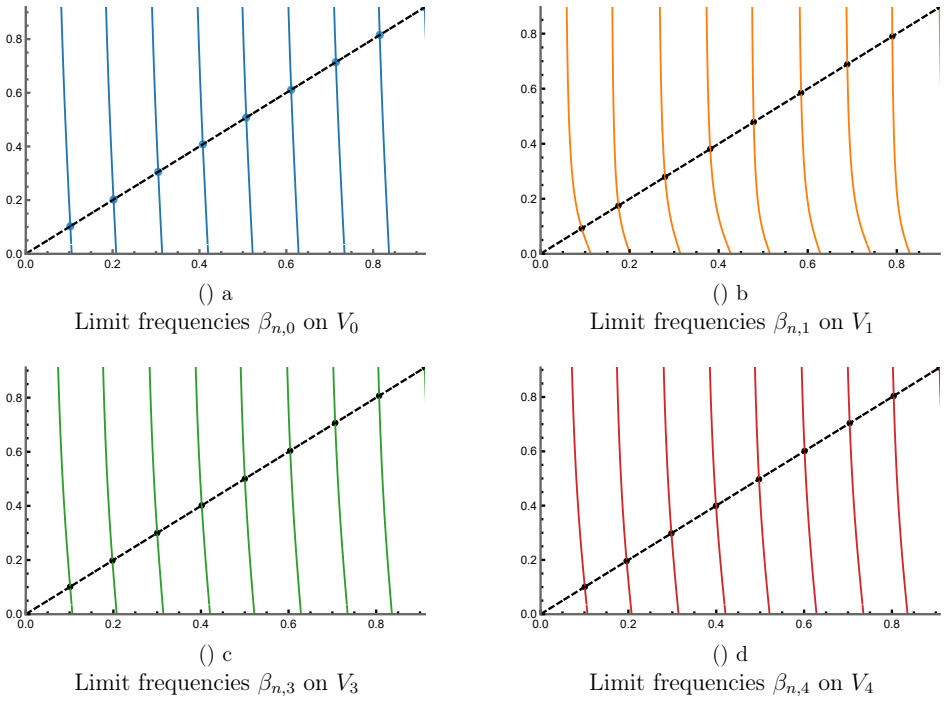
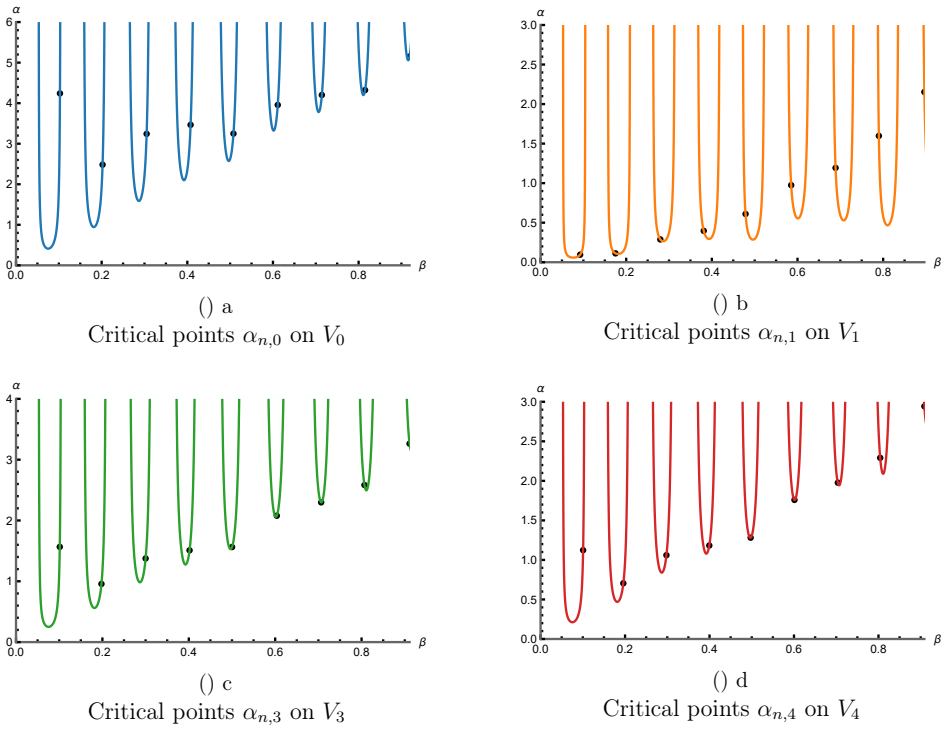
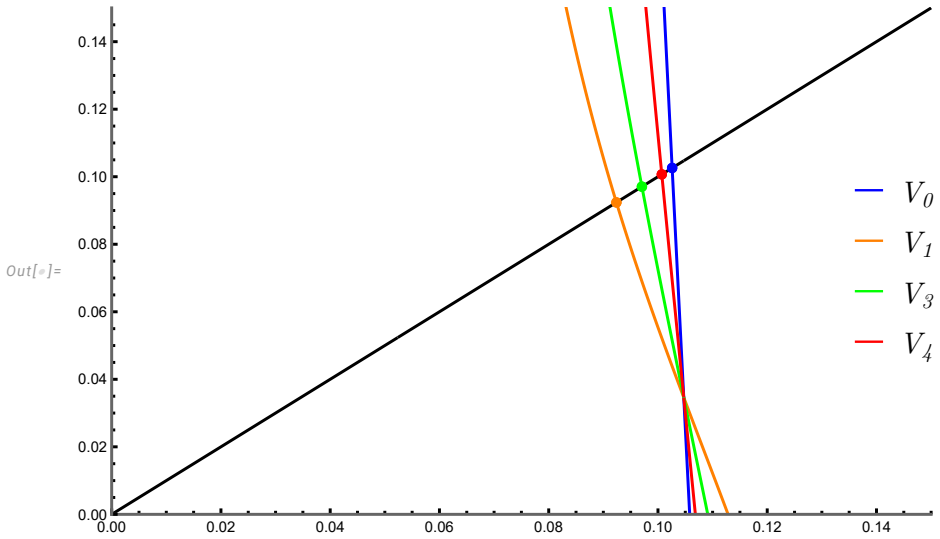
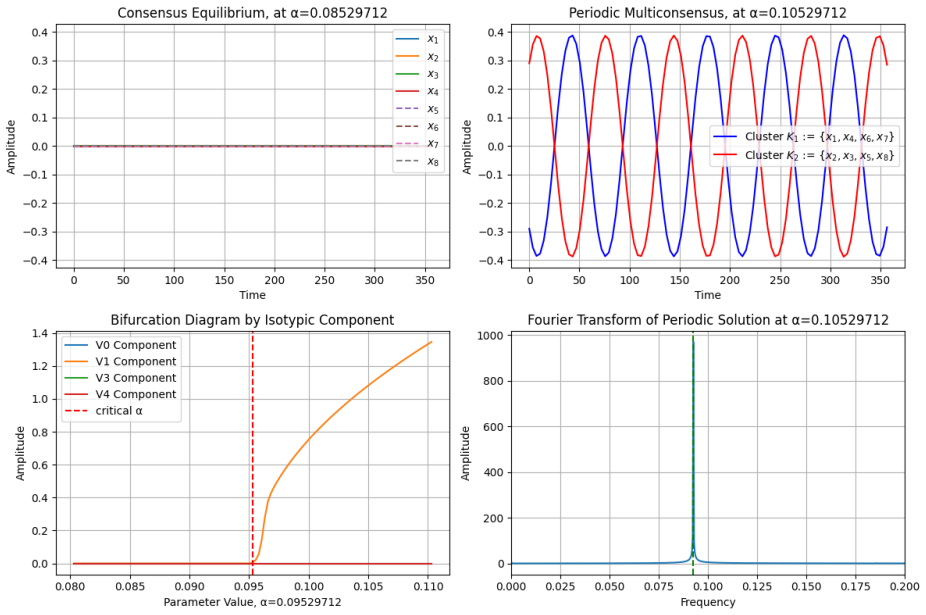
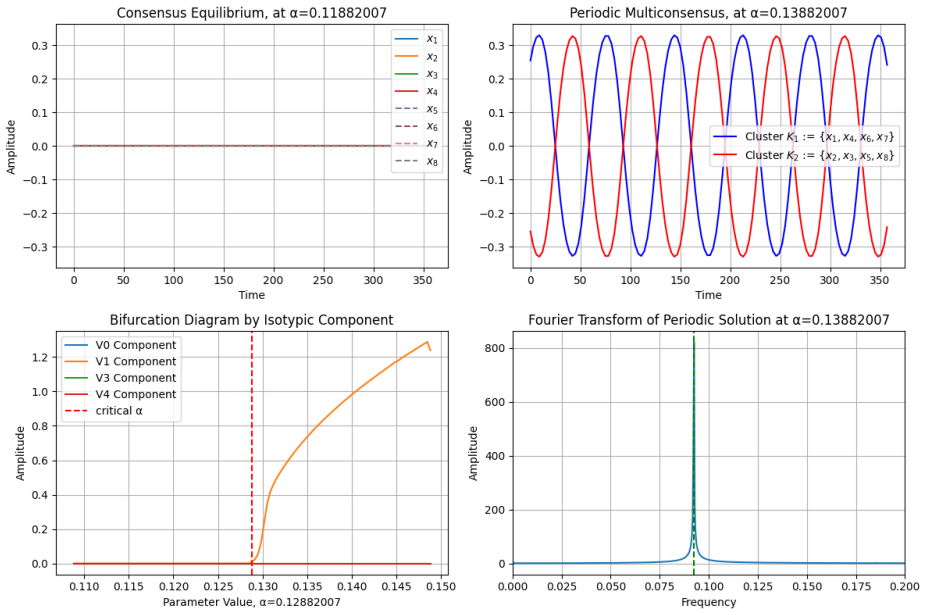
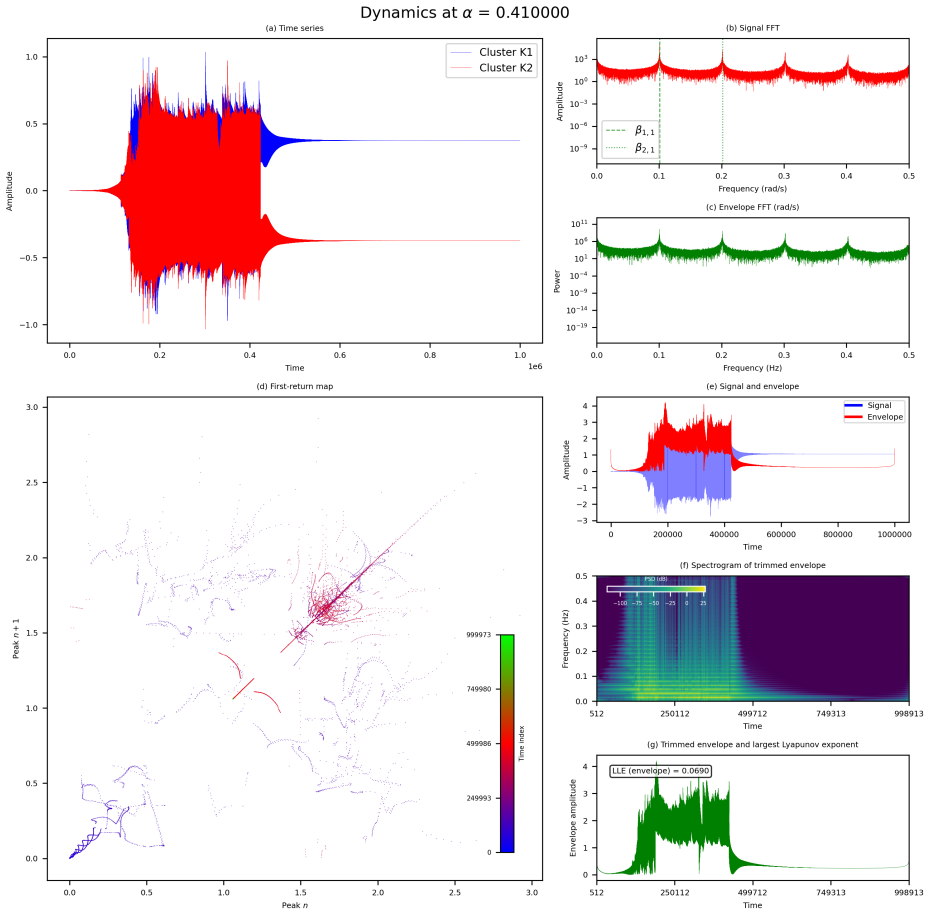
This dissertation provides the first systematic study of symmetric consensus-breaking bifurcation to periodic multiconsensus in multi-agent systems. It analyzes this for three classes of multi-agent systems based on three different types of memory, whose closed-loop dynamics equations form delay differential equations of retarded type, neutral type, and pseudoneutral type - a subclassification of retarded type equations introduced in this dissertation which bridges retarded and neutral type delay equations. Equivariant twisted degree is used to analyze the symmetric global Hopf bifurcation problem in these systems, i.e. bifurcation from a stable consensus to periodic multiconsensus. This shows how the effects of memory allow self-organizing agents to move beyond mere stationary consensus. Theoretical results for the global Hopf bifurcation and symmetric classification of periodic multiconsensus solutions across all three systems are provided, and numerical results are conducted to both validate and enhance the theoretical predictions by providing stability information on the branches which is not obtainable by the degree alone. These principles are demonstrated in three real-world applications: one involving the control of formations of UAVs, allowing them to maintain their overall spatial relationships while dancing in complex selectable oscillations; and two more in networked asset markets featuring different traders with different memory-based strategies, showing how similar mechanisms can be responsible for economic cycles of bubbles and crashes. Finally, we also numerically investigate resonant double Hopf bifurcations in the neutral delay system, showing strong evidence of a breakdown to chaos via the Ruelle-Takens-Newhouse scenario and the existence of riddled basins.
Editorial analysis
A structured set of objections, weighed in public.
Referee Report
Summary. The manuscript claims to deliver the first systematic study of symmetric consensus-breaking global Hopf bifurcations to periodic multiconsensus in memory-based multi-agent systems. It models three classes of such systems via retarded, neutral, and a newly introduced pseudoneutral subclass of delay differential equations, applies equivariant twisted degree theory to obtain global bifurcation results and symmetric classifications of solutions, supplies numerical simulations that add stability information unavailable from the degree alone, and demonstrates the framework in UAV formation control and two networked asset-market models; it also reports numerical evidence of resonant double Hopf bifurcations leading to chaos via the Ruelle-Takens-Newhouse route and riddled basins.
Significance. If the central degree-theoretic results hold, the work supplies a symmetry-based, largely parameter-independent classification of memory-induced periodic multiconsensus states across three DDE classes, together with concrete applications that link the bifurcation mechanism to formation control and economic cycles. The numerical validation of stability and the resonant-double-Hopf investigation constitute genuine added value beyond the abstract degree calculation.
major comments (2)
- [Modeling sections (likely §2–§3)] The central claim that the closed-loop MAS dynamics are faithfully captured by the three DDE classes (retarded, neutral, pseudoneutral) whose symmetry groups permit direct application of equivariant twisted degree is load-bearing; the manuscript must explicitly verify, in the modeling sections, that the functional-analytic hypotheses of the degree (e.g., compactness of the solution operator, properness of the equivariant map) are satisfied for each class, including the newly defined pseudoneutral equations.
- [Global bifurcation theorems (likely §4)] The global Hopf bifurcation theorems rely on the equivariant twisted degree being non-zero on suitable isolating neighborhoods; the manuscript should provide, for at least one representative system, an explicit computation or reference to the degree value that establishes the existence of the claimed branches (rather than only stating that the degree is applied).
minor comments (2)
- [Introduction / §2] The definition and functional-analytic properties of the pseudoneutral subclass should be stated with a precise equation or operator form early in the text so that readers can immediately compare it with standard retarded and neutral equations.
- [Numerical results sections] Numerical figures showing branch stability and the transition to chaos would benefit from clearer labeling of the symmetry types of the observed periodic orbits and from error bars or convergence checks on the integration scheme.
Simulated Author's Rebuttal
We thank the referee for the constructive and detailed report. We address each major comment below and will incorporate the suggested clarifications into the revised manuscript.
read point-by-point responses
-
Referee: [Modeling sections (likely §2–§3)] The central claim that the closed-loop MAS dynamics are faithfully captured by the three DDE classes (retarded, neutral, pseudoneutral) whose symmetry groups permit direct application of equivariant twisted degree is load-bearing; the manuscript must explicitly verify, in the modeling sections, that the functional-analytic hypotheses of the degree (e.g., compactness of the solution operator, properness of the equivariant map) are satisfied for each class, including the newly defined pseudoneutral equations.
Authors: We agree that explicit verification of the functional-analytic hypotheses is required for rigor. In the revised manuscript we will add, within the modeling sections for each of the three classes, a concise verification that the solution operators are compact (via standard Arzelà–Ascoli arguments for continuous right-hand sides with bounded delays) and that the equivariant maps are proper on the relevant Banach spaces, with the pseudoneutral subclass treated under the Lipschitz and growth conditions introduced in the dissertation to guarantee these properties. revision: yes
-
Referee: [Global bifurcation theorems (likely §4)] The global Hopf bifurcation theorems rely on the equivariant twisted degree being non-zero on suitable isolating neighborhoods; the manuscript should provide, for at least one representative system, an explicit computation or reference to the degree value that establishes the existence of the claimed branches (rather than only stating that the degree is applied).
Authors: The global bifurcation statements in §4 rest on the non-vanishing of the equivariant twisted degree, which follows from the standard computational formulas in the cited literature on twisted degree for symmetric Hopf problems. In the revision we will augment at least one representative example with either a brief explicit degree calculation on the chosen isolating neighborhood or a precise reference to the specific result in the degree-theory literature that confirms the required non-zero value, thereby making the existence argument fully explicit. revision: yes
Circularity Check
No significant circularity
full rationale
The derivation applies established equivariant twisted degree theory to retarded, neutral, and newly introduced pseudoneutral DDEs whose symmetries are stated to permit direct application; the global Hopf results and symmetric classification follow from this framework without reduction to fitted parameters, self-definitional loops, or load-bearing self-citations. Numerical validation and applications are presented as downstream checks rather than inputs that define the claims. The work remains self-contained against external mathematical benchmarks in degree theory and delay equations.
Axiom & Free-Parameter Ledger
axioms (1)
- domain assumption Equivariant twisted degree theory applies to the symmetric delay differential equations arising from the memory-based multi-agent models.
invented entities (1)
-
pseudoneutral type delay equations
no independent evidence
Reference graph
Works this paper leans on
-
[1]
Alexander, J. C., C. Grebogi, E. Ott, and J. A. Yorke (1992). Riddled basins.Interna- tional Journal of Bifurcation and Chaos 2(4), 795–812
work page 1992
-
[2]
Ansmann, G. (2018). Efficiently and easily integrating differential equations with JiTCODE, JiTCDDE, and JiTCSDE.Chaos 28(4), 043116
work page 2018
-
[3]
Balanov, Z. and W. Krawcewicz (2008). Symmetric hopf bifurcation: Twisted degree approach. In F. Battelli and M. Fečkan (Eds.),Handbook of Differential Equations: Ordinary Differential Equations, Volume 4, pp. 1–131. Amsterdam: Elsevier/North Holland
work page 2008
-
[4]
Balanov, Z., W. Krawcewicz, D. Rachinskii, J. Yu, and H. Wu (2025).Degree Theory and Symmetric Equations Assisted by GAP System. American Mathematical Society
work page 2025
-
[5]
Balanov, Z., W. Krawcewicz, and H. Ruan (2006). Applied equivariant degree. I: An ax- iomatic approach to primary degree.Discrete and Continuous Dynamical Systems 15(3), 983–1016
work page 2006
-
[6]
Balanov, Z., W. Krawcewicz, and H. Steinlein (2006).Applied Equivariant Degree, Volume 1 ofAIMS Series on Differential Equations & Dynamical Systems. American Institute of Mathematical Sciences
work page 2006
-
[7]
Beja, A. and M. B. Goldman (1980). On the dynamic behavior of prices in disequilibrium. Journal of Finance 35(2), 235–248
work page 1980
-
[8]
Brouwer, L. E. J. (1912). über abbildung von mannigfaltigkeiten.Mathematische Annalen 71, 97–115. 260
work page 1912
-
[9]
Cassidy, T. (2025). Using multidelay discrete delay differential equations to accurately simulate models with distributed delays.Studies in Applied Mathematics 154(6), e70069
work page 2025
-
[10]
Chen, C., C. Crane, and T. Hensley (2026). Global hopf bifurcation in symmetric configurations of distributed delay differential equations.Communications on Pure and Applied Analysis 27, 170–194
work page 2026
- [11]
-
[12]
Chiarella, C. (1992). The dynamics of speculative behaviour.Annals of Operations Research 37, 253–287
work page 1992
-
[13]
Chossat, P. and M. Golubitsky (1988). Symmetry-increasing bifurcation of chaotic attractors.Physica D 32(3), 423–436
work page 1988
-
[14]
Darbo, G. (1955). Punti uniti in trasformazioni a codominio non compatto.Rendiconti del Seminario Matematico della Università di Padova 24, 84–92
work page 1955
-
[15]
Dibeh, G. (2007). Dynamics of a speculative market with time delays.Chaos, Solitons & Fractals 31(2), 511–518
work page 2007
-
[16]
Dobrescu, L. I., M. Neamtu, and G. Mircea (2016). Asset price dynamics in a chartist- fundamentalist model with time delays: A bifurcation analysis.Discrete Dynamics in Nature and Society 2016
work page 2016
-
[17]
Dylawerski, G. (1988). AnS1-degree and S1-maps between representation spheres. In T. tom Dieck (Ed.),Algebraic Topology and Transformation Groups, Volume 1361 of Lecture Notes in Mathematics, pp. 14–28. Berlin: Springer. 261
work page 1988
-
[18]
Dylawerski, G., K. Gęba, J. Jodel, and W. Marzantowicz (1991). Ans1-equivariant degree and the fuller index.Annales Polonici Mathematici 52(3), 243–280
work page 1991
-
[19]
Erbe, L. H., W. Krawcewicz, and J. H. Wu (1993). A composite coincidence degree with applications to boundary value problems of neutral equations.Transactions of the American Mathematical Society 335(2), 459–478
work page 1993
-
[20]
Faria, T. and L. T. Magalhães (1995). Normal forms for retarded functional differential equations with parameters and applications to hopf bifurcation.Journal of Differential Equations 122(2), 181–200
work page 1995
-
[21]
Guerrini, L., M. Sodini, and F. Szidarovszky (2014). Heterogeneous fundamentalists in a continuous time model with delays.Discrete Dynamics in Nature and Society 2014
work page 2014
-
[22]
Guo, S. and J. Wu (2013).Introduction to Functional Differential Equations, pp. 41–60. Springer, New York
work page 2013
-
[23]
Gęba, K., W. Krawcewicz, and J. Wu (1994). An equivariant degree with applications to symmetric bifurcation problems. part 1: Construction of the degree.Proceedings of the London Mathematical Society 69(2), 377–398
work page 1994
-
[24]
Hale, J. K. (1977).Theory of Functional Differential Equations, Volume 3 ofApplied Mathematical Sciences. New York: Springer-Verlag
work page 1977
-
[25]
Hale, J. K. (2006). History of delay equations. In O. Arino, M. L. Hbid, and E. Ait Dads (Eds.),Delay Differential Equations and Applications, Volume 205 ofNATO Science Series II: Mathematics, Physics and Chemistry, pp. 1–28. Dordrecht: Springer
work page 2006
-
[26]
He, X. Z. and M. Zheng (2010). Dynamics of moving average rules in a continuous-time financial market model.Journal of Economic Behavior & Organization 76(3), 615–634. 262
work page 2010
-
[27]
Hespanha, J. P., P. Naghshtabrizi, and Y. Xu (2007). A survey of recent results in networked control systems.Proceedings of the IEEE 95(1), 138–162
work page 2007
-
[28]
Hutchinson, G. E. (1948). Circular causal systems in ecology.Annals of the New York Academy of Sciences 50, 221–246
work page 1948
-
[29]
Hutt, A. and F. M. Atay (2005). Analysis of nonlocal neural fields for both general and gamma-distributed connectivities.Physica D: Nonlinear Phenomena 203(1–2), 30–54
work page 2005
-
[30]
Ize, J., I. Massabò, and A. Vignoli (1989). Degree theory for equivariant maps, i. Transactions of the American Mathematical Society 315(2), 433–510
work page 1989
-
[31]
Ize, J., I. Massabò, and A. Vignoli (1992). Degree theory for equivariant maps, the generals 1-action.Memoirs of the American Mathematical Society 100(481)
work page 1992
-
[32]
Ize, J. and A. Vignoli (2003).Equivariant Degree Theory. Berlin: de Gruyter
work page 2003
-
[33]
Jadbabaie, A., J. Lin, and A. S. Morse (2003). Coordination of groups of mobile autonomous agents using nearest neighbor rules.IEEE Transactions on Automatic Control 48, 988–1001
work page 2003
-
[34]
Keller, A. A. (2011).Time-Delay Systems: With Applications to Economic Dynamics and Control. Lambert Academic Publishing
work page 2011
-
[35]
Krasnosel’skii, M. A. (1956).Topological Methods in the Theory of Nonlinear Integral Equations. Moscow: Gosudarstv. Izdat. Tehn.-Teor. Lit. English translation: Pergamon Press, 1964
work page 1956
-
[36]
Krawcewicz, W. and J. Wu (1997).Theory of Degrees with Applications to Bifurcations and Differential Equations. John Wiley & Sons. 263
work page 1997
- [37]
-
[38]
Leray, J. and J. Schauder (1934). Topologie et équations fonctionnelles.Annales Scientifiques de l’École Normale Supérieure 51, 45–78
work page 1934
-
[39]
Matsumoto, A. and F. Szidarovszky (2016). A heterogeneous agent model of asset price with three time delays.Frontiers in Applied Mathematics and Statistics 2, 15
work page 2016
-
[40]
Münz, U., A. Papachristodoulou, and F. Allgöwer (2011). Consensus in multi-agent systems with communication delays: A survey.Annual Reviews in Control 35(1), 77–97
work page 2011
-
[41]
Nussbaum, R. D. (1972). Degree theory for local condensing maps.Journal of Mathe- matical Analysis and Applications 37, 741–766
work page 1972
-
[42]
Olfati-Saber, R. and R. M. Murray (2004). Consensus problems in networks of agents with switching topology and time-delays.IEEE Transactions on Automatic Control 49, 1520–1533
work page 2004
-
[43]
Rabinowitz, P. H. (1971). Some global results for nonlinear eigenvalue problems.Journal of Functional Analysis 7(3), 487–513
work page 1971
-
[44]
Rabinowitz, P. H. (1985). Global aspects of bifurcation. InTopological Methods in Bifurcation Theory, Volume 91 ofSéminaire de Mathématiques Supérieures, pp. 63–112. Montréal: Presses de l’Université de Montréal
work page 1985
-
[45]
Rackauckas, C. and Q. Nie (2017). Differentialequations.jl – a performant and feature- rich ecosystem for solving differential equations in julia.Journal of Open Research Software 5(1), 15. 264
work page 2017
-
[46]
Ren, W. and R. W. Beard (2005). Consensus seeking in multiagent systems under dy- namically changing interaction topologies.IEEE Transactions on Automatic Control 50, 655–661
work page 2005
-
[47]
Reynolds, C. W. (1987). Flocks, herds and schools: A distributed behavioral model. SIGGRAPH Computer Graphics 21, 25–34
work page 1987
-
[48]
Rosenstein, M. T., J. J. Collins, and C. J. De Luca (1993). A practical method for calculating largest lyapunov exponents from small data sets.Physica D: Nonlinear Phenomena 65(1), 117–134
work page 1993
-
[49]
Ruelle, D. and F. Takens (1971). On the nature of turbulence.Communications in Mathematical Physics 20, 167–192
work page 1971
-
[50]
Sadovskii, B. N. (1971). Applications of topological methods to the theory of periodic solutions of nonlinear differential-operator equations of neutral type.Soviet Mathematics Doklady 12, 1543–1547
work page 1971
- [51]
-
[52]
Sharma, S. K. and Karmeshu (2013). Neuronal model with distributed delay: Emergence of unimodal and bimodal ISI distributions.IEEE Transactions on NanoBioscience 12(1), 1–12
work page 2013
-
[53]
Sipahi, R., F. M. Atay, and S.-I. Niculescu (2015). Stability analysis of a constant time-headway driving strategy with driver memory effects modeled by distributed delays. InIFAC-PapersOnLine, Volume 28, pp. 376–381. 12th IFAC Workshop on Time Delay Systems (TDS 2015), Ann Arbor, MI, USA
work page 2015
-
[54]
Tarasov, V. E. and V. V. Tarasova (2021).Economic Dynamics with Memory: Fractional Calculus Approach. Berlin/Boston: Walter de Gruyter GmbH. 265
work page 2021
-
[55]
Tavakoli, S. K. and A. Longtin (2020). Multi-delay complexity collapse.Physical Review Research 2(3), 033485
work page 2020
-
[56]
The GAP Group (2024).GAP – Groups, Algorithms, and Programming, Version 4.13.1. The GAP Group
work page 2024
- [57]
- [58]
-
[59]
Wang, Y., J. Cao, B. Lu, and Z. Cheng (2021). Global asymptotic consensus of multi- agent internet congestion control system.Neurocomputing 446, 50–64
work page 2021
-
[60]
Wearing, H. J., P. Rohani, and M. J. Keeling (2005). Appropriate models for the management of infectious diseases.PLoS Medicine 2(7), e174
work page 2005
-
[61]
(2024).GAP Equivariant Degree Library
Wu, H. (2024).GAP Equivariant Degree Library. Github. GAP package
work page 2024
-
[62]
Xie, D., S. Xu, Z. Li, and Y. Zou (2015). Second-order group consensus for multi-agent systems with time delays.Neurocomputing 153, 133–139
work page 2015
-
[63]
Yu, J. and M. Peng (2016). Stability and bifurcation analysis for the Kaldor-Kalecki model with a discrete delay and a distributed delay.Physica A: Statistical Mechanics and its Applications 460, 66–75. 266
work page 2016
discussion (0)
Sign in with ORCID, Apple, or X to comment. Anyone can read and Pith papers without signing in.