Symmetric edge polytopes are not gamma-positive
Pith reviewed 2026-07-03 10:15 UTC · model grok-4.3
The pith
The Ehrhart h*-polynomials of symmetric edge polytopes are not gamma-positive.
A machine-rendered reading of the paper's core claim, the machinery that carries it, and where it could break.
Core claim
By constructing an infinite family of symmetric edge polytopes, the paper shows that their Ehrhart h*-polynomials are not gamma-positive. This supplies explicit counterexamples to the general claim of gamma-positivity for this class, including polytopes of arbitrarily high dimension whose smallest instance is 36-dimensional.
What carries the argument
Symmetric edge polytopes together with explicit computation of the coefficients in their Ehrhart h*-polynomials to test the gamma-positivity condition.
If this is right
- The claim that Ehrhart h*-polynomials of symmetric edge polytopes are always gamma-positive does not hold.
- There exist symmetric edge polytopes whose h*-polynomials have at least one negative gamma coefficient.
- Gamma-positivity fails for this class of polytopes in every dimension at or above 36.
- The property cannot be assumed without additional restrictions on the underlying graph or signed graph.
Where Pith is reading between the lines
- Constructions of this type could be adapted to produce counterexamples for gamma-positivity conjectures on other families of polytopes.
- Cases of dimension less than 36 may still satisfy gamma-positivity, pointing to a possible threshold effect.
- It would be natural to classify which symmetric edge polytopes do satisfy gamma-positivity and which do not.
Load-bearing premise
The constructed objects qualify as symmetric edge polytopes and the computed h*-polynomials correctly display negative coefficients in their gamma expansions.
What would settle it
Direct computation of the h*-polynomial for the 36-dimensional example that shows at least one gamma coefficient is negative.
Figures
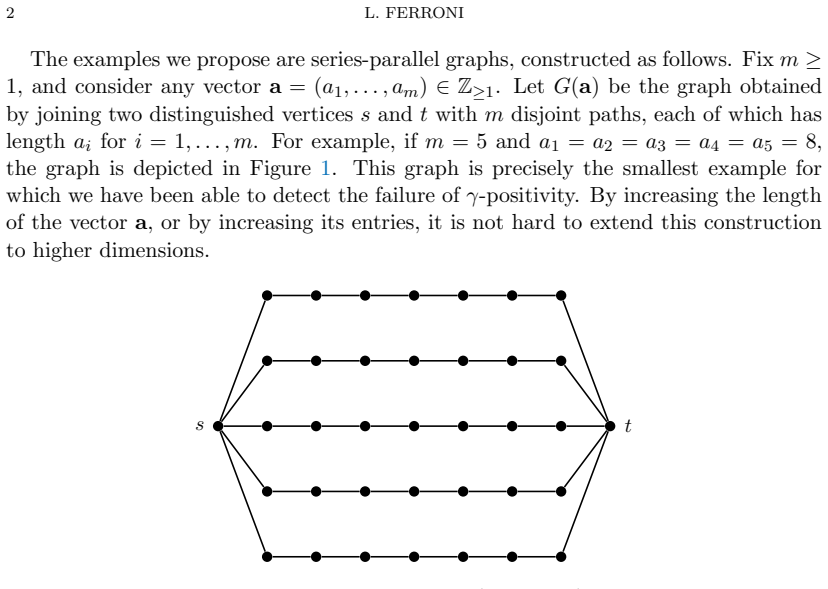
read the original abstract
A conjecture posed by Ohsugi and Tsuchiya (2019) postulates that the Ehrhart $h^*$-polynomials of symmetric edge polytopes are $\gamma$-positive. We disprove this conjecture by exhibiting an infinite family of counterexamples. The smallest example provided by our construction is a $36$-dimensional symmetric edge polytope.
Editorial analysis
A structured set of objections, weighed in public.
Referee Report
Summary. The manuscript claims to disprove the conjecture of Ohsugi and Tsuchiya (2019) that the Ehrhart h*-polynomials of symmetric edge polytopes are gamma-positive. The disproof proceeds by explicit construction of an infinite family of counterexamples whose smallest member is a 36-dimensional symmetric edge polytope.
Significance. If the counterexamples are valid, the result is significant: it supplies a negative answer to an open conjecture together with an explicit infinite family, which is a strong form of evidence in Ehrhart theory. The work is a direct disproof by counterexample rather than a derived positive statement, and the provision of an infinite family strengthens the claim beyond a single sporadic example.
major comments (2)
- [§3] §3 (Construction of the family): the manuscript must supply an unambiguous, machine-readable description (e.g., adjacency list or edge set) of the smallest 36-dimensional graph so that independent verification that the resulting polytope is a symmetric edge polytope can be performed.
- [§4] §4 (Computation of the h*-polynomial): because the gamma-coefficient sign is obtained by a change-of-basis computation at dimension 36, the paper must document the exact software, input data, and algorithm used for the Ehrhart polynomial and the subsequent gamma-basis conversion; without this pipeline the sign claim cannot be reproduced.
minor comments (1)
- [Abstract] The abstract states the dimension but does not indicate the order of the underlying graph; adding this datum would improve readability.
Simulated Author's Rebuttal
We thank the referee for the careful reading and the detailed comments on reproducibility. We address each major comment below.
read point-by-point responses
-
Referee: [§3] §3 (Construction of the family): the manuscript must supply an unambiguous, machine-readable description (e.g., adjacency list or edge set) of the smallest 36-dimensional graph so that independent verification that the resulting polytope is a symmetric edge polytope can be performed.
Authors: We agree that an explicit machine-readable description will facilitate independent verification. The revised manuscript will include the full edge set (or adjacency list) of the smallest 36-dimensional graph together with a precise description of the infinite family generated from it. revision: yes
-
Referee: [§4] §4 (Computation of the h*-polynomial): because the gamma-coefficient sign is obtained by a change-of-basis computation at dimension 36, the paper must document the exact software, input data, and algorithm used for the Ehrhart polynomial and the subsequent gamma-basis conversion; without this pipeline the sign claim cannot be reproduced.
Authors: We will add a new subsection in the revised version that documents the full computational pipeline: the software employed, the precise input data or files, and the sequence of steps used to obtain the Ehrhart polynomial and perform the change-of-basis to the gamma basis. This will make the sign computation fully reproducible. revision: yes
Circularity Check
Direct counterexample construction with no circularity
full rationale
The paper disproves the Ohsugi-Tsuchiya conjecture by exhibiting an explicit infinite family of symmetric edge polytopes whose h*-polynomials fail gamma-positivity, with the smallest member 36-dimensional. This is a direct falsification via construction and computation; no positive result is derived from fitted parameters, self-definitions, or self-citation chains. The central claim rests on verifiable object definitions and explicit polynomial computation rather than any reduction to inputs by construction.
Axiom & Free-Parameter Ledger
axioms (1)
- standard math Standard definitions and properties of Ehrhart polynomials, h*-polynomials, and gamma-positivity in the theory of lattice polytopes.
Reference graph
Works this paper leans on
-
[1]
Arithmetic aspects of symmetric edge polytopes , JOURNAL =
Higashitani, Akihiro and Jochemko, Katharina and Micha. Arithmetic aspects of symmetric edge polytopes , JOURNAL =. 2019 , NUMBER =. doi:10.1112/s0025579319000147 , URL =
-
[2]
On a generalization of symmetric edge polytopes to regular matroids , fjournal =
D'Al. On a generalization of symmetric edge polytopes to regular matroids , fjournal =. Int. Math. Res. Not. , issn =. 2024 , language =. doi:10.1093/imrn/rnae107 , keywords =
-
[3]
Higashitani, Akihiro and Kummer, Mario and Micha. Interlacing. Sel. Math., New Ser. , issn =. 2017 , language =. doi:10.1007/s00029-017-0350-6 , keywords =
-
[4]
Ehrhart theory of symmetric edge polytopes via ribbon structures , year =
Tam. Ehrhart theory of symmetric edge polytopes via ribbon structures , year =
-
[5]
K. Algebr. Comb. , issn =. 2023 , language =. doi:10.5802/alco.318 , keywords =
-
[6]
The number of edges of a symmetric edge polytope. arXiv e-prints , keywords =. doi:10.48550/arXiv.2512.16572 , archivePrefix =. 2512.16572 , primaryClass =
-
[7]
On the Ehrhart Theory of Generalized Symmetric Edge Polytopes
On the Ehrhart Theory of Generalized Symmetric Edge Polytopes. arXiv e-prints , keywords =. doi:10.48550/arXiv.2401.03383 , archivePrefix =. 2401.03383 , primaryClass =
work page internal anchor Pith review Pith/arXiv arXiv doi:10.48550/arxiv.2401.03383
-
[8]
Matsui, Tetsushi and Higashitani, Akihiro and Nagazawa, Yuuki and Ohsugi, Hidefumi and Hibi, Takayuki , TITLE =. J. Algebraic Combin. , FJOURNAL =. 2011 , NUMBER =. doi:10.1007/s10801-011-0290-8 , URL =
-
[9]
Ohsugi, Hidefumi and Tsuchiya, Akiyoshi , TITLE =. Selecta Math. (N.S.) , FJOURNAL =. 2020 , NUMBER =. doi:10.1007/s00029-020-00588-0 , URL =
-
[10]
On the gamma-vector of symmetric edge polytopes , JOURNAL =
D'Al\`. On the gamma-vector of symmetric edge polytopes , JOURNAL =. 2023 , NUMBER =. doi:10.1137/22M1492799 , URL =
-
[11]
Bruns, Winfried and R\". J. Combin. Theory Ser. A , FJOURNAL =. 2007 , NUMBER =. doi:10.1016/j.jcta.2006.03.003 , URL =
-
[12]
Real root conjecture fails for five- and higher-dimensional spheres , JOURNAL =
Gal,. Real root conjecture fails for five- and higher-dimensional spheres , JOURNAL =. 2005 , NUMBER =. doi:10.1007/s00454-005-1171-5 , URL =
-
[13]
Ohsugi, Hidefumi and Tsuchiya, Akiyoshi , title =. Discrete Comput. Geom. , issn =. 2021 , language =. doi:10.1007/s00454-020-00236-6 , keywords =
-
[14]
Sign-graded posets, unimodality of
Br. Sign-graded posets, unimodality of. Electron. J. Combin. , FJOURNAL =. 2004/06 , NUMBER =. doi:10.37236/1866 , URL =
- [15]
discussion (0)
Sign in with ORCID, Apple, or X to comment. Anyone can read and Pith papers without signing in.