Microwave shielding of ultracold polar molecules on the transition boldsymbol{n=1 rightarrow 2}
Pith reviewed 2026-07-03 01:42 UTC · model grok-4.3
The pith
Microwave shielding on the n=1 to 2 transition prevents destructive collisions in ultracold polar molecules without forming bound states.
A machine-rendered reading of the paper's core claim, the machinery that carries it, and where it could break.
Core claim
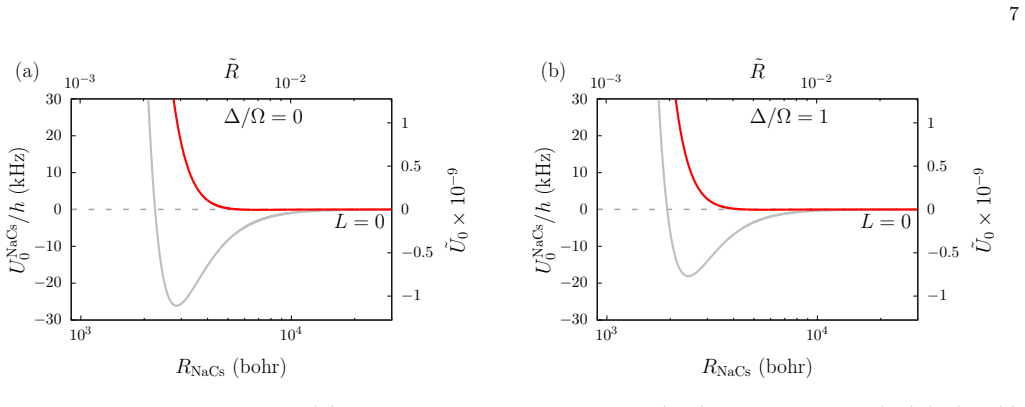
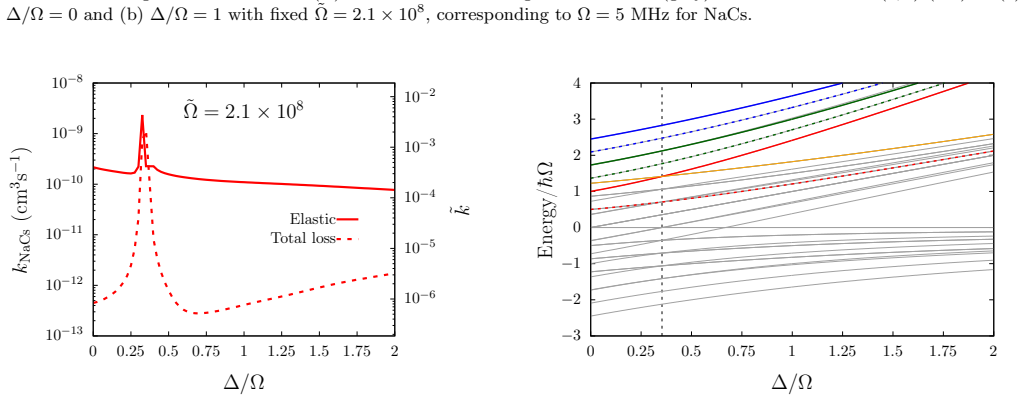
We show that microwave shielding on the rotational transition n=1→2 can be effective in preventing destructive collisions between ultracold polar molecules. It is slightly less efficient than shielding on the transition 0→1, but has some important advantages. In particular, it does not produce 2-molecule bound states under the conditions needed for shielding, so it will not enhance 3-body recombination. It thus obviates the need for double-field microwave shielding using a second field of different polarization.
What carries the argument
Microwave dressing on the n=1 to n=2 rotational transition that induces a long-range repulsive intermolecular potential.
If this is right
- Microwave shielding on n=1→2 prevents destructive collisions between ultracold polar molecules.
- The method is slightly less efficient than shielding on the n=0→1 transition.
- No two-molecule bound states form under the shielding conditions.
- Three-body recombination rates are not increased.
- Double-field microwave shielding with a second field of different polarization is not required.
Where Pith is reading between the lines
- Single-field shielding on this transition simplifies the microwave setup needed for stable ultracold molecule experiments.
- The absence of bound states supports the use of this method at higher molecular densities without added recombination losses.
Load-bearing premise
The model calculations correctly predict both the shielding effectiveness and the absence of bound states for the n=1 to 2 transition under the relevant microwave fields and interaction conditions.
What would settle it
An experiment that measures either high collision loss rates or the presence of two-molecule bound states when microwaves are applied on the n=1 to 2 transition at the shielding parameters would falsify the claim.
Figures
read the original abstract
We show that microwave shielding on the rotational transition $n=1\rightarrow 2$ can be effective in preventing destructive collisions between ultracold polar molecules. It is slightly less efficient than shielding on the transition $0\rightarrow 1$, but has some important advantages. In particular, it does not produce 2-molecule bound states under the conditions needed for shielding, so it will not enhance 3-body recombination. It thus obviates the need for double-field microwave shielding using a second field of different polarization.
Editorial analysis
A structured set of objections, weighed in public.
Referee Report
Summary. The manuscript claims that microwave shielding on the n=1→2 rotational transition of ultracold polar molecules suppresses inelastic collisions effectively, though slightly less so than the n=0→1 transition. It further asserts that this scheme produces no two-molecule bound states at the required dressing parameters, thereby avoiding enhanced three-body recombination rates and removing the necessity for a second microwave field of orthogonal polarization.
Significance. If the numerical scattering and bound-state calculations hold, the result offers a technically simpler route to long-lived ultracold molecular samples. The absence of bound states under shielding conditions is a concrete advantage over prior single-field schemes and could reduce experimental overhead in quantum-degenerate molecular gases.
minor comments (2)
- [Abstract] The abstract states that shielding on n=1→2 is 'slightly less efficient' than on 0→1 without quoting a numerical ratio of loss rates or elastic-to-inelastic cross sections; adding a quantitative comparison in the abstract or a dedicated results paragraph would strengthen the claim.
- [Title and Abstract] Notation for the rotational quantum number alternates between n and N in the title and abstract; consistent use of one symbol throughout would improve readability.
Simulated Author's Rebuttal
We thank the referee for their supportive summary of our manuscript and for recommending minor revision. The referee accurately captures our central claims regarding the effectiveness of microwave shielding on the n=1→2 transition, its comparison to n=0→1, and the absence of two-molecule bound states that would enhance three-body recombination. No specific major comments were listed in the report.
Circularity Check
No significant circularity detected
full rationale
The paper's claims rest on direct numerical evaluation of the microwave-dressed Hamiltonian for the n=1→2 transition, producing scattering loss rates and a bound-state spectrum. These outputs are obtained from the same Schrödinger equation solved for both shielding efficiency and the absence of two-body bound states; neither quantity is fitted to the other or renamed as a prediction. No self-citation supplies a uniqueness theorem or ansatz that the present work then treats as external. The reported advantage (no bound states under shielding conditions) follows from the eigenvalue search itself and is independent of any prior result by the same authors. The derivation is therefore self-contained.
Axiom & Free-Parameter Ledger
Reference graph
Works this paper leans on
-
[1]
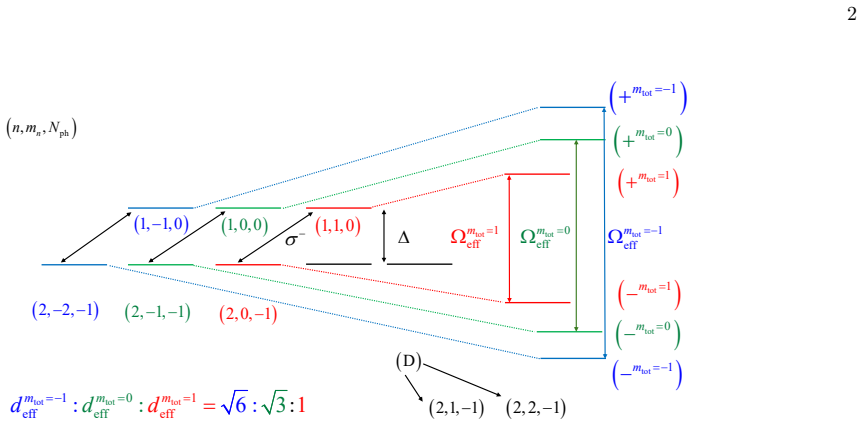
For each value ofm tot, the splitting between the dressed states is the effective Rabi frequency Ωeff = √ Ω2 + ∆2, which follows Ωmtot=−1 eff >Ω mtot=0 eff >Ω mtot=1 eff . B. Coupled-channel formalism for microwave shielding The Hamiltonian that describes a two-body collision in the center-of-mass frame is ˆH= ℏ2 2µred − 1 R d2 dR2 R+ ˆL 2 R2 ! + ˆhA + ˆh...
-
[2]
Reduced scattering properties are defined as ˜α= α/R3, ˜β=β/R 3, ˜σ=σ/(4πR 2 3), and ˜k=k/k 3, where k3 = 4πR3ℏ/µred
are the scaling factors for length and energy, respectively [16]. Reduced scattering properties are defined as ˜α= α/R3, ˜β=β/R 3, ˜σ=σ/(4πR 2 3), and ˜k=k/k 3, where k3 = 4πR3ℏ/µred. The two-body collision properties of microwave- shielded molecules are universal [44]. When Ω,∆≪ brot/ℏ, the shielding physics is dominated by channels within an energy wind...
-
[3]
Quantum computation and quantum simulation with ultracold molecules
S. L. Cornish, M. R. Tarbutt, and K. R. A. Hazzard. “Quantum computation and quantum simulation with ultracold molecules.” Nat. Phys.,20, 730 (2024)
2024
-
[4]
Quan- tum magnetism with ultracold molecules
M. L. Wall, K. R. A. Hazzard, and A. M. Rey. “Quan- tum magnetism with ultracold molecules.” In S. A. Ma- linovskaya and I. Novikova (Editors), “From Atomic to Mesoscale,” (World Scientific, Singapore, 2015), chap- ter 1, 3–37
2015
-
[5]
Univer- sal few-body physics and cluster formation
C. H. Greene, P. Giannakeas, and J. P´ erez-R´ ıos. “Univer- sal few-body physics and cluster formation.” Rev. Mod. Phys.,89, 035006 (2017)
2017
-
[6]
The physics of dipolar bosonic quantum gases
T. Lahaye, C. Menotti, L. Santos, M. Lewenstein, and T. Pfau. “The physics of dipolar bosonic quantum gases.” Rep. Prog. Phys.,72, 126401 (2009)
2009
-
[7]
Condensed matter theory of dipolar quantum gases
M. A. Baranov, M. Dalmonte, G. Pupillo, and P. Zoller. “Condensed matter theory of dipolar quantum gases.” Chem. Rev.,112, 5012 (2012)
2012
-
[8]
Bimolecular chemistry in the ul- tracold regime
Y. Liu and K.-K. Ni. “Bimolecular chemistry in the ul- tracold regime.” Ann. Rev. Phys. Chem.,73, 73 (2022)
2022
-
[9]
Ultracold chemistry as a testbed for few-body physics
T. Karman, M. Tomza, and J. P´ erez-R´ ıoz. “Ultracold chemistry as a testbed for few-body physics.” Nature Physics,20, 722 (2024)
2024
-
[10]
Scattering of ultracold molecules in the highly resonant regime
M. Mayle, G. Qu´ em´ ener, B. P. Ruzic, and J. L. Bohn. “Scattering of ultracold molecules in the highly resonant regime.” Phys. Rev. A,87, 012709 (2013)
2013
-
[11]
Photoinduced two-body loss of ultra- cold molecules
A. Christianen, M. W. Zwierlein, G. C. Groenenboom, and T. Karman. “Photoinduced two-body loss of ultra- cold molecules.” Phys. Rev. Lett.,123, 123402 (2019)
2019
-
[12]
Quantum-state controlled chemical reactions of ultracold KRb molecules
S. Ospelkaus, K.-K. Ni, D. Wang, M. H. G. de Miranda, B. Neyenhuis, G. Qu´ em´ ener, P. S. Julienne, J. L. Bohn, D. S. Jin, and J. Ye. “Quantum-state controlled chemical reactions of ultracold KRb molecules.” Science,327, 853 (2010)
2010
-
[13]
Direct observation of bi- molecular reactions of ultracold KRb molecules
M.-G. Hu, Y. Liu, D. D. Grimes, Y.-W. Lin, A. H. Gheorghe, R. Vexiau, N. Bouloufa-Maafa, O. Dulieu, T. Rosenband, and K.-K. Ni. “Direct observation of bi- molecular reactions of ultracold KRb molecules.” Sci- ence,366, 1111 (2019)
2019
-
[14]
Controlling the quantum stereodynamics of ultra- cold bimolecular reactions
M. H. G. de Miranda, A. Chotia, B. Neyenhuis, D. Wang, G. Qu´ em´ ener, S. Ospelkaus, J. L. Bohn, J. Ye, and D. S. Jin. “Controlling the quantum stereodynamics of ultra- cold bimolecular reactions.” Nat. Phys.,7, 502 (2011)
2011
-
[15]
Dipolar evaporation of reac- tive molecules to below the Fermi temperature
G. Valtolina, K. Matsuda, W. G. Tobias, J.-R. Li, L. De Marco, and J. Ye. “Dipolar evaporation of reac- tive molecules to below the Fermi temperature.” Nature, 588, 239 (2020)
2020
-
[16]
Suppres- sion of inelastic collisions of polar 1Σ state molecules in an electrostatic field
A. V. Avdeenkov, M. Kajita, and J. L. Bohn. “Suppres- sion of inelastic collisions of polar 1Σ state molecules in an electrostatic field.” Phys. Rev. A,73, 022707 (2006)
2006
-
[17]
Tuning ultracold collisions of excited rotational dipolar molecules
G. Wang and G. Qu´ em´ ener. “Tuning ultracold collisions of excited rotational dipolar molecules.” New J. Phys., 17, 035015 (2015)
2015
-
[18]
Adimensional theory of shielding in ultracold collisions of dipolar rotors
M. L. Gonz´ alez-Mart´ ınez, J. L. Bohn, and G. Qu´ em´ ener. “Adimensional theory of shielding in ultracold collisions of dipolar rotors.” Phys. Rev. A,96, 032718 (2017)
2017
-
[19]
Shielding collisions of ultracold CaF molecules with static electric fields
B. Mukherjee, M. D. Frye, C. R. Le Sueur, M. R. Tarbutt, and J. M. Hutson. “Shielding collisions of ultracold CaF molecules with static electric fields.” Phys. Rev. Res.,5, 033097 (2023)
2023
-
[20]
Controlling collisional loss and scattering lengths of ultracold dipolar molecules with static electric fields
B. Mukherjee and J. M. Hutson. “Controlling collisional loss and scattering lengths of ultracold dipolar molecules with static electric fields.” Phys. Rev. Res.,6, 013145 (2024)
2024
-
[21]
Microwave shielding of ultracold polar molecules
T. Karman and J. M. Hutson. “Microwave shielding of ultracold polar molecules.” Phys. Rev. Lett.,121, 163401 (2018). 9
2018
-
[22]
Controlling the scat- tering length of ultracold dipolar molecules
L. Lassabli` ere and G. Qu´ em´ ener. “Controlling the scat- tering length of ultracold dipolar molecules.” Phys. Rev. Lett.,121, 163402 (2018)
2018
-
[23]
Microwave shielding of ultracold polar molecules with imperfectly circular polar- ization
T. Karman and J. M. Hutson. “Microwave shielding of ultracold polar molecules with imperfectly circular polar- ization.” Phys. Rev. A,100, 052704 (2019)
2019
-
[24]
Microwave shielding with far-from-circular polarization
T. Karman. “Microwave shielding with far-from-circular polarization.” Phys. Rev. A,101, 042702 (2020)
2020
-
[25]
Resonant and first-order dipolar interactions between ultracold 1Σ molecules in static and microwave electric fields
T. Karman, Z. Z. Yan, and M. Zwierlein. “Resonant and first-order dipolar interactions between ultracold 1Σ molecules in static and microwave electric fields.” Phys. Rev. A,105, 013321 (2022)
2022
-
[26]
Effective potential and superfluidity of microwave-shielded polar molecules
F. Deng, X.-Y. Chen, X.-Y. Luo, W. Zhang, S. Yi, and T. Shi. “Effective potential and superfluidity of microwave-shielded polar molecules.” Phys. Rev. Lett., 130, 183001 (2023)
2023
-
[27]
Resonant collisional shielding of reactive molecules using electric fields
K. Matsuda, L. De Marco, J.-R. Li, W. G. Tobias, G. Val- tolina, G. Qu´ em´ ener, and J. Ye. “Resonant collisional shielding of reactive molecules using electric fields.” Sci- ence,370, 1324 (2020)
2020
-
[28]
Tuning of dipolar interactions and evaporative cooling in a three- dimensional molecular quantum gas
J.-R. Li, W. G. Tobias, K. Matsuda, C. Miller, G. Val- tolina, L. De Marco, R. R. W. Wang, L. Lassabli` ere, G. Qu´ em´ ener, J. L. Bohn, and J. Ye. “Tuning of dipolar interactions and evaporative cooling in a three- dimensional molecular quantum gas.” Nat. Phys.,17, 1144 (2021)
2021
-
[29]
Evaporation of microwave-shielded polar molecules to quantum degen- eracy
A. Schindewolf, R. Bause, X.-Y. Chen, M. Duda, T. Karman, I. Bloch, and X.-Y. Luo. “Evaporation of microwave-shielded polar molecules to quantum degen- eracy.” Nature,607, 677 (2022)
2022
-
[30]
Collisionally stable gas of bosonic dipolar ground-state molecules
N. Bigagli, C. Warner, W. Yuan, S. Zhang, I. Steven- son, T. Karman, and S. Will. “Collisionally stable gas of bosonic dipolar ground-state molecules.” Nat. Phys.,19, 1579 (2023)
2023
-
[31]
Microwave shielding of bosonic NaRb molecules
J. Lin, G. Chen, M. Jin, Z. Shi, F. Deng, W. Zhang, G. Qu´ em´ ener, T. Shi, S. Yi, and D. Wang. “Microwave shielding of bosonic NaRb molecules.” Phys. Rev. X,13, 031032 (2023)
2023
-
[32]
Observation of Bose-Einstein condensation of dipolar molecules
N. Bigagli, W. Yuan, S. Zhang, B. Bulatovic, T. Karman, I. Stevenson, and S. Will. “Observation of Bose-Einstein condensation of dipolar molecules.” Nature,631, 289 (2024)
2024
-
[33]
Bose-Einstein condensate of ultracold sodium-rubidium molecules with tunable dipolar inter- actions
Z. Shi, Z. Huang, F. Deng, W.-J. Jin, S. Yi, T. Shi, and D. Wang. “Bose-Einstein condensate of ultracold sodium-rubidium molecules with tunable dipolar inter- actions.” arXiv:2508.20518 (2025)
-
[34]
Dipolar droplets of strongly interacting molecules
T. Langen, J. Boronat, J. S´ anchez-Baena, R. Bomb´ ın, T. Karman, and F. Mazzanti. “Dipolar droplets of strongly interacting molecules.” Phys. Rev. Lett.,134, 053001 (2025)
2025
-
[35]
Bose-Einstein con- densates of microwave-shielded polar molecules
W.-J. Jin, F. Deng, S. Yi, and T. Shi. “Bose-Einstein con- densates of microwave-shielded polar molecules.” Phys. Rev. Lett.,134, 233003 (2025)
2025
-
[36]
A. Schindewolf, J. Hertkorn, I. Stevenson, M. Ciardi, P. Gross, D. Wang, T. Karman, G. Qu´ em´ ener, S. Will, T. Pohl, and T. Langen. “From few- to many-body physics: Strongly dipolar molecular Bose-Einstein con- densates and quantum fluids.” arXiv:2512.14511 (2025)
-
[37]
Observation of self-bound droplets of ultracold dipolar molecules
S. Zhang, W. Yuan, N. Bigagli, H. Kwak, T. Kar- man, I. Stevenson, and S. Will. “Observation of self-bound droplets of ultracold dipolar molecules.” arXiv:2507.15208 (2025)
-
[38]
Supersolid phases in ultracold gases of mi- crowave shielded polar molecules
W. Zhang, H. Liu, F. Deng, K. Chen, S. Yi, and T. Shi. “Supersolid phases in ultracold gases of mi- crowave shielded polar molecules.” arXiv:2506.23820 (2025)
-
[39]
Ex- ploring molecular supersolidity via exact and mean-field theories: single microwave shielding
T. A. Cardinale, T. Bland, and S. M. Reimann. “Ex- ploring molecular supersolidity via exact and mean-field theories: single microwave shielding.” arXiv:2509.18051 (2025)
-
[40]
Observation of generalized t-Jspin dynamics with tunable dipolar interactions
A. N. Carroll, H. Hirzler, C. Miller, D. Wellnitz, S. R. Muleady, J. Lin, K. P. Zamarski, R. R. W. Wang, J. L. Bohn, A. M. Rey, and J. Ye. “Observation of generalized t-Jspin dynamics with tunable dipolar interactions.” Sci- ence,388, 381 (2025)
2025
-
[41]
SU(N) magnetism with ultracold molecules
B. Mukherjee, J. M. Hutson, and K. R. A. Hazzard. “SU(N) magnetism with ultracold molecules.” New J. Phys.,27, 013013 (2025)
2025
-
[42]
Two- and many-body physics of ultracold molecules dressed by dual microwave fields
F. Deng, X. Hu, W.-J. Jin, S. Yi, and T. Shi. “Two- and many-body physics of ultracold molecules dressed by dual microwave fields.” Nat. Commun.,16, 11219 (2025)
2025
-
[43]
Double microwave shielding
T. Karman, N. Bigagli, W. Yuan, S. Zhang, I. Steven- son, and S. Will. “Double microwave shielding.” PRX Quantum,6, 020358 (2025)
2025
-
[44]
Effective anisotropic interaction potentials for pairs of ultracold molecules shielded by a static electric field
B. Mukherjee, L. Santos, and J. M. Hutson. “Effective anisotropic interaction potentials for pairs of ultracold molecules shielded by a static electric field.” New J. Phys.,27, 093204 (2025)
2025
-
[45]
Quasi- universal dipolar scattering in cold and ultracold gases
J. L. Bohn, M. Cavagnero, and C. Ticknor. “Quasi- universal dipolar scattering in cold and ultracold gases.” New J. Phys.,11, 055039 (2009)
2009
-
[46]
Universality in the microwave shielding of ultracold polar molecules
J. Dutta, B. Mukherjee, and J. M. Hutson. “Universality in the microwave shielding of ultracold polar molecules.” Phys. Rev. Res,7, 023164 (2025)
2025
-
[47]
Linking ultracold polar molecules
A. V. Avdeenkov and J. L. Bohn. “Linking ultracold polar molecules.” Phys. Rev. Lett.,90, 043006 (2003)
2003
-
[48]
Electroas- sociation of ultracold dipolar molecules into tetramer field-linked states
G. Qu´ em´ ener, J. L. Bohn, and J. F. E. Croft. “Electroas- sociation of ultracold dipolar molecules into tetramer field-linked states.” Phys. Rev. Lett.,131, 043402 (2023)
2023
-
[49]
Field-linked resonances of polar molecules
X.-Y. Chen, A. Schindewolf, S. Eppelt, R. Bause, M. Duda, S. Biswas, T. Karman, T. Hilker, I. Bloch, and X.-Y. Luo. “Field-linked resonances of polar molecules.” Nature,614, 59 (2023)
2023
-
[50]
Ultracold field-linked tetratomic molecules
X.-Y. Chen, S. Biswas, S. Eppelt, A. Schindewolf, F. Deng, T. Shi, S. Yi, T. A. Hilker, I. Bloch, and X.- Y. Luo. “Ultracold field-linked tetratomic molecules.” Nature,626, 283 (2024)
2024
-
[51]
Three- body recombination of ultracold microwave-shielded po- lar molecules
I. Stevenson, S. Singh, A. Elkamshishy, N. Bigagli, W. Yuan, S. Zhang, C. H. Greene, and S. Will. “Three- body recombination of ultracold microwave-shielded po- lar molecules.” Phys. Rev. Lett.,133, 263402 (2024)
2024
-
[52]
Tuning interactions between static-field- shielded polar molecules with microwaves
C. J. Ho, J. Dutta, B. Mukherjee, J. M. Hutson, and M. R. Tarbutt. “Tuning interactions between static-field- shielded polar molecules with microwaves.” Phys. Rev. Res.,8, 023087 (2026)
2026
-
[53]
Bound-state-free F¨ orster reso- nant shielding of strongly dipolar ultracold molecules
R. R. W. Wang. “Bound-state-free F¨ orster reso- nant shielding of strongly dipolar ultracold molecules.” arXiv:2601.21928 (2026)
-
[54]
Controlled symmetry breaking of the Fermi surface in ultracold po- lar molecules
S. Biswas, S. Eppelt, W. Tian, W. Zhang, F. Deng, C. Frank, T. Shi, I. Bloch, and X.-Y. Luo. “Controlled symmetry breaking of the Fermi surface in ultracold po- lar molecules.” (2026)
2026
-
[55]
Cohen-Tannoudji, J
C. Cohen-Tannoudji, J. Dupont-Roc, and G. Grynberg. Atom-Photon Interactions: Basic Processes and Applica- tions(Wiley, New York, 1998)
1998
-
[56]
Controlling colli- sional spin relaxation of cold molecules with microwave laser fields
S. V. Alyabyshev and R. V. Krems. “Controlling colli- sional spin relaxation of cold molecules with microwave laser fields.” Phys. Rev. A,80, 033419 (2009). 10
2009
-
[57]
Chemical reactions dominated by long-range intermolecular forces
D. C. Clary and J. P. Henshaw. “Chemical reactions dominated by long-range intermolecular forces.” Faraday Discuss. Chem. Soc.,84, 333 (1987)
1987
-
[58]
L. M. C. Janssen.Cold collision dynamics of NH radicals. Ph.D. thesis, Radboud University, Nijmegen (2012)
2012
-
[59]
molscat: a pro- gram for non-reactive quantum scattering calculations on atomic and molecular collisions
J. M. Hutson and C. R. Le Sueur. “molscat: a pro- gram for non-reactive quantum scattering calculations on atomic and molecular collisions.” Comp. Phys. Comm., 241, 9 (2019)
2019
-
[60]
molscat,boundand field, version 2025.0
J. M. Hutson and C. R. Le Sueur. “molscat,boundand field, version 2025.0.”https://github.com/molscat/ molscat(2025)
2025
-
[61]
Feshbach resonances in ultracold atomic and molecular collisions: threshold behaviour and sup- pression of poles in scattering lengths
J. M. Hutson. “Feshbach resonances in ultracold atomic and molecular collisions: threshold behaviour and sup- pression of poles in scattering lengths.” New J. Phys.,9, 152 (2007)
2007
-
[62]
Molecular beam electric deflection and resonance spectroscopy of the heteronuclear alkali dimers: 39K7Li, Rb 7Li, 39K23Na, Rb23Na, and 133Cs23Na
P. J. Dagdigian and L. Wharton. “Molecular beam electric deflection and resonance spectroscopy of the heteronuclear alkali dimers: 39K7Li, Rb 7Li, 39K23Na, Rb23Na, and 133Cs23Na.” J. Chem. Phys.,57, 1487 (1972)
1972
-
[63]
The coupling of the X 1Σ+ and a 3Σ+ states of the atom pair Na + Cs and modelling cold collisions
O. Docenko, M. Tamanis, J. Zaharova, R. Ferber, A. Pashov, H. Kn¨ ockel, and E. Tiemann. “The coupling of the X 1Σ+ and a 3Σ+ states of the atom pair Na + Cs and modelling cold collisions.” J. Phys. B - At. Mol. Opt.,39, S929 (2006)
2006
-
[64]
Creation of an ultracold gas of ground-state dipolar 23Na87Rb molecules
M. Guo, B. Zhu, B. Lu, X. Ye, F. Wang, R. Vex- iau, N. Bouloufa-Maafa, G. Qu´ em´ ener, O. Dulieu, and D. Wang. “Creation of an ultracold gas of ground-state dipolar 23Na87Rb molecules.” Phys. Rev. Lett.,116, 205303 (2016)
2016
-
[65]
High-resolution internal state control of ultracold 23Na87Rb molecules
M. Guo, X. Ye, J. He, G. Qu´ em´ ener, and D. Wang. “High-resolution internal state control of ultracold 23Na87Rb molecules.” Phys. Rev. A,97, 020501(R) (2018)
2018
-
[66]
Highly polar molecules consisting of a copper or silver atom interacting with an alkali-metal or alkaline-earth-metal atom
M. ´Smia lkowski and M. Tomza. “Highly polar molecules consisting of a copper or silver atom interacting with an alkali-metal or alkaline-earth-metal atom.” Phys. Rev. A,103, 022802 (2021)
2021
discussion (0)
Sign in with ORCID, Apple, or X to comment. Anyone can read and Pith papers without signing in.