REVIEW 2 major objections 6 minor 18 references
Physics-Informed Neural State-Space Modeling of Battery-Electric Vehicle Dynamics for Closed-Loop Automated Parking Simulation
T0 review · 2 major / 6 minor · reviewed 2026-07-12 · grok-4.5
Pith's one-line read A physics-informed neural model of parking dynamics, learned from 16 field tests, lets a real planner park a battery-electric car in closed loop without proprietary chassis parameters.
desk verdict Solid engineering paper: parking-regime NSS with residual yaw and gear losses, plus a closed-loop actuator study that actually shows signal MSE is a bad proxy; main limit is 16 flat-ground trials on one car. read the letter →
The pith
A machine-rendered reading of the paper's core claim, the machinery that carries it, and where it could break.
The reading
What carries the argument
Physics-informed neural state-space model with gear-conditioned velocity losses and residual yaw-rate readout on a kinematic-bicycle prior; chained with per-channel actuator submodels that can be consequence-tuned by back-propagating vehicle-state loss through the frozen plant.
What would settle it
Re-run the same closed-loop 36-cell scenario grid and ISO/TS 18571 rating protocol after collecting a comparable set of maneuvers on a different vehicle, slope, or surface adhesion; if completion rate, goal error, or state ratings collapse, the transfer claim fails.
Extended reading notes
Core claim
A physics-informed neural state-space model of parking-regime battery-electric vehicle dynamics, identified entirely from sixteen field tests and equipped with dedicated actuator submodels, generalizes in open-loop rollout, earns Good ISO/TS 18571 ratings on the vehicle states, and serves as a real-time plant through which a production-representative planning stack parks the vehicle, without requiring proprietary chassis or actuator parameters.
Load-bearing premise
That sixteen flat-ground parking trials on one production sedan already span the dynamics needed for held-out open-loop accuracy and closed-loop robustness; the learning curve is still descending and slopes or surface changes are left as future work.
Editorial analysis
A structured set of objections, weighed in public.
Referee Report
Summary. The paper develops a physics-informed neural state-space (NSS) model of parking-regime dynamics for a production battery-electric sedan, identified from 16 field-test maneuvers. The state is longitudinal velocity and a residual yaw rate; yaw is reconstructed as a kinematic-bicycle prior plus learned residual, and a gear-conditioned three-branch soft velocity loss is imposed at training so that an inference-time state limiter becomes redundant. Dedicated drive, brake, and steering actuator submodels are identified and chained in front of the NSS; signal-level fidelity is shown not to predict closed-loop value, and consequence-level fine-tuning of a long-memory brake reverses the architecture ranking. Open-loop multi-step rollouts on held-out maneuvers, ISO/TS 18571 ratings of the assembled command-to-vehicle chain, and closed-loop parking by a production-representative planner through the learned plant (36-cell scenario grid plus 252-cell robustness grid) are reported, with code and models released.
Significance. If the results hold under the stated data regime, the work supplies a practical, modular plant for model-in-the-loop automated-parking development that does not require proprietary chassis or actuator parameters. Strengths that raise the contribution above a pure identification exercise include: (i) training-time physics that demonstrably replace the customary inference limiter; (ii) an actuator study that separates signal fidelity from closed-loop value and shows consequence-level co-tuning can reverse architecture rankings; (iii) standardized ISO/TS 18571 ratings on the full chain; (iv) closed-loop completion of every plannable cell on a deterministic scenario grid with a planner that retains its own kinematic model; and (v) public code and trained models. The leave-r-repeats-out learning curve and seed-noise floor discipline are also above typical practice for small-data vehicle identification.
major comments (2)
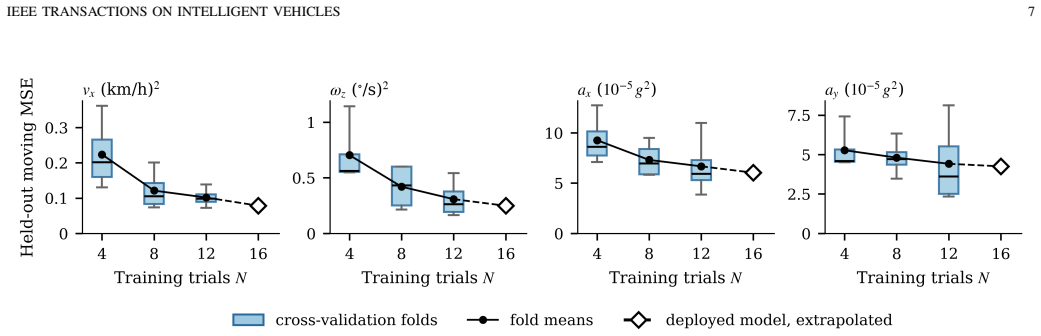
- The central transfer claim—that the model is suitable for pre-calibrating a production parking stack without proprietary parameters—rests on 16 flat-ground trials of one sedan (four classes × four repeats), with velocity masked for |vx| < 0.5 km/h. Fig. 6 shows the leave-r-repeats-out curve still descending at the data boundary; Sec. VI itself flags slopes and adhesion as future work; and the 252-cell robustness grid only perturbs geometry and start pose under the same surface and vehicle. The manuscript should state the domain of validity more sharply (flat, dry, single-vehicle parking) and either add a limited surface/vehicle-variation probe or qualify the pre-calibration claim so that it matches the evidence actually presented.
- Table IV reports that under the learned plant 10 of 31 completed cells finish below the 20 cm ultrasonic clearance floor that the kinematic plant maintains by construction, and that the predictive tracker cuts corners inside the plan. The paper correctly calls this a controller-level trade, but the abstract and contribution list still present the closed-loop result as enabling the stack to “park the vehicle through the learned dynamics” without quantifying clearance erosion. A short, explicit statement of the accuracy–clearance trade (and that production resolutions such as replanning or clearance-aware tracking are out of scope) should appear in the abstract or the closed-loop contribution bullet so that the claim is not read as free of side effects.
minor comments (6)
- Eq. (5): the indicator thresholds |dg| ≤ 0.5 / > 0.5 are written in scaled space; a one-sentence reminder that gear is already min–max scaled (or that the thresholds are applied after scaling) would avoid ambiguity for readers who implement the loss.
- Fig. 5 caption and body: the green dashed line marks the training-window horizon, but the two maneuvers share a common time scale while having different absolute lengths; stating the absolute durations (or marking the horizon in seconds) would make the beyond-horizon claim easier to verify visually.
- Table II: each axis is evaluated at a “stage-specific baseline,” so absolute numbers are not comparable across axes. A footnote or column note stating that only within-axis ranking is meaningful would prevent misreading.
- Sec. III-A: the cascade through booster rod stroke is mentioned as examined but not adopted; a single quantitative sentence (e.g., correlation or MSE relative to direct a*_x → pb) would make the design choice reproducible.
- ISO/TS 18571 ratings (Fig. 8): the paper correctly applies identical 5 Hz conditioning to measured and predicted signals; stating the filter order and whether it is applied before or after the corridor/phase/magnitude/slope decomposition would aid exact reproduction.
- Notation: u_o drops dg while the drive submodel still consumes dg; a brief cross-reference in Sec. II-A to Fig. 2 would clarify that gear is both a pass-through and a drive-submodel feature.
Circularity Check
No significant circularity: identification from field logs, soft physics regularizers, and held-out/closed-loop evaluation are independent of the inputs by construction.
full rationale
The paper is a system-identification and closed-loop deployment study, not a first-principles derivation that could collapse into its premises. The NSS state/output maps are fitted to measured bus signals and scored by multi-step open-loop rollout on stratified held-out maneuvers (Table I) and by ISO/TS 18571 reconstruction of the deployed chain; the ISO ratings are explicitly labeled reconstruction fidelity of the all-16 fit, with held-out generalization reported separately. The kinematic-bicycle yaw prior (Eq. 3) is an empirical structural prior (R²=0.997 on the data) used only as a residual readout (Eq. 4) and a soft training loss (Eq. 6), not as a tautology that forces the reported velocity or ISO scores. The gear-conditioned velocity loss (Eq. 5) is likewise a soft regularizer; the paper shows the inference-time limiter is redundant within seed noise, which is an empirical check rather than a definitional identity. Actuator submodels are selected by end-to-end vehicle-state error and optional consequence fine-tuning through a frozen plant; the authors note co-adaptation when the chain dips below the all-measured reference and still report the modular chain against measured baselines (Table III, Fig. 7). Closed-loop claims use a planner that retains its own kinematic model and synthetic scenario grids never used for identification. Citation of the precursor NSS [4] supplies architectural lineage for the reduced-order formulation and is not a uniqueness theorem or load-bearing external fact that forbids alternatives. No step reduces a claimed prediction to a fitted parameter or self-definition by construction.
Assumptions & free parameters
free parameters (8)
- NSS state/output network weights (θ, ϕ)
- Physics loss weights λ_vx=0.1, λ_ωz=0.5
- State/output MLP capacity (6×128 and 3×128 tanh)
- Training window length 2121 samples, Adam LR 2e-3 cosine, ~3200 epochs
- Percentile clip 0.5–99.5 before min–max scaling
- Actuator submodel architectures and histories (1 s NARX brake, state-aware drive NARX, first-order steering lag)
- Command-interface gains (longitudinal controller + gear state machine)
- Wheelbase Lw=3.0 m, steering ratio isw=12.1 (and related geometry)
assumptions (7)
- domain assumption At parking speeds tire slip is negligible so the kinematic-bicycle yaw prior ωz,ref = (vx/Lw) tan(δsw/isw) is a reliable structural prior (R²≈0.997 on field data).
- domain assumption Gear state dg ∈ {−1,0,+1} maps to mutually exclusive reverse / standstill / drive velocity sign constraints (soft loss L_vx).
- domain assumption Wheel-speed velocity below ~0.5 km/h is quantization noise and must be masked in losses and headline metrics.
- ad hoc to paper Forward-Euler integration at Δt=10 ms is adequate for the parking-regime NSS (higher-order integrators change metrics <1%).
- domain assumption Neutral and park are dynamically equivalent for the modeled states and may be merged as dg=0.
- domain assumption Physical input/output envelopes (command clamps, non-negative torque/pressure, ±400° lock, slew limit) keep closed-loop commands inside a physically grounded domain.
- standard math Standard MLP/NARX/GRU universal-approximation and system-ID practice (Adam, MAE, open-loop BPTT) is a valid identification framework.
invented entities (2)
-
Physics-residual yaw-rate readout (internal ωz,res + kinematic prior reconstruction)
independent evidence
-
Gear-conditioned three-branch soft velocity loss L_vx
independent evidence
Cite this review
Pith. "Pith review of Physics-Informed Neural State-Space Modeling of Battery-Electric Vehicle Dynamics for Closed-Loop Automated Parking Simulation." pith.science (2026). https://pith.science/paper/GLYQQO6N
@misc{pith2026260703000,
  author       = {Pith},
  title        = {Pith review of: Physics-Informed Neural State-Space Modeling of Battery-Electric Vehicle Dynamics for Closed-Loop Automated Parking Simulation},
  year         = {2026},
  howpublished = {\url{https://pith.science/paper/GLYQQO6N}},
  note         = {Machine review of arXiv:2607.03000}
}
read the original abstract
This paper contributes to vehicle dynamics modeling by introducing a physics-informed neural state-space model tailored for the parking regime of a production battery-electric sedan, identified entirely from field-test maneuvers. At parking speeds the model captures what the kinematic idealization omits, including actuator lag, drivetrain creep, brake-hold transitions through standstill, and frequent reversals of the motion direction. A gear-conditioned velocity constraint is imposed during training, and the yaw rate is read out as a learned residual on a kinematic-bicycle prior, so that the network devotes its capacity to the deviation from physics rather than to its reproduction. These training-time physics make the customary inference-time state limiter redundant. The commanded-to-actual behavior of the drive, brake, and steering actuators is reproduced by dedicated submodels, for which signal fidelity proves an unreliable proxy for closed-loop value; tuning the brake on its velocity consequence rather than on its own signal reverses the verdict reached at the signal level. The model generalizes to held-out maneuvers in fully open-loop simulation, and, despite being identified from only 16 field tests, the assembled command-to-vehicle chain earns Good ratings on the vehicle states under the ISO/TS 18571 objective rating metric. Embedded as the real-time plant of an interactive simulator, it enables a production-representative planning stack to park the vehicle through the learned dynamics. This makes the model suitable for pre-calibrating an automated-parking planning and control stack in the virtual development phase without the manufacturer's proprietary chassis and actuator parameters.
Figures


Figures from the paper (7 more)




Reference graph
Works this paper leans on
-
[1]
Modeling of vehicle dynamics from real vehicle measurements using a neural network with two-stage hybrid learning for accurate long-term prediction,
S.-Y . Oh and Y . Yim, “Modeling of vehicle dynamics from real vehicle measurements using a neural network with two-stage hybrid learning for accurate long-term prediction,” inProc. IEEE Int. Symp. Comput. Intell. Robot. Autom. (CIRA), Monterey, CA, USA, 1999, pp. 83–88
1999
-
[2]
Neural network vehicle models for high-performance automated driving,
N. A. Spielberg, M. Brown, N. R. Kapania, J. C. Kegelman, and J. C. Gerdes, “Neural network vehicle models for high-performance automated driving,”Sci. Robot., vol. 4, no. 28, Art. no. eaaw1975, 2019
2019
-
[3]
Deep-neural-network-based modelling of longitudinal-lateral dynamics to predict the vehicle states for autonomous driving,
X. Nie, C. Min, Y . Pan, K. Li, and Z. Li, “Deep-neural-network-based modelling of longitudinal-lateral dynamics to predict the vehicle states for autonomous driving,”Sensors, vol. 22, no. 6, Art. no. 2013, 2022
2013
-
[4]
Data-driven vehicle dynam- ics: Neural network modeling for system identification and prediction in driver assistance control,
P. Song, L. Zheng, G. Tian, and L. Zhang, “Data-driven vehicle dynam- ics: Neural network modeling for system identification and prediction in driver assistance control,”Automot. Innov., vol. 8, no. 1, pp. 46–58, 2025
2025
-
[5]
Neural ordinary differential equations,
R. T. Q. Chen, Y . Rubanova, J. Bettencourt, and D. Duvenaud, “Neural ordinary differential equations,” inProc. Adv. Neural Inf. Process. Syst. (NeurIPS), Montreal, QC, Canada, 2018, pp. 6571–6583
2018
-
[6]
Learning nonlinear state-space models using autoencoders,
D. Masti and A. Bemporad, “Learning nonlinear state-space models using autoencoders,”Automatica, vol. 129, Art. no. 109666, 2021
2021
-
[7]
Continuous-time system identification with neural networks: Model structures and fitting criteria,
M. Forgione and D. Piga, “Continuous-time system identification with neural networks: Model structures and fitting criteria,”Eur. J. Control, vol. 59, pp. 69–81, 2021
2021
-
[8]
Physics-informed neural networks: A deep learning framework for solving forward and inverse problems involving nonlinear partial differential equations,
M. Raissi, P. Perdikaris, and G. E. Karniadakis, “Physics-informed neural networks: A deep learning framework for solving forward and inverse problems involving nonlinear partial differential equations,”J. Comput. Phys., vol. 378, pp. 686–707, 2019
2019
Show all 18 references
-
[9]
Deep dynamics: Vehicle dynamics modeling with a physics-constrained neural network for autonomous racing,
J. Chrosniak, J. Ning, and M. Behl, “Deep dynamics: Vehicle dynamics modeling with a physics-constrained neural network for autonomous racing,”IEEE Robot. Autom. Lett., vol. 9, no. 5, pp. 5292–5297, 2024
2024
-
[11]
Available: https://arxiv.org/abs/2103.06727
[Online]. Available: https://arxiv.org/abs/2103.06727
-
[12]
Path planning for autonomous vehicles in unknown semi-structured environments,
D. Dolgov, S. Thrun, M. Montemerlo, and J. Diebel, “Path planning for autonomous vehicles in unknown semi-structured environments,”Int. J. Robot. Res., vol. 29, no. 5, pp. 485–501, 2010
2010
-
[13]
Trajectory planning for autonomous valet parking in narrow environments with enhanced hybrid A* search and nonlinear optimization,
J. Lian, W. Ren, D. Yang, L. Li, and F. Yu, “Trajectory planning for autonomous valet parking in narrow environments with enhanced hybrid A* search and nonlinear optimization,”IEEE Trans. Intell. Veh., vol. 8, no. 6, pp. 3723–3734, 2023
2023
-
[14]
Long short-term memory,
S. Hochreiter and J. Schmidhuber, “Long short-term memory,”Neural Comput., vol. 9, no. 8, pp. 1735–1780, 1997
1997
-
[15]
Nonlinear black-box modeling in system identification: A unified overview,
J. Sj ¨oberget al., “Nonlinear black-box modeling in system identification: A unified overview,”Automatica, vol. 31, no. 12, pp. 1691–1724, 1995
1995
-
[16]
Learning phrase representations using RNN encoder– decoder for statistical machine translation,
K. Choet al., “Learning phrase representations using RNN encoder– decoder for statistical machine translation,” inProc. Conf. Empiri- cal Methods Natural Lang. Process. (EMNLP), Doha, Qatar, 2014, pp. 1724–1734
2014
-
[17]
Optimal paths for a car that goes both forwards and backwards,
J. Reeds and L. Shepp, “Optimal paths for a car that goes both forwards and backwards,”Pac. J. Math., vol. 145, no. 2, pp. 367–393, 1990
1990
-
[18]
Optimization-based collision avoidance,
X. Zhang, A. Liniger, and F. Borrelli, “Optimization-based collision avoidance,”IEEE Trans. Control Syst. Technol., vol. 29, no. 3, pp. 972– 983, 2021
2021
-
[19]
The kinematic bicycle model: A consistent model for planning feasible trajectories for autonomous vehicles?
P. Polack, F. Altch ´e, B. d’Andr ´ea-Novel, and A. de La Fortelle, “The kinematic bicycle model: A consistent model for planning feasible trajectories for autonomous vehicles?” inProc. IEEE Intell. Veh. Symp. (IV), Redondo Beach, CA, USA, 2017, pp. 812–818. [19]Road Vehicles,...
2017
Reviewed July 12, 2026 · model on record in the stance chip above.
Discussion (0). Sign in to comment.