REVIEW 2 major objections 8 minor 38 references
A Reconfigurable and Representation-Adaptive ISA-Based Architecture for Efficient DNN Acceleration
T0 review · 2 major / 8 minor · reviewed 2026-07-11 · grok-4.5
Pith's one-line read An ML-oriented ISA with lightweight cores and RNS dynamic precision reaches 5–10 TOPS/W and up to 1.2× the energy efficiency of fixed-point while staying programmable.
desk verdict Solid programmable DNN accelerator with real 22 nm PnR numbers and a clean RNS vs FXP Pareto; the ISA/decoupling story is the real contribution, not just another RNS PE. read the letter →
The pith
A machine-rendered reading of the paper's core claim, the machinery that carries it, and where it could break.
The reading
What carries the argument
The four-domain data-stream architecture (fetch / pre-process / tensor / post-process) controlled by Type-I/II/III mCores whose instruction set is deliberately independent of the underlying number system; the same binaries therefore drive either fixed-point or RNS PEs, while a dynamic-programming layer-wise base selection maps each WxAy configuration onto the cheapest active residue channels.
What would settle it
Re-quantize the same four models (or a new transformer/CNN suite) under the paper’s own dynamic-programming procedure, measure end-to-end energy and accuracy on both the RNS and fixed-point silicon (or cycle-accurate power models), and check whether the RNS design still delivers a ≥1.2× efficiency advantage at equal accuracy within a 1 % loss budget.
Extended reading notes
Core claim
A custom ML-oriented ISA executed by lightweight mCores and decoupled SIMD domains, when instantiated with dynamic-precision RNS arithmetic (primary base {5,7,9,31,32}), yields a 22 nm accelerator that simultaneously sustains high PE utilization, supports 3–8-bit mixed precision, preserves model accuracy, and achieves 5.14–10.47 TOPS/W—up to 1.2× the energy efficiency of its fixed-point counterpart and better than listed RISC-V and fixed-function mixed-precision designs.
Load-bearing premise
That the chosen RNS base together with the 16-interval piecewise-linear approximations for softmax and GeLU keep accuracy loss no larger than the fixed-point mixed-precision baseline under the same energy-cost model; if overflow or approximation error grows on other models, the claimed iso-accuracy efficiency gain disappears.
Editorial extensions
If this is right
- New DNN layers or operators can be added by writing short mCore templates rather than redesigning hardwired FSMs, shortening retargeting time.
- Any future number system (block-floating-point, posits, etc.) can be swapped under the same ISA without rewriting the control programs.
- Layer-fusion schemes such as fused depthwise–pointwise convolution become ordinary programs, raising PE utilization on MobileNet-class models without extra silicon.
- The measured control overhead of a few percent of total power becomes a concrete design target for other programmable AI accelerators.
Reading between the lines
- If the representation-agnostic ISA is adopted more widely, architecture teams could treat numerical format as a late-stage, model-specific choice rather than a fixed micro-architectural decision.
- The same decoupled post-processing domain that hides RNS conversion latency could also absorb online quantization or adaptive activation functions without stalling the MAC arrays.
- Extending the primary RNS base set and re-running the optimal-base search under tighter timing corners would give a portable recipe for other process nodes or supply voltages.
Editorial analysis
A structured set of objections, weighed in public.
Referee Report
Summary. The paper proposes a machine-learning-oriented ISA and a reconfigurable accelerator organized into decoupled data-fetching, pre-processing, tensor-processing, and post-processing domains, controlled by lightweight programmable mCores and data-stream abstractions. The ISA is representation-independent and supports dynamic precision, flexible addressing, SIMD MAC/post-processing, and interrupts for domain decoupling. A 22 nm RNS instantiation with 3–8-bit fine-grained weight precision and 4/8-bit activations is fully placed-and-routed; post-PnR results report 5.14–10.47 TOPS/W on a representative matmul, control overhead of ~4–9%, high PE utilization for matmul/conv, and up to 1.2× end-to-end energy efficiency versus a same-architecture mixed-precision fixed-point design on ResNet-50, YOLOv5-m, BERT-base, and ViT, while matching or beating listed mixed-precision and RISC-V accelerators in Table IV. Supporting material includes program templates (matmul, 3×3 conv, attention/softmax, fused DW–PW), a systematic RNS base-selection procedure (§III-D), and accuracy checks for PWL softmax/GeLU (Fig. 9).
Significance. If the results hold, the work is a concrete and useful contribution to the efficiency–programmability tradeoff in DNN accelerators: an ML-specialized ISA with low control overhead, demonstrated post-PnR silicon-quality numbers on 22 nm, representation independence (enabling an RNS case study), and systematic DP base selection under a hardware cost model (Eq. 2). Strengths that should be credited include full place-and-route with annotated hierarchy and area/power breakdowns (Figs. 15–17, Table III), PE-utilization curves including I-cache effects (Fig. 8), iso-architecture RNS-vs-FXP Pareto fronts on four public models (Fig. 18), and explicit quantification of PWL approximation impact on BERT F1 (Fig. 9). These go beyond purely microarchitectural proposals that lack end-to-end accuracy–cost analysis or PnR evidence.
major comments (2)
- §IV-A, Table III and Eq. (2): Switching activity and absolute power are reported for a single (64,512)×(512,64) matmul under three precision modes. End-to-end Pareto fronts in Fig. 18 and the 1.2× RNS-vs-FXP claim are then obtained by plugging those component powers (Pj, Pmem, Pppu) into the analytical cost model. Convolution (OP1CACHE, border buffers, padding) and attention (two memory passes, red_max/red_sum, pwl_mem, lower PE utilization) change memory traffic and PPU duty cycle relative to dense matmul. Please report post-PnR power (or at least memory/control/PPU fractions) for at least one 3×3 convolution and one attention/softmax kernel, or provide a sensitivity bound showing that Fig. 18 rankings are stable under plausible α_m/α_a variation. Without this, the load-bearing end-to-end efficiency claim rests on an incompletely validated activity model.
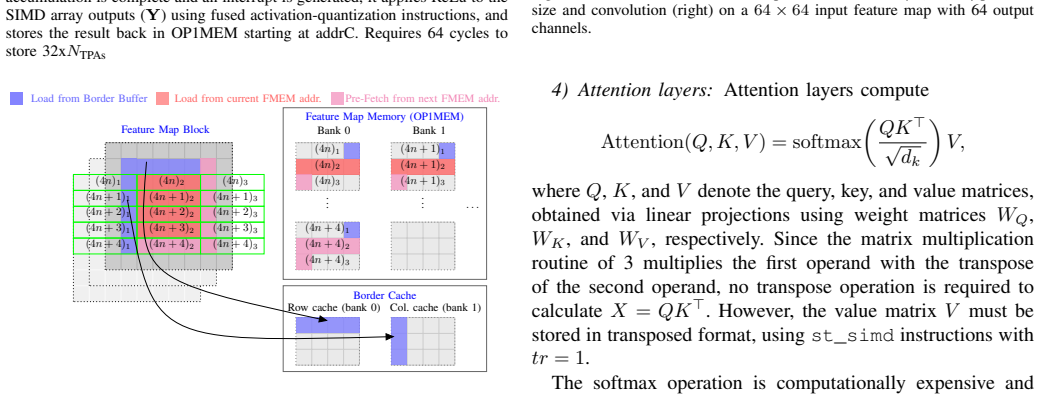
- §II-E / §IV-C and Table IV: Programmability is demonstrated via parameterized assembly templates and high PE utilization; a general model compiler is explicitly future work. Comparisons to RISC-V systems (MARSELLUS, Flex-v, Spatz, MX) emphasize TOPS/W and utilization but do not quantify software-stack cost, binary size, or retargeting effort for a new operator. The central “bridges efficiency and programmability” claim would be more defensible if the paper either (a) states clearly that the contribution is the ISA/architecture substrate (not end-to-end software productivity) and limits the comparison accordingly, or (b) adds a short quantitative discussion of instruction counts / control overhead versus a representative RISC-V + matrix-extension baseline for the same layers. As written, the efficiency side is strong; the programmability side is only partially evidenced.
minor comments (8)
- Abstract states 5.12–10.47 TOPS/W; §I and Table III use 5.14–10.47. Align the numbers.
- Fig. 1 caption and §II-D: VRF naming is inconsistent (VRF_PP / VFR_PP / VFR_Is). Standardize notation.
- §II-E.2 / Fig. 4: Several instruction mnemonics in the convolution listing (ldcp_add, ldib, subi) are not fully defined in Table I; add them or map them to the documented ISA.
- §III-B: The product-range rule R ≥ 2^{x+y+2} is stated without a short derivation or pointer to the overflow analysis in [27]; a one-sentence justification would help readers who do not have the prior paper.
- Table IV footnote and body: Clarify whether all listed TOPS/W numbers are peak or workload-average, and whether 1 MAC = 2 OPS is applied uniformly to every compared design.
- Fig. 18(c) legend appears to contain a typo (“BNS mixed”); should be FXP mixed for consistency with (a)(b)(d).
- §II-G fused DW–PW: g_DW = 1, g_PW = 31 is a single design point; a brief note on sensitivity of utilization (Fig. 13) to this split would strengthen the layer-fusion claim.
- Typos: “VisionT Transformer”, “coeffcients”, “bitwdith”, “prepossessing”, “coulumn loop”, “approc instruction” — standard copy-edit pass.
Circularity Check
No significant circularity: TOPS/W, 1.2× RNS-vs-FXP gains, and utilization numbers rest on post-PnR measurements and independent accuracy runs, not on self-defined or fitted-as-predicted quantities.
full rationale
The paper’s central efficiency and programmability claims are grounded in a concrete 22 nm place-and-route implementation (area 2.25 mm², 800 MHz nominal, power analysis at 0.65 V / 500 MHz with switching activity from a representative MatMul workload) together with cycle-accurate PE-utilization figures obtained by executing the published ISA program templates. The RNS-versus-FXP Pareto comparison (Fig. 18) populates the same hardware-aware cost model (Eq. 2) with measured component powers for both numerical representations; the reported 1.2× end-to-end advantage is therefore an observed outcome of that comparison, not a quantity forced by construction. Accuracy numbers (Fig. 9, BERT-SQuAD F1; ImageNet / COCO results) come from separate post-training quantization + 16-interval 12-bit PWL evaluations on public models and are not used to define the hardware cost model. Self-citations to the authors’ earlier RNS accelerators supply background on residue arithmetic and prior fixed-function designs but are not invoked as uniqueness theorems, uniqueness proofs, or load-bearing premises that force the new ISA, the domain decoupling, or the measured efficiency numbers. No parameter is fitted to a data subset and then re-presented as a prediction of a closely related quantity; no ansatz is smuggled in via citation; no known empirical pattern is merely renamed. Consequently the derivation chain is self-contained against external benchmarks and exhibits only the ordinary, non-circular self-citation common in architecture papers.
Assumptions & free parameters
free parameters (4)
- primary RNS base BP = {5,7,9,31,32}
- PWL intervals n_int = 16 and 12-bit coefficients
- TPA/PE counts (16×32) and memory sizes
- cost-model weights α_m, α_a and power values Pj, Pmem, Pppu
assumptions (4)
- domain assumption Inter-layer independence of quantization error (standard mixed-precision assumption)
- standard math RNS addition/multiplication are carry-free and can be clock-gated per channel
- ad hoc to paper Piecewise-linear approximations with 16 intervals suffice for softmax/GeLU at the reported accuracy
- domain assumption Pseudo-1R1W and banked SRAMs deliver the assumed bandwidth without contention under the programmed dataflows
invented entities (3)
-
mCore (Type-I/II/III lightweight programmable cores)
-
representation-independent ML-oriented ISA with data-stream abstraction
-
virtual register files (VRFs) and fused DW-PW data stream
Cite this review
Pith. "Pith review of A Reconfigurable and Representation-Adaptive ISA-Based Architecture for Efficient DNN Acceleration." pith.science (2026). https://pith.science/paper/WN4EKV3O
@misc{pith2026260704475,
  author       = {Pith},
  title        = {Pith review of: A Reconfigurable and Representation-Adaptive ISA-Based Architecture for Efficient DNN Acceleration},
  year         = {2026},
  howpublished = {\url{https://pith.science/paper/WN4EKV3O}},
  note         = {Machine review of arXiv:2607.04475}
}
read the original abstract
Domain-specific hardware accelerators provide significantly higher performance and energy efficiency for deep neural network (DNN) workloads than general-purpose processors, but often lack adaptability to evolving model architectures. In contrast, general-purpose ISA-based solutions, such as RISC-V-based accelerators, improve programmability at the cost of efficiency. This work addresses this tradeoff by introducing a machine-learning-oriented instruction set architecture (ISA) and a reconfigurable hardware platform that combine high efficiency with flexibility. The proposed ISA enables fine-grained control over data movement, dynamic precision, and decoupled execution across data-fetching, tensor processing, and post-processing domains. The corresponding architecture employs lightweight programmable cores and SIMD units to maintain high processing-element utilization with low control overhead, while remaining independent of the underlying numerical representation. We demonstrate the approach using a Residue Number System (RNS) instantiation supporting 3-8-bit dynamic precision. A 22-nm implementation achieves 5.12-10.47 TOPS/W for a typical workload and up to 1.2x higher energy efficiency than its fixed-point counterpart, while preserving model accuracy. It also outperforms state-of-the-art and mixed-precision accelerators. These results show that the proposed design effectively bridges the gap between efficiency and programmability in modern DNN accelerators.
Figures


Figures from the paper (16 more)




Reference graph
Works this paper leans on
-
[1]
A multi-mode 8k-mac hw-utilization-aware neural processing unit with a unified multi-precision datapath in 4nm flagship mobile soc,
J.-S. Park, C. Park, S. Kwon, H.-S. Kim, T. Jeon, Y . Kang, H. Lee, D. Lee, J. Kim, Y . Lee, S. Park, J.-W. Jang, S. Ha, M. Kim, J. Bang, S. H. Lim, and I. Kang, “A multi-mode 8k-mac hw-utilization-aware neural processing unit with a unified multi-precision datapath in 4nm flagship mobile soc,” in2022 IEEE International Solid-State Circuits Conference (IS...
2022
-
[2]
A 12.1 tops/w quantized network acceleration processor with effective-weight- based convolution and error-compensation-based prediction,
H. Mo, W. Zhu, W. Hu, Q. Li, A. Li, S. Yin, S. Wei, and L. Liu, “A 12.1 tops/w quantized network acceleration processor with effective-weight- based convolution and error-compensation-based prediction,”IEEE Jour- nal of Solid-State Circuits, vol. 57, no. 5, pp. 1542–1557, 2022. 19
2022
-
[3]
A 28nm 0.22uj/token memory-compute- intensity-aware cnn-transformer accelerator with hybrid-attention-based layer-fusion and cascaded pruning for semantic-segmentation,
P. Dong, Y . Tan, X. Liu, P. Luo, Y . Liu, L. Liang, Y . Zhou, D. Pang, M.-T. Yung, D. Zhang, X. Huang, S.-Y . Liu, Y . Wu, F. Tian, C.-Y . Tsui, F. Tu, and K.-T. Cheng, “A 28nm 0.22uj/token memory-compute- intensity-aware cnn-transformer accelerator with hybrid-attention-based layer-fusion and cascaded pruning for semantic-segmentation,” in2025 IEEE Inte...
2025
-
[4]
Mega.mini: An energy-efficient npu leveraging a novel big/little core with hybrid input activation for generative ai acceleration,
D. Han and A. P. Chandrakasan, “Mega.mini: An energy-efficient npu leveraging a novel big/little core with hybrid input activation for generative ai acceleration,”IEEE Journal of Solid-State Circuits, pp. 1–14, 2025
2025
-
[5]
T-rex: A 68-to-567us/token 0.41-to-3.95uj/token transformer accelerator with reduced external memory access and enhanced hardware utilization in 16nm finfet,
S. Moon, M. Li, G. K. Chen, P. C. Knag, R. K. Krishnamurthy, and M. Seok, “T-rex: A 68-to-567us/token 0.41-to-3.95uj/token transformer accelerator with reduced external memory access and enhanced hardware utilization in 16nm finfet,” in2025 IEEE International Solid-State Circuits Conference (ISSCC), vol. 68, 2025, pp. 406–408
2025
-
[6]
A 28nm 11.2tops/w hardware-utilization- aware neural-network accelerator with dynamic dataflow,
C.-Y . Du, C.-F. Tsai, W.-C. Chen, L.-Y . Lin, N.-S. Chang, C.-P. Lin, C.-S. Chen, and C.-H. Yang, “A 28nm 11.2tops/w hardware-utilization- aware neural-network accelerator with dynamic dataflow,” in2023 IEEE International Solid-State Circuits Conference (ISSCC), 2023, pp. 1–3
2023
-
[7]
How to keep pushing ml accelerator performance? know your rooflines!
M. Verhelst, L. Benini, and N. Verma, “How to keep pushing ml accelerator performance? know your rooflines!”IEEE Journal of Solid- State Circuits, vol. 60, no. 6, pp. 1888–1905, 2025
1905
-
[8]
Datamaestro: A versatile and efficient data streaming engine bringing decoupled memory access to dataflow accelerators,
X. Yi, Y . Deng, R. Antonio, F. Kong, G. Paim, and M. Verhelst, “Datamaestro: A versatile and efficient data streaming engine bringing decoupled memory access to dataflow accelerators,” in2025 62nd ACM/IEEE Design Automation Conference (DAC), 2025, pp. 1–7
2025
Show all 38 references
-
[9]
Xpulpnn: Enabling energy efficient and flexible inference of quantized neural networks on risc-v based iot end nodes,
A. Garofalo, G. Tagliavini, F. Conti, L. Benini, and D. Rossi, “Xpulpnn: Enabling energy efficient and flexible inference of quantized neural networks on risc-v based iot end nodes,”IEEE Transactions on Emerging Topics in Computing, vol. 9, no. 3, pp. 1489–1505, 2021
2021
-
[10]
Vega: A ten-core soc for iot endnodes with dnn acceleration and cognitive wake-up from mram-based state-retentive sleep mode,
D. Rossi, F. Conti, M. Eggiman, A. D. Mauro, G. Tagliavini, S. Mach, M. Guermandi, A. Pullini, I. Loi, J. Chen, E. Flamand, and L. Benini, “Vega: A ten-core soc for iot endnodes with dnn acceleration and cognitive wake-up from mram-based state-retentive sleep mode,”IEEE Journa...
2022
-
[11]
22.1 A 12.4TOPS/W @ 136GOPS AI-IoT System-on-Chip with 16 RISC-V , 2-to-8b Precision-Scalable DNN Acceleration and 30%-Boost Adaptive Body Biasing,
F. Conti, D. Rossi, G. Paulin, A. Garofalo, A. Di Mauro, G. Rutishauer, G. m. Ottavi, M. Eggimann, H. Okuhara, V . Huard, O. Montfort, L. Jure, N. Exibard, P. Gouedo, M. Louvat, E. Botte, and L. Benini, “22.1 A 12.4TOPS/W @ 136GOPS AI-IoT System-on-Chip with 16 RISC-V , 2-to-8...
2023
-
[12]
Mx: Enhancing risc-v’s vector isa for ultra-low overhead, energy-efficient matrix multiplication,
M. Perotti, Y . Zhang, M. Cavalcante, E. Mustafa, and L. Benini, “Mx: Enhancing risc-v’s vector isa for ultra-low overhead, energy-efficient matrix multiplication,” in2024 Design, Automation and Test in Europe Conference and Exhibition (DATE), 2024, pp. 1–6
2024
-
[13]
A 3 tops/w risc-v parallel cluster for inference of fine-grain mixed-precision quantized neural networks,
A. Nadalini, G. Rutishauser, A. Burrello, N. Bruschi, A. Garofalo, L. Benini, F. Conti, and D. Rossi, “A 3 tops/w risc-v parallel cluster for inference of fine-grain mixed-precision quantized neural networks,” in2023 IEEE Computer Society Annual Symposium on VLSI (ISVLSI), 202...
2023
-
[14]
Spatz: Clustering compact risc-v-based vector units to maximize computing efficiency,
M. Cavalcante, M. Perotti, S. Riedel, and L. Benini, “Spatz: Clustering compact risc-v-based vector units to maximize computing efficiency,” arXiv preprint arXiv:2309.10137, 2023
2023 arXiv
-
[15]
Quadrilatero: A risc-v programmable matrix coprocessor for low-power edge applications,
D. Cammarata, M. Perotti, M. Bertuletti, A. Garofalo, P. D. Schiavone, D. Atienza, and L. Benini, “Quadrilatero: A risc-v programmable matrix coprocessor for low-power edge applications,” inProceedings of the 22nd ACM International Conference on Computing Frontiers: Workshops ...
2025
-
[16]
A survey and comparative analysis of number systems for deep neural networks,
G. Alsuhli, V . Sakellariou, H. Saleh, M. Al-Qutayri, B. Mohammad, and T. Stouraitis, “A survey and comparative analysis of number systems for deep neural networks,”Proceedings of the IEEE, vol. 113, no. 2, pp. 172–207, 2025
2025
-
[17]
A 22-nm 4.92 tops/w end-to-end rns dnn accelerator for edge-ai devices,
V . Sakellariou, V . Paliouras, I. Kouretas, H. Saleh, and T. Stouraitis, “A 22-nm 4.92 tops/w end-to-end rns dnn accelerator for edge-ai devices,” IEEE Transactions on Emerging Topics in Computing, pp. 1–16, 2026
2026
-
[18]
Online normalizer calculation for softmax,
M. Milakov and N. Gimelshein, “Online normalizer calculation for softmax,”arXiv preprint arXiv:1805.02867, 2018
2018 arXiv
-
[19]
Mobilenets: Efficient convo- lutional neural networks for mobile vision applications,
A. G. Howard, M. Zhu, B. Chen, D. Kalenichenko, W. Wang, T. Weyand, M. Andreetto, and H. Adam, “Mobilenets: Efficient convo- lutional neural networks for mobile vision applications,”arXiv preprint arXiv:1704.04861, 2017
2017 arXiv
-
[20]
A 22-nm 4.92 TOPS/W end-to-end RNS DNN Accelerator for Edge-AI Devices,
V . Sakellariou, V . Paliouras, I. Kouretas, H. Saleh, and T. Stouraitis, “A 22-nm 4.92 TOPS/W end-to-end RNS DNN Accelerator for Edge-AI Devices,”Authorea Preprints, 2024
2024
-
[21]
Res-DNN: A Residue Number System-Based DNN Accelerator Unit,
N. Samimi, M. Kamal, A. Afzali-Kusha, and M. Pedram, “Res-DNN: A Residue Number System-Based DNN Accelerator Unit,”IEEE Trans- actions on Circuits and Systems I: Regular Papers, vol. 67, no. 2, pp. 658–671, 2020
2020
-
[22]
A deep convolutional neural network based on nested residue number system,
H. Nakahara and T. Sasao, “A deep convolutional neural network based on nested residue number system,” in2015 25th International Conference on Field Programmable Logic and Applications (FPL), 2015, pp. 1–6
2015
-
[23]
Application of the residue number system to reduce hardware costs of the convolutional neural network implementation,
M. Valueva, N. Nagornov, P. Lyakhov, G. Valuev, and N. Chervyakov, “Application of the residue number system to reduce hardware costs of the convolutional neural network implementation,”Mathematics and Computers in Simulation, vol. 177, pp. 232–243, 2020
2020
-
[24]
RNSiM: Efficient Deep Neural Network Accelerator Using Residue Number Systems,
A. Roohi, M. Taheri, S. Angizi, and D. Fan, “RNSiM: Efficient Deep Neural Network Accelerator Using Residue Number Systems,” in2021 IEEE/ACM International Conference On Computer Aided Design (IC- CAD), 2021, pp. 1–9
2021
-
[25]
RNSnet: In-Memory Neural Network Acceleration Using Residue Number System,
S. Salamat, M. Imani, S. Gupta, and T. Rosing, “RNSnet: In-Memory Neural Network Acceleration Using Residue Number System,” 11 2018, pp. 1–12
2018
-
[26]
A multiplier-Free RNS-Based CNN accelerator exploiting bit-Level sparsity,
V . Sakellariou, V . Paliouras, I. Kouretas, H. Saleh, and T. Stouraitis, “A multiplier-Free RNS-Based CNN accelerator exploiting bit-Level sparsity,”IEEE Transactions on Emerging Topics in Computing, pp. 1– 16, 2023
2023
-
[27]
A mixed-precision rns dnn accelerator,
——, “A mixed-precision rns dnn accelerator,” in2025 IEEE Interna- tional Symposium on Circuits and Systems (ISCAS), 2025, pp. 1–5
2025
-
[28]
Improving post training neural quantization: Layer-wise calibration and integer programming,
I. Hubara, Y . Nahshan, Y . Hanani, R. Banner, and D. Soudry, “Improving post training neural quantization: Layer-wise calibration and integer programming,”arXiv preprint arXiv:2006.10518, 2020
2006 arXiv
-
[29]
Optimal brain compression: A framework for accurate post-training quantization and pruning,
E. Frantar and D. Alistarh, “Optimal brain compression: A framework for accurate post-training quantization and pruning,”Advances in Neural Information Processing Systems, vol. 35, pp. 4475–4488, 2022
2022
-
[30]
Effi- cient Diminished1 Modulo2 n + 1Multipliers,
C. Efstathiou, H. Vergos, G. Dimitrakopoulos, and D. Nikolos, “Effi- cient Diminished1 Modulo2 n + 1Multipliers,”IEEE Transactions on Computers - TC, vol. 54, pp. 491–496, 04 2005
2005
-
[31]
Deep Residual Learning for Image Recognition,
K. He, X. Zhang, S. Ren, and J. Sun, “Deep Residual Learning for Image Recognition,” in2016 IEEE Conference on Computer Vision and Pattern Recognition (CVPR), 2016, pp. 770–778
2016
-
[32]
An image is worth 16x16 words: Transformers for image recognition at scale,
A. Dosovitskiy, L. Beyer, A. Kolesnikov, D. Weissenborn, X. Zhai, T. Unterthiner, M. Dehghani, M. Minderer, G. Heigold, S. Gellyet al., “An image is worth 16x16 words: Transformers for image recognition at scale,”arXiv preprint arXiv:2010.11929, 2020
2010 arXiv
-
[33]
Yolov3: An incremental improvement,
J. Redmon and A. Farhadi, “Yolov3: An incremental improvement,” arXiv preprint arXiv:1804.02767, 2018
2018 arXiv
-
[34]
BERT: Pre-training of Deep Bidirectional Transformers for Language Understanding,
J. Devlin, M.-W. Chang, K. Lee, and K. Toutanova, “BERT: Pre-training of Deep Bidirectional Transformers for Language Understanding,” inNorth American Chapter of the Association for Computational Linguistics, 2019. [Online]. Available: https://api.semanticscholar.org/CorpusID:52967399
2019
-
[35]
Bit- Blade: Energy-Efficient Variable Bit-Precision Hardware Accelerator for Quantized Neural Networks,
S. Ryu, H. Kim, W. Yi, E. Kim, Y . Kim, T. Kim, and J.-J. Kim, “Bit- Blade: Energy-Efficient Variable Bit-Precision Hardware Accelerator for Quantized Neural Networks,”IEEE Journal of Solid-State Circuits, vol. 57, no. 6, pp. 1924–1935, 2022
1924
-
[36]
DIANA: An End-to-End Energy-Efficient Digital and ANAlog Hybrid Neural Network SoC,
K. Ueyoshi, I. A. Papistas, P. Houshmand, G. M. Sarda, V . Jain, M. Shi, Q. Zheng, S. Giraldo, P. Vrancx, J. Doevenspeck, D. Bhattacharjee, S. Cosemans, A. Mallik, P. Debacker, D. Verkest, and M. Verhelst, “DIANA: An End-to-End Energy-Efficient Digital and ANAlog Hybrid Neural...
2022
-
[37]
Bit Fusion: Bit-Level Dynamically Composable Ar- chitecture for Accelerating Deep Neural Network,
H. Sharma, J. Park, N. Suda, L. Lai, B. Chau, J. K. Kim, V . Chandra, and H. Esmaeilzadeh, “Bit Fusion: Bit-Level Dynamically Composable Ar- chitecture for Accelerating Deep Neural Network,” in2018 ACM/IEEE 45th Annual International Symposium on Computer Architecture (ISCA), 2...
2018
-
[38]
Toward attention-based tinyml: A heteroge- neous accelerated architecture and automated deployment flow,
P. Wiese, G. ˙Islamo˘glu, M. Scherer, L. Macan, V . J.-B. Jung, A. Burrello, F. Conti, and L. Benini, “Toward attention-based tinyml: A heteroge- neous accelerated architecture and automated deployment flow,”IEEE Design & Test, vol. 42, no. 5, pp. 63–72, 2025
2025
Reviewed July 11, 2026 · model on record in the stance chip above.
Discussion (0). Sign in to comment.