REVIEW 3 major objections 28 references
Storage as a Transmission Asset (SATA) for Large-Load Congestion Relief
T0 review · 3 major / 0 minor · reviewed 2026-07-11 · grok-4.5
Pith's one-line read How storage is dispatched—not its size—decides how much it can relieve transmission congestion for large loads.
desk verdict Clean same-hardware Monte Carlo comparison shows operator-directed SATA beats frozen forecast arbitrage on EENS/LOLH/CVaR, but the baseline is deliberately non-adaptive and the model is DC-only on RTS-24. read the letter →
The pith
A machine-rendered reading of the paper's core claim, the machinery that carries it, and where it could break.
The reading
What carries the argument
Day-ahead DC optimal power flow that co-optimizes generation, ESS charge/discharge, and load curtailment under two dispatch policies on the same scenarios: free co-optimization (SATA) versus a pre-committed forecast-price arbitrage schedule, with siting and rating fixed by expected congestion price and PTDF sensitivity.
What would settle it
Re-solve the same RTS-24 scenarios with an AC security-constrained OPF (or post-process AC power-flow checks) and test whether the EENS, LOLH, and CVaR advantage of SATA over pure arbitrage remains statistically significant.
Extended reading notes
Core claim
On identical hardware, energy budget, and Monte Carlo scenarios of demand and generator outages, operator-directed SATA dispatch reduces expected energy not served, loss-of-load hours, and the 95% CVaR of daily unserved energy relative to pure-arbitrage dispatch of the same ESS. The operating designation—not the physical asset—is therefore a primary driver of storage’s transmission reliability value.
Load-bearing premise
All reliability numbers rest on a linear DC power-flow model whose solutions are never checked for AC feasibility; if voltage or reactive limits bind, the reported gaps between SATA and arbitrage can change.
Signed reviews
Editorial analysis
A structured set of objections, weighed in public.
Referee Report
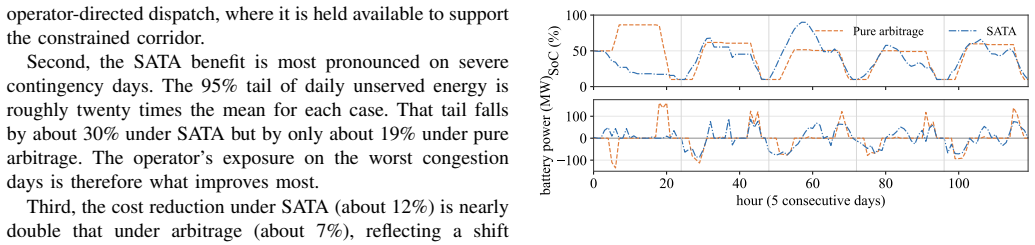
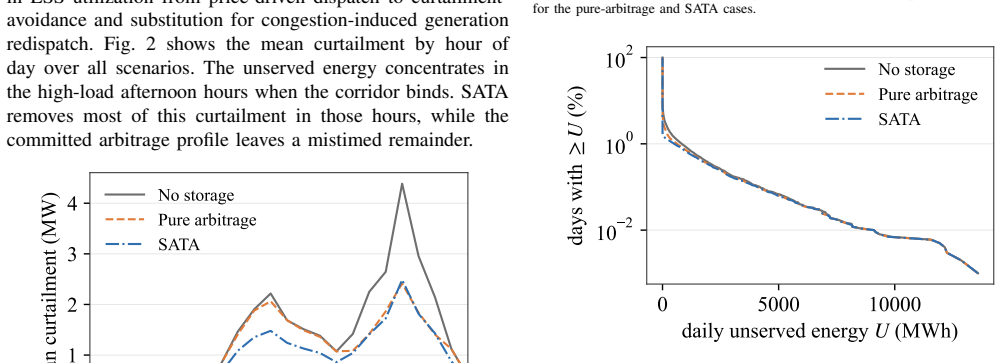
Summary. The paper quantifies the day-ahead operating reliability of energy storage used as a transmission asset (SATA) for congestion relief of a large concentrated load. On the IEEE RTS-24 system with a 500 MW data-center load at Bus 3, a day-ahead DC OPF co-optimizes generation, ESS charge/discharge, and curtailment over N=10^5 Monte Carlo demand and generator-outage scenarios. Three cases share the same network, ESS model (3), siting/sizing via congestion prices and PTDFs (5)–(6), and scenario set: no storage; pure arbitrage with a forecast-committed schedule (4) frozen across realizations; and operator-directed SATA with free co-optimized (c_t,d_t). Reliability is reported via EENS, LOLH, and CVaR_0.95 of daily unserved energy (Table I). The central claim is that operator-directed SATA reduces average unserved energy, loss-of-load hours, and tail risk relative to the same hardware under pure arbitrage, so that operating designation—not hardware—is a primary driver of transmission value.
Significance. The contribution is timely for hyperscale-load interconnection and for the regulatory SATA designation. Strengths include a clean experimental isolation (identical hardware, energy budget, and scenarios; only dispatch policy differs), a reproducible congestion-price/PTDF siting and applicability screen that correctly flags import-limited vs uncongested regimes, standard adequacy indices plus CVaR, and Monte Carlo convergence evidence (Fig. 5). If the designation gap holds under more realistic market baselines and AC checks, the work supplies concrete operating-level evidence that operators and regulators have lacked. The screening rule and the explicit SATA-vs-arbitrage comparison are useful even if quantitative deltas are system-specific.
major comments (3)
- §II-D and Eq. (4): The pure-arbitrage baseline commits (c̄_t,d̄_t) once from forecast prices and freezes discharge across all realized scenarios; only charging may be preempted. A market ESS that can re-optimize or be re-dispatched once the day-ahead outage/demand realization is known would close part of the timing mismatch attributed solely to designation. Table I’s EENS/LOLH/CVaR gaps (e.g., 20.89 vs 24.33 MWh/day EENS; 0.190 vs 0.358 LOLH) therefore measure SATA against a deliberately non-adaptive market policy. Dual-use with operator priority is noted as unmodeled (§III-D), so the isolation of “designation” as the primary driver is incomplete for policy use. Please either (i) add a re-optimizing/market-adaptive baseline, or (ii) qualify the abstract and §III-C/D claim to “relative to forecast-committed pure arbitrage” and discuss how much of the gap may be foresight rather than regul
- §II-A/B and §III-D: All results rest on a linear DC OPF; AC feasibility (voltage, reactive power, AC thermal limits) is never verified. The paper correctly flags this as required before operational use, but the central reliability deltas (Table I; Figs. 2–4) are presented as operating-level evidence for SATA. If AC constraints bind on the same scenarios, EENS/LOLH/CVaR gaps can change. At minimum, state clearly in the abstract/conclusion that reported indices are DC-model adequacy metrics, and preferably report a spot AC security check on a sample of high-curtailment days or bound the sensitivity.
- §II-E Eqs. (5)–(6) and free parameters: P_max = γ f_max_ℓ*/|H_ℓ*,k*| with γ=0.15 and T_d=4 h is fixed without sensitivity. The claim that designation—not hardware—drives value is supported by holding hardware fixed across cases, but the absolute SATA benefit and the screening outcome depend on γ, T_d, V, and the 15% generation scale-up. A short parametric sweep (or at least γ and T_d) would show whether the ranking SATA ≻ arbitrage ≻ no storage is robust or specific to the chosen rating.
Circularity Check
No significant circularity: SATA vs. arbitrage reliability gap is an empirical Monte Carlo output under two explicitly different dispatch policies on identical hardware and scenarios.
full rationale
The paper's central claim (operator-directed SATA yields lower EENS/LOLH/CVaR than pure arbitrage with the same ESS) is obtained by solving the identical day-ahead DC OPF (Eq. 2) and ESS dynamics (Eq. 3) on the same Monte Carlo demand/outage scenarios under two policies that differ only by construction of the experiment: free co-optimization of (c_t, d_t) for SATA versus a once-and-for-all forecast-price schedule (Eq. 4) that is frozen for arbitrage. Metrics (Eqs. 9–11) are then computed directly from the resulting unserved-energy realizations; nothing is fitted to the target indices and then re-predicted. Siting/sizing (Eqs. 5–6) uses expected congestion prices and PTDFs from the no-ESS base case solely to choose location and rating before evaluation; those signals are not tuned to force a SATA advantage. Self-citations appear only as background on related storage/resilience work and do not supply a uniqueness theorem or load-bearing premise for the quantitative gap. The derivation is therefore self-contained and non-circular; any modeling critique (non-adaptive arbitrage baseline, DC approximation) is a correctness/scope issue, not circularity.
Assumptions & free parameters
free parameters (7)
- congestion-relief ratio γ =
0.15
- storage duration Td =
4 h
- value of lost load V =
9000 $/MWh
- generation capacity scale factor =
+15%
- CVaR confidence level α =
0.95
- Monte Carlo sample size N =
100000
- ESS efficiency and SoC band =
η=0.95; SoC∈[0.1,0.9]; E_init=50%
assumptions (6)
- domain assumption Linear DC power-flow / PTDF model maps injections to line flows and is an adequate proxy for thermal congestion relief.
- domain assumption Generator forced outages are independent Bernoulli draws at each hour; corridor forced outage is excluded.
- domain assumption Value of lost load greatly exceeds generation cost, so the OPF deploys ESS first to avoid curtailment under SATA.
- ad hoc to paper Pure-arbitrage schedule is committed once from forecast prices and fixed across all realized scenarios (discharge not retimed to corridor binding).
- standard math Round-trip efficiency <1 implies simultaneous charge and discharge is never optimal, keeping the ESS model linear.
- domain assumption Demand forecast error is Gaussian with σ set by a six-sigma span of the hourly load range.
Cite this review
Pith. "Pith review of Storage as a Transmission Asset (SATA) for Large-Load Congestion Relief." pith.science (2026). https://pith.science/paper/YWHQC36J
@misc{pith2026260704545,
  author       = {Pith},
  title        = {Pith review of: Storage as a Transmission Asset (SATA) for Large-Load Congestion Relief},
  year         = {2026},
  howpublished = {\url{https://pith.science/paper/YWHQC36J}},
  note         = {Machine review of arXiv:2607.04545}
}
read the original abstract
Hyperscale data centers and other large concentrated loads can impose substantial new demand on existing transmission networks. If import corridors lack sufficient transfer capability, operators may need to curtail load, delay interconnection, or reinforce the network to maintain reliable service. An energy storage system (ESS) deployed as a storage-as-transmission asset (SATA) offers a non-wires alternative by providing operator-directed support to constrained import corridors. However, the operating-level reliability value of SATA dispatch remains insufficiently quantified. This paper evaluates operator-directed SATA using a day-ahead DC optimal power flow that co-optimizes generation, ESS dispatch, and load curtailment across Monte Carlo scenarios of demand and generator availability. Operating reliability is assessed using expected energy not served (EENS), loss-of-load hours (LOLH), and the conditional value at risk (CVaR) of daily unserved energy. Congestion-price and flow-sensitivity metrics are used to identify the limiting corridor and storage location. The interconnection is then screened to determine whether SATA is suitable, reinforcement is required, or storage would provide little transmission value. Results show that operator-directed SATA reduces average unserved energy, loss-of-load exposure, and tail risk compared with deploying the same ESS for pure arbitrage. These results demonstrate that the operating designation of storage is a primary driver of its transmission value.
Figures

Figures from the paper (1 more)

Reference graph
Works this paper leans on
-
[1]
2024 united states data center energy usage report,
A. Shehabi, S. J. Smith, A. Hubbard, A. Newkirk, N. Lei, M. A. B. Siddik, B. Holecek, J. Koomey, E. Masanet, and D. Sartor, “2024 united states data center energy usage report,” Lawrence Berkeley National Laboratory, Tech. Rep. LBNL- 2001637, Dec. 2024
2024
-
[2]
Energy storage as a transmission asset: Definitions and use cases,
J. Twitchell, “Energy storage as a transmission asset: Definitions and use cases,” The Electricity Journal, vol. 37, p. 107441, 2024
2024
-
[3]
Financing storage as a transmission asset: Initial considerations for an emerging use case,
D. S. Boff, J. T. Barlow, and J. B. Twitchell, “Financing storage as a transmission asset: Initial considerations for an emerging use case,” Pacific Northwest National Laboratory (PNNL), Richland, W A (United States), Tech. Rep., 01 2026. [Online]. Available: https://www.osti.gov/biblio/3013844
arXiv 2026
-
[4]
Electric storage participation in markets operated by regional transmission organizations and independent system operators,
Federal Energy Regulatory Commission, “Electric storage participation in markets operated by regional transmission organizations and independent system operators,” Feb. 2018
2018
-
[5]
Energy storage for relief of transmission congestion,
A. D. Del Rosso and S. W. Eckroad, “Energy storage for relief of transmission congestion,”IEEE Trans. Smart Grid, vol. 5, no. 2, pp. 1138–1146, 2014
2014
-
[6]
Near-optimal method for siting and sizing of distributed storage in a transmission network,
H. Pand ˇzi´c, Y . Wang, T. Qiu, Y . Dvorkin, and D. S. Kirschen, “Near-optimal method for siting and sizing of distributed storage in a transmission network,”IEEE Trans. Power Systems, vol. 30, no. 5, pp. 2288–2300, 2015
2015
-
[7]
Energy storage as a service: Optimal sizing for transmission congestion relief,
J. Arteaga, H. Zareipour, and N. Amjady, “Energy storage as a service: Optimal sizing for transmission congestion relief,”Applied Energy, vol. 298, 2021
2021
-
[8]
Quantification of storage necessary to firm up wind generation,
S. Sulaeman, Y . Tian, M. Benidris, and J. Mitra, “Quantification of storage necessary to firm up wind generation,”IEEE Transactions on Industry Applications, vol. 53, no. 4, pp. 3228–3236, 2017
2017
Show all 28 references
-
[9]
Energy storage integration for grid reliability,
J. Sanchez, C. Chaudhary, M. Benidris, and J. Mitra, “Energy storage integration for grid reliability,” in2024 18th International Conference on Probabilistic Methods Applied to Power Systems (PMAPS), 2024, pp. 1–6
2024
-
[10]
Quantitative resilience assessment of power system in the presence of energy storage,
C. Chaudhary, M. Benidris, and J. Mitra, “Quantitative resilience assessment of power system in the presence of energy storage,” in2025 IEEE Kansas Power and Energy Conference (KPEC), 2025, pp. 1–6
2025
-
[11]
Resilience oriented optimization of distributed energy storage in networked microgrids,
C. Chaudhary, M. Benidris, and J. Mitra, “Resilience oriented optimization of distributed energy storage in networked microgrids,” in2025 Resilience Week (RWS), 2025, pp. 1–10
2025
-
[12]
Adaptive energy storage coordination for grid resilience during heatwave,
C. Chaudhary, A. Abdelkader, Y . Pei, M. Benidris, and J. Mitra, “Adaptive energy storage coordination for grid resilience during heatwave,” in2026 IEEE/PES Transmission and Distribution Conference and Exposition (T&D), 2026
2026
-
[13]
Peak demand mitigation with reinforcement learning-enabled battery energy storage systems,
Y . Pei, C. Chaudhary, A. Abdelkader, M. Benidris, and J. Mitra, “Peak demand mitigation with reinforcement learning-enabled battery energy storage systems,” in IEEE/PES Transmission and Distribution Conference and Exposition (T&D), 2026
2026
-
[14]
Incorporating storage as a flexible transmission asset in power system operation procedure,
M. Almassalkhi, Y . Dvorkin, J. Marley, R. Fern ´andez-Blanco, I. Hiskens, D. Kirschen, J. Martin, H. Pand ˇziˇc, T. Qiu, M. Sarker, M. Vrakopoulou, Y . Wang, and M. Xue, “Incorporating storage as a flexible transmission asset in power system operation procedure,” in2016 Power...
2016
-
[15]
Evaluation of battery energy storage system to provide virtual transmission service,
Q. Wang and X. Li, “Evaluation of battery energy storage system to provide virtual transmission service,”Electric Power Systems Research, vol. 244, 2025
2025
-
[16]
Assessing the reliability benefits of energy storage as a transmission asset,
D. Sehloff, J. Kwon, M. Mehrtash, T. Levin, and B. F. Hobbs, “Assessing the reliability benefits of energy storage as a transmission asset,”IEEE Transactions on Industry Applications, vol. 61, no. 1, pp. 994–1005, 2025
2025
- [17]
-
[18]
Two-stage optimization for dynamic line rating and energy storage deployment,
A. Tiwari, P. T. Sherpa, C. Chaudhary, M. Ben-Idris, and J. Mitra, “Two-stage optimization for dynamic line rating and energy storage deployment,” 2026. [Online]. Available: https://arxiv.org/abs/2606.23586
2026 arXiv
-
[19]
A. J. Wood, B. F. Wollenberg, and G. B. Shebl ´e,Power Generation, Operation, and Control, 3rd ed. Hoboken, NJ, USA: Wiley, 2013
2013
-
[20]
F. C. Schweppe, M. C. Caramanis, R. D. Tabors, and R. E. Bohn,Spot Pricing of Electricity. Norwell, MA, USA: Kluwer Academic, 1988
1988
-
[21]
Estimating the value of electricity storage in PJM: Arbitrage and some welfare effects,
R. Sioshansi, P. Denholm, T. Jenkin, and J. Weiss, “Estimating the value of electricity storage in PJM: Arbitrage and some welfare effects,”Energy Economics, vol. 31, no. 2, pp. 269–277, 2009
2009
-
[22]
2020 grid energy storage technology cost and performance assessment,
K. Mongird, V . Viswanathan, J. Alam, C. Vartanian, V . Sprenkle, and R. Baxter, “2020 grid energy storage technology cost and performance assessment,” U.S. Department of Energy, Tech. Rep. DOE/PA-0204, Dec. 2020
2020
-
[23]
The IEEE reliability test system– 1996,
C. Grigg, P. Wong, P. Albrecht, R. Allan, M. Bhavaraju, R. Billinton, Q. Chen, C. Fong, S. Haddad, S. Kuruganty, W. Li, R. Mukerji, D. Patton, N. Rau, D. Reppen, A. Schneider, M. Shahidehpour, and C. Singh, “The IEEE reliability test system– 1996,”IEEE Trans. Power Systems, vo...
1996
-
[24]
Billinton and R
R. Billinton and R. N. Allan,Reliability Evaluation of Power Systems, 2nd ed. New York, NY , USA: Plenum Press, 1996
1996
-
[25]
Optimization of conditional value-at-risk,
R. T. Rockafellar and S. Uryasev, “Optimization of conditional value-at-risk,” Journal of Risk, vol. 2, no. 3, pp. 21–41, 2000
2000
-
[26]
A. J. Conejo, M. Carri ´on, and J. M. Morales,Decision Making Under Uncertainty in Electricity Markets. New York, NY , USA: Springer, 2010
2010
-
[27]
Risk-based probabilistic quantification of power distribution system operational resilience,
S. Poudel, A. Dubey, and A. Bose, “Risk-based probabilistic quantification of power distribution system operational resilience,”IEEE Systems Journal, vol. 14, no. 3, pp. 3506–3517, 2020
2020
-
[28]
Enabling principles for dual participation by energy storage as a transmission and market asset,
J. B. Twitchell, D. Bhatnagar, S. E. Barrows, and K. Mongird, “Enabling principles for dual participation by energy storage as a transmission and market asset,” Pacific Northwest National Laboratory (PNNL), Richland, W A (United States), Tech. Rep., 02 2022. [Online]. Availabl...
2022
Reviewed July 11, 2026 · model on record in the stance chip above.
Discussion (0). Continue with ORCID to comment.