REVIEW 3 major objections 5 minor 68 references
Orbital-Selective Mott and Antiferromagnetic Phases in Diagonally Compressed Kagome Lattice
T0 review · 3 major / 5 minor · reviewed 2026-07-11 · grok-4.5
Pith's one-line read Diagonal compression of a kagome Hubbard lattice splits the three sublattices into orbital-selective metal and Mott regimes and, under strong compression, produces antiferromagnetic B–C chains.
desk verdict Solid DQMC survey of a new compression axis; orbital-selective Mott is real, the AFM boundary is only finite-size. read the letter →
The pith
A machine-rendered reading of the paper's core claim, the machinery that carries it, and where it could break.
The reading
What carries the argument
The diagonally compressed kagome lattice with exponential hopping t(r) = t0 exp(−r/r0), simulated by determinant quantum Monte Carlo; the central observables are sublattice-resolved compressibility (used to extract effective charge gaps) and the longest-distance B–C spin correlation (used to locate the onset of antiferromagnetic order).
What would settle it
A systematic finite-size scaling study of the B–C spin structure factor and correlation ratio that either shows the antiferromagnetic signal vanishing in the thermodynamic limit or confirms a true long-range ordered phase below 52 degrees.
Extended reading notes
Core claim
Geometric compression of the half-filled kagome Hubbard model with distance-dependent hopping produces clear sublattice differentiation: above roughly 52 degrees the A sublattice’s longer-range hoppings suppress metallicity on B/C and drive a selective Mott transition, while below 52 degrees long-range antiferromagnetic correlations on the B–C chains suppress metallicity on A, again producing an orbital-selective Mott phase and a rich U–θ diagram of paramagnetic and antiferromagnetic metal and Mott states.
Load-bearing premise
The claim that a statistically nonzero longest-distance B–C spin correlation on a 108-site lattice already marks the thermodynamic onset of long-range antiferromagnetism that can be drawn as a phase boundary.
Editorial extensions
If this is right
- The metal–Mott boundary of the whole lattice stays nearly flat with compression, while the sublattice-resolved critical interactions cross, so bulk transport can drop when only one sublattice localizes.
- Strong compression converts the system into quasi-one-dimensional B–C antiferromagnetic chains that suppress multi-step A–B–C–A hopping and thereby lower the A-site Mott threshold.
- The same geometric deformation simultaneously reduces triangular frustration and enhances bandwidth anisotropy, providing a single control parameter for both magnetic order and orbital-selective localization.
- Cold-atom optical lattices or engineered moiré kagome platforms can realize the required hopping hierarchy without macroscopic elastic strain.
Reading between the lines
- If the finite-size AFM signal survives scaling, the phase diagram supplies a concrete route from a frustrated paramagnet to an orbital-selective antiferromagnet by continuous lattice deformation alone.
- The sharp drop in U_c^A near the AFM onset suggests that magnetic order on one sublattice can act as an effective random field or Pauli blockade for the third sublattice, a mechanism that may generalize to other multi-orbital frustrated lattices.
- Local compressibility imaging in cold-atom realizations could map the orbital-selective crossover directly, testing whether the global Mott boundary is set by the first or the last sublattice to localize.
Editorial analysis
A structured set of objections, weighed in public.
Referee Report
Summary. The manuscript reports determinant quantum Monte Carlo (DQMC) simulations of the half-filled Hubbard model on a diagonally compressed kagome lattice with exponentially decaying long-range hopping t(r)=t0 exp(-r/r0). By varying the compression angle θ and interaction U, the authors measure double occupancy, charge compressibility (global and sublattice-resolved), and spin–spin correlations. They report that geometric compression breaks sublattice equivalence and produces orbital-selective Mott behavior: for θ≳52° the A sublattice remains more metallic while B/C become insulating first; for θ≲52° finite-size B–C antiferromagnetic correlations appear and are argued to suppress A-site metallicity, lowering U^c_A while raising U^c_{B/C}. An estimated U–θ phase diagram is constructed with paramagnetic-metal, paramagnetic-Mott, antiferromagnetic-metal, and antiferromagnetic-Mott regions.
Significance. If the reported sublattice differentiation and the associated selective Mott crossovers hold, the work supplies a concrete, geometry-driven route to orbital-selective Mott physics on a frustrated lattice that is distinct from the more commonly studied kagome–Lieb anisotropy. The systematic use of sublattice-resolved compressibility and double occupancy, together with an explicit half-filling chemical-potential determination for a non-particle-hole-symmetric hopping network, is a solid technical contribution. The finite-size spin diagnostics and the honest caveats about thermodynamic order are useful for guiding cold-atom or moiré realizations of tunable kagome hopping hierarchies. The central numerical survey is therefore of genuine interest to the frustrated-Hubbard and orbital-selective-Mott communities, provided the magnetic boundary and the causal AFM–selective-Mott link are stated at the level the data support.
major comments (3)
- [Sec. III.B, Figs. 9–12] Sec. III.B and Fig. 12: The blue AFM boundary and the claim that long-range B–C AFM correlations drive the sharp drop in U^c_A for θ≲52° rest on G^x_BC(r_max) becoming statistically nonzero, an alternating-sign pattern, a sharpened S^x_BC(q=π) peak, and R_π, all obtained on a single size L=6 (N=108) at T=0.5. The text itself states that these quantities “cannot by themselves … determine a thermodynamic critical point” and that “systematic finite-size analysis … is left for future work.” Drawing a thermodynamic-looking AFM-metal / AFM-Mott boundary and using it as the causal organizer of the strong-compression half of the phase diagram therefore overstates the evidence. Either additional sizes (or at least a clear finite-size trend of G^x_BC(r_max) and R_π) should be supplied, or the boundary and the mechanism language should be demoted to “finite-size onset of long-range AFM correlations
- [Sec. III.A, Appendix A, Fig. 8] Sec. III.A and Appendix A: The metal–Mott boundary is located by the sign change of an effective gap Δ_c extracted from an activated fit κ(T)=k1 exp(-Δ_c/T) over T<1. On a finite lattice at the lowest temperature T=0.5 this procedure yields only a crossover scale, not a thermodynamic gap. The manuscript already notes that κ does not vanish at finite T; the phase diagram and abstract still present U^c (and the selective U^c_A, U^c_{B/C}) as sharp critical interactions. The claim would be more accurate if the boundaries were labeled as low-T crossover loci from the activated fit, with a brief discussion of how the extracted U^c would shift under lower T or larger L.
- [Abstract, Sec. III.C, Fig. 12(b)] Abstract and Sec. III.C: The abstract asserts that for θ≲52° the B–C chains “develop long-range antiferromagnetic correlations … which in turn suppresses the metallic behavior of the A sublattice.” The temporal/causal “in turn” is not demonstrated; the coincidence of the drop in U^c_A with the finite-size AFM onset is shown, but no controlled comparison (e.g., a calculation that freezes or removes the staggered BC background while keeping the hopping network) is provided. Softening the causal wording to “coincides with” or “is consistent with suppression by” would align the claim with the data actually presented.
minor comments (5)
- [Sec. II, Fig. 2] Fig. 2 and surrounding text: The average sign is shown only at T=0.5. A brief statement of ⟨s⟩ at the higher temperatures used in the κ(T) fits would reassure readers that the activated-fit data are not sign-limited.
- [Sec. II] Eq. (1) and Fig. 1: The choice t0=100, r0=0.11 is fixed so that t(0.5)≈1 and t(1.0)≈0.011. A short sensitivity check (or a sentence that results are qualitatively stable under modest changes of r0) would strengthen the claim that the physics is geometric rather than parameter-specific.
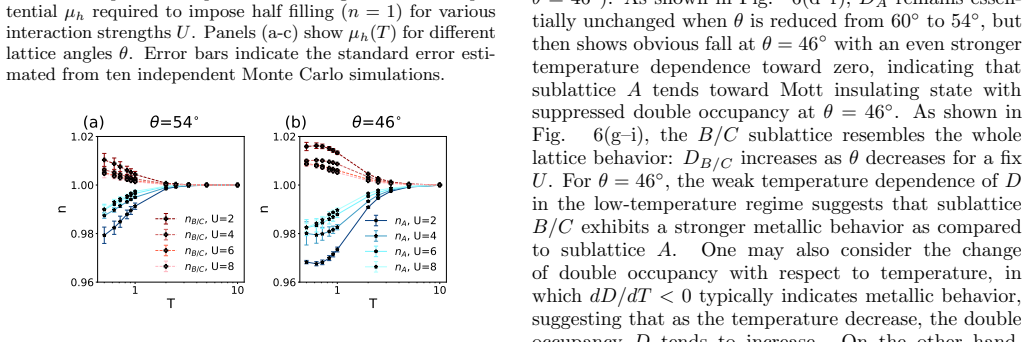
- [Sec. III, Fig. 5] Fig. 5: The sublattice densities n_A and n_{B/C} deviate from 1 at small U; it would help to state explicitly that all subsequent κ_α and D_α are evaluated at the same global μ_h that enforces total n=1, so that the selective Mott analysis is not contaminated by a global density shift.
- [Throughout] Typographical / notation: “Observables” is misspelled as “OBSERV ABLES” in the section heading; “moir’e” appears with an inconsistent apostrophe in the conclusion; the arXiv header date “July 7, 2026” is presumably a placeholder and should be corrected.
- [Sec. III.A] References: The discussion of orbital-selective Mott physics cites the standard multi-orbital literature; a brief pointer to recent site-selective Mott work in nickelates (already partially cited) could be expanded by one sentence to clarify the analogy drawn in Sec. III.A.
Circularity Check
No significant circularity: DQMC measurements of a defined Hamiltonian produce the phase diagram; modeling choices (exponential hopping, activated Δc fit) are inputs, not redefinitions of the claimed selective-Mott or AFM results.
full rationale
The paper defines a half-filled Hubbard model on a diagonally compressed kagome lattice with an explicit distance-dependent hopping t(r)=t0 exp(-r/r0), then measures double occupancy, compressibility, and spin correlations via DQMC. Sublattice-resolved Uc values are operationally extracted from the sign change of an effective charge activation scale fitted to low-T κ(T); the AFM boundary is assigned from finite-size indicators (nonzero Gx_BC(rmax), alternating sign, sharpened Sx_BC(q=π)). These are modeling and analysis choices, not circular reductions: the observables are not fitted to force the phases, no uniqueness theorem or self-citation is load-bearing for the central claims, and the authors themselves flag the AFM boundary as finite-size only. The derivation chain is therefore self-contained numerical survey work; the reader’s score of ~1 is appropriate. Minor residual is only the usual interpretive step of drawing a phase boundary from finite-size data, which is not circularity under the stated criteria.
Assumptions & free parameters
free parameters (4)
- t0, r0 in t(r)=t0 exp(-r/r0) =
t0=100, r0=0.11
- linear system size L =
L=6
- imaginary-time step δτ =
0.1
- lowest temperature T=0.5 =
T=0.5
assumptions (4)
- domain assumption The half-filled repulsive Hubbard model with the given long-range hopping captures the essential physics of a compressed kagome lattice.
- domain assumption DQMC with HS decoupling and Trotter decomposition at δτ=0.1 yields controlled finite-temperature observables once the average sign is monitored.
- ad hoc to paper An activated fit κ(T)=k1 exp(-Δc/T) whose Δc changes sign locates the metal-Mott boundary.
- ad hoc to paper Statistically nonzero Gx_BC(r_max) plus alternating signs and sharpened R_π on L=6 indicate the onset of long-range AFM correlations.
Cite this review
Pith. "Pith review of Orbital-Selective Mott and Antiferromagnetic Phases in Diagonally Compressed Kagome Lattice." pith.science (2026). https://pith.science/paper/TF5CUUQ3
@misc{pith2026260704621,
  author       = {Pith},
  title        = {Pith review of: Orbital-Selective Mott and Antiferromagnetic Phases in Diagonally Compressed Kagome Lattice},
  year         = {2026},
  howpublished = {\url{https://pith.science/paper/TF5CUUQ3}},
  note         = {Machine review of arXiv:2607.04621}
}
abstract
We perform determinant quantum Monte Carlo simulations of the half-filled Hubbard model on a diagonally compressed kagome lattice, introducing exponential decay long-range hopping $t(r) = t_0 \exp\bigl(-r / r_0\bigr)$ to account for the evolving bond length. By varying the lattice angle $\theta$ and the on-site interaction $U$, double occupancy, charge compressibility, and spin-spin correlation functions of the whole system and each sub-lattice are measured. We find that geometric compression induces a clear sublattice differentiation: for $\theta\gtrsim52^\circ$, the A sublattice establishes long-range hoppings, which in turn suppresses the metallic behavior of the $B/C$ sublattice and drives a selective Mott transition; for $\theta\lesssim52^\circ$, the $B$-$C$ chains develop long-range antiferromagnetic correlations within the finite-size simulations, which in turn suppresses the metallic behavior of the $A$ sublattice and drives a selective Mott transition. The critical interaction $U^c_A$ for the $A$ sites decreases sharply near the onset of $B$-$C$ antiferromagnetic correlations, while $U^c_{B/C}$ increases. These competing orders give rise to an orbital-selective Mott phase and a rich $U$-$\theta$ phase diagram featuring paramagnetic-metal, paramagnetic-Mott, antiferromagnetic-metal, and antiferromagnetic-Mott states. Our results highlight the complex interplay between lattice geometry, magnetic frustration, and strong correlations in frustrated two-dimensional systems.
Figures


Figures from the paper (10 more)



Reference graph
Works this paper leans on
-
[1]
Balents, Spin liquids in frustrated magnets, Nature, 464, 199–208 (2010)
L. Balents, Spin liquids in frustrated magnets, Nature, 464, 199–208 (2010)
2010
-
[2]
Y. Zhou, K. Kanoda, and T.-K. Ng, Quantum spin liquid states, Rev. Mod. Phys.,89, 025003 (2017)
2017
-
[3]
J. S. Heltonet al., Spin dynamics of the spin-1/2 kagome lattice antiferromagnet ZnCu 3(OH)6Cl2, Phys. Rev. Lett.,98, 107204 (2007)
2007
-
[4]
T.-H. Han, J. S. Helton, S. Chu, D. G. Nocera, J. A. Rodriguez-Rivera, C. Broholm, and Y. S. Lee, Frac- tionalized excitations in the spin-liquid state of a kagome- lattice antiferromagnet, Nature492, 406–410 (2012)
2012
-
[5]
Shimizu, K
Y. Shimizu, K. Miyagawa, K. Kanoda, M. Maesato, and G. Saito, Spin liquid state in an organic Mott insulator with a triangular lattice, Phys. Rev. Lett.91, 107001 (2003)
2003
-
[6]
Nakatsuji, N
S. Nakatsuji, N. Kiyohara, and T. Higo, Large anomalous Hall effect in a non-collinear antiferromagnet at room temperature, Nature527, 212–215 (2015)
2015
-
[7]
Ikhlas, T
M. Ikhlas, T. Tomita, T. Koretsune, M.-T. Suzuki, D. Nishio-Hamane, R. Arita, Y. Otani, and S. Nakat- suji, Large anomalous Nernst effect at room temperature in a chiral antiferromagnet, Nat. Phys.,13, 1085-1090 (2017)
2017
-
[8]
L. Ye, M. Kang, J. Liu, F. von Cube, C. R. Wicker, T. Suzuki, C. Jozwiak, A. Bostwick, E. Rotenberg, D. C. Bell, L. Fu, R. Comin, and J. G. Checkelsky , Massive Dirac fermions in a ferromagnetic kagome metal, Nature555, 638–642 (2018)
2018
Show all 68 references
-
[9]
B. R. Ortiz, L. C. Gomes, J. R. Morey, M. Winiarski, M. Bordelon, J. S. Mangum, I. W. H. Oswald, J. A. Rodriguez-Rivera, J. R. Neilson, S. D. Wil- son, E. Ertekin, T. M. McQueen, and E. S. Toberer, New kagome prototype materials: discovery of KV 3Sb5, RbV3Sb5, and CsV 3Sb5, Ph...
2019
-
[10]
Neupert, M
T. Neupert, M. M. Denner, J.-X. Yin, R. Thomale, and M. Z. Hasan, Charge order and superconductivity in kagome materials, Nat. Phys.18, 137 (2022)
2022
-
[11]
Zhang, T
W. Zhang, T. F. Poon, C. W. Tsang, W. Wang, X. Liu, J. Xie, S. T. Lam, S. Wang, K. T. Lai, A. Pourret, G. Sey- farth, G. Knebel, W. C. Yu, and S. K. Goh, Large Fermi surface in pristine kagome metal CsV 3Sb5 and enhanced quasiparticle effective masses, Proc. Natl. Acad. Sci. U...
2024
-
[12]
Z. Wang, L. Wang, K. Y. Yip, Y. K. Tsui, T. F. Poon, W. Wang, C. W. Tsang, S. Wang, D. Graf, A. Pourret, G. Seyfarth, G. Knebel, K. T. Lai, W. C. Yu, W. Zhang, and S. K. Goh, Discovery of a new phase in thin flakes of KV3Sb5 under pressure, Adv. Sci. (Weinh.)12, e2415012 (2025)
2025
-
[13]
Liu, Z.-Y
Y. Liu, Z.-Y. Liu, J.-K. Bao, P.-T. Yang, L.-W. Ji, S.- Q. Wu, Q.-X. Shen, J. Luo, J. Yang, J.-Y. Liu, C.-C. Xu, W.-Z. Yang, W.-L. Chai, J.-Y. Lu, C.-C. Liu, B.-S. Wang, H. Jiang, Q. Tao, Z. Ren, X.-F. Xu, C. Cao, Z.-A. Xu, R. Zhou, J.-G. Cheng, and G.-H. Cao, Superconduc- tiv...
2024
-
[14]
C. Xu, S. Wu, G.-X. Zhi, G. Cao, J. Dai, C. Cao, X. Wang, and H.-Q. Lin, Altermagnetic ground state in distorted kagome metal CsCr 3Sb5 , Nat. Commun.16, 3114 (2025)
2025
-
[15]
Imada, A
M. Imada, A. Fujimori, and Y. Tokura, Metal-insulator transitions, Rev. Mod. Phys.,70, 1039 (1998)
1998
-
[16]
P. A. Lee, N. Nagaosa, and X.-G. Wen, Doping a Mott in- 13 sulator: Physics of high-temperature superconductivity, Rev. Mod. Phys.,78, 17–85 (2006)
2006
-
[17]
Orenstein and A
J. Orenstein and A. J. Millis, Advances in the physics of high-temperature superconductivity, Science288, 468–474 (2000)
2000
-
[18]
E. Gull, O. Parcollet, and A. J. Millis, Superconductiv- ity and the pseudogap in the two-dimensional Hubbard model, Phys. Rev. Lett.110, 216405 (2013)
2013
-
[19]
Keimer, S
B. Keimer, S. A. Kivelson, M. R. Norman, S. Uchida, and J. Zaanen, From quantum matter to high-temperature superconductivity in copper oxides, Nature518, 179–186 (2015)
2015
-
[20]
C. Zou, J. Choi, Q. Li, S. Ye, C. Yin, M. Garcia- Fernandez, S. Agrestini, and et al., Evolution from a charge-ordered insulator to a high-temperature supercon- ductor in Bi 2Sr2(Ca, Dy)Cu2O8+δ, Nat. Commun.15, 7739 (2024)
2024
-
[21]
X. H. Chen, T. Wu, G. Wu, R. H. Liu, H. Chen, and D. F. Fang, Superconductivity at 43 K in SmFeAsO1−xFx, Na- ture453, 761–762 (2008)
2008
-
[22]
Bernardini, G
F. Bernardini, G. Garbarino, A. Sulpice, M. N´ u˜ nez- Regueiro, E. Gaudin, B. Chevalier, M.-A. Measson, A. Cano, and S. Tenc´ e, Iron-based superconductivity ex- tended to the novel silicide LaFeSiH, Phys. Rev. B97, 100504 (2018)
2018
-
[23]
Ohashi, T
T. Ohashi, T. Momoi, H. Tsunetsugu, and N. Kawakami , Finite temperature Mott transition in Hubbard model on anisotropic triangular lattice, Phys. Rev. Lett.100, 076402 (2008)
2008
-
[24]
Yamada, K
A. Yamada, K. Seki, R. Eder, and Y. Ohta , Mott transition and ferrimagnetism in the Hubbard model on the anisotropic kagome lattice, Phys. Rev. B83, 195127 (2011)
2011
-
[25]
Higa and K
R. Higa and K. Asano, Bond formation effects on the metal-insulator transition in the half-filled kagome Hub- bard model, Phys. Rev. B93, 245123 (2016)
2016
-
[26]
Ohashi, N
T. Ohashi, N. Kawakami, and H. Tsunetsugu, Mott tran- sition in kagome lattice Hubbard model, Phys. Rev. Lett. 97, 066401 (2006)
2006
-
[27]
Kuratani, A
S. Kuratani, A. Koga, and N. Kawakami, Mott transition of correlated electrons on the kagome lattice, J. Phys.: Condens. Matter19, 145252 (2007)
2007
-
[28]
Guertler, Kagome lattice Hubbard model at half filling, Phys
S. Guertler, Kagome lattice Hubbard model at half filling, Phys. Rev. B90, 081105 (2014)
2014
-
[29]
Sun and Z
R.-Y. Sun and Z. Zhu, Metal-insulator transition and in- termediate phases in the kagome lattice Hubbard model, Phys. Rev. B104, L121118 (2021)
2021
-
[30]
A. R. Medeiros–Silva, N. C. Costa, and T. Paiva , Ther- modynamic, magnetic, and transport properties of the repulsive Hubbard model on the kagome lattice, Phys. Rev. B107, 035134 (2023)
2023
-
[31]
Kaufmann, K
J. Kaufmann, K. Steiner, R. T. Scalettar, K. Held, and O. Janson , How correlations change the magnetic struc- ture factor of the kagome Hubbard model Phys. Rev. B 104, 165127 (2021)
2021
-
[32]
Bulut, W
N. Bulut, W. Koshibae, and S. Maekawa, Magnetic corre- lations in the Hubbard model on triangular and kagom´ e lattices, Phys. Rev. Lett.95, 037001 (2005)
2005
-
[33]
W. P. Lima, D. R. da Costa, S. H. R. Sena, and J. Milton Pereira, Jr. , Effects of uniaxial and shear strains on the electronic spectrum of Lieb and kagome lattices , Phys. Rev. B108, 125433 (2023)
2023
-
[34]
Lim, J.-N
L.-K. Lim, J.-N. Fuchs, F. Pi´ echon, and G. Montambaux, Dirac points emerging from flat bands in Lieb-kagome lattices, Phys. Rev. B,101, 045131 (2020)
2020
-
[35]
Jiang, M
W. Jiang, M. Kang, H. Huang, H. Xu, T. Low, and F. Liu, Topological band evolution between Lieb and kagome lattices, Phys. Rev. B99, 125131 (2019)
2019
-
[36]
Jiang, M
W. Jiang, M. Kang, H. Huang, H. Xu, T. Low, and F. Liu , Erratum: Topological band evolution be- tween Lieb and kagome lattices [Phys. Rev. B 99, 125131 (2019)], Phys. Rev. B105, 159901 (2022)
2019
-
[37]
L. O. Lima, A. R. Medeiros–Silva, R. R. dos Santos, T. Paiva, and N. C. Costa , Magnetism and metal- insulator transitions in the anisotropic kagome lattice, Phys. Rev. B108, 235163 (2023)
2023
-
[38]
G.-B. Jo, J. Guzman, C. K. Thomas, P. Hosur, A. Vish- wanath, and D. M. Stamper-Kurn, Ultracold atoms in a tunable optical kagome lattice, Phys. Rev. Lett.108, 045305 (2012)
2012
-
[39]
Chern, C.-C
G.-W. Chern, C.-C. Chien, and M. Di Ventra, Dynam- ically generated flat-band phases in optical kagome lat- tices, Phys. Rev. A,90, 013609 (2014)
2014
-
[40]
Leung, M
T.-H. Leung, M. N. Schwarz, S.-W. Chang, C. D. Brown, G. Unnikrishnan, and D. Stamper–Kurn , Interaction- enhanced group velocity of bosons in the flat band of an optical kagome lattice Phys. Rev. Lett.125, 133001 (2020)
2020
-
[41]
Blankenbecler, D
R. Blankenbecler, D. J. Scalapino, and R. L. Sugar, Monte Carlo calculations of coupled boson-fermion sys- tems. I, Phys. Rev. D24, 2278 (1981)
1981
-
[42]
R. R. Santos, Introduction to quantum Monte Carlo sim- ulations for fermionic systems, Braz. J. Phys.33, 36–54 (2003)
2003
-
[43]
Z. Bai, W. Chen, R. Scalettar, and I. Yamazaki, Lecture notes on advances of numerical methods for quantum Monte Carlo simulations of the Hubbard model, Lecture notes, (2007)
2007
-
[44]
M. Qin, H. Shi, and S. Zhang, Benchmark study of the two-dimensional Hubbard model with auxiliary-field quantum Monte Carlo method, Phys. Rev. B94, 085103 (2016)
2016
-
[45]
V. I. Iglovikov, E. Khatami, and R. T. Scalettar, Geom- etry dependence of the sign problem in quantum Monte Carlo simulations, Phys. Rev. B92, 045110 (2015)
2015
-
[46]
Pan and Z
G. Pan and Z. Y. Meng, Sign problem in quantum Monte Carlo simulation, arXiv:2204.08777 (2022)
2022 arXiv
-
[47]
Wick, The evaluation of the collision matrix, Phys
G.-C. Wick, The evaluation of the collision matrix, Phys. Rev.80, 268 (1950)
1950
-
[48]
C. Wen, X. Zhu, Z. Xiao, N. Hao, R. Mondaini, H. Guo, and S. Feng, Superconducting pairing symme- try in the kagome-lattice Hubbard model, Phys. Rev. B 105, 075118 (2022)
2022
-
[49]
Xiao, Y.-Y
B. Xiao, Y.-Y. He, A. Georges, and S. Zhang, Tem- perature dependence of spin and charge orders in the doped two-dimensional Hubbard model, Phys. Rev. X 13, 011007 (2023)
2023
-
[50]
C. N. Varney, C.-R. Lee, Z. J. Bai, S. Chiesa, M. Jarrell, and R. T. Scalettar, Quantum Monte Carlo study of the two-dimensional fermion Hubbard model, Phys. Rev. B 80, 075116 (2009)
2009
-
[51]
A. W. Sandvik, Computational studies of quantum spin systems, AIP Conf. Proc.1297, 135–338 (2010)
2010
-
[52]
W. S. Oliveira, T. Paiva, R. T. Scalettar, and N. C. Costa, Magnetic and singlet phases in the three- dimensional periodic Anderson model, Phys. Rev. B108, 115121 (2023)
2023
-
[53]
V. I. Anisimov, I. A. Nekrasov, D. E. Kondakov, T. M. 14 Rice, and M. Sigrist, Orbital-selective Mott-insulator transition in Ca 2−xSrxRuO4, Eur. Phys. J. B25, 191 (2002)
2002
-
[54]
A. Koga, N. Kawakami, T. M. Rice, and M. Sigrist, Orbital-selective Mott transitions in the degenerate Hub- bard model, Phys. Rev. Lett.92, 216402 (2004)
2004
-
[55]
Liebsch, Single Mott transition in the multiorbital Hubbard model, Phys
A. Liebsch, Single Mott transition in the multiorbital Hubbard model, Phys. Rev. B70, 165103 (2004)
2004
-
[56]
de’ Medici, A
L. de’ Medici, A. Georges, and S. Biermann, Orbital- selective Mott transition in multiband systems: Slave- spin representation and dynamical mean-field theory, Phys. Rev. B72, 205124 (2005)
2005
-
[57]
Yu and Q
R. Yu and Q. Si, Orbital-selective Mott phase in multi- orbital models for alkaline iron selenides K 1−xFe2−ySe2, Phys. Rev. Lett.110, 146402 (2013)
2013
-
[58]
Herbrych, N
J. Herbrych, N. Kaushal, A. Nocera, G. Alvarez, A. Moreo, and E. Dagotto, Spin dynamics of the block orbital-selective Mott phase, Nat. Commun.9, 3736 (2018)
2018
-
[59]
S. Kim, S. Backes, H. Yoon, W. Kim, C. Sohn, J. Son, S. Biermann, T. W. Noh, and S. Y. Park, Orbital- selective Mott and Peierls transition in H xVO2, npj Quantum Mater.7, 95 (2022)
2022
-
[60]
M. Kim, S. Choi, W. H. Brito, and G. Kotliar, Orbital- Selective Mott Transition Effects and Nontrivial Topol- ogy of iron chalcogenide, Phys. Rev. Lett.132, 136504 (2024)
2024
-
[61]
H. Park, A. J. Millis, and C. A. Marianetti, Site-selective Mott transition in rare-earth-element nickelates, Phys. Rev. Lett.109, 156402 (2012)
2012
-
[62]
Layek, E
S. Layek, E. Greenberg, D. Levy, V. Prakapenka, S. S. Saxena, and G. Kh. Rozenberg, Correlated electron physics near a site-selective pressure-induced Mott tran- sition inα-LiFe 5O8, Commun. Mater.5, 155 (2024)
2024
-
[63]
P. M. Duarte, R. A. Hart, T.-L. Yang, X. Liu, T. Paiva, E. Khatami, R. T. Scalettar, N. Trivedi, and R. G. Hulet, Compressibility of a fermionic Mott insulator of ultracold atoms, Phys. Rev. Lett.114, 070403 (2015)
2015
-
[64]
L. D. Landau, E. M. Lifshitz, A. M. Kosevich, and L. P. Pitaevskii,Theory of Elasticity, Course of Theoretical Physics, Vol. 7, 3rd ed. Pergamon Press, Oxford, (1986)
1986
-
[65]
M. F. Ashby and D. R. H. Jones,Engineering Materi- als 1: An Introduction to Properties, Applications and Design, 4th ed. Elsevier, (2012)
2012
-
[66]
W. M. Haynes,CRC Handbook of Chemistry and Physics, CRC Press, (2016)
2016
-
[67]
ASM Handbook Committeeet al.,Properties and Selec- tion: Nonferrous Alloys and Special-Purpose Materials, ASM International, (1990)
1990
-
[68]
Motruk, D
J. Motruk, D. Rossi, D. A. Abanin, and L. Rademaker, Kagome chiral spin liquid in transition metal dichalco- genide moir´ e bilayers, Phys. Rev. Research5, L022049 (2023). 15 0.5 1.0 1.5 2.0 1/T 3.5 3.0 2.5 2.0 1.5 ln[ ] (a) =60 0.5 1.0 1.5 2.0 1/T 3.5 3.0 2.5 2.0 1.5 ln[ ] (b...
2023
Reviewed July 11, 2026 · model on record in the stance chip above.
Discussion (0). Sign in to comment.