REVIEW 3 major objections 5 minor 35 references
Reachability Analysis for Power Systems with Heterogeneous Resources via Jordan Transformation
T0 review · 3 major / 5 minor · reviewed 2026-07-11 · grok-4.5
Pith's one-line read A real Jordan split turns mixed generator-and-inverter grid dynamics into fast certified reachable tubes under bounded load and generation swings.
desk verdict Solid, incremental methods paper: real-Jordan mode split plus interval/contraction bounds gives certified tubes for a reduced linear power-system ODE, with ~0.1 s multi-second runs that largely envelope EMT trajectories. read the letter →
The pith
A machine-rendered reading of the paper's core claim, the machinery that carries it, and where it could break.
The reading
What carries the argument
Real Jordan transformation of the reduced system matrix: it block-diagonalizes the dynamics into a real-eigenvalue block (handled by interval embedding) and 2-by-2 rotation-scaling blocks (handled by logarithmic-norm contraction balls), so that the full reachable set is recovered as the image of a Cartesian product of an interval and Euclidean balls.
What would settle it
On the same modified IEEE 39-bus system, introduce a load or generation step whose EMT trajectories systematically and persistently leave the computed reachable tube after the brief PLL transient, or show that the Jordan-based tube computation exceeds the time of a comparable set of reduced-model trajectory roll-outs.
Extended reading notes
Core claim
For the reduced linear ODE obtained from frequency-divider and Schur reduction of a heterogeneous transmission grid, a real Jordan decomposition lets non-oscillatory modes be over-approximated by a single embedding trajectory and oscillatory modes by explicit contraction-ball radii; the product of those sets, transformed back and optionally intersected with a steady-state-informed tube, yields a certified reachable tube under bounded power injections that can be evaluated in sub-second time for multi-second horizons.
Load-bearing premise
The reduced linear model—with fixed voltages, DC power flow, algebraic grid-following frequencies via the frequency divider, and simplified swing and governor dynamics—must stay close enough to the real stiff plant that tubes certified only for the linear ODE remain useful envelopes for high-fidelity electromagnetic-transient trajectories.
Editorial extensions
If this is right
- Operators can obtain multi-second certified frequency and power envelopes in ~0.1 s, fast enough for near-real-time contingency screening.
- Sequential multi-event scenarios can be tracked by successive tube intersections without combinatorial explosion of EMT simulations.
- Algebraic states (non-swing angles, GFL frequencies) are recovered a posteriori from the dynamic tube via the same linear map used in the reduction.
- The same modal split applies to any linear system whose complex eigenvalues have equal algebraic and geometric multiplicity.
Reading between the lines
- The same Jordan-plus-contraction pattern could be reused for distribution networks once a suitable reduced linear model is derived.
- Tightening the frequency-divider approximation (or restoring a low-order PLL state) would close the short post-event GFL gap without sacrificing the sub-second runtime.
- If the method is extended to time-varying or set-valued voltage magnitudes, it could bound voltage-security metrics as well as frequency ones.
Signed reviews
Editorial analysis
A structured set of objections, weighed in public.
Referee Report
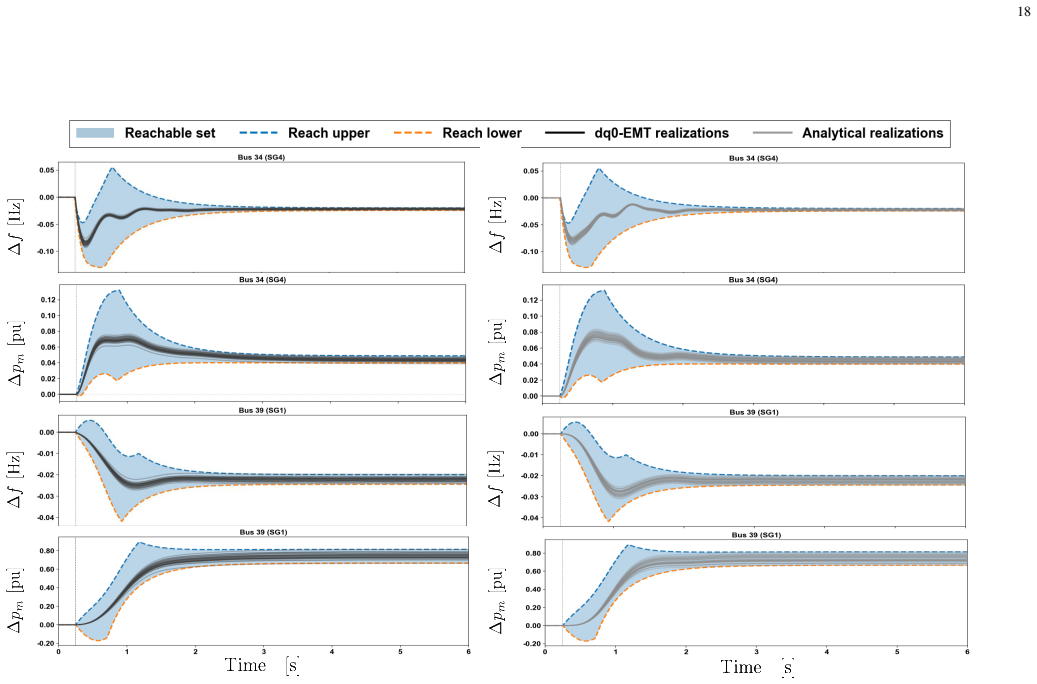
Summary. The paper proposes a computationally efficient reachability framework for transmission systems with synchronous generators, grid-forming and grid-following inverters, and bounded power disturbances. Starting from reduced-order device models and a frequency-divider network representation, the authors eliminate algebraic variables by Schur complement to obtain a linear ODE (12). Reachable tubes for this ODE are constructed via a real Jordan decomposition (Lemma 1): non-oscillatory modes are over-approximated by an interval embedding system (Theorem 1), oscillatory modes by logarithmic-norm ball bounds (Theorem 2), with an optional steady-state-informed intersection for piecewise-constant post-event inputs (Theorems 3–4, Algorithm 1). On a modified IEEE 39-bus system the method produces multi-second tubes in ~0.1 s that largely contain high-fidelity dq0 EMT trajectories for two load-step scenarios, with a brief, expected GFL frequency mismatch attributed to the frequency-divider approximation.
Significance. If the reduced-model certificates and the reported runtimes hold, the work offers a practical path to near-real-time set-based assessment of frequency and power envelopes under bounded load/generation uncertainty in mixed SG–IBR grids—something small-signal and single-trajectory transient tools do not provide. Strengths include an explicit, invertible reduction from DAE to ODE, proofs of the interval and contraction bounds (Section VII), a mode-decoupled construction that exploits the real Jordan structure, and a clear scoping that certificates apply to the analytical model while EMT is used only for validation. The sub-second multi-second tubes on a 39-bus system are a concrete computational contribution relative to stiff EMT roll-outs.
major comments (3)
- Section V and Table III support the efficiency claim only against reduced-model trajectory roll-outs and dq0 EMT, not against established set-propagation tools (zonotopes, support functions, differential inclusions) applied to the same linear ODE (12). The introduction argues that those methods are prohibitive for large networks, but without a head-to-head comparison on (12) the claim that the Jordan-based hybrid method is ‘several orders of magnitude faster’ than existing reachability methods remains incompletely substantiated. A comparison on the IEEE 39-bus reduced model (even for a short horizon) would make the computational contribution load-bearing rather than suggestive.
- The central practical claim is that tubes certified for the reduced ODE remain useful envelopes for the stiff EMT plant (Abstract; contribution c3; Section V). Scenario 1 already shows a brief post-event GFL frequency exit of the tube, correctly attributed to the frequency-divider quasi-steady approximation (Section III-B, Eq. (8)). The manuscript does not systematically quantify when or how far EMT trajectories can leave the tube (e.g., across larger uncertainty sets, consecutive events, or different GFL PLL bandwidths). Without such quantification or an explicit modeling-error discussion, the ‘validation against EMT’ claim risks overstating the operational usefulness of certificates that rigorously hold only for (12).
- Lemma 1 assumes that every eigenvalue of A with nonzero imaginary part has equal algebraic and geometric multiplicity so that oscillatory blocks are pure 2×2 rotation-scaling matrices. The paper states that this is measure-zero and ‘verified numerically via case studies in Section V,’ but Section V does not report the spectrum of A, multiplicities, or conditioning of V. Because Theorems 2–3 and the ball radii depend on this block structure, an explicit numerical check (eigenvalues and Jordan-block sizes for the IEEE 39-bus A) should be included so that the assumption is not left as an unreported claim.
minor comments (5)
- Figures 2–3 and Appendix D figures would benefit from consistent axis units (p.u. frequency deviation vs. Hz), explicit identification of which bus each panel corresponds to in the caption, and a legend distinguishing EMT, analytical trajectories, and tube bounds.
- Notation for the input set dimension m = |I|+|G|+|F|+N (Section IV) is easy to misread as including all buses rather than load components; a short clarification that p_ℓ is the full N-vector of bus loads would help.
- Table I and Appendix B are valuable but dense; a one-sentence pointer in Section III to which analytical parameters are matched to EMT (bold entries in Appendix C) would help readers who skip the appendices.
- Algorithm 1 uses a fixed step h but does not discuss how h is chosen relative to the fastest retained mode; a brief remark on step-size selection or that the continuous-time bounds are evaluated at discrete samples would reduce ambiguity.
- Minor typographical issues: ‘areachable tube’ (Introduction), inconsistent spacing around citations, and duplicate panel labels ‘(f)’ in Fig. 3.
Circularity Check
No significant circularity: certified tubes are derived for an explicitly reduced linear ODE via standard Jordan/interval/contraction arguments; EMT comparisons are independent validation, not definitional inputs.
full rationale
The paper’s load-bearing chain is: (i) reduced-order device models + DC network + frequency-divider algebraic GFL → semi-explicit DAE (9)–(10); (ii) nonsingularity of A22 and Schur reduction → linear ODE (12); (iii) real Jordan split (Lemma 1) → non-oscillatory embedding (17)/Theorem 1 and oscillatory logarithmic-norm balls (Theorem 2) → over-approximation Theorem 3, tightened for piecewise-constant inputs by equilibrium shift (Theorem 4). These steps are algebraic and analytic constructions with proofs in Section VII; they do not fit free parameters to the EMT trajectories later used for validation, nor define the reachable set in terms of those trajectories. EMT simulations (Section V) are external numerical checks of modeling fidelity, and the paper explicitly scopes certificates to the reduced ODE while acknowledging the brief GFL exit as a modeling (not set-propagation) discrepancy. Self-citations to the authors’ prior interval-embedding and contraction papers supply standard tools whose arguments are restated in the proofs; they do not force the power-system claim by uniqueness import or by renaming a fit as a prediction. Frequency-divider is re-derived and also cited to external work. No self-definitional loop, fitted-input-as-prediction, or uniqueness-from-authors step is present.
Assumptions & free parameters
free parameters (2)
- Post-event load uncertainty interval endpoints (e.g., U_35=[1.8,2.2], U_20=[1.35,1.65] p.u.)
- Time discretization step h in Algorithm 1
assumptions (7)
- domain assumption DC power-flow approximation: constant voltage magnitudes, small angle differences, negligible line resistance so p(θ)=B θ_bus.
- domain assumption Frequency-divider quasi-steady map: GFL/PLL dynamics are fast enough that ω_F = H_I ω_I + H_G ω_G algebraically (Eqs. 7–8).
- ad hoc to paper Every eigenvalue of A with nonzero imaginary part has equal algebraic and geometric multiplicity, so the real Jordan form has pure 2×2 rotation-scaling blocks (Lemma 1).
- domain assumption A is nonsingular so the equilibrium shift x⋆(u)=−A^{-1} B u is well-defined for the steady-state-informed tube.
- standard math S_LF^T B̄ S_LF is invertible (grounded Laplacian principal submatrix positive definite on a connected network).
- domain assumption Reduced-order device models (swing + governor lag for SGs; virtual-inertia swing for GFM; algebraic FFR for GFL) capture dominant electromechanical timescales for reachability design.
- domain assumption Admissible inputs remain in a known hyper-rectangle U; for tightening, post-event inputs are piecewise constant.
Cite this review
Pith. "Pith review of Reachability Analysis for Power Systems with Heterogeneous Resources via Jordan Transformation." pith.science (2026). https://pith.science/paper/46HBLOCE
@misc{pith2026260705599,
  author       = {Pith},
  title        = {Pith review of: Reachability Analysis for Power Systems with Heterogeneous Resources via Jordan Transformation},
  year         = {2026},
  howpublished = {\url{https://pith.science/paper/46HBLOCE}},
  note         = {Machine review of arXiv:2607.05599}
}
read the original abstract
This paper develops a computationally efficient framework for reachability analysis of transmission-level power system dynamics with synchronous generators, grid-forming and grid-following inverters, and uncertain power injections/withdrawals. Starting from reduced-order device models and a frequency-divider representation, we derive a linear ordinary-differential-equation model suitable for efficient reachable-set computation under bounded disturbances across network buses. The proposed reachability method combines interval reachability and contraction-based bounds to construct certified over-approximations for the linear ordinary-differential-equation model. A real Jordan transformation separates non-oscillatory modes, handled through a linear embedding system, from oscillatory modes, enclosed using contraction-based ball bounds. Numerical experiments on a modified IEEE 39-bus system validate the reachable tubes against high-fidelity electromagnetic-transient (EMT) simulations, and demonstrate multi-second reachable sets computed in sub-second time.
Figures


Figures from the paper (4 more)


Reference graph
Works this paper leans on
-
[1]
Power systems without fuel,
J. A. Taylor, S. V . Dhople, and D. S. Callaway, “Power systems without fuel,”Renewable and Sustainable Energy Reviews, vol. 57, pp. 1322– 1336, 2016
2016
-
[2]
Foundations and challenges of low-inertia systems,
F. Milano, F. D ¨orfler, G. Hug, D. J. Hill, and G. Verbi ˇc, “Foundations and challenges of low-inertia systems,” inPower Systems Computation Conference, 2018
2018
-
[3]
Control of low-inertia power systems,
F. D ¨orfler and D. Groß, “Control of low-inertia power systems,”Annual Review of Control, Robotics, and Autonomous Systems, vol. 6, no. 1, pp. 415–445, 2023
2023
-
[4]
Estimating feasible nodal power injections in distribution networks,
A. Al-Digs, S. V . Dhople, and Y . C. Chen, “Estimating feasible nodal power injections in distribution networks,” in2016 IEEE Power & Energy Society Innovative Smart Grid Technologies Conference (ISGT), 2016, pp. 1–5
2016
-
[5]
Revisiting power systems time-domain simulation methods and models,
J. D. Lara, R. Henriquez-Auba, D. Ramasubramanian, S. Dhople, D. S. Callaway, and S. Sanders, “Revisiting power systems time-domain simulation methods and models,”IEEE Transactions on Power Systems, vol. 39, no. 2, pp. 2421–2437, 2024
2024
-
[6]
Power system stability,
P. Kunduret al., “Power system stability,”Power system stability and control, vol. 10, no. 1, pp. 7–1, 2007
2007
-
[7]
P. W. Sauer, M. A. Pai, and J. H. Chow,Power system dynamics and stability: with synchrophasor measurement and power system toolbox. John Wiley & Sons, 2017
2017
-
[8]
Set propagation techniques for reachability analysis,
M. Althoff, G. Frehse, and A. Girard, “Set propagation techniques for reachability analysis,”Annual Review of Control, Robotics, and Autonomous Systems, vol. 4, no. 1, pp. 369–395, 2021
2021
Show all 35 references
-
[9]
Reachability analysis for cyber- physical systems: Are we there yet?
X. Chen and S. Sankaranarayanan, “Reachability analysis for cyber- physical systems: Are we there yet?” inNASA formal methods sympo- sium. Springer, 2022, pp. 109–130
2022
-
[10]
A method to study the effect of renewable resource variability on power system dynamics,
Y . C. Chen and A. D. Dominguez-Garcia, “A method to study the effect of renewable resource variability on power system dynamics,”IEEE Transactions on Power Systems, vol. 27, no. 4, pp. 1978–1989, 2012. 10 (a) (b) (c) (d) (f) (e) (f) Fig. 3: Reachable-set over-approximations a...
1978
-
[11]
Formal and compositional analysis of power systems using reachable sets,
M. Althoff, “Formal and compositional analysis of power systems using reachable sets,”IEEE Transactions on Power Systems, vol. 29, no. 5, pp. 2270–2280, 2014
2014
-
[12]
Reachability analysis of power system frequency dynamics with new high-capacity hvac and hvdc transmission lines,
H. N. V . Pico, D. C. Aliprantis, and E. C. Hoff, “Reachability analysis of power system frequency dynamics with new high-capacity hvac and hvdc transmission lines,” in2013 IREP Symposium Bulk Power System Dynamics and Control-IX Optimization, Security and Control of the Emerg...
2013
-
[13]
Uncertainty propagation with semidefinite programming,
H. Choi, P. J. Seiler, and S. V . Dhople, “Uncertainty propagation with semidefinite programming,” in2015 54th IEEE Conference on Decision and Control (CDC), 2015, pp. 5966–5971
2015
-
[14]
Propagating Uncertainty in Power-System DAE Models With Semidefinite Programming,
——, “Propagating Uncertainty in Power-System DAE Models With Semidefinite Programming,”IEEE Transactions on Power Systems, vol. 32, no. 4, pp. 3146–3156, 2017
2017
-
[15]
Compositional transient stability analysis of power systems via the computation of reachable sets,
A. El-Guindy, Y . C. Chen, and M. Althoff, “Compositional transient stability analysis of power systems via the computation of reachable sets,” inAmerican Control Conference. IEEE, 2017, pp. 2536–2543
2017
-
[16]
Reachability analysis based transient stability design in power systems,
L. Jin, R. Kumar, and N. Elia, “Reachability analysis based transient stability design in power systems,”International Journal of Electrical Power & Energy Systems, vol. 32, no. 7, pp. 782–787, 2010
2010
-
[17]
Review on set-theoretic methods for safety verification and control of power system,
Y . Zhang, Y . Li, K. Tomsovic, S. M. Djouadi, and M. Yue, “Review on set-theoretic methods for safety verification and control of power system,”IET Energy Systems Integration, vol. 2, no. 3, pp. 226–234, 2020
2020
-
[18]
Hamilton-Jacobi reachability: A brief overview and recent advances,
S. Bansal, M. Chen, S. Herbert, and C. J. Tomlin, “Hamilton-Jacobi reachability: A brief overview and recent advances,” inIEEE Conference on Decision and Control. IEEE, 2017, pp. 2242–2253
2017
-
[19]
Powersimulationsdynamics.jl – an open source modeling package for modern power systems with inverter-based resources,
J. D. Lara, R. Henriquez-Auba, M. Bossart, D. S. Callaway, and C. Barrows, “Powersimulationsdynamics.jl – an open source modeling package for modern power systems with inverter-based resources,” 2023
2023
-
[20]
A library of second-order models for synchronous machines,
O. Ajala, A. Dom ´ınguez-Garc´ıa, P. Sauer, and D. Liberzon, “A library of second-order models for synchronous machines,”IEEE Transactions on Power Systems, vol. 35, no. 6, pp. 4803–4814, 2020
2020
-
[21]
Integrated system models for networks with generators & inverters,
D. Venkatramanan, M. K. Singh, O. Ajala, A. Dominguez-Garcia, and S. Dhople, “Integrated system models for networks with generators & inverters,” 2022. [Online]. Available: https://arxiv.org/abs/2203.08253
2022 arXiv
-
[22]
Equivalence of virtual synchronous machines and frequency-droops for converter-based microgrids,
S. D’Arco and J. A. Suul, “Equivalence of virtual synchronous machines and frequency-droops for converter-based microgrids,”IEEE Transac- tions on Smart Grid, vol. 5, no. 1, pp. 394–395, 2014
2014
-
[23]
Frequency divider,
F. Milano and A. Ortega, “Frequency divider,”IEEE Transactions on Power Systems, vol. 32, no. 2, pp. 1493–1501, 2016
2016
-
[24]
C. D. Meyer,Matrix Analysis and Applied Linear Algebra. Philadel- phia, PA: Society for Industrial and Applied Mathematics, 2013
2013
-
[25]
Efficient interaction- aware interval analysis of neural network feedback loops,
S. Jafarpour, A. Harapanahalli, and S. Coogan, “Efficient interaction- aware interval analysis of neural network feedback loops,”IEEE Trans- actions on Automatic Control, vol. 69, no. 12, pp. 8706–8721, 2024
2024
-
[26]
Sundials: Suite of nonlinear and differ- ential/algebraic equation solvers,
A. C. Hindmarsh, P. N. Brown, K. E. Grant, S. L. Lee, R. Serban, D. E. Shumaker, and C. S. Woodward, “Sundials: Suite of nonlinear and differ- ential/algebraic equation solvers,”ACM Transactions on Mathematical Software (TOMS), vol. 31, no. 3, pp. 363–396, 2005
2005
-
[27]
Powersystems. jl—a power system data management package for large scale modeling,
J. D. Lara, C. Barrows, D. Thom, D. Krishnamurthy, and D. Callaway, “Powersystems. jl—a power system data management package for large scale modeling,”SoftwareX, vol. 15, p. 100747, 2021
2021
-
[28]
Yazdani and R
A. Yazdani and R. Iravani,Voltage-sourced converters in power systems: modeling, control, and applications. John Wiley & Sons, 2010
2010
-
[29]
Electrical networks and algebraic graph theory: Models, properties, and applications,
F. D ¨orfler, J. W. Simpson-Porco, and F. Bullo, “Electrical networks and algebraic graph theory: Models, properties, and applications,”Proceed- ings of the IEEE, vol. 106, no. 5, pp. 977–1005, 2018
2018
-
[30]
G. H. Golub and C. F. Van Loan,Matrix computations. JHU press, 2013
2013
-
[31]
Bullo,Contraction Theory for Dynamical Systems, 1.2 ed
F. Bullo,Contraction Theory for Dynamical Systems, 1.2 ed. Kindle Direct Publishing, 2024
2024
-
[32]
Non-euclidean contraction theory for robust nonlinear stability,
A. Davydov, S. Jafarpour, and F. Bullo, “Non-euclidean contraction theory for robust nonlinear stability,”IEEE Transactions on Automatic Control, vol. 67, no. 12, pp. 6667–6681, 2022. 11 APPENDIXA IEEE 39-BUSTESTSYSTEM ANDINITIALIZATION Both the analytical model and thedq0EMT ...
2022
-
[33]
Bus Data: TABLE IV: Bus data of the modified IEEE 39-bus case: bus type (1 = PQ, 2 = PV , 3 = Reference), loads in MW/MV Ar, voltages in p.u., and nominal voltage levels in kV . Bus TypeP D QD Vm θ(deg)V max Vmin kV 1 1 97.6 44.2 1.047 -8.439 1.06 0.94 345 2 1 0.0 0.0 1.049 -5...
-
[34]
Generator Data: TABLE V: Generator case data of the modified IEEE 39-bus system: active/reactive injections in MW/MV Ar, device base in MV A, and active/reactive operating limits. BusP G QG Qmax Qmin VG Sbase Pmax Pmin 30 250.0 146.16 400 140 1.048 1000 840 0 31 520.8 198.25 3...
-
[35]
L 0 0 L # d dt
Branch Data: TABLE VI: Branch case data of the modified IEEE 39-bus system: series resistanceR, reactanceX, total line charging susceptanceB, thermal rating, tap ratio, and phase shift. All quantities are given on the 100 MV A system base. Entries with nonzeroTAPcorrespond to ...
Reviewed July 11, 2026 · model on record in the stance chip above.
Discussion (0). Continue with ORCID to comment.