REVIEW 4 major objections 8 minor 64 references
CompoVista: A Composition-Graph-Based Visual Analytics System for Compositional Analysis of Traditional Chinese Paintings
T0 review · 4 major / 8 minor · reviewed 2026-07-09 · glm-5.2
Pith's one-line read Making Chinese painting composition computationally searchable
desk verdict Solid VA system for TCP compositional analysis; the matching pipeline is a black box that needs opening read the letter →
The pith
A machine-rendered reading of the paper's core claim, the machinery that carries it, and where it could break.
The reading
What carries the argument
Composition Graph G_p = (V_p, E_p, Z_p, M_p) with entity, relation, void-space, and context layers; weighted matching function S(Q, G_p) scoring query components; format-aware coordinate normalization for spatial comparison; canvas-based node interface linking query, cohort, comparison, and detail views
What would settle it
If the matching function's weights are varied across a reasonable range and the resulting cohorts change substantially — meaning different weightings produce different art-historical patterns — then the case-study findings are artifacts of parameter choice rather than discoveries about TCP composition.
Extended reading notes
Core claim
The Composition Graph extends scene-graph representation to TCP-specific compositional structure by adding two layers that generic scene graphs lack: a void space layer that treats reserved blank regions as first-class spatial primitives, and a context layer that anchors spatial and relational patterns to art-historical metadata. This four-layer structure, combined with a coarse-to-fine weighted matching function, enables structure-aware retrieval where a user can search for paintings sharing a compositional pattern (e.g., dense elements in one corner paired with a large void opposite) rather than a keyword or a visual look-alike. The system then normalizes retrieved cohorts into format-comb
Load-bearing premise
The retrieval pipeline depends on a weighted matching function whose component weights are not specified as fitted, uniform, or hand-tuned, so the demonstrated cohort patterns may reflect a particular weighting choice rather than robust compositional similarity.
Editorial extensions
If this is right
- Composition-specific structured representations could be ported to other painting traditions where spatial arrangement carries art-historical meaning, such as Renaissance altarpieces or Japanese screen paintings, by redefining the entity vocabulary and relation types while keeping the four-layer architecture.
- Treating void space as a queryable primitive rather than mere background could shift how computational art history models negative space across all visual traditions, making absence a searchable structural feature.
- The cohort-as-provisional-evidence-space concept — where a working set is formed, inspected, revised, and dissolved during analysis — could generalize to other humanities domains where scholars iterate between distant viewing and close reading.
- If the matching function proves robust to weight variation, the approach could support automated discovery of compositional formulas across a collection, surfacing structural repetitions that no scholar has yet named.
Reading between the lines
- The four-layer decomposition is testable for inter-annotator reliability: if different annotators produce substantially different void-space or relation layers for the same paintings, the representation's stability as an analytical object is uncertain, and cohort comparisons may reflect annotation conventions rather than compositional fact.
- The matching function's sensitivity to weight settings could be stress-tested directly: if varying the lambda weights shifts cohort membership substantially, the case-study patterns (e.g., Ma Yuan's corner formula retrieval) may be artifacts of a particular weighting rather than robust structural matches.
- The exclusion of handscrolls from normalized spatial comparison suggests that sequential-viewing formats may require a fundamentally different compositional representation — perhaps a fifth layer encoding viewing sequence or temporal progression — which the paper acknowledges but does not resolve.
Signed reviews
Editorial analysis
A structured set of objections, weighed in public.
Referee Report
Summary. This paper introduces CompoVista, a visual analytics system for compositional analysis of Traditional Chinese Paintings (TCPs). The core contribution is the Composition Graph, a four-layer structured representation (entities, relations, void space, context) built on scene-graph foundations. The system supports format-aware cohort construction through visual queries, cohort-level summarization (Distribution View, Relations View), cross-cohort comparison (Comparison View), and painting-level evidence inspection. The work is grounded in a formative study with two art historians and evaluated through a task-based user study (12 participants), two case studies, and expert interviews. The case studies demonstrate the system's use in discovering compositional patterns, such as Ma Yuan's corner formula and fisherman motif variations across dynasties.
Significance. The paper addresses a genuine gap in computational art history: existing TCP computational methods focus on style, attribution, or object presence rather than spatial composition, and existing scene-graph methods are designed for natural images without TCP-specific concepts like void space and format-aware placement. The Composition Graph representation and the integrated VA workflow connecting structured retrieval, cohort comparison, and evidence inspection are well-motivated by the formative study. The system design is thoughtful, with domain-appropriate visual encodings (calligraphic entity labels, paper-like textures, perceptually grounded color palettes). The evaluation with 12 domain-aware participants provides reasonable qualitative evidence for usability. However, the computational foundation of the retrieval pipeline is underspecified, which limits the reproducibility and verifiability of the demonstrated findings.
major comments (4)
- §V-B, Eq. (3): The matching function S(Q, G_p) is the computational foundation of the entire system—all downstream visualizations depend on which paintings are retrieved into a cohort. However, the component scoring functions S_c(Q, G_p) ∈ [0,1] are never defined. It is unclear what similarity metric is used for entity matching (bounding-box IoU? center distance?), relation matching (exact match? partial credit?), or void-space overlap. Without these definitions, the retrieval pipeline cannot be reproduced or independently verified. The paper should specify each S_c and provide at least a minimal quantitative evaluation of retrieval quality (e.g., precision@k against expert-judged relevance for a small set of queries).
- §V-B, Eq. (3): The weights λ_c are stated to sum to 1 but are never specified as uniform, hand-tuned, or learned. Both case studies depend on retrieval working correctly: Case 1's 'Ma Yuan corner formula' structural query (§VII-B) and Case 2's 'sitting on boat' vs 'standing on boat' relation queries produce cohorts whose patterns are then interpreted as art-historical findings. If the weights were tuned post-hoc to produce desirable results, the case study findings could be artifacts of the weighting rather than robust compositional matches. The paper should disclose the weight settings and justify them, or demonstrate that findings are robust to weight perturbation.
- §V-A2 and §VIII-C: The relation evidence is extremely sparse—1,197 relation instances across 960 paintings, averaging approximately 1.25 relations per painting. This raises a correctness-risk concern for the Relations View and relation-level comparison, which are central to Case 2's findings about fisherman postures. Some relations may be absent because they were not annotated rather than because they have no visual meaning. The paper acknowledges this in §VIII-C but does not address how it affects the reliability of the case study interpretations. The authors should either (a) report the relation density within the specific cohorts used in the case studies, or (b) add a caveat that relation-level findings are preliminary given annotation sparsity.
- §VII-A, Fig. 8B: The user study reports that only 5/12 participants agreed or strongly agreed that the system helped compare compositional tendencies across cohorts (Q4), and only 6/12 for turning findings into research clues (Q8). Cross-cohort comparison is a central claimed contribution (T3, R2). The paper should discuss whether this indicates a fundamental limitation of the Comparison View's design or a usability issue that could be addressed, and whether the comparison claim should be scoped more narrowly given these results.
minor comments (8)
- §V-B: The threshold θ for cohort membership is mentioned but never given a value or a method for selecting it. Please specify.
- §V-A2, Table I: The 'Other/Unclassified' theme category (79 paintings) and 'Other or unspecified' format category (93 paintings) are non-trivial fractions of the corpus. Please clarify whether these are included in analysis or excluded.
- §V-A2, Fig. 4: The void-space extraction procedure uses ink-density and texture-density cues, but the specific thresholds or parameters for selecting candidate regions are not given. Please specify or cite the method.
- §VI-B: The Distribution View uses font size to encode average spatial size and opacity to encode frequency. This is an unconventional encoding that may be confusing—please justify why this is preferable to the standard word-cloud convention or provide evidence that users interpreted it correctly.
- §VII-B, Case 1: P3's finding that Ma Yuan's corner formula 'could carry a small courtly scene' is presented as a hypothesis. The paper should be clearer that this is an interpretive suggestion from the participant, not a system-verified finding.
- §II-C: The related work on visual analytics for cultural heritage could cite more recent work on interactive cohort construction and provenance management in VA systems.
- §VIII-C: The exclusion of handscrolls from normalized spatial analysis is acknowledged, but 44 handscrolls are in the corpus (Table I). Please clarify whether these paintings appear in any analysis or are entirely excluded from spatial views.
- Fig. 6 and Fig. 7: The visual encoding descriptions are detailed but the figures themselves are difficult to parse at the resolution provided. Consider adding annotated close-ups for key interactions.
Circularity Check
No significant circularity found; the derivation chain is self-contained, with one minor non-load-bearing self-citation for annotation taxonomy.
full rationale
The paper's derivation chain proceeds: Composition Graph (Eq. 1) is defined from art-historical concepts (entities, relations, void space, context) — not from its own outputs. The Composition Query (Eq. 2) mirrors the graph structure for querying. The matching function (Eq. 3) is a weighted sum of component scores S_c, and cohort summaries (Sec. V-C) are normalized statistics over retrieved sets. Cross-cohort comparison (Eq. 4) is simple differencing of normalized summaries. None of these steps reduce to their inputs by construction. The case studies (Case 1: Ma Yuan corner formula; Case 2: fisherman postures) are demonstrations of expert interpretive use, not the system validating its own predictions — experts apply external domain knowledge (e.g., imperial inscriptions, 'one river two banks' scheme) to interpret system output. The paper explicitly states comparisons 'are meant to guide evidence inspection, not to issue automatic art-historical conclusions.' The underspecified weights λ_c, component scores S_c, and threshold θ in Eq. (3) are reproducibility and evaluation concerns, not circularity — the function is not defined in terms of its own outputs. The self-citation to VisTCP [45] (shared authors Zhou, Zheng) provides an annotation taxonomy, not a mathematical theorem; it is not load-bearing for the system's analytical claims and any taxonomy could be substituted. Score 1 reflects this minor non-load-bearing self-citation.
Assumptions & free parameters
free parameters (3)
- Matching weights λ_c =
unspecified
- Matching threshold θ =
unspecified
- Void space density thresholds =
unspecified
assumptions (3)
- domain assumption Scene graphs can be adapted to model TCP composition by adding void space and context layers.
- domain assumption Format-aware coordinate normalization enables valid spatial comparison across paintings of the same format.
- domain assumption Human-annotated relations and void spaces are sufficiently accurate for computational comparison.
invented entities (1)
-
Composition Graph
independent evidence
Cite this review
Pith. "Pith review of CompoVista: A Composition-Graph-Based Visual Analytics System for Compositional Analysis of Traditional Chinese Paintings." pith.science (2026). https://pith.science/paper/LNY6FJO2
@misc{pith2026260707105,
  author       = {Pith},
  title        = {Pith review of: CompoVista: A Composition-Graph-Based Visual Analytics System for Compositional Analysis of Traditional Chinese Paintings},
  year         = {2026},
  howpublished = {\url{https://pith.science/paper/LNY6FJO2}},
  note         = {Machine review of arXiv:2607.07105}
}
read the original abstract
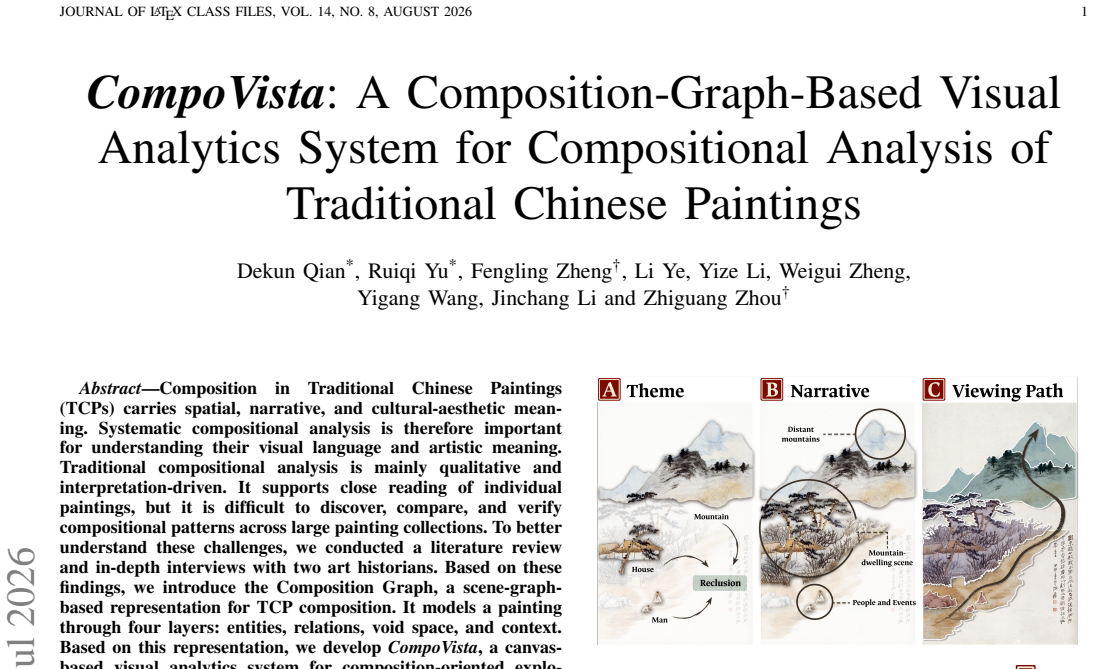
Composition in Traditional Chinese Paintings (TCPs) carries spatial, narrative, and cultural-aesthetic meaning. Systematic compositional analysis is therefore important for understanding their visual language and artistic meaning. Traditional compositional analysis is mainly qualitative and interpretation-driven. It supports close reading of individual paintings, but it is difficult to discover, compare, and verify compositional patterns across large painting collections. To better understand these challenges, we conducted a literature review and in-depth interviews with two art historians. Based on these findings, we introduce the Composition Graph, a scene-graph-based representation for TCP composition. It models a painting through four layers: entities, relations, void space, and context. Based on this representation, we develop CompoVista, a canvas-based visual analytics system for composition-oriented exploration of TCPs. CompoVista allows art historians to construct and revise format-aware painting cohorts through visual queries and context queries. It also supports cohort-level inspection of entity distributions and relations, comparison of compositional differences across cohorts, and tracing aggregate patterns back to painting-level evidence.We evaluated CompoVista through a task-based user study with 12 domain participants, two case studies, and expert interviews. The results show that CompoVista supports composition-oriented cohort construction, pattern discovery, iterative refinement, and evidence inspection. The evaluation also reveals future needs, including clearer result explanations, fuzzier composition queries, and stronger exploration history management. Our work contributes a composition-specific structured representation and an integrated visual analytics workflow for studying TCP composition at collection scale.
Figures


Figures from the paper (7 more)


Reference graph
Works this paper leans on
-
[1]
Jiang,Huihua Goutu yu Chuangzuo [Painting Composition and Creation]
Y . Jiang,Huihua Goutu yu Chuangzuo [Painting Composition and Creation]. Hefei, China: Anhui Fine Arts Publishing House, 2012, in Chinese, ISBN 978-7-5398-3231-9
work page 2012
-
[2]
Silbergeld,Chinese Painting Style: Media, Methods, and Principles of Form
J. Silbergeld,Chinese Painting Style: Media, Methods, and Principles of Form. Seattle: University of Washington Press, 1982
work page 1982
-
[3]
H. Wolfflin,Principles of Art History: The Problem of the Development of Style in Early Modern Art: One Hundredth Anniversary Edition. Getty Publications, 2015
work page 2015
-
[4]
Arnheim,Art and visual perception: A psychology of the creative eye
R. Arnheim,Art and visual perception: A psychology of the creative eye. Univ of California Press, 1954
work page 1954
-
[5]
S.-y. Liu, “Qian xuan’s loyalist revision of iconic imagery in tao yuanming returning home and wang xizhi watching geese,”Metropolitan Museum Journal, vol. 54, no. 1, pp. 26–46, 2019
work page 2019
-
[6]
J. K. Murray,Mirror of morality: Chinese narrative illustration and Confucian ideology. University of Hawaii Press, 2007
work page 2007
-
[7]
Computational approaches for traditional chinese painting: From the “six principles of painting
W. Zhang, J.-W. Zhang, K.-K. Wong, Y .-F. Wang, Y .-C.-J. Feng, L.-W. Wang, and W. Chen, “Computational approaches for traditional chinese painting: From the “six principles of painting” perspective,”Journal of Computer Science and Technology, vol. 39, no. 2, p. 269–285, Mar
-
[8]
Available: http://dx.doi.org/10.1007/s11390-024-3408-x
[Online]. Available: http://dx.doi.org/10.1007/s11390-024-3408-x
Show all 64 references
-
[9]
The chinese theory of art. by lin yutang. new york: G. p. putnam’s sons, 1967. xii, 244 pp. illustrations, charts, tables, index. $5.95
K. Munakata, “The chinese theory of art. by lin yutang. new york: G. p. putnam’s sons, 1967. xii, 244 pp. illustrations, charts, tables, index. $5.95.”The Journal of Asian Studies, vol. 27, no. 2, p. 385–385, 1968
1967
-
[10]
A study of the influence of design composition on chinese painting,
B. Xue, “A study of the influence of design composition on chinese painting,”Highlights in Art and Design, vol. 1, no. 2, p. 58–60, Oct. 2022. [Online]. Available: https://drpress.org/ojs/index.php/hiaad/ article/view/2075
2022
-
[11]
Visual link retrieval in a database of paintings,
B. Seguin, C. Striolo, I. diLenardo, and F. Kaplan, “Visual link retrieval in a database of paintings,” inEuropean conference on computer vision. Springer, 2016, pp. 753–767
2016
-
[12]
Discovering visual patterns in art collections with spatially-consistent feature learning,
X. Shen, A. A. Efros, and M. Aubry, “Discovering visual patterns in art collections with spatially-consistent feature learning,” inProceedings of the IEEE/CVF conference on computer vision and pattern recognition, 2019, pp. 9278–9287
2019
-
[13]
Linking art through human poses,
T. Jenicek and O. Chum, “Linking art through human poses,” in 2019 International Conference on Document Analysis and Recognition (ICDAR). IEEE, 2019, pp. 1338–1345
2019
-
[14]
Understanding compositional structures in art historical images using pose and gaze priors: Towards scene understanding in digital art history,
P. Madhu, T. Marquart, R. Kosti, P. Bell, A. Maier, and V . Christlein, “Understanding compositional structures in art historical images using pose and gaze priors: Towards scene understanding in digital art history,” inEuropean Conference on Computer Vision. Springer, 2020, p...
2020
-
[15]
Icc++: Explainable feature learning for art history using image compositions,
P. Madhu, T. Marquart, R. Kosti, D. Suckow, P. Bell, A. Maier, and V . Christlein, “Icc++: Explainable feature learning for art history using image compositions,”Pattern Recognition, vol. 136, p. 109153, 2023
2023
-
[16]
Wumkg: a chinese painting and calligraphy multimodal knowledge graph,
J. Wan, H. Zhang, J. Zou, A. Zou, Y . Chen, Q. Zeng, X. Li, and Q. Wang, “Wumkg: a chinese painting and calligraphy multimodal knowledge graph,”Heritage Science, vol. 12, no. 1, pp. 1–18, 2024
2024
-
[17]
Multi-modal visual analytic approach for attributing and authenticat- ing ancient chinese paintings,
X. Chen, Y . Chen, T. Tang, X. Ge, R. Wang, Y . Wang, and X. Wang, “Multi-modal visual analytic approach for attributing and authenticat- ing ancient chinese paintings,”Journal of Computer-Aided Design & Computer Graphics, vol. 37, no. 4, pp. 713–724, 2025
2025
-
[18]
Image retrieval using scene graphs,
J. Johnson, R. Krishna, M. Stark, L.-J. Li, D. Shamma, M. Bernstein, and L. Fei-Fei, “Image retrieval using scene graphs,” inProceedings of the IEEE conference on computer vision and pattern recognition, 2015, pp. 3668–3678
2015
-
[19]
A com- prehensive survey of scene graphs: Generation and application,
X. Chang, P. Ren, P. Xu, Z. Li, X. Chen, and A. Hauptmann, “A com- prehensive survey of scene graphs: Generation and application,”IEEE Transactions on Pattern Analysis and Machine Intelligence, vol. 45, no. 1, pp. 1–26, 2021
2021
-
[20]
Fong,Beyond representation: Chinese painting and calligraphy, 8th- 14th century
W. Fong,Beyond representation: Chinese painting and calligraphy, 8th- 14th century. Metropolitan Museum of Art, 1992
1992
-
[21]
Distant viewing: analyzing large visual cor- pora,
T. Arnold and L. Tilton, “Distant viewing: analyzing large visual cor- pora,”Digital Scholarship in the Humanities, vol. 34, no. Supplement 1, pp. i3–i16, 2019
2019
-
[22]
Manovich,Cultural analytics
L. Manovich,Cultural analytics. Mit Press, 2020
2020
-
[23]
The sensemaking process and leverage points for analyst technology as identified through cognitive task analysis,
P. Pirolli and S. Card, “The sensemaking process and leverage points for analyst technology as identified through cognitive task analysis,” in Proceedings of international conference on intelligence analysis, vol. 5, no. 1. McLean, V A, USA, 2005, pp. 2–4
2005
-
[24]
An effective method to detect and categorize digitized traditional chinese paintings,
S. Jiang, Q. Huang, Q. Ye, and W. Gao, “An effective method to detect and categorize digitized traditional chinese paintings,”Pattern Recognition Letters, vol. 27, no. 7, pp. 734–746, 2006
2006
-
[25]
Convolutional neural network style transfer towards chinese paintings,
J. Sheng, C. Song, J. Wang, and Y . Han, “Convolutional neural network style transfer towards chinese paintings,”IEEE Access, vol. 7, pp. 163 719–163 728, 2019
2019
-
[26]
Mtffnet: A multi-task feature fusion framework for chinese painting classification,
W. Jiang, X. Wang, J. Ren, S. Li, M. Sun, Z. Wang, and J. S. Jin, “Mtffnet: A multi-task feature fusion framework for chinese painting classification,”Cognitive Computation, vol. 13, no. 5, pp. 1287–1296, 2021
2021
-
[27]
Brushstroke based sparse hybrid convolutional neural networks for author classification of chinese ink-wash paintings,
M. Sun, D. Zhang, J. Ren, Z. Wang, and J. S. Jin, “Brushstroke based sparse hybrid convolutional neural networks for author classification of chinese ink-wash paintings,” in2015 IEEE International Conference on Image Processing (ICIP). IEEE, 2015, pp. 626–630
2015
-
[28]
Bush and H.-y
S. Bush and H.-y. Shih,Early Chinese texts on painting. Hong Kong University Press, 2012, vol. 1
2012
-
[29]
Deep residual learning for image recognition,
K. He, X. Zhang, S. Ren, and J. Sun, “Deep residual learning for image recognition,” inProceedings of the IEEE conference on computer vision and pattern recognition, 2016, pp. 770–778
2016
-
[30]
Learning transferable visual models from natural language supervision,
A. Radford, J. W. Kim, C. Hallacy, A. Ramesh, G. Goh, S. Agarwal, G. Sastry, A. Askell, P. Mishkin, J. Clarket al., “Learning transferable visual models from natural language supervision,” inInternational conference on machine learning. PmLR, 2021, pp. 8748–8763
2021
-
[31]
Visual genome: Connecting language and vision using crowdsourced dense image annotations,
R. Krishna, Y . Zhu, O. Groth, J. Johnson, K. Hata, J. Kravitz, S. Chen, Y . Kalantidis, L.-J. Li, D. A. Shammaet al., “Visual genome: Connecting language and vision using crowdsourced dense image annotations,” International journal of computer vision, vol. 123, no. 1, pp. 32–73, 2017
2017
-
[32]
Image-to-image retrieval by learning similarity between scene graphs,
S. Yoon, W. Y . Kang, S. Jeon, S. Lee, C. Han, J. Park, and E.-S. Kim, “Image-to-image retrieval by learning similarity between scene graphs,” inProceedings of the AAAI Conference on Artificial Intelligence, vol. 35, no. 12, 2021, pp. 10 718–10 726
2021
-
[33]
ipoet: interactive painting poetry creation with visual multimodal analysis,
Y . Feng, J. Chen, K. Huang, J. K. Wong, H. Ye, W. Zhang, R. Zhu, X. Luo, and W. Chen, “ipoet: interactive painting poetry creation with visual multimodal analysis,”Journal of Visualization, vol. 25, no. 3, pp. 671–685, 2022
2022
-
[34]
Efficient and interactive spatial- semantic image retrieval,
R. Furuta, N. Inoue, and T. Yamasaki, “Efficient and interactive spatial- semantic image retrieval,”Multimedia Tools and Applications, vol. 78, no. 13, pp. 18 713–18 733, 2019
2019
-
[35]
Visualization of cultural heritage collection data: State of the art and future challenges,
F. Windhager, P. Federico, G. Schreder, K. Glinka, M. D ¨ork, S. Miksch, and E. Mayr, “Visualization of cultural heritage collection data: State of the art and future challenges,”IEEE transactions on visualization and computer graphics, vol. 25, no. 6, pp. 2311–2330, 2018
2018
-
[36]
Past visions and reconciling views: Visualizing time, texture and themes in cultural collections
K. Glinka, C. Pietsch, and M. D ¨ork, “Past visions and reconciling views: Visualizing time, texture and themes in cultural collections.”DHQ: Digital Humanities Quarterly, no. 2, 2017
2017
-
[37]
Increasing access to cultural heritage objects from mul- tiple museums through semantically-aware maps,
C. Portal ´es, P. Casanova-Salas, J. Sevilla, J. Sebasti ´an, A. Le ´on, and J. J. Samper, “Increasing access to cultural heritage objects from mul- tiple museums through semantically-aware maps,”ISPRS International Journal of Geo-Information, vol. 11, no. 4, p. 266, 2022
2022
-
[38]
Musekg: A knowledge graph over museum collections,
J. Li, J. Qi, S. C. Han, and E.-J. Holden, “Musekg: A knowledge graph over museum collections,”arXiv preprint arXiv:2511.16014, 2025
2025 arXiv
-
[39]
Scrolltimes: Tracing the provenance of paintings as a window into history,
W. Zhang, W. Kam-Kwai, Y . Chen, A. Jia, L. Wang, J.-W. Zhang, L. Cheng, H. Qu, and W. Chen, “Scrolltimes: Tracing the provenance of paintings as a window into history,”IEEE Transactions on Visualization and Computer Graphics, vol. 30, no. 6, pp. 2981–2994, 2024
2024
-
[40]
Artevoviewer: A system for visualizing interpersonal influence among painters,
R. Oda, E. Nakamura, D. Pahr, H. Ehlers, E. Gr ¨oller, R. G. Raidou, and T. Itoh, “Artevoviewer: A system for visualizing interpersonal influence among painters,” in2025 29th International Conference Information Visualisation (IV). IEEE, 2025, pp. 171–176
2025
-
[41]
Visual order of chinese ink paintings,
Z.-B. Fan and K. Zhang, “Visual order of chinese ink paintings,”Visual computing for industry, biomedicine, and art, vol. 3, no. 1, p. 23, 2020
2020
-
[42]
M. K. Hearn,How to read Chinese paintings. Metropolitan Museum of Art, 2008
2008
-
[43]
R. M. Barnhart, X. Yang, N. Chongzheng, J. Cahill, H. Wu, and L. Shaojun,Three thousand years of Chinese painting. Yale University Press, 1997
1997
-
[44]
Chinese handscrolls,
D. Delbanco, “Chinese handscrolls,”Heilbrunn Timeline of Art History. New York: The Metropolitan Museum of Art, 2000
2000
-
[45]
Cahill,The painter’s practice: How artists lived and worked in traditional China
J. Cahill,The painter’s practice: How artists lived and worked in traditional China. Columbia University Press, 1994, no. 29
1994
-
[46]
Vistcp: A visualization framework to construct knowledge-graph-based representation for traditional chinese painting,
Z. Zhou, F. Zheng, M. Hu, L. You, J. Wen, H. Liu, W. Zhang, D. Qian, Y . Liu, W. Chen, Y . Wang, and Y . Wang, “Vistcp: A visualization framework to construct knowledge-graph-based representation for traditional chinese painting,” 2026. [Online]. Available: https://arxiv. org/...
2026 arXiv
-
[47]
Murck and W
A. Murck and W. Fong,Words and images: Chinese poetry, calligraphy, and painting. Metropolitan Museum of Art, 1991
1991
-
[48]
Using thematic analysis in psychology,
V . Braun and V . Clarke, “Using thematic analysis in psychology,” Qualitative research in psychology, vol. 3, no. 2, pp. 77–101, 2006. JOURNAL OF LATEX CLASS FILES, VOL. 14, NO. 8, AUGUST 2026 16
2006
-
[49]
Interactive dynamics for visual analysis: A taxonomy of tools that support the fluent and flexible use of visual- izations,
J. Heer and B. Shneiderman, “Interactive dynamics for visual analysis: A taxonomy of tools that support the fluent and flexible use of visual- izations,”Queue, vol. 10, no. 2, pp. 30–55, 2012
2012
-
[50]
Interactive visual pattern search on graph data via graph representation learning,
H. Song, Z. Dai, P. Xu, and L. Ren, “Interactive visual pattern search on graph data via graph representation learning,”IEEE Transactions on Visualization and Computer Graphics, vol. 28, no. 1, pp. 335–345, 2021
2021
-
[51]
Envisage: Towards expressive visual graph querying,
X. Wen, Q. Fu, S. Han, Y . Guo, J. K. Liu, and Y . Wan, “Envisage: Towards expressive visual graph querying,”IEEE Transactions on Visu- alization and Computer Graphics, 2025
2025
-
[52]
Escaping rgbland: Selecting col- ors for statistical graphics,
A. Zeileis, K. Hornik, and P. Murrell, “Escaping rgbland: Selecting col- ors for statistical graphics,”Computational Statistics & Data Analysis, vol. 53, no. 9, pp. 3259–3270, 2009
2009
-
[53]
Taking word clouds apart: An empirical investigation of the design space for keyword summaries,
C. Felix, S. Franconeri, and E. Bertini, “Taking word clouds apart: An empirical investigation of the design space for keyword summaries,” IEEE transactions on visualization and computer graphics, vol. 24, no. 1, pp. 657–666, 2017
2017
-
[54]
Circos: an information aesthetic for comparative genomics,
M. Krzywinski, J. Schein, I. Birol, J. Connors, R. Gascoyne, D. Hors- man, S. J. Jones, and M. A. Marra, “Circos: an information aesthetic for comparative genomics,”Genome research, vol. 19, no. 9, pp. 1639– 1645, 2009
2009
-
[55]
Hierarchical edge bundles: Visualization of adjacency re- lations in hierarchical data,
D. Holten, “Hierarchical edge bundles: Visualization of adjacency re- lations in hierarchical data,”IEEE Transactions on visualization and computer graphics, vol. 12, no. 5, pp. 741–748, 2006
2006
-
[56]
The eyes have it: A task by data type taxonomy for information visualizations,
B. Shneiderman, “The eyes have it: A task by data type taxonomy for information visualizations,” inThe craft of information visualization. Elsevier, 2003, pp. 364–371
2003
-
[57]
Dynamic queries for information exploration: An implementation and evaluation,
C. Ahlberg, C. Williamson, and B. Shneiderman, “Dynamic queries for information exploration: An implementation and evaluation,” in Proceedings of the SIGCHI conference on Human factors in computing systems, 1992, pp. 619–626
1992
-
[58]
Dynamic queries for visual information seeking,
B. Shneiderman, “Dynamic queries for visual information seeking,” IEEE software, vol. 11, no. 6, pp. 70–77, 2002
2002
-
[59]
Vue flow: A highly customizable vue 3 flowchart component,
B. Cakmakoglu, “Vue flow: A highly customizable vue 3 flowchart component,” 2025. [Online]. Available: https://github.com/bcakmakoglu/ vue-flow
2025
-
[60]
D 3 data-driven documents,
M. Bostock, V . Ogievetsky, and J. Heer, “D 3 data-driven documents,” IEEE transactions on visualization and computer graphics, vol. 17, no. 12, pp. 2301–2309, 2011
2011
-
[61]
Fong and M
W. Fong and M. Fu,Sung and Yuan paintings. Metropolitan museum of art, 1973
1973
-
[62]
Cahill,Hills beyond a river: Chinese painting of the Y ¨uan Dynasty, 1279-1368
J. Cahill,Hills beyond a river: Chinese painting of the Y ¨uan Dynasty, 1279-1368. Weatherhill, 1976
1976
-
[63]
Guidelines for human- ai interaction,
S. Amershi, D. Weld, M. V orvoreanu, A. Fourney, B. Nushi, P. Collisson, J. Suh, S. Iqbal, P. N. Bennett, K. Inkpenet al., “Guidelines for human- ai interaction,” inProceedings of the 2019 chi conference on human factors in computing systems, 2019, pp. 1–13
2019
-
[64]
Characterizing prove- nance in visualization and data analysis: an organizational framework of provenance types and purposes,
E. D. Ragan, A. Endert, J. Sanyal, and J. Chen, “Characterizing prove- nance in visualization and data analysis: an organizational framework of provenance types and purposes,”IEEE transactions on visualization and computer graphics, vol. 22, no. 1, pp. 31–40, 2015
2015
Reviewed July 9, 2026 · model on record in the stance chip above.
Discussion (0). Continue with ORCID to comment.