REVIEW 2 major objections 10 minor 60 references
On stationary Quasi-Geostrophic Shallow-Water flows
T0 review · 2 major / 10 minor · reviewed 2026-07-09 · glm-5.2
Pith's one-line read Stationary vortex patches exist for shallow-water flows
desk verdict Letter to colleague read the letter →
The pith
A machine-rendered reading of the paper's core claim, the machinery that carries it, and where it could break.
The reading
What carries the argument
The Crandall-Rabinowitz bifurcation theorem applied to a contour dynamics functional linearized at annular equilibria, with the linearized operator being a 2×2 Fourier multiplier matrix M_n(λ,b) whose determinant D_n(λ,b) involves modified Bessel functions I_n and K_n. The proof hinges on: (1) uniform convergence of D_n to a limiting profile D_∞ that is strictly negative on (0,1), forcing zeros to accumulate at the boundary; (2) a resummed Taylor expansion overcoming the fact that all derivatives of Λ_n grow polynomially in n; (3) a transversality check requiring the first non-vanishing term in an asymptotic expansion of a scalar product, where the leading-order term vanishes and higher-corO
What would settle it
A numerical computation at a specific (λ, m) pair showing that the transversality expression T_{m,λ} or T_{m,b} is zero or has the wrong sign, contradicting the asymptotic positivity/negativity derived in Propositions 2.4(iv) and 2.6(iv).
Extended reading notes
Core claim
The determinant D_n(λ,b), whose zeros are the candidate bifurcation points, changes sign inside (0,1) for each parameter due to the QGSW Green kernel's non-homogeneous structure — a phenomenon absent in the Euler limit (λ=0) where the corresponding frequencies never vanish. This sign change, combined with the Crandall-Rabinowitz transversality condition (verified through higher-order asymptotic corrections beyond the leading term), produces non-trivial stationary doubly-connected patches. The asymptotic laws 1 - b_{m,λ} ~ β(λ)/m and λ_{m,b} ~ 2/√((1-b²)m log m) characterize the bifurcation loci precisely.
Load-bearing premise
The transversality condition for the Crandall-Rabinowitz theorem is verified by extracting the first non-vanishing term in an asymptotic expansion of a scalar product involving the derivative of the linearized matrix. If the leading-order asymptotic of this expression were computed incorrectly, or if the O(1/m) remainder terms dominated the leading term, the bifurcation argument would fail.
Editorial extensions
If this is right
- The existence of stationary doubly-connected patches for QGSW but not for Euler (λ=0) shows that the Coriolis force qualitatively changes the solution landscape, creating stationary equilibria inaccessible in the non-rotating limit.
- The asymptotic law λ_{m,b} ~ 2/√((1-b²)m log m) means that as symmetry increases, the QGSW model must approach Euler to support stationary patches — the patches live in a narrow corridor between the two models.
- The rigidity result for simply-connected patches (stationary ones must be discs) combined with the existence result for doubly-connected patches establishes a sharp topological dichotomy: topology of the domain determines whether non-trivial stationary solutions exist.
- The analytic regularity of the bifurcated patch boundaries (via existing results for uniformly rotating solutions) means these stationary patches have smooth, explicitly characterizable geometry near the annulus.
Reading between the lines
- The function β(λ) being strictly decreasing with an explicit lower bound suggests a continuous family of stationary patches interpolating between different rotation regimes, parameterized by the Coriolis strength.
- The second bifurcation regime (varying λ) could potentially be extended to λ → ∞ by combining the uniform convergence of D_n with large-argument asymptotics of Bessel functions, which the authors note numerically but leave open.
- The resummation technique for Taylor expansions of Λ_n — where all orders contribute at the same scale — may be applicable to other bifurcation problems involving special functions with simultaneously large order and argument.
- The quantitative bound on patch deformation (Corollary 3.1) approaching the disc as angular velocity approaches the critical value suggests a continuous deformation path from non-trivial to trivial patches, hinting at possible global bifurcation structure beyond the local result.
Editorial analysis
A structured set of objections, weighed in public.
Referee Report
Summary. This paper proves the existence of m-fold doubly-connected stationary vortex patches for the quasi-geostrophic shallow-water (QGSW) equations via Crandall–Rabinowitz bifurcation from annuli. Two bifurcation regimes are analyzed: one with the inner radius b as the bifurcation parameter (fixed λ), and one with the inverse Rossby radius λ as the parameter (fixed b). The core technical difficulty lies in the spectral analysis of the linearized operator, which involves modified Bessel functions depending on both the order and the argument as large parameters. The paper also proves rigidity results for simply-connected V-states (Theorem 1.2), showing that stationary simply-connected patches must be discs, and that sufficiently fast rotation forces radial symmetry.
Significance. The results are novel: stationary doubly-connected patches for QGSW do not exist in the Euler limit (λ = 0), making this a genuinely QGSW phenomenon. The b-bifurcation result is analogous to Gómez-Serrano's gSQG result [23] but requires substantially more delicate analysis due to the non-homogeneity of the QGSW kernel. The λ-bifurcation—using the model parameter itself as the bifurcation variable—is a new idea. The asymptotic laws (1–b_{m,λ} ~ β(λ)/m and λ_{m,b} ~ 2/√((1–b²)m log m)) are explicitly characterized. The rigidity results complete a natural classification table (Tables 1–2). The transversality verifications, particularly for the b-bifurcation, involve nontrivial sign arguments using Wronskian identities and monotonicity of Bessel function products; these are the most technically demanding parts of the paper and are carried out carefully.
major comments (2)
- Proposition 2.4(iv), transversality for the b-bifurcation: I have carefully checked the chain of inequalities establishing τ(λ) < 0. The argument proceeds as follows: (a) the Wronskian identity (2.44) gives λI₁K₀ < 1/2 < λI₀K₁; (b) the lower bound β(λ) > 1/(2λI₀K₁) from (2.39) is derived via the function ϖ(x) = 1−Φ(x), using the elementary inequality ϖ(1/(2x)) > 2x(1−x) and the Wronskian to conclude ϖ(1/(2λI₀K₁)) > ϖ(β(λ)); (c) combining (a) and (b) yields λI₁K₀ − 2λβI₀K₁ < −1/2 < 0; (d) since the second term −λI₁K₀(1−2λβI₀K₁)² in τ(λ) is non-positive, one obtains τ(λ) ≤ e^{−2β}(λI₁K₀ − 2λβI₀K₁) < 0. This argument is correct and the bound is in fact robust—it does not require tight asymptotics on β(λ), only the strict inequality from (2.39). The transversality for the λ-bifurcation (Proposition 2.6(iv)) is more straightforward, with T_{m,b} ~ −b(1−b²)^{5/2}/(4√(m log m)) → −∞. No load-ba
- Remark 2.4 / Proposition 2.5: The λ-bifurcation result is stated on (0, λ_max) rather than (0, ∞). The authors acknowledge this limitation and explain the difficulty (uniform control of D_{n,b} for large λ). While this does not affect the main theorem as stated (Theorem 1.1(ii) only requires λ_{m,b} → 0), it would strengthen the paper if the authors could at least sketch how the uniform convergence (2.7) combined with the large-argument asymptotics (A.10) could be used to exclude zeros in [λ̄, ∞) for n large, even if the full argument is deferred. At minimum, the authors should clarify in the statement of Theorem 1.1(ii) that the result holds for λ in a neighborhood of 0 (which is what the asymptotic λ_{m,b} → 0 implies), so that readers are not confused about the scope.
minor comments (10)
- Section title 2.1.2: 'linearzation' should be 'linearization'.
- Appendix A title: 'Formular on modified Bessel functions' should be 'Formulas on modified Bessel functions' or 'Formulae on modified Bessel functions'.
- The word 'asymtotic' appears multiple times (e.g., in the proof of Lemma 2.5, before equation (2.50); in the text before Lemma 2.4). Should be 'asymptotic'.
- Section 2.3, proof of Proposition 2.6: 'transersality' should be 'transversality'.
- The proof of the positivity of α(λ) in Lemma 2.5 (pages 23–25) is quite lengthy. While the argument is correct, it would benefit from a brief summary at the beginning stating the strategy (reducing to showing Ψ(x) > 0, then to h(x) > 0, then to the quadratic Q_x analysis), so the reader can follow the logical structure more easily.
- Equation (2.11): the decomposition of D_n into D_∞ plus correction terms is used repeatedly but is only displayed inline. Giving it an equation number and referencing it explicitly would improve readability.
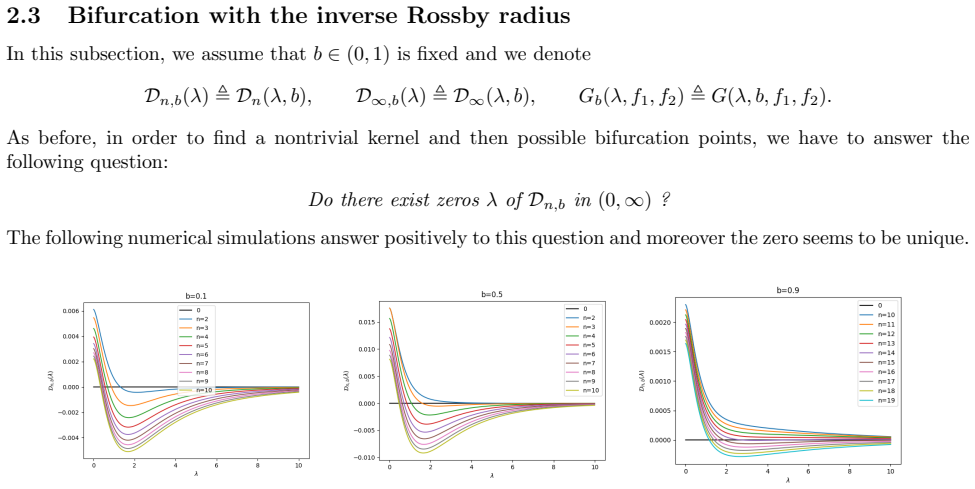
- Figures 2–5 are referenced but not visible in the manuscript text provided. The authors should ensure these are properly included and captioned in the final version.
- In the proof of Theorem 1.2(ii), the function x ↦ I₁(x)/x is stated to be increasing on (0,∞) 'from (A.1)'. A one-line justification (e.g., differentiating the power series) would be helpful.
- The reference [34] is cited for derivative bounds on I_nK_n (equation (2.24)) and for the regularity of the functional with respect to λ. Since [34] appears to be a memoir by two of the authors, it would be appropriate to state the relevant results explicitly rather than referring the reader to page numbers, at least for the key estimate (2.24).
- Corollary 3.1: the estimate involves f_λ^{-1}(Ω), but the domain of f_λ is stated as (0,∞) → (0, 1/2). It should be clarified that f_λ is applied to the spatial variable (i.e., f_λ(x) = I₁(λx)K₁(λx)), not to λ itself, to avoid confusion with the notation elsewhere in the paper.
Simulated Author's Rebuttal
We thank the referee for the careful reading and the positive assessment. The referee raises two points: (1) a verification of the transversality argument in Proposition 2.4(iv), which the referee confirms is correct, and (2) a request regarding the lambda-bifurcation result (Proposition 2.5 / Theorem 1.1(ii)) to either sketch how zeros of D_{n,b} could be excluded for large lambda, or at minimum clarify the scope of Theorem 1.1(ii) in its statement. We address both below.
read point-by-point responses
-
Referee: Proposition 2.4(iv), transversality for the b-bifurcation: The referee has carefully checked the chain of inequalities establishing tau(lambda) < 0 and confirms the argument is correct and robust.
Authors: We thank the referee for the careful verification of the transversality argument in Proposition 2.4(iv). The referee's reconstruction of the proof is accurate: the Wronskian identity (2.44) gives the key inequality (2.58), the lower bound (2.39) on beta(lambda) is derived via the function varpi and the elementary inequality varpi(1/(2x)) > 2x(1-x), and combining these yields tau(lambda) <= e^{-2beta}(lambda I_1 K_0 - 2 lambda beta I_0 K_1) < -1/2 e^{-2beta} < 0. We agree that the bound is robust in that it does not require tight asymptotics on beta(lambda), only the strict inequality from (2.39). No revision is needed for this point. revision: no
-
Referee: Remark 2.4 / Proposition 2.5: The lambda-bifurcation result is stated on (0, lambda_max) rather than (0, infinity). The referee requests either a sketch of how uniform convergence (2.7) combined with large-argument asymptotics (A.10) could exclude zeros in [lambda_bar, infinity) for n large, or at minimum a clarification in the statement of Theorem 1.1(ii) that the result holds for lambda in a neighborhood of 0.
Authors: We agree with the referee that the statement of Theorem 1.1(ii) should be clarified to make the scope explicit. The result indeed produces bifurcation points lambda_{m,b} converging to 0, so the theorem holds for lambda in a neighborhood of 0. We will add a clarifying sentence to the statement of Theorem 1.1(ii) making this explicit, so that readers are not confused about the scope. Regarding the suggestion to sketch how zeros could be excluded for large lambda: we agree that the natural approach would combine the uniform convergence (2.7) with the large-argument asymptotics (A.10). The key observation is that D_{infty,b}(lambda) < 0 for all lambda > 0 by (2.9), so for any fixed compact [0, Lambda], uniform convergence already excludes zeros for n large. The difficulty, as noted in Remark 2.4, is obtaining uniform control on [Lambda, infinity): the large-argument asymptotics (A.10) show that I_n(lambda) K_n(lambda) ~ 1/(2 lambda) for lambda >> n, but the regime where lambda is comparable to n requires more refined uniform asymptotics (Debye-type expansions) that would substantially lengthen the paper. We will expand Remark 2.4 to sketch this strategy and explain the remaining difficulty more precisely, while keeping the full argument for future work. This is a partial revision: the clarification in the theorem statement is straightforward, and the expanded remark provides the requested sketch, but the complete proof of non-existence of zeros for large lambda is deferred. revision: partial
Circularity Check
No circularity found: the derivation is self-contained against external benchmarks.
full rationale
The paper proves existence of stationary QGSW vortex patches via Crandall-Rabinowitz bifurcation. The functional setup and linearized operator (Proposition 2.1) cite [52] (Roulley, 2022) for the functional framework and linearization formula, but these are used as building blocks, not as circular inputs: the kernel characterization, determinant analysis, zero-finding (Lemmas 2.2-2.5), and transversality (Propositions 2.4(iv), 2.6(iv)) are all derived here from first principles using modified Bessel function identities (Appendix A). The Crandall-Rabinowitz theorem (Theorem B.1) is a standard external result. The key asymptotic expansions (1.7) and (1.8) for the bifurcation points b_{m,λ} and λ_{m,b} are derived from the determinant equation D_n(λ,b)=0 via Taylor integral formulas and Bessel asymptotics, not fitted to data. The transversality conditions reduce to checking non-vanishing of scalar products T_{m,λ} and T_{m,b}, whose signs are established through Wronskian identities, monotonicity of Bessel products, and explicit asymptotic analysis — all self-contained mathematical arguments. The rigidity result (Theorem 1.2) follows from verifying structural assumptions of [25] and a maximum principle argument. No prediction is equivalent to its input by construction, and no self-citation is load-bearing in the sense of smuggling an unverified ansatz. The concern about the transversality sign argument being delicate is a correctness risk, not a circularity issue: the chain of inequalities is derived, not assumed.
Assumptions & free parameters
free parameters (3)
- λ (inverse Rossby radius)
- b (inner radius)
- m (symmetry parameter)
assumptions (4)
- standard math Crandall-Rabinowitz bifurcation theorem (Theorem B.1)
- standard math Properties of modified Bessel functions (Appendix A)
- domain assumption Yudovich theory for QGSW (cited from [43])
- standard math Kellogg-Warschawski theorem
Cite this review
Pith. "Pith review of On stationary Quasi-Geostrophic Shallow-Water flows." pith.science (2026). https://pith.science/paper/CREMHFU2
@misc{pith2026260707541,
  author       = {Pith},
  title        = {Pith review of: On stationary Quasi-Geostrophic Shallow-Water flows},
  year         = {2026},
  howpublished = {\url{https://pith.science/paper/CREMHFU2}},
  note         = {Machine review of arXiv:2607.07541}
}
abstract
In this paper, we prove the existence of $\mathbf{m}$-fold doubly-connected stationary vortex patches for the quasi-geostrophic shallow-water equations. The solutions are obtained through a bifurcation analysis based on the Crandall-Rabinowitz theorem, with either the inner radius of an annulus or the Rossby deformation length serving as the bifurcation parameter. A central feature of the work is the highly nontrivial analysis of modified Bessel functions arising in the spectral study of the linearized operator. The proof requires delicate and extensive manipulations of these special functions, including precise asymptotic expansions, differentiation formulas, recurrence identities, monotonicity properties and the analysis of singular quantities governing the bifurcation mechanism. These ingredients are essential for characterizing the bifurcation points and establishing the transversality conditions. Finally, we investigate the radial symmetry of stationary and uniformly rotating simply-connected vortex patch solutions, therefore motivating the previous bifurcation results.
Figures


Figures from the paper (2 more)

Reference graph
Works this paper leans on
-
[23]
G´ omez-Serrano,On the existence of stationary patches,Advances in Mathematics 343 (2019), 110–140
J. G´ omez-Serrano,On the existence of stationary patches,Advances in Mathematics 343 (2019), 110–140
work page 2019
-
[1]
M. Abramowitz, I. A. Stegun,Handbook of mathematical functions with formulas, graphs, and mathe- matical tables, volume 55 of National Bureau of Standards Applied Mathematics Series, (1964)
work page 1964
-
[2]
A. Baricz,On a product of modified Bessel functions,Proceedings of the American Mathematical Society 137 (2009), no. 1, 189–193
work page 2009
-
[3]
Burbea,Motions of vortex patches,Letters in Mathematical Physics 6 (1982), no
J. Burbea,Motions of vortex patches,Letters in Mathematical Physics 6 (1982), no. 1, 1–16
work page 1982
- [4]
-
[5]
M. G. Crandall, P. H. Rabinowitz,Bifurcation from simple eigenvalues.Journal of Functional Analysis 8 (1971), 321–340
work page 1971
- [6]
-
[7]
F. de la Hoz, Z. Hassainia, T. Hmidi,Doubly-connected V-States for the Generalized Surface Quasi- Geostrophic Equations,Archive for Rational Mechanics and Analysis 220 (2016), 1209–1281
work page 2016
Show all 60 references
-
[8]
de la Hoz, Z
F. de la Hoz, Z. Hassainia, T. Hmidi, J. Mateu,An analytical and numerical study of steady patches in the disc,Analysis and PDE, 9 (2015), no. 10
2015
-
[9]
de la Hoz, T
F. de la Hoz, T. Hmidi, J. Mateu, J. Verdera,Doubly-connected V-states for the planar Euler equations, SIAM Journal on Mathematical Analysis 48 (2016), no. 3, 1892–1928
2016
-
[10]
D. G. Dritschel, T. Hmidi, C. Renault,Imperfect bifurcation for the shallow-water quasi-geostrophic equations, Archive for Rational Mechanics and Analysis 231 (2019), no. 3, 1853–1915
2019
-
[11]
Elgindi, Y
T. Elgindi, Y. Huang,On the flexibility of 2D Euler steady states,arXiv:2604.12962. 39
-
[12]
Elgindi, Y
T. Elgindi, Y. Huang, A. Said, C. Xie,A Classification theorem for steady Euler flows,arXiv:2408.14662. To appear in Duke Mathematical Journal
-
[13]
Enciso, A
A. Enciso, A. Fern´ andez, D. Ruiz,Smooth nonradial stationary Euler flows on the plane with compact support,arXiv:2406.04414. To appear in Journal of the European Mathematical Society
-
[14]
Enciso, A
A. Enciso, A. Fern´ andez, D. Ruiz,Uniformly rotating Euler flows with compactly supported velocity, arXiv:2511.12293
-
[15]
B. Fan, Y. Wang, W. Zhan,Radial symmetry of stationary and uniformly-rotating solutions to the 2D Euler equation in a disc,arXiv:2412.05973
-
[16]
B. Fan, Y. Wang, W. Zhan,Remarks on radial symmetry of stationary and uniformly-rotating solutions for the 2D Euler equation,arXiv:2506.05034
-
[17]
Fraenkel,An introduction to maximum principles and symmetry in elliptic problems,Cambridge University Press 128 (2000)
E. Fraenkel,An introduction to maximum principles and symmetry in elliptic problems,Cambridge University Press 128 (2000)
2000
-
[18]
Garc´ ıa, Z
C. Garc´ ıa, Z. Hassainia, E. Roulley,Dynamics of vortex cap solutions on the rotating unit sphere,Journal of Differential Equations 417 (2025), 1–63
2025
-
[19]
Garc´ ıa, T
C. Garc´ ıa, T. Hmidi, J. Mateu,Time periodic solutions for the 3D quasi–geostrophic model,Communi- cations in Mathematical Physics 390 (2022), 617–756
2022
-
[20]
Garc´ ıa, T
C. Garc´ ıa, T. Hmidi, J. Mateu,Time periodic doubly connected solutions for the 3D quasi-geostrophic model,SIAM Journal on Mathematical Analysis 55 (2023), no. 6, 6133–6195
2023
-
[21]
Garc´ ıa, T
C. Garc´ ıa, T. Hmidi, J. Mateu,Time periodic solutions close to localized radial monotone profiles for the 2D Euler equations,Annals of PDE 10 (2024), no. 1
2024
-
[22]
Garc´ ıa, T
C. Garc´ ıa, T. Hmidi, J. Soler,Non uniform rotating vortices and periodic orbits for the two–dimensional Euler equations,Archive for Rational Mechanics and Analysis 238 (2020), 929–1086
2020
-
[24]
G´ omez-Serrano, J
J. G´ omez-Serrano, J. Park, J. Shi,Existence of non-trivial non-concentrated compactly supported sta- tionary solutions of the 2D Euler equation with finite energy,Memoirs of the American Mathematical Society 311 (2025), no. 1577, v+82 pp
2025
-
[25]
G´ omez-Serrano, J
J. G´ omez-Serrano, J. Park, J. Shi, Y. Yao,Symmetry in stationary and uniformly-rotating solutions of active scalar equations,Duke Mathematical Journal 170 (2021), no. 13, 2957–3038
2021
-
[26]
C. Gui, C. Xie, H. Xu,On a Classification of Steady Solutions to Two-Dimensional Euler Equations, Communications in Mathematical Physics 407 (2026), no. 112
2026
-
[27]
Hassainia, T
Z. Hassainia, T. Hmidi,On the V-States for the generalized quasi-geostrophic equations,Communications in Mathematical Physics 337 (2015), no. 1, 321–377
2015
-
[28]
Hassainia, H
Z. Hassainia, H. Houamed,Dynamic Behavior of a Multi-Layer Quasi-Geostrophic Model: Weak and Time-Periodic Solutions,Pure and Applied Analysis 7 (2025), no. 2, 251–297
2025
-
[29]
Hassainia, N
Z. Hassainia, N. Masmoudi, M. H. Wheeler,Global bifurcation of rotating vortex patches, Communications on Pure and Applied Mathematics Vol. LXXIII (2020), 1933–1980
2020
-
[30]
Hmidi,On the trivial solutions for the rotating patch model,Journal of Evolution Equation 15 (2015), no
T. Hmidi,On the trivial solutions for the rotating patch model,Journal of Evolution Equation 15 (2015), no. 4, 801–816
2015
-
[31]
Hmidi, H
T. Hmidi, H. Houamed, E.Roulley, M. Zerguine,Uniformly rotating vortices for the lake equation,Math- ematische Annalen 392 (2025), 3065–3160
2025
-
[32]
Hmidi, J
T. Hmidi, J. Mateu,Degenerate bifurcation of the rotating patches,Advances in Mathematics 302 (2016), 799–850
2016
-
[33]
Hmidi, J
T. Hmidi, J. Mateu, J. Verdera,Boundary Regularity of Rotating Vortex Patches,Archive for Rational Mechanics and Analysis 209 (2013), no. 1, 171–208
2013
-
[34]
Hmidi, E
T. Hmidi, E. Roulley,Time quasi-periodic vortex patches for quasi-geostrophic shallow-water equations, To appear in M´ emoires de la Soci´ et´ e Math´ ematique de France (2026), arXiv:2110.13751. 40
2026 arXiv
-
[35]
Hmidi, L
T. Hmidi, L. Xue, Z. Xue,Unified theory on V-states structures for active scalar equations,Advances in Mathematics 486 (2026), no. 110750
2026
-
[36]
Hmidi, L
T. Hmidi, L. Xue, Z. Xue,Doubly connected V-states in geophysical models: a general framework,Cal- culus of Variations and Partial Differential Equations 65 (2026), no. 137
2026
-
[37]
P. E. Hoggan, A. Sidi,Asymptotics of modified Bessel functions of high order, International Journal of Pure and Applied Mathematics 71 (2011), no. 3, 481–498
2011
-
[38]
Houamed, M
H. Houamed, M. Maga˜ na,Sharp strong convergence in ideal flows,Nonlinearity 38 (2025), no. 12
2025
-
[39]
Huang,On the rigidity of uniformly rotating vortex patch near the Rankine vortex,Nonlinearity 38 (2025), no
Y. Huang,On the rigidity of uniformly rotating vortex patch near the Rankine vortex,Nonlinearity 38 (2025), no. 1
2025
-
[40]
Jalali, D
M. Jalali, D. Dritschel,Stability and evolution of two opposite-signed quasi-geostrophic shallow-water vortex patches,Geophysical & Astrophysical Fluid Dynamics 114 (2020), no. 4-5, 561–587
2020
-
[41]
Kirchhoff,Vorlesungen uber mathematische Physik, Leipzig, (1874)
G. Kirchhoff,Vorlesungen uber mathematische Physik, Leipzig, (1874)
-
[42]
N. N. Lebedev,Special Functions and their applications, Prentice-Hall, (1965)
1965
-
[43]
Maga˜ na, J
M. Maga˜ na, J. Mateu, J. Orobitg,The regularity of the boundary of vortex patches for the quasi- geostrophic shallow-water equations,arXiv:2602.22767
-
[44]
Park,Quantitative estimates for uniformly-rotating vortex patches,Advances in Mathematics 411, 108779
J. Park,Quantitative estimates for uniformly-rotating vortex patches,Advances in Mathematics 411, 108779
-
[45]
Plotka, D
H. Plotka, D. Dritschel,Shallow-water vortex equilibria and their stability,Journal of Physics: Conference Series, 318 (2011), no. 6
2011
-
[46]
Plotka, D
H. Plotka, D. Dritschel,Quasi-geostrophic shallow-water doubly-connected vortex equilibria and their stability,Journal of Fluid Mechanics 723 (2013), 40–68
2013
-
[47]
Plotka, D
H. Plotka, D. Dritschel,Simply-connected vortex-patch shallow-water quasi-equilibria,Journal of Fluid Mechanics 743 (2014), 481–502
2014
-
[48]
Polvani,Two-layer geostrophic vortex dynamics
L. Polvani,Two-layer geostrophic vortex dynamics. Part 2. Alignment and two-layer V-states,Journal of Fluid Mechanics 225 (1991), 241–270
1991
-
[49]
Polvani, N
L. Polvani, N. Zabusky, G. Flierl,Two-layer geostrophic vortex dynamics. Part 1. Upper-layer V-states and merger,Journal of Fluid Mechanics 205 (1989), 215–242
1989
-
[50]
Pommerenke,Boundary behaviour of conformal maps,Springer-Verlag (1992)
C. Pommerenke,Boundary behaviour of conformal maps,Springer-Verlag (1992)
1992
-
[51]
Renault,Relative equilibria with holes for the surface quasi-geostrophic equations, Journal of Differ- ential Equations 263 (2017), no
C. Renault,Relative equilibria with holes for the surface quasi-geostrophic equations, Journal of Differ- ential Equations 263 (2017), no. 1, 567–614
2017
-
[52]
Roulley,Vortex rigid motion in quasi-geostrophic shallow-water equations,Asymptotic Analysis 133 (2022), no
E. Roulley,Vortex rigid motion in quasi-geostrophic shallow-water equations,Asymptotic Analysis 133 (2022), no. 3, 397–446
2022
-
[53]
Roulley,Periodic and quasi-periodic Euler-αflows close to Rankine vortices,Dynamics of Partial Differential Equations 20 (2023), no
E. Roulley,Periodic and quasi-periodic Euler-αflows close to Rankine vortices,Dynamics of Partial Differential Equations 20 (2023), no. 4, 311–366
2023
-
[54]
Roulley,Local and global bifurcation of electron-states,Discrete and Continuous Dynamical Systems 45 (2025), no
E. Roulley,Local and global bifurcation of electron-states,Discrete and Continuous Dynamical Systems 45 (2025), no. 8, 2381–2419
2025
-
[55]
Roulley,Ions-electrons-states for the two-component Vlasov-Poisson equation,arXiv:2602.09293
E. Roulley,Ions-electrons-states for the two-component Vlasov-Poisson equation,arXiv:2602.09293
-
[56]
G. K. Vallis,Atmospheric and Oceanic Fluid Dynamics: Fundamentals and Large-Scale Circulation, Cambridge University Press, 2nd edition, (2017)
2017
-
[57]
Y. Wang, X. Xu, M. Zhou,Degenerate bifurcation of two-fold doubly-connected vortex patches, arXiv:2212.01869
-
[58]
S. E. Warschawski,On the higher derivatives at the boundary in conformal mapping,Transactions of the American Mathematical Society 38 (1935), no. 2, 310–340
1935
-
[59]
G. N. Watson,A Treatise on the Theory of Bessel Functions, Cambridge University Press, (1922). 41
1922
-
[60]
Modeling Nature
F. Yan, Q. Zhang,Global solutions of quasi-geostrophic shallow-water fronts,Journal of Differential Equations 406 (2024), 1–86. Vittorio Baroncini Departamento de An´ alisis Matem´ atico and IMUS, Universidad de Sevilla, 41012 Seville, Spain. E-mail address: vbaroncini@us.es C...
2024
Reviewed July 9, 2026 · model on record in the stance chip above.
Discussion (0). Sign in to comment.