REVIEW 2 major objections 4 minor 60 references
Analysis of collisional and facility effects in a magnetic nozzle plasma expansion
T0 review · 2 major / 4 minor · reviewed 2026-07-10 · grok-4.5
Pith's one-line read Global outer-boundary conditions, not throat ambipolarity, correctly capture how chamber walls and background pressure reshape magnetic-nozzle thrust.
desk verdict Solid fluid extension of DIMAGNO that recovers experimental thrust-vs-p_bg trends with OFW BCs and a convective electron closure; residual force at finite domain is a real but secondary caveat, not a collapse of the claim. read the letter →
The pith
A machine-rendered reading of the paper's core claim, the machinery that carries it, and where it could break.
The reading
What carries the argument
The convective electron-energy closure: under high magnetization the electron flow G, adiabaticity function A, and thermalized potential Φ are integrated along magnetic lines from the outer boundary, with energy flux taken as purely convective (specific enthalpy γe Te/(γe-1), γe=1.2 fixed). This replaces both polytropic laws and conductive heat-flux models that require anomalous resistivity.
What would settle it
Repeat the background-pressure thrust series (0–4 mPa) on a thruster whose outer boundary is electrically floating versus deliberately shorted or dielectric; if thrust still falls with pressure under shorted conditions, the claimed superiority of the global floating-wall boundary is false.
Extended reading notes
Core claim
Global current-free (outer floating-wall) electron boundary conditions are physically more reliable than local throat current ambipolarity. They incorporate the influence of metallic chamber walls on the ambipolar electric field, enable extrapolation to undisturbed free-space expansion, and alone recover the experimentally observed decrease of magnetic thrust with background pressure; local throat conditions produce the opposite, unphysical trend.
Load-bearing premise
Electron energy transport is assumed to be almost purely convective, so the conductive heat flux can be neglected; if conduction or free-versus-confined kinetic subpopulations dominate, cooling without anomalous resistivity no longer holds.
Signed reviews
Editorial analysis
A structured set of objections, weighed in public.
Referee Report
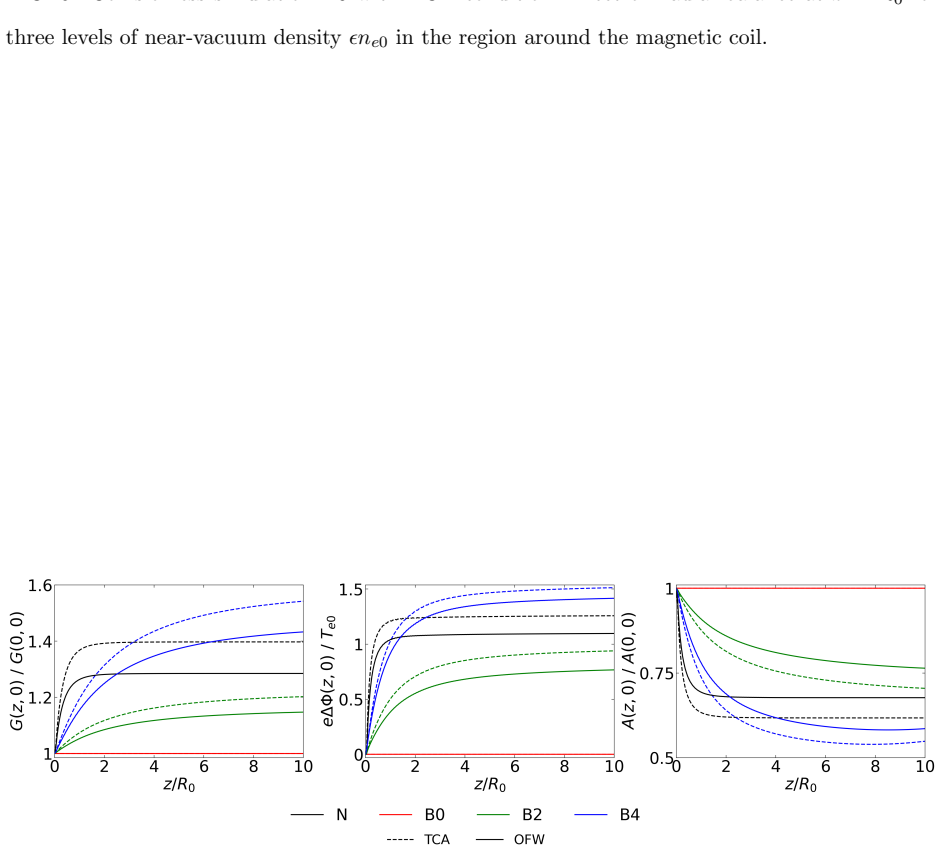
Summary. The paper develops an axisymmetric quasineutral three-fluid model (DIMAGNO-DG) for magnetic-nozzle plasma expansion that includes ionization, elastic, and charge-exchange collisions with neutrals emitted from the source or present as a uniform background. Electron energy transport is closed by assuming a mainly convective flux (specific enthalpy γe Te/(γe−1) with fixed γe=1.2), allowing electron cooling without anomalous resistivity; under high magnetization the electron continuity, energy and parallel momentum equations reduce to ODEs along magnetic lines for the flow G, adiabaticity A and thermalized potential Φ. Performance is quantified by volume integrals of mass, magnetic thrust and power (Appendix B). Two electron boundary conditions are compared: local throat current ambipolarity (TCA) and a global current-free floating-wall condition at the outer boundary (OFW). The central claim is that OFW is physically preferable because it couples the plume to chamber walls (or free space), shapes the ambipolar field, and alone recovers the experimental decrease of thrust with background pressure (Table II).
Significance. If the convective-energy closure and the OFW preference hold, the work supplies a computationally tractable fluid tool that can both interpret facility-pressure effects and extrapolate laboratory magnetic-nozzle data to free-space conditions—an important practical need for electrodeless thrusters. Strengths include clean conservation balances (Appendix B), explicit domain-size and Hall-parameter validity checks (Figs. 9–10, §VI), and a transparent comparison of TCA versus OFW that isolates the electrical boundary as the driver of the thrust-versus-p_bg trend. The model therefore advances the collisionless DIMAGNO lineage while remaining falsifiable against existing ion-velocity and thrust measurements.
major comments (2)
- §V and Table II: the claim that only OFW recovers the experimental decrease of thrust with p_bg rests on FP/F0 falling from 1.69 (B0) to 1.66 (B4) under OFW while rising under TCA. §VI.A and Fig. 9 show that even at L/R0=15 the axial force profiles have not asymptoted; residual magnetic force remains and φD−φW≈20 V. Because that residual is comparable to the 2–9 % thrust differences that separate the two BCs, the sign of dFP/dp_bg could reverse once the domain is large enough for the force to saturate. A larger-domain (or asymptotic-matching) demonstration is needed before the OFW preference can be regarded as robust.
- §II.B, Eqs. (13)–(16) and (20)–(23): the no-anomalous-resistivity claim is load-bearing and rests entirely on the convective-energy closure (conductive heat flux neglected, γe fixed at 1.2). The manuscript cites kinetic studies [29–31] but does not quantify how sensitive the cooling rate, potential fall or thrust gain are to modest conductive contributions or to free/confined subpopulation effects. A short parametric variation of γe (or an explicit bound on the neglected heat-flux term) would strengthen the central modeling claim.
minor comments (4)
- Table I lists Mi0=0.5 for ions while the text (§III.A) argues that higher values produce non-monotonic ϕ(z,0); a brief sensitivity plot of ϕ(z,0) versus Mi0 would make the choice transparent.
- Fig. 4 caption notes that sharp minima of jne at the corners are “likely of numerical origin”; a short remark on mesh refinement or flux limiting would reassure the reader.
- §VI.C discusses anomalous resistivity but does not state whether the present high-magnetization ordering remains valid once a Bohm-type term with χ̄∼1/64 is added; a one-sentence estimate would be useful.
- Typographical inconsistencies appear in author names and journal titles in the reference list (e.g., “Scinece”, “Fern´ andez”); a careful proof-reading pass is needed.
Circularity Check
Minor self-citation for the convective electron-energy closure; thrust/OFW results are independent numerical outputs, not forced by construction.
-
self citation load bearing
[Abstract; §II.B, Eqs. (13)–(16), (20)–(23); refs. [29]–[31]]
"As a difference with other models, electron cooling in the plume is achieved by treating the electron energy flux as mainly convective and without the need to postulate any anomalous resistivity. [...] The closure is based on kinetic (Vlasov-based) studies suggesting that the electron energy flux in a MN rarefied plasma expansion is mainly convective [29–31]. [...] Those investigations conclude that the mixture is reasonably well characterized with an specific enthalpy (Ee + Te) = Te γe/(γe − 1)."
The claim that cooling is obtained without anomalous resistivity rests on adopting a convective-only energy flux and fixed γe enthalpy. That closure is motivated almost solely by kinetic papers whose authors overlap with the present team; it is not re-derived here. Once adopted, the rest of the model is independent, so the step is a mild self-citation supporting an ansatz rather than a reduction of the Table II thrust numbers to their inputs.
full rationale
The derivation chain is a standard fluid integration under stated closures: ion/neutral conservation laws plus high-magnetization electron equations (15)–(23) with G, A, Φ integrated along magnetic lines; performance metrics (32)–(35) and Table II are volume/surface integrals of the solved fields. No equation reduces to its own input by definition, and no parameter is fitted to a data subset then re-presented as a prediction of a closely related quantity. The OFW-vs-TCA thrust-vs-p_bg comparison is an output of two different BC choices under the same PDE system, not a tautology. The only mild circularity-adjacent element is that the central modeling premise enabling cooling without anomalous resistivity—the neglect of conductive heat flux and the enthalpy closure (Ee+Te)=γe Te/(γe−1)—is justified almost exclusively by kinetic studies whose author lists overlap with the present paper ([29]–[31]). That is a self-citation supporting an ansatz, not a uniqueness theorem or a fitted input renamed as prediction; the subsequent collisional and facility results remain independent of that citation once the closure is fixed. Score 2 reflects that single non-load-bearing self-citation; the paper is otherwise self-contained against its own equations and external experimental trends.
Assumptions & free parameters
free parameters (4)
- γe (electron specific-heat ratio) =
1.2
- Mi0 (ion Mach number at throat) =
0.5 (nominal)
- ϵ (near-vacuum density floor) =
10^{-3}
- Domain size L/R0 =
10 (nominal)
assumptions (5)
- domain assumption Electron energy flux is mainly convective; conductive heat flux is neglected so that Ee+Te = γe Te/(γe−1).
- domain assumption High electron magnetization (χ̄ ≪ 1) allows reduction of electron continuity and energy to magnetic-line ODEs for G, A, Φ.
- domain assumption Quasineutrality ne = ni holds everywhere, including across the plasma–vacuum interface.
- domain assumption Plasma-induced magnetic field is negligible; applied B is a pure current-loop field.
- ad hoc to paper Outer boundary is adjacent to a floating conducting wall (or free-space matching layer) whose potential is set by global current-free condition (37).
Cite this review
Pith. "Pith review of Analysis of collisional and facility effects in a magnetic nozzle plasma expansion." pith.science (2026). https://pith.science/paper/Z2OOMHMD
@misc{pith2026260707861,
  author       = {Pith},
  title        = {Pith review of: Analysis of collisional and facility effects in a magnetic nozzle plasma expansion},
  year         = {2026},
  howpublished = {\url{https://pith.science/paper/Z2OOMHMD}},
  note         = {Machine review of arXiv:2607.07861}
}
read the original abstract
An axisymmetric, quasineutral three-fluid model is proposed to study the plasma expansion in a magnetic nozzle under the presence of neutrals coming either from the plasma source or as an homogeneous background. As a difference with other models, electron cooling in the plume is achieved by treating the electron energy flux as mainly convective and without the need to postulate any anomalous resistivity. Solutions are presented for the electron high-magnetization limit, in which the electron main magnitudes can be integrated along magnetic lines. Ionization, elastic and charge-exchange collisions with neutrals do not change the main qualitative features of the plasma expansion, known from previous collisionless models. Ionization enhances the plasma flow in the nozzle, and leads to additional electron cooling, which decreases the electric potential fall along the nozzle. The efficiency of the nozzle is quantified in terms of the gain of magnetic thrust and the plume divergence angle. Two types of boundary conditions are discussed for the electron flow: local current ambipolarity conditions at the nozzle throat and global current-free conditions at the outer boundary (i.e., metallic vacuum chamber walls). These last ones are shown to be physically more reliable: they introduce the influence of the chamber walls on the plasma expansion by shaping the ambipolar electric field; they permit the extrapolation to undisturbed free space conditions; and they approximate better experimental trends with the background pressure.
Figures


Figures from the paper (7 more)




Reference graph
Works this paper leans on
-
[1]
Z P dS[jniQ +j neQ(ϕW )] = 0 (37) wherej niQ ≡(j i ·1 n)Q does not depend onϕ W . Once this wall potential is determined,j neQ is known at each point of the boundary P, andu ∥eQ satisfies u∥eQ = p TeQ/(2πme) exp(−eϕW Q/TeQ) (1∥ ·1 n)Q .(38) This Outer-boundary Floating Wall (OFW) condition is proposed to substitute the TCA 13 condition (30), allowing Eq. ...
-
[2]
consider values ofp bg up to 3.45 mPa. With the adopted model assumptions, the background density affects only the ionization and electron-momentum collision frequenciesν ion andν e; charge-exchange collisions are considered marginal in these cases and thus neglected. For each simulation, both TCA and OFW boundary conditions are considered. Figure 7 shows...
-
[3]
The maxima of the two conditions are at top- right section of the plots, and are the result ofu θe increasing nearly proportional tor[12]; 20 fortunately it is a region of secondary interest. The neglect of electron finite Larmor radius (FLR) effects (i.e. electron inertia, pressure anisotropy, and gyroviscosity) [52], applied on the momentum equations (1...
-
[4]
Ahedo, Plasma Physics and Controlled Fusion53, 124037 (2011)
E. Ahedo, Plasma Physics and Controlled Fusion53, 124037 (2011)
work page 2011
-
[5]
S. Bathgate, M. Bilek, and D. Mckenzie, Plasma Science and Technology19, 083001 (2017)
work page 2017
-
[6]
A. Sheppard and J. Little, in AIAA Propulsion and Energy 2021 Forum (August, 9-11, 2021) p. 3375
work page 2021
- [7]
-
[8]
Batishchev, IEEE Transactions on Plasma Science37, 1563 (2009)
O. Batishchev, IEEE Transactions on Plasma Science37, 1563 (2009)
work page 2009
Show all 60 references
-
[9]
Takahashi, T
K. Takahashi, T. Lafleur, C. Charles, P. Alexander, R. Boswell, M. Perren, R. Laine, S. Pot- tinger, V. Lappas, T. Harle, et al., Applied Physics Letters98, 141503 (2011)
2011
-
[10]
Navarro-Cavall´ e, M
J. Navarro-Cavall´ e, M. Wijnen, P. Fajardo, and E. Ahedo, Vacuum149, 69 (2018)
2018
-
[11]
Sercel, in AIAA 19th Fluid Dynamics, Plasma Dynamics and Lasers Conference, 87-1407 (1987)
J. Sercel, in AIAA 19th Fluid Dynamics, Plasma Dynamics and Lasers Conference, 87-1407 (1987)
1987
-
[12]
Cannat, T
F. Cannat, T. Lafleur, J. Jarrige, P. Chabert, P. Elias, and D. Packan, Physics of Plasmas 22, 053503 (2015)
2015
-
[13]
M. R. Inchingolo, M. Merino, and J. Navarro-Cavall´ e, Journal of Applied Physics133, 113304 (2023)
2023
-
[14]
Andersen, V
S. Andersen, V. Jensen, P. Nielsen, and N. D’Angelo, Phys. Fluids12, 557 (1969)
1969
-
[15]
Ahedo and M
E. Ahedo and M. Merino, Physics of Plasmas17, 073501 (2010)
2010
-
[16]
Merino and E
M. Merino and E. Ahedo, in Encyclopedia of Plasma Technology, Vol. 2, edited by J. L. Shohet (Taylor and Francis, 2016) pp. 1329–1351
2016
-
[17]
I. D. Kaganovich, A. Smolyakov, Y. Raitses, E. Ahedo, I. G. Mikellides, B. Jorns, F. Tac- cogna, R. Gueroult, S. Tsikata, A. Bourdon, J.-P. Boeuf, M. Keidar, A. T. Powis, M. Merino, M. Cappelli, K. Hara, J. A. Carlsson, N. J. Fisch, P. Chabert, I. Schweigert, T. Lafleur, K. Ma...
2020
-
[18]
Merino and E
M. Merino and E. Ahedo, Plasma Sources Science and Technology26, 095001 (2017)
2017
-
[19]
Merino and E
M. Merino and E. Ahedo, Plasma Sources Science and Technology23, 032001 (2014). 27
2014
-
[20]
Merino and E
M. Merino and E. Ahedo, IEEE Transactions on Plasma Science43, 244 (2015)
2015
-
[21]
Merino and E
M. Merino and E. Ahedo, Plasma Sources Science and Technology25, 045012 (2016)
2016
-
[22]
Vialis, J
T. Vialis, J. Jarrige, and D. Packan, in Proc. 35th Int. Electr. Propuls. Conf, 378 (Atlanta, Georgia, October, 8-12, 2017) pp. 1–12
2017
-
[23]
N. R. Caruso and M. L. Walker, Journal of Propulsion and Power34, 58 (2018)
2018
-
[24]
Wachs and B
B. Wachs and B. Jorns, Plasma Sources Science and Technology29, 045002 (2020)
2020
-
[25]
D´ esangles, D
V. D´ esangles, D. Packan, J. Jarrige, S. Peterschmitt, P. Dietz, S. Scharmann, K. Holste, and P. J. Klar, Journal of Electric Propulsion2, 10 (2023)
2023
-
[26]
Andriulli, S
R. Andriulli, S. Andrews, N. Souhair, M. Magarotto, and F. Ponti, Acta Astronautica215, 362 (2024)
2024
-
[27]
Andrews, S
S. Andrews, S. Di Fede, and M. Magarotto, Plasma Sources Science and Technology31, 035022 (2022)
2022
-
[28]
T. A. Marks, I. G. Mikellides, A. Lopez Ortega, and B. Jorns, in AIAA Propulsion and Energy 2020 Forum, 2020-3642 (2020)
2020
-
[29]
Correyero, J
S. Correyero, J. Jarrige, D. Packan, and E. Ahedo, Plasma Sources Science and Technology 28, 095004 (2019)
2019
-
[30]
Little and E
J. Little and E. Choueiri, Physical Review Letters117, 225003 (2016)
2016
-
[31]
Zhang, C
Y. Zhang, C. Charles, and R. Boswell, Physical Review Letters116, 025001 (2016)
2016
-
[32]
Mart´ ınez-S´ anchez, J
M. Mart´ ınez-S´ anchez, J. Navarro-Cavall´ e, and E. Ahedo, Physics of Plasmas22, 053501 (2015)
2015
-
[33]
Ahedo, S
E. Ahedo, S. Correyero, J. Navarro, and M. Merino, Plasma Sources Science and Technology 29, 045017 (2020)
2020
-
[34]
J. Zhou, G. S´ anchez-Arriaga, and E. Ahedo, Plasma Sources Science and Technology30, 045009 (2021)
2021
-
[35]
Merino, D
M. Merino, D. Garc´ ıa-Lahuerta, and E. Ahedo, Plasma Sources Science and Technology32, 065005 (2023)
2023
-
[36]
Bello-Ben´ ıtez and E
E. Bello-Ben´ ıtez and E. Ahedo, Plasma Sources Science and Technology30, 035003 (2021)
2021
-
[37]
J. Zhou, A. Dom´ ınguez-V´ azquez, P. Fajardo, and E. Ahedo, Plasma Sources Science and Technology31, 045021 (2022)
2022
-
[38]
Perales-D´ ıaz, A
J. Perales-D´ ıaz, A. Dom´ ınguez-V´ azquez, E. Ahedo, A. Di Sarli, and A. Kitaeva, Journal of Physics D: Applied Physics58, 135211 (2025). 28
2025
-
[39]
Fern´ andez-Tena, T
I. Fern´ andez-Tena, T. Perrotin, J. Navarro-Cavall´ e, J. Zhou, E. Ahedo, and A. Dom´ ınguez- V´ azquez, Plasma Sources Science and Technology35, 065011 (2026)
2026
-
[40]
Stangeby, J
P. Stangeby, J. Canik, and D. Whyte, Nuclear Fusion50, 125003 (2010)
2010
-
[41]
R. C. Malone, R. L. McCrory, and R. L. Morse, Physical Review Letters34, 721 (1975)
1975
-
[42]
Bell, The Physics of Fluids28, 2007 (1985)
A. Bell, The Physics of Fluids28, 2007 (1985)
2007
-
[43]
Araki, R
S. Araki, R. Martin, D. Bilyeu, and J. Koo, in 52nd Joint Propulsion Conference, 2016-4939 (Salt Lake City, Utah, July 25-27, 2016)
2016
-
[44]
Cichocki, A
F. Cichocki, A. Dom´ ınguez-V´ azquez, M. Merino, and E. Ahedo, Plasma Sources Science and Technology26, 125008 (2017)
2017
-
[45]
A. E. Vinci, S. Mazouffre, V. G´ omez, P. Fajardo, and J. Navarro-Cavall´ e, Plasma Sources Science and Technology31, 095007 (2022)
2022
-
[46]
Collard and B
T. Collard and B. Jorns, Plasma Sources Science and Technology28, 105019 (2019)
2019
-
[47]
Ahedo and M
E. Ahedo and M. Merino, Physics of Plasmas18, 053504 (2011)
2011
-
[48]
Merino and E
M. Merino and E. Ahedo, Physics of Plasmas23, 023506 (2016)
2016
-
[49]
Dom´ ınguez-V´ azquez, J
A. Dom´ ınguez-V´ azquez, J. Zhou, A. Sevillano-Gonz´ alez, and E. Ahedo, Plasma Sources Science and Technology34, 085004 (2025)
2025
-
[50]
Perales-D´ ıaz, A
J. Perales-D´ ıaz, A. Dom´ ınguez-V´ azquez, P. Fajardo, E. Ahedo, F. Faraji, M. Reza, and T. Andreussi, Journal of Applied Physics131, 103302 (2022)
2022
-
[51]
Charles, Applied Physics Letters96, 051502 (2010)
C. Charles, Applied Physics Letters96, 051502 (2010)
2010
-
[52]
J. M. Little and E. Y. Choueiri, Physical Review Letters123, 145001 (2019)
2019
-
[53]
Z. Chen, Y. Wang, H. Tang, J. Ren, M. Li, Z. Zhang, S. Cao, and J. Cao, Phys. Rev. E101, 053208 (2020)
2020
-
[54]
Lieberman and A
M. Lieberman and A. Lichtenberg, Principles of Plasma Discharges and Materials Processing (John Wiley and Sons, Hoboken, NJ, 2005)
2005
-
[55]
Ramos, Physics of Plasmas12, 112301 (2005)
J. Ramos, Physics of Plasmas12, 112301 (2005)
2005
-
[56]
Ahedo and M
E. Ahedo and M. Merino, Physics of Plasmas19, 083501 (2012)
2012
-
[57]
Hepner, B
S. Hepner, B. Wachs, and B. Jorns, Applied Physics Letters116, 263502 (2020)
2020
-
[58]
Takahashi, C
K. Takahashi, C. Charles, and R. W. Boswell, Scientific Reports12, 20137 (2022)
2022
-
[59]
Maddaloni, B
D. Maddaloni, B. Bay´ on-Buj´ an, J. Navarro-Cavall´ e, and M. Merino, Plasma Sources Scinece and Technology34, 045008 (2025)
2025
-
[60]
C. W. Shu and S. Osher, Journal of Computational Physics77, 439 (1988). 29 TABLE I. Nominal simulation N. Throat boundary conditions for each plasma species and selected plasma parameters. α n i e ˙mα0 [µg/s] 60 100 – ¯nα0 [1017 m−3] 7.7 3 3 Tα0 [eV] 0.1 0.1 10 cα0 [km/s] 0.35...
1988
Reviewed July 10, 2026 · model on record in the stance chip above.
Discussion (0). Continue with ORCID to comment.