REVIEW 1 major objections 6 minor 39 references
SCI-Mamba: Unsupervised Learning based Low-Light Image Enhancement for Non-Cooperative Spacecraft
T0 review · 1 major / 6 minor · reviewed 2026-07-10 · glm-5.2
Pith's one-line read Flatten once, enhance in 1D: a lightweight pipeline for dark spacecraft imagery
desk verdict The 1D-only Mamba pipeline is a real engineering contribution, but Table 3 undercuts the visual quality claim — the raw input scores better than SCI-Mamba on all three no-reference metrics. read the letter →
The pith
A machine-rendered reading of the paper's core claim, the machinery that carries it, and where it could break.
The reading
What carries the argument
The VSS1D module: a residual block that receives a globally flattened 1D patch sequence and uses an embedded SCSG (Sequential Cross-scan Generator) to produce four directional scan sequences (row-forward, column-forward, row-reverse, column-reverse) purely via 1D permutation and reversal operations. Each sequence is processed by Mamba's selective state-space model, then an SCSR (Sequential Cross-scan Restorer) reverses the permutations and fuses all four streams back to row-major order inside 1D space. This replaces VMamba's standard SS2D, which requires 2D feature map reconstruction at every layer.
What would settle it
A test set of real orbital images where the spacecraft target is so small or so dim that the Otsu-based bright-region map and gradient-based texture map fail to produce a coherent structural mask. If the auto-generated target illumination map misidentifies background noise as texture or misses the actual spacecraft structure, the differentiated enhancement would either amplify background noise or leave the target under-enhanced, showing no advantage over the global brightness amplification methods the paper claims to surpass.
Extended reading notes
Core claim
The paper's central discovery is that a fully sequence-dominated pipeline, which performs a single global 2D-to-1D flattening at input and a single 1D-to-2D reconstruction at output, can serve as a complete and efficient substitute for the repeated cross-dimensional transformations used in standard visual Mamba architectures for low-light enhancement. Within this 1D-only domain, a Sequential Cross-scan Generator (SCSG) rearranges the base sequence into four directional traversal streams to recover the spatial context lost during flattening, and a Sequential Cross-scan Restorer (SCSR) fuses them back—all without ever reconstructing a 2D feature map. Combined with a self-calibrated Retinex框架,
Load-bearing premise
The prior-guided illumination monitor assumes that Otsu thresholding and morphological operations applied to extremely dark, noisy input images can reliably segment spacecraft foreground from deep-space background. If these heuristic masks fail on degenerate inputs, the differentiated enhancement strategy would collapse into the same indiscriminate noise amplification the paper criticizes in CNN baselines.
Editorial extensions
If this is right
- If the one-flatten design principle generalizes, other image-to-sequence tasks (e.g., denoising, super-resolution) currently using VMamba-style architectures could adopt the VSS1D module to reduce memory and latency without sacrificing spatial modeling.
- The prior-guided illumination monitor, if robust, suggests that unsupervised differentiated enhancement can be achieved for any domain with a strong foreground-background radiometric separation (e.g., underwater imagery, medical imaging) by auto-generating target illumination maps from input gradients and brightness alone.
- The Space Dark-1.0 dataset, combining synthetic renders, hardware-in-the-loop darkroom captures, and real orbital footage, provides a benchmark that could standardize evaluation for future space-target perception algorithms under low-light conditions.
- If the 1D-sequence Retinex operations (element-wise Hadamard multiplication/division on flattened sequences) prove numerically stable across deeper pipelines, they could replace image-domain Retinex in other multi-stage enhancement frameworks to reduce cross-domain switching overhead.
Signed reviews
Editorial analysis
A structured set of objections, weighed in public.
Referee Report
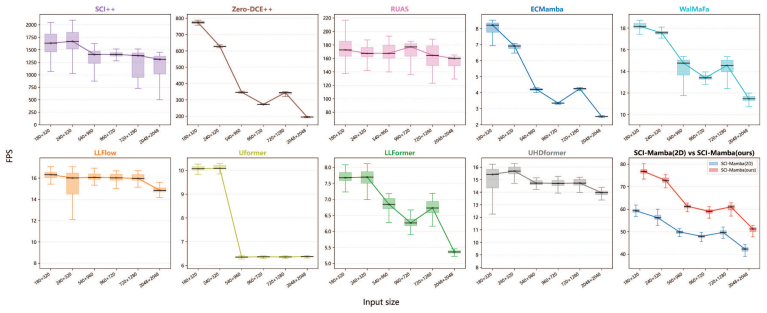
Summary. This paper proposes SCI-Mamba, an unsupervised low-light image enhancement network designed for non-cooperative spacecraft imagery. The architecture combines the self-calibrated illumination learning of SCI++ with a 1D-only sequence processing pipeline built on VMamba's state-space modeling, performing a single 2D-to-1D flattening at input and a single 1D-to-2D reconstruction at output to eliminate layer-wise cross-dimensional overhead. A multi-objective loss includes a prior-guided illumination monitor that auto-generates target illumination maps from input brightness and texture features to drive differentiated foreground/background enhancement. The authors also construct Space Dark-1.0, a multi-source dataset combining synthetic renders, darkroom hardware-in-the-loop captures, and real on-orbit footage. Efficiency results (Table 2) demonstrate strong speed and memory advantages over Transformer and Mamba competitors, with a 23.05% speedup over the 2D-scan ablation baseline.
Significance. The paper addresses a genuine engineering gap: existing low-light enhancement methods are either too computationally heavy (Transformer/Mamba variants with quadratic or layer-wise overhead) or lack global context modeling (CNN methods). The one-time bidirectional conversion design is a concrete, verifiable architectural contribution, and the ablation in Table 2 (SCI-Mamba vs. SCI-Mamba(2D)) directly supports the 23.05% speedup claim. The release of Space Dark-1.0, integrating real ADRAS-J orbital footage with hardware-in-the-loop data, is a valuable resource contribution. Code availability is stated. The work targets a well-motivated application domain with strict hardware constraints.
major comments (1)
- Table 3 and the visual quality claim. The paper's central claim is a 'favorable trade-off between visual quality, noise suppression, and hardware efficiency.' The efficiency side is well-supported. However, on all three no-reference metrics in Table 3, the raw unenhanced input scores better than SCI-Mamba (NIQE: 20.21 vs. 20.39; BRISQUE: 54.98 vs. 56.71; PIQE: 54.17 vs. 54.62). The text acknowledges this for PIQE but obscures it for NIQE and BRISQUE by framing SCI-Mamba's scores favorably only relative to competing enhancement methods. This means the quantitative evidence does not support improved visual quality over the raw input. The visual quality claim then rests entirely on subjective Figures 8-13. The authors should either (a) add full-reference metrics on the synthetic subset where ground truth is available, or (b) add a downstream task evaluation (e.g., pose estimation or targetd
minor comments (6)
- Table 1 caption says 'Training Overhead Comparison Across Unsupervised Enhancement Algorithms' but includes no Transformer or Mamba methods, only CNN-based unsupervised competitors. The caption should clarify this scope or the table title should be adjusted to avoid confusion with the inference comparison in Table 2.
- Section 4.2: The training set combines 8000 samples from Space Dark-1.0, 1600 from ExDark, and 2400 from SPEED+. The test set is described as 1400 unseen samples from Space Dark-1.0. It is unclear whether the 8000 training images and 1400 test images are drawn from the same 9400-image pool or from disjoint partitions. Please clarify the exact train/test split.
- The large number of hand-tuned hyperparameters (alpha_1 through alpha_5, beta weights, lambda_d, lambda_b, sigma values, percentile thresholds, etc.) makes reproducibility challenging. A sensitivity analysis on at least the most impactful parameters (e.g., alpha_5 for Loss5, lambda_d/lambda_b for the illumination monitor) would help readers understand robustness.
- Figures 8-13: The qualitative comparisons would be more informative if zoomed-in crops of specific regions (e.g., solar panel edges, background noise patches) were provided alongside full images, as is standard in image restoration papers. At current scale, fine differences are difficult to verify for readers.
- Reference [27] (SISIFOS) and several others cite 2026 conference/forum dates. If these are accepted/published, the citations should be updated to final DOIs/venue information rather than pending.
- Eq. (1): The notation I_3^{(-1)} is described as 'element-wise Hadamard inverse' but the superscript notation could be confused with matrix inversion. Consider using I_3^{odot (-1)} or explicitly stating 'element-wise reciprocal' to match standard conventions.
Circularity Check
No significant circularity: the prior-guided illumination monitor is a heuristic target, not a self-definitional loop
full rationale
The paper's core architectural and efficiency claims (one-time 2D-to-1D conversion, VSS1D module, 23.05% speedup over the 2D baseline) are independently verifiable engineering results with no circular structure. The prior-guided illumination monitor (Loss5, Section 3.5) does generate its 'target' illumination map from the input image via fixed heuristic rules (Otsu thresholding, morphological operations, gradient percentiles), and the network is trained to match this auto-generated target. While this is a weak supervisory signal — the 'target' is derived from the input — it is not circular in the self-definitional sense: the network's learned mapping is not identical to the heuristic by construction. The network could in principle learn a different mapping that satisfies the multi-objective loss, and the heuristic target is parameterized independently of the network's weights. The reader's concern about Table 3 (raw input scoring better than SCI-Mamba on no-reference metrics) is a correctness/evaluation concern, not circularity: the metrics are computed by external algorithms (NIQE, BRISQUE, PIQE) on the output images, and the comparison does not reduce to a tautology. No equation in the paper defines an output in terms of itself, and no central claim rests on a self-citation chain that is itself unverified. The SCI++ framework [9] is cited as the basis for the self-calibration mechanism, but the present paper's contribution (replacing 2D SS2D with 1D-only VSS1D) is an independent architectural modification validated by ablation. Overall, the derivation is self-contained against external benchmarks.
Assumptions & free parameters
free parameters (9)
- alpha_1 through alpha_5 =
0.006, 0.003, 0.25, 0.006, 2.2
- beta weights for stages 1-3 =
0.50, 0.75, 1.00
- lambda_d, lambda_b =
1.35, 0.12
- alpha_b, alpha_g =
0.78, 0.82
- theta_0, theta_1 =
0.45, 0.55
- sigma parameters (sigma_b, sigma_y, sigma_f, sigma_e, sigma_s) =
0.8, 0.6, 1.2, 0.6, 10
- Percentile thresholds (Pb, Pl, Ph) =
99.5%, 85%, 99%
- A_min =
300
- Delta_min, Delta_max =
1e-5, 0.1
assumptions (5)
- domain assumption Retinex decomposition: observed image = illumination x reflectance
- domain assumption Illumination maps should be spatially smooth and color-neutral
- domain assumption Texture-rich regions correspond to spacecraft foreground; smooth dark regions correspond to deep-space background
- ad hoc to paper Otsu thresholding on extremely low-light, noisy images produces meaningful brightness/texture segmentation
- domain assumption No-reference IQA metrics (NIQE, BRISQUE, PIQE) correlate with human perceptual quality for space imagery
invented entities (4)
-
VSS1D module
independent evidence
-
SCSG (Sequential Cross-scan Generator)
independent evidence
-
SCSR (Sequential Cross-scan Restorer)
independent evidence
-
Space Dark-1.0 dataset
Cite this review
Pith. "Pith review of SCI-Mamba: Unsupervised Learning based Low-Light Image Enhancement for Non-Cooperative Spacecraft." pith.science (2026). https://pith.science/paper/Z4BXRELT
@misc{pith2026260708033,
  author       = {Pith},
  title        = {Pith review of: SCI-Mamba: Unsupervised Learning based Low-Light Image Enhancement for Non-Cooperative Spacecraft},
  year         = {2026},
  howpublished = {\url{https://pith.science/paper/Z4BXRELT}},
  note         = {Machine review of arXiv:2607.08033}
}
read the original abstract
Low-light visual perception acts as the core visual foundation for on-orbit servicing missions targeting non-cooperative spacecraft, supporting autonomous rendezvous, pose estimation, component detection and robotic capture operations. Spaceborne imagery suffers from severe low-light degradation, while the extreme scarcity of paired normal/low-light space samples severely limits the generalization capacity of supervised enhancement algorithms. To address this practical bottleneck, this paper proposes SCI-Mamba, an unsupervised enhancement network for low-light orbital spacecraft observations. The proposed framework unites self-calibrated unsupervised learning, linear-complexity VMamba architecture and Retinex physical priors, delivering a lightweight enhancement pipeline adaptable to resource-limited spaceborne hardware. We construct Space Dark-1.0, a dedicated low-light spacecraft dataset integrating real orbital footage, darkroom hardware-in-the-loop measurements and physically constrained synthetic data covering diverse illumination, motion and attitude conditions. Comprehensive comparisons with CNN-, Transformer- and prevailing Mamba-based approaches verify the advantages of SCI-Mamba in visual authenticity, color fidelity and inference speed. The proposed framework provides a practical low-light enhancement solution for close-proximity non-cooperative space operations. The code is available at https://github.com/bitswh/SCI-Mamba
Figures


Figures from the paper (10 more)




Reference graph
Works this paper leans on
-
[1]
I. G. Velentzas, P. Tsiotras, Irolsd: Illumination robu st line segment de- tection for spacecraft relative navigation, Acta Astronau tica 239 (2026) 148–161
work page 2026
-
[2]
J. Peng, W. Xu, L. Yan, E. Pan, B. Liang, A.-G. Wu, A pose mea - surement method of a space noncooperative target based on ma ximum outer contour recognition, IEEE Transactions on Aerospace and Elec- tronic Systems 56 (1) (2019) 512–526
work page 2019
- [3]
-
[4]
Y. Cao, J. Mu, X. Cheng, F. Liu, Spacecraft-ds: A spacecra ft dataset for key components detection and segmentation via hardware-in -the-loop capture, IEEE Sensors Journal 24 (4) (2024) 5347–5358. 37
work page 2024
-
[5]
W. Xu, B. Liang, Y. Xu, Survey of modeling, planning, and g round ver- ification of space robotic systems, Acta Astronautica 68 (11 -12) (2011) 1629–1649
work page 2011
-
[6]
T. H. Park, S. D’Amico, Adaptive neural-network-based u nscented kalman filter for robust pose tracking of noncooperative spa cecraft, Jour- nal of Guidance, Control, and Dynamics 46 (9) (2023) 1671–16 88
work page 2023
-
[7]
C. Zhao, H. Wang, Q. Yan, J. Zhang, Y. Zhu, J. Sun, Y. Zhang, A review of optical image enhancement for extreme space envir onments, Advances in Astronautics 8 (2) (2025) 171–199
work page 2025
-
[8]
L. Ma, T. Ma, R. Liu, X. Fan, Z. Luo, Toward fast, flexible, a nd robust low-light image enhancement, in: Proceedings of the IEEE/C VF Confer- ence on Computer Vision and Pattern Recognition, 2022, pp. 5 637–5646
work page 2022
Show all 39 references
-
[9]
L. Ma, T. Ma, C. Xu, J. Liu, X. Fan, Z. Luo, R. Liu, Learning w ith self- calibrator for fast and robust low-light image enhancement , IEEE Trans- actions on Pattern Analysis and Machine Intelligence 47 (10 ) (2025) 9095–9112
2025
-
[10]
N. An, L. Ma, G. Han, X. Fan, R. Liu, Striving for faster and better: A one-layer architecture with auto re-paramete rization for low-light image enhancement, IEEE Transactions on Circ uits and Systems for Video Technology 35 (8) (2025) 7455–7470. doi:10.1109/TCSVT.2025.3547029
2025 doi
-
[11]
Y. Cai, H. Bian, J. Lin, H. Wang, R. Timofte, Y. Zhang, Ret inexformer: One-stage retinex-based transformer for low-light image e nhancement, in: Proceedings of the IEEE/CVF international conference o n computer vision, 2023, pp. 12504–12513
2023
-
[12]
J. Bai, Y. Yin, Q. He, Y. Li, X. Zhang, Retinexmamba: Reti nex-based mamba for low-light image enhancement, in: International C onference on Neural Information Processing, Springer, 2024, pp. 427– 442
2024
-
[13]
C. Li, C. Guo, C. C. Loy, Learning to enhance low-light im age via zero- reference deep curve estimation, IEEE transactions on patt ern analysis and machine intelligence 44 (8) (2021) 4225–4238. 38
2021
-
[14]
W. Wang, H. Yang, J. Fu, J. Liu, Zero-reference low-ligh t enhancement via physical quadruple priors, in: Proceedings of the IEEE/ CVF confer- ence on computer vision and pattern recognition, 2024, pp. 2 6057–26066
2024
-
[15]
Z. Feng, Y. Jiang, Y. Yang, X. Guo, H. Zhao, Q. Cao, Dmat: D ynamic modality-adaptive transformer for infrared-visible spac e object identifi- cation, Acta Astronautica (2026)
2026
-
[16]
Z. Wang, X. Cun, J. Bao, W. Zhou, J. Liu, H. Li, Uformer: A g en- eral u-shaped transformer for image restoration, in: Proce edings of the IEEE/CVF conference on computer vision and pattern reco gnition, 2022, pp. 17683–17693
2022
-
[17]
T. Wang, K. Zhang, T. Shen, W. Luo, B. Stenger, T. Lu, Ultr a-high- definition low-light image enhancement: A benchmark and tra nsformer- based method, in: Proceedings of the AAAI conference on arti ficial intelligence, Vol. 37, 2023, pp. 2654–2662
2023
-
[18]
C. Wang, J. Pan, W. Wang, G. Fu, S. Liang, M. Wang, X.-M. Wu , J. Liu, Correlation matching transformation transformers for uhd im- age restoration, in: Proceedings of the AAAI Conference on A rtificial Intelligence, Vol. 38, 2024, pp. 5336–5344
2024
-
[19]
H. Wang, X. Yan, X. Hou, J. Li, Y. Dun, K. Zhang, Division g ets better: Learning brightness-aware and detail-sensitive represen tations for low- light image enhancement, Knowledge-Based Systems 299 (202 4) 111958
-
[20]
S. H. Ahmad, J. H. Kai, S. M. H. U. Hassan, B. I. Rabiu, Airc raft engine fault diagnosis using a mamba-bigru model with perturbatio n strategy, Aerospace Science and Technology (2026) 111988
2026
-
[21]
J. She, Y. Liu, R. Zhou, N. Qi, Joint multi-target detect ion and single- target tracking framework for vehicles tracking based on ua v, Aerospace Science and Technology (2026) 111625
2026
-
[22]
C. Ge, J. Zhang, L. Wang, X. Wang, J. Yao, T. Yang, J. Du, Pc - transformer: Probabilistic flight trajectory prediction w ith multi-stage predictive coding, Aerospace Science and Technology (2025 ) 110910
2025
-
[23]
A. Gu, T. Dao, Mamba: Linear-time sequence modeling wit h selective state spaces, arXiv preprint arXiv:2312.00752 (2023). 39
2023 arXiv
-
[24]
Y. Liu, Y. Tian, Y. Zhao, H. Yu, L. Xie, Y. Wang, Q. Ye, J. Ji ao, Y. Liu, Vmamba: Visual state space model, Advances in neural inform ation processing systems 37 (2024) 103031–103063
2024
-
[25]
W. Dong, H. Zhou, Y. Zhang, X. Liu, J. Chen, Ecmamba: Cons olidating selective state space model with retinex guidance for efficie nt multiple exposure correction, Advances in Neural Information Proce ssing Sys- tems 37 (2024) 53438–53457
2024
-
[26]
J. Tan, S. Pei, W. Qin, B. Fu, X. Li, L. Huang, Wavelet-bas ed mamba with fourier adjustment for low-light image enhancement, i n: Proceed- ings of the Asian conference on computer vision, 2024, pp. 34 49–3464
2024
-
[27]
I. G. Velentzas, J.-D. Florez Castillo, N. Bruckner, M. Dor, P. Tsiotras, Sisifos: Specialized illumination simulator for orbiting spacecraft, in: AIAA SCITECH 2026 Forum, 2026, p. 2597
2026
-
[28]
H. Liu, P. Guo, S. Yang, Z. Jiang, Q. Hu, D. Li, Spaceseg: A high-precision intelligent perception segmentation meth od for multi- spacecraft on-orbit targets, arXiv preprint arXiv:2503.1 1133 (2025)
2025
-
[29]
Kisantal, S
M. Kisantal, S. Sharma, T. H. Park, D. Izzo, M. Märtens, S . D’ Amico, Satellite pose estimation challenge: Dataset, competitio n design, and results, IEEE Transactions on Aerospace and Electronic Sys tems 56 (5) (2020) 4083–4098
2020
-
[30]
T. H. Park, M. Märtens, G. Lecuyer, D. Izzo, S. D’Amico, S peed+: Next-generation dataset for spacecraft pose estimation ac ross domain gap, in: 2022 IEEE aerospace conference (AERO), IEEE, 2022, pp. 1– 15
2022
-
[31]
Bechini, M
M. Bechini, M. Lavagna, P. Lunghi, Dataset generation a nd validation for spacecraft pose estimation via monocular images proces sing, Acta Astronautica 204 (2023) 358–369
2023
-
[32]
P. F. Proença, Y. Gao, Deep learning for spacecraft pose estimation from photorealistic rendering, in: 2020 IEEE Internationa l Conference on Robotics and Automation (ICRA), IEEE, 2020, pp. 6007–601 3
2020
-
[33]
X. Yi, H. Xu, H. Zhang, L. Tang, J. Ma, Diff-retinex++: Ret inex- driven reinforced diffusion model for low-light image enhan cement, IEEE 40 Transactions on Pattern Analysis and Machine Intelligence 47 (8) (2025) 6823–6841. doi:10.1109/TPAMI.2025.3563612
2025 doi
-
[34]
Y. P. Loh, C. S. Chan, Getting to know low-light images wi th the ex- clusively dark dataset, Computer vision and image understa nding 178 (2019) 30–42
2019
-
[35]
R. Liu, L. Ma, J. Zhang, X. Fan, Z. Luo, Retinex-inspired unrolling with cooperative prior architecture search for low-light image enhancement, in: Proceedings of the IEEE/CVF conference on computer visi on and pattern recognition, 2021, pp. 10561–10570
2021
-
[36]
Y. Wang, R. Wan, W. Yang, H. Li, L.-P. Chau, A. Kot, Low-li ght image enhancement with normalizing flow, in: Proceedings of the AAAI conference on artificial intelligence, Vol. 36, 2022, pp. 26 04–2612
2022
-
[37]
comp letely blind
A. Mittal, R. Soundararajan, A. C. Bovik, Making a "comp letely blind" image quality analyzer, IEEE Signal processing letters 20 ( 3) (2012) 209–212
2012
-
[38]
Mittal, A
A. Mittal, A. K. Moorthy, A. C. Bovik, No-reference imag e quality as- sessment in the spatial domain, IEEE Transactions on image p rocessing 21 (12) (2012) 4695–4708
2012
-
[39]
Venkatanath, D
N. Venkatanath, D. Praneeth, S. C. Sumohana, S. M. Swaru p, et al., Blind image quality evaluation using perception based feat ures, in: 2015 twenty first national conference on communications (NCC), I EEE, 2015, pp. 1–6. 41
2015
Reviewed July 10, 2026 · model on record in the stance chip above.
Discussion (0). Continue with ORCID to comment.