REVIEW 4 major objections 5 minor 35 references
FFLV bases for covariant representations of $\mathfrak{gl}(m|n)$
T0 review · 4 major / 5 minor · reviewed 2026-08-02 · deepseek-v4-flash
Pith's one-line read The paper constructs lattice polytopes whose lattice points index monomial bases for a broad family of atypical covariant gl(m|n)-modules, and derives flat degenerations of partial flag supervarieties into toric supervarieties.
desk verdict First FFLV-type basis for atypical covariant gl(m|n) reps, with a plausible main theorem but an abstract-level overclaim about toric degenerations and a few proof gaps that need patching. read the letter →
The pith
A machine-rendered reading of the paper's core claim, the machinery that carries it, and where it could break.
The reading
What carries the argument
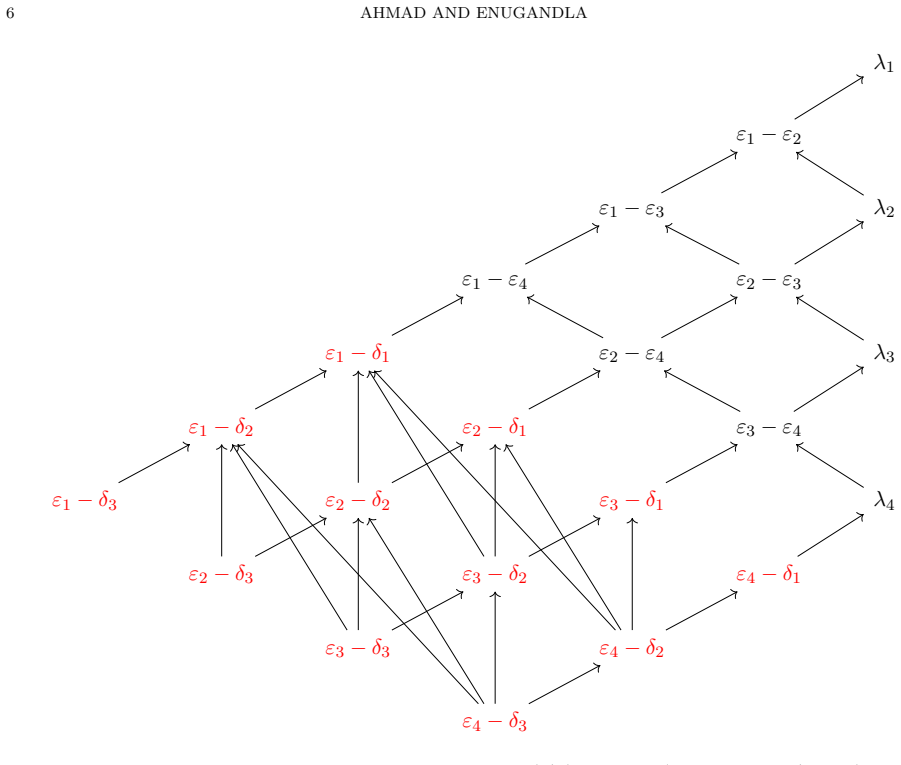
The central object is the lattice polytope P(λ|μ,0^{n−1}) defined from a marked poset of positive roots: its coordinates are exponents of negative root vectors, and its inequalities are chain inequalities of extended Dyck type. The unusual feature is the cube truncation s_{ε_i−δ_j} ≤ 1 on all odd roots, which turns the odd part of the monomials into exterior (square-zero) variables. Two pieces of machinery carry the argument: (1) the straightening law (Propositions 4.7 and 7.7), which uses differential operators ∂_α imitating the adjoint action of positive root vectors to rewrite any monomial violating an inequality as a combination of smaller monomials in the ideal; and (2) the Minkowski de
What would settle it
In a small covariant module such as V(1|1,0) for gl(1|2) or V(1^2|1) for gl(2|1), compute the action of f_{ε_i−δ_j}^2 on the highest weight vector and check whether its image in grV is zero; equivalently, compare the number of lattice points |P(λ|μ,0^{n−1})| with dim V(λ|μ,0^{n−1}). A single weight for which these differ, or for which f_α^2 · v_λ ≠ 0 in grV, would disprove the theorem.
Extended reading notes
Core claim
The central claim is Theorem 7.6: for any partition λ of length at most m with λ_m ≠ 0 and any integer μ ≥ 0, there is a lattice polytope P(λ|μ,0^{n−1}) whose lattice points S(λ|μ,0^{n−1}) parametrize a monomial basis of gr V(λ|μ,0^{n−1}), the associated graded space of the covariant gl(m|n)-module of highest weight (λ|μ,0^{n−1}) with respect to the PBW filtration. The polytope is cut out by inequalities (3.3)–(3.5) and (7.2)–(7.3): sums of coordinates along extended Dyck paths are bounded by differences of the λ_i, and the coordinate of every odd positive root is bounded by 1. In the typical case λ_m ≥ n these extra bounds are redundant and the polytope coincides with the previously known F
Load-bearing premise
The spanning proof (Sections 4 and 7.1) assumes, without stating or proving, that on every covariant module V(λ|μ,0^{n−1}) the square of any single negative odd root vector f_α annihilates the highest weight vector (so its leading class in grV is zero), which is what lets the construction discard monomials with odd-root exponents ≥ 2; if that nilpotence ever fails, the proposed set is not a spanning set.
Editorial extensions
If this is right
- The atypical covariant modules V(λ|μ,0^{n−1}) now carry explicit monomial bases compatible with the PBW filtration, a feature previously available only for typical representations.
- For strip weights (λ|0^n), the modules are favourable, so the embedded partial flag supervariety degenerates flatly into a toric supervariety whose coordinate ring is generated by the lattice-point monomials (Theorem 8.11).
- In the typical range λ_m ≥ n the new polytopes match the known typical FFLV polytopes, so the result is a genuine extension rather than a parallel construction.
- The Minkowski decomposition gives a recursive description of the basis: every lattice point decomposes as a sum of an exterior-power point from S(1^m|μ,0^{n−1}) and a point from S(λ−1^m|0^n), with no odd-root coordinate exceeding 1.
- The lattice polytope property and explicit inequalities make the basis amenable to computation; dimensions and characters of these associated graded spaces can be read off by counting lattice points.
Reading between the lines
- The unstated nilpotence premise—that f_α^2 acts by zero on every covariant module—is testable in low rank; if it fails for some atypical weight, the spanning half of the theorem collapses, so a proof or counterexample would sharply delimit the theorem's true range.
- The cube truncation {0,1}^{d_2} suggests reading the odd part of the basis as an exterior algebra; similar truncations may govern FFLV-type bases for other supergroups or for quiver flag varieties, where odd directions are inherently nilpotent.
- The paper itself notes (Remark 8.7) that for μ ≠ 0 the semigroup of essential monomials is suspected to be not finitely generated, so the toric degeneration conclusion may be qualitatively special to the one-row case; proving or disproving that suspicion would clarify whether a broader degeneration theory exists.
- Remark 7.11 shows the Minkowski decomposition fails for some weights with larger second partition (e.g., gl(1|2) with (2|2,0)), so extending the construction to general covariant weights (λ|μ) will require a new ingredient beyond decomposition into exterior powers.
Editorial analysis
A structured set of objections, weighed in public.
Referee Report
Summary. The paper constructs Feigin–Fourier–Littelmann–Vinberg (FFLV) type polytopes for certain covariant representations of the Lie superalgebra gl(m|n). For weights of the form (λ|0^n) and then (λ|μ,0^{n−1}), it defines lattice polytopes P(λ|0^n), P(λ|μ,0^{n−1}) and proves that their lattice points parametrize monomial bases of the associated graded space gr V(λ|μ,0^{n−1}) with respect to the PBW filtration. The proof proceeds by a marked-chain-polytope model, a monomial order on Sym(n^-), straightening laws, and Minkowski decompositions. For the strip case μ=0 the paper also claims favorable-module properties and, via an external result [Ahm26], a flat degeneration of the embedded partial flag supervariety to a toric supervariety (Theorem 8.11).
Significance. If the proof gaps are closed, the paper provides the first FFLV-type basis for atypical covariant gl(m|n)-representations, extending the typical-case results of [FK21]. The constructions are explicit and combinatorial, and the Minkowski decomposition in Proposition 7.10 is a valuable structural result. The polytope formulation is concrete and should be useful for further questions about PBW degenerations in the super setting. However, the advertised geometric consequence is narrower than the abstract suggests, and several load-bearing steps in the spanning and independence arguments are either sketched or delegated to a self-cited external paper.
major comments (4)
- [§3–§4, Definition 3.2, inequality (3.5)] The polytope imposes s_α ≤ 1 for every odd root α, but the spanning proof never proves that monomials with s_α ≥ 2 are zero or redundant in gr V(λ|0^n). In the super setting, gr U(n^-) is the super-symmetric algebra, and for the odd root vectors f_{ε_i−δ_j} the square is zero in U(n^-) because the corresponding elementary matrix squares to zero. This fact is not stated in the paper, although the whole argument implicitly uses it. Without this lemma, the straightening argument in Claim 4.8 does not control the monomials excluded by (3.5). The authors should add an explicit statement and proof that f_α^2 · v = 0 for odd α, and clarify the identification of gr U(n^-) with the appropriate super-symmetric algebra rather than the ordinary symmetric algebra.
- [Abstract and §8, Theorem 8.11] The abstract announces toric degenerations of partial flag supervarieties for GL(m|n) as a consequence of the basis theorem, but Theorem 8.11 proves the degeneration only for weights ν = (ν_1|0^n), i.e., μ = 0. Remark 8.7 explicitly disclaims the case μ ≠ 0 and even suspects that the semigroup of essential monomials is not finitely generated there. Thus the scope of the geometric claim in the abstract exceeds what is proved. The abstract and Introduction should be revised to state that the toric degeneration is obtained in the μ = 0 case, while the basis theorem is proved for the larger family (λ|μ,0^{n−1}).
- [§6, Proposition 6.3] The linear-independence step for arbitrary λ in the strip is delegated to [Ahm26, Proposition 3.12] without stating that proposition or verifying its hypotheses. Since this is a self-citation and the independence statement is central to Theorem 3.11, the paper should include the precise statement of the cited result, explain why the Minkowski decomposition in Proposition 6.2 and the squarefree-odd condition from §5 place the present situation in its hypotheses, and indicate how the conclusion follows. A bare reference to an external result is not sufficient for a step of this weight, especially when the cited paper is by the same first author.
- [§4, Claim 4.8] The leading-term analysis in the proof of Claim 4.8 is sketched rather than proved. The base case q=1 argues after equation (4.9) that applying ∂^{k−|J|}_{1,a} gives monomials bounded by f_{ε_a−ε_m}, but the monomial order of Definition 4.1 also involves the odd variables f_{δ_i−δ_j}, and it is not shown that all additional terms are strictly smaller than the desired leading term. The induction step introduces quantities k_{t_i}, gs_{i,•}, fs_{i,•} that are not consistently defined, and the final reduction to [FFL11a, Proposition 1] is asserted rather than demonstrated. Since Claim 4.8 is the core of the spanning property, this proof needs to be completed or replaced by an exact, verifiable citation with the relevant hypotheses checked.
minor comments (5)
- [§1, Introduction] Typo: “we show show” appears in the paragraph after Theorem 3.11.
- [§4, Definition 4.5 and §7.1] Typos: “otherweise” should be “otherwise”, and “distiguish” should be “distinguish”. These should be corrected.
- [§5, Lemma 5.3] In the proof of Lemma 5.3, the displayed formula “s_{ε_{i1}−ε_{j1}} = ... = s_{ε_{i1}−ε_{j1}} = 1” appears to contain a repeated index; it should be s_{ε_{i_p}−ε_{j_p}} = 1 for each p. The intended bijection is clear but the formula should be fixed.
- [§7, Theorem 7.6] The list of three items to be verified for Theorem 7.6 is not explicitly linked to the subsections where each item is proved. Adding cross-references to §7.1, §7.2, §7.3 would improve readability.
- [References] The paper relies heavily on [Ahm26] for Proposition 6.3 and Theorem 8.11. Since this is a self-citation and the article is dated 2026, the authors should state explicitly whether the cited results are published, accepted, or available as a preprint, and give the precise statements used.
Circularity Check
No circular derivation: the polytope-basis theorem is obtained by straightening, exterior-power bijections, and Minkowski decompositions; the Ahm26 citations are independent published support, and the abstract's all-covariant degeneration claim is a scope overstatement rather than circularity.
full rationale
No step in the paper's derivation reduces by construction to its own input. The central Theorem 3.11 / 7.6 is proved by (i) a straightening law showing the proposed monomials span grV(λ|0^n) and grV(λ|μ,0^{n-1}) (Section 4 and Claim 7.7), (ii) a direct bijection between lattice points and a weight basis for exterior powers V^k C^{m|n} and V^{m+μ} C^{m|n} (Lemma 5.3 and Lemma 7.9), and (iii) Minkowski decompositions for the polytopes (Propositions 6.1, 6.2, 7.10). These are independent combinatorial and representation-theoretic arguments, not a renaming or a fitted-input prediction. The references to [Ahm26] — in Proposition 6.3 ('Applying the same arguments as in [Ahm26, Proposition 3.12]') and in Theorem 8.11 ('We can use [Ahm26, Theorem 1, or Corollary 7.2]') — are citations to a same-first-author published theorem with stated, parameter-free hypotheses. They are load-bearing for linear independence and for the toric degeneration, but they do not presuppose the present theorem and are therefore independent support; self-citation alone is not circularity. The abstract's claim of degenerations of partial flag supervarieties for GL(m|n) is broader than what is proved: Theorem 8.11 covers only ν=(ν_1|0^n), and Remark 8.7 explicitly says the μ≠0 case 'cannot use the previous argument' and that the essential-monomial semigroup 'is not even finitely generated.' That is a scope/correctness discrepancy, not a circular step. Similarly, the concern about odd-root squares is a proof-presentation gap: the polytope bound s_α≤1 for odd roots (3.5) is consistent with the super-PBW filtration, under which odd generators are exterior in the associated graded algebra, so monomials with s_α≥2 are zero in grV; the paper should state this explicitly, but omitting it is not circularity. Overall, no specific equation is equivalent by definition to an input, and no prediction is forced from a fitted subset of data.
Assumptions & free parameters
assumptions (9)
- standard math PBW theorem for U(n^-) with ordered monomials in odd generators at most once (Theorem 2.7)
- domain assumption Semisimplicity of tensor powers of C^{m|n} and Schur-Weyl duality for gl(m|n)
- standard math Marked chain/order polytope theory and Minkowski sum results (ABS11; Fou16, Lemma 2)
- standard math Even-root straightening law for type A ([FFL11a, Prop. 1])
- domain assumption [Ahm26, Prop. 3.12]: essential monomials obtained via Minkowski decomposition form a basis
- domain assumption [Ahm26, Thm. 1/Cor. 7.2]: favourable modules give flat degenerations of embedded flag varieties
- standard math Gruson's homogeneous-ideal description of the orbit G·[v_ν] ([Gru94, Thm. 1.3])
- domain assumption Jankowski's toric supervarieties are affine spectra of such monomial algebras ([Jan25; Jan26])
- domain assumption Odd root vectors f_α act nilpotently with f_α^2=0 on all covariant representations, so exponents in (3.5) can be bounded by 1
Cite this review
Pith. "Pith review of FFLV bases for covariant representations of $\mathfrak{gl}(m|n)$." pith.science (2026). https://pith.science/paper/ASSEYFKV
@misc{pith2026260711133,
  author       = {Pith},
  title        = {Pith review of: FFLV bases for covariant representations of $\mathfrakgl(m|n)$},
  year         = {2026},
  howpublished = {\url{https://pith.science/paper/ASSEYFKV}},
  note         = {Machine review of arXiv:2607.11133}
}
abstract
We study the PBW filtration on covariant representations for the Lie superalgebra $\mathfrak{gl}(m|n)$. We prove for all covariant weights of the form $(\lambda|\mu,0^{n-1})$, that there exists a lattice polytope such that the lattice points of this polytope parametrize a basis of the corresponding associated graded space. As a consequence, we obtain degenerations of partial flag supervarieties for the supergroup $GL(m|n)$ into toric supervarieties.
Figures


Reference graph
Works this paper leans on
-
[1]
Computing the Continuous Discretely: Integer-point Enumeration in Polyhedra , author=
-
[2]
Compositio Mathematica , volume=
Positroid Varieties: Juggling and Geometry , author=. Compositio Mathematica , volume=. 2013 , publisher=
2013
-
[3]
Journal f
Projections of Richardson Varieties , author=. Journal f. 2012 , publisher=
2012
-
[4]
arXiv preprint arXiv:2303.04831 , year=
Richardson Varieties, Projected Richardson Varieties and Positroid Varieties , author=. arXiv preprint arXiv:2303.04831 , year=
-
[5]
, TITLE =
Stanley, Richard P. , TITLE =. 2012 , PAGES =
2012
-
[6]
2024 , PAGES =
Anderson, David and Fulton, William , TITLE =. 2024 , PAGES =
2024
-
[7]
Feigin, Evgeny and Fourier, Ghislain and Littelmann, Peter , TITLE =. Transform. Groups , FJOURNAL =. 2011 , NUMBER =. doi:10.1007/s00031-010-9115-4 , URL =
-
[8]
Fourier, Ghislain , TITLE =. J. Pure Appl. Algebra , FJOURNAL =. 2016 , NUMBER =. doi:10.1016/j.jpaa.2015.07.007 , URL =
Show all 35 references
-
[9]
2012 , PAGES =
Cheng, Shun-Jen and Wang, Weiqiang , TITLE =. 2012 , PAGES =. doi:10.1090/gsm/144 , URL =
2012 doi
-
[10]
2011 , issn =
Gelfand– Tsetlin polytopes and Feigin– Fourier– Littelmann– Vinberg polytopes as marked poset polytopes , journal =. 2011 , issn =. doi:https://doi.org/10.1016/j.jcta.2011.06.004 , author =
2011 doi
-
[11]
2011 , PAGES =
Carmeli, Claudio and Caston, Lauren and Fioresi, Rita , TITLE =. 2011 , PAGES =. doi:10.4171/097 , URL =
2011 doi
-
[12]
Kac, V. G. , TITLE =. Advances in Math. , FJOURNAL =. 1977 , NUMBER =. doi:10.1016/0001-8708(77)90017-2 , URL =
1977 doi
-
[13]
, TITLE =
Kac, V. , TITLE =. Differential geometrical methods in mathematical physics,. 1978 , ISBN =
1978
-
[14]
Perspectives in
Serganova, Vera , TITLE =. Perspectives in. 2017 , ISBN =
2017
-
[15]
2026 , issn =
Flat degenerations of flag supermanifolds for basic Lie superalgebras , journal =. 2026 , issn =. doi:https://doi.org/10.1016/j.jpaa.2026.108271 , url =
2026
-
[16]
Gruson, Caroline , TITLE =. J. Geom. Phys. , FJOURNAL =. 1994 , NUMBER =. doi:10.1016/0393-0440(94)90053-1 , URL =
1994 doi
-
[17]
, TITLE =
Stanley, Richard P. , TITLE =. Discrete Comput. Geom. , FJOURNAL =. 1986 , NUMBER =. doi:10.1007/BF02187680 , URL =
1986 doi
-
[18]
Sergeev, A. N. , TITLE =. Mat. Sb. (N.S.) , FJOURNAL =. 1984 , NUMBER =
1984
-
[19]
and Regev, A
Berele, A. and Regev, A. , TITLE =. Adv. in Math. , FJOURNAL =. 1987 , NUMBER =. doi:10.1016/0001-8708(87)90007-7 , URL =
1987 doi
-
[20]
Feigin, Evgeny and Fourier, Ghislain and Littelmann, Peter , TITLE =. Int. Math. Res. Not. IMRN , FJOURNAL =. 2011 , NUMBER =. doi:10.1093/imrn/rnr014 , URL =
2011 doi
-
[21]
2025 , eprint=
Reduced superschemes and the combinatorics of toric supervarieties , author=. 2025 , eprint=
2025
-
[22]
Transform
Jankowski, Eric , TITLE =. Transform. Groups , FJOURNAL =. 2026 , NUMBER =. doi:10.1007/s00031-024-09889-6 , URL =
2026 doi
- [23]
-
[24]
Gel'fand, I. M. and Cetlin, M. L. , TITLE =. Doklady Akad. Nauk SSSR (N.S.) , FJOURNAL =. 1950 , PAGES =
1950
-
[25]
Transform
Feigin, Evgeny and Fourier, Ghislain and Littelmann, Peter , TITLE =. Transform. Groups , FJOURNAL =. 2017 , NUMBER =. doi:10.1007/s00031-016-9389-2 , URL =
2017 doi
-
[26]
Cerulli Irelli, Giovanni and Lanini, Martina , TITLE =. Int. Math. Res. Not. IMRN , FJOURNAL =. 2015 , NUMBER =. doi:10.1093/imrn/rnu128 , URL =
2015 doi
-
[27]
Pacific J
Cerulli Irelli, Giovanni and Lanini, Martina and Littelmann, Peter , TITLE =. Pacific J. Math. , FJOURNAL =. 2016 , NUMBER =. doi:10.2140/pjm.2016.284.283 , URL =
2016 doi
-
[28]
Selecta Math
Feigin, Evgeny , TITLE =. Selecta Math. (N.S.) , FJOURNAL =. 2012 , NUMBER =. doi:10.1007/s00029-011-0084-9 , URL =
2012 doi
-
[29]
Fang, Xin and Fourier, Ghislain and Littelmann, Peter , TITLE =. Adv. Math. , FJOURNAL =. 2017 , PAGES =. doi:10.1016/j.aim.2017.03.014 , URL =
2017 doi
-
[30]
Gornitski i, A. A. , TITLE =. Mat. Zametki , FJOURNAL =. 2015 , NUMBER =. doi:10.4213/mzm10384 , URL =
2015 doi
-
[31]
Backhaus, Teodor and Kus, Deniz , TITLE =. J. Pure Appl. Algebra , FJOURNAL =. 2019 , NUMBER =. doi:10.1016/j.jpaa.2018.03.009 , URL =
2019 doi
-
[32]
Makhlin, Igor , TITLE =. Algebr. Comb. , FJOURNAL =. 2019 , NUMBER =. doi:10.5802/alco.41 , URL =
2019 doi
-
[33]
Fourier, Ghislain and Kus, Deniz , TITLE =. J. Lie Theory , FJOURNAL =. 2021 , NUMBER =
2021
-
[34]
Molev, A. I. , TITLE =. Bull. Inst. Math. Acad. Sin. (N.S.) , FJOURNAL =. 2011 , NUMBER =
2011
-
[35]
Stoilova, N. I. and Van der Jeugt, J. , TITLE =. J. Math. Phys. , FJOURNAL =. 2010 , NUMBER =. doi:10.1063/1.3478297 , URL =
2010 doi
Reviewed August 2, 2026 · model on record in the stance chip above.
Discussion (0). Continue with ORCID to comment.