REVIEW 6 minor 1 cited by
Combinatorial interpretation of the coefficients of the order polynomial of fence posets
T0 review · 0 major / 6 minor · reviewed 2026-07-14 · grok-4.5
Pith's one-line read A new block statistic on permutations counts the coefficients of the order polynomial of every fence poset.
desk verdict Solid combinatorial answer to two named open questions via a new block statistic on fences; the main identity is proved by recurrence matching and the proof checks out. read the letter →
The pith
A machine-rendered reading of the paper's core claim, the machinery that carries it, and where it could break.
The reading
What carries the argument
The unique valid block partition of a labeled fence: a left-to-right greedy decomposition into maximal convex subposets whose roots satisfy the ascent/descent inequalities forced by the labeling; bl_P(σ) simply counts those blocks.
What would settle it
Compute the order polynomial of a small fence by the classical ideal-chain formula and the block-statistic generating function by exhaustive enumeration of the n! labelings; any mismatch of coefficients disproves the identity.
Extended reading notes
Core claim
For every fence poset P of size n the order polynomial satisfies n! Ω(P;t) = sum over all permutations σ of t raised to the power bl_P(σ), where bl_P(σ) is the number of blocks in the unique valid block partition of the labeled fence (P,σ). The same identity, after a truncation of the fence, interprets the Ehrhart polynomial of every Schubert matroid base polytope.
Load-bearing premise
The proof that every labeled fence has exactly one valid block partition relies on the linear (path-like) shape of the fence; uniqueness is only conjectured once the poset becomes a skew shape or a cycle.
Editorial extensions
If this is right
- The coefficients of the order polynomial of every fence are non-negative and equal the number of labelings with a fixed number of blocks.
- The Ehrhart polynomial of every Schubert matroid (and every hypersimplex) acquires an explicit positive combinatorial formula as a sum of truncated block statistics.
- The linear coefficient of the Ehrhart polynomial of any order polytope is bounded below by a sum of harmonic numbers determined by the lengths of its ascending and descending runs.
- If the conjectured block statistics for skew shapes and circular fences are valid, the same combinatorial interpretation extends to those larger families.
Reading between the lines
- The greedy block construction is essentially a generalized Foata cycle map for zigzag posets; further specialization may recover classical permutation statistics.
- The same uniqueness argument may adapt to other series-parallel or path-like posets, potentially giving Ehrhart interpretations for a wider class of matroid polytopes.
- A probabilistic reading of the block statistic immediately produces higher-moment formulae for all coefficients of the Ehrhart polynomial, not only the linear term.
Editorial analysis
A structured set of objections, weighed in public.
Referee Report
Summary. The paper defines a statistic bl_P on the labelings (permutations) of a fence poset P of size n, given by the number of blocks in the unique valid block partition of (P,σ). It proves that n! Ω(P;t) equals the generating function ∑ t^{bl_P(σ)} over S_n (Theorem 3.8), answering a question of Ferroni–Morales–Panova. The same statistic, after truncation, yields a combinatorial interpretation of the Ehrhart polynomial of the base polytope of any Schubert matroid (Theorem 6.7), and therefore of hypersimplices, answering Stanley’s 1999 question. As an application the authors obtain a lower bound on the linear Ehrhart coefficient of the order polytope of a fence (Theorem 5.3). Analogous statistics are defined for skew-shape and circular fence posets and conjectured to give the same generating functions.
Significance. The result supplies the first explicit combinatorial interpretation of all coefficients of the order polynomial for the important class of fence posets, which appear as the building blocks in the recent Ehrhart-positivity proof for lattice-path matroids. The interpretation for Schubert matroids / hypersimplices resolves a long-standing open problem of Stanley. The lower bound on the linear coefficient, obtained by linearity of expectation on the indicator variables for roots, is the first nontrivial bound of its kind. The uniqueness of the valid block partition (Lemma 3.3) is proved by a short, self-contained induction that uses only the path geometry of a fence; the subsequent recurrence-matching argument is fully written out. These are genuine combinatorial advances that will be useful for further work on order polytopes and matroid polytopes.
minor comments (6)
- Numerous typographical and grammatical errors appear throughout (e.g., “decompostions”, “coonected filter”, “my Ferroni”, “e≤µ”, “P n k=0 ak =n!”, inconsistent capitalization of “Theorem”, missing articles). A careful copy-edit is needed before publication.
- Notation for the generating function is introduced twice: A(P;t) is defined as (1/n!)∑ t^{bl_P(σ)} in Definition 3.5, yet the main theorem equates Ω(P;t) with A(P;t). It would be cleaner to work exclusively with the integer-coefficient polynomial n!Ω or to state the equality of generating functions once and for all.
- Figures 6–8 and 10–12 are helpful but the captions and the surrounding text do not always make the colour coding (roots red, ascents blue, descents green) explicit; a single sentence in the caption of Figure 6 would suffice for all later figures.
- In the abstract and introduction the lower-bound application is phrased as holding for “an order polytope”; the statement proved (Theorem 5.3) is only for fences. A one-word clarification (“of a fence poset”) would avoid any possible over-reading.
- Section 7 is long and cancellation-heavy. While the algebra checks out, a short roadmap paragraph at the beginning of the section (listing the four groups of terms that cancel via Lemmas 7.1–7.2) would make the argument far easier to follow.
- The symbol S_n(P) appears in Conjectures 4.4 and 4.8 without definition; it is clear from context that it means the set of all labelings, but a one-line definition would remove any ambiguity.
Circularity Check
No significant circularity: the block statistic is defined combinatorially and matched to the order polynomial by independent recurrence comparison.
full rationale
The central claim (Theorem 3.8) equates n! Ω(P;t) to the generating function of the newly defined statistic bl_P(σ). The statistic is introduced via an explicit, self-contained combinatorial construction (unique valid block partition of a labeled fence, Lemma 3.3, proved by left-to-right induction that uses only the path structure and ascent/descent dichotomy). A(P;t) is then defined directly from that count. Both A and Ω are shown to obey matching recurrences (Lemma 3.6 from the greedy block construction; Theorem 3.7 from the known convex-subposet decomposition restated as Theorem 2.9). Equality follows by induction plus elementary term-by-term cancellation that invokes only the closed formula for the linear coefficient c1 of a fence (Lemma 2.5, taken from FMP25). Self-citations (Kahane 2025 for the language of standard decompositions; FMP25/FMP26 for positivity, c1 and the matroid decomposition) supply background facts used as black boxes; none of them redefine the target polynomial or force the statistic by construction. The matroid and hypersimplex interpretations are direct specializations of the same identity. Conjectures for skew and circular cases are left open and do not affect the proved theorem. The derivation is therefore self-contained against external benchmarks; the single minor self-citation is not load-bearing.
Assumptions & free parameters
assumptions (3)
- domain assumption The order polynomial Ω(P;t) is a polynomial of degree n whose leading coefficient is e(P)/n! and whose linear coefficient for a fence is given by the explicit factorial formula of Ferroni–Morales–Panova.
- domain assumption Every standard decomposition of a poset into convex subposets induces a partial order on the blocks, and the coefficients of Ω admit the Shareshian–Wright–Zhao / Kahane expansion in terms of products of linear coefficients.
- standard math Ordinary set-theoretic induction and the uniqueness of greedy left-to-right constructions on paths.
invented entities (2)
-
bl_P statistic and valid block partition of a labeled fence
independent evidence
-
Truncated block statistic TrBl_P for Schubert matroids
independent evidence
Cite this review
Pith. "Pith review of Combinatorial interpretation of the coefficients of the order polynomial of fence posets." pith.science (2026). https://pith.science/paper/OLIDFE2W
@misc{pith2026260711225,
  author       = {Pith},
  title        = {Pith review of: Combinatorial interpretation of the coefficients of the order polynomial of fence posets},
  year         = {2026},
  howpublished = {\url{https://pith.science/paper/OLIDFE2W}},
  note         = {Machine review of arXiv:2607.11225}
}
read the original abstract
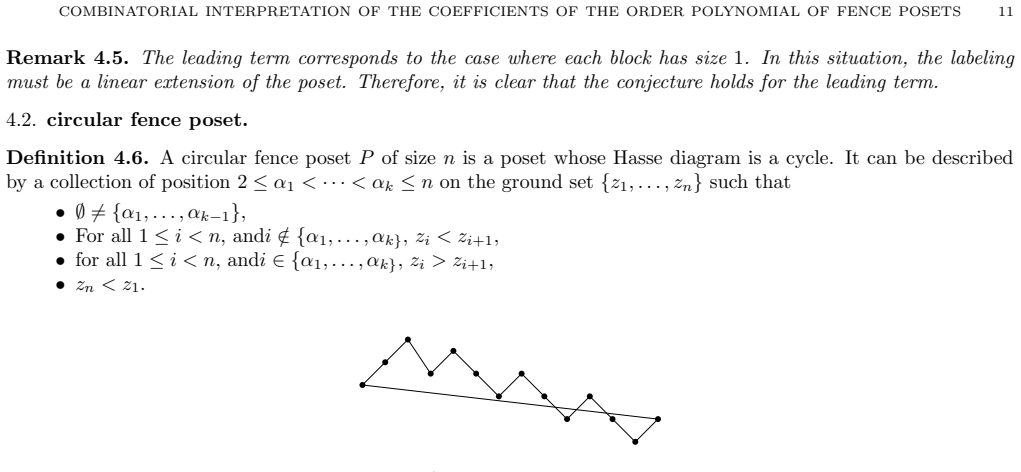
Given a fence poset P , we define a new statistic on permutations, denoted by blP, that provides a combinatorial interpretation of the coefficients of the order polynomial of P , answering a question of Ferroni, Morales, and Panova (2025). Using the fact that the base polytope of a lattice path matroid can be decomposed into order polytopes of fence posets, we also obtain a combinatorial interpretation of the coefficients of the Ehrhart polynomial of the base polytope of Schubert matroids, answering a question of Stanley (1999). As an application of this statistic, we establish the first nontrivial lower bound for the linear coefficient of the Ehrhart polynomial of an order polytope. Finally, we conjecture generalizations of this statistic to skew-shape posets and circular fence posets.
Figures


Figures from the paper (14 more)




Forward citations
Cited by 1 Pith paper
-
Bernstein Transfers and Greedy Records for Fence and Circular-Fence Order Polynomials
A greedy permutation record statistic matches the order polynomial of every fence poset, and a cyclic version proves the circular-fence order-polynomial conjecture.
Reference graph
Works this paper leans on
-
[1]
2015 , PAGES =
Beck, Matthias and Robins, Sinai , TITLE =. 2015 , PAGES =
2015
-
[2]
Recent trends in algebraic combinatorics , pages=
On positivity of Ehrhart polynomials , author=. Recent trends in algebraic combinatorics , pages=. 2019 , publisher=
2019
-
[3]
2003 , eprint=
A New Approach to Order Polynomials of Labeled Posets and Their Generalizations , author=. 2003 , eprint=
2003
-
[4]
Transactions of the American Mathematical Society , volume=
Excited Young diagrams and equivariant Schubert calculus , author=. Transactions of the American Mathematical Society , volume=
-
[5]
Advances in Mathematics , volume=
Correlation inequalities for linear extensions , author=. Advances in Mathematics , volume=. 2024 , publisher=
2024
-
[6]
arXiv preprint arXiv:2203.15942 , year=
Combinatorics of triangular partitions , author=. arXiv preprint arXiv:2203.15942 , year=
-
[7]
arXiv preprint math/0412289 , year=
Some positive differences of products of Schur functions , author=. arXiv preprint math/0412289 , year=
-
[8]
, label =
OEIS Foundation Inc. , label =. http://oeis.org , title =
Show all 64 references
-
[9]
Sage Developers, The , key =
-
[10]
2008 , PAGES =
Haglund, James , TITLE =. 2008 , PAGES =
2008
-
[11]
Knutson, Allen and Miller, Ezra and Yong, Alexander , TITLE =. J. Reine Angew. Math. , FJOURNAL =. 2009 , PAGES =. doi:10.1515/CRELLE.2009.033 , URL =
2009 doi
-
[12]
Ikeda, Takeshi and Naruse, Hiroshi , TITLE =. Trans. Amer. Math. Soc. , FJOURNAL =. 2009 , NUMBER =. doi:10.1090/S0002-9947-09-04879-X , URL =
2009 doi
-
[13]
Chen, William Y. C. and Yan, Guo-Guang. and Yang, Arthur L. B. , TITLE =. J. Algebraic Combin. , VOLUME =. 2005 , NUMBER =
2005
-
[14]
and Grassl, Richard M
Hillman, Abraham P. and Grassl, Richard M. , TITLE =. J. Combinatorial Theory Ser. A , FJOURNAL =. 1976 , NUMBER =. doi:10.1016/0097-3165(76)90065-0 , URL =
1976 doi
-
[15]
Discrete Anal
Chan, Swee Hong and Pak, Igor and Panova, Greta , TITLE =. Discrete Anal. , FJOURNAL =. 2021 , PAGES =. doi:10.19086/da , URL =
2021 doi
-
[16]
and Robinson, Gilbert de B
Frame, James S. and Robinson, Gilbert de B. and Thrall, Robert M. , year =. Can. J. Math. , title =. doi:10.4153/cjm-1954-030-1 , number =
1954 doi
-
[17]
European J
Lascoux, Alain and Pragacz, Piotr , TITLE =. European J. Combin. , FJOURNAL =. 1988 , NUMBER =. doi:10.1016/S0195-6698(88)80053-2 , URL =
1988 doi
- [18]
-
[19]
and Zhu, Daniel , TITLE =
Morales, Alejandro H. and Zhu, Daniel , TITLE =. S\'. 2020 , PAGES =
2020
-
[20]
and Pak, Igor and Panova, Greta , TITLE =
Morales, Alejandro H. and Pak, Igor and Panova, Greta , TITLE =. J. Combin. Theory Ser. A , FJOURNAL =. 2018 , PAGES =
2018
-
[21]
, TITLE =
Stanley, Richard P. , TITLE =. 2012 , PAGES =
2012
-
[22]
, TITLE =
Stanley, Richard P. , TITLE =. 1999 , PAGES =
1999
-
[23]
and Pak, Igor and Panova, Greta , TITLE =
Morales, Alejandro H. and Pak, Igor and Panova, Greta , TITLE =. SIAM J. Discrete Math. , FJOURNAL =. 2017 , NUMBER =. doi:10.1137/16M1099625 , URL =
2017 doi
-
[24]
Morales and Igor Pak and Greta Panova , year =
Alejandro H. Morales and Igor Pak and Greta Panova , year =. Algebr. Comb. , title =. doi:10.5802/alco.67 , eprint =
-
[25]
Algebraic Combinatorics , publisher =
Naruse, Hiroshi and Okada, Soichi , title =. Algebraic Combinatorics , publisher =. 2019 , pages =. doi:10.5802/alco.54 , language =
2019 doi
-
[27]
Chan, Swee Hong and Pak, Igor , title =. Adv. Math. , issn =. 2024 , language =. doi:10.1016/j.aim.2024.109954 , keywords =
2024 doi
-
[28]
, title =
Stanley, Richard P. , title =. Combinatorics and graphs. Selected papers based on the presentations at the 20th anniversary conference of IPM on combinatorics, Tehran, Iran, May 15--21, 2009. Dedicated to Reza Khosrovshahi on the occasion of his 70th birthday , isbn =. 2010 , ...
2009
-
[29]
2024 , eprint=
A Triangulation of the Flow Polytope of the Zigzag Graph , author=. 2024 , eprint=
2024
-
[30]
Forum Math
Morier-Genoud, Sophie and Ovsienko, Valentin , TITLE =. Forum Math. Sigma , FJOURNAL =. 2020 , PAGES =. doi:10.1017/fms.2020.9 , URL =
2020 doi
-
[31]
and Pak, Igor and Panova, Greta , TITLE =
Morales, Alejandro H. and Pak, Igor and Panova, Greta , TITLE =. Zap. Nauchn. Sem. S.-Peterburg. Otdel. Mat. Inst. Steklov. (POMI) , FJOURNAL =. 2021 , NUMBER =
2021
-
[32]
Electron
Park, GaYee , TITLE =. Electron. J. Combin. , FJOURNAL =. 2022 , NUMBER =. doi:10.37236/10444 , URL =
2022 doi
-
[33]
Andrei Okounkov and Grigori Olshanski , year =. St. Petersburg Math. J. , title =
-
[34]
Schubert calculus and hook formula , howpublished =
Hiroshi Naruse , year =. Schubert calculus and hook formula , howpublished =
-
[35]
A bijective proof of the hook-length formula for skew shapes , doi =
Matja. A bijective proof of the hook-length formula for skew shapes , doi =. 2020 , journal =
2020
-
[36]
Hook, line and sinker:
Matja. Hook, line and sinker:. 2020 , journal =. doi:10.1016/j.ejc.2019.103079 , eid =
2020 doi
-
[37]
Electron
Jiradilok, Pakawut and McConville, Thomas , TITLE =. Electron. J. Combin. , FJOURNAL =. 2023 , NUMBER =. doi:10.37236/10753 , URL =
2023 doi
-
[38]
Combinatorial and geometric representation theory (
Ram, Arun , TITLE =. Combinatorial and geometric representation theory (. 2003 , MRCLASS =. doi:10.1090/conm/325/05670 , URL =
2003 doi
-
[39]
Selecta Math
Garver, Alexander and Patrias, Rebecca and Thomas, Hugh , TITLE =. Selecta Math. (N.S.) , FJOURNAL =. 2023 , NUMBER =. doi:10.1007/s00029-023-00831-4 , URL =
2023 doi
-
[40]
, TITLE =
Gansner, Emden R. , TITLE =. J. Combin. Theory Ser. A , FJOURNAL =. 1981 , NUMBER =. doi:10.1016/0097-3165(81)90041-8 , URL =
1981 doi
-
[41]
SIAM Journal on Discrete Mathematics , volume =
Kim, Jang Soo and Yoo, Meesue , title =. SIAM Journal on Discrete Mathematics , volume =. 2021 , doi =
2021
-
[42]
S\'eminaire Lotharingien de Combinatoire , year =
Pak, Igor , title =. S\'eminaire Lotharingien de Combinatoire , year =. doi:10.1007/s00184-019-00760-3 , URL =
-
[43]
2018 , issn =
Asymptotics of the number of standard Young tableaux of skew shape , journal =. 2018 , issn =
2018
-
[44]
Cassels, Peter , title =
-
[45]
Journal of Combinatorial Theory, Series A , volume=
Another probabilistic method in the theory of Young tableaux , author=. Journal of Combinatorial Theory, Series A , volume=. 1984 , publisher=
1984
-
[46]
arXiv preprint arXiv:0912.4240 , year=
A survey of alternating permutations , author=. arXiv preprint arXiv:0912.4240 , year=
-
[47]
European Journal of Combinatorics , volume=
Zig-zag Eulerian polynomials , author=. European Journal of Combinatorics , volume=. 2025 , publisher=
2025
-
[48]
2025 , eprint=
Hilbert-Kunz multiplicity of quadrics via Ehrhart theory , author=. 2025 , eprint=
2025
-
[49]
Cambridge studies in advanced mathematics , year=
Enumerative combinatorics volume 1 second edition , author=. Cambridge studies in advanced mathematics , year=
-
[50]
arXiv preprint arXiv:2503.16403 , year=
Skew shapes, Ehrhart positivity and beyond , author=. arXiv preprint arXiv:2503.16403 , year=
-
[51]
Mathematische Annalen , volume=
The Hilbert-Kunz function , author=. Mathematische Annalen , volume=. 1983 , publisher=
1983
-
[52]
Nagoya Mathematical Journal , volume=
Hilbert-Kunz multiplicity of three-dimensional local rings , author=. Nagoya Mathematical Journal , volume=. 2005 , publisher=
2005
-
[53]
Sur une classe de problemes de d
Kreweras, Germain , journal=. Sur une classe de problemes de d
-
[54]
Discrete & Computational Geometry , volume=
Two poset polytopes , author=. Discrete & Computational Geometry , volume=. 1986 , publisher=
1986
-
[55]
2025 , eprint=
Analysis in Hilbert-Kunz theory , author=. 2025 , eprint=
2025
-
[56]
Séminaire Lotharingien de Combinatoire , year =
Kahane, Yakob and Mishna, Marni , title =. Séminaire Lotharingien de Combinatoire , year =
-
[57]
Proceedings of the Genetic and Evolutionary Computation Conference Companion , pages=
Hot off the Press: The First Proven Performance Guarantees for the Non-Dominated Sorting Genetic Algorithm II (NSGA-II) on a Combinatorial Optimization Problem , author=. Proceedings of the Genetic and Evolutionary Computation Conference Companion , pages=
-
[58]
2020 , eprint=
The h^* -polynomial of the order polytope of the zig-zag poset , author=. 2020 , eprint=
2020
-
[59]
1991 , journal =
Counting linear extensions , author =. 1991 , journal =
1991
-
[60]
Extensions of partial cyclic orders and consecutive coordinate polytopes , volume=
Ayyer, Arvind and Josuat-Vergès, Matthieu and Ramassamy, Sanjay , year=. Extensions of partial cyclic orders and consecutive coordinate polytopes , volume=. doi:10.5802/ahl.33 , journal=
-
[61]
arXiv preprint arXiv:2512.20442 , year=
A Proof of a conjecture of Watanabe--Yoshida via Ehrhart Theory , author=. arXiv preprint arXiv:2512.20442 , year=
-
[62]
Yakob Kahane , title =
-
[63]
2025 , eprint=
Order polytopes of crown posets , author=. 2025 , eprint=
2025
-
[64]
Decompositions of rational convex polytopes , author=. Ann. Discrete Math , volume=
-
[65]
2026 , eprint=
Ehrhart positivity for lattice path matroids , author=. 2026 , eprint=
2026
Reviewed July 14, 2026 · model on record in the stance chip above.
Discussion (0). Continue with ORCID to comment.