REVIEW 4 minor 121 references
Stochastic individual-bases models
T0 review · 0 major / 4 minor · reviewed 2026-07-14 · grok-4.5
Pith's one-line read Scaling limits of stochastic individual-based models recover the main predictions of adaptive dynamics.
desk verdict Solid lecture notes that cleanly organise 25 years of rigorous stochastic adaptive-dynamics limits; pedagogical synthesis, not new theorems. read the letter →
The pith
A machine-rendered reading of the paper's core claim, the machinery that carries it, and where it could break.
The reading
What carries the argument
The individual-based Markov process on finite point measures, generated by births without/with mutation, natural death and competition, then rescaled by carrying capacity K (competition of order 1/K), mutation probability µ and step size σ; its law-of-large-numbers limit is a competitive Lotka–Volterra system whose invasion fitnesses and branching-process approximations control successive invasions and the resulting pure-jump or continuous limit processes.
What would settle it
Construct a finite-trait competitive Lotka–Volterra system (with parameters allowed by the model) that, after addition of one positive-invasion-fitness mutant, fails to converge to a unique locally stable equilibrium (e.g., exhibits a stable cycle or multiple attractors) and check whether the stochastic process still produces a well-defined pure-jump polymorphic evolution sequence on the evolutionary time scale.
Extended reading notes
Core claim
Under stated joint limits of carrying capacity K, mutation probability µ_K and mutation-step size σ_K, the rescaled individual-based process converges (in finite-dimensional distributions or Skorokhod topology) to the polymorphic evolution sequence, the canonical equation of adaptive dynamics, or a metastable jump process across fitness valleys, thereby giving rigorous stochastic foundations for the principal qualitative claims of adaptive dynamics.
Load-bearing premise
After a successful mutant invasion the deterministic competitive Lotka–Volterra system is assumed always to converge to a unique locally strictly stable equilibrium; without that global attractivity the polymorphic evolution sequence is not well-defined as a pure jump process.
Editorial extensions
If this is right
- Trait-substitution sequences and polymorphic evolution sequences emerge as rigorous K→∞, µ_K≪1/(K ln K) limits of the individual-based process.
- The canonical equation of adaptive dynamics is recovered as a simultaneous small-step limit under K^{-1/2+α}≪σ_K≪1 and exp(-K^α)≪µ_K≪σ_K^{1+α}/(K ln K).
- Escape from evolutionary stable conditions across fitness valleys of width L>α occurs on the explicit exponential time scale 1/(K µ_K^L) with explicitly computable rates and success probabilities.
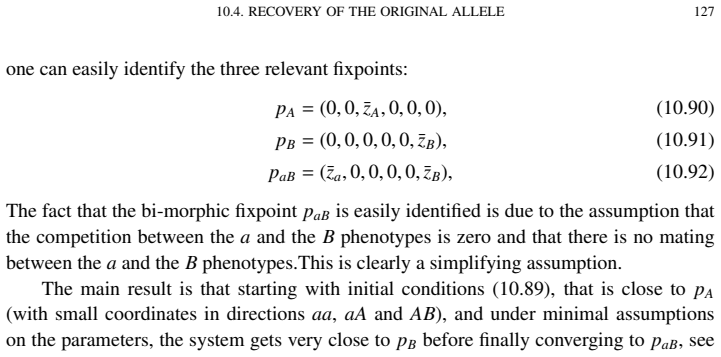
- Diploid Mendelian models, phenotypic plasticity via fast switches, and time-varying environments admit the same scaling analysis and produce prolonged survival of unfit alleles or accelerated valley crossing.
- The hierarchy of limits supplies a concrete dictionary between microscopic rates and macroscopic evolutionary regimes (monomorphic walks, branching, metastability).
Reading between the lines
- The same generator-plus-scaling template can be reused to derive hybrid limits in which ecological fluctuations remain of order one while evolutionary jumps still occur, producing stochastic corrections to the canonical equation.
- Quantitative control of the exit time from an evolutionary stable condition supplies a natural clock for comparing the relative likelihood of valley crossing versus environmental change.
- Because the notes already treat diploid inheritance, the same programme can be applied to models with recombination or sexual selection to test when genetic diversity persists beyond the monomorphic regime of haploid adaptive dynamics.
Signed reviews
Editorial analysis
A structured set of objections, weighed in public.
Referee Report
Summary. These lecture notes give a rigorous, self-contained synthesis of the stochastic individual-based theory of adaptive dynamics developed over the last 25 years. Starting from a continuous-time Markov process on finite point measures whose generator encodes birth, death, competition and mutation, the notes derive, under successive scalings of carrying capacity K, mutation probability µ_K and mutation step size σ_K, the principal macroscopic objects of adaptive dynamics: the law of large numbers (competitive Lotka–Volterra), the polymorphic evolution sequence (PES), the canonical equation of adaptive dynamics (CEAD), evolutionary branching, and metastable jumps across fitness valleys. The exposition is organised in three parts—background and tools, the various scaling regimes, and extensions (diploidy, phenotypic plasticity, changing environments)—and is aimed at master’s students with a solid background in Markov processes.
Significance. The notes fill a genuine pedagogical gap: they collect, in a single coherent narrative, a body of technically demanding results that previously existed only as a scattered sequence of research papers (Champagnat, Méléard, Fournier, Bovier et al.). By emphasising the interplay of the three scaling parameters and by making the underlying martingale, branching-process and large-deviation arguments explicit, they render the field accessible to a new generation of probabilists and mathematical biologists. The derivations are standard and already peer-reviewed; the value lies in the unified presentation, the careful statement of hypotheses (e.g. Assumption 5.1), and the inclusion of more recent extensions. No new theorems are claimed, but the synthesis itself is a substantial contribution to the literature.
minor comments (4)
- The title on the arXiv page and in the manuscript header reads “Stochastic individual-bases models”; this is almost certainly a typographical error for “individual-based” and should be corrected before any formal publication.
- In several places (e.g. the statement of Theorem 5.2 and the discussion surrounding Assumption 5.1) the text refers to “the polymorphic evolution sequence” without immediately recalling that its well-definedness as a pure jump process rests on the global attractivity hypothesis. A short parenthetical reminder would help the student reader.
- Chapter 6 ends with a series of conjectures on evolutionary branching under simultaneous limits; while clearly labelled as such, a brief pointer to the most recent progress (or lack thereof) would be useful for readers who wish to pursue the open problems.
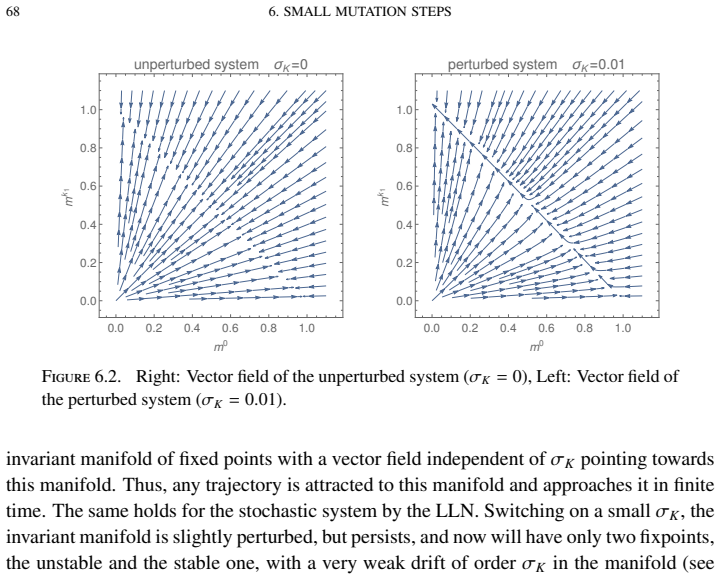
- A few figures (e.g. the broken-line pictures in Chapters 7–9) are described only in the text; if the notes are to be used as a course text, the actual plots should be included or a repository link provided.
Circularity Check
No significant circularity: lecture notes derive scaling limits from the microscopic Markov generator via standard weak-convergence, branching-process and large-deviation arguments; target objects (PES, CEAD, metastable jumps) are not inserted by definition.
full rationale
The manuscript is an explicit pedagogical synthesis of existing rigorous results (primarily Champagnat–Méléard and collaborators, with some co-authored papers). The individual-based process is constructed from its generator (2.4); all subsequent limits (LLN to Lotka–Volterra, PES under µ_K ≪ 1/(K ln K), CEAD under simultaneous K,µ,σ o limits, escape from ESC via fitness valleys, etc.) are obtained by coupling to branching processes, Wentzell–Freidlin exit estimates, and tightness arguments that do not presuppose the macroscopic objects. Self-citations appear only as references to prior proofs that are independent of the present exposition; they are not load-bearing uniqueness theorems that force the conclusions. Assumption 5.1 (global attractivity of the (d+1)-dimensional competitive LV system) is stated as a hypothesis under which the PES is well-defined as a pure jump process, not derived circularly. No parameter is fitted to data and then “predicted,” no ansatz is smuggled via self-citation, and no known empirical pattern is merely renamed. Circularity burden is therefore minimal (score 1 for ordinary self-citation of the authors’ earlier technical papers).
Assumptions & free parameters
assumptions (3)
- standard math The individual-based process is a pure-jump Markov process on the space of finite point measures whose generator is given by the birth, death and mutation rates of Assumption 2.2.
- domain assumption Competitive Lotka–Volterra systems of any finite dimension possess a unique locally strictly stable equilibrium whenever the invasion-fitness conditions of Definition 3.7 hold (Assumption 5.1).
- domain assumption Mutation kernels have bounded support and the trait space is a Polish space (or a finite graph in later chapters).
Cite this review
Pith. "Pith review of Stochastic individual-bases models." pith.science (2026). https://pith.science/paper/PABX4KQT
@misc{pith2026260711520,
  author       = {Pith},
  title        = {Pith review of: Stochastic individual-bases models},
  year         = {2026},
  howpublished = {\url{https://pith.science/paper/PABX4KQT}},
  note         = {Machine review of arXiv:2607.11520}
}
read the original abstract
These are lecture notes for an advanced topics course in the master's programme at Bonn University. It aims to give a concise review of some of the work that has been done around the topic of adaptive dynamics from a rigorous stochastic point of view over the last 25 years and to make this area accessible to students with a good knowledge of probability in general, and the theory of Markov processes in particular. Our emphasis is on the issue of emerging scaling limits, where scaling parameters are time, population size, mutation rates, and mutation step size. These allow to exhibit within a fairly simple class of models a variety of biologically relevant phenomena. These notes are organised in three parts. Part 1 presents some historical background as well as the mathematical setting and main tools. Part 2 is the core of the notes and discusses the various scaling regimes and scaling limits. Part 3 looks at some extensions on the basic model, notably diploid models, phenotypic plasticity, and effects of environmental changes over time.
Figures


Figures from the paper (3 more)


Reference graph
Works this paper leans on
-
[1]
Aldous,Stopping times and tightness, Ann
D. Aldous,Stopping times and tightness, Ann. Probability, 6 (1978), pp. 335–340
1978
-
[2]
V . I. Arnold,Ordinary differential equations, Springer Textbook, Springer-Verlag, Berlin, 1992
1992
-
[3]
K. B. Athrey a,Some results on multitype continuous time Markov branching processes, Ann. Math. Statist., 39 (1968), pp. 347–357
1968
-
[4]
K. B. Athrey a andP. E. Ney,Branching processes, Springer-Verlag, New York-Heidelberg, 1972. Die Grundlehren der mathematischen Wissenschaften, Band 196
1972
-
[5]
Baar andA
M. Baar andA. Bovier,The polymorphic evolution sequence for populations with phenotypic plasticity, Electron. J. Probab., 23 (2018), pp. 1–27
2018
-
[6]
M. Baar, A. Bovier,andN. Champagnat,From stochastic, individual-based models to the canonical equation of adaptive dynamics in one step, Ann. Appl. Probab., 27 (2017), pp. 1093–1170
2017
-
[7]
M. Baar, L. Coquille, H. Mayer, M. H ¨olzel, M. Roga v a, T. T¨uting,andA. Bovier,A stochastic model for immunotherapy of cancer, Scientific Reports, 6 (2016), p. 24169
2016
-
[8]
Bansaye andS
V . Bansaye andS. M ´el´eard,Stochastic models for structured populations, vol. 1 of Mathematical Bio- sciences Institute Lecture Series. Stochastics in Biological Systems, Springer, Cham; MBI Mathematical Biosciences Institute, Ohio State University, Columbus, OH, 2015. Scaling limits and long time behavior
2015
Show all 121 references
-
[9]
H. J. E. Beaumont, J. Gallie, C. Kost, G. C. Ferguson,andP. B. Rainey,Experimental evolution of bet hedging, Nature, 462 (2009), pp. 90–93
2009
-
[10]
Berestycki, E
J. Berestycki, E. Brunet,andZ. Shi,The number of accessible paths in the hypercube, Bernoulli, 22 (2016), pp. 653–680
2016
-
[11]
,Accessibility percolation with backsteps, ALEA Lat. Am. J. Probab. Math. Stat., 14 (2017), pp. 45–62
2017
-
[12]
Bolker andS
B. Bolker andS. W. Pacala,Using moment equations to understand stochastically driven spatial pattern formation in ecological systems, Theor. Popul. Biol., 52 (1997), pp. 179–197
1997
-
[13]
B. M. Bolker andS. W. Pacala,Spatial moment equations for plant competition: understanding spatial strategies and the advantages of short dispersal, Am. Nat., 153 (1999), pp. 575–602
1999
-
[14]
Bovier, L
A. Bovier, L. Coquille,andR. Neukirch,The recovery of a recessive allele in a Mendelian diploid model, J. Math. Biol., 77 (2018), pp. 971–1033
2018
-
[15]
Bovier, L
A. Bovier, L. Coquille,andC. Smadi,Crossing a fitness valley as a metastable transition in a stochastic population model, Ann. Appl. Probab., 29 (2019), pp. 3541–3589
2019
-
[16]
Bovier andF.denHollander,Metastability: A potential-theoretic approach, vol
A. Bovier andF.denHollander,Metastability: A potential-theoretic approach, vol. 351 of Grundlehren der Mathematischen Wissenschaften [Fundamental Principles of Mathematical Sciences], Springer, Cham, 2015
2015
-
[17]
Bovier andS.-D
A. Bovier andS.-D. Wang,Trait substitution trees on two time scales analysis, Markov. Proc. Rel. Fields, 19 (2013), pp. 607–642
2013
-
[18]
Bramson,Convergence of solutions of the Kolmogorov equation to travelling waves, Mem
M. Bramson,Convergence of solutions of the Kolmogorov equation to travelling waves, Mem. Amer. Math. Soc., 44 (1983), pp. iv+190
1983
-
[19]
B ¨urger,The mathematical theory of selection, recombination, and mutation, Wiley Series in Mathe- matical and Computational Biology, John Wiley & Sons, Ltd., Chichester, 2000
R. B ¨urger,The mathematical theory of selection, recombination, and mutation, Wiley Series in Mathe- matical and Computational Biology, John Wiley & Sons, Ltd., Chichester, 2000
2000
-
[20]
Champagnat,A microscopic interpretation for adaptive dynamics trait substitution sequence models, Stochastic Processes Appl., 116 (2006), pp
N. Champagnat,A microscopic interpretation for adaptive dynamics trait substitution sequence models, Stochastic Processes Appl., 116 (2006), pp. 1127–1160
2006
-
[21]
Champagnat, R
N. Champagnat, R. Ferri`ere,andG. BenArous,The canonical equation of adaptive dynamics: A math- ematical view, Selection, 2 (2001), pp. 73–83
2001
-
[22]
Champagnat, R
N. Champagnat, R. Ferri`ere,andS. M ´el´eard,From individual stochastic processes to macroscopic mod- els in adaptive evolution, Stochastic Models, 24 (2008), pp. 2–44
2008
-
[23]
Champagnat andV
N. Champagnat andV . Hass,Convergence of population processes with small and frequent mutations to the canonical equation of adaptive dynamics, Ann. Appl. Probab., 35 (2025), pp. 1–63. 154 12. EVOLUTION IN A CHANGING ENVIRONMENT
2025
-
[24]
Champagnat andS
N. Champagnat andS. M ´el´eard,Polymorphic evolution sequence and evolutionary branching, Probab. Theor. Rel. Fields, 151 (2011), pp. 45–94
2011
-
[25]
Champagnat, S
N. Champagnat, S. M ´el´eard,andV . C. Tran,Stochastic analysis of emergence of evolutionary cyclic behavior in population dynamics with transfer, Ann. Appl. Probab., 31 (2021), pp. 1820–1867
2021
-
[26]
Collet, S
P. Collet, S. M´el´eard,andJ. A. J. Metz,A rigorous model study of the adaptive dynamics of Mendelian diploids, J. Math. Biol., 67 (2013), pp. 569–607
2013
-
[27]
Coquille, A
L. Coquille, A. Kraut,andC. Smadi,Stochastic individual-based models with power law mutation rate on a general finite trait space, Electron. J. Probab., 26 (2021), pp. Paper No. 123, 37
2021
-
[28]
Coron,Stochastic modeling of density-dependent diploid populations and the extinction vortex, Adv
C. Coron,Stochastic modeling of density-dependent diploid populations and the extinction vortex, Adv. Appl. Probab., 46 (2014), pp. 446–477
2014
-
[29]
,Slow-fast stochastic diffusion dynamics and quasi-stationarity for diploid populations with vary- ing size, J. Math. Biol., 72(1-2) (2016), pp. 171–202
2016
-
[30]
Coron, S
C. Coron, S. M ´el´eard, E. Porcher,andA. Robert,Quantifying the mutational meltdown in diploid populations, Am. Nat., 181 (2013), pp. 623–636
2013
-
[31]
M. C. Cowperthw aite, J. J. Bull,andL. A. Meyers,From bad to good: Fitness reversals and the ascent of deleterious mutations, PLoS Comp. Biol., 2 (2006), p. e141
2006
-
[32]
J. F. Crow, M. Kimura,andOthers,An introduction to population genetics theory, New York, Evanston and London: Harper & Row, Publishers, 1970
1970
-
[33]
Darwin,The Origin of Species, John Murray, London, 1859
C. Darwin,The Origin of Species, John Murray, London, 1859
-
[34]
Darwin,Temple of Nature; or, The Origin of Society, John W
E. Darwin,Temple of Nature; or, The Origin of Society, John W. Butler, and Bonsal and Niles, Baltimore, 1804
-
[35]
D. A. Dawson,Introductory Lectures on Stochastic Population Systems, arXiv 1705.03781, 2017
2017 arXiv
-
[36]
Versuche und Beobachtungen über die Entstehung von Arten im Pflanzenreich, Veit & Comp., Leipzig, 1901-03
H.deVries,Die Mutationstheorie. Versuche und Beobachtungen über die Entstehung von Arten im Pflanzenreich, Veit & Comp., Leipzig, 1901-03
1901
-
[37]
D. L. DeAngelis andV . Grimm,Individual-based models in ecology after four decades, F1000Prime Reports, 6 (2014)
2014
-
[38]
Dieckmann andR
U. Dieckmann andR. Law,The dynamical theory of coevolution: a derivation from stochastic ecological processes, J. Math. Biol., 34 (1996), pp. 579–612
1996
-
[39]
Dieckmann, R
,Moment approximations of individual-based models, in The geometry of ecological interactions: simplifying spatial complexity, U. Dieckmann, R. Law, and J. A. J. Metz, eds., Cambridge University Press, 2000, pp. 252–270
2000
-
[40]
C. R. Doering, C. Mueller,andP. Smereka,Interacting particles, the stochastic Fisher-Kolmogorov- Petrovsky-Piscounov equation, and duality, Phys. A, 325 (2003), pp. 243–259. Stochastic systems: from randomness to complexity (Erice, 2002)
2003
-
[41]
Dupuis andR
P. Dupuis andR. S. Ellis,A weak convergence approach to the theory of large deviations, Wiley Series in Probability and Statistics: Probability and Statistics, John Wiley & Sons, Inc., New York, 1997. A Wiley-Interscience Publication
1997
-
[42]
Esser andA
M. Esser andA. Kraut,Crossing a fitness valley in a changing environment: With and without pit stop. arXiv:2503.19766, 2025
2025 arXiv
-
[43]
Esser andA
M. Esser andA. Kraut,Effective growth rates in a periodically changing environment: from mutation to invasion, Stochastic Process. Appl., 184 (2025), pp. Paper No. 104598, 36
2025
-
[44]
A. M. Etheridge,Survival and extinction in a locally regulated population, Ann. Appl. Probab., 14 (2004), pp. 188–214
2004
-
[45]
S. N. Ethier andT. G. Kurtz,Markov processes, Wiley Series in Probability and Mathematical Statistics: Probability and Mathematical Statistics, John Wiley & Sons, Inc., New York, 1986
1986
-
[46]
S. N. Ethier andM. F. Norman,Error estimate for the diffusion approximation of the Wright–Fisher model, Proc. Natl. Acad. Sci., 74 (1977), pp. 5096–8. REFERENCES 155
1977
-
[47]
W. J. Ewens,Mathematical Population Genetics. I Theoretical Introduction, vol. 27 of Interdisciplinary Applied Mathematics, Springer-Verlag, New York, second ed., 2004
2004
-
[48]
R. A. Fisher,The correlation between relatives on the supposition of Mendelian inheritance, Trans. Roy. Soc. Edinb., 42 (1918), pp. 399–433
1918
-
[49]
Eugenics, 7 (1937), pp
,The wave of advance of an advantageous gene, Ann. Eugenics, 7 (1937), pp. 355–369
1937
-
[50]
Fournier andS
N. Fournier andS. M ´el´eard,A microscopic probabilistic description of a locally regulated population and macroscopic approximations, Ann. Appl. Probab., 14 (2004), pp. 1880–1919
2004
-
[51]
R. E. Franklin andG. R.G.,Molecular configuration in sodium thymonucleate, Nature, 171 (1953), pp. 740–741
1953
-
[52]
M. I. Freidlin andA. D. Wentzell,Random perturbations of dynamical systems, vol. 260 of Grundlehren der Mathematischen Wissenschaften [Fundamental Principles of Mathematical Sciences], Springer, Hei- delberg, third ed., 2012
2012
-
[53]
Fusco andA
G. Fusco andA. Minelli,Phenotypic plasticity in development and evolution: facts and concepts, Phil. Trans. Royal Soc. London B: Biol. Sci., 365 (2010), pp. 547–556
2010
-
[54]
Giachetti andJ
C. Giachetti andJ. J. Holland,Altered replicase specificity is responsible for resistance to defective interfering particle interference of an sdi-mutant of vesicular stomatitis virus, Jour. Virol., 62 (1988), pp. 3614–3621
1988
-
[55]
D. T. Gillespie,A general method for numerically simulating the stochastic time evolution of coupled chemical reactions, J. Computational Phys., 22 (1976), pp. 403–434
1976
-
[56]
J. H. Gillespie,Molecular evolution over the mutational landscape, Evolution, 38 (1984), pp. 1116–1129
1984
-
[57]
Grimm andS
V . Grimm andS. F. Railsback,Individual-based modeling and ecology, Princeton Series in Theoretical and Computational Biology, Princeton University Press, Princeton, NJ, 2005
2005
-
[58]
J. B. Haldane,A mathematical theory of natural and artificial selection. Part I, Trans. Camb. Phil. Soc., 23 (1924), pp. 19–41
1924
-
[59]
Part II, Trans
,A mathematical theory of natural and artificial selection. Part II, Trans. Camb. Phil. Soc., Biol, Sci., 1 (1924), pp. 158–163
1924
-
[60]
G. H. Hardy,Mendelian proportions in a mixed population, Science, 28 (1908), pp. 49–50
1908
-
[61]
Hofbauer andK
J. Hofbauer andK. Sigmund,Adaptive dynamics and evolutionary stability, Appl Math Lett, 3 (1990), pp. 75–79
1990
-
[62]
,Evolutionary Games and Population Dynamics, Cambridge University Press, Cambridge, 1998
1998
-
[63]
H ¨olzel, A
M. H ¨olzel, A. Bovier,andT. T ¨uting,Plasticity of tumour and immune cells: a source of heterogeneity and a cause for therapy resistance?, Nat. Rev. Cancer, 13 (2013), pp. 365–376
2013
-
[64]
Houchmandzadeh andM
B. Houchmandzadeh andM. Vallade,Fisher waves: An individual-based stochastic model, Phys Rev E., 96 (2017), p. 012414
2017
-
[65]
Jabin andG
P.-E. Jabin andG. Raoul,On selection dynamics for competitive interactions, J. Math. Biol., 63 (2011), pp. 493–517
2011
-
[66]
Jain,Evolutionary dynamics of the most populated genotype on rugged fitness landscapes, Phys
K. Jain,Evolutionary dynamics of the most populated genotype on rugged fitness landscapes, Phys. Rev. E, 76 (2007), p. 031922
2007
-
[67]
Jain andJ
K. Jain andJ. Krug,Evolutionary trajectories in rugged fitness landscapes, J. Statist. Mech., P04008 (2005)
2005
-
[68]
1275–1288
,Deterministic and stochastic regimes of asexual evolution on rugged fitness landscapes, Genetics, 175 (2007), pp. 1275–1288
2007
-
[69]
C.d. L. Jean-BaptistePierreAntoine deMonet,Philosophie Zoologique, Dentu, Paris, 1809
-
[70]
Kauffman andS
S. Kauffman andS. Levin,Towards a general theory of adaptive walks on rugged landscapes, J. Theoret. Biol., 128 (1987), pp. 11–45
1987
-
[71]
S. A. Kauffman,The origins of order: Self-organization and selection in evolution, in Spin glasses and biology, World Scientific, 1992, pp. 61–100. 156 12. EVOLUTION IN A CHANGING ENVIRONMENT
1992
-
[72]
Kesten andB
H. Kesten andB. P. Stigum,Additional limit theorems for indecomposable multidimensional Galton- Watson processes, Ann. Math. Statist., 37 (1966), pp. 1463–1481
1966
-
[73]
,A limit theorem for multidimensional Galton-Watson processes, Ann. Math. Statist., 37 (1966), pp. 1211–1223
1966
-
[74]
,Limit theorems for decomposable multi-dimensional Galton-Watson processes, J. Math. Anal. Appl., 17 (1967), pp. 309–338
1967
-
[75]
H. K. Khalil,Nonlinear systems, Macmillan Publishing Company, New York, 1992
1992
-
[76]
Kimura,Solution of a process of random genetic drift with a continuous model, Proc
M. Kimura,Solution of a process of random genetic drift with a continuous model, Proc. Natl. Acad. Sci., 41 (1955), pp. 144–150
1955
-
[77]
Kisdi andS
É. Kisdi andS. A. H. Geritz,Adaptive dynamics in allele space: Evolution of genetic polymorphism by small mutations in a heterogeneous environment, Evolution, 53 (1999), pp. 993–1008
1999
-
[78]
A. N. Kolmogorov, I. G. Petrovsky,andN. S. Piscounov,Etude de l’équation de la diffusion avec crois- sance de la quantité de matière et son application à un problème biologique, Moscow Univ. Math. Bull., 1 (1937), pp. 1–25
1937
-
[79]
Kraut andA
A. Kraut andA. Bovier,From adaptive dynamics to adaptive walks, J. Math. Biol., 79 (2019), pp. 1699– 1747
2019
-
[80]
Krug,Accessibility percolation in random fitness landscapes, in Probabilistic Structures in Evolution, E
J. Krug,Accessibility percolation in random fitness landscapes, in Probabilistic Structures in Evolution, E. Baake and A. Wakolbinger, eds., EMS Press, Berlin, 2021, pp. 1–22
2021
-
[81]
Krug andC
J. Krug andC. Karl,Punctuated evolution for the quasispecies model, Physica A, 318 (2003), pp. 137– 143
2003
-
[82]
T. G. Kurtz,Solutions of ordinary differential equations as limits of pure jump Markov processes, J. Appl. Probability, 7 (1970), pp. 49–58
1970
-
[83]
T. G. Kurtz,Limit theorems for sequences of jump Markov processes approximating ordinary differential processes, J. Appl. Probability, 8 (1971), pp. 344–356
1971
-
[84]
T. G. Kurtz,Strong approximation theorems for density dependent Markov chains, Stochastic Process. Appl., 6 (1977/78), pp. 223–240
1977
-
[85]
Lennon, F.denHollander, M
J. Lennon, F.denHollander, M. Wilke-Berenguer,andJ. Blath,Principles of seed banks and the emergence of complexity from dormancy, Nat. Comm., 12 (2021), p. 4807
2021
-
[86]
R. E. Lenski, C. Ofria, R. T. Pennock,andC. Adami,The evolutionary origin of complex features, Nature, 423 (2003), pp. 139–144
2003
-
[87]
A. J. Lotka,Quantitative studies in epidemiology, Nature, 88 (1912), pp. 497–498
1912
-
[88]
Maisnier-Patin, O
S. Maisnier-Patin, O. G. Berg, L. Liljas,andD. I. Andersson,Compensatory adaptation to the deleteri- ous effect of antibiotic resistance in salmonella typhimurium, Mol. Microbiol., 46 (2002), pp. 355–366
2002
-
[89]
Malthus,An Essay on the Principle of Population as it Affects the Future Improvement of Society, with Remarks on the Speculations of Mr
T. Malthus,An Essay on the Principle of Population as it Affects the Future Improvement of Society, with Remarks on the Speculations of Mr. Goodwin, M. Condorcet and Other Writers, J. Johnson in St Paul’s Church-yard, London, 1798
-
[90]
MaynardSmith, in The Scientist Speculates: an Anthology of Partly-Baked Ideas, I
J. MaynardSmith, in The Scientist Speculates: an Anthology of Partly-Baked Ideas, I. Good, ed., Basic Books, New York, 1962, pp. 252–256
1962
-
[91]
,Natural selection and the concept of a protein space, Nature, 225 (1970), pp. 563–564
1970
-
[92]
M ´el´eard,Modèles aléatoires en ecologie et evolution, vol
S. M ´el´eard,Modèles aléatoires en ecologie et evolution, vol. 77 of Mathématiques & Applications (Berlin) [Mathematics & Applications], Springer-Verlag, Berlin, 2016
2016
-
[93]
Mendel,Versuche über Pflanzen-Hybriden, Verhandlungen des naturforschenden Vereines in Brünn, IV (1865), pp
G. Mendel,Versuche über Pflanzen-Hybriden, Verhandlungen des naturforschenden Vereines in Brünn, IV (1865), pp. 3–47
-
[94]
,Über einige aus künstlicher Befruchtung gewonnenen Hieracium-Bastarde, Verhandlungen des naturforschenden Vereines in Brünn, VIII (1869), pp. 26–31
-
[95]
J. A. Metz,Adaptive dynamics, in Encyclopedia of Theoretical Ecology, Cambridge University Press, Cambridge, 2012. REFERENCES 157
2012
-
[96]
J. A. J. Metz,Invasion fitness, canonical equations, and global invasion criteria for Mendelian popula- tions, in Elements of Adaptive Dynamics, U. Dieckmann and J. A. J. Metz, eds., Cambridge University Press, 2012
2012
-
[97]
J. A. J. Metz, S. A. H. Geritz, G. Mesz ´ena, F. J. A. Jacobs,andJ. S.v anHeerw aarden,Adaptive dy- namics, a geometrical study of the consequences of nearly faithful reproduction, in Stochastic and spatial structures of dynamical systems (Amsterdam, 1995), vol. 45 of Konink. ...
1995
-
[98]
P. A. P. Moran,Random processes in genetics, Math. Proc. Cambridge Phil. Soc., 54 (1958), pp. 60–71
1958
-
[99]
Mukherjee,The Gene, Bodley, London, 2016
S. Mukherjee,The Gene, Bodley, London, 2016
2016
-
[100]
Nagylaki,Introduction to theoretical population genetics, vol
T. Nagylaki,Introduction to theoretical population genetics, vol. 21 of Biomathematics, Springer-Verlag, Berlin, 1992
1992
-
[101]
Neidhart andJ
J. Neidhart andJ. Krug,Adaptive walks and extreme value theory, Phys. Rev. Lett., 107 (2011), p. 178102
2011
-
[102]
Neukirch andA
R. Neukirch andA. Bovier,Survival of a recessive allele in a Mendelian diploid model, J. Math. Biol., 75 (2017), pp. 145–198
2017
-
[103]
Now ak andJ
S. Now ak andJ. Krug,Analysis of adaptive walks on NK fitness landscapes with different interaction schemes, J. Stat. Mech. Theory Exp., 2015 (2015), p. P06014
2015
-
[104]
P. J. O’Hara, S. T. Nichol, F. M. Horodyski,andJ. J. Holland,Vesicular stomatitis virus defective interfering particles can contain extensive genomic sequence rearrangements and base substitutions, Cell, 36 (1984), pp. 915–924
1984
-
[105]
H. A. Orr,A minimum on the mean number of steps taken in adaptive walks, J. Theoret. Biol., 220 (2003), pp. 241–247
2003
-
[106]
S. P ´enisson,Conditional limit theorems for multitype branching processes and illustration in epidemio- logical risk analysis, PhD thesis, Universität Potsdam, Potsdam (Germany), 2010
2010
-
[107]
L. C. G. Rogers andD. Williams,Diffusions, Markov processes, and martingales. Vol. 1, Cambridge Mathematical Library, Cambridge University Press, Cambridge, 2000. Foundations, Reprint of the second (1994) edition
2000
-
[108]
,Diffusions, Markov processes, and martingales. Vol. 2, Cambridge Mathematical Library, Cam- bridge University Press, Cambridge, 2000. Itô calculus, Reprint of the second (1994) edition
2000
-
[109]
Schmiegelt andJ
B. Schmiegelt andJ. Krug,Evolutionary accessibility of modular fitness landscapes, J. Stat. Phys., 154 (2014), pp. 334–355
2014
-
[110]
S. J. Schrag, V . Perrot,andB. R. Levin,Adaptation to the fitness costs of antibiotic resistance in es- cherichia coli, Proc. Royal Soc. London B: Biological Sciences, 264 (1997), pp. 1287–1291
1997
-
[111]
B. A. Sew astjanow,Verzweigungsprozesse, R. Oldenbourg Verlag, Munich-Vienna, 1975
1975
-
[112]
S. J. Smale,On the differential equations of species in competition, J. Math. Biol., 3 (1976), pp. 5–7
1976
-
[113]
Uchiy ama,The behavior of solutions of some nonlinear diffusion equations for large time, J
K. Uchiy ama,The behavior of solutions of some nonlinear diffusion equations for large time, J. Math. Kyoto Univ., 18 (1978), pp. 453–508
1978
-
[114]
Volterra,Variations and fluctuations of the number of individuals in animal species living together, J
V . Volterra,Variations and fluctuations of the number of individuals in animal species living together, J. Conseil Int. Explor. Mer., 3 (1928), pp. 1–51
1928
-
[115]
Wang,Multi-scale analysis of adaptive population dynamics, ph.d
S.-D. Wang,Multi-scale analysis of adaptive population dynamics, ph.d. thesis, Bonn University, 2011
2011
-
[116]
J. D. Watson andF. H. C. Crick,A structure for deoxyribose nucleic acid, Nature, 171 (1953), pp. 737– 738
1953
-
[117]
Weinberg,Über den Nachweis der Vererbung beim Menschen, Jahreshefte des Vereins für vaterländis- che Naturkunde in Württemberg, 64 (1908), pp
W. Weinberg,Über den Nachweis der Vererbung beim Menschen, Jahreshefte des Vereins für vaterländis- che Naturkunde in Württemberg, 64 (1908), pp. 368–382
1908
-
[118]
M. H. Wilkins, A. R. Stokes,andH. R. Wilson,Molecular structure of deoxypentose nucleic acids, Nature, 171 (1953), pp. 738–40
1953
-
[119]
S. G. Wright,Evolution in Mendelian populations, Genetics, 16 (1931), pp. 97–157. 158 12. EVOLUTION IN A CHANGING ENVIRONMENT
1931
-
[120]
G. U. Yule,On the theory of inheritance of quantitative compound characters on the basis of Mendel’s laws: a preliminary note, Spottiswoode & Company, Limited, 1907
1907
-
[121]
M. L. Zeeman,Hopf bifurcations in competitive three-dimensional Lotka-Volterra systems, Dynam. Sta- bility Systems, 8 (1993), pp. 189–217. Index adaptive dynamics, 10, 50, 53 adaptive speciation, 11 adaptive walk, 49 greedy, 51 adaptive walks, 11, 44 allele, 6 bet hedging, 131...
1993
Reviewed July 14, 2026 · model on record in the stance chip above.
Discussion (0). Continue with ORCID to comment.