REVIEW 3 major objections 4 minor 85 references
Destabilization of temperature-gradient-driven plasma turbulence by equilibrium $\vec{E}\times \vec{B}$ flow shear
T0 review · 3 major / 4 minor · reviewed 2026-08-02 · deepseek-v4-flash
Pith's one-line read Imposed E×B flow shear can destroy the zonal flows that regulate plasma turbulence, setting off a sharp rise in heat transport.
desk verdict Imposed E×B shear can break the Dimits state and sharply increase ITG transport; the simulation evidence is solid, though the geometric threshold theory leans on constants fitted from the same runs. read the letter →
The pith
A machine-rendered reading of the paper's core claim, the machinery that carries it, and where it could break.
The reading
What carries the argument
The load-bearing object is a simple inequality, the compatibility condition ω⊥/ωc ≤ λ ≡ (ℓmax−ℓmin)/(ℓmax+ℓmin), where ω⊥ is the imposed E×B shear, ωc the critical shear of the Dimits state, and ℓmin and ℓmax the minimum and maximum radial widths that a zonal-shear band can have while still suppressing turbulence. The argument counts how many alternating shear regions of total shear ±ωc can fit across a domain of width L; when the imposed shear is too large, no integer number of bands satisfies both width bounds, so the self-organized pattern breaks down. This geometric argument carries the paper's explanation for why transport increases in the interval λ < ω⊥/ωc < 1. A second key ingredient
What would settle it
Run a flux-tube gyrokinetic or fluid simulation below the Dimits threshold and scan the imposed E×B shear finely across 0 < ω⊥/ωc < 1; if the time-averaged heat flux never rises above its zero-shear value before being quenched, the claimed destabilization window does not exist. Equivalently, a controlled tokamak rotation-shear scan with fixed profiles that shows no local heat-flux peak would contradict the mechanism.
Extended reading notes
Core claim
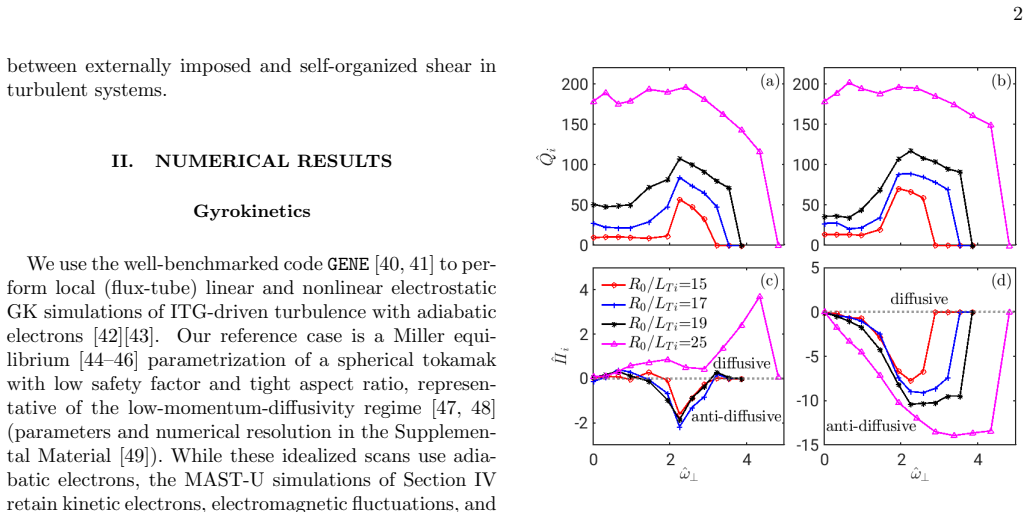
The central claim is that imposed equilibrium E×B flow shear can destabilize the Dimits state of ion-temperature-gradient turbulence. In this low-transport state, self-organized zonal flows—large-scale bands of perpendicular flow—regulate the turbulence. The paper shows that the turbulent eddies respond only to the total perpendicular shear, the sum of imposed and zonal shear. Weak imposed shear is absorbed by a reorganization of the zonal-flow pattern, but when the imposed shear becomes comparable to the intrinsic zonal shear, the alternating zonal-shear regions can no longer satisfy the required width bounds, the zonal flows break down, and heat transport rises sharply before being quenche
Load-bearing premise
The geometric argument assumes that the Dimits state always requires alternating shear bands whose widths stay between a fixed minimum and a fixed maximum that do not depend on the imposed shear; the paper notes the mechanism setting the maximum width is not yet established.
Editorial extensions
If this is right
- In the Dimits regime, equilibrium flow shear is not a monotonic confinement knob: there is a window of imposed shear in which heat transport rises sharply before larger shear quenches the turbulence.
- The mechanism is independent of kinetic effects and toroidal geometry, since a minimal two-dimensional fluid model reproduces it; analogous combinations of self-organized and imposed shear in other turbulent systems may show the same breakdown.
- In spherical tokamaks, steady-state rotation shear can be pinned below the destabilization threshold, so toroidal rotation is set by the balance of heat and momentum injection rather than by momentum diffusivity alone.
- Machines operating in this regime face a heat-flux hill: to reach the strongly suppressed high-shear state, enough heat must be injected to sustain the profiles through the enhanced transport.
Reading between the lines
- If the compatibility condition is generic, existing databases of flow-shear scans in other tokamaks could be re-examined for a heat-flux peak below the quench threshold; a local maximum in transport versus rotation shear would be a direct experimental signature.
- The same geometric incompatibility might appear in planetary atmospheres or oceans, where externally forced mean zonal winds interact with self-organized zonal jets; idealized beta-plane simulations with imposed large-scale shear could test whether the zonal jet pattern breaks down analogously.
- The empirical finding that the Dimits shift grows at low safety factor and tight aspect ratio implies the destabilization window widens in such geometries, which may make the effect more prominent in future compact tokamaks or spherical devices.
Signed reviews
Editorial analysis
A structured set of objections, weighed in public.
Referee Report
Summary. The manuscript reports a non-monotonic dependence of ion heat transport on imposed equilibrium E×B flow shear in local gyrokinetic ITG simulations: weak shear leaves the Dimits state roughly intact, intermediate shear destroys the self-generated zonal flows and produces a sharp transport increase, and strong shear quenches turbulence. The authors interpret this as a geometric incompatibility: if the Dimits state requires alternating zonal-shear layers of widths between ℓmin and ℓmax, an imposed shear ω⊥ is compatible only for ω⊥/ωc ≤ λ=(ℓmax−ℓmin)/(ℓmax+ℓmin), leaving a destabilizing interval λ<ω⊥/ωc<1. A reduced 2D fluid model reproduces the phenomenology. Gyrokinetic simulations of MAST-U discharges find the inferred rotation shear at or below the onset of the transport increase, suggesting rotation can be limited by heat injection.
Significance. If the mechanism holds, it overturns the standard expectation that equilibrium flow shear monotonically suppresses ITG transport and identifies a concrete constraint on spherical-tokamak operation, with possible broader implications for shear-driven zonal/mean-flow interactions. The paper's strengths are its systematic numerical evidence: the GENE scans cover multiple gradients and explicitly remove PVG to rule out the obvious alternative mechanism; the fluid model shows the effect is not tied to kinetic or toroidal details; the MAST-U analysis covers six discharges and includes kinetic electrons, electromagnetic fluctuations, and collisions; and a global GENE run is cited as a partial check. The main weakness is that the central geometric criterion, Eq. (4), is not yet a predictive theory because ℓmin and ℓmax are estimated from the same simulations and the scale ℓmax is admittedly not understood.
major comments (3)
- [Section III, Eqs. (2)–(4)] The compatibility condition is derived from assumptions (i)–(iv), but its predictive content depends on ℓmin and ℓmax being fixed, finite, and independent of ω⊥ and of the simulation domain. The manuscript states that 'the mechanism setting ℓmax remains to be established' and offers a speculative finite-mean-free-path argument; the quoted estimates are made from the ω⊥=0 saturated Dimits state in the Supplemental Material. Thus λ is calibrated on the same simulations Eq. (4) is supposed to explain. If ℓmax changes with ω⊥ — e.g., because the avalanche/ferdinon mean free path depends on total shear — or if it grows with the radial box size in the flux-tube geometry, the predicted interval is not a robust prediction. Please provide direct measurements of ℓ±(ω⊥) and ℓmax(Lx), an independent estimate of ℓmax, and a comparison of Eq. (4) with the measured onset in Fig. 1 without free adjustme
- [Section III, assumption (i) and Fig. 4] The derivation idealizes the total shear profile as piecewise constant equal to ±ωc and counts N discrete shear regions. The actual profiles in Fig. 2(e–h) are smooth and asymmetric, with no clear square-wave structure. It is not demonstrated that the inequalities ℓ+≤ℓmax and ℓ−≥ℓmin apply to the actual profiles or that N is well-defined. Please show that the square-wave idealization is conservative, for example by checking Eq. (3) against the measured widths in the GK and fluid runs, or derive the criterion for continuous profiles.
- [Section II and footnote [75]] The simulations establishing the effect (Fig. 1 and the fluid model) are local, gradient-driven, and radially periodic; the global gyrokinetic check mentioned in footnote [75] is not documented. Because the geometric argument invokes a finite ℓmax and the local flux-tube domain imposes radial periodicity on zonal flows, the possibility that ℓmax is influenced by the periodic box (or that profile relaxation changes the zonal response) needs to be addressed with quantitative evidence. Please report the global-run setup and result, or provide a dedicated finite-domain convergence study of the onset shear.
minor comments (4)
- [Figure 5 caption] The panel labeling is inconsistent: (a,c) are time traces while (b),(d) are flux-versus-shear plots, but the caption reads 'Time traces ... (a,c), and (b) ion heat flux and (d) ion toroidal angular momentum flux ...'. Please clarify, e.g., 'Panels (a) and (c): time traces; panels (b) and (d): fluxes versus flow shear.'
- [Section III, Eq. (4)] The symbol λ is introduced but not given a name; later it is referred to as a threshold. Consider defining it explicitly as the 'compatibility threshold' to avoid confusion with the plasma micro-scales.
- [Supplemental Material [50]] The estimates of ℓmin and ℓmax, the box-size-independence check, and the derivation of the mean-flow-shear terms in the fluid model are all relegated to the Supplement. Since the finite-ℓmax assumption underpins the central theoretical claim, the box-size-independence result should appear in the main text or at least be described with a quantitative summary.
- [Figure 2 caption] The remark that y-axes are '(same for the pairs of simulations with equal radial box size)' is unclear. Please specify the radial box size in each panel or state explicitly where the normalization changes.
Circularity Check
No significant circularity: Eq. (4) is a constraint-satisfaction argument with empirically estimated widths, not a self-derived prediction; admitted gaps limit predictive force but do not make the derivation circular.
full rationale
The paper's central result—the non-monotonic heat-flux response to imposed E×B shear—is a direct output of GENE gyrokinetic simulations and of the reduced fluid model, not a consequence of Eq. (4). Equation (4) is obtained from the explicit inequalities in Eq. (3) using assumptions (i)–(iv); none of these assumptions contain Eq. (4), so the algebra is not self-definitional. The quantities ℓmin and ℓmax are empirical inputs: the paper states "In both GK and reduced-fluid simulations, we also observe a maximum zonal-flow radial scale that is independent of the radial box size ... implying a finite ℓmax [50]" and separately says "the mechanism setting ℓmax remains to be established." This is an acknowledged missing first-principles derivation, not a circular step: the finite-ℓmax observation is a constraint on the zero-shear Dimits state that could in principle fail, and it is used to rationalize, rather than to generate, the observed breakdown interval. If the Supplemental estimates of ℓmin and ℓmax are taken from the same zero-shear saturated state, the resulting numerical threshold comparison is a consistency check rather than an independent prediction, but the main mechanism claim does not reduce to that comparison. Self-citations to [60] and [49] provide the reduced model and regime context, but the GK results and MAST-U comparisons stand on the simulations performed here; no load-bearing uniqueness theorem or ansatz is imported from the authors' prior work. Overall the derivation chain is self-contained; the identified weaknesses (unproven ℓmax bound, local flux-tube idealization) are correctness/predictive-power limitations, not circularity.
Assumptions & free parameters
free parameters (3)
- ℓmin, minimum zonal-shear-region width =
estimated from saturated Dimits state (Supplemental Material)
- ℓmax, maximum zonal-shear-region width =
estimated from saturated Dimits state
- (R0/LTi)0 and a in Dimits-shift fit =
(R0/LTi)0 = 46, a = 0.56
assumptions (5)
- domain assumption Dimits-state zonal shear regions must organize into alternating positive/negative regions of total shear whose magnitudes are approximately ±ωc.
- domain assumption The Dimits state requires zonal-shear regions of width between ℓmin and ℓmax.
- domain assumption Local flux-tube, gradient-driven gyrokinetics represents the relevant experimental regime, with the equilibrium shear imposed as a constant parameter.
- domain assumption The two-dimensional cold-ion fluid model captures the Dimits-regime mechanism of the gyrokinetic system.
- domain assumption PVG terms can be artificially removed while leaving the underlying turbulence dynamics representative.
invented entities (2)
-
Ferdinons
-
Dimits-incompatible rotation (the ω⊥/ωc < 1 interval)
independent evidence
Cite this review
Pith. "Pith review of Destabilization of temperature-gradient-driven plasma turbulence by equilibrium $\vec{E}\times \vec{B}$ flow shear." pith.science (2026). https://pith.science/paper/MWYHLJQD
@misc{pith2026260711784,
  author       = {Pith},
  title        = {Pith review of: Destabilization of temperature-gradient-driven plasma turbulence by equilibrium $\vecE\times \vecB$ flow shear},
  year         = {2026},
  howpublished = {\url{https://pith.science/paper/MWYHLJQD}},
  note         = {Machine review of arXiv:2607.11784}
}
abstract
A novel physical mechanism whereby sheared equilibrium flow enables temperature-gradient-driven turbulence is identified. Gyrokinetic simulations of ion-scale plasma turbulence show that imposed equilibrium $\vec{E}\times \vec{B}$ flow shear can destroy the self-generated zonal flows that regulate the turbulence. This results in transport that increases sharply with flow shear. A reduced fluid model demonstrates that this is due to the spatial incompatibility of imposed and zonal shear layers. Simulations of spherical tokamak discharges place the inferred rotation shear at, or just below, the threshold of the sharp transport increase, implying that the toroidal rotation can be determined primarily by heat, rather than momentum, injection.
Figures


Figures from the paper (10 more)


Reference graph
Works this paper leans on
-
[75]
For MAST-U shot 51653, we also performed global, gradient-drivenGENEsimulations and observed the same ⃗E× ⃗Bdestabilization
-
[1]
P. B. Rhines, Waves and turbulence on a beta-plane, J. Fluid Mech.69, 417 (1975)
1975
-
[2]
P. W. Terry, Suppression of turbulence and transport by sheared flow, Rev. Mod. Phys.72, 109 (2000)
2000
-
[3]
Srinivasan and W
K. Srinivasan and W. R. Young, Zonostrophic instability, J. Atmos. Sci.69, 1633 (2012)
2012
-
[4]
S. M. Tobias and J. B. Marston, Direct statistical sim- ulation of out-of-equilibrium jets, Phys. Rev. Lett.110, 104502 (2013)
2013
-
[5]
A. R. Vasavada and A. P. Showman, Jovian atmospheric dynamics: an update after Galileo and Cassini, Rep. Prog. Phys.68, 1935 (2005)
1935
-
[6]
P. H. Diamond, S.-I. Itoh, K. Itoh, and T. S. Hahm, Zonal flows in plasma–—a review, Plasma Phys. Controlled Fu- sion47, R35 (2005)
2005
-
[7]
R. H. Kraichnan, Inertial ranges in two-dimensional tur- bulence, Phys. Fluids10, 1417 (1967)
1967
Show all 85 references
-
[8]
R. H. Kraichnan, Eddy viscosity in two and three dimen- sions, J. Atmos. Sci.33, 1521 (1976)
1976
-
[9]
large-scale
In this work, we use the adjective “large-scale” to de- scribe zonal flows whose radial correlation length is larger than that of the nonzonal fluctuations. We find no evi- dence that the zonal correlation length scales with the radial size of the flux-tube domain. Were it pre...
-
[10]
A. M. Dimits, G. Bateman, M. A. Beer, B. I. Cohen, W. Dorland, G. W. Hammett, C. Kim, J. E. Kinsey, M. Kotschenreuther, A. H. Kritz,et al., Comparisons and physics basis of tokamak transport models and tur- bulence simulations, Phys. Plasmas7, 969 (2000)
2000
-
[11]
G. M. Staebler and R. R. Dominguez, Electric field effects on ion temperature gradient modes in a sheared slab, Nucl. Fusion31, 1891 (1991)
1991
-
[12]
R. E. Waltz, G. D. Kerbel, J. Milovich, and G. W. Ham- mett, Advances in the simulation of toroidal gyro-Landau fluid model turbulence, Phys. Plasmas2, 2408 (1995)
1995
-
[13]
X.-H. Wang, P. H. Diamond, and M. N. Rosenbluth, Sta- bility of ion-temperature-gradient-driven modes in the presence of sheared poloidal flows, Phys. Fluids B4, 2402 (1992)
1992
-
[14]
Biglari, P
H. Biglari, P. H. Diamond, and P. W. Terry, Influence of sheared poloidal rotation on edge turbulence, Phys. Fluids B2, 1 (1990). 7
1990
-
[15]
K. C. Shaing, E. C. Crume, Jr., and W. A. Houlberg, Bifurcation of poloidal rotation and suppression of tur- bulent fluctuations: A model for the L–H transition in tokamaks, Phys. Fluids B2, 1492 (1990)
1990
-
[16]
Y. Z. Zhang and S. M. Mahajan, Edge turbulence scaling with shear flow, Phys. Fluids B4, 1385 (1992)
1992
-
[17]
S. L. Newton, S. C. Cowley, and N. F. Loureiro, Under- standing the effect of sheared flow on microinstabilities, Plasma Phys. Controlled Fusion52, 125001 (2010)
2010
-
[18]
E. G. Highcock, M. Barnes, A. A. Schekochihin, F. I. Parra, C. M. Roach, and S. C. Cowley, Transport bifur- cation in a rotating tokamak plasma, Phys. Rev. Lett. 105, 215003 (2010)
2010
-
[19]
Barnes, F
M. Barnes, F. I. Parra, E. G. Highcock, A. A. Schekochi- hin, S. C. Cowley, and C. M. Roach, Turbulent transport in tokamak plasmas with rotational shear, Phys. Rev. Lett.106, 175004 (2011)
2011
-
[20]
C. M. Roachet al., Gyrokinetic simulations of spherical tokamaks, Plasma Phys. Controlled Fusion51, 124020 (2009)
2009
-
[21]
Christen, M
N. Christen, M. Barnes, and F. I. Parra, Continuous-in- time approach to flow shear in a linearly implicit localδf gyrokinetic code, J. Plasma Phys.87, 905870230 (2021)
2021
-
[22]
H. Sun, J. Ball, S. Brunner, and A. Volˇ cokas, A new quasilinear model for turbulent momentum transport in tokamaks with flow shear and plasma shaping, Nucl. Fu- sion64, 036026 (2024)
2024
-
[23]
Ninomiya and the JT-60 Team, JT-60U latest results and future prospects, Phys
H. Ninomiya and the JT-60 Team, JT-60U latest results and future prospects, Phys. Fluids B4, 2070 (1992)
-
[24]
Kondoh and the JT-60 Team, High performance and current drive experiments in the JAERI Tokamak-60 Up- grade, Phys
T. Kondoh and the JT-60 Team, High performance and current drive experiments in the JAERI Tokamak-60 Up- grade, Phys. Plasmas1, 1489 (1994)
1994
-
[25]
E. A. Lazaruset al., Higher fusion power gain with cur- rent and pressure profile control in strongly shaped DIII- D tokamak plasmas, Phys. Rev. Lett.77, 2714 (1996)
1996
-
[26]
P. C. de Vries, K. M. Rantam¨ aki, C. Giroud, E. Asp, G. Corrigan, A. Eriksson, M. de Greef, I. Jenkins, H. C. M. Knoops, P. Mantica, H. Nordman, P. Strand, T. Tala, J. Weiland, and K.-D. Zastrow (JET EFDA Contributors), Plasma rotation and momentum trans- port studies at JET,...
2006
-
[27]
P. C. de Vries, M.-D. Hua, D. C. McDonald, C. Giroud, M. Janvier, M. F. Johnson, T. Tala, and K.-D. Zastrow (JET EFDA Contributors), Scaling of rotation and mo- mentum confinement in JET plasmas, Nucl. Fusion48, 065006 (2008)
2008
-
[28]
K. Ida, S. Hidekuma, Y. Miura, T. Fujita, M. Mori, K. Hoshino, N. Suzuki, and T. Yamauchi (JFT-2M Group), Edge electric-field profiles of H-mode plasmas in the JFT-2M tokamak, Phys. Rev. Lett.65, 1364 (1990)
1990
-
[29]
Mantica, D
P. Mantica, D. Strintzi, T. Tala, C. Giroud, T. John- son, H. Leggate, E. Lerche, T. Loarer, A. G. Peeters, A. Salmi, S. Sharapov, D. Van Eester, P. C. de Vries, L. Zabeo, and K.-D. Zastrow, Experimental study of the ion critical-gradient length and stiffness level and the im-...
2009
-
[30]
Angioni, R
C. Angioni, R. M. McDermott, F. J. Casson, E. Fable, A. Bottino, R. Dux, R. Fischer, Y. Podoba, T. P¨ utterich, F. Ryter, and E. Viezzer (ASDEX Upgrade Team), In- trinsic toroidal rotation, density peaking, and turbulence regimes in the core of tokamak plasmas, Phys. Rev. Lett...
2011
-
[31]
D. A. Schaffner, T. A. Carter, G. D. Rossi, D. S. Guice, J. E. Maggs, S. Vincena, and B. Friedman, Modification of turbulent transport with continuous variation of flow shear in the Large Plasma Device, Phys. Rev. Lett.109, 135002 (2012)
2012
-
[32]
Y.-c. Ghim, A. R. Field, A. A. Schekochihin, E. G. High- cock, and C. Michael (the MAST Team), Local depen- dence of ion temperature gradient on magnetic configura- tion, rotational shear and turbulent heat flux in MAST, Nucl. Fusion54, 042003 (2014)
2014
-
[33]
N. T. Howard, C. Holland, A. E. White, M. Green- wald, and J. Candy, Multi-scale gyrokinetic simulation of tokamak plasmas: enhanced heat loss due to cross-scale coupling of plasma turbulence, Nucl. Fusion56, 014004 (2016)
2016
-
[34]
E. A. Frieman and L. Chen, Nonlinear gyrokinetic equa- tions for low-frequency electromagnetic waves in general plasma equilibria, Phys. Fluids25, 502 (1982)
1982
-
[35]
D. H. E. Dubin, J. A. Krommes, C. Oberman, and W. W. Lee, Nonlinear gyrokinetic equations, Phys. Fluids26, 3524 (1983)
1983
-
[36]
T. S. Hahm, P. H. Diamond, O. D. Gurcan, and G. Re- woldt, Nonlinear gyrokinetic theory of toroidal momen- tum pinch, Phys. Plasmas14, 072302 (2007)
2007
-
[37]
A. J. Brizard and T. S. Hahm, Foundations of nonlinear gyrokinetic theory, Rev. Mod. Phys.79, 421 (2007)
2007
-
[38]
I. G. Abel, G. G. Plunk, E. Wang, M. Barnes, S. C. Cowley, W. Dorland, and A. A. Schekochihin, Multiscale gyrokinetics for rotating tokamak plasmas: fluctuations, transport and energy flows, Rep. Prog. Phys.76, 116201 (2013)
2013
-
[39]
P. J. Catto, Practical gyrokinetics, J. Plasma Phys.85, 925850301 (2019)
2019
-
[40]
Seiferling, A
F. Seiferling, A. G. Peeters, S. R. Grosshauser, F. Rath, and A. Weikl, The interplay of an external torque and E×Bstructure formation in tokamak plasmas, Phys. Plasmas26, 102306 (2019)
2019
-
[41]
Jenko, W
F. Jenko, W. Dorland, M. Kotschenreuther, and B. N. Rogers, Electron temperature gradient driven turbu- lence, Phys. Plasmas7, 1904 (2000)
1904
-
[42]
G¨ orler, X
T. G¨ orler, X. Lapillonne, S. Brunner, T. Dannert, F. Jenko, F. Merz, and D. Told, The global version of the gyrokinetic turbulence code GENE, J. Comput. Phys. 230, 7053 (2011)
2011
-
[43]
G. W. Hammett, M. A. Beer, W. Dorland, S. C. Cowley, and S. A. Smith, Developments in the gyrofluid approach to tokamak turbulence simulations, Plasma Phys. Con- trolled Fusion35, 973 (1993)
1993
-
[44]
A limited set of kinetic-electron runs follows the behav- ior discussed in Section II, but their cost precludes the parameter scans reported here
-
[45]
R. L. Miller, M. S. Chu, J. M. Greene, Y. R. Lin-Liu, and R. E. Waltz, Noncircular, finite aspect ratio, local equilibrium model, Phys. Plasmas5, 973 (1998)
1998
-
[46]
E. A. Belli, G. W. Hammett, and W. Dorland, Effects of plasma shaping on nonlinear gyrokinetic turbulence, Phys. Plasmas15, 092303 (2008)
2008
-
[47]
Snoep, J
G. Snoep, J. T. W. Koenders, C. Bourdelle, and J. Citrin (JET Contributors), Improved flux-surface parameteriza- tion through constrained nonlinear optimization, Phys. Plasmas30, 063906 (2023)
2023
-
[48]
B. F. McMillan and J. Dominski, Tokamak parame- ter regimes with low toroidal momentum diffusivity, J. Plasma Phys.85, 175850301 (2019). 8
2019
-
[49]
H. Sun, J. Ball, S. Brunner, A. Field, B. Patel, D. Kennedy, C. Roach, D. J. Cruz-Zabala, F. Puentes Del Pozo, E. Viezzer, and M. Garcia Munoz, Reducing turbulent transport in tokamaks by combining intrinsic rotation and the low momentum diffusivity regime, Nucl. Fusion65, 076...
2025
-
[50]
See Supplemental Material at [URL will be inserted by publisher] for theGENEsimulation parameters, numerical resolutions, and flux normalizations, for estimates of the admissible zonal-shear-region widthsℓ min andℓ max from the saturated Dimits state, and for the derivation of...
-
[51]
A common alternative notation forω ⊥ isγ E
-
[52]
P. J. Catto, M. N. Rosenbluth, and C. S. Liu, Parallel velocity shear instabilities in an inhomogeneous plasma with a sheared magnetic field, Phys. Fluids16, 1719 (1973)
1973
-
[53]
Kobayashi and B
S. Kobayashi and B. N. Rogers, The quench rule, Dim- its shift, and eigenmode localization by small-scale zonal flows, Phys. Plasmas19, 012315 (2012)
2012
-
[54]
Kobayashi, ¨O
S. Kobayashi, ¨O. D. G¨ urcan, and P. H. Diamond, Direct identification of predator-prey dynamics in gyrokinetic simulations, Phys. Plasmas22, 090702 (2015)
2015
-
[55]
F. Rath, A. G. Peeters, R. Buchholz, S. R. Grosshauser, P. Migliano, A. Weikl, and D. Strintzi, Comparison of gradient and flux driven gyro-kinetic turbulent transport, Phys. Plasmas23, 052309 (2016)
2016
-
[56]
Weikl, A
A. Weikl, A. G. Peeters, F. Rath, S. R. Grosshauser, R. Buchholz, W. A. Hornsby, F. Seiferling, and D. Strintzi, Ion temperature gradient turbulence close to the finite heat flux threshold, Phys. Plasmas24, 102317 (2017)
2017
-
[57]
F. I. Parra, M. Barnes, and A. G. Peeters, Up-down sym- metry of the turbulent transport of toroidal angular mo- mentum in tokamaks, Phys. Plasmas18, 062501 (2011)
2011
-
[58]
Christen, M
N. Christen, M. Barnes, M. Hardman, and A. Schekochi- hin, Bistable turbulence in strongly magnetised plasmas with a sheared mean flow, J. Plasma Phys.88, 905880504 (2022)
2022
-
[59]
To be more precise, the fluctuating contributions to the transport equations, which we do not solve here, would drive up the rotational shear at this flux surface
-
[60]
P. G. Ivanov, A. A. Schekochihin, W. Dorland, A. R. Field, and F. I. Parra, Zonally dominated dynamics and Dimits threshold in curvature-driven ITG turbulence, J. Plasma Phys.86, 855860502 (2020)
2020
-
[61]
Hallatschek, Turbulent saturation of tokamak-core zonal flows, Phys
K. Hallatschek, Turbulent saturation of tokamak-core zonal flows, Phys. Rev. Lett.93, 065001 (2004)
2004
-
[62]
Seiferling, A
F. Seiferling, A. G. Peeters, R. Buchholz, S. R. Grosshauser, F. Rath, and A. Weikl, Damping of zonal modes through turbulent momentum transport, Phys. Plasmas25, 022505 (2018)
2018
-
[63]
P. G. Ivanov, T. Adkins, D. Kennedy, M. Giacomin, M. Barnes, and A. A. Schekochihin, Suppression of temperature-gradient-driven turbulence by sheared flows in fusion plasmas, J. Plasma Phys.91, e58 (2025)
2025
-
[64]
Adkins, I
T. Adkins, I. G. Abel, M. Barnes, S. Buller, W. Dorland, P. G. Ivanov, R. Meyrand, F. I. Parra, A. A. Schekochi- hin, and J. Squire, Asymptotic scaling theory of electro- static turbulent transport in magnetised fusion plasmas (2026), arXiv:2601.15391 [physics.plasm-ph]
2026
-
[65]
Y.-c. Ghim, A. A. Schekochihin, A. R. Field, I. G. Abel, M. Barnes, G. Colyer, S. C. Cowley, F. I. Parra, D. Dunai, and S. Zoletnik (the MAST Team), Exper- imental signatures of critically balanced turbulence in MAST, Phys. Rev. Lett.110, 145002 (2013)
2013
-
[66]
R. Nies, F. Parra, M. Barnes, N. Mandell, and W. Dor- land, Saturation of magnetized plasma turbulence by propagating zonal flows, Phys. Rev. Research8, 013295 (2026)
2026
-
[67]
Nies and F
R. Nies and F. I. Parra, Theory of zonal flow growth and propagation in toroidal geometry, Plasma Phys. Con- trolled Fusion68, 045028 (2026)
2026
-
[68]
Here, (q, ϵ) = (1.05,0.36) versus (1.4,0.18) in CBC
-
[69]
P. G. Ivanov, A. A. Schekochihin, and W. Dorland, Dimits transition in three-dimensional ion-temperature- gradient turbulence, J. Plasma Phys.88, 905880506 (2022)
2022
-
[70]
T. S. Hahm, M. A. Beer, Z. Lin, G. W. Hammett, W. W. Lee, and W. M. Tang, Shearing rate of time-dependent E×B flow, Phys. Plasmas6, 922 (1999)
1999
-
[71]
B. F. McMillan, S. Jolliet, T. M. Tran, L. Villard, A. Bot- tino, and P. Angelino, Avalanchelike bursts in global gy- rokinetic simulations, Phys. Plasmas16, 022310 (2009)
2009
-
[72]
Villard, P
L. Villard, P. Angelino, A. Bottino, S. Brunner, S. Jol- liet, B. F. McMillan, T. M. Tran, and T. Vernay, Global gyrokinetic ion temperature gradient turbulence simu- lations of ITER, Plasma Phys. Controlled Fusion55, 074017 (2013)
2013
-
[73]
van Wyk, E
F. van Wyk, E. G. Highcock, A. A. Schekochihin, C. M. Roach, A. R. Field, and W. Dorland, Transition to sub- critical turbulence in a tokamak plasma, J. Plasma Phys. 82, 905820609 (2016)
2016
-
[74]
van Wyk, E
F. van Wyk, E. G. Highcock, A. R. Field, C. M. Roach, A. A. Schekochihin, F. I. Parra, and W. Dorland, Ion- scale turbulence in MAST: anomalous transport, subcrit- ical transitions, and comparison to BES measurements, Plasma Phys. Controlled Fusion59, 114003 (2017)
2017
-
[76]
E. A. Belli, J. Candy, and I. Sfiligoi, Flow-shear destabi- lization of multiscale electron turbulence, Plasma Phys. Controlled Fusion66, 045019 (2024)
2024
-
[77]
F. J. Casson, A. G. Peeters, Y. Camenen, W. A. Hornsby, A. P. Snodin, D. Strintzi, and G. Szepesi, Anomalous parallel momentum transport due toE×Bflow shear in a tokamak plasma, Phys. Plasmas16, 092303 (2009)
2009
-
[78]
R. L. Panetta, Zonal jets in wide baroclinically unstable regions: Persistence and scale selection, J. Atmos. Sci. 50, 2073 (1993)
-
[79]
B. F. Farrell and P. J. Ioannou, Formation of jets by baroclinic turbulence, J. Atmos. Sci.65, 3353 (2008)
2008
-
[80]
Berloff, I
P. Berloff, I. Kamenkovich, and J. Pedlosky, A mecha- nism of formation of multiple zonal jets in the oceans, J. Fluid Mech.628, 395 (2009)
2009
-
[81]
Barnes, F
M. Barnes, F. I. Parra, and A. A. Schekochihin, Critically balanced ion temperature gradient turbulence in fusion plasmas, Phys. Rev. Lett.107, 115003 (2011)
2011
-
[82]
Lippert, F
M. Lippert, F. Rath, and A. G. Peeters, Size convergence of the E×B staircase pattern in flux tube simulations of ion temperature gradient-driven turbulence, Phys. Plas- mas30, 074501 (2023)
2023
-
[83]
R. E. Waltz, R. L. Dewar, and X. Garbet, Theory and simulation of rotational shear stabilization of turbulence, Phys. Plasmas5, 1784 (1998). 9
1998
-
[84]
R. E. Waltz, G. D. Kerbel, and J. Milovich, Toroidal gyro-Landau fluid model turbulence simulations in a non- linear ballooning mode representation with radial modes, Phys. Plasmas1, 2229 (1994)
1994
-
[85]
quench” rule [83, 84]). The strongly turbulent state atR 0/LT i>25 exhibits a linear scaling of the heat flux as predicted by the theory of “grand critical balance
M. N. Rosenbluth and F. L. Hinton, Poloidal flow driven by ion-temperature-gradient turbulence in toka- maks, Phys. Rev. Lett.80, 724 (1998). 10 END MA TTER Fluid model—The equations of the fluid model consid- ered in Section II are d dt φ′ −ρ s 2 ⃗∇2 ⊥φ +ω ⊥ρs 2 ∂2T ∂x∂y − ρi...
1998
Reviewed August 2, 2026 · model on record in the stance chip above.
Discussion (0). Continue with ORCID to comment.