REVIEW 2 major objections 6 minor 48 references
Wichmann-Kroll Correction to the Interelectronic Interaction in He- and Li-Like Ions
T0 review · 2 major / 6 minor · reviewed 2026-08-02 · deepseek-v4-flash
Pith's one-line read Improved all-order Wichmann-Kroll values for interelectronic interaction in He- and Li-like ions.
desk verdict Solid He-like values and a useful method; Li-like numbers rest on a private communication and an unbenchmarked tail extrapolation—needs referee scrutiny, not desk rejection. read the letter →
The pith
A machine-rendered reading of the paper's core claim, the machinery that carries it, and where it could break.
The reading
What carries the argument
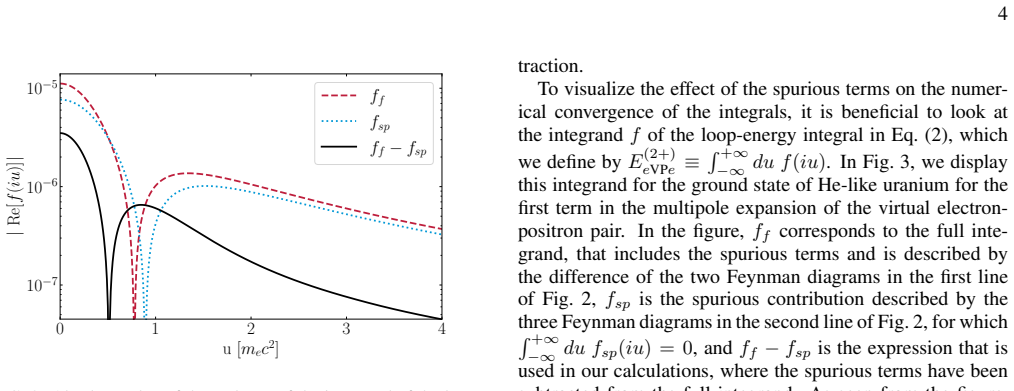
The central object is the Wichmann-Kroll loop in the photon line, expressed through two Dirac-Coulomb Green's functions in the nuclear field, expanded in multipoles κ,κ′ and photon partial waves. The load-bearing mechanism is the subtraction scheme: replacing the two bound propagators by a second-derivative expression with free propagators and the Coulomb potential removes non-gauge-invariant spurious terms that vanish after integration, shortening the integrand's tail and accelerating energy/radial integration by about two orders of magnitude. The multipole tail is handled by polynomial extrapolation in inverse powers of |κ| beyond κ,κ′ = ±16; a Wick rotation to the imaginary axis and Gauß
What would settle it
Recompute the correction with the multipole truncation raised to κ,κ′ = ±32 (or with a different subtraction/regularization) and compare the extrapolated tail contribution to the quoted uncertainty; a deviation larger than the stated error would falsify the precision claim. For the Li-like discrepancy, an independently published recalculation that resolves the two-body values would settle which set of numbers is correct.
Extended reading notes
Core claim
Central claim: all-order-in-αZ numerical values for E^(2+)_eVPe, the Wichmann-Kroll correction to the one-photon-exchange interelectronic interaction, for the He-like ground state and the 2s1/2, 2p1/2, 2p3/2 states of Li-like ions. Using the Dirac-Coulomb Green's function, the authors compute point-nucleus values plus a finite-nuclear-size difference, find a sign change near Z≈74 in the He-like ground state, and report a finite-size correction exceeding 5% for heavy ions. He-like values agree with the earlier calculation; Li-like values disagree and are supported by a private independent calculation. The subtraction method transfers, the authors argue, to the two-loop self-energy-vacuum-pola
Load-bearing premise
The several-orders-of-magnitude uncertainty reduction rests on a polynomial extrapolation of the multipole tail beyond κ,κ′=±16 that no independent calculation has verified.
Editorial extensions
If this is right
- The new He-like values supersede the earlier numbers for the interelectronic Wichmann-Kroll contribution, replacing their error bars with uncertainties several orders of magnitude smaller.
- The Li-like values, if adopted, shift predicted transition energies in lithium-like ions by a few meV relative to the earlier calculation, which is relevant for x-ray and dielectronic-recombination measurements.
- The finite-nuclear-size correction, up to and beyond 5% for heavy ions, must be included in any comparison of high-Z Lamb-shift theory with experiment.
- The subtraction scheme provides a template for all-order calculations of the two-loop self-energy-vacuum-polarization diagram, currently a dominant theory uncertainty.
Reading between the lines
- A natural test of the tail extrapolation would be to push the multipole series to κ,κ′ = ±32 or use a mixed-gauge subtraction; if the extrapolated tail shifts by more than the quoted uncertainty, the 'several orders of magnitude' claim would need revision.
- If the Li-like discrepancy is due to an error in the old calculation, existing experimental data on high-Z lithium-like ions may already prefer the new values; reanalyzing those data with the new correction would be a check.
- The same subtraction idea may accelerate other multi-loop bound-state QED diagrams where spurious gauge-dependent terms slow convergence, not just the SVPE diagram mentioned in the paper.
- The sign change near Z≈74 in the He-like ground state is a nontrivial prediction of the all-order treatment that could serve as a sensitive fingerprint for the Wichmann-Kroll contribution at moderate Z.
Signed reviews
Editorial analysis
A structured set of objections, weighed in public.
Referee Report
Summary. The paper presents an all-order-in-αZ calculation of the Wichmann–Kroll (higher-order vacuum-polarization) correction to the one-photon exchange interelectronic interaction in He- and Li-like ions, denoted E^(2+)_eVPe. The method uses the Dirac–Coulomb Green's function, an angular multipole expansion, and a subtraction of spurious non-gauge-invariant terms (Sec. II.C) to improve convergence of the radial and loop-energy integrations. Numerical results are reported for Z=20–100 for point nuclei and for finite nuclear size (Tables I and II). He-like results are in agreement with Artemyev et al. [30] with substantially smaller quoted uncertainties; Li-like results disagree with Artemyev et al. [31] but agree with an independent calculation communicated privately by A. Malyshev [47]. The finite-nuclear-size correction is found to exceed 5% for some heavy ions. The authors argue the method transfers to the two-loop self-energy–vacuum-polarization diagram.
Significance. If correct, this work materially improves the precision of a hard QED correction in few-electron high-Z ions, with direct relevance to ongoing Lamb-shift and g-factor experiments and to the all-order treatment of the two-loop SVPE diagram. The derivation is self-contained, the Uehling part is handled analytically, and the error budget is explicit: quadrature convergence, multipole truncation with polynomial tail extrapolation, and nuclear-model dependence. The He-like benchmark against Artemyev et al. [30] gives confidence in the low-multipole part. However, the two load-bearing pillars — the extrapolation beyond κ,κ′ = ±16 and the Li-like discrepancy — are not independently verified in the manuscript: the former is tested only by an internal consistency check, and the latter rests on a private communication. Both need to be strengthened before the claimed accuracy can be accepted.
major comments (2)
- [Sec. III, multipole truncation] The claimed improvement of 'several orders of magnitude' over Refs. [30,31] rests entirely on the reliability of the tail estimate for the partial-wave expansion of the two Dirac-Coulomb propagators, truncated at κ,κ′ = ±16. The paper estimates the tail by fitting polynomials in inverse powers of |κ| and assigns an uncertainty by varying the cutoff by 25% and the polynomial degree. That is an internal consistency check, not a validation: it assumes the tail is a polynomial in 1/|κ| with no logarithmic or oscillatory contributions, and it cannot detect a systematic bias of that ansatz. The He-like agreement in Table I validates the low multipoles at the older, coarser precision; it does not test the tail at the new claimed precision. I ask the authors to provide an independent check for at least one or two high-Z cases — for example, recomputation with κmax = 24 and 32, or a comparison wi
- [Sec. IV, Li-like results] The Li-like values are a central deliverable of the paper, but the disagreement with Ref. [31] for uranium is left unresolved, and the only supporting evidence is a private communication from A. Malyshev [47] that the reader cannot inspect. This is load-bearing because the manuscript offers no other way to decide between Ref. [31] and the present calculation. I strongly recommend that the authors either (i) include the numerical data from [47] in a table or appendix, or arrange a citable, inspectable publication of that independent calculation; (ii) identify and resolve the source of the discrepancy with Ref. [31] (for example, the sign of ω, the angular reduction, or the summation over core magnetic substates); or (iii) clearly mark the Li-like results as provisional and reduce the stated accuracy. As written, the Li-like half of the paper cannot be independently verified.
minor comments (6)
- [Table II, Z=92a row] The Ref. [31] values are quoted without their original uncertainties and without specifying whether they include finite nuclear size. Since the Li-like discrepancy is a key issue, the complete comparison with errors should be shown.
- [Eq. (21)] The ω-dependent Uehling expression is not the standard static form; please add a brief derivation or an explicit reference for the branch and prefactor conventions in the exponential.
- [Refs. [43,44]] FLINT is described as 'Fast Library for Number Theory'; the Whittaker-function evaluation likely uses Arb [44] or another special-functions package. Please verify the citations and state which software actually evaluates the special functions.
- [Sec. III / Fig. 3] The convergence criterion (50% more integration points changes the result by <1e-6) should be stated as applying after the spurious-term subtraction and for all Z and states; also clarify how the radial infinity cutoff is chosen.
- [Sec. IV, low-Z scaling] The asserted Z^6 scaling in the low-Z region is not quantified. A fit or an explicit leading-Z^6 formula would make the statement testable and more informative.
- [Eq. (18)] The notation E^(2+)_eVPe is used before it is defined; please define it explicitly at first use and state that it is the Wichmann–Kroll part after Uehling subtraction.
Circularity Check
No significant circularity: the Wichmann-Kroll correction is computed from first-principles bound-state QED expressions; no fitted parameter or self-citation is the source of the claimed values.
full rationale
The derivation of E^(2+)_eVPe starts from the standard bound-state QED amplitude Eqs. (1)-(15), evaluates Dirac-Coulomb Green's functions with multipole expansions, and subtracts only the standard analytic Uehling term (Eq. 21). No input quantity is defined in terms of the tabulated output energies; nuclear radii are taken from published tables [45] or the Johnson-Soff formula [46]. The partial-wave tail is estimated by fitting polynomials in inverse powers of |kappa| to the already computed partial-wave contributions, so the fit is constrained by the calculation itself rather than tuned to force the final values; this is an internal numerical extrapolation, not a fitted quantity masquerading as a prediction. The agreement with Ref. [30] in the He-like case is an external benchmark, and the Li-like discrepancy is resolved by an independent (though privately communicated) calculation [47], not by a self-citation. Self-citations such as [28], [36], and [41,42] are used for method details and comparisons and are not load-bearing reductions of the central result. The unbenchmarked tail extrapolation and the uninspectable private communication are legitimate reproducibility/correctness concerns, but they are not circularity: the paper exhibits no equation that reduces to its inputs by construction.
Assumptions & free parameters
assumptions (6)
- domain assumption Bound-state QED Feynman rules yield Eq. (2) for the two-electron vacuum-polarization exchange matrix element, with the sign ω = E_a − E_b fixed by the redefined-vacuum argument.
- standard math Spectral representation of the Dirac-Coulomb Green's function: sum over bound states plus integrals over positive and negative continua (Eqs. 5-7).
- domain assumption Wick rotation of the loop-energy integral along the imaginary axis is legitimate for this diagram.
- domain assumption The large-mass (M → ∞) derivation of Refs. [22,40] supplies the correct spurious-term subtraction (Eq. 22).
- domain assumption Nuclear structure enters only through model charge distributions (spherical shell, uniform sphere, Fermi) with radii from Ref. [45] or the Johnson–Soff formula [46].
- ad hoc to paper The multipole tail beyond κ,κ′ = ±16 can be estimated by polynomial fits in inverse powers of |κ|, with uncertainty from truncation-point variation.
Cite this review
Pith. "Pith review of Wichmann-Kroll Correction to the Interelectronic Interaction in He- and Li-Like Ions." pith.science (2026). https://pith.science/paper/5KZVNVJ2
@misc{pith2026260712168,
  author       = {Pith},
  title        = {Pith review of: Wichmann-Kroll Correction to the Interelectronic Interaction in He- and Li-Like Ions},
  year         = {2026},
  howpublished = {\url{https://pith.science/paper/5KZVNVJ2}},
  note         = {Machine review of arXiv:2607.12168}
}
abstract
We present a theoretical study of the higher-order QED contribution to the interelectronic interaction in He- and Li-like ions, where a virtual electron-positron loop is inserted into the photon line of the one-photon exchange diagram. Our approach is based on the Dirac-Coulomb Green's function and accounts for the interaction of the virtual $e^+e^-$ pair with the electric field of the nucleus to all orders in $\alpha Z$, with $\alpha$ being the fine-structure constant and $Z$ the atomic charge number. We show that the numerical convergence of the involved integrals can be significantly improved by explicitly subtracting the non-gauge-invariant spurious contributions from the integrands. We present improved numerical values for this contribution to the Lamb shift over a wide range of nuclear charge numbers $Z$. Our calculations agree well with previous results by Artemyev and co-workers [Phys. Rev. A 56, 3529 (1997); Phys. Rev. A 60, 45 (1999)] for He-like ions, but we find a discrepancy in the Li-like case. Moreover, we calculate the finite nuclear size correction to this diagram, which can reduce its size by more than 5% for heavy ions. The improved QED calculations not only decrease the uncertainty of theoretical predictions for the interelectronic interaction in few-electron ions but the methods could also be used in the future to improve calculations of closely related one-electron two-loop QED diagrams.
Figures


Figures from the paper (1 more)

Reference graph
Works this paper leans on
-
[30]
A. N. Artemyev, V . M. Shabaev, and V . A. Yerokhin, Vacuum polarization screening corrections to the ground-state energy of two-electron ions, Phys. Rev. A56, 3529 (1997)
1997
-
[31]
A. N. Artemyev, T. Beier, G. Plunien, V . M. Shabaev, G. Soff, and V . A. Yerokhin, Vacuum-polarization screening corrections to the energy levels of lithiumlike ions, Phys. Rev. A60, 45 (1999)
1999
-
[47]
Malyshev, private communication
A. Malyshev, private communication
-
[1]
P. Mohr, G. Plunien, and G. Soff, QED Corrections in Heavy Atoms, Phys. Rep.293, 227 (1998)
1998
-
[2]
V . M. Shabaev, A. I. Bondarev, D. A. Glazov, M. Y . Kay- gorodov, Y . S. Kozhedub, I. A. Maltsev, A. V . Malyshev, R. V . Popov, I. I. Tupitsyn, and N. A. Zubova, Stringent tests of QED using highly charged ions, Hyperfine Interactions239, 60 (2018)
2018
-
[3]
M. G. Kozlov, M. S. Safronova, J. R. Crespo L ´opez-Urrutia, and P. O. Schmidt, Highly charged ions: Optical clocks and ap- plications in fundamental physics, Rev. Mod. Phys.90, 045005 (2018)
2018
-
[4]
Indelicato, Topical Review: QED tests with highly-charged ions, jpbAMOP52, 232001 (2019)
P. Indelicato, Topical Review: QED tests with highly-charged ions, jpbAMOP52, 232001 (2019)
2019
-
[5]
Brandau, C
C. Brandau, C. Kozhuharov, A. M ¨uller, W. Shi, S. Schippers, T. Bartsch, S. B ¨ohm, C. B ¨ohme, A. Hoffknecht, H. Knopp, N. Gr¨un, W. Scheid, T. Steih, F. Bosch, B. Franzke, P. H. Mok- ler, F. Nolden, M. Steck, T. St ¨ohlker, and Z. Stachura, Pre- cise Determination of the2s 1/2−2p1/2 Splitting in Very Heavy Lithiumlike Ions Utilizing Dielectronic Recomb...
2003
Show all 48 references
-
[6]
Gumberidze, T
A. Gumberidze, T. St ¨ohlker, D. Bana ´s, K. Beckert, P. Beller, H. F. Beyer, F. Bosch, X. Cai, S. Hagmann, C. Kozhuharov, D. Liesen, F. Nolden, X. Ma, P. H. Mokler, A. Or ˇsi´c-Muthig, M. Steck, D. Sierpowski, S. Tashenov, A. Warczak, and Y . Zou, Electron-Electron Interactio...
2004
-
[7]
Beiersdorfer, H
P. Beiersdorfer, H. Chen, D. B. Thorn, and E. Trabert, Mea- surement of the two-loop Lamb shift in lithiumlike U89+, Phys. Rev. Lett.95(2005)
2005
-
[8]
Bruhns, J
H. Bruhns, J. Braun, K. Kubi ˇcek, J. R. Crespo L ´opez-Urrutia, and J. Ullrich, Testing QED Screening and Two-Loop Contri- butions with He-Like Ions, Phys. Rev. Lett.99, 113001 (2007)
2007
-
[9]
Ullmann, Z
J. Ullmann, Z. Andelkovic, C. Brandau, A. Dax, W. Geith- ner, C. Geppert, C. Gorges, M. Hammen, V . Hannen, S. Kauf- mann, K. K ¨onig, Y . A. Litvinov, M. Lochmann, B. Maaß, J. Meisner, T. Murb ¨ock, R. S ´anchez, M. Schmidt, S. Schmidt, M. Steck, T. St ¨ohlker, R. C. Thompson...
2017
-
[10]
Blaum, S
K. Blaum, S. Eliseev, and S. Sturm, Perspectives on testing fun- damental physics with highly charged ions in Penning traps, Quantum Science & Technology6, 014002 (2021)
2021
-
[11]
Sailer, V
T. Sailer, V . Debierre, Z. Harman, F. Heiße, C. K ¨onig, J. Morgner, B. Tu, A. V . V olotka, C. H. Keitel, K. Blaum, and S. Sturm, Measurement of the bound-electron g-factor differ- ence in coupled ions, Nature606, 479 (2022)
2022
-
[12]
Loetzsch, H
R. Loetzsch, H. F. Beyer, L. Duval, U. Spillmann, D. Bana ´s, P. Dergham, F. M. Kr¨oger, J. Glorius, R. E. Grisenti, M. Guerra, A. Gumberidze, R. Heß, P. M. Hillenbrand, P. Indelicato, P. Jagodzinski, E. Lamour, B. Lorentz, S. Litvinov, Y . A. 8 Litvinov, J. Machado, N. Paul, ...
2024
-
[13]
Sapirstein, Theoretical methods for the relativistic atomic many-body problem, Rev
J. Sapirstein, Theoretical methods for the relativistic atomic many-body problem, Rev. Mod. Phys.70, 55 (1998)
1998
-
[14]
A. N. Artemyev, V . M. Shabaev, V . A. Yerokhin, G. Plunien, and G. Soff, QED calculation of then= 1andn= 2energy levels in He-like ions, Phys. Rev. A71, 062104 (2005)
2005
-
[15]
Pachucki, A
K. Pachucki, A. Czarnecki, U. D. Jentschura, and V . A. Yerokhin, Complete two-loop correction to the bound-electron gfactor, Phys. Rev. A72, 022108 (2005)
2005
-
[16]
V . A. Yerokhin and V . M. Shabaev, Lamb Shift of n = 1 and n = 2 States of Hydrogen-like Atoms, 1≤Z≤110, J. Phys. Chem. Ref. Data.44, 033103 (2015)
2015
-
[17]
Pachucki, V
K. Pachucki, V . c. v. Patk ´oˇs, and V . A. Yerokhin, Testing fun- damental interactions on the helium atom, Phys. Rev. A95, 062510 (2017)
2017
-
[18]
A. V . Malyshev, D. A. Glazov, Y . S. Kozhedub, I. S. Anisimova, M. Y . Kaygorodov, V . M. Shabaev, and I. I. Tupitsyn, Ab initio Calculations of Energy Levels in Be-Like Xenon: Strong Inter- ference between Electron-Correlation and QED Effects, Phys. Rev. Lett.126, 183001 (2021)
2021
-
[19]
Sikora, V
B. Sikora, V . A. Yerokhin, C. H. Keitel, and Z. Harman, Improved Bound-Electrong-Factor Theory through Complete Two-Loop QED Calculations, Phys. Rev. Lett.134, 123001 (2025)
2025
-
[20]
G. A. Rinker and L. Wilets, Vacuum Polarization in High-Z, Finite-Size Nuclei, Phys. Rev. Lett.31, 1559 (1973)
1973
-
[21]
Gyulassy, Nuclear-Size Effects on Vacuum Polarization in Muonic Pb, Phys
M. Gyulassy, Nuclear-Size Effects on Vacuum Polarization in Muonic Pb, Phys. Rev. Lett.32, 1393 (1974)
1974
-
[22]
Soff and P
G. Soff and P. Mohr, Vacuum Polarization in a Strong External Field, Phys. Rev. A38, 5066 (1988)
1988
-
[23]
P. J. Mohr, Self-energy radiative corrections in hydrogen-like systems, Ann. Phys.88, 26 (1974)
1974
-
[24]
P. J. Mohr, Self-energy of then= 2states in a strong Coulomb field, Phys. Rev. A26, 2338 (1982)
1982
-
[25]
V . A. Yerokhin, P. Indelicato, and V . M. Shabaev, Two-loop QED corrections with closed fermion loops, Phys. Rev. A77, 062510 (2008)
2008
-
[26]
A. V . Malyshev, Y . S. Kozhedub, and V . M. Shabaev, Ab initio calculations of the2p 3/2 →2stransition in He-, Li-, and Be- like uranium, Phys. Rev. A107, 042806 (2023)
2023
-
[27]
Milstein and M
A. Milstein and M. Schumacher, Present status of Delbr ¨uck scattering, Phys. Rep.243, 183 (1994)
1994
-
[28]
Sommerfeldt, V
J. Sommerfeldt, V . A. Yerokhin, T. St¨ohlker, and A. Surzhykov, All-Order Coulomb Corrections to Delbr ¨uck Scattering above the Pair-Production Threshold, Phys. Rev. Lett.131, 061601 (2023)
2023
-
[29]
O. Y . Andreev, D. Yu, K. N. Lyashchenko, and D. M. Vasileva, Energy spectra of electron-positron pairs produced in bound- bound muon transitions, Phys. Rev. A113, 042804 (2026)
2026
-
[32]
Sunnergren,Complete One-Loop QED Calculations for Few- Electrons Ions
P. Sunnergren,Complete One-Loop QED Calculations for Few- Electrons Ions. - Applications to Electron-Electron Interaction, the Zeeman Effect and Hyperfine Structure, Phd thesis, Univer- sity of Gothenburg (1998)
1998
-
[33]
Shabaev, Two-time Green’s function method in quantum electrodynamics of high-Z few-electron atoms, Phys
V . Shabaev, Two-time Green’s function method in quantum electrodynamics of high-Z few-electron atoms, Phys. Rep.356, 119 (2002)
2002
-
[34]
D. J. Hylton, The reduced Dirac Green function for the Coulomb potential, J. Math. Phys.25, 1125 (1984)
1984
-
[35]
Salvat and R
F. Salvat and R. Mayol, Accurate numerical solution of the Schr¨odinger and Dirac wave equations for central fields, Com- put. Phys. Commun.62, 65 (1991)
1991
-
[36]
Sommerfeldt and P
J. Sommerfeldt and P. Indelicato, All-order Wichmann-Kroll contribution in heavy electronic and exotic atoms, Phys. Rev. A113, 022806 (2026)
2026
-
[37]
W. R. Johnson, S. A. Blundell, and J. Sapirstein, Many-body perturbation-theory calculations of energy levels along the lithium isoelectronic sequence, Phys. Rev. A37, 2764 (1988)
1988
-
[38]
V . A. Yerokhin and V . M. Shabaev, First-order self-energy cor- rection in hydrogenlike systems, Phys. Rev. A60, 800 (1999)
1999
-
[39]
Scherdin, A
A. Scherdin, A. Sch ¨afer, W. Greiner, G. Soff, and P. J. Mohr, Coulomb corrections to Delbr ¨uck scattering, Z. Phys. A.353, 273 (1995)
1995
-
[40]
Gyulassy, Higher order vacuum polarization for finite radius nuclei, Nuclear Physics A244, 497 (1975)
M. Gyulassy, Higher order vacuum polarization for finite radius nuclei, Nuclear Physics A244, 497 (1975)
1975
-
[41]
V . A. Yerokhin, Z. Harman, and C. H. Keitel, One-loop elec- tron self-energy with accelerated partial-wave expansion in the Coulomb gauge, Phys. Rev. A111, 012802 (2025)
2025
-
[42]
V . A. Yerokhin, Z. Harman, and C. H. Keitel, Two-loop electron self-energy with accelerated partial-wave expansion, Phys. Rev. A111, 042820 (2025)
2025
-
[43]
T. F. team,FLINT: Fast Library for Number Theory(2026), version 3.5.0,https://flintlib.org
2026
-
[44]
Johansson, Arb: Efficient Arbitrary-Precision Midpoint- Radius Interval Arithmetic, IEEE Trans
F. Johansson, Arb: Efficient Arbitrary-Precision Midpoint- Radius Interval Arithmetic, IEEE Trans. Comput.66, 1281 (2017)
2017
-
[45]
Angeli and K
I. Angeli and K. Marinova, Table of experimental nuclear ground state charge radii: An update, At. Data Nucl. Data Ta- bles99, 69 (2013)
2013
-
[46]
Johnson and G
W. Johnson and G. Soff, The lamb shift in hydrogen-like atoms, 1≤Z≤110, At. Data Nucl. Data Tables33, 405 (1985)
1985
-
[48]
R. N. Soguel, A. V . V olotka, E. V . Tryapitsyna, D. A. Glazov, V . P. Kosheleva, and S. Fritzsche, Redefined vacuum approach and gauge-invariant subsets in two-photon-exchange diagrams for a closed-shell system with a valence electron, Phys. Rev. A 103, 042818 (2021)
2021
Reviewed August 2, 2026 · model on record in the stance chip above.
Discussion (0). Continue with ORCID to comment.