REVIEW 6 major objections 5 minor 41 references
Estimation of Elastic Parameters with Guidance-based Diffusion model
T0 review · 6 major / 5 minor · reviewed 2026-08-02 · deepseek-v4-flash
Pith's one-line read A diffusion model trained as a prior over elastic models, steered by a linearized AVA forward operator, recovers sharper VP/VS/density from angle-stack data — and its own uncertainty analysis shows the error bars are overconfident.
desk verdict A competent DPS-AVA inversion paper whose honest UQ finding is useful, but the Poseidon field validation needs provenance disclosure before the real-data claim can stand. read the letter →
The pith
A machine-rendered reading of the paper's core claim, the machinery that carries it, and where it could break.
The reading
What carries the argument
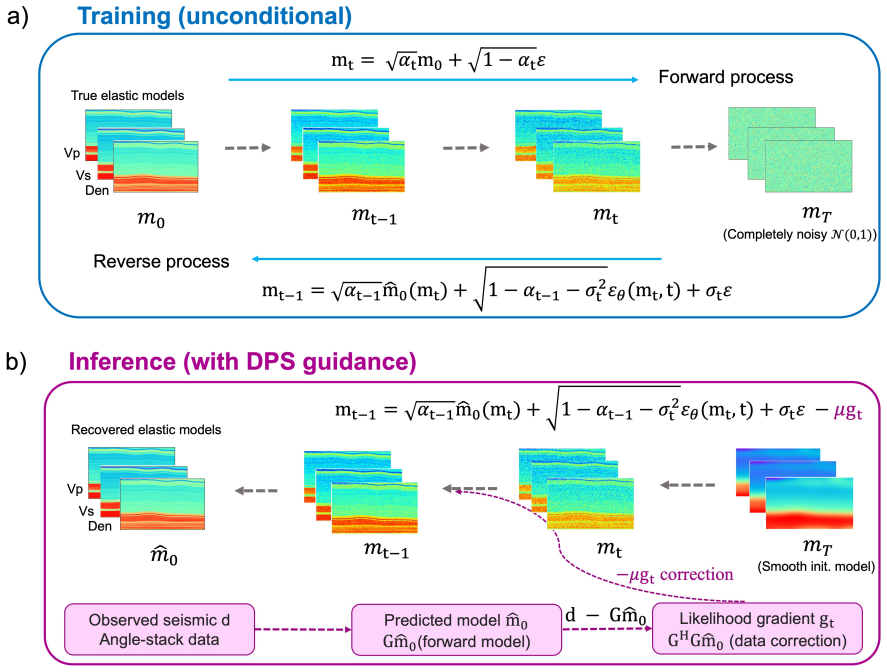
The engine is an unconditional Denoising Diffusion Probabilistic Model (DDPM) trained on 5,000 elastic models (benchmark synthetics plus well-log-derived 2D models) to represent the joint non-Gaussian prior over Vp, Vs, and density. At inference, Diffusion Posterior Sampling (DPS) injects a likelihood-gradient correction into each reverse diffusion step, where the gradient is computed by passing the Tweedie denoised estimate through an Aki-Richards linearized forward operator (wavelet convolution plus reflectivity) and back-projecting the data misfit with the adjoint operator. This steers sampling toward models that are both data-consistent and plausible under the learned prior.
What would settle it
Compare the normalized Vp, Vs, and density profiles of the four Poseidon validation wells against the 2D training models said to be generated from field well-log profiles; any exact or near-exact match between a validation well and a training sample would show the field test is in-distribution rather than a generalization test.
Extended reading notes
Core claim
The paper claims that a diffusion model, trained without labels to capture the joint distribution of Vp, Vs, and density, can act as an implicit prior for AVA inversion when steered by Diffusion Posterior Sampling with an Aki-Richards forward operator. On the Otway synthetic benchmark, the DPS result achieves the highest structural similarity scores, particularly for Vs, while conventional LSQR and TV-regularized ADMM sometimes score higher on peak signal-to-noise ratio. Applied to the Poseidon field data, the DPS inversion produces sharper, more laterally continuous elastic sections that align better with well logs, and an ensemble of 100–500 reverse-diffusion realizations yields spatially
Load-bearing premise
The Poseidon field validation depends on the unstated premise that the well-log-derived synthetics used for training were not generated from the same Poseidon wells used for validation; if they were, the field test is in-distribution and does not demonstrate generalization.
Editorial extensions
If this is right
- The same pretrained diffusion prior can be applied to new angle-stack surveys without task-specific retraining, since guidance is injected only at inference time.
- Compared with LSQR and ADMM+TV, the diffusion-prior results favor structural fidelity over peak SNR, especially for Vs, which can help interpreters delineate lithological boundaries and lateral continuity.
- Ensemble reverse-diffusion runs provide spatially resolved 2D uncertainty maps directly in the model domain, unlike trace-wise analytical Gaussian solutions that rely on linearity and Gaussianity.
- The systematic overconfidence finding implies that DPS ensemble width is not calibrated posterior uncertainty; the mean estimate may be useful, but the error bounds need external calibration or a hybrid formulation.
- Because the likelihood uses the linearized Aki-Richards operator, the framework inherits its limited validity at strong contrasts and wide angles; replacing it with full Zoeppritz guidance is the stated path to broader applicability.
Reading between the lines
- Inference: If the reported overconfidence is a generic property of DPS, practitioners should treat DPS ensemble width as a lower bound on uncertainty and recalibrate before using it for drilling or containment decisions.
- Inference: The paper's silence on which wells generated the well-log-derived training synthetics leaves the Poseidon field test's out-of-distribution status open; checking overlap between validation wells and training samples is a quick empirical test.
- Inference: Because the overconfidence is attributed to the data-misfit gradient collapsing the ensemble, an annealed guidance schedule that weakens the likelihood term in early reverse steps is a concrete modification that could widen the posterior spread toward the analytical reference.
Editorial analysis
A structured set of objections, weighed in public.
Referee Report
Summary. The paper proposes a 2D AVA inversion workflow in which a pre-trained DDPM over joint VP/VS/density models is conditioned on angle-stack seismic data through Diffusion Posterior Sampling (DPS), using an Aki–Richards convolutional forward operator implemented with PyLops. The authors validate on the Otway synthetic model and on Poseidon field data, comparing against LSQR and ADMM+TV baselines, and quantify uncertainty from an ensemble of DPS realizations against the closed-form Buland–Omre Gaussian posterior. They report that DPS gives structurally sharper results (higher SSIM) even when peak SNR is lower, and that DPS uncertainty is systematically overconfident relative to the analytical posterior covariance.
Significance. If the claims are supported, the paper offers a useful demonstration that a data-driven diffusion prior can regularize multi-parameter AVA inversion while producing geologically plausible structures, and it gives an honest, quantitative account of the main weakness of DPS-based uncertainty quantification. The mathematical framework is standard, the use of PyLops is beneficial for reproducibility, and the Poseidon field test is a valuable real-data case study. The significance is conditional: the synthetic comparison is weakened by inverse-crime and by an unclear stochastic-realization protocol, and the field demonstration depends on undisclosed training-data provenance. The UQ finding is interesting but its calibration reference is only as strong as the unspecified hyperparameters of the analytical prior. These are fixable with disclosure and additional experiments.
major comments (6)
- [Sec. 2.5 vs. Sec. 3.2] Training-data provenance is undisclosed and load-bearing. Sec. 2.5 says the 5000-model training set is 'supplemented by 2D models generated from field well-log profiles' without identifying the wells or fields. The Poseidon validation in Sec. 3.2 uses four publicly available wells, and the same wells are also used to build the initial model via PWD extrapolation. If any Poseidon logs were used to generate training models, the Poseidon result is in-distribution and the claim of practical viability on out-of-distribution field data collapses. The authors must state which wells/fields generated the training synthetics and, ideally, retrain without Poseidon logs or provide an ablation showing the field result is unchanged when Poseidon-derived training samples are excluded.
- [Sec. 3.1] The Otway synthetic test is an inverse crime. The angle stacks are generated with the same Aki–Richards linearized operator and the same Ricker wavelet (150 Hz) used in the inversion forward model, so the likelihood is exactly the data-generating model. This can inflate the performance of any method, including DPS, relative to realistic conditions with wavelet, amplitude, and physics mismatches. To make the quantitative Otway comparison meaningful, the authors should test with a different wavelet, a different noise realization, or data generated with the full Zoeppritz equations while inverting with the linearized operator.
- [Sec. 3.1, Sec. 3.3, and Introduction] The comparison protocol for DPS point estimates is ambiguous and potentially unfair. The Introduction says 'we consider a single realization,' while Sec. 3.3.1 generates 100 independent realizations and uses the posterior mean as the prediction. Figure 4 and the SNR/SSIM table do not state whether the DPS result is one stochastic sample or the ensemble mean, and no error bars are given for the stochastic DPS metrics. Since DPS is stochastic, a single run cannot be directly compared with deterministic baselines. The authors should state which estimator is used, and report the mean and spread of SNR/SSIM over multiple DPS runs, or use the posterior mean consistently for all point-estimate comparisons.
- [Sec. 2.6.2 and Sec. 3.3] The calibration of the analytical Bayesian reference is not specified. The posterior covariance in Eqs. (24)–(25) depends on the prior precision (22) through λ_I and λ_lap, and on σ_d, but none of these values are reported. The central UQ conclusion — that DPS is 'systematically overconfident relative to the exact posterior covariance' — is only meaningful if the analytical prior is calibrated in a defensible way. The authors should report all hyperparameters, describe how they were selected, and show a sensitivity analysis (e.g., varying λ_I and λ_lap by an order of magnitude) to demonstrate that the overconfidence conclusion is robust, rather than an artifact of an arbitrarily broad analytical prior.
- [Sec. 3.2] The Poseidon field comparison lacks quantitative metrics. The Abstract states that 'quantitative comparisons confirm' the diffusion framework recovers sharper and more realistic models, but the field section provides only visual comparisons and 1D well-log overlays. For a claim of practical viability, error metrics against the well logs (e.g., RMS error, correlation, or normalized misfit over the validation interval) should be reported for LSQR, ADMM+TV, and DPS, together with a statement of which DPS estimator (single sample or posterior mean) is being evaluated.
- [Eq. (18) and Sec. 3.3] The manuscript should clarify how the 'smooth initial model' is used in the reverse process. Eq. (18) is a standard DPS update starting from noise, but the field workflow initializes with a smoothed PWD-extrapolated model. It is not explained whether this initial model replaces m_T, is added as a data-consistency term, or is used only to construct the analytical prior. This matters for reproducibility and for interpreting the posterior realizations.
minor comments (5)
- [Sec. 3.2] The phrase 'linearized Zoeppritz operator' is ambiguous; likely the Aki–Richards approximation is meant. Please use consistent terminology.
- [Sec. 2.6.1] The sentence 'the stochasticity of the reverse process is fully retained by fixing the stochasticity level of the diffusion transitions to unity (η=1, in equation 14)' refers to η controlling σ_t in Eq. (14), not to Eq. (14) itself. Please correct the cross-reference.
- [General] Several guidance hyperparameters (μ, σ_d, number of reverse steps, U-Net configuration) and the analytical prior weights (λ_I, λ_lap) are not reported. A table of all experimental settings would substantially improve reproducibility.
- [Sec. 2.5] The claim that training is 'unsupervised' may confuse readers, since the diffusion model is trained on labeled elastic-model images. The intended meaning (no seismic data used for training) should be stated explicitly.
- [References] Some references have formatting errors (e.g., duplicated arXiv identifiers, missing page ranges, inconsistent use of 'et al.'). Please normalize the bibliography.
Circularity Check
No significant circularity: the derivation chain is self-contained and externally benchmarked.
full rationale
The paper is an empirical method application, not a derivation that reduces to its inputs. The diffusion prior is trained on benchmark models and on '2D models generated from field well-log profiles' (Sec. 2.5), while the Poseidon validation uses four separately described public wells (Sec. 3.2); although the paper does not explicitly rule out overlap, that would be a data-leakage concern rather than a definitional or self-citation circularity. The synthetic Otway test generates data with the same Aki-Richards operator used in guidance, but inverse crime is a validation methodology issue, not a circularity: the target elastic models are external, and the operator is a fixed physics approximation. The DPS update (Eq. 18) combines a learned score with a likelihood gradient derived from the forward operator; neither term is defined in terms of the inverted result. Uncertainty quantification is benchmarked against the independent Buland-Omre closed-form posterior, and the paper honestly reports that DPS is overconfident, which is a falsifiable, non-circular finding. Self-citations (Taufik et al. 2024; Brandolin & Alkhalifah 2026) support prior art and initial-model construction, not the central claim. No load-bearing step reduces by construction to its own input.
Assumptions & free parameters
free parameters (4)
- guidance weight μ
- data noise variance σ_d^2
- analytical prior weights λ_I, λ_lap
- DDPM schedule β and U-Net configuration
assumptions (7)
- domain assumption Aki-Richards linearized reflectivity is an adequate forward model for the AVA data at these angles.
- domain assumption Measurement noise is zero-mean Gaussian with known variance σ_d^2.
- domain assumption The DDPM prior trained on benchmark and well-log-derived models represents the true distribution of geologically realistic elastic models.
- ad hoc to paper The tracewise Gaussian Buland-Omre posterior is a valid calibration standard for DPS uncertainty.
- ad hoc to paper No train/test overlap between well-log-derived training synthetics and the Poseidon validation wells.
- ad hoc to paper DPS can start from a smooth initial model while still sampling the posterior.
- domain assumption Wavelet and PWD-derived initial models are adequate for the field data.
Cite this review
Pith. "Pith review of Estimation of Elastic Parameters with Guidance-based Diffusion model." pith.science (2026). https://pith.science/paper/KLC2ECLB
@misc{pith2026260713207,
  author       = {Pith},
  title        = {Pith review of: Estimation of Elastic Parameters with Guidance-based Diffusion model},
  year         = {2026},
  howpublished = {\url{https://pith.science/paper/KLC2ECLB}},
  note         = {Machine review of arXiv:2607.13207}
}
read the original abstract
Elastic parameters are fundamental rock properties for reservoir characterization, but their reliable estimation from angle-stack seismic data remains challenging due to strong nonlinearity and imperfect physical modeling. Conventional deterministic approaches based on linearized Zoeppritz approximations yield a single point estimate and cannot quantify solution uncertainty, while probabilistic methods are computationally expensive. To address these limitations, we present a workflow for elastic parameter inversion from angle-stack seismic data using a guided diffusion model as an implicit prior over the joint distribution of P-wave velocity, S-wave velocity, and density. The diffusion model is trained in an unsupervised manner on benchmark datasets and well-log-derived synthetic models, learning the non-Gaussian statistical coupling among the three elastic parameters. For guidance, we employ Diffusion Posterior Sampling (DPS), which approximates the likelihood function through a forward operator based on the Aki-Richards approximation and injects data-consistency gradient corrections at each reverse diffusion step, sampling from a posterior conditioned on the misfit between observed and modeled angle-stack data. We evaluate the framework on two datasets: the 2D Otway synthetic elastic model and field data from the Poseidon field, NW Shelf, Browse Basin, Australia, comparing it against two baselines: LSQR least-squares inversion and ADMM-based inversion with total variation regularization. Quantitative comparisons confirm that the diffusion-based framework recovers sharper lithological contrasts and geologically more realistic elastic profiles. Uncertainty quantification is achieved by generating multiple independent posterior realizations through repeated reverse diffusion runs, producing spatially resolved uncertainty maps for each elastic parameter.
Figures


Figures from the paper (13 more)


Reference graph
Works this paper leans on
-
[1]
Quantitative seismology
Keiiti Aki and Paul Richards. Quantitative seismology. MIT Press, 2002
2002
-
[2]
A two-stage Markov chain Monte Carlo method for seismic inversion and uncertainty quantification
Mattia Aleardi, Fabio Ciabarri, and Timur Gukov. A two-stage Markov chain Monte Carlo method for seismic inversion and uncertainty quantification. Geophysics, 84 0 (6): 0 R1003--R1020, 2019. doi:10.1190/geo2018-0893.1
-
[3]
Monitoring of CO _2 injected at Sleipner using time-lapse seismic data
Rob Arts, Ola Eiken, Andy Chadwick, Peter Zweigel, Bert van der Meer, and Bernard Zinszner. Monitoring of CO _2 injected at Sleipner using time-lapse seismic data. Energy, 29 0 (9--10): 0 1383--1392, 2004. doi:10.1016/j.energy.2004.03.072
-
[4]
Quantitative seismic interpretation: Applying rock physics tools to reduce interpretation risk
Per Avseth, Tapan Mukerji, and Gary Mavko. Quantitative seismic interpretation: Applying rock physics tools to reduce interpretation risk. Cambridge university press, 2010
2010
-
[5]
Geostatistical seismic amplitude-versus-angle inversion
Leonardo Azevedo, R \'u ben Nunes, Am \' lcar Soares, Guenther Schwedersky Neto, and Teresa S Martins. Geostatistical seismic amplitude-versus-angle inversion. Geophysical Prospecting, 66 0 (S1): 0 116--131, 2018
2018
-
[6]
Geostatistical rock physics ava inversion
Leonardo Azevedo, Dario Grana, and Catarina Amaro. Geostatistical rock physics ava inversion. Geophysical Journal International, 216 0 (3): 0 1728--1739, 2019
2019
-
[7]
Velocity model building and editing with guided denoising diffusion implicit models
Francesco Brandolin and Tariq Alkhalifah. Velocity model building and editing with guided denoising diffusion implicit models. arXiv preprint arXiv:2603.01231, 2026
arXiv 2026
-
[8]
Bayesian linearized avo inversion
Arild Buland and Henning Omre. Bayesian linearized avo inversion. Geophysics, 68 0 (1): 0 185--198, 2003
2003
Show all 41 references
-
[9]
Offset-dependent reflectivity—Theory and practice of AVO analysis
John P Castagna and Milo M Backus. Offset-dependent reflectivity—Theory and practice of AVO analysis. Society of Exploration Geophysicists, 1993
1993
-
[10]
Unsupervised seismic acoustic impedance inversion based on generative diffusion model
Hongling Chen, Jie Chen, Mauricio D Sacchi, Jinghuai Gao, and Ping Yang. Unsupervised seismic acoustic impedance inversion based on generative diffusion model. Geophysics, 90 0 (4): 0 M109--M121, 2025
2025
-
[11]
Poisson's ratio and crustal seismology
Nikolas I Christensen. Poisson's ratio and crustal seismology. Journal of Geophysical Research: Solid Earth, 101 0 (B2): 0 3139--3156, 1996
1996
-
[12]
Improving diffusion models for inverse problems using manifold constraints
Hyungjin Chung, Byeongsu Sim, Dohoon Ryu, and Jong Chul Ye. Improving diffusion models for inverse problems using manifold constraints. Advances in Neural Information Processing Systems, 35: 0 25683--25696, 2022
2022
-
[13]
Applications of plane-wave destruction filters
Sergey Fomel. Applications of plane-wave destruction filters. Geophysics, 67 0 (6): 0 1946--1960, 2002. doi:10.1190/1.1527095
1946 doi
-
[14]
Goupillaud
Pierre L. Goupillaud. An approach to inverse filtering of near-surface layer effects from seismic records. Geophysics, 26 0 (6): 0 754--760, 1961. doi:10.1190/1.1438951
1961 doi
-
[15]
Bayesian linearized rock-physics inversion
Dario Grana. Bayesian linearized rock-physics inversion. Geophysics, 81 0 (6): 0 D625--D641, 2016
2016
-
[16]
Probabilistic petrophysical-properties estimation integrating statistical rock physics with seismic inversion
Dario Grana and Ernesto Della Rossa. Probabilistic petrophysical-properties estimation integrating statistical rock physics with seismic inversion. Geophysics, 75 0 (3): 0 O21--O37, 2010
2010
-
[17]
Prediction of co _2 saturation spatial distribution using geostatistical inversion of time-lapse seismic data
Dario Grana, Leandro Passos de Figueiredo, and Klaus Mosegaard. Prediction of co _2 saturation spatial distribution using geostatistical inversion of time-lapse seismic data. Geophysics, 82 0 (5): 0 M43--M56, 2017. doi:10.1190/geo2016-0648.1
2017 doi
-
[18]
Probabilistic inversion of seismic data for reservoir petrophysical characterization: Review and examples
Dario Grana, Leonardo Azevedo, Leandro De Figueiredo, Patrick Connolly, and Tapan Mukerji. Probabilistic inversion of seismic data for reservoir petrophysical characterization: Review and examples. Geophysics, 87 0 (5): 0 M199--M216, 2022
2022
-
[19]
Geostatistical inversion-a sequential method of stochastic reservoir modelling constrained by seismic data
Andre Haas and Olivier Dubrule. Geostatistical inversion-a sequential method of stochastic reservoir modelling constrained by seismic data. First break, 12 0 (11), 1994
1994
-
[20]
Denoising diffusion probabilistic models
Jonathan Ho, Ajay Jain, and Pieter Abbeel. Denoising diffusion probabilistic models. Advances in neural information processing systems, 33: 0 6840--6851, 2020
2020
-
[21]
Diffusion posterior sampling with 3D lateral constraints for post-stack seismic impedance inversion
Shuangyu Jin et al. Diffusion posterior sampling with 3D lateral constraints for post-stack seismic impedance inversion. Journal of Applied Geophysics, 2026. doi:10.1016/j.jappgeo.2026.105701
2026
-
[22]
Kingma and Jimmy Ba
Diederik P. Kingma and Jimmy Ba. Adam: A method for stochastic optimization. arXiv preprint arXiv:1412.6980, 2014. URL https://arxiv.org/abs/1412.6980
2014 arXiv
-
[23]
Seismic impedance inversion based on conditional diffusion probabilistic model
Yang Liu et al. Seismic impedance inversion based on conditional diffusion probabilistic model. In 86th EAGE Annual Conference & Exhibition, 2024. doi:10.3997/2214-4609.202410147
2024
-
[24]
Lorentzen et al
Rolf J. Lorentzen et al. Diffusion model priors in ensemble smoother seismic inversion. The Leading Edge, 44 0 (8): 0 620--628, 2025. doi:10.1190/tle44080620.1
2025 doi
-
[25]
David E. Lumley. Time-lapse seismic reservoir monitoring. Geophysics, 66 0 (1): 0 50--53, 2001. doi:10.1190/1.1444921
2001 doi
-
[26]
Monte Carlo sampling of solutions to inverse problems
Klaus Mosegaard and Albert Tarantola. Monte Carlo sampling of solutions to inverse problems. Journal of Geophysical Research: Solid Earth, 100 0 (B7): 0 12431--12447, 1995. doi:10.1029/94JB03097
1995 doi
-
[27]
Solving geophysical inverse problems with measurement-guided diffusion models
Matteo Ravasi. Solving geophysical inverse problems with measurement-guided diffusion models. arXiv preprint, 2025. URL https://arxiv.org/abs/2501.04881
2025 arXiv
-
[28]
PyLops -- a linear-operator Python library for scalable algebra and optimization
Matteo Ravasi and Ivan Vasconcelos. PyLops -- a linear-operator Python library for scalable algebra and optimization. SoftwareX, 11: 0 100361, 2020. doi:10.1016/j.softx.2019.100361
2020
-
[29]
Generative modeling of seismic data using diffusion models and its applications to seismic inversion
Yudong Shi et al. Generative modeling of seismic data using diffusion models and its applications to seismic inversion. arXiv preprint, 2025. URL https://arxiv.org/abs/2506.12897
2025 arXiv
-
[30]
R. T. Shuey. A simplification of the Zoeppritz equations. Geophysics, 50 0 (4): 0 609--614, 1985. doi:10.1190/1.1441936
1985 doi
-
[31]
Smith, Carl H
Tad M. Smith, Carl H. Sondergeld, and Chandra S. Rai. Gassmann fluid substitutions: A tutorial. Geophysics, 68 0 (2): 0 430--440, 2003. doi:10.1190/1.1567211
2003 doi
-
[32]
Denoising diffusion implicit models
Jiaming Song, Chenlin Meng, and Stefano Ermon. Denoising diffusion implicit models. arXiv preprint arXiv:2010.02502, 2020. URL https://arxiv.org/abs/2010.02502
2010 arXiv
-
[33]
Inversion of seismic reflection data in the acoustic approximation
Albert Tarantola. Inversion of seismic reflection data in the acoustic approximation. Geophysics, 49 0 (8): 0 1259--1266, 1984. doi:10.1190/1.1441754
1984 doi
-
[34]
Inverse Problem Theory and Methods for Model Parameter Estimation
Albert Tarantola. Inverse Problem Theory and Methods for Model Parameter Estimation. SIAM, 2005
2005
-
[35]
Wavenumber-aware diffusion sampling to regularize multiparameter elastic full waveform inversion
Mohammad Hasyim Taufik and Tariq Alkhalifah. Wavenumber-aware diffusion sampling to regularize multiparameter elastic full waveform inversion. Geophysical Journal International, 240 0 (2): 0 1215--1233, 2025. doi:10.1093/gji/ggae399
2025 doi
-
[36]
Learned regularizations for multi-parameter elastic full waveform inversion using diffusion models
Mohammad Hasyim Taufik, Fu Wang, and Tariq Alkhalifah. Learned regularizations for multi-parameter elastic full waveform inversion using diffusion models. Journal of Geophysical Research: Machine Learning and Computation, 1 0 (1), 2024. doi:10.1029/2024JH000125
2024 doi
-
[37]
Tikhonov and Vasiliy Y
Andrei N. Tikhonov and Vasiliy Y. Arsenin. Solutions of Ill-Posed Problems. Winston and Sons, Washington D.C., 1977
1977
-
[38]
A prior regularized full waveform inversion using generative diffusion models
Fu Wang, Xinquan Huang, and Tariq A Alkhalifah. A prior regularized full waveform inversion using generative diffusion models. IEEE transactions on geoscience and remote sensing, 61: 0 1--11, 2023
2023
-
[39]
Hctnet: Robust prestack seismic inversion using a hybrid convolutional transformer
Liuqing Yang, Sergey Fomel, Shoudong Wang, Wenjin Li, Jinyu Meng, Chao Li, and Yangkang Chen. Hctnet: Robust prestack seismic inversion using a hybrid convolutional transformer. Geophysics, 90 0 (4): 0 N17--N32, 2025
2025
-
[40]
Monitoring geological storage of CO _2 using a new rock physics model
Rui Zhang et al. Monitoring geological storage of CO _2 using a new rock physics model. Scientific Reports, 12: 0 350, 2022. doi:10.1038/s41598-021-04400-7
2022 doi
-
[41]
Seismic acoustic impedance inversion framework based on conditional latent generative diffusion model
Lei Zhao et al. Seismic acoustic impedance inversion framework based on conditional latent generative diffusion model. arXiv preprint, 2025. URL https://arxiv.org/abs/2506.13529
2025 arXiv
Reviewed August 2, 2026 · model on record in the stance chip above.
Discussion (0). Continue with ORCID to comment.