REVIEW 5 major objections 5 minor 35 references
Posterior-Confidence Driven Beamforming for Energy-Efficient Integrated Sensing and Communication
T0 review · 5 major / 5 minor · reviewed 2026-08-02 · deepseek-v4-flash
Pith's one-line read This paper claims that a sensing-skip policy driven by tracker confidence can cut transmit power in ISAC systems without degrading communication and with acceptable tracking loss.
desk verdict A genuinely new 'when to sense' decision inside an ISAC beamforming SDP, with a clean convex relaxation—but the power savings are partly baked into the relaxed constraint and track-loss robustness needs more than one simulation. read the letter →
The pith
A machine-rendered reading of the paper's core claim, the machinery that carries it, and where it could break.
The reading
What carries the argument
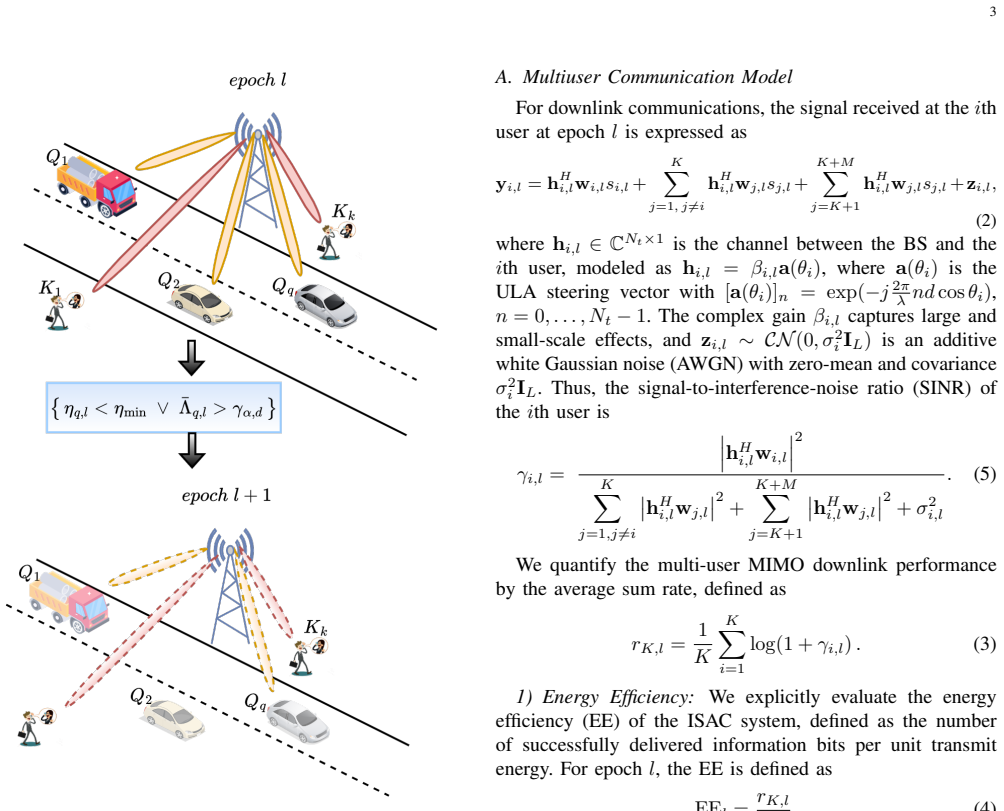
The key mechanism is the skip-aware sensing policy and the safety illumination floor embedded in a convex transmit-covariance optimization. The EKF maintains a constant-velocity state with covariance P; the scalar confidence η = 1/tr(P) shrinks as the estimate sharpens, and the NIS Λ = yᵀS⁻¹y gates whether a measurement is consistent. The binary activation variable u_q,l+1 = 1{η_q,l < η_min ∨ Λ_q,l > γ_α,d} triggers full sensing only when confidence drops or innovation is inconsistent. During skipped epochs, only a fraction ρ of the nominal illumination α_q is imposed (Eq. 28c), so the target remains weakly observable. This lets the SDP reallocate power away from unnecessary probing and towa
What would settle it
Run the same skip-aware policy on a target executing an abrupt maneuver (e.g., a sudden acceleration) or with ρ set to 0.1; if the EKF loses track quickly or the track-loss probability jumps sharply, the fixed safety-floor assumption fails. Conversely, an analytic posterior Cramér–Rao bound under intermittent illumination showing that the bound remains finite for ρ > 0 would support the claim.
Extended reading notes
Core claim
The paper's central claim is that radar probing can be temporarily skipped when the EKF indicates high confidence and consistent measurements, without losing the track. The skip decision is made per target per epoch using two complementary statistics: the posterior confidence η_q,l = 1/tr(P_q,l) and the NIS gate Λ_q,l ≤ γ_α,d. When sensing is skipped, a nonzero safety illumination floor ρα_q is still enforced in the beamforming optimization (Problem 28), preserving enough observability for the EKF to remain stable. The resulting transmit-covariance SDP minimizes total radiated power subject to per-user SINR constraints and sector-based beampattern guarantees. Numerical results show that the
Load-bearing premise
The load-bearing premise is that the reduced illumination floor ρα_q during skipped epochs keeps the EKF observable enough to avoid track divergence; the paper validates this only through simulation with ρ = 0.3 and provides no analytic guarantee tying ρ to track-loss probability.
Editorial extensions
If this is right
- If correct, continuous sensing is unnecessary for reliable tracking; a predictive EKF with a minimal illumination floor can sustain tracks at much lower power.
- The communication sum-rate is unaffected by the skip policy because the SINR constraints are fixed; energy savings translate directly into higher energy efficiency, not lower QoS.
- The gap in track-loss probability between full probing and adaptive skipping narrows at higher SNR, suggesting that confidence-driven skipping becomes safer as channel conditions improve.
- The framework extends naturally to adaptive scheduling of sensing resources across multiple targets, prioritizing only those targets whose estimates carry high uncertainty.
- The safety floor ρ is a tunable knob that trades energy against tracking robustness; the paper identifies ρ = 0.3 as a balanced operating point.
Reading between the lines
- The fixed ρ = 0.3 safety floor is validated only through simulation; an analytic relation between ρ, target dynamics, and track-loss probability would let a system adapt ρ per target or per scenario rather than picking a constant.
- The identical sum-rate across schemes is an artifact of the min-power formulation; under a rate-maximizing objective, the saved sensing power could instead be converted into higher throughput, a regime the paper does not explore.
- The confidence/NIS gating could be applied to other tracking filters (e.g., unscented Kalman or particle filters) or to extended-target tracking, where the innovation distribution is non-Gaussian and the NIS gate would need re-calibration.
- The paper's claim implies a testable prediction: in a scenario with maneuvering targets or stronger clutter, the fixed ρ floor will become insufficient and track-loss will rise sharply; the optimal ρ would need to increase with target agility.
Signed reviews
Editorial analysis
A structured set of objections, weighed in public.
Referee Report
Summary. The paper proposes an energy-efficient beamforming framework for a MIMO dual-functional radar-communication (DFRC) base station. At each epoch, the base station minimizes total transmit power subject to per-user SINR constraints and target-sector beampattern illumination constraints. The novelty is a sensing activation policy driven by EKF-derived posterior confidence and normalized innovation squared (NIS): a target is fully illuminated only when confidence is low or the innovation is inconsistent; otherwise it receives a reduced safety illumination floor ρ α_q. The optimization is posed as a convex SDP, and numerical comparisons are made against full-probing and periodic low-power baselines. The reported results show lower transmit power and equal communication sum-rate for the proposed adaptive skip-aware probing (ASP), with track-loss probability between the baselines.
Significance. If the claims are substantiated, the paper would contribute a practical, tracking-aware mechanism for reducing sensing energy in ISAC systems, a timely topic for 6G green communications. The idea of coupling EKF statistics with transmit-covariance optimization is interesting and the convex formulation is a strength. The paper also provides a clear set of tracking-stability metrics and a comparison with two reasonable baselines. However, the significance is currently limited by several internal inconsistencies and missing modeling links. The main energy-saving result is, to a large degree, built into the relaxed illumination constraint, and the robustness claim for the safety floor is not backed by a detection-probability model or an analytic link between ρ and track-loss probability. These issues must be resolved before the contribution can be fully assessed.
major comments (5)
- [Section V, Eq. (28b)] The SINR constraint in the skip-aware SDP is printed incorrectly. It should be tr(H_i W_i) − τ_k(∑_{j≠i} tr(H_i W_j) + tr(H_i F)) ≥ τ_k σ_i^2, as in Eq. (26b). As printed, the constraint is τ_k(∑_{j≠i} tr(H_i W_j) + tr(H_i F)) ≥ τ_k σ_i^2, which omits the desired signal term and reduces to an inequality on interference only. Because Algorithm 1 solves Problem (28), the simulated power and sum-rate results in Section VI are not supported by the stated optimization. Please correct the equation and verify that the simulations use the correct constraint.
- [Algorithm 1, step 6 vs Eq. (28c)] Step 6 instructs to 'set sensing power to zero' for skipped targets, while Eq. (28c) imposes a nonzero safety floor ρ α_q on the total transmit covariance toward those targets. If F_l is set to zero, the floor must be satisfied by communication beams alone; if F_l is not set to zero, the statement is misleading. This contradiction obscures the mechanism by which the floor preserves observability during skipped epochs. Please clarify the role of F_l and precisely how the safety floor is realized.
- [Section III.B.2 and Section VI.A.3] The track-loss probability P_loss(ρ) in Eq. (23) is defined as a function of ρ, but no model connects ρ to measurement availability or measurement quality. The EKF in Eq. (12) uses a fixed R_z and assumes a measurement is available whenever the NIS gate passes; there is no detection-probability or SNR-dependent noise term linking the beampattern floor ρ α_q to the probability of obtaining a useful measurement. Thus the claim that ρ=0.3 'guarantees' reliable tracking is only supported by the specific simulation scenario, not by an analytic or semi-analytic argument. Please provide a detection-probability model or a substantially broader sensitivity study (maneuvers, clutter, SNR, ρ) to establish this link.
- [Section V, Eq. (27)] The activation rule for epoch l+1 uses Λ_{q,l}, the NIS at epoch l. If epoch l was a skipped epoch, no radar measurement is produced under the model in Eq. (12), so Λ_{q,l} is undefined. The paper does not specify how the NIS is computed following a skipped epoch, nor whether the safety illumination floor yields a measurement. Without this specification, Algorithm 1 is not implementable as written, and the meaning of the NIS trigger is unclear. Clarify the measurement model during skipped epochs or modify the decision rule to depend only on confidence after a skip.
- [Section V, Eq. (28c) and Fig. 2] The reduction in normalized transmit power of ASP relative to FP is a direct consequence of the constraint relaxation: for skipped targets the illumination floor is lowered from α_q to ρ α_q, enlarging the feasible set of the SDP. Therefore the power saving in Fig. 2 is not an empirical discovery but is structurally guaranteed. The substantive claim is the track-loss performance at the selected ρ. To support the claim that the EKF/NIS policy, rather than the relaxation itself, is responsible for the good energy-tracking trade-off, compare ASP against a random or periodic skip policy with the same average sensing rate and the same safety floor.
minor comments (5)
- [Section IV] The text refers to 'SINR constraints (28b)' when discussing the baseline problem; the intended reference is (26b).
- [General] Equation numbering is inconsistent: Eq. (3) appears after Eq. (5), and some equation numbers are referenced out of order. Please renumber and update cross-references.
- [Section VI.A.1] The discussion of the NIS threshold α is ambiguous. A larger α relaxes the acceptance gate (so more measurements are used when taken), but also reduces the frequency of NIS-triggered activations. The net effect on skipping frequency is not monotonic unless the precise interplay between the gate and the activation rule is stated. Please clarify.
- [Section III.B.2] Eq. (22) defines track loss using T_loss consecutive epochs, but the simulation value of T_loss is never specified. Please state the value used in the numerical results.
- [General] There are several typos, including 'alwyes' (Section VI.A.2), 'UA V' (references), 'Inspiring by' (Introduction), and 'And Q_w' (Section III.A). A thorough proofread is needed.
Circularity Check
ASP-vs-FP power saving is a mathematical consequence of the relaxed floor (28c); the EKF/NIS policy itself is not circular, but track robustness is not analytically tied to rho.
-
self definitional
[Equation (28c) vs Equation (26c), Section V; claimed result in Section VI.A.1 and Fig. 2]
"tr(A_{q,m,l}(F_l + Σ_{j∈K} W_{j,l})) ≥ (u_{q,l}+ρ(1−u_{q,l}))α_q, ∀q [Eq. (28c)] vs. tr(A_{q,m,l}(F_l + Σ_{i∈K} W_{i,l})) ≥ α_q, ∀q [Eq. (26c)]; and 'The ASP achieves the lowest normalized transmit power across the entire SNR range.'"
Because u_{q,l}∈{0,1}, the right-hand side of (28c) is either α_q or ρα_q, both ≤ α_q. Thus the ASP feasible set contains the full-probing feasible set, the objective (28a) is identical to (26a), and the optimal power under (28) is necessarily no larger than under (26). The headline comparison to FP is therefore guaranteed by the constraint relaxation before any simulation; it is not an empirical prediction. The non-circular content is the comparison to PLP and the tracking-loss/EE trade-off.
full rationale
The paper has no self-citation chain and no imported uniqueness theorem; its adaptive skip policy is not circular because the decision u_{q,l} in Eq. (27) depends on EKF confidence and NIS, not on the optimized transmit power. However, one headline numerical result is built into the formulation: replacing α_q by (u+ρ(1−u))α_q ≤ α_q in Eq. (28c) relaxes the sensing constraint of the continuous-probing SDP (26c) while keeping the same min-power objective, so the ASP-vs-FP power saving is a monotonicity fact, not a derived finding. The PLP comparison and the tracking/EE results are not forced this way, so the overall circularity is only partial. Separately, the claimed tracking robustness is not analytically tied to ρ: the EKF measurement model (12) uses a fixed R_z and has no detection-probability model connecting beampattern gain to measurement availability, so P_loss(ρ) in (23) is only simulated; Algorithm 1 step 6 ('set sensing power to zero') also conflicts with the nonzero floor required by (28c). These are support and consistency concerns, not circularity, and they prevent the sensing-robustness claim from being fully established outside the specific simulation setting.
Assumptions & free parameters
free parameters (6)
- Safety illumination factor ρ =
0.3
- Posterior confidence threshold η_min =
0.85
- NIS gate quantile α =
0.95
- Illumination threshold α_q per target =
15 dB
- EKF process noise intensity q_a =
not stated
- Measurement noise covariance R_z =
not stated
assumptions (5)
- domain assumption Constant-velocity target model with Gaussian process noise (Eqs. 9–11)
- domain assumption Measurement noise is Gaussian with known R_z, so NIS follows χ²_d
- domain assumption Targets can be resolved in at least one domain, so data association is reliable
- standard math Rank-one recovery of optimal beamformers via [32, Theorem 4]
- standard math The SDP (28) is solved to global optimality at each epoch
Cite this review
Pith. "Pith review of Posterior-Confidence Driven Beamforming for Energy-Efficient Integrated Sensing and Communication." pith.science (2026). https://pith.science/paper/O7FE535F
@misc{pith2026260713470,
  author       = {Pith},
  title        = {Pith review of: Posterior-Confidence Driven Beamforming for Energy-Efficient Integrated Sensing and Communication},
  year         = {2026},
  howpublished = {\url{https://pith.science/paper/O7FE535F}},
  note         = {Machine review of arXiv:2607.13470}
}
read the original abstract
Energy efficiency will pose an essential limitation for sixth-generation (6G) integrated sensing and communication (ISAC) systems, given the high sensing power consumption associated with persistent sensing, despite stable communication requirements. This paper proposes an energy-efficient multiple-input multiple-output (MIMO) dual-functional radar-communication (DFRC) beamforming framework that minimizes transmit power while guaranteeing per-user signal-to-interference-plus-noise ratio (SINR) and reliable multi-target tracking. The key innovation is a tracking-aware, skip-enabled sensing policy that departs from the conventional always-on probing paradigm. Instead of enforcing sensing at every epoch, sensing is selectively triggered according to two complementary statistics derived from an extended Kalman filter (EKF): a posterior confidence metric and the normalized innovation squared (NIS). While the former ensures accurate estimation, the latter guarantees reliable measurements, and thus sensing can only be activated when additional information is required. To ensure robustness under intermittent sensing, sector-based beampattern constraints are combined with a nonzero safety illumination floor imposed to guarantee reliable target tracking when skipping occurs. Numerical results show that the proposed framework achieves a significant reduction in transmit power compared to other baselines, without any deterioration in the communication system's performance or excessive impact on the sensing process.
Figures


Figures from the paper (9 more)


Reference graph
Works this paper leans on
-
[1]
The real climate and transformative impact of ICT: A critique of estimates, trends, and regulations,
C. Freitag, M. Berners-Lee, K. Widdicks, B. Knowles, G. S. Blair, and A. Friday, “The real climate and transformative impact of ICT: A critique of estimates, trends, and regulations,”Patterns, vol. 2, no. 9, 2021
2021
-
[2]
Assessing ICT global emissions footprint: Trends to 2040 & recommendations,
L. Belkhir and A. Elmeligi, “Assessing ICT global emissions footprint: Trends to 2040 & recommendations,”Journal of Cleaner Production, vol. 177, pp. 448–463, Mar. 2018
-
[3]
ICT industry to re- duce greenhouse gas emissions by 45 percent by 2030,
International Telecommunication Union (ITU), “ICT industry to re- duce greenhouse gas emissions by 45 percent by 2030,” International Telecommunication Union (ITU), Tech. Rep., 2020
-
[4]
5G energy efficiencies: Green is the new black (the sequel),
GSMA Intelligence, “5G energy efficiencies: Green is the new black (the sequel),” GSMA Intelligence, November 2023, available online: https://www.gsma.com
2023
-
[5]
ICT sector guidance: built on the ghg protocol product life cycle accounting and reporting standard,
G. e Sustainability Initiative (GeSI) and C. Trust, “ICT sector guidance: built on the ghg protocol product life cycle accounting and reporting standard,” Global e-Sustainability Initiative (GeSI), Tech. Rep., July 2017
2017
-
[6]
Guidance for ICT companies setting science based targets: Mobile network operators, fixed network operators and data centres operators,
I. G. G. SBTI, “Guidance for ICT companies setting science based targets: Mobile network operators, fixed network operators and data centres operators,” International Telecommunication Union (ITU), Tech. Rep., January 2020
2020
-
[7]
Toward in- tegrated sensing and communications for 6G: Key enabling technologies, standardization, and challenges,
A. Kaushik, R. Singh, S. Dayarathna, R. Senanayake, M. Di Renzo, M. Dajer, H. Ji, Y . Kim, V . Sciancalepore, A. Zapponeet al., “Toward in- tegrated sensing and communications for 6G: Key enabling technologies, standardization, and challenges,”IEEE Commun. Mag., vol. 8, no. 2, pp. 52–59, Jun. 2024
2024
-
[8]
Toward green RF chain design for integrated sensing and communications: Technologies and future directions,
Y . Gong, X. Li, F. Meng, L. Liu, M. Guizani, and Z. Xu, “Toward green RF chain design for integrated sensing and communications: Technologies and future directions,”IEEE Commun. Mag., vol. 62, no. 9, pp. 36–42, Sep. 2024
2024
Show all 35 references
-
[9]
Net-zero energy dual- functional radar-communication systems,
I. Valiulahi, C. Masouros, and A. Salem, “Net-zero energy dual- functional radar-communication systems,”IEEE Trans. Green Commun. Netw., vol. 7, no. 1, pp. 356–369, Mar. 2023
2023
-
[10]
Resource allocation for uav swarm-assisted green isac networks via multi-agent rl,
Q. Zhu, R. Liu, Q. Liu, and C. Chen, “Resource allocation for uav swarm-assisted green isac networks via multi-agent rl,”IEEE Trans. Green Commun. Netw., vol. 9, no. 3, pp. 1354–1367, Oct. 2024
2024
-
[11]
Trade-off between radar sensing and energy consumption in integrated sensing, computing, and communication uav network,
Y . Zhou and X. Liu, “Trade-off between radar sensing and energy consumption in integrated sensing, computing, and communication uav network,”IEEE Trans. Green Commun. Netw., Jul. 2025. 11
2025
-
[12]
Uav trajectory and beamforming optimization for integrated periodic sensing and communication,
K. Meng, Q. Wu, S. Ma, W. Chen, and T. Q. Quek, “Uav trajectory and beamforming optimization for integrated periodic sensing and communication,”IEEE Wireless Communications Letters, vol. 11, no. 6, pp. 1211–1215, Mar. 2022
2022
-
[13]
Energy-aware resource allocation and trajectory design for UA V-enabled ISAC,
A. Khalili, A. Rezaei, D. Xu, and R. Schober, “Energy-aware resource allocation and trajectory design for UA V-enabled ISAC,” inProc. IEEE Global Commun. Conf. (GLOBECOM), Kuala Lumpur, Malaysia, Dec. 2023, pp. 4193–4198
2023
-
[14]
Irs-aided non-orthogonal isac systems: Performance analysis and beamforming design,
Z. Yu, X. Hu, C. Liu, and M. Peng, “Irs-aided non-orthogonal isac systems: Performance analysis and beamforming design,”IEEE Trans. Green Commun. Netw., vol. 8, no. 4, pp. 1930–1942, Dec. 2024
1930
-
[15]
Beamforming techniques for noma-based integrated sensing and communication systems,
C. Li, S. Mohammadzadeh, H. Al-Obiedollah, K. Cumanan, and O. A. Dobre, “Beamforming techniques for noma-based integrated sensing and communication systems,”IEEE Trans. Green Commun. Netw., vol. 10, pp. 667–680, Aug. 2026
2026
-
[16]
Power allocation of integrated sensing and communication system for the internet of vehicles,
Z. Pu, W. Wang, Z. Lao, Y . Yan, and H. Qin, “Power allocation of integrated sensing and communication system for the internet of vehicles,”IEEE Trans. Green Commun. Netw., vol. 8, no. 4, pp. 1717– 1728, Apr. 2024
2024
-
[17]
Energy-efficient MIMO integrated sensing and communications with On–Off nontransmission power,
G. Wu, Y . Fang, J. Xu, Z. Feng, and S. Cui, “Energy-efficient MIMO integrated sensing and communications with On–Off nontransmission power,”IEEE Internet Things J., vol. 11, no. 7, pp. 12 177–12 191, Apr. 2024
2024
-
[18]
Energy efficiency maximization for active ris-aided ISAC,
M. Rihanet al., “Energy efficiency maximization for active ris-aided ISAC,”EURASIP J. Wirel. Commun. Netw, vol. 2024, no. 1, p. 20, Apr. 2024
2024
-
[19]
Energy-efficient integrated sensing and communication in collaborative millimeter wave networks,
Y . Cui, H. Ding, Y . Ma, X. Li, H. Zhang, and Y . Fang, “Energy-efficient integrated sensing and communication in collaborative millimeter wave networks,”IEEE Trans. Wireless Commun., vol. 24, no. 3, pp. 2341– 2357, Mar. 2025
2025
-
[20]
Green transceiver design and antenna selection for qos-aware integrated sensing and communica- tion systems,
M. Anjum, D. Mishra, and A. Seneviratne, “Green transceiver design and antenna selection for qos-aware integrated sensing and communica- tion systems,”IEEE Trans. Green Commun. Netw., vol. 10, pp. 457–470, Jul. 2026
2026
-
[21]
Joint processing and transmission energy optimization for ISAC in cell-free massive MIMO with URLLC,
Z. Behdad, ¨O. T. Demir, K. W. Sung, and c. Cavdar, “Joint processing and transmission energy optimization for ISAC in cell-free massive MIMO with URLLC,”arXiv:2401.10315, 2024
2024 arXiv
-
[22]
Energy-efficient beamforming design for integrated sensing and com- munications systems,
J. Zou, S. Sun, C. Masouros, Y . Cui, Y .-F. Liu, and D. W. K. Ng, “Energy-efficient beamforming design for integrated sensing and com- munications systems,”IEEE Transactions on Communications, vol. 72, no. 6, pp. 3766–3782, Jun. 2024
2024
-
[23]
Energy-efficient joint beamforming and trajectory optimization for UA V-enabled integrated sensing and communication,
B. He, W. Mao, Y . Liu, W. Huangfu, Y . Xiao, F. Wang, and Y . Ji, “Energy-efficient joint beamforming and trajectory optimization for UA V-enabled integrated sensing and communication,”IEEE Trans. Commun., pp. 1–1, 2025, Early Access
2025
-
[24]
Mimo integrated sensing and commu- nication: Crb-rate tradeoff,
H. Hua, T. X. Han, and J. Xu, “Mimo integrated sensing and commu- nication: Crb-rate tradeoff,”IEEE Trans. Wireless Commun., vol. 23, no. 4, pp. 2839–2854, Apr. 2024
2024
-
[25]
NR; physical layer procedures for data,
“NR; physical layer procedures for data,” 3GPP TS 38.214, v18.3.0, 2024
2024
-
[26]
Study on network energy savings for NR,
“Study on network energy savings for NR,” 3GPP TR 38.864, Rel-18, 2022
2022
-
[27]
Feasibility study on integrated sensing and communication (ISAC),
“Feasibility study on integrated sensing and communication (ISAC),” 3rd Generation Partnership Project (3GPP), TSG SA, Technical Report TR 22.837, Jun. 2024, release 19. [Online]. Available: https://www.3gpp.org/ftp/Specs/archive/22 series/22.837/
2024
-
[28]
Efficient global algorithms for transmit beamforming design in isac systems,
J. Wu, Z. Wang, Y .-F. Liu, and F. Liu, “Efficient global algorithms for transmit beamforming design in isac systems,”IEEE Trans. Signal Process., vol. 72, pp. 4493–4508, Sep. 2024
2024
-
[29]
Cooperative sensing- assisted predictive beam tracking for mimo-ofdm networked isac sys- tems,
X. Yang, Z. Wei, J. Xu, H. Wu, and Z. Feng, “Cooperative sensing- assisted predictive beam tracking for mimo-ofdm networked isac sys- tems,”IEEE Trans. Wireless Commun., Jun. 2025
2025
-
[30]
Joint beamforming design and trajectory optimization for uav-enabled cell-free isac mimo systems,
J. Zhong, J. Wu, Y . Li, C. Zhang, and P. Zhu, “Joint beamforming design and trajectory optimization for uav-enabled cell-free isac mimo systems,”IEEE Commun. Lett., Jun. 2025
2025
-
[31]
Dynamic isac beamforming design for uav-enabled vehicular networks,
X. Pang, S. Guo, J. Tang, N. Zhao, and N. Al-Dhahir, “Dynamic isac beamforming design for uav-enabled vehicular networks,”IEEE Trans. Wireless Commun., vol. 23, no. 11, pp. 16 852–16 864, Aug. 2024
2024
-
[32]
Cram ´er-rao bound optimization for joint radar-communication beamforming,
F. Liu, Y .-F. Liu, A. Li, C. Masouros, and Y . C. Eldar, “Cram ´er-rao bound optimization for joint radar-communication beamforming,”IEEE Trans. Signal Process., vol. 70, pp. 240–253, Dec. 2021
2021
-
[33]
Multiobjective- optimization-based transmit beamforming for multitarget and multiuser mimo-isac systems,
C. Meng, Z. Wei, D. Ma, W. Ni, L. Su, and Z. Feng, “Multiobjective- optimization-based transmit beamforming for multitarget and multiuser mimo-isac systems,”IEEE Internet Things J., vol. 11, no. 18, pp. 29 260–29 274, Jun. 2024
2024
-
[34]
Transmit design for joint MIMO radar and multiuser communications with transmit covariance constraint,
X. Liu, T. Huang, and Y . Liu, “Transmit design for joint MIMO radar and multiuser communications with transmit covariance constraint,” IEEE J. Sel. Areas Commun., vol. 40, no. 6, pp. 1932–1950, Mar. 2022
1932
-
[35]
Performance evaluation metrics and approaches for target tracking: A survey,
Y . Song, Z. Hu, T. Li, and H. Fan, “Performance evaluation metrics and approaches for target tracking: A survey,”Sensors, vol. 22, no. 3, p. 793, Jan. 2022
2022
Reviewed August 2, 2026 · model on record in the stance chip above.
Discussion (0). Continue with ORCID to comment.