REVIEW 3 major objections 5 minor 80 references
On phase-field regularization in dynamic fracture with brittle and cohesive formulations
T0 review · 3 major / 5 minor · reviewed 2026-08-03 · deepseek-v4-flash
Pith's one-line read Phase-field regularization itself, not numerics, causes oscillations and widening in dynamic brittle fracture; a cohesive variant recovers sharp-crack behavior.
desk verdict Solid, useful paper: it gives a credible mechanistic explanation for the oscillations and widening in dynamic phase-field fracture, and a new dynamic cohesive model with an analytical opening law; the TMM/FEM split-model gap and the inertia-free eigenstrain assumption are the main soft spots. read the letter →
The pith
A machine-rendered reading of the paper's core claim, the machinery that carries it, and where it could break.
The reading
What carries the argument
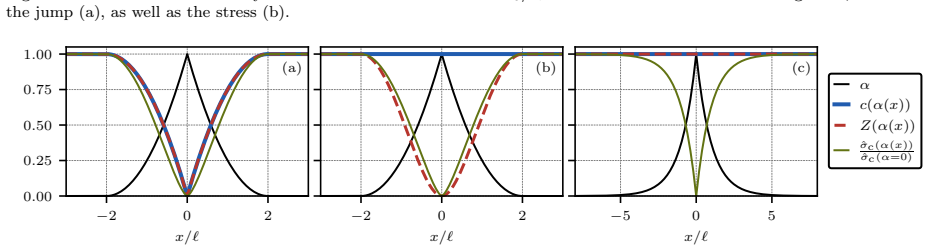
The key object is the acoustic impedance profile Z(α) = sqrt(g(α)E0ρ0) and the WKB adiabaticity parameter δ(x) = |Z'(x)|/Z(x) · c(x)/ω. For the optimal AT1 phase-field profile, δ tends to λ/(2πℓ) near the crack center, making ℓ/λ the single governing parameter that separates reflecting (sharp-crack-like) from transmitting (homogeneous-like) regimes. For the cohesive model, the key machinery is the eigenstrain field η and the strength-degradation function a(α)=1−α, which leave the bulk wave equation unchanged; the condition (59) ensures the strength criterion is met only at the crack, and the complementary relations yield the linear ODE (60) whose solution is the analytical dynamic cohesive l
What would settle it
Compute the reflection and transmission power coefficients for a fixed phase-field crack as a function of ℓ/λ, e.g. by transfer-matrix or spectral simulations; if the transition does not fall near ℓ/λ ≈ 0.08–0.221, the impedance-based explanation is wrong.
Extended reading notes
Core claim
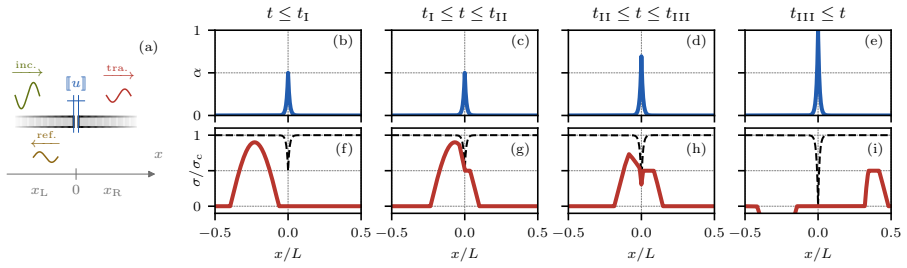
On the paper's own terms: for a stiffness-degrading brittle phase-field model, a crack is not a free surface but a smooth impedance well; a harmonic wave is reflected only when the adiabatic parameter δ ≈ λ/(2πℓ) is large, and transmitted when ℓ/λ is large, with transfer-matrix results giving the sharp-crack-like reflection regime for ℓ/λ ⪅ 0.08 and transmission for ℓ/λ ⪆ 0.221. The same mechanism, combined with the local strength profile of the AT1 model, explains the widening of the damaged band. Degrading the density in addition to stiffness removes the wave-speed dip but deepens the impedance well, yielding total reflection for all ℓ/λ in tension and also altering compression. The newly
Load-bearing premise
The cohesive model's dynamic law rests on the assumption that the eigenstrain carries no inertia and its pointwise evolution is identical to the quasi-static stationarity condition at every instant.
Editorial extensions
If this is right
- The reported 'numerical' artifacts in dynamic brittle phase-field simulations will persist under mesh refinement and even with numerical dissipation, because they stem from the regularization itself as long as ℓ/λ is not small.
- For brittle stiffness-degrading models, the sharp-crack response is recovered only as ℓ/λ→0, which conflicts with using ℓ as a material parameter to set the nucleation stress.
- The stiffness+density degradation variant, despite constant wave speed in tension, is not a remedy: it produces full reflection for all ℓ/λ, fails on compressive waves, and breaks mass conservation.
- For the new cohesive model, the regularization length ℓ is decoupled from the material strength and can be chosen purely from numerical considerations, with the dynamic response governed by c0/ℓch, which is testable.
- In the 2D benchmark, crack branching is captured by both the stiffness-degraded brittle model and the cohesive model, while the density-degraded model produces straight cracks; conclusions about branching from the latter should be reconsidered.
Reading between the lines
- Beyond the paper, the finding that the bulk wave equation is untouched in the cohesive model implies that any spurious wave–crack interactions in existing simulations using brittle models can be quantified a priori by computing ℓ/λ; a practical quality metric for dynamic phase-field simulations would be to report it.
- Beyond the paper, the condition (59) is derived for the incident-wave stress envelope of a half-sine pulse; for broadband or multiply reflected waves, the boundary in Fig. 13b may shift, so a more general criterion would be needed before using it as a universal safeguard.
- Beyond the paper, the analytical opening law suggests that the dimensionless number c0/ℓch is the natural time-scale for dynamic cohesive crack opening, which could be used to design experiments that distinguish cohesive from brittle dynamic response in a material.
- Beyond the paper, the similarity of the branching patterns between the brittle and cohesive models—despite very different mechanisms—suggests that branching itself may be insensitive to the regularization details provided the elastic domain and dissipation are matched; testing this hypothesis would require a systematic parameter sweep.
Editorial analysis
A structured set of objections, weighed in public.
Referee Report
Summary. The paper analyzes three phase-field formulations for dynamic fracture in 1D and 2D. For brittle stiffness-degradation models, it argues—through WKB/scattering analysis, transfer-matrix computations, and FEM experiments with two time integrators and two mesh resolutions—that high-frequency oscillations and phase-field widening in wave-crack interaction are intrinsic consequences of the regularization, governed by the ratio ℓ/λ of regularization length to wavelength. It shows that adding density degradation restores constant wave speed but violates mass balance and still fails compressive-wave transmission. The paper then extends a recently proposed eigenstrain-based cohesive phase-field model (strength degradation only) to elastodynamics, derives a condition (ℓ/λ, σ̃/σc) for sharp-crack-like response, and derives a closed-form dynamic cohesive opening law governed by c0/ℓch, verified against FEM. A 2D pre-notched plate benchmark compares branching behavior.
Significance. If the claims hold, the paper clarifies a long-debated issue: the oscillations reported in dynamic phase-field fracture are not merely numerical artifacts but an intrinsic feature of stiffness-degrading regularization, and the proposed cohesive formulation offers a principled alternative. The manuscript has notable strengths: the scattering analysis is self-contained, the transfer-matrix predictions are falsifiable, the analytical opening law is checked against direct FEM solutions of the same PDE system (Fig. 27), the numerical studies include systematic mesh and time-integration checks, and the implementations are publicly available. These features make the paper a potentially valuable contribution to computational fracture mechanics. However, the quantitative threshold claims for the brittle model rest on an unsplit surrogate, and the cohesive model's predictions rest on a rate-independent elimination of the eigenstrain that is stated but not discussed in depth; these caveats need attention.
major comments (3)
- [§2.1.3 / §2.1.5, Eq. (16), (20), Fig. 2 & 5] The TMM thresholds in Fig. 2 (ℓ/λ≈0.08 and 0.221) are computed for the unsplit heterogeneous wave equation (16) with the fixed optimal AT1 profile, whereas the FEM simulations of §2.1.5 use the tension–compression split (20), as the paper itself states ('only qualitative'). This gap is load-bearing for the quantitative claim that the wave-crack interaction is governed by the impedance profile with these specific thresholds. Since incident and reflected waves superpose during the interaction, both signs of u′ coexist in the phase-field support; in the split model the effective stiffness profile becomes solution-dependent, so the impedance profile from the TMM is not the one actually experienced by the FEM solution. Moreover, the pulse (21) is a truncated sinusoid, so its spectral content is not captured by the monochromatic TMM parameter ℓ/λ̃. I therefore do not consider the quantitative
- [§3.1 footnote / Appendix D, Eq. (46)] The dynamic extension of the cohesive model eliminates the eigenstrain η by invoking, in the §3.1 footnote, that 'the eigenstrain carries no inertia' and that pointwise stationarity coincides with quasi-static optimality. This is a strong modeling assumption, and every subsequent cohesive result—the condensed energy (46), the diffuse-jump criterion (59), and the opening law (60)-(62)—inherits it. The manuscript does not discuss the physical scope of this assumption (e.g., what a finite relaxation time for η would change, or why zero inertia is the appropriate limit for a fracture process). Because this is the first dynamic extension of this cohesive model, the authors should state this limitation explicitly in the conclusions and, if possible, support the rate-independent elimination by an asymptotic argument. As written, the 'dynamic cohesive law' is dynamic only in the displacement fie
- [§3.4, Eqs. (57)–(59), Fig. 13] The no-diffuse-jump condition (56) is converted into the regime diagram of Fig. 13b using the stress envelope (57) and the strength profile (58). Equation (57) is stated without derivation; it is not the incident-wave maximum, since for a free-end reflection of a half-sine pulse the total (incident+reflected) stress at a fixed point has this form. The derivation should be given, including the assumptions (half-sine pulse, no secondary reflections, α frozen at its initial profile before the criterion is violated). The figure caption calls (b) 'numerically obtained limits', but it is obtained by solving the inequality analytically; this is misleading. Since Fig. 13b defines the regime in which the cohesive model is claimed to recover sharp-crack behavior, this is a central element and needs a rigorous derivation or a direct FEM verification along the boundary.
minor comments (5)
- [§2.1.5, Eq. (21), Fig. 5] The relationship between the nominal wavelength λ̃ of the truncated sinusoid and the monochromatic λ of the TMM deserves a word; the pulse's spectral width is probably why FEM at ℓ/λ̃=0.075 still shows visible transmission although the monochromatic TMM would place it in the near-full-reflection regime.
- [§3.1 footnote] The footnote could be more precise: the action (6) contains no kinetic term for η by construction; this is a modeling choice, not a consequence of the quasi-static model. Please phrase it that way.
- [Fig. 13 caption] Replace 'numerically obtained limits' with 'analytically obtained from (59)' to avoid implying a parameter sweep over FEM solutions.
- [§4.2.1, Figs. 20–23] The 2D comparison uses ℓ/∆x≈5 only. Given the 1D sensitivity to discretization, a brief mesh-convergence statement for the branching patterns would increase confidence.
- [Eq. (57) / §2.1.3] The notation λ̃ vs λ is used inconsistently between the pulse section and the TMM section; please unify and clarify which quantity is being used in each threshold.
Circularity Check
No load-bearing circularity: the TMM analysis and the dynamic cohesive opening law are derived from stated model equations and checked against FEM solutions of the same system; self-citation to the prior cohesive model is legitimate background, with only acknowledged limitations (qualitative FEM/TMM bridge, inertia-free eigenstrain) but no reduction-by-construction.
full rationale
The claimed derivations are self-contained. The ℓ/λ control parameter and the reflection/transmission thresholds come from a WKB criterion and transfer-matrix solution of the 1D heterogeneous wave equation (Eq. 16, Appendix A/B), i.e. from stated material profiles, not from the FEM results. The paper explicitly flags that the subsequent FEM comparison with the strain-split model is only qualitative: 'The comparison between FEM and TMM results is therefore only qualitative' (§2.1.5, repeated in §2.2.4). That is a limitation on quantitative transfer, not a circular fit. The dynamic cohesive opening law (ODE (60), solution (61)-(62), Appendix E) is derived from d'Alembert solutions, stress continuity, and the model's own KKT/cohesive relations (50)-(55); it is not an assumption imported to match data. Its validation in Fig. 27 is against direct FEM solutions of the same PDE system ('Clearly, analytical and FEM results coincide'), which is consistency testing rather than circular prediction. The main self-reference is the adoption of the cohesive phase-field model from [39,40]; that is prior published work and supplies the model ingredients, not the paper's conclusions about dynamic behavior. Two assumptions are flagged as such: the inertia-free elimination of the eigenstrain ('the eigenstrain carries no inertia, so the point-wise stationarity condition...', §3.1 footnote), and the incident-wave-only stress envelope used in criterion (59) ('For an incoming wave (21), the temporal maximum at each spatial point reads...', Eq. (57)). Both are limitations/assumptions, not self-definitional reductions of the claimed results. No fitted parameter is renamed as a prediction, and no uniqueness claim from the authors' prior work is used to force the model choice. Overall score 1 reflects minor self-citation and these acknowledged assumptions, but no circular derivation.
Assumptions & free parameters
free parameters (5)
- g0 (residual stiffness) =
1e-6
- h0 (residual density) =
1e-2
- epsilon (residual energy density) =
1e-7
- sigma_c (tensile strength, 1D cohesive simulations) =
5 MPa
- p_c, tau_c (2D cohesive strength surface) =
8.94 MPa, 10.95 MPa
assumptions (7)
- standard math Linear isotropic elasticity, infinitesimal strains, volumetric–deviatoric split (3)
- domain assumption Rate-independent damage evolution with irreversibility α̇≥0 and KKT conditions (12)
- domain assumption Sharp-crack benchmark: a fully open crack reflects a tensile wave completely and transmits a compressive wave undistorted
- standard math WKB/scattering criterion (18) for smoothly graded media
- ad hoc to paper Eigenstrain carries no inertia; pointwise stationarity with respect to η in the action functional coincides with quasi-static optimality
- ad hoc to paper Special case p²c/τ²c = κ0/(2μ0) enabling the condensed formulation (46)
- ad hoc to paper Stress envelope (57) for the diffuse-jump criterion (59): temporal max of stress equals the incident wave's amplitude profile
Cite this review
Pith. "Pith review of On phase-field regularization in dynamic fracture with brittle and cohesive formulations." pith.science (2026). https://pith.science/paper/IODFGUB7
@misc{pith2026260713599,
  author       = {Pith},
  title        = {Pith review of: On phase-field regularization in dynamic fracture with brittle and cohesive formulations},
  year         = {2026},
  howpublished = {\url{https://pith.science/paper/IODFGUB7}},
  note         = {Machine review of arXiv:2607.13599}
}
read the original abstract
Phase-field models of fracture are widely used for simulating crack nucleation and propagation, yet the role of the phase-field regularization in the dynamic regime is not fully understood and depends critically on how the damage variable is coupled to the displacement field. In this paper, we analyze three alternative formulations: the brittle model with stiffness degradation, its variant with stiffness+density degradation, and our recently proposed phase-field regularization of cohesive fracture, which we extend to elastodynamics. By studying the interaction of a tensile and a compressive elastic wave with a phase-field crack in a one-dimensional bar, we determine for which models and under which conditions the phase-field regularization preserves the features of the wave-crack interaction expected for a sharp crack, and we theoretically explain which variables control the behavior. For the new cohesive model extended to dynamics, we further derive an analytical dynamic cohesive opening law. Finally, we study the dynamic behavior including branching of a two-dimensional notched plate at two loading intensities.
Figures


Figures from the paper (32 more)





Reference graph
Works this paper leans on
-
[1]
Ravi-Chandar, Dynamic Fracture, Elsevier, Oxford, 2004
K. Ravi-Chandar, Dynamic Fracture, Elsevier, Oxford, 2004
2004
-
[2]
K. Ravi-Chandar, W. G. Knauss, An experimental investigation into dynamic fracture: Iii. on steady- state crack propagation and crack branching, International Journal of Fracture 26 (2) (1984) 141–154. doi:10.1007/BF01157550
-
[3]
M. J. Buehler, H. Gao, Dynamical fracture instabilities due to local hyperelasticity at crack tips, Nature 439 (2006) 307–310.doi:10.1038/nature04408
-
[4]
A. Vasudevan, Y. Lubomirsky, C.-H. Chen, E. Bouchbinder, A. Karma, Oscillatory and tip-splitting instabilities in 2d dynamic fracture: The roles of intrinsic material length and time scales, Journal of the Mechanics and Physics of Solids 151 (2021) 104372.doi:10.1016/j.jmps.2021.104372
arXiv 2021
-
[5]
M. Wang, S. Shi, J. Fineberg, Tensile cracks can shatter classical speed limits, Science 381 (6656) (2023) 415–419.doi:10.1126/science.adg7693. URLhttps://www.science.org/doi/abs/10.1126/science.adg7693
-
[6]
J. Fineberg, M. Marder, Instability in dynamic fracture, Physics Reports 313 (1) (1999) 1–108.doi: 10.1016/S0370-1573(98)00085-4
-
[7]
E. Sharon, S. P. Gross, J. Fineberg, Local crack branching as a mechanism for instability in dynamic fracture, Phys. Rev. Lett. 74 (1995) 5096–5099.doi:10.1103/PhysRevLett.74.5096. 33
-
[8]
E. Sharon, J. Fineberg, Microbranching instability and the dynamic fracture of brittle materials, Phys. Rev. B 54 (1996) 7128–7139.doi:10.1103/PhysRevB.54.7128
Show all 80 references
-
[9]
Livne, G
A. Livne, G. Cohen, J. Fineberg, Universality and hysteretic dynamics in rapid fracture, Phys. Rev. Lett. 94 (2005) 224301.doi:10.1103/PhysRevLett.94.224301
2005 doi
-
[10]
A. A. Griffith, The phenomena of rupture and flow in solids, Philosophical Transactions of the Royal Society of London 221 (1921) 163–198
1921
-
[11]
K. Pham, H. Amor, J.-J. Marigo, C. Maurini, Gradient damage models and their use to approximate brittle fracture, International Journal of Damage Mechanics 20 (4) (2011) 618–652.doi:10.1177/ 1056789510386852
2011
-
[12]
Bourdin, G
B. Bourdin, G. Francfort, J.-J. Marigo, Numerical experiments in revisited brittle fracture, Journal of the Mechanics and Physics of Solids 48 (4) (2000) 797–826.doi:10.1016/S0022-5096(99)00028-9
2000 doi
-
[13]
Francfort, J.-J
G. Francfort, J.-J. Marigo, Revisiting brittle fracture as an energy minimization problem, Journal of the Mechanics and Physics of Solids 46 (8) (1998) 1319–1342.doi:10.1016/S0022-5096(98)00034-9
1998 doi
-
[14]
Bourdin, C
B. Bourdin, C. L. Richardson, A time-discrete model for dynamic fracture based on crack regularization, International Journal of Fracture 168 (2011) 133–143.doi:10.1007/s10704-010-9562-x
2011 doi
-
[15]
A.Schlüter, A.Willenbücher, C.Kuhn, R.Müller, Phasefieldapproximationofdynamicbrittlefracture, Computational Mechanics 54 (2014) 1141–1161.doi:10.1007/s00466-014-1045-x
2014 doi
-
[16]
Hofacker, C
M. Hofacker, C. Miehe, A phase field model of dynamic fracture: Robust field updates for the analysis of complex crack patterns, International Journal for Numerical Methods in Engineering 93 (3) (2013) 276–301.doi:10.1002/nme.4387
2013 doi
-
[17]
T. Li, Analyse de la rupture dynamique fragile via les modèles d’endommagement à gradient : principes variationnels et simulations numériques, Theses, Université Paris Saclay (COmUE) (Oct. 2016). URLhttps://pastel.hal.science/tel-01487449
2016
-
[18]
Li, J.-J
T. Li, J.-J. Marigo, Crack tip equation of motion in dynamic gradient damage models, Journal of Elasticity 127 (2017) 25–57.doi:10.1007/s10659-016-9595-0
2017 doi
-
[19]
G.Fischer, J.-J.Marigo, Gradientdamagemodelsappliedtodynamicfragmentationofbrittlematerials, International Journal of Fracture 220 (2019) 143–165.doi:10.1007/s10704-019-00356-y
2019 doi
-
[20]
Agrawal, K
V. Agrawal, K. Dayal, Dependence of equilibrium griffith surface energy on crack speed in phase-field models for fracture coupled to elastodynamics, International Journal of Fracture 207 (2017) 243–249. doi:10.1007/s10704-017-0234-y
2017 doi
-
[21]
Bleyer, C
J. Bleyer, C. Roux-Langlois, J.-F. Molinari, Dynamic crack propagation with a variational phase-field model: limiting speed, crack branching and velocity-toughening mechanisms, International Journal of Fracture 204 (2017) 79–100.doi:10.1007/s10704-016-0163-1
2017 doi
-
[22]
M. J. Borden, C. V. Verhoosel, M. A. Scott, T. J. Hughes, C. M. Landis, A phase-field description of dynamic brittle fracture, Computer Methods in Applied Mechanics and Engineering 217-220 (2012) 77–95.doi:10.1016/j.cma.2012.01.008
2012 doi
-
[23]
Schlüter, C
A. Schlüter, C. Kuhn, R. Müller, D. Gross, An investigation of intersonic fracture using a phase field model, Archive of Applied Mechanics 86 (2016) 321–333.doi:10.1007/s00419-015-1114-4
2016 doi
-
[24]
C.-H. Chen, E. Bouchbinder, A. Karma, Instability in dynamic fracture and the failure of the classical theory of cracks, Nature Physics 13 (12) (2017) 1186–1190.doi:10.1038/nphys4237. 34
2017 doi
-
[25]
Bleyer, J.-F
J. Bleyer, J.-F. Molinari, Microbranching instability in phase-field modelling of dynamic brittle fracture, Applied Physics Letters 110 (15) (2017).doi:10.1063/1.4980064
2017 doi
-
[26]
Marigo, A
J.-J. Marigo, A. Geromel Fischer, Gradient Damage Models Coupled With Plasticity and Their Ap- plication to Dynamic Fragmentation, John Wiley and Sons, Ltd, 2018, Ch. 3, pp. 95–141.doi: 10.1002/9781119579311.ch3
2018 doi
-
[27]
T. K. Mandal, V. P. Nguyen, J.-Y. Wu, Evaluation of variational phase-field models for dynamic brittle fracture, Engineering Fracture Mechanics 235 (2020) 107169.doi:10.1016/j.engfracmech.2020. 107169
2020 doi
-
[28]
C. J. Larsen, C. Ortner, E. Süli, Existence of solutions to a regularized model of dynamic fracture, Math. Models Methods Appl. Sci. 20 (7) (2010) 1021–1048.doi:10.1142/S0218202510004520
2010 doi
-
[29]
H. Ren, X. Zhuang, C. Anitescu, T. Rabczuk, An explicit phase field method for brittle dynamic fracture, Computers & Structures 217 (2019) 45–56.doi:10.1016/j.compstruc.2019.03.005
2019 doi
-
[30]
Schlüter, C
A. Schlüter, C. Kuhn, T. Noll, F. Diewald, R. Müller, Numerical solution strategies for a dynamic phase field fracture model, Applied Mechanics and Materials 869 (2017) 29–49. URLhttps://doi.org/10.4028/www.scientific.net/AMM.869.29
2017 doi
-
[31]
Nagaraja, M
S. Nagaraja, M. Elhaddad, M. Ambati, S. Kollmannsberger, L. De Lorenzis, E. Rank, Phase-field modelingofbrittlefracturewithmulti-levelhp-femandthefinitecellmethod, ComputationalMechanics 63 (2019) 1283–1300.doi:10.1007/s00466-018-1649-7
2019 doi
-
[32]
Gupta, U
A. Gupta, U. M. Krishnan, T. K. Mandal, R. Chowdhury, V. P. Nguyen, An adaptive mesh refinement algorithm for phase-field fracture models: Application to brittle, cohesive, and dynamic fracture, Com- puter Methods in Applied Mechanics and Engineering 399 (2022) 115347.doi:10.1...
2022 doi
-
[33]
Ziaei-Rad, Y
V. Ziaei-Rad, Y. Shen, Massive parallelization of the phase field formulation for crack propagation with time adaptivity, Computer Methods in Applied Mechanics and Engineering 312 (2016) 224–253, phase Field Approaches to Fracture.doi:10.1016/j.cma.2016.04.013
2016 doi
-
[34]
Schlüter, A
A. Schlüter, A. Willenbücher, C. Kuhn, Gpu-accelerated crack path computation based on a phase field approach for brittle fracture, Tagungsband Young Researcher Symposium (YRS) 2013 (2013) 60–71
2013
-
[35]
Steinke, K
C. Steinke, K. Ozenc, G. Chinaryan, M. Kaliske, A comparative study of the r-adaptive material force approach and the phase-field method in dynamic fracture, International Journal of Fracture 210 (2016) 97–778.doi:10.1007/s10704-016-0125-7
2016 doi
-
[36]
Durussel, G
S. Durussel, G. Molnár, J.-F. Molinari, Origins of phase-field crack widening in dynamic fragmentation explained, Computer Methods in Applied Mechanics and Engineering 456 (2026) 118942.doi:10. 1016/j.cma.2026.118942
2026
-
[37]
Lubomirsky, C.-H
Y. Lubomirsky, C.-H. Chen, A. Karma, E. Bouchbinder, Universality and stability phase diagram of two-dimensional brittle fracture, Phys. Rev. Lett. 121 (2018) 134301.doi:10.1103/PhysRevLett.121. 134301
2018 doi
-
[38]
F. Tian, J. Zeng, X. Tang, T. Xu, L. Li, A dynamic phase field model with no attenuation of wave speed for rapid fracture instability in hyperelastic materials, International Journal of Solids and Structures 202 (2020) 685–698.doi:10.1016/j.ijsolstr.2020.07.004
2020 doi
- [39]
-
[40]
Vicentini, J
F. Vicentini, J. Heinzmann, P. Carrara, L. D. Lorenzis, Variational phase-field modeling of cohesive fracture, JMPS 207 (2026).doi:10.1016/j.jmps.2025.106424
2026
-
[41]
Li, J.-J
T. Li, J.-J. Marigo, D. Guilbaud, S. Potapov, Numerical investigation of dynamic brittle fracture via gradient damage models, Advanced Modeling and Simulation in Engineering Sciences 3 (2016). doi:10.1186/s40323-016-0080-x
2016 doi
-
[42]
Amor, J.-J
H. Amor, J.-J. Marigo, C. Maurini, Regularized formulation of the variational brittle fracture with unilateral contact: Numerical experiments, Journal of the Mechanics and Physics of Solids 57 (8) (2009) 1209–1229.doi:10.1016/j.jmps.2009.04.011
2009 doi
-
[43]
Miehe, F
C. Miehe, F. Welschinger, M. Hofacker, Thermodynamically consistent phase-field models of fracture: Variational principles and multi-field fe implementations, International journal for numerical methods in engineering 83 (10) (2010) 1273–1311
2010
-
[44]
Freddi, G
F. Freddi, G. Royer-Carfagni, Regularized variational theories of fracture: A unified approach, Journal of the Mechanics and Physics of Solids 58 (8) (2010) 1154–1174.doi:10.1016/j.jmps.2010.02.010
2010 doi
-
[45]
De Lorenzis, C
L. De Lorenzis, C. Maurini, Nucleation under multi-axial loading in variational phase-field mod- els of brittle fracture, International Journal of Fracture 237 (1-2) (2022) 61–81.doi:10.1007/ s10704-021-00555-6
2022
-
[46]
Vicentini, C
F. Vicentini, C. Zolesi, P. Carrara, C. Maurini, L. De Lorenzis, On the energy decomposition in vari- ational phase-field models for brittle fracture under multi-axial stress states, International Journal of Fracture (2024).doi:10.1007/s10704-024-00763-w
2024 doi
-
[47]
Ambrosio, V
L. Ambrosio, V. M. Tortorelli, On the approximation of free discontinuity problems, Bollettino della Unione Matematica Italiana 6 (1) (1992) 105–123
1992
-
[48]
C. G. Gray, E. F. Taylor, When action is not least, American Journal of Physics 75 (5) (2007) 434–458. doi:10.1119/1.2710480
2007 doi
-
[49]
Gerasimov, L
T. Gerasimov, L. De Lorenzis, On penalization in variational phase-field models of brittle fracture, Computer Methods in Applied Mechanics and Engineering 354 (2019) 990–1026.doi:10.1016/j.cma. 2019.05.038
2019 doi
-
[50]
Bremmer, The W.K.B
H. Bremmer, The W.K.B. approximation as the first term of a geometric-optical series, Communications on Pure and Applied Mathematics 4 (1) (1951) 105–115.doi:10.1002/cpa.3160040111
1951 doi
-
[51]
L. M. Brekhovskikh, Waves in Layered Media, 2nd Edition, Academic Press, New York, 1980
1980
-
[52]
L. M. Brekhovskikh, O. A. Godin, Acoustics of Layered Media I, Springer-Verlag Berlin Heidelberg GmbH, Heidelberg, 1990
1990
-
[53]
Tanné, T
E. Tanné, T. Li, B. Bourdin, J.-J. Marigo, C. Maurini, Crack nucleation in variational phase-field models of brittle fracture, Journal of the Mechanics and Physics of Solids 110 (2018) 80–99.doi: 10.1016/j.jmps.2017.09.006
2018 doi
-
[54]
M. Levy, F. Vicentini, Z. Yosibash, Crack nucleation in heterogeneous bars:h−andp−fem of a phase field model, Computational Mechanics 74 (2024) 661–681.doi:10.1007/s00466-024-02449-5
2024 doi
-
[55]
N. M. Newmark, A method of computation for structural dynamics, Journal of the Engineering Me- chanics Division, Proceedings of the American Society of Civil Engineers 85 (3) (1959) 67–94
1959
-
[56]
Heinzmann, F
J. Heinzmann, F. Vicentini, P. Carrara, L. De Lorenzis, Iterative convergence in phase-field brittle fracture computations: exact line search is all you need, Computational Mechanics (2026).doi:10. 1007/s00466-026-02779-6. 36
2026
-
[57]
Lorentz, S
E. Lorentz, S. Cuvilliez, K. Kazymyrenko, Convergence of a gradient damage model toward a cohesive zone model, Comptes Rendus. Mécanique 339 (1) (2011) 20–26
2011
-
[58]
Lorentz, S
E. Lorentz, S. Cuvilliez, K. Kazymyrenko, Modelling large crack propagation: From gradient damage to cohesive zone models, International Journal of Fracture 178 (2012) 85–95
2012
-
[59]
J.-Y. Wu, V. P. Nguyen, A length scale insensitive phase-field damage model for brittle fracture, Journal of the Mechanics and Physics of Solids 119 (2018) 20–42
2018
-
[60]
R. J. Geelen, Y. Liu, T. Hu, M. R. Tupek, J. E. Dolbow, A phase-field formulation for dynamic cohesive fracture, Computer Methods in Applied Mechanics and Engineering 348 (2019) 680–711.doi: 10.1016/j.cma.2019.01.026
2019 doi
-
[61]
V. P. Nguyen, J.-Y. Wu, Modeling dynamic fracture of solids with a phase-field regularized cohesive zone model, Computer Methods in Applied Mechanics and Engineering 340 (2018) 1000–1022.doi: 10.1016/j.cma.2018.06.015
2018 doi
-
[62]
Alessi, J.-J
R. Alessi, J.-J. Marigo, S. Vidoli, Gradient damage models coupled with plasticity: variational formula- tion and main properties, Mechanics of Materials 80 (2015) 351–367.doi:10.1016/j.mechmat.2013. 12.005
2015 doi
-
[63]
T. Hageman, Cohesive phase-field fracture with an explicit strength surface: an eigenstrain-based return-mapping formulation, Engineering Fracture Mechanics (2026).doi:10.1016/j.engfracmech. 2026.112292
2026
-
[64]
Bourdin, G
B. Bourdin, G. A. Francfort, J.-J. Marigo, The variational approach to fracture, Journal of elasticity 91 (2008) 5–148
2008
-
[65]
Müller, Theory of elastic waves, Scientific Technical Report STR 07/03, Deutsches Geo- ForschungsZentrum GFZ, Potsdam (2007).doi:10.2312/GFZ.b103-07037
G. Müller, Theory of elastic waves, Scientific Technical Report STR 07/03, Deutsches Geo- ForschungsZentrum GFZ, Potsdam (2007).doi:10.2312/GFZ.b103-07037
2007 doi
-
[66]
J.-H. Song, H. Wang, T. Belytschko, A comparative study on finite element methods for dynamic fracture, Computational Mechanics 42 (2008) 239–250.doi:10.1007/s00466-007-0210-x
2008 doi
-
[67]
Ravi-Chandar, W
K. Ravi-Chandar, W. G. Knauss, An experimental investigation into dynamic fracture: I. crack initia- tion and arrest, International Journal of Fracture 25 (4) (1984) 247–262.doi:10.1007/BF00963460
1984 doi
-
[68]
Cr˘ etu, I
N. Cr˘ etu, I. Niţă, Pulse propagation in finite elastic inhomogeneous media, Computational Materials Science 31 (3–4) (2004) 329–336.doi:10.1016/j.commatsci.2004.04.002
2004 doi
-
[69]
I. A. Baratta, J. P. Dean, J. S. Dokken, M. Habera, J. S. Hale, C. N. Richardson, M. E. Rognes, M. W. Scroggs, N. Sime, G. N. Wells, Dolfinx: The next generation fenics problem solving environment (2023). doi:10.5281/zenodo.10447666
2023 doi
-
[70]
M. W. Scroggs, J. S. Dokken, C. N. Richardson, G. N. Wells, Construction of arbitrary order finite element degree-of-freedom maps on polygonal and polyhedral cell meshes, ACM Trans. Math. Softw. 48 (2) (2022).doi:10.1145/3524456
2022 doi
-
[71]
M. W. Scroggs, I. A. Baratta, C. N. Richardson, G. N. Wells, Basix: a runtime finite element basis evaluation library, Journal of Open Source Software 7 (73) (2022).doi:10.21105/joss.03982
2022 doi
-
[72]
Balay, S
S. Balay, S. Abhyankar, M. F. Adams, S. Benson, J. Brown, P. Brune, K. Buschelman, E. M. Constanti- nescu, L. Dalcin, A. Dener, V. Eijkhout, J. Faibussowitsch, W. D. Gropp, V. Hapla, T. Isaac, P. Jolivet, D. Karpeev, D. Kaushik, M. G. Knepley, F. Kong, S. Kruger, D. A. May, L....
2024
-
[73]
Balay, S
S. Balay, S. Abhyankar, M. F. Adams, S. Benson, J. Brown, P. Brune, K. Buschelman, E. Constanti- nescu, L. Dalcin, A. Dener, V. Eijkhout, J. Faibussowitsch, W. D. Gropp, V. Hapla, T. Isaac, P. Jolivet, D. Karpeev, D. Kaushik, M. G. Knepley, F. Kong, S. Kruger, D. A. May, L. C....
2024
-
[74]
Balay, W
S. Balay, W. D. Gropp, L. C. McInnes, B. F. Smith, Efficient management of parallelism in object oriented numerical software libraries, in: E. Arge, A. M. Bruaset, H. P. Langtangen (Eds.), Modern Software Tools in Scientific Computing, Birkhauser Press, 1997, pp. 163–202
1997
-
[75]
M. S. Alnaes, A. Logg, K. B. Olgaard, M. E. Rognes, G. N. Wells, Unified form language: A domain- specific language for weak formulations of partial differential equations, ACM Trans. Math. Softw. 40 (2) (2014).doi:10.1145/2566630
2014 doi
-
[76]
L. D. Dalcin, R. R. Paz, P. A. Kler, A. Cosimo, Parallel distributed computing using python, Advances in Water Resources 34 (9) (2011) 1124–1139, new Computational Methods and Software Tools.doi: 10.1016/j.advwatres.2011.04.013
2011 doi
-
[77]
Hofacker, C
M. Hofacker, C. Miehe, Continuum phase field modeling of dynamic fracture: variational principles and staggered fe implementation, International Journal of Fracture 178 (2012) 113–129.doi:10.1007/ s10704-012-9753-8
2012
-
[78]
S. J. Benson, T. S. Munson, Flexible complementarity solvers for large-scale applications, Optimization Methods and Software 21 (1) (2006) 155–168.doi:10.1080/10556780500065382
2006 doi
-
[79]
Amestoy, I
P. Amestoy, I. S. Duff, J. Koster, J.-Y. L’Excellent, A fully asynchronous multifrontal solver using distributed dynamic scheduling, SIAM Journal on Matrix Analysis and Applications 23 (1) (2001) 15–41
2001
-
[80]
Amestoy, A
P. Amestoy, A. Buttari, J.-Y. L’Excellent, T. Mary, Performance and scalability of the block low-rank multifrontal factorization on multicore architectures, ACM Transactions on Mathematical Software 45 (2019) 1–26. Appendices A. Scattering analysis of the 1D heterogeneous wave...
2019
Reviewed August 3, 2026 · model on record in the stance chip above.
Discussion (0). Continue with ORCID to comment.