REVIEW 27 references
From Metric to Mechanism: Designing Wireless Resilience through Finite Blocklength Dynamics
T0 review · reviewed 2026-08-02 · deepseek-v4-flash
Pith's one-line read The paper claims that wireless resilience in URLLC networks can be engineered by treating blocklength as a dynamic control variable, jointly optimized with beamforming and RIS phase shifts.
desk verdict Useful metric and framing, but the blocklength updates minimize concave functions at their maxima, so the central mechanism is unsupported. read the letter →
The pith
A machine-rendered reading of the paper's core claim, the machinery that carries it, and where it could break.
The reading
What carries the argument
The load-bearing mechanism is the variable-length time slot: with bandwidth fixed, a codeword of length η takes T_q = η/B seconds, so choosing the blocklength is equivalent to choosing how long a recovery step lasts and how large the finite-blocklength rate penalty is. The framework tracks service deficits in a virtual queue driven by expected arrivals rather than random ones, and uses a log-barrier Lyapunov drift term to sense when a user is approaching overflow. The optimization alternates between beamforming via successive convex approximation, RIS phase-shift updates via a penalty method, and a closed-form blocklength update, with the blocklength update acting as the temporal control tha
What would settle it
Recompute the stationary point from Appendix VII-A: with A_k = C_k − α_des, the per-user gap δ̄_k as a function of √η is a downward-opening quadratic, so its derivative zero is a maximum. For the Fig. 4 parameters, evaluate δ̄_k at the formula's value, at η_min, and at η_max; if an endpoint gives a smaller worst-case gap, (51) is not the minimizer. Then rerun Algorithm 1 with an exhaustive search over [128, 512] for η and compare the QSI trajectory against the closed-form version; a material difference would show the reported resilience gains depend on the disputed update.
Extended reading notes
Core claim
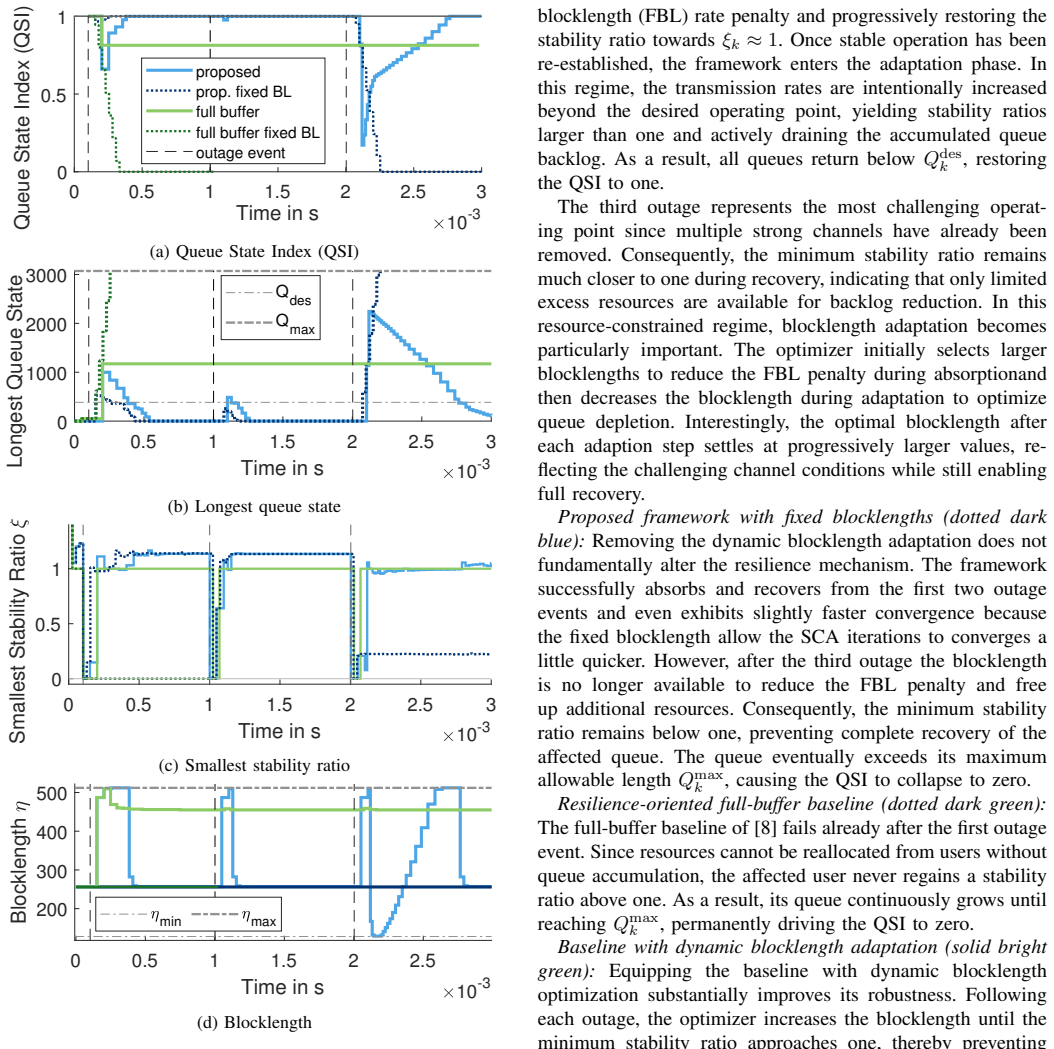
The paper's central claim is that a wireless URLLC system can absorb and recover from abrupt disturbances by explicitly optimizing how long each transmission lasts. Because the achievable rate in the finite-blocklength regime carries a penalty that shrinks as the blocklength grows, the system can use a longer blocklength during a disruption to reduce that penalty and stop queue growth, then switch to a shorter blocklength during recovery to transmit more aggressively and drain the backlog. The paper formalizes this as a two-phase problem — absorption, then adaptation — and claims that jointly optimizing beamforming, RIS phase shifts, and blocklength keeps queues stable through repeated outag
Load-bearing premise
The blocklength-update formulas assume that the best blocklength is the point where the stability-gap function stops changing, but that function curves downward, so the point they identify is a maximum of the gap, not the minimum; the true worst-case-minimizing blocklength sits at one of the allowed endpoints.
Editorial extensions
If this is right
- If the framework holds, a network can survive repeated direct-link outages that a fixed-blocklength policy cannot survive, because the blocklength can be raised during absorption to cut the FBL rate penalty and restore stability.
- The two-phase structure implies that resilience requires deliberately over-serving after an outage — pushing rates above the nominal target to drain accumulated backlog — not just returning to nominal service.
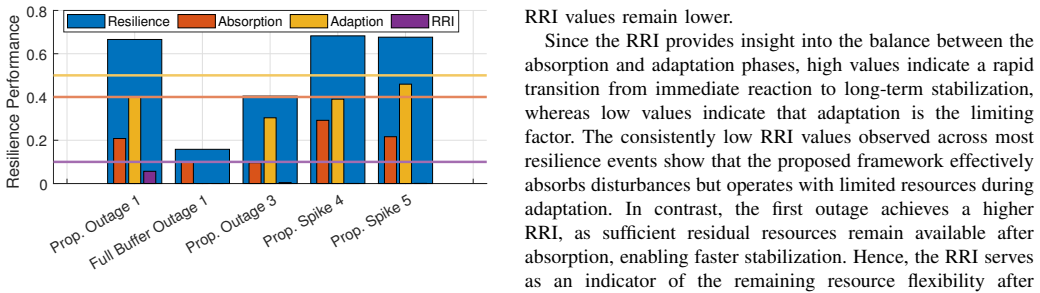
- The metric's decomposition means channel outages and traffic surges can be scored on the same absorption–adaptation–recovery scale, revealing which phase limits a given system.
- The paper's comparisons imply that systems without dynamic blocklength control remain stable at best and permanently degraded at worst, with queues stuck above their desired operating point even when they do not overflow.
Reading between the lines
- The closed-form blocklength formulas (51) and (58)–(60) are obtained by setting the derivative of the stability-gap function to zero, but that function is concave in the square root of the blocklength, so the stationary point is a maximum rather than a minimum; if so, the true blocklength minimizer lies at an endpoint of the allowed range.
- Because the metric and the two-phase formulation are separable from the closed-form solver, a clean test is to replace the blocklength formulas in Algorithm 1 with a simple search over [η_min, η_max]; if the reported recovery behavior changes materially, the formulas are carrying the result, and if not, the framework's qualitative claims survive.
- The paper's imperfect-CSI results point to an extension it leaves implicit: building channel-estimation error into the rate constraints as a robustness margin would likely change when recovery is possible, and the same metric could quantify the benefit.
Editorial analysis
A structured set of objections, weighed in public.
Circularity Check
No circularity: derivation chain is grounded in external FBL/queueing results; self-cited [8] serves only as a baseline, and the proposed metric is a constructed evaluation measure rather than a hidden input.
full rationale
The paper's core model is built on external, independently established components: the finite-blocklength rate expression (9) is from Polyanskiy et al. [23]; the variable slot duration T_q = eta_q/B in (18) is from Durisi et al. [13]; queue stability conditions are from Neely [24]; and the SCA/convexification techniques are standard. The closed-form blocklength expressions (51), (58)-(60) are obtained algebraically from the stated objectives (50) and (P7), not fitted to the simulation outcomes, so they do not constitute a fitted input renamed as a prediction. The resilience metric (30) is a newly defined evaluation measure with explicitly stated weights; using it to compare the proposed algorithm against fixed-blocklength and full-buffer variants is a conventional self-contained evaluation, not a definitional circularity. The main self-citation, [8], is used as a comparison baseline and as an interpretation of blocklength thresholds in the numerical discussion, but it is not load-bearing for the derivation of any analytical result. The skeptical observation that the stationary points in (51) and (58) may be maxima of concave functions rather than minima is a correctness concern about whether the stated optimization is actually solved; it is not a circularity, because the formulas are derived from the objective rather than assumed as the answer. No prediction or first-principles result reduces to its own input by construction.
Assumptions & free parameters
free parameters (6)
- Resilience weights λ1, λ2, λ3 =
0.4, 0.5, 0.1
- Relaxed stability threshold ζ_Thr =
not specified (0<ζ_Thr≪1)
- Penalty constant α_v =
1000
- Virtual queue thresholds Q_des, Q_max =
Q_des=0.25M_p, Q_max=2M_p (or 6M_pβ)
- Blocklength bounds η_min, η_max, η_0 =
128, 512, 256
- CSI error factor ρ_e =
0.05
assumptions (5)
- domain assumption FBL normal approximation (9) with dispersion V(Γ)=1-(1+Γ)^-2 and Gaussian signaling
- domain assumption Quasi-static block fading with T_q ≪ T_coh and MMSE channel estimates
- domain assumption Virtual queue (21) with expected arrivals αdes_k replacing stochastic arrivals; stability condition (17)
- ad hoc to paper Two-phase absorption-adaptation structure and the definitions (24)-(26) are the right resilience model
- ad hoc to paper Quadratic inequality direction in (75) selects the smaller root as the feasible upper bound
invented entities (1)
-
Virtual queue Q_k(t_q)
Cite this review
Pith. "Pith review of From Metric to Mechanism: Designing Wireless Resilience through Finite Blocklength Dynamics." pith.science (2026). https://pith.science/paper/P6EOF2X5
@misc{pith2026260713710,
  author       = {Pith},
  title        = {Pith review of: From Metric to Mechanism: Designing Wireless Resilience through Finite Blocklength Dynamics},
  year         = {2026},
  howpublished = {\url{https://pith.science/paper/P6EOF2X5}},
  note         = {Machine review of arXiv:2607.13710}
}
read the original abstract
Next-generation wireless networks must maintain reliable operation under abrupt and severe disruptions, particularly in ultra-reliable low-latency communication (URLLC) scenarios where strict time constraints dominate system design. This work addresses network resilience from a time-centric perspective by explicitly integrating finite blocklength (FBL) communication, thereby exposing transmission duration as a controllable resource for system recovery. To this end, we propose a unified cross-layer framework that jointly couples queue dynamics, rate adaptation, and blocklength optimization, enabling the system to actively absorb, adapt to, and recover from diverse resilience events. To systematically evaluate these mechanisms, we introduce an interpretable resilience metric that decomposes disruption impact into absorption loss, adaptation efficiency, and recovery behavior, enabling a direct and intuitive assessment of system resilience. Building on this framework, we develop a three-stage alternating optimization approach that jointly optimizes PHY-layer parameters, including beamforming, reconfigurable intelligent surface (RIS) phase shifts, and blocklength, revealing the importance of time-aware resource allocation in the FBL regime. Numerical results demonstrate strong resilience performance under repeated channel disruptions and AI-driven traffic surges, highlighting the effectiveness of cross-layer resource adaptation. Finally, the proposed resilience metric enables an intuitive and consistent comparison of resilience performance across different approaches and disruption types, while revealing their respective strengths and limitations.
Figures


Figures from the paper (4 more)


Reference graph
Works this paper leans on
-
[1]
Towards 6G wireless communication networks: Vision, enabling technologies, and new paradigm shifts,
X. You, C.-X. Wang, J. Huang, X. Gao, Z. Zhang, M. Wang, Y . Huang, C. Zhang, Y . Jiang, J. Wanget al., “Towards 6G wireless communication networks: Vision, enabling technologies, and new paradigm shifts,” Science China information sciences, vol. 64, pp. 1–74, 2021
2021
-
[2]
On the ruin of age of information in aug- mented reality over wireless terahertz (THz) networks,
C. Chaccour and W. Saad, “On the ruin of age of information in aug- mented reality over wireless terahertz (THz) networks,” inGLOBECOM, 2020
2020
-
[3]
A survey on goal-oriented semantic communication: Techniques, challenges, and future directions,
T. M. Getu, G. Kaddoum, and M. Bennis, “A survey on goal-oriented semantic communication: Techniques, challenges, and future directions,” IEEE Access, vol. 12, pp. 51 223–51 274, 2024
2024
-
[4]
Resilience and criticality: Brothers in arms for 6G,
R.-J. Reifert, Y . Karacora, C. Chaccour, A. Sezgin, and W. Saad, “Resilience and criticality: Brothers in arms for 6G,”arXiv preprint arXiv:2412.03661, 2024
arXiv 2024
-
[5]
Comeback kid: Resilience for mixed-critical wireless network resource management,
R.-J. Reifert, S. Roth, A. A. Ahmad, and A. Sezgin, “Comeback kid: Resilience for mixed-critical wireless network resource management,” IEEE Trans. on Vehicul. Techn, vol. 72, no. 12, pp. 16 177–16 194, 2023
2023
-
[6]
Resilient-by-design: A resilience framework for future wireless networks,
N. H. Mahmood, S. Samarakoon, P. Porambage, M. Bennis, and M. Latva-Aho, “Resilient-by-design: A resilience framework for future wireless networks,”IEEE Commun. Mag., vol. 63, no. 11, pp. 158–164, 2025
2025
-
[7]
A vision of 6G wireless systems: Applications, trends, technologies, and open research problems,
W. Saad, M. Bennis, and M. Chen, “A vision of 6G wireless systems: Applications, trends, technologies, and open research problems,”IEEE Network, vol. 34, no. 3, pp. 134–142, 2020
2020
-
[8]
When every symbol counts: Resilient wireless systems under finite blocklength constraints,
K. Weinberger and A. Sezgin, “When every symbol counts: Resilient wireless systems under finite blocklength constraints,” inEurop. Wirel., 2025, pp. 46–51
2025
Show all 27 references
-
[9]
GenAINet: Enabling wireless collective intelligence via knowledge transfer and reasoning,
H. Zou, Q. Zhao, S. Lasaulce, L. Bariah, M. Bennis, and M. Debbah, “GenAINet: Enabling wireless collective intelligence via knowledge transfer and reasoning,”IEEE Access, vol. 13, pp. 77 764–77 777, 2025
2025
-
[10]
Resilience and survivability in communication networks: Strategies, principles, and survey of disciplines,
J. P. Sterbenz, D. Hutchison, E. K. C ¸ etinkaya, A. Jabbar, J. P. Rohrer, M. Sch¨oller, and P. Smith, “Resilience and survivability in communication networks: Strategies, principles, and survey of disciplines,”Computer networks, vol. 54, no. 8, pp. 1245–1265, 2010
2010
-
[11]
Design and assessment methodology for system resilience metrics,
M. Najarian and G. J. Lim, “Design and assessment methodology for system resilience metrics,”Risk Anal., vol. 39, no. 9, pp. 1885–1898, 2019
2019
-
[12]
Resource allocation and beamforming design in the short blocklength regime for URLLC,
A. A. Nasir, H. D. Tuan, H. H. Nguyen, M. Debbah, and H. V . Poor, “Resource allocation and beamforming design in the short blocklength regime for URLLC,”IEEE Trans. on Wirel. Commun., vol. 20, no. 2, pp. 1321–1335, 2021
2021
-
[13]
Toward massive, ultrareliable, and low-latency wireless communication with short packets,
G. Durisi, T. Koch, and P. Popovski, “Toward massive, ultrareliable, and low-latency wireless communication with short packets,”Proceedings of the IEEE, vol. 104, no. 9, pp. 1711–1726, 2016
2016
-
[14]
Wireless communications through reconfigurable intelligent surfaces,
E. Basar, M. Di Renzo, J. De Rosny, M. Debbah, M.-S. Alouini, and R. Zhang, “Wireless communications through reconfigurable intelligent surfaces,”IEEE access, vol. 7, pp. 116 753–116 773, 2019
2019
-
[15]
Synergistic benefits in IRS- and RS-enabled C-RAN with energy-efficient clustering,
K. Weinberger, A. A. Ahmad, A. Sezgin, and A. Zappone, “Synergistic benefits in IRS- and RS-enabled C-RAN with energy-efficient clustering,” IEEE Trans. on Wirel. Commun., 2022
2022
-
[16]
ResCTC: Resilience in wireless networks through cross-technology communication,
A. Zubow, I. v. Stebut, S. R ¨osler, and F. Dressler, “ResCTC: Resilience in wireless networks through cross-technology communication,” in2024 IEEE 35th PIMRC, 2024, pp. 1–6
2024
-
[17]
Resilient-native and intelligent next-generation wireless systems: Key enablers, foundations, and applications,
M. Bennis, S. Samarakoon, T. Alshammari, C. Weeraddana, Z. Tian, and C. B. Issaid, “Resilient-native and intelligent next-generation wireless systems: Key enablers, foundations, and applications,”arXiv preprint arXiv:2506.22991, 2025
2025 arXiv
-
[18]
Cross-layer optimization for ultra- reliable and low-latency radio access networks,
C. She, C. Yang, and T. Q. S. Quek, “Cross-layer optimization for ultra- reliable and low-latency radio access networks,”IEEE Trans. on Wirel. Commun., vol. 17, no. 1, pp. 127–141, 2018
2018
-
[19]
Optimization of the downlink spectral- and energy- efficiency of RIS- aided multi-user URLLC MIMO systems,
M. Soleymani, I. Santamaria, E. A. Jorswieck, R. Schober, and L. Hanzo, “Optimization of the downlink spectral- and energy- efficiency of RIS- aided multi-user URLLC MIMO systems,”IEEE Trans. on Commun., vol. 73, no. 5, pp. 3497–3513, 2025
2025
-
[20]
RIS-enhanced resilience in cell-free MIMO,
K. Weinberger, R.-J. Reifert, A. Sezgin, and E. Basar, “RIS-enhanced resilience in cell-free MIMO,” inWSA and SCC, 2023
2023
-
[21]
Joint optimization of URLLC parameters and beamforming design for multi-RIS-aided MU- MISO URLLC system,
S. Pala, K. Singh, M. Katwe, and C.-P. Li, “Joint optimization of URLLC parameters and beamforming design for multi-RIS-aided MU- MISO URLLC system,”IEEE Wirel. Commun. Lett., vol. 12, no. 1, pp. 148–152, 2023
2023
-
[22]
Intelligent reflecting surface-assisted multi-user MISO communication: Channel estimation and beamforming design,
Q.-U.-A. Nadeem, H. Alwazani, A. Kammoun, A. Chaaban, M. Debbah, and M.-S. Alouini, “Intelligent reflecting surface-assisted multi-user MISO communication: Channel estimation and beamforming design,” IEEE OJCOM, vol. 1, pp. 661–680, 2020
2020
-
[23]
Channel coding rate in the finite blocklength regime,
Y . Polyanskiy, H. V . Poor, and S. Verdu, “Channel coding rate in the finite blocklength regime,”IEEE Trans. on Inform. Theory, vol. 56, no. 5, pp. 2307–2359, 2010
2010
-
[24]
Introduction to queues,
M. J. Neely, “Introduction to queues,” inStoch. Network Opt. with Appl. to Commun. and Queueing Systems. Springer, 2010, pp. 15–28
2010
-
[25]
Accelerated recovery with RIS: Designing wireless resilience in mission-critical environments,
K. Weinberger, R.-J. Reifert, A. Sezgin, and M. Bennis, “Accelerated recovery with RIS: Designing wireless resilience in mission-critical environments,”arXiv preprint arXiv:2504.11589, 2025
2025 arXiv
-
[26]
Max-min fairness and PHY-layer design of uplink MIMO rate-splitting multiple access with finite blocklength,
J. Xu and B. Clerckx, “Max-min fairness and PHY-layer design of uplink MIMO rate-splitting multiple access with finite blocklength,”IEEE Trans. on Commun., vol. 73, no. 5, pp. 3671–3682, 2025. Kevin Weinbergerreceived the B.Sc. and M.Sc. degrees in electrical engineering and i...
2025
-
[2009]
He has co-authored articles that received the Best Poster Award at the IEEE Communication Theory Workshop, in 2011, the Best Paper Award at ICCSPA, in 2015, ICC, in 2019, and ISAP, in 2023. Mehdi Bennis(Fellow, IEEE) is a Full (Tenured) Professor with the Centre for Wireless C...
2011
Reviewed August 2, 2026 · model on record in the stance chip above.
Discussion (0). Continue with ORCID to comment.