REVIEW 5 major objections 6 minor 25 references
Learning Robust Execution in Robotic Manipulation with Agentic Reinforcement Learning
T0 review · 5 major / 6 minor · reviewed 2026-08-02 · deepseek-v4-flash
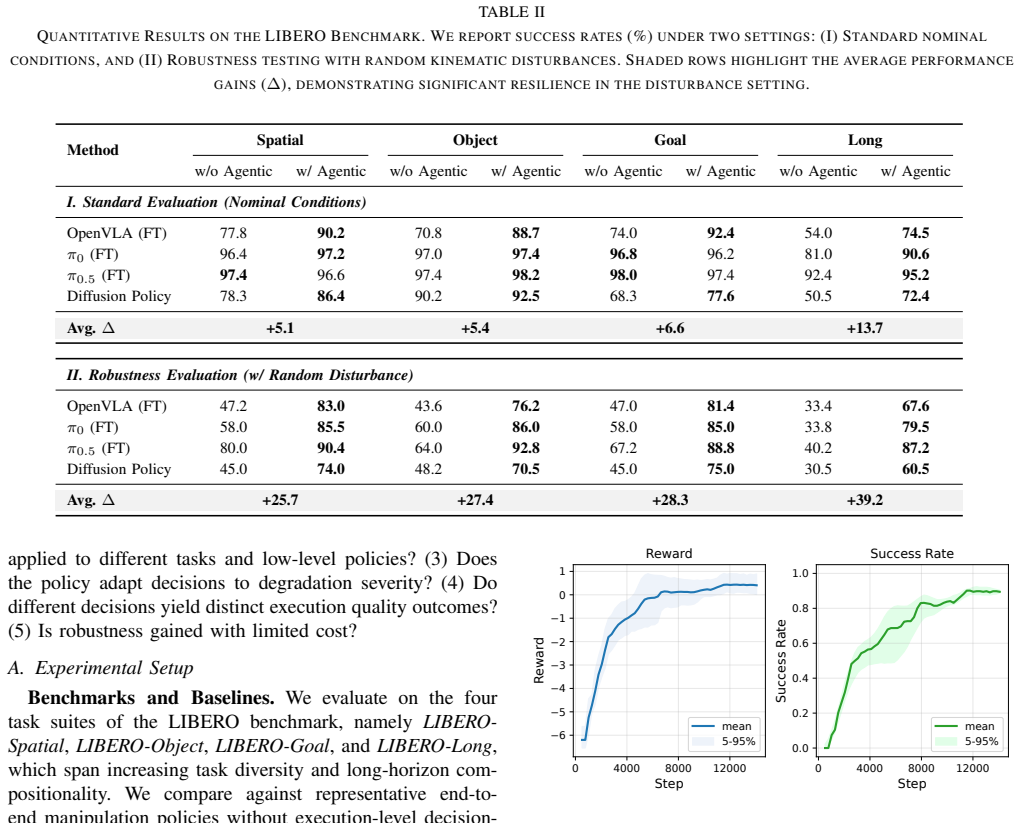
Pith's one-line read The paper argues that a frozen manipulation policy can be made resilient to execution-level failures by adding a lightweight learned manager that chooses among four recovery modes, raising success rates by up to 13.7% nominally and 39.2% un
desk verdict Plausible but incremental execution wrapper for frozen VLA policies; the learning claim needs a fixed-recovery baseline before it holds. read the letter →
The pith
A machine-rendered reading of the paper's core claim, the machinery that carries it, and where it could break.
The reading
What carries the argument
The load-bearing object is a POMDP formulation of execution management, with a discrete action space A={EXECUTE, RETRY, REPAIR, RESET}. The agentic policy receives an execution history (the last L steps of proprioception, low-level actions, and q_local/q_global) and is trained with PPO. The quality metrics bridge raw execution and decision: q_local aggregates motion effectiveness (distance moved divided by commanded action magnitude) and smoothness (inverse coefficient of variation of speed); q_global compares a feature vector of the recent window against k-nearest neighbors in progress-binned reference trajectories. Recovery is realized by an operational space controller that returns the ro
What would settle it
Train the agentic wrapper on a task where the frozen policy succeeds in fewer than, say, 10 of 50 attempts, so the reference library is thin or biased; if the method requires the full 50 to trigger recovery, its gains should shrink to the baseline. Alternatively, inject a disturbance type that the recovery mechanisms do not cover — for instance, an object dropped out of the workspace — and check whether the success rate with the agentic policy remains close to the baseline, indicating the recovery ladder is not actually selecting appropriate responses.
Extended reading notes
Core claim
The paper's central claim is that execution-level degradation in robotic manipulation can be detected and corrected by a high-level agentic policy trained with PPO, which regulates a frozen low-level policy. Rather than generating new actions, the agentic policy selects among four execution modes, using two metrics: local execution quality (motion effectiveness and smoothness in a sliding window) and global execution quality (distance of the current trajectory prefix to a stage-aware library of successful reference trajectories). When quality drops, RETRY rolls back to the best recent state, REPAIR rolls back to a contact-free state further in the past, and RESET restarts the episode. The au
Load-bearing premise
The global quality score relies on a pre-collected library of 50 successful trajectories per task; if such trajectories cannot be obtained for a task, or the fixed binning and distance thresholds are not representative, the agentic policy cannot detect drift and the recovery gains collapse.
Editorial extensions
If this is right
- The framework converts failure-prone policies (OpenVLA, diffusion) into substantially more reliable executors, with the largest gains on LIBERO-Long, the most compositionally difficult suite.
- Because the low-level policy stays frozen, the approach can wrap any existing manipulation policy without retraining it or collecting new demonstrations.
- Recovery decisions are interpretable: mild degradations trigger RETRY, collisions trigger REPAIR, and irrecoverable states trigger RESET, and each decision measurably improves subsequent execution quality.
- Overhead is modest — roughly one to two extra recoveries and 5–15% longer episodes, scaling with the fragility of the base policy.
Reading between the lines
- The stage-aware reference library suggests a natural generalization: the same rollout library could be built online during deployment, letting the system adapt to new tasks without a separate collection phase.
- The binary contact indicator (threshold 5 N) hints that the rollback selection could be transferred to real hardware using any contact-force proxy, but the hand-set parameters (B=10, k=5, alpha, lambda, M, N) would likely need per-domain tuning.
- A testable extension is to replace the hand-designed q_local with a learned critic of the same variables, potentially removing the manual sensitivity constants while retaining the recovery structure.
- The framing as execution management rather than replanning implies a separation that could also apply to non-manipulation domains like mobile navigation, where a frozen planner could be regulated by a similar agentic loop.
Signed reviews
Editorial analysis
A structured set of objections, weighed in public.
Referee Report
Summary. The paper proposes an execution-level wrapper for frozen low-level manipulation policies. It introduces a local execution quality metric (Eqs. 1-4) and a global execution quality metric based on a reference library of successful trajectories, aggregates them into q_agg (Eq. 5), and trains a high-level PPO policy over four discrete modes: EXECUTE, RETRY, REPAIR, and RESET. The agentic policy observes a history of proprioception, low-level actions, and quality scores, and triggers recovery mechanisms without modifying the frozen policy. Experiments on LIBERO with OpenVLA, π0, π0.5, and Diffusion Policy report success-rate improvements up to +13.7% average under standard conditions and +39.2% under injected disturbances.
Significance. If the learned agentic selection is indeed the cause of the reported gains, the approach would be a lightweight, policy-agnostic mechanism for improving robustness of VLAs and diffusion policies without retraining, with interpretable decisions and modest overhead. The paper addresses a real gap in current VLA deployment and its design is sensible. However, the evidence as presented bundles the fixed recovery mechanisms with the learned policy, lacks statistical uncertainty measures on the main table, and leaves several load-bearing hyperparameters unspecified. The significance is therefore conditional on addressing these empirical gaps.
major comments (5)
- [§V-A, Table II] The 'w/o Agentic' vs 'w/ Agentic' comparison bundles two interventions: (i) the execution-quality metrics plus fixed recovery primitives (RETRY/REPAIR/RESET, §IV-B) and (ii) the learned PPO policy that selects when to invoke them (§IV-C). No baseline uses the same metrics and recovery mechanisms with fixed or hand-coded triggering. A threshold policy — e.g., RETRY when q_agg drops below a threshold, REPAIR when contact is sustained, RESET after prolonged low quality — is needed to isolate the value of learning. Without such a control, the reported +13.7/+39.2 gains may be due to the recovery primitives alone, which would weaken the central 'learning' claim.
- [Table II, §V-B] The main results are single point estimates with no error bars, number of seeds, or significance tests. Figure 5 provides 95% CIs only for one training run (LIBERO-Spatial/OpenVLA). The text's claim of 'consistent improvements' is contradicted by the π0.5 rows: 97.4→96.6 (Spatial) and 98.0→97.4 (Goal) under standard settings. Without variability information, the reader cannot tell whether these are noise or genuine degradations. All rows of Table II should be repeated over seeds and reported with CIs, or the claim must be revised.
- [§V-A, RESET counting] The paper states 'episodes in which RESET is invoked are counted as failures to ensure fair comparison.' This means an episode that invokes RESET and subsequently completes the task is scored as a failure, so the reported success rate is not simply task completion. This unusual criterion can distort the comparison and makes the metric less interpretable. Please report both the standard task-completion rate and the RESET-invoked rate, or justify why the current definition is appropriate.
- [§IV-A.2, Eqs. (4)-(5)] The global quality signal depends on a reference library of N=50 successful trajectories per task and on hand-set parameters B=10, k=5, α, λ, W, c, w1, w2, b, β, τ, M, N. No sensitivity analysis is provided. If the frozen policy cannot reliably produce 50 successful trajectories for a task, or if these thresholds do not transfer, the global quality signal is undefined. The paper should report the actual numerical values used and include ablations over at least N, B, k, α, and λ. Without this, the transferability claim in §VI is not supported.
- [§V-A, training/evaluation] The text says 'The agentic policy is trained separately for each task' but also 'Training spans multiple tasks within each LIBERO subset.' These statements conflict. If the agentic policy is trained and evaluated on the same task, the comparison is in-distribution; if one policy is trained across tasks and evaluated on held-out tasks, the experimental protocol should state this explicitly and avoid any risk of leakage. Please clarify the exact train/test split for each row in Table II.
minor comments (6)
- [Author affiliation] Typo in affiliation: 'Inteligence' should be 'Intelligence'.
- [Table II] The table formatting has minor issues: 'A vg.∆' and the use of shaded rows should be cleaned up for clarity.
- [Fig. 6] The 'execution degradation types' are described as manually inspected and categorized. Please define the taxonomy and the criteria used, otherwise the conditional distribution in Fig. 6 is not reproducible.
- [§IV-A, Eq. (3)] The 'inverse coefficient of variation' definition is unusual: S = 1/(1+σ²/μ²). Please clarify the relationship to the standard coefficient of variation and why this particular bounded form is used.
- [§IV-C] It is stated that information generated during recovery phases is not recorded in the execution history. Please specify whether the history length L=20 refers to low-level steps before the recovery or after, and how the decision interval K interacts with recovery phases.
- [References] Reference [15] uses the notation 'π∗0.6', which is inconsistent with the π0/π0.5 notation used elsewhere. Please standardize.
Circularity Check
No significant circularity: the evaluation is task success independently measured, and the learned policy is optimized on task rewards rather than on the quality metrics it observes.
full rationale
The paper's derivation chain is not circular. The claimed outcome is task success rate from the environment (Table II), computed independently of the proposed q_local/q_global metrics. The RL objective (Eq. 7) uses terminal success/failure (+1/-1), a time penalty, and fixed recovery costs; it does not regress on the q_global reference library or optimize the quality scores themselves. The global quality metric is constructed from 50 successful trajectories of the frozen policy (Sec. IV-A.2) and is used only as an observation and as a rollback-state selector in the recovery mechanisms (Sec. IV-B), not as the training target or the success criterion. While the reference library and the q_agg-based rollback introduce design assumptions whose independent value could be probed (e.g., a fixed-threshold recovery baseline is not reported), lack of an ablation is a confound/correctness concern, not a circular reduction: no equation defines the reported gains in terms of the metric, and no fitted parameter is renamed as a prediction. The paper also does not rely on load-bearing self-citations or on an imported uniqueness theorem; the references are external prior work. Therefore the central empirical claim stands on its own measured outcomes.
Assumptions & free parameters
free parameters (15)
- Local metric window W =
not reported
- Saturation constant c =
not reported
- Sigmoid threshold b and sensitivity k =
not reported
- Quality weights w1, w2 =
not reported
- EMA smoothing beta =
not reported
- Global quality sensitivity alpha =
not reported
- Aggregation weight lambda =
not reported
- Rollback horizons M, N =
M=15, N=30
- Contact threshold tau =
5 N
- Decision interval K =
5
- History length L =
20
- Recovery costs =
-0.1 / -0.3 / -0.5
- Reference library size and neighbors =
N=50, k=5
- Progress bins B =
10
- Disturbance magnitude and duration =
delta=3.0, 5 steps
assumptions (6)
- domain assumption Successful reference trajectories collected from the frozen policy are representative of nominal execution at deployment.
- domain assumption Rolling back to a previously visited high-quality state and resuming the frozen policy restores nominal execution.
- ad hoc to paper The hand-crafted quality metrics are sufficient statistics of execution health, and their thresholds transfer across tasks and policies.
- domain assumption MuJoCo's contact-force threshold tau=5 N reliably identifies contact-free states across tasks.
- domain assumption LIBERO success rate is a valid proxy for real-world manipulation robustness.
- domain assumption PPO with sparse task-level rewards and a privileged critic trains a stable agentic policy.
Cite this review
Pith. "Pith review of Learning Robust Execution in Robotic Manipulation with Agentic Reinforcement Learning." pith.science (2026). https://pith.science/paper/SEF3O5PG
@misc{pith2026260713818,
  author       = {Pith},
  title        = {Pith review of: Learning Robust Execution in Robotic Manipulation with Agentic Reinforcement Learning},
  year         = {2026},
  howpublished = {\url{https://pith.science/paper/SEF3O5PG}},
  note         = {Machine review of arXiv:2607.13818}
}
read the original abstract
Robotic manipulation poses fundamental challenges due to uncertainty, long-horizon execution, and compounding errors, which can easily destabilize execution and lead to task failure. Although recent vision-language-action (VLA) models exhibit strong generalization, they typically lack explicit mechanisms to assess execution stability and to recover when execution deviates from its nominal behavior. In this paper, we propose: (1) two complementary metrics to assess execution quality at runtime, and (2) an agentic reinforcement learning framework that learns to restore effective execution through high-level decision-making rather than directly learning low-level actions. In this framework, an agentic policy reasons over recent execution history and selects among a small set of execution modes to regulate the execution process. Under execution degradation, it triggers appropriate recovery mechanisms to restore the robot to previously visited nominal states, enabling the task to continue. We evaluate the proposed method on the LIBERO benchmark, achieving up to a 13.7% improvement in success rate under standard settings and up to a 39.2% improvement under disturbance settings, demonstrating substantially enhanced execution robustness.
Figures


Figures from the paper (3 more)


Reference graph
Works this paper leans on
-
[1]
Towards a unified understand- ing of robot manipulation: A comprehensive survey,
S. Bai, W. Song, J. Chen, Y . Ji, Z. Zhong, J. Yang, H. Zhao, W. Zhou, W. Zhao, Z. Li,et al., “Towards a unified understand- ing of robot manipulation: A comprehensive survey,”arXiv preprint arXiv:2510.10903, 2025
arXiv 2025
-
[2]
Embodied robot manipulation in the era of foundation models: Planning and learning perspectives,
S. Bai, W. Song, J. Chen, Y . Ji, Z. Zhong, J. Yang, H. Zhao, W. Zhou, Z. Li, P. Ding,et al., “Embodied robot manipulation in the era of foundation models: Planning and learning perspectives,”arXiv preprint arXiv:2512.22983, 2025
arXiv 2025
-
[3]
Vision- language-action models for robotics: A review towards real-world applications,
K. Kawaharazuka, J. Oh, J. Yamada, I. Posner, and Y . Zhu, “Vision- language-action models for robotics: A review towards real-world applications,”IEEE Access, 2025
2025
-
[4]
Recoverychaining: Learning local recovery policies for robust ma- nipulation,
S. Vats, D. K. Jha, M. Likhachev, O. Kroemer, and D. Romeres, “Recoverychaining: Learning local recovery policies for robust ma- nipulation,” in2025 IEEE/RSJ International Conference on Intelligent Robots and Systems (IROS), 2025, pp. 9776–9783
2025
-
[5]
Robustvla: Robustness-aware reinforcement post-training for vision-language- action models,
H. Zhang, S. Zhang, J. Jin, Q. Zeng, R. Li, and D. Wang, “Robustvla: Robustness-aware reinforcement post-training for vision-language- action models,”arXiv preprint arXiv:2511.01331, 2025
arXiv 2025
-
[6]
Open- vla: An open-source vision-language-action model,
M. J. Kim, K. Pertsch, S. Karamcheti, T. Xiao, A. Balakrishna, S. Nair, R. Rafailov, E. Foster, G. Lam, P. Sanketi,et al., “Open- vla: An open-source vision-language-action model,”arXiv preprint arXiv:2406.09246, 2024
arXiv 2024
-
[7]
π 0: A vision-language- action flow model for general robot control,
K. Black, N. Brown, D. Driess, A. Esmail, M. Equi, C. Finn, N. Fusai, L. Groom, K. Hausman, B. Ichter,et al., “π 0: A vision-language- action flow model for general robot control,” inProceedings of Robotics: Science and Systems (RSS), 2025
2025
-
[8]
π 0.5: a vision-language-action model with open-world generalization,
P. Intelligence, K. Black, N. Brown, J. Darpinian, K. Dhabalia, D. Driess, A. Esmail, M. Equi, C. Finn, N. Fusai,et al., “π 0.5: a vision-language-action model with open-world generalization,” in9th Annual Conference on Robot Learning (CoRL), 2025
2025
Show all 25 references
-
[9]
Agentic robot: A brain-inspired framework for vision-language-action models in embodied agents,
Z. Yang, Y . Chen, X. Zhou, J. Yan, D. Song, Y . Liu, Y . Li, Y . Zhang, P. Zhou, H. Chen,et al., “Agentic robot: A brain-inspired framework for vision-language-action models in embodied agents,”arXiv preprint arXiv:2505.23450, 2025
2025 arXiv
-
[10]
Aha: A vision- language-model for detecting and reasoning over failures in robotic manipulation,
J. Duan, W. Pumacay, N. Kumar, Y . R. Wang, S. Tian, W. Yuan, R. Krishna, D. Fox, A. Mandlekar, and Y . Guo, “Aha: A vision- language-model for detecting and reasoning over failures in robotic manipulation,” inProceedings of the International Conference on Learning Representat...
2025
-
[11]
On the vulnerability of llm/vlm- controlled robotics,
X. Wu, S. Chakraborty, R. Xian, J. Liang, T. Guan, F. Liu, B. M. Sadler, D. Manocha, and A. S. Bedi, “On the vulnerability of llm/vlm- controlled robotics,” in2025 IEEE/RSJ International Conference on Intelligent Robots and Systems (IROS), 2025, pp. 1914–1921
2025
-
[12]
Diffusion policy: Visuomotor policy learning via action diffusion,
C. Chi, Z. Xu, S. Feng, E. Cousineau, Y . Du, B. Burchfiel, R. Tedrake, and S. Song, “Diffusion policy: Visuomotor policy learning via action diffusion,”The International Journal of Robotics Research, vol. 44, no. 10-11, pp. 1684–1704, 2025
2025
-
[13]
Libero: Benchmarking knowledge transfer for lifelong robot learn- ing,
B. Liu, Y . Zhu, C. Gao, Y . Feng, Q. Liu, Y . Zhu, and P. Stone, “Libero: Benchmarking knowledge transfer for lifelong robot learn- ing,”Advances in Neural Information Processing Systems, vol. 36, pp. 44 776–44 791, 2023
2023
-
[14]
Rt-2: Vision-language-action models transfer web knowledge to robotic control,
B. Zitkovich, T. Yu, S. Xu, P. Xu, T. Xiao, F. Xia, J. Wu, P. Wohlhart, S. Welker, A. Wahid,et al., “Rt-2: Vision-language-action models transfer web knowledge to robotic control,” in7th Annual Conference on Robot Learning (CoRL), 2023, pp. 2165–2183
2023
-
[15]
π ∗ 0.6: a vla that learns from experience,
P. Intelligence, A. Amin, R. Aniceto, A. Balakrishna, K. Black, K. Conley, G. Connors, J. Darpinian, K. Dhabalia, J. DiCarlo, et al., “π ∗ 0.6: a vla that learns from experience,”arXiv preprint arXiv:2511.14759, 2025
2025 arXiv
-
[16]
Long-vla: Unleashing long-horizon capability of vision language action model for robot manipulation,
Y . Fan, P. Ding, S. Bai, X. Tong, Y . Zhu, H. Lu, F. Dai, W. Zhao, Y . Liu, S. Huang,et al., “Long-vla: Unleashing long-horizon capability of vision language action model for robot manipulation,” in9th Annual Conference on Robot Learning (CoRL), 2025
2025
-
[17]
Seqvla: Sequential task ex- ecution for long-horizon manipulation with completion-aware vision- language-action model,
R. Yang, Z. An, L. Zhou, and Y . Feng, “Seqvla: Sequential task ex- ecution for long-horizon manipulation with completion-aware vision- language-action model,”arXiv preprint arXiv:2509.14138, 2025
2025
-
[18]
Vision language action models in robotic manipulation: A systematic review,
M. U. Din, W. Akram, L. S. Saoud, J. Rosell, and I. Hussain, “Vision language action models in robotic manipulation: A systematic review,” arXiv preprint arXiv:2507.10672, 2025
2025
-
[19]
Failure-aware rl: Reliable offline-to-online reinforcement learn- ing with self-recovery for real-world manipulation,
H. Li, K. Lei, S. Zang, K. Hu, Y . Liang, B. An, X. Li, and H. Xu, “Failure-aware rl: Reliable offline-to-online reinforcement learn- ing with self-recovery for real-world manipulation,”arXiv preprint arXiv:2601.07821, 2026
2026
-
[20]
Back to the manifold: Recovering from out-of-distribution states,
A. Reichlin, G. L. Marchetti, H. Yin, A. Ghadirzadeh, and D. Kragic, “Back to the manifold: Recovering from out-of-distribution states,” in 2022 IEEE/RSJ International Conference on Intelligent Robots and Systems (IROS), 2022, pp. 8660–8666
2022
-
[21]
Unpacking failure modes of generative policies: Runtime monitoring of consistency and progress,
C. Agia, R. Sinha, J. Yang, Z.-a. Cao, R. Antonova, M. Pavone, and J. Bohg, “Unpacking failure modes of generative policies: Runtime monitoring of consistency and progress,” in8th Annual Conference on Robot Learning (CoRL), 2024
2024
-
[22]
Failure prediction at runtime for generative robot policies,
R. Römer, A. Kobras, L. Worbis, and A. P. Schoellig, “Failure prediction at runtime for generative robot policies,”Advances in Neural Information Processing Systems, vol. 38, 2025
2025
-
[23]
Hierarchical reinforcement learning: A comprehensive survey,
S. Pateria, B. Subagdja, A.-h. Tan, and C. Quek, “Hierarchical reinforcement learning: A comprehensive survey,”ACM Computing Surveys (CSUR), vol. 54, no. 5, pp. 1–35, 2021
2021
-
[24]
Mujoco: A physics engine for model-based control,
E. Todorov, T. Erez, and Y . Tassa, “Mujoco: A physics engine for model-based control,” in2012 IEEE/RSJ International Conference on Intelligent Robots and Systems (IROS), 2012, pp. 5026–5033
2012
-
[25]
Proximal policy optimization algorithms,
J. Schulman, F. Wolski, P. Dhariwal, A. Radford, and O. Klimov, “Proximal policy optimization algorithms,”arXiv preprint arXiv:1707.06347, 2017
2017 arXiv
Reviewed August 2, 2026 · model on record in the stance chip above.
Discussion (0). Continue with ORCID to comment.