REVIEW 3 major objections 4 minor 35 references
Combinations and chromatography of paths of Kleinian groups
T0 review · 3 major / 4 minor · reviewed 2026-08-02 · deepseek-v4-flash
Pith's one-line read A continuous path in hyperbolic 3-space exists along which every group is a different isomorphism type.
desk verdict Genuinely new path-combination theorem plus an exotic pairwise-non-isomorphic path in D_3; the main gap is an unproved ping-pong conjugacy assertion, and the decomposition section leans heavily on the author's unpublished preprint. read the letter →
The pith
A machine-rendered reading of the paper's core claim, the machinery that carries it, and where it could break.
The reading
What carries the argument
The load-bearing object is the path-level Combination Theorem. Given a locally finite collection of paths P:I→D_n and disjoint closed sets A_P with uniform separation, if every nonidentity element ψ∈P(s) satisfies ψ(H^n−A_P)⊂A_P, then the union of the groups P(s) generates a discrete group Π(s) for each s, and s↦Π(s) is continuous in the Chabauty topology. The proof works by tracking reduced words: a distance inequality bounds word length uniformly near a limit, so convergent elements in the generated groups must be products of convergent elements in the constituent paths. Around this core, the paper develops tracking maps that carry elements of P(0) through a path until they 'go to infinity
What would settle it
For one prime p from Lemma 3.2, take the non-cyclic convex cocompact group Γ_p with H_1 = Z^2⊕Z/p and try to find a round disk D such that every nonidentity element maps the complementary disk into D. A concrete computation: choose two noncommuting elements a and b and test the commutator [a,b] on a point far outside D; if [a,b] sends that point back outside D for every candidate D, then the asserted conjugates cannot exist, and Theorem A's continuity argument collapses at that step.
Extended reading notes
Core claim
The central claim is Theorem A (the Binary Path): there is a continuous map Φ:[0,1]→D_3 such that Φ(t)≅Φ(s) iff t=s. The construction takes a sequence of primes p_n and, for each n and a range of integers m, attaches a convex cocompact group whose first homology contains a Z/p_n factor; as t moves, these factors switch on and off in a pattern that reproduces the binary expansion of t. The torsion of the abelianization of Φ(t) therefore determines t uniquely. Continuity is proved by a combination theorem for paths: a locally finite family of paths, each carrying a disjoint closed half-space and each nonidentity element sending the complement of its half-space into that half-space, generates a
Load-bearing premise
The Binary Path construction assumes without proof that each convex cocompact group Γ_{p_n} can be conjugated so that a single fixed half-space A_{n,m} absorbs the complement under every non-identity element; this half-space ping-pong condition is what makes the Combination Theorem apply, so if such conjugates do not exist the path is not known to be continuous.
Editorial extensions
If this is right
- If Theorem A is correct, the Chabauty space D_3 contains a continuous path with pairwise non-isomorphic groups, and the same embedding of H^3 into H^n makes such paths exist in every D_n, n≥3.
- The Binary Path shows that isomorphism type is a complete invariant along this particular path: the torsion of the abelianization recovers the parameter t exactly.
- The path-level Combination Theorem turns any sufficiently separated family of isomorphism bump paths into a continuous path, so it gives a general construction method for exotic paths in D_n.
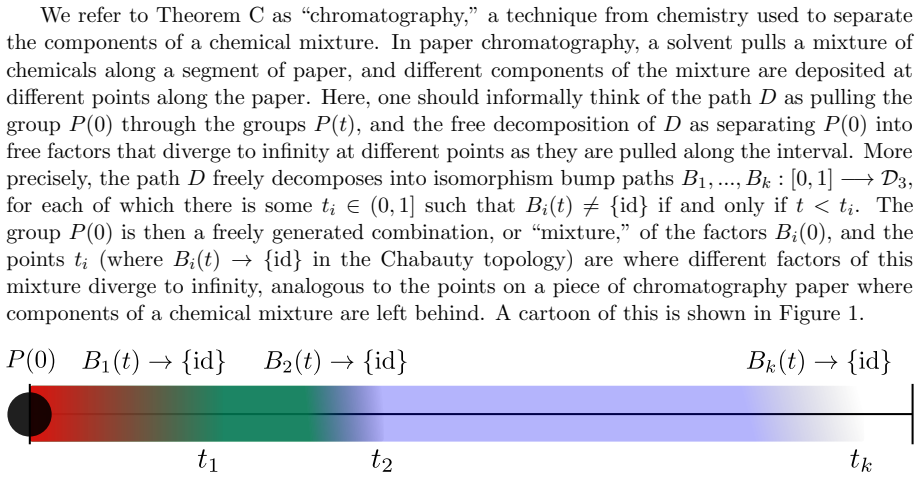
- Theorem C guarantees that every convex cocompact path P in D_3 has a companion path D starting at P(0) which stays a free factor and splits into finitely many isomorphism bump paths.
- Example 4.16 shows the stronger statement — that every convex cocompact path itself freely decomposes into isomorphism bump paths — is false in general.
Reading between the lines
- The binary/torsion coding is a template for other injective paths: any sequence of finite abelian groups that can be realized as homology torsion of convex cocompact Kleinian groups should yield a path with pairwise non-isomorphic groups, as long as the half-space ping-pong condition can be met.
- The cardinality contrast with D_2 (only countably many isomorphism types along any path) suggests that the binary path is essentially a 3-dimensional phenomenon; a natural question the author leaves implicit is whether a path with pairwise non-isomorphic groups can be built in D_n without homology coding, using only geometry of the limit sets.
- The unproved conjugation assertion in Section 3.2 is the step most worth stress-testing: if some Γ_{p_n} cannot be conjugated to send the complement of a single half-space into that half-space, then the Binary Path's continuity argument would need a new ingredient, and the theorem would survive only in a weaker form.
Signed reviews
Editorial analysis
A structured set of objections, weighed in public.
Referee Report
Summary. The paper studies continuous paths in the Chabauty space D_n of torsion-free discrete subgroups of Isom^+(H^n). It proves a combination theorem for paths (Theorem B), uses it to construct a 'Binary Path' Φ:[0,1]→D_3 along which the isomorphism type is injective as a function of t, with the binary expansion of t encoded in the torsion of the abelianization of Φ(t) (Theorem A), and introduces 'chromatography', a decomposition theorem for convex cocompact paths in D_3 (Theorem C). A final example shows that not every convex cocompact path freely decomposes into isomorphism bump paths.
Significance. If the stated results are correct, Theorem A is a striking contribution to the study of the Chabauty topology: it gives a continuous path through pairwise non-isomorphic Kleinian groups, with an explicit and checkable invariant. Theorem B is a natural and potentially useful combination tool for paths, and Theorem C introduces an appealing structural framework for decomposing convex cocompact paths. The paper is ambitious, carefully written, and the constructions are concrete. However, two load-bearing gaps—one in the proof of Theorem A and one in the dependence on the author's unpublished preprint—need to be addressed before the paper can be accepted.
major comments (3)
- [Section 3.2, proof of Theorem A] The sentence 'Since each Γ_{p_n} has non-empty domain of discontinuity, for any m∈Z there is a PSL_2C conjugate Γ_{n,m}^{p_n} of Γ_{p_n} such that ψ(H^3−A_{n,m})⊂A_{n,m} for all ψ≠id' is unproved. This is exactly hypothesis (3) of Theorem B, and without it the paths B_{n,m} cannot be shown to satisfy the hypotheses of the Combination Theorem; the continuity of Φ is therefore not established. The statement is plausible—one can choose a point in the domain of discontinuity with trivial stabilizer and a sufficiently small boundary disk avoiding its orbit, then conjugate—but the manuscript needs a proof or a precise reference. As written this is a genuine gap in the proof of the paper's central theorem.
- [Sections 4.1–4.2] The proof of Theorem C relies on the tracking maps J_{s,t} and their properties, imported as Proposition 4.2 and Lemma 4.3 from the author's unpublished preprint [34] (see also Lemma 4.5's use of '[34, Prop. 4.3]'). These are the core machinery for identifying free factors along paths. Without a proof or a published, refereed version of [34], the decomposition theorem cannot be verified from this manuscript alone. Please include the needed statements and proofs, or provide a complete reference to a refereed source.
- [Section 4.2, Proposition 4.9 (footnote 2)] The proof of Proposition 4.9 uses a corrected version of Bowditch's theorem stated only in a footnote: CC(M)⊂M^{≤η}∪W∪N_η(C). The footnote says this follows by 'filling 2-spheres...', but no proof is supplied. Since this inclusion is used to show that an embedded thick convex core gives a free factor, it is load-bearing. Please provide a detailed proof of the modified assertion or a reference where it is proved.
minor comments (4)
- [Example 3.3] The path B:R→D_3 is only defined for t∈[0,1] (with B(0)=B(1)={id}); outside [0,1] it should be set to {id} to match the statement.
- [Theorem A proof] The displayed formula Ab_tor(Φ(t)) ∼= ∏ Ab_tor(B_{n,m}(t)) is misleading: the abelianization of an infinite free product is the direct sum of the abelianizations, not the Cartesian product. The subsequent counting arguments should be phrased for the direct sum (or 'restricted direct product').
- [Theorem B statement] The proof chooses a point q∈H^n∖∪ A_P and uses that this complement is non-empty and open. The hypotheses should explicitly include that the complement of ∪ A_P is non-empty, or that the union is a proper closed subset.
- [Lemma 4.17] The proof appeals to 'standard techniques (see [11])' to show that {A,B,C} is a classical Schottky generating set. Please provide enough detail to make the lemma checkable, or indicate the exact statement in [11] that yields it.
Circularity Check
No significant circularity: the main constructions are self-contained; the self-citations are auxiliary and the theorem proofs do not reduce to their inputs.
full rationale
The central derivation chain is constructive rather than circular. Theorem A is built by explicitly designing paths B_{n,m} with prescribed intervals of conjugacy to Γ_{p_n}, combining them via the Combination Theorem, and then reading off binary digits from the torsion of Ab_tor(Φ(t)). The injectivity t↦Φ(t) is a consequence of the explicit interval placement, not an assumed conclusion or fitted parameter. Theorem B's continuity proof derives Chabauty convergence from the three hypotheses using Claim 2.1 and Lemma 2.2, which are independent estimates; the conclusion is not equivalent to the hypotheses by construction. Theorem C relies on the author's own preprint [34] for the J_{s,t} tracking maps (Proposition 4.2, Lemma 4.3, Lemma 4.5, [34, Thm. A]). This is a genuine self-citation, and it is load-bearing for the decomposition theorem, but the cited results are auxiliary technical tools with assumptions that do not contain Theorem C, and the paper supplies substantial new content (Proposition 4.9, Lemma 4.11, Lemma 4.14, the rank-induction) that is not a re-statement of [34]. Thus the use of [34] does not reduce the target claims to their own inputs. One correctness gap is flagged, but it is not circularity: in the proof of Theorem A (Section 3.2), the paper asserts without proof that 'Since each Γ_{p_n} has non-empty domain of discontinuity, for any m∈Z there is a PSL_2C conjugate Γ_{n,m}^{p_n} of Γ_{p_n} such that ψ(H^3−A_{n,m})⊂A_{n,m} for all ψ≠id.' This is exactly hypothesis (3) of the Combination Theorem and is neither derived nor cited; it is a verification risk, not a fitted-prediction or definitional circularity. Overall, no step of the derivation is equivalent to its inputs by construction.
Assumptions & free parameters
assumptions (5)
- domain assumption Thurston hyperbolization + Comar surgery theorem: Dehn surgery on a homologically trivial knot in a genus-2 handlebody yields infinite-volume convex cocompact hyperbolic 3-manifolds with H1 ≅ Z^2 ⊕ Z/pZ for all sufficiently large primes p.
- domain assumption Proposition 4.2 and Lemma 4.3 from the author's preprint [34]: every path in D_n admits canonical tracking maps J_{s,t}: Γ_s → Γ_t ∪ {∞} with continuity and cocycle properties.
- ad hoc to paper For each convex cocompact Γ_{p_n} with nonempty domain of discontinuity and each lattice disk A_{n,m}, there is a conjugate satisfying ψ(H^3−A_{n,m})⊂A_{n,m} for all ψ≠id.
- domain assumption Marden stability theorem, Bowditch's convex-core injectivity bound, Susskind's intersection theorem for convex cocompact groups.
- standard math Grushko's theorem: for finitely generated groups, rank(A*B)=rank(A)+rank(B).
Cite this review
Pith. "Pith review of Combinations and chromatography of paths of Kleinian groups." pith.science (2026). https://pith.science/paper/ADHYC4P7
@misc{pith2026260713950,
  author       = {Pith},
  title        = {Pith review of: Combinations and chromatography of paths of Kleinian groups},
  year         = {2026},
  howpublished = {\url{https://pith.science/paper/ADHYC4P7}},
  note         = {Machine review of arXiv:2607.13950}
}
abstract
We study continuous paths in the Chabauty topology on the set $\mathcal{D}_n$ of torsion free discrete subgroups of the isometry group of $n$-dimensional hyperbolic space. We prove a combination theorem for paths in $\mathcal{D}_n$, which allows us to construct an exotic path of discrete subgroups along which no two subgroups are isomorphic. We also introduce a technique we refer to as "chromatography" to prove a decomposition theorem that characterizes paths of convex cocompact groups in $\mathcal{D}_3$.
Figures

Reference graph
Works this paper leans on
-
[34]
Matthew Zevenbergen,Connectivity in the space of framed hyperbolic 3-manifolds, arXiv preprint (2026), available atarXiv:2410.15537. 31
arXiv 2026
-
[1]
Anderson,On the finitely generated intersection property for Kleinian groups, Complex Variables Theory Appl.17(1991), no
James W. Anderson,On the finitely generated intersection property for Kleinian groups, Complex Variables Theory Appl.17(1991), no. 1-2, 111–112. MR1123809
1991
-
[2]
Anderson and Richard D
James W. Anderson and Richard D. Canary,Cores of hyperbolic3-manifolds and limits of Kleinian groups. II, J. London Math. Soc. (2)61(2000), no. 2, 489–505. MR1760675
2000
-
[3]
MR1219310
Riccardo Benedetti and Carlo Petronio,Lectures on hyperbolic geometry, Universitext, Springer-Verlag, Berlin, 1992. MR1219310
1992
-
[4]
Ian Biringer,Geometry and rank of fibered hyperbolic 3-manifolds, Algebr. Geom. Topol.9(2009), no. 1, 277–292. MR2482077
2009
-
[5]
Ian Biringer, Nir Lazarovich, and Arielle Leitner,On the Chabauty space ofPSL 2(R), I: Lattices and grafting, Mem. Amer. Math. Soc.318(2026), no. 1617, v+105. MR5042657
2026
-
[6]
B. H. Bowditch,Some results on the geometry of convex hulls in manifolds of pinched negative curvature, Comment. Math. Helv.69(1994), no. 1, 49–81. MR1259606
1994
-
[7]
Bowditch,An upper bound for injectivity radii in convex cores, Groups Geom
Brian H. Bowditch,An upper bound for injectivity radii in convex cores, Groups Geom. Dyn.7(2013), no. 1, 109–126. MR3019077
2013
Show all 35 references
-
[8]
Jeffrey Brock, Kenneth Bromberg, Richard Evans, and Juan Souto,Tameness on the boundary and Ahlfors’ measure conjecture, Publ. Math. Inst. Hautes ´Etudes Sci.98(2003), 145–166. MR2031201
2003
-
[9]
Brock,Iteration of mapping classes and limits of hyperbolic 3-manifolds, Invent
Jeffrey F. Brock,Iteration of mapping classes and limits of hyperbolic 3-manifolds, Invent. Math.143(2001), no. 3, 523–570. MR1817644
2001
-
[10]
Brock, Richard D
Jeffrey F. Brock, Richard D. Canary, and Yair N. Minsky,The classification of Kleinian surface groups, II: The ending lamination conjecture, Ann. of Math. (2)176(2012), no. 1, 1–149. MR2925381
2012
-
[11]
Jack Button,All Fuchsian Schottky groups are classical Schottky groups, The Epstein birthday schrift, 1998, pp. 117–125. MR1668339
1998
-
[12]
Canary,A covering theorem for hyperbolic3-manifolds and its applications, Topology35(1996), no
Richard D. Canary,A covering theorem for hyperbolic3-manifolds and its applications, Topology35(1996), no. 3, 751–778. MR1396777
1996
-
[13]
Timothy Comar,Hyperbolic dehn surgery and convergence of kleinian groups, PhD dissertation, 1996
1996
-
[14]
Farb,Relatively hyperbolic groups, Geom
B. Farb,Relatively hyperbolic groups, Geom. Funct. Anal.8(1998), no. 5, 810–840. MR1650094
1998
-
[15]
Purcell, and Saul Schleimer,Excluding cosmetic surgeries on hyperbolic 3-manifolds, Journal of Computational Geometry16(2025Nov.), no
David Futer, Jessica S. Purcell, and Saul Schleimer,Excluding cosmetic surgeries on hyperbolic 3-manifolds, Journal of Computational Geometry16(2025Nov.), no. 1, 694–736
-
[16]
Junzhi Huang and Matthew Zevenbergen,Systolic lattice extensions of classical Schottky groups, Adv. Math. 490(2026), Paper No. 110848, 16. MR5031097 30
2026
-
[17]
Jørgensen and A
T. Jørgensen and A. Marden,Algebraic and geometric convergence of Kleinian groups, Math. Scand.66 (1990), no. 1, 47–72. MR1060898
1990
-
[18]
Knot Theory Ramifications27(2018), no
Marc Kegel,The Legendrian knot complement problem, J. Knot Theory Ramifications27(2018), no. 14, 1850067, 36. MR3896311
2018
-
[19]
Kerckhoff and William P
Steven P. Kerckhoff and William P. Thurston,Non-continuity of the action of the modular group at Bers’ boundary of Teichmuller space, Collected works of William P. Thurston with commentary. Vol. I. Foliations, surfaces and differential geometry, [2022]©2022, pp. 587–609. Repri...
2022
-
[20]
A. M. Macbeath,Packings, free products and residually finite groups, Proc. Cambridge Philos. Soc.59(1963), 555–558. MR148731
1963
-
[21]
Albert Marden,The geometry of finitely generated kleinian groups, Ann. of Math. (2)99(1974), 383–462. MR349992
1974
-
[22]
Bernard Maskit,On boundaries of Teichm¨ uller spaces and on Kleinian groups. II, Ann. of Math. (2)91 (1970), 607–639. MR297993
1970
-
[23]
287, Springer-Verlag, Berlin, 1988
,Kleinian groups, Grundlehren der mathematischen Wissenschaften [Fundamental Principles of Math- ematical Sciences], vol. 287, Springer-Verlag, Berlin, 1988. MR959135
1988
-
[24]
Oxford Science Pub- lications
Katsuhiko Matsuzaki and Masahiko Taniguchi,Hyperbolic manifolds and Kleinian groups, Oxford Mathe- matical Monographs, The Clarendon Press, Oxford University Press, New York, 1998. Oxford Science Pub- lications. MR1638795
1998
-
[25]
2, 115–127
Robert Myers,Excellent1-manifolds in compact3-manifolds, Topology Appl.49(1993), no. 2, 115–127. MR1206219
1993
-
[26]
Hossein Namazi and Juan Souto,Heegaard splittings and pseudo-Anosov maps, Geom. Funct. Anal.19(2009), no. 4, 1195–1228. MR2570321
2009
-
[27]
2, 323–395
,Non-realizability and ending laminations: proof of the density conjecture, Acta Math.209(2012), no. 2, 323–395. MR3001608
2012
-
[28]
7, Publish or Perish, Inc., Houston, TX,
Dale Rolfsen,Knots and links, Mathematics Lecture Series, vol. 7, Publish or Perish, Inc., Houston, TX,
-
[29]
Stallings,A topological proof of Grushko’s theorem on free products, Math
John R. Stallings,A topological proof of Grushko’s theorem on free products, Math. Z.90(1965), 1–8. MR188284
1965
-
[30]
Analyse Math.52(1989), 26–38
Perry Susskind,Kleinian groups with intersecting limit sets, J. Analyse Math.52(1989), 26–38. MR981494
1989
-
[31]
Thurston,The geometry and topology of 3-manifolds, Princeton University Math
William P. Thurston,The geometry and topology of 3-manifolds, Princeton University Math. Dept, 1978
1978
-
[32]
,Hyperbolic structures on3-manifolds. I. Deformation of acylindrical manifolds, Ann. of Math. (2) 124(1986), no. 2, 203–246. MR855294
1986
-
[33]
,Hyperbolic structures on 3-manifolds, ii: Surface groups and 3-manifolds which fiber over the circle, arXiv preprint (1998), available atarXiv:math/9801045
1998 arXiv
-
[1990]
MR1277811
Corrected reprint of the 1976 original. MR1277811
1976
Reviewed August 2, 2026 · model on record in the stance chip above.
Discussion (0). Continue with ORCID to comment.