REVIEW 4 major objections 6 minor 29 references
A Universal Relation Between Primordial Density-Potential Cross-correlation Coefficient and Spin Factor Distribution
T0 review · 4 major / 6 minor · reviewed 2026-08-02 · deepseek-v4-flash
Pith's one-line read The mean and variance of the primordial spin factor are determined solely by the density-potential cross-correlation coefficient, a universality that holds across smoothing scales in both ΛCDM and wCDM cosmologies.
desk verdict Useful empirical fit, but 'universal' is not earned—the wCDM runs do not actually change the early-universe power spectrum. read the letter →
The pith
A machine-rendered reading of the paper's core claim, the machinery that carries it, and where it could break.
The reading
What carries the argument
The central object is the correlation coefficient q, defined as the density-potential cross-correlation normalized by the square roots of the density and potential auto-correlations at two smoothing scales, and the heuristic functional form that expresses τ̄ and Sτ through q via a threshold parameter and power-law index. The work it does is to compress a formally 12-dimensional Gaussian integration over density and potential Hessian components into a q-only dependence, making the distribution of τ fully reconstructable from a single number.
What would settle it
Run a cosmological simulation with a markedly different matter power spectrum shape (for instance, a changed spectral index or a bump in the spectrum) but with q matched to a ΛCDM case at the same smoothing scales; if the measured τ̄ and Sτ deviate from the universal curve, the q-only dependence is false. Alternatively, measure τ̄ and Sτ at fixed q but varying σ8 in the same cosmology — any significant shift would contradict the claim.
Extended reading notes
Core claim
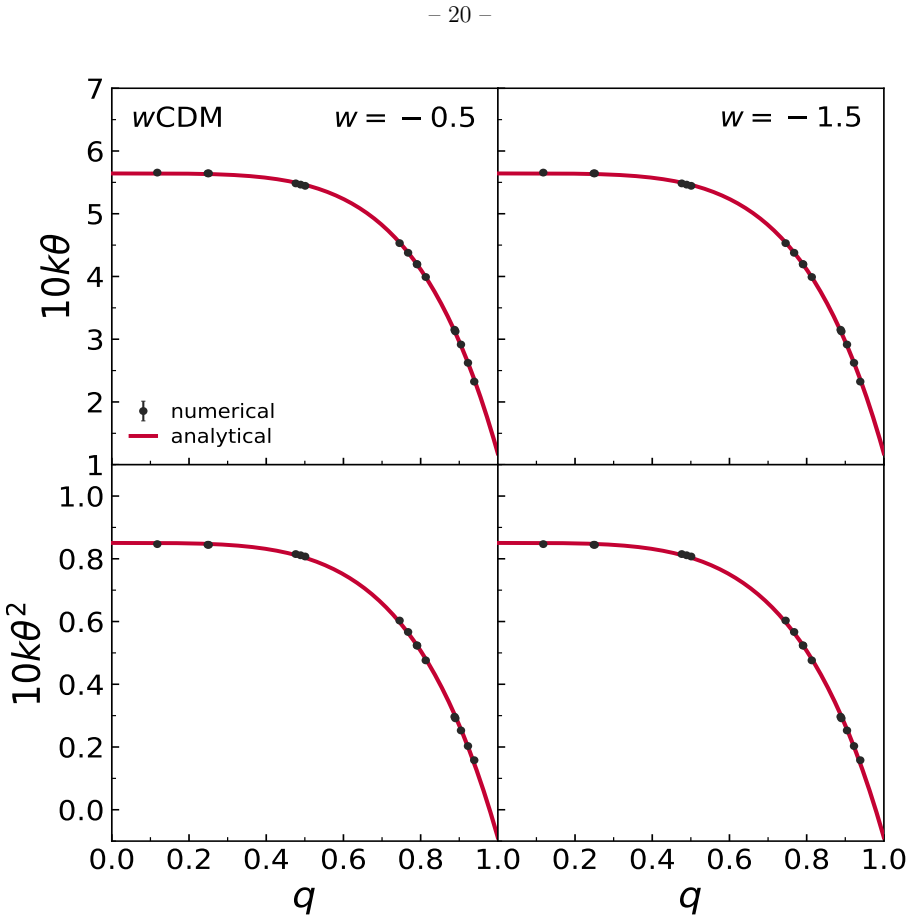
The authors propose heuristic formulas, Eqs. (10)–(11), in which both the mean τ̄ and variance Sτ of the primordial spin factor decrease from a plateau value as an exponential-with-power-law function of q, with a threshold value of q below which the decline is mild and above which it is steep. They find that three best-fit parameters in each formula — a normalization, a threshold, and a power-law index — remain constant, within errors, across ΛCDM cosmologies with different dark-energy densities and wCDM cosmologies with different equations of state, and across nine combinations of the two smoothing scales. Together with the Gamma-distribution form of p(τ), this means the entire spin-factor
Load-bearing premise
The load-bearing assumption is that the mean and variance of the spin factor depend only on the cross-correlation coefficient q, meaning the 12-dimensional Gaussian integration marginalizes away every other property of the density and potential fields; if the shape or amplitude of their power spectra matters independently of q, the universal formula fails.
Editorial extensions
If this is right
- Given the earlier result that the τ distribution can be reconstructed from the observed galaxy size distribution, the universal τ–q relation allows the density–potential cross-correlation coefficient q to be inferred from the same observables.
- Because q is independent of the amplitude of the initial density fluctuations, this diagnostic is expected to suffer less from the standard cosmological parameter degeneracies than other large-scale-structure probes.
- The universality over dark-energy density and equation of state means the relation is robust for a range of viable cosmologies, not just the standard one.
- If q can be constrained on galactic scales, it opens a new probe of early-universe physics such as scale-dependent primordial non-Gaussianity, a running spectral index, or early dark energy.
Reading between the lines
- The near-identical fitted parameters across four cosmologies hint that the functional form may be derivable from the Gaussian statistics of the smoothed fields alone; if so, the constants would be exact, not heuristic, and the relation could be tested with fully analytic calculations.
- A direct testable extension is to vary the smoothing filter shape (e.g., top-hat instead of Gaussian) or the spectral index: if the τ–q relation shifts while q is held fixed, the universality claim is bounded to Gaussian-filtered Gaussian fields.
- One can also test the relation at higher redshift or in simulations with non-Gaussian initial conditions; a deviation would signal either non-Gaussianity or a breakdown of the q-only assumption, either of which is cosmologically interesting.
Editorial analysis
A structured set of objections, weighed in public.
Referee Report
Summary. This paper proposes a heuristic analytic relation between the initial density-potential cross-correlation coefficient q and the distribution of the primordial spin factor τ. The authors assume, in Section 2, that the mean and variance of τ depend only on q, and then fit two three-parameter functional forms, Eqs. (10)-(11), to measurements from four Multiverse N-body simulations at z=99 (two ΛCDM and two wCDM backgrounds) over nine combinations of smoothing scales. They report that the fitted parameters are robustly constant across these cases and conclude that the formula is universal, suggesting that q could be reconstructed from observed galaxy size distributions via the τ distribution.
Significance. The idea of connecting the early-universe density-potential cross-correlation to observable galaxy spin statistics is interesting and potentially useful. The numerical analysis is based on large simulations and a systematic set of smoothing scales, and the paper is clearly written. However, the central advertised result is not established: the 'analytic expression' is a six-parameter fitting function, not a derivation, and the same measurements are used both to determine and to validate it. The wCDM rows in Tables 1-2 are essentially degenerate with the ΩΛ=0.74 ΛCDM case at z=99, so they do not test cosmology-independence. If the claims are appropriately narrowed and an independent validation is added, the empirical relation could be a useful calibration, but as it stands the 'universality' claim is overreaching.
major comments (4)
- [Section 3, Eqs. (10)-(11), Tables 1-2] The 'analytic expression' is a phenomenological fit with six free parameters (three for τ̄ and three for Sτ). The same simulation data are used to set these parameters and then to demonstrate agreement in Figures 3 and 6; there is no holdout, out-of-sample prediction, or independent test. Consequently the abstract's statement that 'we prove that this analytic expression is universally valid' is not supported by the evidence. The authors should either add a genuine predictive test (e.g., a cosmology, smoothing scale, or power-spectrum shape not used in the fit) or explicitly reframe the result as an empirical calibration for the tested simulations.
- [Section 2, first bullet, and Eqs. (4)-(7), Tables 1-2] The assumption that τ̄ and Sτ depend on q alone is load-bearing but is only argued heuristically; no test is shown that fixes q while varying the individual auto-correlations σδ² and σΦ². Moreover, q is a correlation coefficient bounded by |q|≤1 via the Cauchy-Schwarz inequality applied to Eqs. (5)-(7), yet the best fit gives qc=1.049 in Table 1 and qs,c=0.979 in Table 2. The qc value lies outside the allowed domain, and the fitted Sτ formula becomes negative near q=1, directly contradicting the stated expectation that the function should vanish as q→1. The fitting domain and positivity constraints need to be addressed, or an explicit explanation is required for why the extrapolated qc>1 is physically meaningful.
- [Section 3, Tables 1-2] The wCDM runs do not provide an independent test of cosmology-independence. At z=99, dark energy is dynamically negligible for all four backgrounds; with Ωde=0.74 and w=-0.5 or -1.5, the early-universe expansion history and linear transfer function are essentially the same as for the ΩΛ=0.74 ΛCDM case. The exact agreement of the fitted parameters for these three rows to the quoted precision suggests that the underlying initial density fields are effectively identical or that the wCDM variation has no dynamical effect at the analyzed epoch. The only genuine shape variation is between the ΩΛ=0.74 and 0.64 runs, which differ in Ωm and thus in the matter-radiation equality scale. To support the claimed universality, the authors need to test initial power spectra with genuinely different shapes (e.g., different ns, running, cutoff, or non-Gaussianity) and to clarify whether independent random
- [Section 4, Discussion] The proposed application—constraining early-universe physics by reconstructing q from galaxy size distributions—rests entirely on the q-only ansatz and on the specific functional forms of Eqs. (10)-(11). Since neither is derived, the discussion should clearly distinguish a testable hypothesis from an established result. At minimum, the authors should either provide a direct analytical derivation of the q-only dependence from the structure of the 12×12 covariance matrix or explicitly state that this is an empirical ansatz that has so far been checked only for a limited family of power spectra and smoothing scales.
minor comments (6)
- [Abstract and throughout] The words 'prove' and 'universally valid' are too strong for a six-parameter fit validated on the same data it was fitted to. Consider 'propose', 'show empirically', or 'calibrate'.
- [Section 3, paragraph 1] Please clarify the matter density parameter for each cosmology. For flat ΛCDM with ΩΛ=0.74, Ωm=0.26, while ΩΛ=0.64 gives Ωm=0.36; the text does not state this explicitly and the later parenthetical 'equivalently, Ωm=0.26' may confuse readers.
- [Figure 3 and Figure 6] The y-axis label '10k' appears garbled; the figure should clearly state whether the plotted quantities are kθ and kθ², and the tick labels should be readable.
- [Footnote 1] Fitting qc in the 'extrapolated range of q, i.e., beyond unity' is problematic because q is a correlation coefficient; this issue should be flagged in the main text and the domain of validity of Eqs. (10)-(11) stated explicitly.
- [Eq. (2)] The integral notation is garbled ('Z s', missing differentials in places). Please rewrite using conventional differential notation with explicit integration domains.
- [References] Two Moon & Lee 2025 entries are cited in the text as 2025a and 2025b, but the reference list does not carry the 'a'/'b' suffixes. Please add them for unambiguous citation.
Circularity Check
The claimed universal τ̄(q), Sτ(q) relation is an in-sample fit presented as a proof; the cosmology-independence test uses simulations with essentially the same initial power-spectrum shape.
-
fitted input called prediction
[Section 3, Eqs. (10)-(11), Tables 1-2; Abstract]
"We fit these numerical results of ¯τ(q) and S(q) to the following formulae: ¯τ=τ0[1−(q/qc)^a exp(q/qc−1)] ,(10), Sτ=Sτ,0[1−(q/qs,c)^b exp(q/qs,c−1)] ,(11) ... there exist excellent agreements between our heuristic model, Eqs.(10)-(11), and the numerically obtained ¯τ(q) and Sτ(q). ... we prove that this analytic expression is universally valid in describing how the mean and variance of τ change with q, regardless of the smoothing scales for both of the cosmologies."
Eqs. (10)-(11) are fitted, not derived: their parameters are best-fit values minimizing χ² to the same numerical ¯τ(q) and Sτ(q) points later displayed as validation, so the agreement is in-sample by construction and the 'universal' constants carry no predictive content. Moreover, the four Multiverse runs share identical Ωm, Ωb, h, ns, σ8 and at z=99 the dark-energy component is dynamically negligible, so they effectively use the same linear Pδ(k) shape; parameter constancy across them only shows the fitting form absorbs one Pδ(k)-dependent relation across smoothing scales, not cosmology-independence. No test with a genuinely different primordial spectrum is presented.
full rationale
The central claim is a heuristic three-parameter fit for τ̄(q) and another for Sτ(q), not a derivation from Eq. (2) (which the authors explicitly avoid computing). Because the parameters are optimized on the same data that are then shown as 'agreement,' the validation is statistically circular: the fitted curves are guaranteed to approximate the fitted points as well as the chosen functions allow. The only independent content would be parameter constancy across genuinely different cosmologies, but the four simulations all start from the same primordial power-spectrum shape (shared cosmological parameters and negligible DE at z=99), so that constancy is not an independent test. I did not score the self-citations to Moon & Lee (2025a,b) as circular: the Gamma ansatz is re-verified against the simulations in Figures 1-2 and 4-5, and Eq. (1) gives an explicit definition. The σ8-independence expectation is an untested extrapolation rather than a circular step. The result is therefore partially circular — the 'prediction' reduces to an in-sample fit — but not definitionally forced, so the score is 6 rather than 8 or 10.
Assumptions & free parameters
free parameters (6)
- τ_0 =
0.564 ± 0.001
- q_c =
1.049 ± 0.001
- a =
3.939 ± 0.042
- S_τ,0 =
0.085 ± 0.0003
- q_s,c =
0.979 ± 0.001
- b =
3.583 ± 0.062
assumptions (6)
- domain assumption Initial density and potential fields are Gaussian random fields.
- standard math Poisson equation relates density and potential: δ ∝ ∇²Φ.
- ad hoc to paper The mean and variance of τ depend only on q, not on the individual auto-correlations σ_δ², σ_Φ².
- ad hoc to paper The functional forms in Eqs. (10)-(11) describe the q-dependence of τ̄ and S_τ.
- domain assumption p(τ) is a Gamma distribution.
- domain assumption The Multiverse N-body simulations accurately reproduce the linear initial conditions at z=99.
Cite this review
Pith. "Pith review of A Universal Relation Between Primordial Density-Potential Cross-correlation Coefficient and Spin Factor Distribution." pith.science (2026). https://pith.science/paper/J2VWVPV2
@misc{pith2026260713971,
  author       = {Pith},
  title        = {Pith review of: A Universal Relation Between Primordial Density-Potential Cross-correlation Coefficient and Spin Factor Distribution},
  year         = {2026},
  howpublished = {\url{https://pith.science/paper/J2VWVPV2}},
  note         = {Machine review of arXiv:2607.13971}
}
abstract
Recent studies have revealed that the key properties of visible galaxies like their optical sizes, stellar ages, star formation rates and morphologies are closely linked with the angular momenta of their host dark matter halos. According to the linear tidal torque theory, the halo angular momentum, as a conserved quantity, is directly proportional to the primordial spin factor, $\tau$, defined as the degree of misalignment between the principal axes of the initial density and potential Hessian matrices, which were found by numerical experiments to follow a Gamma distribution, fully characterized by its mean and variance. In this study, we heuristically develop an analytic expression for the mean and variance of $\tau$ in terms of the initial density-potential cross-correlation coefficient, $q$. Analyzing a dataset from the Multiverse simulations performed for both of the flat $\Lambda$CDM and $w$CDM cosmologies, we prove that this analytic expression is universally valid in describing how the mean and variance of $\tau$ change with $q$, regardless of the smoothing scales for both of the cosmologies. Given the prior finding that the $\tau$-distribution can be reconstructed from the observable galaxy size distribution, this universal analytic expression may allow us to determine $q$ from the same observable via the mean and variance of $\tau$. We discuss a possibility of constraining the early universe physics from the reconstructed $q$ via our heuristic model, without suffering from cosmological degeneracies.
Figures


Figures from the paper (3 more)


Reference graph
Works this paper leans on
-
[1]
G., Aguilar, J., Ahlen, S., et al
Adame, A. G., Aguilar, J., Ahlen, S., et al. 2025, JCAP, 2025, 2,
2025
-
[15]
doi:10.1086/164143 Berta, Z. K., Jimenez, R., Heavens, A. F., et al. 2008, MNRAS, 391, 1,
doi:10.1086/164143 2008
-
[18]
doi:10.1088/1475-7516/2025/03/018 Moon, J.-S. & Lee, J. 2025, ApJ, 993, 1,
-
[22]
The Cross Correlation between the Gravitational Potential and the Large Scale Matter Distribution
doi:10.48550/arXiv.astro-ph/9709099 Moon, J.-S. & Lee, J. 2023, ApJ, 952, 2,
work page Pith review arXiv doi:10.48550/arxiv.astro-ph/9709099 2023
-
[26]
doi:10.1088/1475- 7516/2011/01/026 Lacasa, F. 2022, A&A, 661, A70. doi:10.1051/0004-6361/202037512 Lee, J. & Pen, U.-L. 2000, ApJ, 532, 1, L5. doi:10.1086/312556 Lee, J. & Pen, U.-L. 2001, ApJ, 555, 1,
doi:10.1088/1475- 2011
-
[38]
2026, Research in Astronomy and Astrophysics, 26, 2, 025009
doi:10.1086/162573 Xue, W., Hua, Z., & Rong, Y. 2026, Research in Astronomy and Astrophysics, 26, 2, 025009. doi:10.1088/1674-4527/ae2759 Zel’dovich, Y. B. 1970, A&A, 5,
doi:10.1086/162573 2026
-
[59]
doi:10.3847/1538-4357/ae1030 Moon, J.-S. & Okumura, T. 2025, ApJ, 995, 1, L8. doi:10.3847/2041-8213/ae23a5 Motloch, P., Yu, H.-R., Pen, U.-L., et al. 2021, Nature Astronomy, 5,
-
[73]
doi:10.3847/1538-4357/aa74b9 Sobotka, A. C., Erickcek, A. L., & Smith, T. L. 2025, Phys. Rev. D, 111, 12, 123522. doi:10.1103/9bd9-fzwh Tr¨ oster, T., S´ anchez, A. G., Asgari, M., et al. 2020, A&A, 633, L10. doi:10.1051/0004- 6361/201936772 Vikhlinin, A., Kravtsov, A. V., Burenin, R. A., et al. 2009, ApJ, 692, 2,
Show all 29 references
- [100]
- [101]
-
[102]
2000, ApJ, 538, 2,
doi:10.1088/1475-7516/2024/10/102 Lewis, A., Challinor, A., & Lasenby, A. 2000, ApJ, 538, 2,
2024 doi
-
[106]
& Pen, U.-L
doi:10.1086/321472 Lee, J. & Pen, U.-L. 2002, ApJ, 567, 2, L111. doi:10.1086/340000 Lee, J. & Erdogdu, P. 2007, ApJ, 671, 2,
2002 doi
- [119]
-
[146]
doi:10.3847/1538-4357/ab2da1 – 14 – Peng, Y. J. & Renzini, A. 2020, MNRAS, 491, 1, L51. doi:10.1093/mnrasl/slz163 Porciani, C., Dekel, A., & Hoffman, Y. 2002, MNRAS, 332, 2,
2020 doi
-
[153]
doi:10.1146/annurev-nucl-111422-024107 – 13 – Kim, J. H. & Lee, J. 2013, MNRAS, 432, 2,
2013 doi
-
[165]
doi:10.1038/s41550- 024-02376-8 White, S. D. M. 1984, ApJ, 286,
1984 doi
-
[283]
K., Padmanabhan, N., et al
doi:10.1038/s41550-020-01262-3 Nikakhtar, F., Sheth, R. K., Padmanabhan, N., et al. 2024, Phys. Rev. D, 109, 12, 123512. doi:10.1103/PhysRevD.109.123512 Park, H., Park, C., Sabiu, C. G., et al. 2019, ApJ, 881, 2,
2024 doi
-
[339]
2025, arXiv:2512.11383
doi:10.1046/j.1365- 8711.2002.05306.x Sheng, M.-J., Yu, H.-R., Bao, M., et al. 2025, arXiv:2512.11383. doi:10.48550/arXiv.2512.11383 Shin, J., Kim, J., Pichon, C., et al. 2017, ApJ, 843, 1,
2002
-
[473]
2025, A&A, 693, A48
doi:10.1086/309179 Liu, K., Guo, H., Wang, S., et al. 2025, A&A, 693, A48. doi:10.1051/0004-6361/202452248 Lu, S., Xu, D., Wang, S., et al. 2022, MNRAS, 509, 2,
2025 doi
-
[581]
R., Neyrinck, M
Granett, B. R., Neyrinck, M. C., & Szapudi, I. 2008, ApJ, 683, 2, L99. doi:10.1086/591670 Hong, S., Jeong, D., Hwang, H. S., et al. 2020, MNRAS, 493, 4,
2008 doi
-
[638]
& Smith, R
doi:10.1111/j.1365-2966.2008.13420.x Desjacques, V. & Smith, R. E. 2008, Phys. Rev. D, 78, 2, 023527. doi:10.1103/PhysRevD.78.023527 Di Valentino, E., Mena, O., Pan, S., et al. 2021, Classical and Quantum Gravity, 38, 15, 153001. doi:10.1088/1361-6382/ac086d Doroshkevich, A. G...
2008
-
[1060]
doi:10.1088/0004-637X/692/2/1060 Walters, D., Woo, J., & Ellison, S. L. 2022, MNRAS, 511, 4,
2022 doi
- [1248]
- [1701]
-
[2707]
G., Gottlober, S., et al
doi:10.1093/mnras/stab3169 Madsen, S., Doroshkevich, A. G., Gottlober, S., et al. 1998, A&A, 329,
1998 doi
- [3369]
-
[3459]
doi:10.1093/mnras/stac2858 Chen, X., Padmanabhan, N., & Eisenstein, D. J. 2025, JCAP, 2025, 8,
2025 doi
-
[5972]
2016, Phys
doi:10.1093/mnras/staa566 Ichiki, K., Yoo, C.-M., & Oguri, M. 2016, Phys. Rev. D, 93, 2, 023529. doi:10.1103/PhysRevD.93.023529 Inman, D. & Ali-Ha ¨ ımoud, Y. 2019, Phys. Rev. D, 100, 8, 083528. doi:10.1103/PhysRevD.100.083528 Kamionkowski, M. & Riess, A. G. 2023, Annual Revie...
2016 doi
-
[6126]
2025, Nature Astronomy, 9,
doi:10.1093/mnras/stac283 Wang, B., Peng, Y., & Cappellari, M. 2025, Nature Astronomy, 9,
2025 doi
Reviewed August 2, 2026 · model on record in the stance chip above.
Discussion (0). Continue with ORCID to comment.