REVIEW 4 minor 1 cited by
Dimers, filters, and $q$-deformed real numbers
T0 review · 0 major / 4 minor · reviewed 2026-08-02 · deepseek-v4-flash
Pith's one-line read This paper constructs a probabilistic q-deformation of every positive real number via weighted snake graphs, and proves that in the irrational case the construction is a well-defined limit independent of the rational approximations used.
desk verdict A clean, honest paper that really does construct [[x]]_q by limits over rational approximants; the main theorem holds up, with one compressed but fixable step and an openly conjectural bridge to MGO q-reals. read the letter →
The pith
A machine-rendered reading of the paper's core claim, the machinery that carries it, and where it could break.
The reading
What carries the argument
The argument is carried by snake posets S_x, whose shape is read off from the continued fraction digits of x, and by two-by-two transfer matrices L(q) and U(q) that propagate filter statistics along the snake. Products of these matrices act on the projective coordinate u_in:u_out of a row vector; the key lemma shows that the matrix L(q)U(q), corresponding to a peak in the snake, multiplies projective distance by a factor κ(q)<1, so the image of the positive cone under a long transfer word has diameter tending to zero. This cone contraction makes ratios of probabilities of finite-window events independent of the tail of the snake, yielding the limiting measure. A weight-preserving bijection,
What would settle it
Take an irrational x, fix q=0.01, and compare the probability that vertex 0 belongs to the filter under two rational approximants whose continued fractions agree with x through a long prefix but diverge later; if the difference does not tend to zero as the prefix length grows, the claimed limit and its independence of approximants are refuted.
Extended reading notes
Core claim
This paper establishes that the probabilistic q-deformation is well defined for every positive real number. For rational r, the finite snake poset S_r carries the probability measure μ_{r,q} in which a filter F has weight q^{|F|}, and the odds that vertex 0 belongs to a random filter equal q[r]_q, matching the known algebraic q-deformation. For irrational x, the infinite snake S_x is determined by the continued fraction expansion of x; the main theorem constructs a unique probability measure μ_{x,q} on its filters as a limit of the rational measures, with finite-window probabilities that stabilize once the approximating snake agrees with S_x on a long enough prefix. Consequently [[x]]_q, the
Load-bearing premise
The existence of a single probability measure on the infinite snake relies on the assertion that the cylinder probabilities built from finite approximations remain compatible as the observed window grows; the paper states this follows because the finite-snake distributions are compatible, but it does not prove the compatibility in detail.
Editorial extensions
If this is right
- For every irrational x and q>0, [[x]]_q is continuous in x at the irrationals; at q=1 it equals x, so the construction is a genuine deformation.
- The identities [[x+1]]_q = q[[x]]_q + q and [[1/x]]_q = 1/[[x]]_{1/q} extend from rationals to all positive reals by continuity.
- For rational r the model reproduces the algebraic q-deformation exactly, and the golden-ratio computation gives an explicit closed form equal to q times its algebraic counterpart.
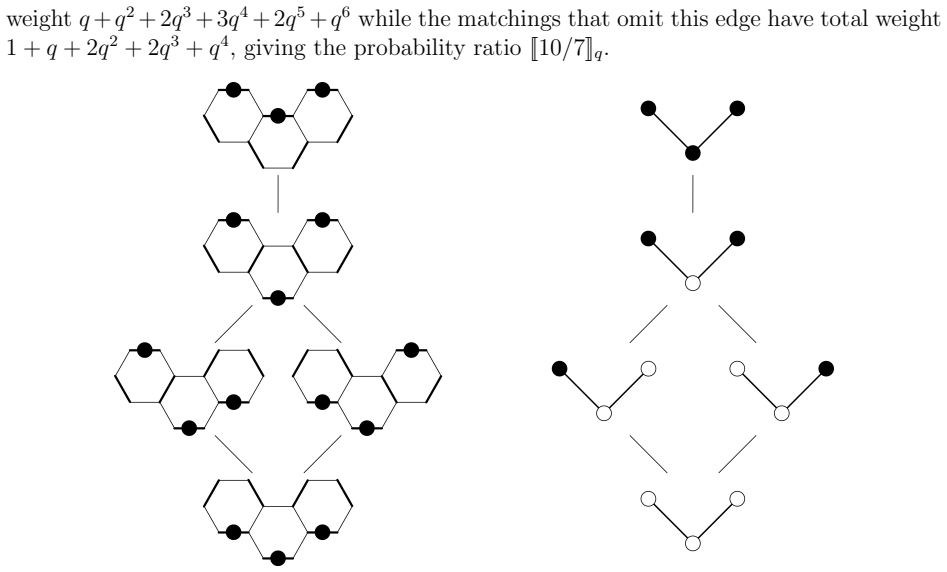
- The same limit defines a unique equilibrium measure on infinite snake graphs, so [[x]]_q has a direct reading as the edge-inclusion odds in a random dimer cover.
- The construction yields a concrete approximation scheme: compute finite snake/dimer odds along any sequence of rationals approaching x, and the values converge to [[x]]_q.
Reading between the lines
- If the conjectured identity [[x]]_q = q[x]_q holds for all irrationals, the probabilistic model would give the algebraic deformation an extension to all positive real q, potentially supporting analytic continuation along the positive ray (editor's inference).
- The same cone-contraction scheme should adapt to k-by-k transfer matrices or two-parameter weightings, producing higher-rank or refined probabilistic deformations of real numbers (editor's inference).
- The devil's-staircase continuity suggests that sampling from μ_{x,q} via finite approximations is numerically stable even near rational discontinuities, making q-deformed reals computable in practice (editor's inference).
- The failure of convergence at negative q (for example the golden-ratio approximants cycle through -1, 0, ∞ at q=-1) indicates that positivity of q is not a technical convenience; deforming negative reals would need a different mechanism (editor's inference).
Editorial analysis
A structured set of objections, weighed in public.
Referee Report
Summary. The paper defines, for each positive real x and q>0, a snake poset S_x determined by the continued fraction expansion of x, together with weighted filters (or, equivalently, dimer covers of a snake graph with activity q). For rational x, the odds [[x]]_q that the distinguished element 0 belongs to a q-weighted random filter are shown to equal q times the Morier-Genoud–Ovsienko q-deformation [x]_q (Prop. 3.6). For irrational x, the paper constructs an infinite snake S_x and proves, via a projective-contraction argument (Lemma 4.6), that the measures on rational approximations converge to a unique Borel probability measure μ_{x,q} independent of the approximating sequence (Theorems 4.8 and 4.10), and defines [[x]]_q as the corresponding odds. A closed-form expression for the q-deformed golden ratio is derived in Section 5, and the filter model is translated into a dimer model in Section 6. The equality [[x]]_q = q[x]_q for irrational x is left as an explicit conjecture.
Significance. The main positive contribution is the infinite-snake construction. Lemma 4.6 is a concrete contraction estimate in Hilbert's projective metric, and it gives a transparent proof that the limiting measure is independent of the approximating rational sequence. The rational equality is proved by matching transfer-matrix recurrences with the MGO recurrences, and the paper is unusually explicit about what is proved and what remains conjectural: the irrational-case equality with q[x]_q is not asserted as a theorem. The dimer reinterpretation connects the construction to an active literature and gives the paper a wider potential audience. If the conjectural equality is eventually established, the construction provides a probabilistically natural extension of q-deformed reals to all q>0, complementing Etingof's analytic obstruction for complex q.
minor comments (4)
- [§4, Theorem 4.8] The compatibility assertion 'These probability distributions are compatible as k varies, because they arise as limits of the compatible finite-snake distributions' is exactly the point that needs proof. A direct justification would strengthen the paper: for k'<k and an atomic event E' on [0,k'], finite compatibility gives μ_n(E')/μ_n(e_{k'}) = [μ_n(e_k)/μ_n(e_{k'})] · Σ_{E⊃E'} μ_n(E)/μ_n(e_k); after taking limits and normalizing, the projected cylinder probabilities agree. Please expand this sentence.
- [§4, paragraph before Definition 4.3] The statement that 'any sequence of rationals approaching an irrational number has eventually constant initial partial quotients' should be made precise: for each fixed k, the sequence eventually shares the first k partial quotients with x. As written, it could be misread as claiming eventual agreement of an infinite prefix. A one-sentence justification via the open intervals of numbers with a fixed finite continued-fraction prefix would suffice.
- [§4, after Theorem 4.10] The discussion of discontinuity and the 'devil's staircase' behavior is presented with 'it is not hard to show' and 'it appears.' If the q=2 claim is used, a proof or a precise reference should be included; otherwise it should be explicitly labeled as a conjecture, since it is not needed for the main theorem.
- [§1 and §7] The abstract and introduction are careful to say that the irrational equality is 'likely' and a 'hope,' but the phrase 'this is definition makes sense' near the end of Section 4 is ungrammatical. More substantively, the title 'q-deformed real numbers' might be read as claiming a proved deformation; consider a phrase in the title or abstract indicating that the construction is a probabilistic analogue whose agreement with the algebraic q-reals is proved only in the rational case.
Circularity Check
No significant circularity: the central infinite-snake limit construction is self-contained and the rational benchmark is proved, not assumed.
full rationale
The central claim is existence and uniqueness of the measure mu_{x,q} on filters of the infinite snake S_x for irrational x. This is obtained directly by taking limits of finite-snake measures and proving projective contraction of the transfer matrices in Lemma 4.6; no parameter is fitted to the target odds [[x]]_q, and the limit is shown to be independent of the approximating rational sequence. For rational r, Proposition 3.6 proves [[r]]_q = q[r]_q by verifying that both sides satisfy the same continued-fraction recurrences (Propositions 3.4 and 3.5), not by assuming the target equality. The irrational definition is not built from Morier-Genoud--Ovsienko's [x]_q; the paper explicitly leaves the general equality [[x]]_q = q[x]_q as an open question in Section 7, which rules out a definition made circular by construction. The one compressed step is in Theorem 4.8, where compatibility of the cylinder distributions is asserted with the sentence 'These probability distributions are compatible as k varies, because they arise as limits of the compatible finite-snake distributions.' This is terse and is more of a proof gap than a completed argument: compatibility does not follow from that sentence alone because the measures are normalized separately for each k. However, the missing argument is direct from the same ratio limits, and the paper's own contraction estimate supplies the missing uniformity. Thus the step is expository compression, not a circular reduction. The self-citations to [13] and [14] concern the dimer/filter correspondence and face-move structure; this correspondence is also implemented by an explicit weight-preserving bijection in Section 6 and is not load-bearing for the main existence/uniqueness theorem, which is proved in poset language. There is no self-definitional step, no fitted input renamed as a prediction, and no load-bearing uniqueness theorem imported from the author's own prior work.
Assumptions & free parameters
assumptions (6)
- standard math Every irrational x>0 has a unique continued fraction expansion, and rational sequences converging to x eventually share each finite initial segment of partial quotients.
- standard math The 2x2 matrices L(q), U(q) are nonnegative and contract Hilbert's projective metric; L(q)U(q) strictly contracts with factor κ(q)<1.
- standard math Kolmogorov/standard extension theorem for Borel measures on {0,1}^N given compatible cylinder probabilities.
- domain assumption Morier-Genoud-Ovsienko q-rationals satisfy recurrences [r+1]_q = q[r]_q+1 and [1/r]_q = 1/[r]_{1/q}, and every positive rational is reachable from 0 via these.
- domain assumption The face-move/lattice theory from [14] and snake-graph correspondence from [13] give a weight-preserving bijection between filters of S_r and perfect matchings of G_r.
- domain assumption For irrational x, the infinite snake S_x has infinitely many peaks, so N(k,ℓ)→∞ as ℓ→∞ for fixed k.
Cite this review
Pith. "Pith review of Dimers, filters, and $q$-deformed real numbers." pith.science (2026). https://pith.science/paper/5JRSMQ3N
@misc{pith2026260714332,
  author       = {Pith},
  title        = {Pith review of: Dimers, filters, and $q$-deformed real numbers},
  year         = {2026},
  howpublished = {\url{https://pith.science/paper/5JRSMQ3N}},
  note         = {Machine review of arXiv:2607.14332}
}
abstract
This article associates to each positive real number $x$ a dimer model on a snake graph with activity parameter $q>0$ whose structure is determined by the continued fraction expansion of $x$. When $x$ is rational, the model is finite and gives rise to a probability measure $\mu_{x,q}$ on perfect matchings. For irrational $x$, the model is infinite, and $\mu_{x,q}$ is defined as a limit over rational approximations to $x$; the main technical result of the paper shows that this limit is well defined and independent of the choice of rational approximants. $[[x]]_q$ denotes the odds that a $\mu_{x,q}$-random perfect matching includes a distinguished edge. When $x$ is rational, $[[x]]_q = q\:[x]_q$, where $[x]_q$ is the algebraic $q$-deformation introduced by Morier-Genoud and Ovsienko. This agreement, together with evidence from the irrational case, suggests a close connection between the probabilistic and algebraic constructions.
Figures


Figures from the paper (9 more)




Forward citations
Cited by 1 Pith paper
-
Coefficients of $q$-real numbers: their combinatorial meaning and growth
Every coefficient of every q-real number between 1 and 2 is bounded in absolute value by the corresponding coefficient of the q-deformed golden ratio, resolving the radius-of-convergence conjecture.
Reference graph
Works this paper leans on
-
[13]
Propp, The combinatorics of frieze patterns and Markoff numbers,Integers20(2020), #A12
J. Propp, The combinatorics of frieze patterns and Markoff numbers,Integers20(2020), #A12
2020
-
[14]
Propp, Lattice structure for orientations of graphs,Electron
J. Propp, Lattice structure for orientations of graphs,Electron. J. Combin.32(2025), P4.26
2025
-
[1]
J.-C. Aval and S. Labb´ e,q-analogs of rational numbers: from Ostrowski numeration systems to perfect matchings (arXiv:2511.11290), preprint (2025)
arXiv 2025
-
[2]
Bapat, L
A. Bapat, L. Becker and A.M. Licata,q-deformed rational numbers and the 2- Calabi–Yau category of typeA 2,Forum Math. Sigma11(2023), Paper No. e47
2023
-
[3]
Burcroff, N
A. Burcroff, N. Ovenhouse, R. Schiffler and S. W. Zhang, Higherq-continued fractions, European J. Combin.131(2026)
2026
-
[4]
Calkin and H
N. Calkin and H. Wilf, Recounting the rationals,Amer. Math. Monthly107(2000), 360–363
2000
-
[5]
Etingof, Onq-real andq-complex numbers (arXiv:2508.08440), preprint (2025)
P. Etingof, Onq-real andq-complex numbers (arXiv:2508.08440), preprint (2025)
arXiv 2025
-
[6]
Georgii, Gibbs Measures and Phase Transitions, De Gruyter Studies in Mathe- matics9, De Gruyter (2011)
H.-O. Georgii, Gibbs Measures and Phase Transitions, De Gruyter Studies in Mathe- matics9, De Gruyter (2011)
2011
Show all 16 references
-
[7]
McConville, J
T. McConville, J. Propp and B. Sagan, Hyperbinary partitions andq-deformed rationals, Forum Math. Sigma14(2026), 1–25
2026
-
[8]
Morier-Genoud and V
S. Morier-Genoud and V. Ovsienko,q-deformed rationals andq-continued fractions, Forum Math. Sigma8(2020), e13
2020
-
[9]
Morier-Genoud and V
S. Morier-Genoud and V. Ovsienko, Onq-deformed real numbers (preprint version) and (paywalled published version),Exp. Math.31(2022), 652–660
2022
-
[10]
Morier-Genoud and V
S. Morier-Genoud and V. Ovsienko,q-deformed rationals and irrationals (arXiv:2503.23834), preprint (2025)
2025 arXiv
-
[11]
Ovsienko,q-rationals and dimers (arXiv:2510.16270), preprint (2025)
V. Ovsienko,q-rationals and dimers (arXiv:2510.16270), preprint (2025)
2025
-
[12]
Propp, A reciprocity theorem for domino tilings,Electron
J. Propp, A reciprocity theorem for domino tilings,Electron. J. Combin.8(1), #R18
-
[15]
R. P. Stanley, Enumerative Combinatorics: Volume 1 (2nd ed.), Cambridge University Press (2011)
2011
-
[16]
M. A. Stern, ¨Uber eine zahlentheoretische Funktion,J. Reine Angew. Math.55(1858), 193–220. 23
Reviewed August 2, 2026 · model on record in the stance chip above.
Discussion (0). Continue with ORCID to comment.