REVIEW 5 major objections 5 minor 29 references
Lights, Camera, Malfunction: When Illumination Robustness Leaves VLA Models Blind to Color
T0 review · 5 major / 5 minor · reviewed 2026-08-02 · deepseek-v4-flash
Pith's one-line read A standard lighting-robustness defense—color jitter—can silently make robot VLA models blind to color; a hue-fixed variant avoids the trade-off.
desk verdict The color-blindness pitfall of naive HSV augmentation is real and worth knowing, but the paper's headline numbers rest on a small, possibly leaky real-world evaluation. read the letter →
The pith
A machine-rendered reading of the paper's core claim, the machinery that carries it, and where it could break.
The reading
What carries the argument
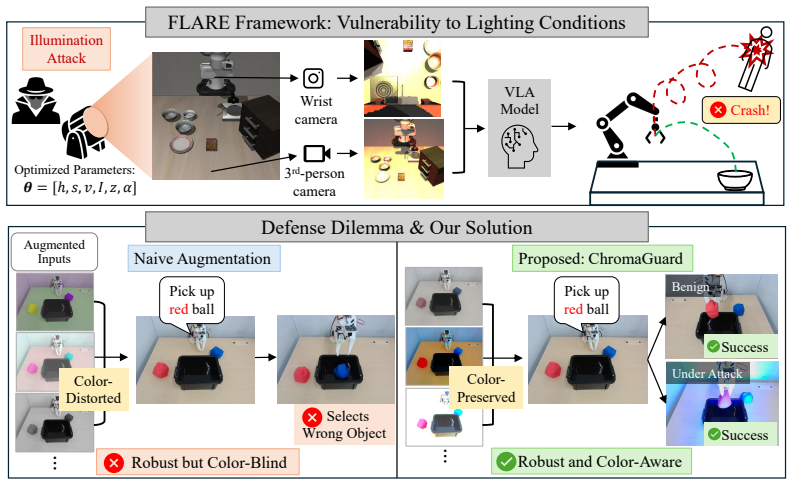
The load-bearing mechanism is the training-time augmentation distribution. Naive-Aug samples hue perturbations up to ±180 degrees, saturation, brightness, contrast, and sharpness, making hue a noisy, uninformative channel; ChromaGuard restricts the augmentation space to saturation, brightness, contrast, and sharpness with hue fixed at zero (h=0), so color remains a reliable cue. The diagnostic that exposes the difference is grayscale inference: converting input images to grayscale at test time reveals whether a model still depends on color. FLARE, the attack side, is a black-box spotlight optimization that searches six physical light parameters with Bayesian optimization to maximize trajecto
What would settle it
Run the benign color-dependent task with at least 100 trials per condition and report confidence intervals; if a naively augmented model's success rate is not significantly below the undefended baseline's, or if grayscale conversion no longer leaves its success high, the central claim fails. Alternatively, if the naively augmented model performs fine on a color-dependent task where red and blue are carefully matched for brightness and texture, the color-blind diagnosis would be contradicted.
Extended reading notes
Core claim
The paper claims three linked results. First, an optimized physical spotlight—parameterized by hue, saturation, value, intensity, height, and cutoff angle and searched by Bayesian optimization—can drop an undefended VLA model's task success to 0% while inducing trajectory deviations up to 115.5 cm. Second, the standard defense of broad HSV-space augmentation only appears to fix this: it conditions the model to discard color, so the defended model performs nearly as well on grayscale inputs as on RGB (90.5% vs 89.8% on one suite) while an undefended model collapses on grayscale. Third, in real-world color-dependent manipulation, that apparent robustness backfires: the naively defended model s
Load-bearing premise
The load-bearing premise is that the 40 real-world color-dependent trials (20 per instruction) are representative and that the red and blue objects are matched except for hue, so the 92.5%-versus-47.5% gap is real and not an artifact of trial noise, overlapping attack selection, or unintended shape or texture differences.
Editorial extensions
If this is right
- Adversarial training with broad HSV jitter should not be assumed to improve robustness; it can trade away the very semantic features the task depends on.
- A defended VLA's high success under lighting attack is insufficient evidence of robustness; checking performance on grayscale inputs exposes whether the model is relying on shape alone.
- Physical spotlight attacks, optimized in simulation and deployed on hardware, can zero out undefended VLA success, so lighting should be treated as a threat channel in robot deployments.
- Hue-preserving augmentation can decouple illumination robustness from color semantics, allowing both to be retained in a single training procedure.
- Color-dependent tasks need dedicated evaluation; standard benchmarks that rarely require color disambiguation can hide this failure mode.
Reading between the lines
- The paper leaves implicit that the same 'robustness but color-blind' failure may occur for other augmentations that destroy task-relevant features (e.g., heavy blur destroying texture, or geometric warping destroying orientation); the grayscale diagnostic generalizes to any feature whose invariance is being learned by discarding it.
- A testable extension would be to probe with hue-shifted images rather than grayscale: if Naive-Aug treats all hues equivalently, it should also confuse green and yellow on color-dependent tasks, not just red and blue.
- The paper's 40-trial real-world evaluation suggests future work should report confidence intervals; the mechanism predicts that Naive-Aug's color-dependent failures will concentrate on trials requiring the disfavored color, which could be checked per instruction.
- If the mechanism holds across architectures, it implies that robustness evaluations for embodied models should be paired with semantic-competence probes; otherwise benchmark gains may reflect feature dropout rather than generalization.
Editorial analysis
A structured set of objections, weighed in public.
Referee Report
Summary. This paper studies how physical lighting attacks and color-based data augmentation interact in VLA robotic manipulation. It introduces FLARE, a black-box Bayesian-optimization framework for spotlight attacks; shows that a baseline SmolVLA model collapses under optimized lighting in LIBERO simulation and physical tasks; reports a "color blindness" pitfall for naive HSV jittering (Naive-Aug), evidenced by high grayscale success in simulation and low success on a real-world color-dependent pick task; and proposes ChromaGuard, a hue-preserving adversarial training variant that retains robustness and color discrimination. Results are reported for SmolVLA and π0.5.
Significance. The paper's main claims are interesting and falsifiable. If the color-blindness effect is real, it is a practical warning: standard color jittering can trade away semantic color perception exactly when color matters. The grayscale diagnostic is a clever, cheap probe, and the physical color-dependent task with failure-cause decomposition is the right kind of evidence. The strengths are a clear black-box threat model, independent benchmarks, and a proposed mitigation with a simple, interpretable design. The main weaknesses are statistical and confound-related in the physical evaluation, and a mismatch between the stated minimax training objective and its implementation. I found no circularity: the central claims are supported by external benchmarks and independent physical tasks, not by a derivation that folds in the desired result.
major comments (5)
- [§5.3, Table 3] The central pitfall claim rests on the benign color-dependent gap: SmolVLA Naive-Aug 47.5% vs Baseline 77.5%, each from 40 trials (20 per instruction). No confidence intervals, statistical test, multiple seeds, or randomization protocol are reported. The standard error of each proportion is roughly 8–10 percentage points; with 40 trials per condition, three flipped outcomes would erase the gap. Please report binomial CIs, per-seed variability, and trial randomization order, and ideally increase the number of physical trials.
- [§5.1, §5.3] The color-dependent task is described as selecting between "structurally identical red and blue balls," but photometric matching is not reported. If the objects differ in luminance, reflectance, or specularity, the task is not purely color-dependent: Naive-Aug could fail due to brightness or position biases while retaining some color sensitivity. Report measured RGB/luminance distributions of the objects, or use targets matched in all photometric properties except hue, and include a hue-swap control.
- [§5.1] Physical spotlight parameters are selected by generating "several attack candidates" in simulation and then picking "the most effective attack in the real-world." No details are given about the number of candidates, the selection criterion, or whether the evaluation episodes were also used in the selection. This makes the attacked-condition success rates (e.g., ChromaGuard 92.5% vs Naive-Aug 40.0%) susceptible to selection bias. Please use a held-out evaluation split and report the selection process.
- [§5.2, Table 2] The grayscale diagnostic is run only on LIBERO in simulation. It demonstrates that Naive-Aug does not need color for those tasks, but it does not by itself establish that the model has lost color discrimination; the real-world color-dependent task is the direct probe. To make the bridge explicit, add a real-world grayscale/desaturation probe on the same color-dependent task, or report a hue-identity control. Also, "purely shape-biased processor" is stronger than what the grayscale evidence shows, since position and object-shape cues remain available; please soften or add a shape/color dissociation test.
- [§3.3, §5.1] The methodology defines ChromaGuard as solving a minimax adversarial objective, but the implementation in §5.1 appears to be random sampling from the hue-constrained augmentation space (fixing hue and perturbing saturation, value, contrast, sharpness). If the inner maximization is not actually computed, the method should be described as hue-preserving augmentation rather than adversarial training, and the claim that it is "adversarial training" is unsupported. Please clarify the optimization procedure or adjust the terminology.
minor comments (5)
- [§3.3, Eq. (3)] Please give the exact values of λ_1 and λ_2 in Eq. (2) and the search ranges for the FLARE optimization, as they are needed for reproducibility.
- [Table 1] The table header distinguishes "TE-Max avg" and "TE-Max" but the difference is not defined in the text. Please define both metrics precisely.
- [§5.3] The π0.5 results show ChromaGuard under attack (70.0%) outperforming its benign condition (55.0%); the explanation that this stems from pretraining is plausible but post hoc. Consider reporting confidence intervals for these comparisons and noting the small sample size.
- [§4.1] The name "Naive-Aug" is used for both the simulation and the real-world model; please also state that the same augmentation hyperparameters are used in both settings, which is currently only implied.
- [References] Reference [26] (LeRobot, arXiv:2602.22818) appears to be from a future/current preprint cycle; please verify it is available and correctly cited.
Circularity Check
No significant circularity: the central claims rest on independent measurements, not on definitions, fitted predictions, or self-citation chains.
full rationale
The paper's central claims are supported by separate empirical measurements rather than by a derivation that folds in its own conclusions. The Naive-Aug pitfall is established through a grayscale diagnostic (Table 2) and a physical color-dependent task (Table 3); both are independent, falsifiable probes of color reliance. The grayscale result does not by construction imply the real-world failure is color-based, and the real-world task is an external measurement. ChromaGuard is an explicit construction (fixing hue perturbation to zero) whose success is then measured, not assumed. FLARE is an optimization over a clearly specified objective, and its attack success is evaluated on held-out physical trials. No equation in the paper equates a fitted parameter with a predicted outcome, and no load-bearing claim relies on a self-citation or an imported uniqueness theorem. The identified statistical weaknesses (n=40, no confidence intervals, possible selection in attack generation) are threats to validity and generalizability, not circularity. Accordingly, no circular step is present.
Assumptions & free parameters
free parameters (4)
- lambda_1, lambda_2 (FLARE objective weights) =
not reported
- Augmentation ranges (Naive-Aug and ChromaGuard) =
hue +/-180 deg (Naive-Aug only); saturation [0,4]; value [0.2,3.0]; contrast [0.8,1.2]; sharpness [0.5,1.5]
- BO search space bounds for FLARE =
z_light in [0.5,3.0]; full HSV color bounds; intensity and cutoff bounds unspecified
- Number and selection of real-world attack candidates =
several (unspecified)
assumptions (5)
- domain assumption MuJoCo-rendered lighting with shadows is a faithful proxy for a physical spotlight.
- domain assumption Grayscale conversion during inference removes color information without introducing other distribution shifts.
- domain assumption The LIBERO suites and the custom physical tasks are representative of VLA manipulation difficulty and of color-dependence.
- domain assumption Bayesian optimization (TPE) with an alternating 5-task partition finds near-worst-case lighting within the trial budget.
- domain assumption In the color-dependent physical task, the red and blue objects are matched in shape, size, position, and texture so that only hue differentiates them.
Cite this review
Pith. "Pith review of Lights, Camera, Malfunction: When Illumination Robustness Leaves VLA Models Blind to Color." pith.science (2026). https://pith.science/paper/QPEJ4NPC
@misc{pith2026260714698,
  author       = {Pith},
  title        = {Pith review of: Lights, Camera, Malfunction: When Illumination Robustness Leaves VLA Models Blind to Color},
  year         = {2026},
  howpublished = {\url{https://pith.science/paper/QPEJ4NPC}},
  note         = {Machine review of arXiv:2607.14698}
}
read the original abstract
Vision-Language-Action (VLA) models have emerged as a powerful paradigm for general-purpose robot manipulation; however, their transition to real-world environments reveals vulnerabilities to minor environmental perturbations. We propose FLARE, an optimized physical spotlight attack framework that exploits these vulnerabilities via targeted illuminations, dropping baseline task success rates to zero without any access to model internals. While adversarial training is the standard countermeasure, we identify a critical and previously underestimated defensive pitfall: naive data augmentations incorrectly condition VLA models to discard color as noise, collapsing their visual perception into a purely shape-biased processor. We expose this degradation through a diagnostic grayscale evaluation, in which the defended model maintains high success rates on grayscale inputs, while its success rate on benign, color-dependent real-world tasks drops to at most 47.5%, well below the undefended baseline. To address this, we propose ChromaGuard, a chroma-preserving adversarial training method. On a physical 6-DoF robotic platform, we demonstrate that ChromaGuard achieves 97.5% and 92.5% success rates in benign and attacked color-dependent tasks, respectively.
Figures


Reference graph
Works this paper leans on
-
[1]
B. Z. et al. RT-2: Vision-Language-Action Models Transfer Web Knowledge to Robotic Con- trol. InPMLR, volume 229, pages 2165–2183, 2023
2023
-
[2]
M. J. Kim, K. Pertsch, S. Karamcheti, T. Xiao, A. Balakrishna, S. Nair, R. Rafailov, E. Foster, G. Lam, P. Sanketi, et al. Openvla: An open-source vision-language-action model.arXiv preprint arXiv:2406.09246, 2024
arXiv 2024
- [3]
-
[4]
K. B. et al.π 0: A Vision-Language-Action Flow Model for General Robot Control, 2024. URLhttps://arxiv.org/abs/2410.24164
arXiv 2024
-
[5]
Jiang, Y
Y . Jiang, Y . Ze, Z. Jiang, S. Song, and J. Wu. BEHA VIOR Robot Suite: Streamlining Real- World Whole-Body Manipulation for Everyday Household Activities. In9th Annual Confer- ence on Robot Learning (CoRL), 2025
2025
-
[6]
Jiang, Z
S. Jiang, Z. Huang, K. Qian, Z. Luo, T. Zhu, Y . Zhong, Y . Tang, M. Kong, Y . Wang, S. Jiao, et al. A Survey on Vision-Language-Action Models for Autonomous Driving. InProceedings of the IEEE/CVF International Conference on Computer Vision, pages 4524–4536, 2025
2025
-
[7]
S. Li, Y . Chen, D. Li, S. Liu, D. Lan, Y . Liu, and Z. Pang. Transferring Vision-Language- Action Models to Industry Applications: Architectures, Performance, and Challenges. In2025 7th International Conference on Industrial Artificial Intelligence (IAI), pages 1–6. IEEE, 2025
2025
-
[8]
Q. Li, B. Yin, W. Huang, R. Liu, B. Zou, R. Yu, J. Ye, W. Yu, and X. Wang. Vision-Language- Action Safety: Threats, Challenges, Evaluations, and Mechanisms, 2026
2026
Show all 29 references
-
[9]
B. Ma, H. Guo, P. Lv, M. Xu, X. Dai, Y . Zhang, Y . Yang, and Y . Zhang. What Breaks Embodied AI Security: LLM Vulnerabilities, CPS Flaws, or Something Else?, 2026
2026
-
[10]
X. Lu, J. Chen, S. Xiao, Z. Jin, Z. Chen, H. Yu, B. Qian, R. Zhou, X. Ji, and W. Xu. Phantom menace: Exploring and enhancing the robustness of vla models against physical sensor attacks. InProceedings of the AAAI Conference on Artificial Intelligence, volume 40, pages 35689– 3...
2026
-
[11]
H. Xu, Y . S. Koh, S. Huang, Z. Zhou, D. Wang, J. Sakuma, and J. Zhang. Model-Agnostic Adversarial Attack and Defense for Vision-Language-Action Models, 2025
2025
-
[12]
X. Wang, J. Li, Z. Weng, Y . Wang, Y . Gao, T. Pang, C. Du, Y . Teng, Y . Wang, Z. Wu, et al. FreezeVLA: Action-Freezing Attacks Against Vision-Language-Action Models, 2025
2025
-
[13]
X. Zhou, G. Tie, G. Zhang, H. Wang, P. Zhou, and L. Sun. Badvla: Towards backdoor attacks on vision-language-action models via objective-decoupled optimization.Advances in Neural Information Processing Systems, 38:127496–127523, 2026
2026
-
[14]
J. Zhou, Y . Wei, R. Zhen, B. Zhao, X. Xia, R. Shao, X. Su, and S. Yang. Inject Once Survive Later: Backdooring Vision-Language-Action Models to Persist Through Downstream Fine- Tuning, 2026
2026
-
[15]
Zhang, W
N. Zhang, W. Tao, X. Xiao, Q. Sun, Y . Zheng, W. Mo, P. Wang, and N. Zhang. Attention- Guided Patch-Wise Sparse Adversarial Attacks on Vision-Language-Action Models, 2025
2025
-
[16]
X. Zhou, Y . Xu, G. Tie, Y . Chen, G. Zhang, D. Chu, P. Zhou, and L. Sun. LIBERO-PRO: To- wards Robust and Fair Evaluation of Vision-Language-Action Models Beyond Memorization. arXiv preprint arXiv:2510.03827, 2025. 9
2025 arXiv
-
[17]
B. Liu, Y . Zhu, C. Gao, Y . Feng, Q. Liu, Y . Zhu, and P. Stone. LIBERO: Benchmarking knowledge transfer for lifelong robot learning.Advances in Neural Information Processing Systems, 36:44776–44791, 2023
2023
-
[18]
D. Y . G. Orjuela, L. Scappatura, V . Di Gennaro, R. A. Izzo, G. Bardaro, and M. Matteucci. Im- proving Robustness of Vision-Language-Action Models by Restoring Corrupted Visual Inputs, 2026
2026
-
[19]
J. Guo, Z. Wu, C. Tu, Y . Ma, X. Kong, Z. Liu, J. Ji, S. Zhang, Y . Chen, K. Chen, et al. On Robustness of Vision-Language-Action Model Against Multi-Modal Perturbations, 2025
2025
-
[20]
Madry, A
A. Madry, A. Makelov, L. Schmidt, D. Tsipras, and A. Vladu. Towards Deep Learning Models Resistant to Adversarial Attacks.arXiv preprint arXiv:1706.06083, 2017
2017 arXiv
-
[21]
Xhonneux, A
S. Xhonneux, A. Sordoni, S. G ¨unnemann, G. Gidel, and L. Schwinn. Efficient Adversarial Training in LLMs with Continuous Attacks.Advances in Neural Information Processing Sys- tems, 37:1502–1530, 2024
2024
-
[22]
Ganin, E
Y . Ganin, E. Ustinova, H. Ajakan, P. Germain, H. Larochelle, F. Laviolette, M. March, and V . Lempitsky. Domain-Adversarial Training of Neural Networks.Journal of machine learning research, 17(59):1–35, 2016
2016
-
[23]
Hanif, M
A. Hanif, M. Naseer, S. Khan, M. Shah, and F. S. Khan. Frequency Domain Adversarial Train- ing for Robust V olumetric Medical Segmentation. InInternational Conference on Medical Image Computing and Computer-Assisted Intervention, pages 457–467. Springer, 2023
2023
-
[24]
S. Yang, W. Xiao, M. Zhang, S. Guo, J. Zhao, and F. Shen. Image Data Augmentation for Deep Learning: A Survey.arXiv preprint arXiv:2204.08610, 2022
2022 arXiv
-
[25]
Akiba, S
T. Akiba, S. Sano, T. Yanase, T. Ohta, and M. Koyama. Optuna: A Next-Generation Hyper- parameter Optimization Framework. InProceedings of the 25th ACM SIGKDD international conference on knowledge discovery & data mining, pages 2623–2631, 2019
2019
-
[26]
LeRobot: An open-source library for end-to-end robot learning.arXiv preprint arXiv:2602.22818, 2026
2026
-
[27]
Todorov, T
E. Todorov, T. Erez, and Y . Tassa. MuJoCo: A physics engine for model-based control. In 2012 IEEE/RSJ international conference on intelligent robots and systems, pages 5026–5033. IEEE, 2012
2012
-
[28]
Knight, P
R. Knight, P. Kooijmans, R. Cadene, S. Alibert, M. Aractingi, D. Aubakirova, A. Zouitine, R. Martino, S. Palma, C. Pascal, and T. Wolf. Standard Open SO-100 & SO-101 Arms. URL https://github.com/TheRobotStudio/SO-ARM100
-
[29]
Intelligence, K
P. Intelligence, K. Black, N. Brown, J. Darpinian, K. Dhabalia, D. Driess, A. Esmail, M. Equi, C. Finn, N. Fusai, et al.π 0.5: a Vision-Language-Action Model with Open-World Generaliza- tion.arXiv preprint arXiv:2504.16054, 2025. 10
2025 arXiv
Reviewed August 2, 2026 · model on record in the stance chip above.
Discussion (0). Continue with ORCID to comment.