REVIEW 5 major objections 5 minor 138 references
Valinor: Architectural Support for Fast, Energy-Efficient and Programmable Physical Memory Allocation
T0 review · 5 major / 5 minor · reviewed 2026-08-02 · deepseek-v4-flash
Pith's one-line read Valinor makes page allocation both hardware-fast and fully programmable by executing OS-supplied allocation libraries on a small engine in the memory controller.
desk verdict Valinor's programmable page-allocation engine is a real new idea with an honest FPGA prototype, but the paper never measures the steady-state translation cost of its no-PTE fast path, so the headline speedup is narrower than it looks. read the letter →
The pith
A machine-rendered reading of the paper's core claim, the machinery that carries it, and where it could break.
The reading
What carries the argument
The load-bearing mechanism is the programmable allocation engine (PAE): a lightweight, three-stage in-order RISC-V pipeline with 4 KB caches, placed in the memory controller and shared across cores. It executes trusted OS-supplied allocation libraries via a compact RV32I-compatible ISA extended with telemetry-read instructions. Two supporting structures carry the rest of the argument: the VMA filter, a small CAM-plus-properties cache that lets the page-table walker decide in hardware whether a faulting region is library-bound and with what permissions; and the single-ownership coordination protocol, which replaces cache coherence with an explicit, barrier-carrying handoff of mapping authorit
What would settle it
Run a multi-threaded test where one thread faults on a PAE-managed page while a second thread calls mprotect on the same region to revoke write permission; if the PAE's alloc commits a writable mapping after the mprotect completes, the fenced VMA-mutation protocol has a bug. Alternatively, measure whether PAE translate-routine traffic for a workload whose working set exceeds TLB capacity keeps minor-fault latency below the baseline kernel handler; if not, the 16% end-to-end speedup will not generalize to larger-footprint workloads.
Extended reading notes
Core claim
Valinor's central claim is that page allocation can be both hardware-fast and software-programmable. The paper introduces the programmable allocation engine (PAE), a small three-stage in-order pipeline placed in the memory controller, running compact 'allocation libraries' that the OS loads and configures per process or per memory object. When the page-table walker faults on a library-bound region, the request is forwarded to the PAE, which executes the library's translate and alloc routines and returns a page-table entry directly to the MMU, completing the allocation without a kernel trap. The paper reports that on a BOOM RISC-V soft-core running Linux this makes minor page-fault handling 1
Load-bearing premise
The end-to-end gains rest on the assumption that a PAE-created mapping need not be installed in the OS page table on the fast path: every later TLB miss on such a page must be serviced by the PAE's translate routine, and correctness depends on the single-ownership protocol whose own revision note admits 'remaining concurrency corner cases' were closed only by making two barrier rules explicit.
Editorial extensions
If this is right
- Minor page faults on library-bound regions can be resolved without entering the kernel, removing pipeline flushes, TLB shootdowns, and zone-lock contention from the critical path.
- Allocation policy becomes a loadable software artifact: the OS can bind different regions to different libraries, so placement can adapt to DRAM bank pressure, memory tiers, or integrity requirements without silicon redesign.
- Because the PAE sits in the memory controller, libraries can act on live telemetry—such as per-bank conflict counters—that a software handler cannot cheaply observe, enabling interference-aware placement for co-located workloads.
- PAE-created mappings are kept out of the OS page table on the fast path, so after TLB eviction the PAE's translate routine, not the kernel, services the miss; this keeps fault handling in hardware but makes the PAE a new element on the translation critical path.
Reading between the lines
- The same template—an OS-programmable engine executing kernel data-plane routines—could extend to other trap-heavy services, such as TLB shootdown handling or page-table walks for non-allocation faults; Valinor does not claim this, but its PAE is a natural incubator for it.
- The fast path makes the PAE's metadata effectively a second page table. A stress test interleaving fork, munmap, and mprotect with PAE-managed allocations would expose whether the single-ownership invariant truly covers all interleavings; the paper's own revision note indicates 'remaining concurrency corner cases' were only recently closed by making two barrier rules explicit.
- The reported energy savings come from a single in-order engine shared across cores; on many-core or multi-socket systems the PAE could become a contention point for TLB-refill traffic, so a larger-scale evaluation would be needed to confirm the per-allocation energy and latency claims.
Signed reviews
Editorial analysis
A structured set of objections, weighed in public.
Referee Report
Summary. Valinor proposes a hardware-OS cooperative memory allocation substrate built around a programmable allocation engine (PAE) at the memory controller and a VMA filter (VMAF) in the MMU path. Applications or the OS bind memory regions to compact OS-supplied allocation libraries, and minor page faults for those regions are resolved by the PAE without trapping into the kernel. On the fast path, PAE-created mappings are cached in the TLB and recorded in library metadata but not installed in the OS page table; later TLB misses are serviced by the PAE's translate routine. The paper reports a 17× reduction in minor-fault handling time on a BOOM RISC-V FPGA prototype running Linux, 16% average end-to-end speedup, 5% average (up to 8%) energy savings, and <1.5% area overhead, together with a simulated study of six allocation libraries and four PAE microarchitectures.
Significance. If the measurements hold, Valinor would be a significant advance: it is the first page-granularity allocation substrate to combine programmable, policy-rich allocation with hardware-class fault handling, and it demonstrates policies—bank-pressure-aware placement, mapping-integrity checks, speculation, tier-aware placement—that fixed-function hardware cannot express. The FPGA prototype on a real BOOM/Linux system, the direct comparison against SW-only and Fixed-HW implementations, the pool-size sensitivity analysis (Fig. 12), and the six-library design-space exploration are concrete strengths that go well beyond a purely simulated proposal. The main caveats are that the no-PTE fast path moves post-allocation TLB refills onto a single shared PAE without being measured, and that the headline energy claims are not actually shown; both directly qualify the central end-to-end claims.
major comments (5)
- [§6.3.2] The fast path deliberately does not install PAE-created mappings into the OS page table, so any later TLB miss on a PAE-managed page must be serviced by the PAE's translate routine instead of a hardware page-table walk over a present PTE. The paper reports per-fault latency (§9.1) but never reports TLB-refill traffic, PAE queue occupancy, or PAE translate-hit latency relative to a baseline PTW. For workloads whose active footprint exceeds L2 TLB capacity and whose pages are reused, every reuse after TLB eviction must traverse VMAF+PAE through a single shared in-order engine (§9.3). The 17× fault-latency improvement is therefore not the right metric for the end-to-end claim; total translation cost per page over its lifetime is needed. Without this measurement, the 16% average speedup may not generalize beyond first-touch-dominated workloads.
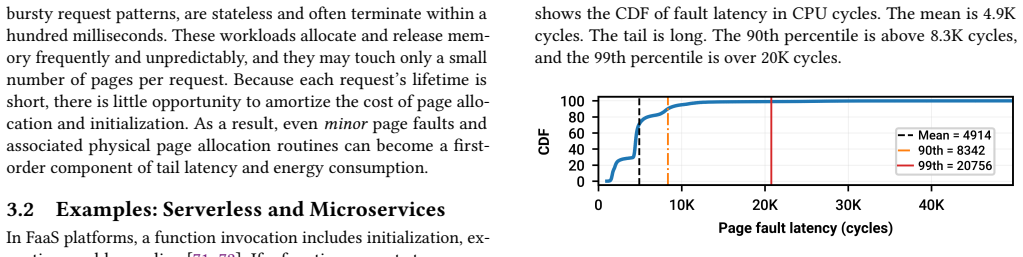
- [Abstract; §3.3; §9.1] The abstract states that minor faults account for 'up to 40% of system energy,' but the measurements in §3.3 and Fig. 2 report up to 18% (and §1 also says 18%). This is a 2.2× discrepancy in a headline motivation. In addition, §9.1 says energy was measured with Synopsys but the figure is 'not shown due to space constraints,' so the claimed 5% average / up to 8% energy savings is not actually presented. Energy is central to the title and abstract; the authors should include the missing figure and reconcile the 40% vs 18% numbers.
- [§9.1] The text says Fixed-HW achieves an average speedup of 16% and is 'the fastest,' while Valinor also achieves an average speedup of 16% yet is 'only 3% slower on average' than Fixed-HW. If Valinor is 3% slower, its speedup should be approximately 12.5%, not 16%, unless the numbers are rounded to the nearest integer. This contradiction affects the central claim of matching fixed hardware. Please report precise per-benchmark and average values, either in the figure or in a table.
- [§6.5] The no-PTE fast path makes the PAE's metadata authoritative for PAE-owned regions, so correctness rests entirely on the single-ownership invariant. However, the protocol is described only in prose, and the section's own text says the 'revision makes the two barrier rules below explicit to close the remaining concurrency corner cases.' No formal model, proof, model-checking result, or concurrency stress test is provided for the drain and VMA-mutation fences. A missed race between drain and a fault, or between a VMA mutation and an in-flight alloc, could install a stale or conflicting mapping. Given that this is the correctness backbone of the architecture, a verification argument or litmus-test evidence is needed.
- [§8] The design-space exploration uses Virtuoso's MimicOS configured to 'mimic Linux's minor page-fault handling behavior.' Since Virtuoso is from the same group and no validation against the real kernel's fault path is reported, the simulated library-latency numbers may partly reflect the imitation's accuracy. Please provide a validation showing that MimicOS reproduces the §3 Linux fault-path characteristics (e.g., instruction counts, lock contention) for the evaluated workloads, or bound the sensitivity of Fig. 13 to the imitation.
minor comments (5)
- [Fig. 10; Fig. 12] Check axis and label typos: Fig. 10 appears to contain 'trnasnp' (likely 'transp'), and Fig. 12's y-axis is labeled 'Reduction in Page Fault Latency' but reaches 120% with reduction values above 100%, which is not meaningful as a reduction; clarify whether this is a speedup ratio.
- [§7.3] The tier-utility weights w_bw, w_cap, locality_value_hot/cold are free parameters, but Fig. 15 sweeps only the per-VMA hint fraction. Please report the default parameter values and provide at least a small sensitivity analysis, since the 2.6× latency result may depend on them.
- [§6.5] The manuscript contains self-referential revision language ('The submitted design already enforces... The revision makes...') and 'revision' phrasing that should be removed for archival publication; the final paper should present the protocol declaratively.
- [§6.4] The claim that the fork() drain cost is 'insignificant' because fork already walks the VMA tree is not self-evident for large PAE-owned segments; this cost is not measured. A quantitative statement of the drain overhead would strengthen the CoW/fork correctness argument.
- [§9.1] The energy methodology is too thin: it says only 'energy measurements with Synopsys.' Please specify what was measured (core, DRAM, full system), how the FPGA prototype's power was obtained, and how the 5% average / up-to-8% energy savings were derived.
Circularity Check
No significant circularity; headline FPGA results are measured against real Linux; only minor non-load-bearing self-citation of the Virtuoso simulator.
full rationale
Valinor's headline numbers—17× fault-latency reduction, 16% end-to-end speedup, up to 8% energy savings, <1.5% area—come from the FPGA prototype running real Linux, not from a fitted model: §9.1 reports 'baseline Linux requires 5881 cycles per minor fault' vs 'Valinor ... still provides a 17.07x improvement over Linux', and Fig. 10 is explicitly the 'end-to-end performance speedup measured on the FPGA prototype'. These are empirical measurements with an independent hardware ground truth. The only self-citation in the evaluation chain is Virtuoso: 'We also implement Valinor in a full-system simulator (Virtuoso [10]+Sniper [11])' and 'We configured MimicOS (the lightweight OS modeled in Virtuoso) to mimic Linux's minor page-fault handling behavior'. Virtuoso is a same-group simulator, and the OS-imitation methodology is calibrated to the real-Xeon measurements of §3; it is used for design-space exploration and the six-library evaluation, not for the central FPGA speedup claims. The tier-aware placement result (§9.2, Fig. 15) shows the per-VMA hint steering pages toward fast tiers; this follows from the library's own utility definition (utility(t)=V(hint)·locality(t)−w_bw·bw_util(t)−w_cap·cap_util(t)), so the 'hint steers placement' observation is by construction a sanity check of the library, not an independent prediction—but it is not load-bearing for the paper's main claims, which are about the programmability of the PAE substrate. The §6.5 revision note ('the revision makes the two barrier rules below explicit to close the remaining concurrency corner cases') is a correctness/verification limitation, not a circularity, and it does not enter the numerical results. No target result is assumed to produce the numbers.
Assumptions & free parameters
free parameters (2)
- Allocation pool size =
16 MB
- Tier-utility weights w_bw, w_cap, locality_value_hot/cold =
not specified
assumptions (4)
- domain assumption Virtuoso's MimicOS faithfully mimics Linux minor page-fault handling behavior.
- domain assumption The single-ownership invariant of §6.5 is sufficient for correctness and can be enforced without hardware cache coherence.
- domain assumption PAE library code is trusted and user-space cannot influence which library runs or corrupt its code.
- domain assumption VMA lookup can be performed in hardware by the VMAF using a small CAM plus a reprogrammable vma_walk routine.
invented entities (2)
-
Programmable Allocation Engine (PAE)
independent evidence
-
Virtual Memory Area Filter (VMAF)
independent evidence
Cite this review
Pith. "Pith review of Valinor: Architectural Support for Fast, Energy-Efficient and Programmable Physical Memory Allocation." pith.science (2026). https://pith.science/paper/O3J4UWXR
@misc{pith2026260714789,
  author       = {Pith},
  title        = {Pith review of: Valinor: Architectural Support for Fast, Energy-Efficient and Programmable Physical Memory Allocation},
  year         = {2026},
  howpublished = {\url{https://pith.science/paper/O3J4UWXR}},
  note         = {Machine review of arXiv:2607.14789}
}
read the original abstract
Physical memory allocation establishes virtual-to-physical mappings on demand. In current systems, each minor page fault traps into the kernel and triggers pipeline flushes, stalls, and a long sequence of allocation steps that can cost tens of thousands of cycles. These overheads are increasingly significant for short-lived workloads such as serverless functions and microservices, where minor faults can account for up to 54% of runtime and up to 40% of system energy. Prior hardware allocation proposals avoid traps and context switches, but either sacrifice useful placement optimizations or rely on fixed-function logic that cannot adapt to new policies or changing hardware conditions. We present Valinor, a hardware-OS cooperative memory allocation substrate that combines software flexibility with hardware-class performance. Valinor introduces a programmable hardware allocation engine that executes compact OS-supplied allocation libraries at close to fixed-hardware speed. It supports diverse policies, including short-lived object allocators, integrity mechanisms, and hardware-telemetry-guided placement. We implement Valinor on a BOOM RISC-V soft core running Linux and in a full-system simulator. On real hardware, Valinor accelerates allocation by 17x, improves end-to-end performance by 16%, and reduces energy consumption by up to 8%. Full-system simulation further evaluates the programmable allocation engine and six allocation libraries, showing that Valinor provides hardware-class performance without sacrificing programmability.
Figures


Figures from the paper (10 more)


Reference graph
Works this paper leans on
-
[1]
Memory Coherence in Shared Virtual Memory Systems
Kai Li and Paul Hudak. Memory Coherence in Shared Virtual Memory Systems. InTOCS, 1989
1989
-
[2]
Appel and Kai Li
Andrew W. Appel and Kai Li. Virtual Memory Primitives for User Programs. InASPLOS, 1991
1991
-
[3]
Machine-Independent Virtual Memory Management for Paged Uniprocessor and Multiprocessor Ar- chitectures
Richard Rashid, Avadis Tevanian, Michael Young, David Golub, Robert Baron, David Black, William Bolosky, and Jonathan Chew. Machine-Independent Virtual Memory Management for Paged Uniprocessor and Multiprocessor Ar- chitectures. InOSR, 1987
1987
-
[4]
Satyanarayanan, Henry H
M. Satyanarayanan, Henry H. Mashburn, Puneet Kumar, David C. Steere, and James J. Kistler. Lightweight Recoverable Virtual Memory. InSOSP, 1993
1993
-
[5]
Memento: Architectural Support for Ephemeral Mem- ory Management in Serverless Environments
Ziqi Wang, Kaiyang Zhao, Pei Li, Andrew Jacob, Michael Kozuch, Todd Mowry, and Dimitrios Skarlatos. Memento: Architectural Support for Ephemeral Mem- ory Management in Serverless Environments. InMICRO, 2023
2023
-
[6]
Lee, and Jinkyu Jeong
Gyusun Lee, Wenjing Jin, Wonsuk Song, Jeonghun Gong, Jonghyun Bae, Tae Jun Ham, Jae W. Lee, and Jinkyu Jeong. A Case for Hardware-Based Demand Paging. InISCA, 2020
2020
-
[7]
Reducing Minor Page Fault Overheads through Enhanced Page Walker
Chandrahas Tirumalasetty, Chih Chieh Chou, Narasimha Reddy, Paul Gratz, and Ayman Abouelwafa. Reducing Minor Page Fault Overheads through Enhanced Page Walker. InTACO, 2022
2022
-
[8]
Benchmarking, Analysis, and Optimization of Serverless Function Snap- shots
Dmitrii Ustiugov, Plamen Petrov, Marios Kogias, Edouard Bugnion, and Boris Grot. Benchmarking, Analysis, and Optimization of Serverless Function Snap- shots. InASPLOS, 2021
2021
Show all 138 references
-
[9]
Accessed: April 7th, 2026
Xilinx ZCU 106 FPGA: https://www.amd.com/en/products/adaptive-socs-and- fpgas/evaluation-boards/zcu106.html. Accessed: April 7th, 2026
2026
-
[10]
Nisa Bostanci, An- dreas Kosmas Kakolyris, Berkin K
Konstantinos Kanellopoulos, Konstantinos Sgouras, F. Nisa Bostanci, An- dreas Kosmas Kakolyris, Berkin K. Konar, Rahul Bera, Mohammad Sadrosadati, Rakesh Kumar, Nandita Vijaykumar, and Onur Mutlu. Virtuoso: Enabling fast and accurate virtual memory research via an imitation-ba...
2025
-
[11]
Carlson, Wim Heirman, and Lieven Eeckhout
Trevor E. Carlson, Wim Heirman, and Lieven Eeckhout. Sniper: Exploring the Level of Abstraction for Scalable and Accurate Parallel Multi-Core Simulations. InSC, 2011
2011
-
[12]
Shen and James L
Kenneth K. Shen and James L. Peterson. A Weighted Buddy Method for Dynamic Storage Allocation. InCACM, 1974
1974
-
[13]
Plimpton, Ron Brightwell, Courtenay Vaughan, Keith Underwood, and Mike Davis
Steven J. Plimpton, Ron Brightwell, Courtenay Vaughan, Keith Underwood, and Mike Davis. A Simple Synchronous Distributed-Memory Algorithm for the HPCC RandomAccess Benchmark. InCluster, 2006
2006
-
[14]
Tramm, Andrew R
John R. Tramm, Andrew R. Siegel, Tanzima Islam, and Martin Schulz. XSBench - The Development and Verification of a Performance Abstraction for Monte Carlo Reactor Analysis. InPHYSOR, 2014
2014
-
[15]
A Hybrid CNN–LSTM Model for Typhoon Formation Forecasting
Chen Rui, Xiang Wang, Weimin Zhang, Xiaoyu Zhu, Aiping Li, and Chao Yang. A Hybrid CNN–LSTM Model for Typhoon Formation Forecasting. 2019
2019
-
[16]
HPCG Benchmark: A New Metric for Ranking High Performance Computing Systems
Jack Dongarra, Michael A Heroux, and Piotr Luszczek. HPCG Benchmark: A New Metric for Ranking High Performance Computing Systems. Techni- cal Report UT-EECS-15-736, Univ. of Tennessee Dept. of Electrical Engg. and Computer Sci., 2015
2015
-
[17]
https://docs.mongodb.org/ manual/tutorial/transparent-huge-pages/, 2016
MongoDB Recommends Disabling Huge Pages. https://docs.mongodb.org/ manual/tutorial/transparent-huge-pages/, 2016
2016
-
[18]
http://antirez.com/news/52, 2016
Redis Recommends Disabling Huge Pages. http://antirez.com/news/52, 2016
2016
-
[19]
Distributed caching with memcached
Brad Fitzpatrick. Distributed caching with memcached. InLinux Journal, 2004
2004
-
[20]
http://www.tpc.org/tpcc/detail.asp
TPC-C. http://www.tpc.org/tpcc/detail.asp
-
[21]
Transaction Processing Performance Council (TPC).TPC BENCHMARK H, 2.17.1 edition, 2014
2014
-
[22]
Ligra: A Lightweight Graph Processing Frame- work for Shared Memory
Julian Shun and Guy E Blelloch. Ligra: A Lightweight Graph Processing Frame- work for Shared Memory. InPPoPP, 2013
2013
-
[23]
Graphicionado: A High-Performance and Energy-Efficient Acceler- ator for Graph Analytics
Tae Jun Ham, Lisa Wu, Narayanan Sundaram, Nadathur Satish, and Margaret Martonosi. Graphicionado: A High-Performance and Energy-Efficient Acceler- ator for Graph Analytics. InMICRO, 2016
2016
-
[24]
The PageR- ank Citation Ranking: Bringing Order to the Web
Lawrence Page, Sergey Brin, Rajeev Motwani, and Terry Winograd. The PageR- ank Citation Ranking: Bringing Order to the Web. Technical report, Stanford InfoLab, 1999
1999
-
[25]
GraphMineSuite: Enabling High-Performance and Programmable Graph Mining Algorithms with Set Algebra
Maciej Besta, Zur Vonarburg-Shmaria, Yannick Schaffner, Leonardo Schwarz, Grzegorz Kwasniewski, Lukas Gianinazzi, Jakub Beranek, Kacper Janda, Tobias Holenstein, Sebastian Leisinger, Peter Tatkowski, Esref Ozdemir, Adrian Balla, Marcin Copik, Philipp Lindenberger, Pavel Kalvod...
2021
-
[26]
Graph 500 Large-Scale Benchmarks
Graph 500. Graph 500 Large-Scale Benchmarks. http://www.graph500.org/
-
[27]
Vasimud- din, Sanchit Misra, David Blaauw, Satish Narayanasamy, and Reetuparna Das
Arun Subramaniyan, Yufeng Gu, Timothy Dunn, Somnath Paul, Md. Vasimud- din, Sanchit Misra, David Blaauw, Satish Narayanasamy, and Reetuparna Das. GenomicsBench: A Benchmark Suite for Genomics. InISPASS, 2021
2021
-
[28]
Biobench: A Benchmark Suite of Bioinformatics Applications
Kursad Albayraktaroglu, Aamer Jaleel, Xue Wu, Manoj Franklin, Bruce Ja- cob, Chau-Wen Tseng, and Donald Yeung. Biobench: A Benchmark Suite of Bioinformatics Applications. InISPASS, 2005
2005
-
[29]
GRIM-Filter: Fast Seed Location Filtering in DNA Read Mapping Using Processing-in-Memory Technologies
Jeremie S Kim, Damla Senol Cali, Hongyi Xin, Donghyuk Lee, Saugata Ghose, Mohammed Alser, Hasan Hassan, Oguz Ergin, Can Alkan, and Onur 14 Mutlu. GRIM-Filter: Fast Seed Location Filtering in DNA Read Mapping Using Processing-in-Memory Technologies. 2018
2018
-
[30]
GenStore: A High-Performance and Energy-Efficient In-Storage Computing System for Genome Sequence Analysis
Nika Mansouri Ghiasi, Jisung Park, Harun Mustafa, Jeremie Kim, Ataberk Olgun, Arvid Gollwitzer, Damla Senol Cali, Can Firtina, Haiyu Mao, Nour Almadhoun Alserr, et al. GenStore: A High-Performance and Energy-Efficient In-Storage Computing System for Genome Sequence Analysis. I...
2022
-
[31]
Damla Senol Cali, Konstantinos Kanellopoulos, Joël Lindegger, Zülal Bingöl, Gurpreet S. Kalsi, Ziyi Zuo, Can Firtina, Meryem Banu Cavlak, Jeremie Kim, Nika Mansouri Ghiasi, Gagandeep Singh, Juan Gómez-Luna, Nour Almadhoun Alserr, Mohammed Alser, Sreenivas Subramoney, Can Alkan...
2022
-
[32]
Mapping Single Molecule Sequencing Reads Using Basic Local Alignment with Successive Refinement (BLASR): Application and Theory
Mark J Chaisson and Glenn Tesler. Mapping Single Molecule Sequencing Reads Using Basic Local Alignment with Successive Refinement (BLASR): Application and Theory. 2012
2012
-
[33]
Aligning Sequence Reads, Clone Sequences and Assembly Contigs with BWA-MEM
Heng Li. Aligning Sequence Reads, Clone Sequences and Assembly Contigs with BWA-MEM. arXiv:1303.3997 [q-bio.GN], 2013
2013 arXiv
-
[34]
Fast and Accurate Short Read Alignment with Burrows–Wheeler Transform
Heng Li and Richard Durbin. Fast and Accurate Short Read Alignment with Burrows–Wheeler Transform. 2009
2009
-
[35]
A Comparison of Seed-and- Extend Techniques in Modern DNA Read Alignment Algorithms
Nauman Ahmed, Koen Bertels, and Zaid Al-Ars. A Comparison of Seed-and- Extend Techniques in Modern DNA Read Alignment Algorithms. InBIBM, 2016
2016
-
[36]
Accelerating Genome Analysis: A Primer on an Ongoing Journey
Mohammed Alser, Zülal Bingöl, Damla Senol Cali, Jeremie Kim, Saugata Ghose, Can Alkan, and Onur Mutlu. Accelerating Genome Analysis: A Primer on an Ongoing Journey. 2020
2020
-
[37]
GateKeeper: A New Hardware Architecture for Accelerating Pre- Alignment in DNA Short Read Mapping
Mohammed Alser, Hasan Hassan, Hongyi Xin, Oğuz Ergin, Onur Mutlu, and Can Alkan. GateKeeper: A New Hardware Architecture for Accelerating Pre- Alignment in DNA Short Read Mapping. 2017
2017
-
[38]
Appuswamy, J
R. Appuswamy, J. Fellay, and N. Chaturvedi. Sequence Alignment Through the Looking Glass. InIPDPSW, 2018
2018
-
[39]
GenASM: A High-Performance, Low- Power Approximate String Matching Acceleration Framework for Genome Sequence Analysis
Damla Senol Cali, Gurpreet S Kalsi, Zülal Bingöl, Can Firtina, Lavanya Sub- ramanian, Jeremie S Kim, Rachata Ausavarungnirun, Mohammed Alser, Juan Gomez-Luna, Amirali Boroumand, et al. GenASM: A High-Performance, Low- Power Approximate String Matching Acceleration Framework fo...
2020
-
[40]
GRIM- Filter: Fast Seed Filtering in Read Mapping using Emerging Memory Technolo- gies
Jeremie S Kim, Damla Senol, Hongyi Xin, Donghyuk Lee, Saugata Ghose, Mo- hammed Alser, Hasan Hassan, Oguz Ergin, Can Alkan, and Onur Mutlu. GRIM- Filter: Fast Seed Filtering in Read Mapping using Emerging Memory Technolo- gies. arXiv:1708.04329 [q-bio.GN], 2017
2017 arXiv
-
[41]
GraphAligner: Rapid and Versatile Sequence-to-Graph Alignment
Mikko Rautiainen and Tobias Marschall. GraphAligner: Rapid and Versatile Sequence-to-Graph Alignment. InGenome Biology, 2020
2020
-
[42]
Architectural Implications of Function-as-a-Service Computing
Mohammad Shahrad, Jonathan Balkind, and David Wentzlaff. Architectural Implications of Function-as-a-Service Computing. MICRO, 2019
2019
-
[43]
Catalyzer: Sub-Millisecond Startup for Serverless Computing with Initialization-Less Booting
Dong Du, Tianyi Yu, Yubin Xia, Binyu Zang, Guanglu Yan, Chenggang Qin, Qixuan Wu, and Haibo Chen. Catalyzer: Sub-Millisecond Startup for Serverless Computing with Initialization-Less Booting. ASPLOS, 2020
2020
-
[44]
Wisefuse: Workload characterization and dag transformation for serverless workflows.Proceedings of the ACM on Measurement and Analysis of Computing Systems, 6(2):1–28, 2022
Ashraf Mahgoub, Edgardo Barsallo Yi, Karthick Shankar, Eshaan Minocha, Sameh Elnikety, Saurabh Bagchi, and Somali Chaterji. Wisefuse: Workload characterization and dag transformation for serverless workflows.Proceedings of the ACM on Measurement and Analysis of Computing Syste...
2022
-
[45]
Architectural implications of function-as-a-service computing
Mohammad Shahrad, Jonathan Balkind, and David Wentzlaff. Architectural implications of function-as-a-service computing. InProceedings of the 52nd annual IEEE/ACM international symposium on microarchitecture, pages 1063– 1075, 2019
2019
-
[46]
Xfaas: Hyperscale and low cost serverless functions at meta
Alireza Sahraei, Soteris Demetriou, Amirali Sobhgol, Haoran Zhang, Abhigna Nagaraja, Neeraj Pathak, Girish Joshi, Carla Souza, Bo Huang, Wyatt Cook, et al. Xfaas: Hyperscale and low cost serverless functions at meta. InProceedings of the 29th Symposium on Operating Systems Pri...
2023
-
[47]
Faster and cheaper serverless computing on harvested resources
Yanqi Zhang, Íñigo Goiri, Gohar Irfan Chaudhry, Rodrigo Fonseca, Sameh Elnikety, Christina Delimitrou, and Ricardo Bianchini. Faster and cheaper serverless computing on harvested resources. InProceedings of the ACM SIGOPS 28th Symposium on Operating Systems Principles, pages 7...
2021
-
[48]
Icebreaker: Warming serverless functions better with heterogeneity
Rohan Basu Roy, Tirthak Patel, and Devesh Tiwari. Icebreaker: Warming serverless functions better with heterogeneity. InProceedings of the 27th ACM International Conference on Architectural Support for Programming Languages and Operating Systems, pages 753–767, 2022
2022
-
[49]
Serverless in the wild: Characterizing and optimizing the serverless workload at a large cloud provider
Mohammad Shahrad, Rodrigo Fonseca, Íñigo Goiri, Gohar Chaudhry, Paul Batum, Jason Cooke, Eduardo Laureano, Colby Tresness, Mark Russinovich, and Ricardo Bianchini. Serverless in the wild: Characterizing and optimizing the serverless workload at a large cloud provider. In2020 U...
2020
-
[50]
Sebs: A serverless benchmark suite for function-as-a-service computing, 2021
Marcin Copik, Grzegorz Kwasniewski, Maciej Besta, Michal Podstawski, and Torsten Hoefler. Sebs: A serverless benchmark suite for function-as-a-service computing, 2021
2021
-
[51]
Faa $ t: A transparent auto-scaling cache for serverless applications
Francisco Romero, Gohar Irfan Chaudhry, Íñigo Goiri, Pragna Gopa, Paul Ba- tum, Neeraja J Yadwadkar, Rodrigo Fonseca, Christos Kozyrakis, and Ricardo Bianchini. Faa $ t: A transparent auto-scaling cache for serverless applications. InProceedings of the ACM symposium on cloud c...
2021
-
[52]
{SONIC}: Application-aware data passing for chained serverless applications
Ashraf Mahgoub, Li Wang, Karthick Shankar, Yiming Zhang, Huangshi Tian, Subrata Mitra, Yuxing Peng, Hongqi Wang, Ana Klimovic, Haoran Yang, et al. {SONIC}: Application-aware data passing for chained serverless applications. In2021 USENIX Annual Technical Conference (USENIX ATC...
2021
-
[53]
Dvfaas: Leveraging dvfs for faas workflows.IEEE Computer Architecture Letters, 2023
Achilleas Tzenetopoulos, Dimosthenis Masouros, Dimitrios Soudris, and Sotirios Xydis. Dvfaas: Leveraging dvfs for faas workflows.IEEE Computer Architecture Letters, 2023
2023
-
[54]
Sequence clock: A dynamic resource orchestrator for serverless architectures
Ioannis Fakinos, Achilleas Tzenetopoulos, Dimosthenis Masouros, Sotirios Xy- dis, and Dimitrios Soudris. Sequence clock: A dynamic resource orchestrator for serverless architectures. In2022 IEEE 15th International Conference on Cloud Computing (CLOUD), pages 81–90, 2022
2022
-
[55]
In2023 USENIX Annual Technical Conference (USENIX ATC 23), pages 879–896, 2023
Ghazal Sadeghian, Mohamed Elsakhawy, Mohanna Shahrad, Joe Hattori, and Mohammad Shahrad.{UnFaaSener}: Latency and cost aware offloading of func- tions from serverless platforms. In2023 USENIX Annual Technical Conference (USENIX ATC 23), pages 879–896, 2023
2023
-
[56]
{ORION} and the three rights: Sizing, bundling, and prewarming for serverless{DAGs}
Ashraf Mahgoub, Edgardo Barsallo Yi, Karthick Shankar, Sameh Elnikety, So- mali Chaterji, and Saurabh Bagchi. {ORION} and the three rights: Sizing, bundling, and prewarming for serverless{DAGs}. In16th USENIX Symposium on Operating Systems Design and Implementation (OSDI 22), ...
2022
-
[57]
Stepconf: Slo-aware dynamic resource configuration for serverless function workflows
Zhaojie Wen, Yishuo Wang, and Fangming Liu. Stepconf: Slo-aware dynamic resource configuration for serverless function workflows. InIEEE INFOCOM 2022-IEEE Conference on Computer Communications, pages 1868–1877. IEEE, 2022
2022
-
[58]
Sizeless: Predicting the optimal size of serverless functions
Simon Eismann, Long Bui, Johannes Grohmann, Cristina Abad, Nikolas Herbst, and Samuel Kounev. Sizeless: Predicting the optimal size of serverless functions. InProceedings of the 22nd International Middleware Conference, pages 248–259, 2021
2021
-
[59]
Parrotfish: Parametric regression for optimizing serverless functions
Arshia Moghimi, Joe Hattori, Alexander Li, Mehdi Ben Chikha, and Mohammad Shahrad. Parrotfish: Parametric regression for optimizing serverless functions. InProceedings of the 2023 ACM Symposium on Cloud Computing, pages 177–192, 2023
2023
-
[60]
How does it function? characterizing long- term trends in production serverless workloads
Artjom Joosen, Ahmed Hassan, Martin Asenov, Rajkarn Singh, Luke Darlow, Jianfeng Wang, and Adam Barker. How does it function? characterizing long- term trends in production serverless workloads. InProceedings of the 2023 ACM Symposium on Cloud Computing, pages 443–458, 2023
2023
-
[61]
Cloud programming simplified: A berkeley view on serverless computing.arXiv preprint arXiv:1902.03383, 2019
Eric Jonas, Johann Schleier-Smith, Vikram Sreekanti, Chia-Che Tsai, Anurag Khandelwal, Qifan Pu, Vaishaal Shankar, Joao Carreira, Karl Krauth, Neeraja Yadwadkar, et al. Cloud programming simplified: A berkeley view on serverless computing.arXiv preprint arXiv:1902.03383, 2019
1902 arXiv
-
[62]
Specfaas: Accelerating serverless applications with speculative function execution
Jovan Stojkovic, Tianyin Xu, Hubertus Franke, and Josep Torrellas. Specfaas: Accelerating serverless applications with speculative function execution. In 2023 IEEE International Symposium on High-Performance Computer Architecture (HPCA), pages 814–827. IEEE, 2023
2023
-
[63]
Kraken: Adaptive container provisioning for deploying dynamic dags in serverless platforms
Vivek M Bhasi, Jashwant Raj Gunasekaran, Prashanth Thinakaran, Cyan Subhra Mishra, Mahmut Taylan Kandemir, and Chita Das. Kraken: Adaptive container provisioning for deploying dynamic dags in serverless platforms. InProceedings of the ACM Symposium on Cloud Computing, pages 15...
2021
-
[64]
Triggerflow: trigger-based orchestration of serverless workflows
Pedro García López, Aitor Arjona, Josep Sampé, Aleksander Slominski, and Lionel Villard. Triggerflow: trigger-based orchestration of serverless workflows. InProceedings of the 14th ACM international conference on distributed and event- based systems, pages 3–14, 2020
2020
-
[65]
Server- less data analytics in the ibm cloud
Josep Sampé, Gil Vernik, Marc Sánchez-Artigas, and Pedro García-López. Server- less data analytics in the ibm cloud. InProceedings of the 19th International Middleware Conference Industry, pages 1–8, 2018
2018
-
[66]
Agile cold starts for scalable serverless
Anup Mohan, Harshad Sane, Kshitij Doshi, Saikrishna Edupuganti, Naren Nayak, and Vadim Sukhomlinov. Agile cold starts for scalable serverless. In 11th USENIX Workshop on Hot Topics in Cloud Computing (HotCloud 19), 2019
2019
-
[67]
Ecofaas: Rethinking the design of serverless environments for energy efficiency
Jovan Stojkovic, Nikoleta Iliakopoulou, Tianyin Xu, Hubertus Franke, and Josep Torrellas. Ecofaas: Rethinking the design of serverless environments for energy efficiency. InProceedings of the 51st Annual International Symposium on Computer Architecture (ISCA’24), 2024
2024
-
[68]
Incendio: priority-based scheduling for alleviating cold start in serverless computing.IEEE Transactions on Computers, 2024
Xinquan Cai, Qianlong Sang, Chuang Hu, Yili Gong, Kun Suo, Xiaobo Zhou, and Dazhao Cheng. Incendio: priority-based scheduling for alleviating cold start in serverless computing.IEEE Transactions on Computers, 2024
2024
-
[69]
Faas- batch: Boosting serverless efficiency with in-container parallelism and resource multiplexing.IEEE Transactions on Computers, 73(4):1071–1085, 2024
Zhaorui Wu, Yuhui Deng, Yi Zhou, Jie Li, Shujie Pang, and Xiao Qin. Faas- batch: Boosting serverless efficiency with in-container parallelism and resource multiplexing.IEEE Transactions on Computers, 73(4):1071–1085, 2024
2024
-
[70]
Jolteon: unleashing the promise of serverless for serverless workflows
Zili Zhang, Chao Jin, and Xin Jin. Jolteon: unleashing the promise of serverless for serverless workflows. In21st USENIX Symposium on Networked Systems Design and Implementation (NSDI 24), pages 167–183, 2024
2024
-
[71]
Towards elastic memory allocation of serverless functions in disaggre- gated memory systems
Achilleas Tzenetopoulos, Dimosthenis Masouros, Dimitrios Soudris, and Sotirios Xydis. Towards elastic memory allocation of serverless functions in disaggre- gated memory systems. InProceedings of the 4th Workshop on Heterogeneous Composable and Disaggregated Systems, HCDS 2025...
2025
-
[72]
Faasmem: Improving memory efficiency of serverless computing with memory pool architecture
Chuhao Xu, Yiyu Liu, Zijun Li, Quan Chen, Han Zhao, Deze Zeng, Qian Peng, Xueqi Wu, Haifeng Zhao, Senbo Fu, and Minyi Guo. Faasmem: Improving memory efficiency of serverless computing with memory pool architecture. In Rajiv Gupta, Nael B. Abu-Ghazaleh, Madan Musuvathi, and Dan...
2024
-
[73]
Codecrunch: Improving serverless performance via function compression and cost-aware warmup location optimization
Rohan Basu Roy, Tirthak Patel, Rohan Garg, and Devesh Tiwari. Codecrunch: Improving serverless performance via function compression and cost-aware warmup location optimization. In Rajiv Gupta, Nael B. Abu-Ghazaleh, Madan Musuvathi, and Dan Tsafrir, editors,Proceedings of the 2...
2024
-
[74]
Serverless cold starts and where to find them
Artjom Joosen, Ahmed Hassan, Martin Asenov, Rajkarn Singh, Luke Darlow, Jianfeng Wang, Qiwen Deng, and Adam Barker. Serverless cold starts and where to find them. InProceedings of the Twentieth European Conference on Computer Systems, pages 938–953, 2025
2025
-
[75]
The Architectural Implications of Cloud Microservices
Yu Gan and Christina Delimitrou. The Architectural Implications of Cloud Microservices. 2018
2018
-
[76]
An Open-Source Benchmark Suite for Microservices and Their Hardware-Software Implications for Cloud & Edge Systems
Yu Gan, Yanqi Zhang, Dailun Cheng, Ankitha Shetty, Priyal Rathi, Nayan Katarki, Ariana Bruno, Justin Hu, Brian Ritchken, Brendon Jackson, Kelvin Hu, Meghna Pancholi, Yuan He, Brett Clancy, Chris Colen, Fukang Wen, Catherine Leung, Siyuan Wang, Leon Zaruvinsky, Mateo Espinosa, ...
2019
-
[77]
Ursa: Lightweight resource management for cloud-native microservices
Yanqi Zhang, Zhuangzhuang Zhou, Sameh Elnikety, and Christina Delimitrou. Ursa: Lightweight resource management for cloud-native microservices. InIEEE International Symposium on High-Performance Computer Architecture, HPCA 2024, Edinburgh, United Kingdom, March 2-6, 2024, page...
2024
-
[78]
Rusty: Runtime interference-aware predictive monitoring for modern multi-tenant systems
Dimosthenis Masouros, Sotirios Xydis, and Dimitrios Soudris. Rusty: Runtime interference-aware predictive monitoring for modern multi-tenant systems. IEEE Transactions on Parallel and Distributed Systems, 32(1):184–198, 2020
2020
-
[79]
Caliper: Interference estimator for multi-tenant environments sharing architectural resources.ACM Transactions on Architecture and Code Optimization (TACO), 16(3):1–25, 2019
Ram Srivatsa Kannan, Michael Laurenzano, Jeongseob Ahn, Jason Mars, and Lingjia Tang. Caliper: Interference estimator for multi-tenant environments sharing architectural resources.ACM Transactions on Architecture and Code Optimization (TACO), 16(3):1–25, 2019
2019
-
[80]
In13th USENIX Symposium on Operating Systems Design and Implementation (OSDI 18), pages 177–194, 2018
Akshitha Sriraman and Thomas F Wenisch.{𝜇 Tune}:{Auto-Tuned} threading for{OLDI} microservices. In13th USENIX Symposium on Operating Systems Design and Implementation (OSDI 18), pages 177–194, 2018
2018
-
[81]
Parties: Qos-aware resource partitioning for multiple interactive services
Shuang Chen, Christina Delimitrou, and José F Martínez. Parties: Qos-aware resource partitioning for multiple interactive services. InProceedings of the Twenty-Fourth International Conference on Architectural Support for Program- ming Languages and Operating Systems, pages 107...
2019
-
[82]
Clite: Efficient and qos-aware co-location of multiple latency-critical jobs for warehouse scale computers
Tirthak Patel and Devesh Tiwari. Clite: Efficient and qos-aware co-location of multiple latency-critical jobs for warehouse scale computers. In2020 IEEE International Symposium on High Performance Computer Architecture (HPCA), pages 193–206. IEEE, 2020
2020
-
[83]
Understanding, predicting and scheduling serverless workloads under partial interference
Laiping Zhao, Yanan Yang, Yiming Li, Xian Zhou, and Keqiu Li. Understanding, predicting and scheduling serverless workloads under partial interference. In Proceedings of the International conference for high performance computing, networking, storage and analysis, pages 1–15, 2021
2021
-
[84]
Twig: Multi-agent task management for colocated latency-critical cloud services
Rajiv Nishtala, Vinicius Petrucci, Paul Carpenter, and Magnus Sjalander. Twig: Multi-agent task management for colocated latency-critical cloud services. In 2020 IEEE International Symposium on High Performance Computer Architecture (HPCA), pages 167–179. IEEE, 2020
2020
-
[85]
Sinan: Ml-based and qos-aware resource management for cloud microservices
Yanqi Zhang, Weizhe Hua, Zhuangzhuang Zhou, G Edward Suh, and Christina Delimitrou. Sinan: Ml-based and qos-aware resource management for cloud microservices. InProceedings of the 26th ACM international conference on architectural support for programming languages and operatin...
2021
-
[86]
Ant-man: Towards agile power management in the microservice era
Xiaofeng Hou, Chao Li, Jiacheng Liu, Lu Zhang, Yang Hu, and Minyi Guo. Ant-man: Towards agile power management in the microservice era. InSC20: International Conference for High Performance Computing, Networking, Storage and Analysis, pages 1–14. IEEE, 2020
2020
-
[87]
Gonzalez, Hao Zhang, and Ion Stoica
Woosuk Kwon, Zhuohan Li, Siyuan Zhuang, Ying Sheng, Lianmin Zheng, Cody Hao Yu, Joseph E. Gonzalez, Hao Zhang, and Ion Stoica. Efficient Memory Management for Large Language Model Serving with PagedAttention. InSOSP, 2023
2023
-
[88]
LLaMA: Open and Efficient Foundation Language Models
Hugo Touvron, Thibaut Lavril, Gautier Izacard, Xavier Martinet, Marie-Anne Lachaux, Timothée Lacroix, Baptiste Rozière, Naman Goyal, Eric Hambro, Faisal Azhar, Aurelien Rodriguez, Armand Joulin, Edouard Grave, and Guillaume Lample. LLaMA: Open and Efficient Foundation Language...
2023
-
[89]
BAGEL: Bootstrapping Agents by Guiding Exploration with Language
Shikhar Murty, Christopher Manning, Peter Shaw, Mandar Joshi, and Kenton Lee. BAGEL: Bootstrapping Agents by Guiding Exploration with Language. In ICML, 2024
2024
-
[90]
Albert Q. Jiang, Alexandre Sablayrolles, Arthur Mensch, Chris Bamford, De- vendra Singh Chaplot, Diego de las Casas, Florian Bressand, Gianna Lengyel, Guillaume Lample, Lucile Saulnier, Lélio Renard Lavaud, Marie-Anne Lachaux, Pierre Stock, Teven Le Scao, Thibaut Lavril, Thoma...
2023
-
[91]
Gomez, Lukasz Kaiser, and Illia Polosukhin
Ashish Vaswani, Noam Shazeer, Niki Parmar, Jakob Uszkoreit, Llion Jones, Aidan N. Gomez, Lukasz Kaiser, and Illia Polosukhin. Attention Is All You Need. InNIPS 2017
2017
-
[92]
GPT-4 Technical Report
OpenAI. GPT-4 Technical Report
-
[93]
throttll’em: Predictive gpu throttling for energy efficient llm inference serving
Andreas Kosmas Kakolyris, Dimosthenis Masouros, Petros Vavaroutsos, Sotirios Xydis, and Dimitrios Soudris. throttll’em: Predictive gpu throttling for energy efficient llm inference serving. In2025 IEEE International Symposium on High Performance Computer Architecture (HPCA), p...
2025
-
[94]
Dynamo: Accelerating language model inference with dynamic multi-token sampling.arXiv preprint arXiv:2405.00888, 2024
Shikhar Tuli, Chi-Heng Lin, Yen-Chang Hsu, Niraj K Jha, Yilin Shen, and Hongxia Jin. Dynamo: Accelerating language model inference with dynamic multi-token sampling.arXiv preprint arXiv:2405.00888, 2024
2024 arXiv
-
[95]
{ServerlessLLM}:{Low-Latency} serverless in- ference for large language models
Yao Fu, Leyang Xue, Yeqi Huang, Andrei-Octavian Brabete, Dmitrii Ustiugov, Yuvraj Patel, and Luo Mai. {ServerlessLLM}:{Low-Latency} serverless in- ference for large language models. In18th USENIX Symposium on Operating Systems Design and Implementation (OSDI 24), pages 135–153, 2024
2024
-
[96]
Parsing gigabytes of JSON per second.The VLDB Journal, 28(6):941–960, 2019
Geoff Langdale and Daniel Lemire. Parsing gigabytes of JSON per second.The VLDB Journal, 28(6):941–960, 2019
2019
-
[97]
https://github.com/vhive-serverless/vSwarm
vSwarm. https://github.com/vhive-serverless/vSwarm
-
[98]
1-bit ai infra: Part 1.1, fast and lossless bitnet b1.58 inference on cpus, 2024
Jinheng Wang, Hansong Zhou, Ting Song, Shaoguang Mao, Shuming Ma, Hongyu Wang, Yan Xia, and Furu Wei. 1-bit ai infra: Part 1.1, fast and lossless bitnet b1.58 inference on cpus, 2024
2024
-
[99]
Rapl: Memory power estimation and capping
Howard David, Eugene Gorbatov, Ulf R Hanebutte, Rahul Khanna, and Christian Le. Rapl: Memory power estimation and capping. InProceedings of the 16th ACM/IEEE international symposium on Low power electronics and design, pages 189–194, 2010
2010
-
[100]
Fast and efficient memory reclamation for serverless microvms
(see arxiv:2411.12893). Fast and efficient memory reclamation for serverless microvms. 2024
2024
-
[101]
ftrace - Function Tracer: https://docs.kernel.org/trace/ftrace.html
-
[102]
Coordinated bank and cache coloring for temporal protection of memory accesses
Noriaki Suzuki, Hyoseung Kim, Dionisio de Niz, Bjorn Andersson, Lutz Wrage, Mark Klein, and Ragunathan Rajkumar. Coordinated bank and cache coloring for temporal protection of memory accesses. In2013 IEEE 16th International Conference on Computational Science and Engineering
-
[103]
Tmc: Near-optimal resource allocation for tiered-memory systems
Yuanjiang Ni, Pankaj Mehra, Ethan Miller, and Heiner Litz. Tmc: Near-optimal resource allocation for tiered-memory systems. SoCC ’23, 2023
2023
-
[104]
Tiered-Latency DRAM: A Low Latency and Low Cost DRAM Architecture
Donghyuk Lee, Yoongu Kim, Vivek Seshadri, Jamie Liu, Lavanya Subramanian, and Onur Mutlu. Tiered-Latency DRAM: A Low Latency and Low Cost DRAM Architecture. InHPCA, 2013
2013
-
[105]
Citadel: Rethinking mem- ory allocation to safeguard against inter-domain rowhammer exploits
Anish Saxena, Walter Wang, and Alexandros Daglis. Citadel: Rethinking mem- ory allocation to safeguard against inter-domain rowhammer exploits. MICRO ’25, 2025
2025
-
[106]
Aws lambda: Run code without thinking about servers or clusters
-
[107]
Borg, omega, and kubernetes.Queue, 14(1):70–93, 2016
Brendan Burns, Brian Grant, David Oppenheimer, Eric Brewer, and John Wilkes. Borg, omega, and kubernetes.Queue, 14(1):70–93, 2016
2016
-
[108]
TCMalloc: Thread-Caching Malloc
Sanjay Ghemawat and Paul Menage. TCMalloc: Thread-Caching Malloc. http: //goog-perftools.sourceforge.net/doc/tcmalloc.html
-
[109]
https://docs.kernel.org/admin-guide/mm/concepts.html
Anonymous Memory. https://docs.kernel.org/admin-guide/mm/concepts.html
-
[110]
https://www.kernel.org/
The linux kernel 6.13.0. https://www.kernel.org/
-
[111]
Accessed: April 7th, 2026
RISCV-MINI: https://github.com/ucb-bar/riscv-mini. Accessed: April 7th, 2026
2026
-
[112]
Accessed: April 7th, 2026
RISC-V architecture: https://riscv.org/specifications/ratified/. Accessed: April 7th, 2026
2026
-
[113]
Ralph C. Merkle. A digital signature based on a conventional encryption function. InAdvances in Cryptology — CRYPTO ’87, volume 293 ofLecture Notes in Computer Science, pages 369–378. Springer, 1987
1987
-
[114]
Linux (5.11.6) [operating system]
Linus Torvalds. Linux (5.11.6) [operating system]. https://github.com/torvalds/ linux/releases/tag/
-
[115]
Nisa Bostanci, An- dreas Kosmas Kakolyris, Berkin Kerim Konar, Rahul Bera, Mohammad Sadrosa- dati, Rakesh Kumar, Nandita Vijaykumar, and Onur Mutlu
Konstantinos Kanellopoulos, Konstantinos Sgouras, F. Nisa Bostanci, An- dreas Kosmas Kakolyris, Berkin Kerim Konar, Rahul Bera, Mohammad Sadrosa- dati, Rakesh Kumar, Nandita Vijaykumar, and Onur Mutlu. Virtuoso: Enabling fast and accurate virtual memory research via an imitati...
2025
-
[116]
Design Compiler
Synopsys, Inc. Design Compiler. Accessed: October 31th, 2021
2021
-
[117]
Hycube: A cgra with reconfigurable single-cycle multi-hop interconnect
Manupa Karunaratne, Aditi Kulkarni Mohite, Tulika Mitra, and Li-Shiuan Peh. Hycube: A cgra with reconfigurable single-cycle multi-hop interconnect. DAC ’17, 2017
2017
-
[118]
Accelerating edge ai with morpher: An integrated design, compilation and simulation framework for cgras, 2023
Dhananjaya Wijerathne, Zhaoying Li, and Tulika Mitra. Accelerating edge ai with morpher: An integrated design, compilation and simulation framework for cgras, 2023
2023
-
[119]
https://github.com/YosysHQ/
Yosys open synthesis suite. https://github.com/YosysHQ/. Accessed: April 7th, 2026
2026
-
[120]
https://github.com/The-OpenROAD- Project/OpenROAD-flow-scripts.git
Nangate freepdk45 open cell library. https://github.com/The-OpenROAD- Project/OpenROAD-flow-scripts.git. Accessed: April 7th, 2026
2026
-
[121]
Chandrahas Tirumalasetty, Chih-Chieh Chou, A. L. Narasimha Reddy, Paul Gratz, and Ayman Abouelwafa. Reducing minor page fault overheads through 16 enhanced page walker.ACM Trans. Archit. Code Optim., 19(4):57:1–57:26, 2022
2022
-
[122]
Clio: A Hardware-software co-designed Disaggregated Memory system
Zhiyuan Guo, Yizhou Shan, Xuhao Luo, Yutong Huang, and Yiying Zhang. Clio: A Hardware-software co-designed Disaggregated Memory system. InASPLOS, 2022
2022
-
[123]
URL: https://www2.eecs.berkeley.edu/Pubs/TechRpts/2019/EECS- 2019-154.pdf
Enabling efficient and transparent remote memory access in disaggregated datacenters. URL: https://www2.eecs.berkeley.edu/Pubs/TechRpts/2019/EECS- 2019-154.pdf
2019
-
[124]
Mallacc: Acceler- ating Memory Allocation
Svilen Kanev, Sam Likun Xi, Gu-Yeon Wei, and David Brooks. Mallacc: Acceler- ating Memory Allocation. InASPLOS, 2017
2017
-
[125]
H. Cam, M. Abd-El-Barr, and S.M. Sait. A high-performance hardware-efficient memory allocation technique and design. InProceedings 1999 IEEE Interna- tional Conference on Computer Design: VLSI in Computers and Processors (Cat. No.99CB37040), pages 274–276, 1999
1999
-
[126]
Morris Chang and Edward F
J. Morris Chang and Edward F. Gehringer. A High-Performance Memory Allocator for Object-Oriented Systems. InTC, 1996
1996
-
[127]
Morris Chang, Witawas Srisa-An, and C-TD Lo
J. Morris Chang, Witawas Srisa-An, and C-TD Lo. Architectural Support for Dynamic Memory Management. InICCD, 2000
2000
-
[128]
A Page-Based Hybrid (Software- Hardware) Dynamic Memory Allocator
Wentong Li, Saraju Mohanty, and Krishna Kavi. A Page-Based Hybrid (Software- Hardware) Dynamic Memory Allocator. InCAL, 2006
2006
-
[129]
Fea- sibility of Decoupling Memory Management From the Execution Pipeline
Wentong Li, Mehran Rezaei, Krishna Kavi, Afrin Naz, and Philip Sweany. Fea- sibility of Decoupling Memory Management From the Execution Pipeline. InJ. Syst. Archit., 2007
2007
-
[130]
Seidl, and Mario Wolczko
Greg Wright, Matthew L. Seidl, and Mario Wolczko. An object-aware memory architecture. Technical report, USA, 2005
2005
-
[131]
Chang and E.F
J.M. Chang and E.F. Gehringer. Evaluation of an object-caching coprocessor design for object-oriented systems. InProceedings of 1993 IEEE International Conference on Computer Design ICCD’93, pages 132–139, 1993
1993
-
[132]
Flexible reference-counting-based hardware acceleration for garbage collection
José A Joao, Onur Mutlu, and Yale N Patt. Flexible reference-counting-based hardware acceleration for garbage collection. InACM SIGARCH Computer Architecture News, volume 37, pages 418–428. ACM, 2009
2009
-
[133]
Iris Bahar
Samuel Thomas, Jiwon Choe, Ofir Gordon, Erez Petrank, Tali Moreshet, Maurice Herlihy, and R. Iris Bahar. Towards hardware accelerated garbage collection with near-memory processing. In2022 IEEE High Performance Extreme Com- puting Conference (HPEC), pages 1–6, 2022
2022
-
[134]
Schmidt and Kelvin D
William J. Schmidt and Kelvin D. Nilsen. Performance of a hardware-assisted real-time garbage collector. InProceedings of the Sixth International Conference on Architectural Support for Programming Languages and Operating Systems, ASPLOS VI, page 76–85, New York, NY, USA, 1994...
1994
-
[135]
Wise, Brian Heck, Caleb Hess, Willie Hunt, and Eric Ost
David S. Wise, Brian Heck, Caleb Hess, Willie Hunt, and Eric Ost. Research demonstration of a hardware reference-counting heap.Lisp Symb. Comput., 10(2):159–181, July 1997
1997
-
[136]
M. Meyer. An On-Chip Garbage Collection Coprocessor for Embedded Real- Time Systems. InProceedings of the 11th IEEE International Conference on Embedded and Real-Time Computing Systems and Applications, pages 517–524, August 2005
2005
-
[137]
Integrated hardware garbage collection.ACM Trans
Andrés Amaya García, David May, and Ed Nutting. Integrated hardware garbage collection.ACM Trans. Embed. Comput. Syst., 20(5), July 2021
2021
-
[138]
Charon: Specialized Near-Memory Processing Architecture for Clearing Dead Objects in Memory
Jaeyoung Jang, Jun Heo, Yejin Lee, Jaeyeon Won, Seonghak Kim, Sung Jun Jung, Hakbeom Jang, Tae Jun Ham, and Jae W Lee. Charon: Specialized Near-Memory Processing Architecture for Clearing Dead Objects in Memory. InMICRO, 2019. 17
2019
Reviewed August 2, 2026 · model on record in the stance chip above.
Discussion (0). Continue with ORCID to comment.