REVIEW 4 major objections 5 minor 62 references
Indirect Variational Inference: Applications to Earnings Dynamics
T0 review · 4 major / 5 minor · reviewed 2026-08-01 · deepseek-v4-flash
Pith's one-line read A new indirect-inference wrapper can make variational estimators consistent for the true parameters of nonlinear earnings models, with no likelihood evaluation.
desk verdict Clever, mostly working method; the fixed-q variant has a real hole and the theory overreaches, but worth refereeing. read the letter →
The pith
A machine-rendered reading of the paper's core claim, the machinery that carries it, and where it could break.
The reading
What carries the argument
The load-bearing object is the binding function b(ϑ)=argmax_rϑ E_{rϑ,ϑ}, the large-sample limit of the variational estimator when data are drawn from parameter ϑ, together with the ELBO identity that rewrites the variational objective as the log-likelihood minus a Kullback-Leibler penalty. IVI leverages the fixed-point property b(ϑ0)=ϑ0 and inverts b through the damped iteration ϑ^(k+1)=ϑ^(k)−κ(b(ϑ^(k))−ϑ̂_VI), or through gradient descent on ||b(ϑ)−ϑ̂_VI||². The mechanism is that any distortion introduced by the variational family is absorbed into b, which is estimated by simulation and then inverted, so the corrected estimator targets the true parameter even when the variational family is m
What would settle it
Simulate data from the paper's nonlinear heterogeneity DGP, compute b(ϑ) on a fine grid around the variational pseudo-true value, and check whether b is globally one-to-one. If two distinct ϑ values produce the same variational estimate, or if the Jacobian of b becomes singular or changes sign at the converged IVI value, the fixed-point iteration can converge to the wrong parameter and the central consistency claim fails. A cheaper check is to run IVI from multiple random starting values and see whether the fixed point is unique.
Extended reading notes
Core claim
The paper's central claim is that variational approximation error can be converted from a bias into a solvable equation. For any parameter value ϑ, define the binding function b(ϑ) as the probability limit of the variational estimator when data are simulated from the model at ϑ. The true parameter ϑ0 satisfies b(ϑ0)=ϑ0; if b is one-to-one, then ϑ0 is the unique solution of b(ϑ)=ϑ̂_VI, the variational estimate on the observed sample. The paper shows that solving this equation through a damped fixed-point iteration produces a root-N consistent, asymptotically normal estimator of the true value, with a sandwich variance that can be estimated without computing the likelihood. In the paper's simu
Load-bearing premise
Everything rests on the binding function b(ϑ) being one-to-one, so that the equation b(ϑ)=ϑ̂_VI has a unique solution; the paper states this as a key identification assumption but only demonstrates it on a one-dimensional slice of the AR(1) parameter, not for the high-dimensional PSID model.
Editorial extensions
If this is right
- Nonlinear earnings dynamics models with heterogeneous, serially correlated, and non-Gaussian shocks become estimable in large panels, since variational inference is differentiable and scalable and IVI removes the bias caused by the variational family.
- Mean-field (diagonal) variational posteriors, a common default in machine learning, can substantially attenuate persistence and understate transitory volatility; researchers should either use flexible Gaussian families or apply IVI.
- IVI inherits indirect inference's asymptotic theory: root-N consistency and asymptotic normality for the true parameter, with a variance inflation factor 1+1/M reflecting simulation noise, even when the variational family is misspecified.
- On the PSID, the bias-corrected estimates change economic conclusions: conditional volatility is U-shaped rather than flat, transitory shocks are leptokurtic and serially correlated, and persistence depends on both the state and the sign of the shock.
- The method scales to longer panels: in the paper's T=40 simulation, IVI corrects variational bias where plain VI still understates shock kurtosis.
Reading between the lines
- Because IVI only needs a binding function, the same correction could be applied to richer approximate posteriors, such as normalizing flows or importance-weighted bounds, provided their binding functions remain invertible; this is an extension beyond the paper's Gaussian-family implementations.
- The one-to-one assumption on b is the natural stress point. The paper verifies invertibility only along a one-dimensional slice of the AR(1) parameter; in the high-dimensional PSID model, a reader should test global invertibility, for example by estimating the Jacobian of b over a grid or running IVI from multiple starting values.
- A practical robustness check follows from the paper's own convergence diagnostics: monitor the residuals ||b(ϑ^(k))−ϑ̂_VI|| across iterations and require them to decrease persistently toward zero; failure indicates the contraction or invertibility condition may not hold.
- The success in earnings dynamics suggests IVI could be imported to other economic latent-variable settings with intractable likelihoods, such as discrete-choice dynamics or network formation models, where variational approximations are already used but bias correction has been missing.
Editorial analysis
A structured set of objections, weighed in public.
Referee Report
Summary. The paper proposes indirect variational inference (IVI), which uses a variational estimator as an auxiliary model in indirect inference. The motivation is that standard VI maximizes a penalized log-likelihood and is generally inconsistent for the true parameter when the variational family is misspecified. IVI aims to correct this bias while retaining VI's tractability: it never evaluates the likelihood. The paper presents a population-level characterization of IVI, a fixed-point implementation, and claims root-N consistency and asymptotic normality for the true parameter. It then applies VI and IVI to a sequence of earnings-dynamics models — linear Gaussian, nonlinear non-Gaussian, with heterogeneity, and with MA(1) transitory shocks — using simulated data and a PSID application. The simulations show that mean-field VI can be badly biased, that flexible Gaussian variational families do better, and that IVI brings estimates close to the truth in the designed experiments. The PSID application reports a nearly linear conditional mean, a U-shaped conditional volatility, heterogeneous transitory variances, and an MA(1) coefficient of about 0.26.
Significance. If the central claims are correct, IVI is a useful methodological contribution: it offers a way to remove or reduce variational approximation bias without likelihood evaluation, which is attractive for nonlinear panel models. The paper also gives a clean analytical decomposition of the ELBO as penalized log-likelihood in Eq. (4.1), and an explicit mean-field penalty for the linear Gaussian case in Eq. (5.15). The simulation designs are relevant to current earnings-dynamics research, and the PSID application illustrates the type of empirical questions the method can address. The scalability comparison in Appendix D is useful. However, the theoretical section as written contains questionable identification statements and an incorrect claim in Appendix B.2, so the paper is not yet publishable in its current form. The main contribution is still potentially publishable after a careful revision.
major comments (4)
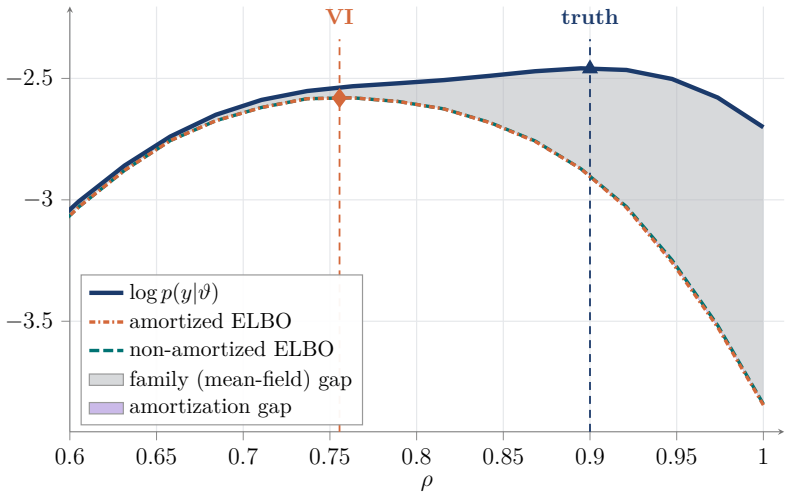
- [§4.2, Eqs. (4.8)–(4.9)] The notation in this section conflates the true parameter with the pseudo-true value. As written, Eq. (4.8) states b(ϑ0)=ϑ0, but under the standard reading where ϑ0 is the true value this is contradicted by Figure 3, where the binding function at ρ0=0.90 returns 0.76 (the mean-field VI pseudo-true value). The correct population identity for indirect inference is b(ϑ*)=\bar{ϑ}_0, where \bar{ϑ}_0 is the probability limit of the VI estimator under the true model. The fixed-point equation being solved should therefore be b(ϑ)=\bar{ϑ}_0 (or, in finite samples, b(ϑ)=\hat{ϑ}_VI), not b(ϑ)=ϑ0. Because Eqs. (4.9), (4.10), and the asymptotic statement (4.13) all build on this identity, this is a load-bearing issue that must be corrected.
- [Appendix B.2] The claim that b_fixed-q(ϑ0)=ϑ0 'by construction' is false. The pseudo-true value ϑ0 is defined as the maximizer over rϑ of max_ϕ E_{Pϑ0}[E_{rϑ,ϕ}], whereas b_fixed-q maximizes E_{Pϑ0}[E_{rϑ,ϕ0}] with ϕ0 held fixed. Replacing the inner maximization by a fixed ϕ0 changes the objective generically, so its argmax need not equal ϑ0. Consequently the fixed-q estimator solves a different equation and is asymptotically biased in general. This is not merely a missing regularity condition: it is an internal error in a proposed implementation. The claim that fixed-q and standard IVI 'share the same fixed point' should be removed unless a genuine condition is proved that guarantees the argmax of the fixed-q objective at ϑ0 is ϑ0.
- [§4.2–§4.3] The one-to-one assumption on the binding function is stated but never established or tested for the high-dimensional models used in the simulations and PSID application. Figure 3 only displays a one-dimensional slice of the binding function for ρ. In the fixed-point implementation (4.10), convergence requires a contraction property and the solution being found must be the unique root of b(ϑ)=target. No evidence is provided on injectivity of the full binding function, multiplicity of fixed points, or sensitivity to starting values. The paper should either prove structural conditions for injectivity for the models considered, or provide numerical diagnostics (e.g., multiple random starts, Jacobian rank checks, or a grid in a lower-dimensional projection) that support the required identification assumption.
- [§4.3 and Appendix A] The central theoretical claim — root-N consistency and asymptotic normality of IVI for the true parameter — is presented as a consequence of combining Westling and McCormick (2019) and Gourieroux et al. (1993), but no theorem with explicit sufficient conditions is stated. Appendix A gives an expansion and says 'we follow the approach in Westling and McCormick (2019) and assume their conditions are satisfied.' This is too informal for a paper whose abstract claims consistency and asymptotic normality. The paper should either state a theorem with verifiable conditions (or cite a precise theorem that covers the VI pseudo-true value in this setting) and then verify those conditions for the earnings-dynamics models, or substantially weaken the claimed theoretical contribution and present IVI primarily as a simulation-based bias-correction procedure.
minor comments (5)
- [Eq. (4.10)] The starting value in the fixed-point algorithm is written as ϑ0, which is ambiguous given the true/pseudo-true notation issue. In the finite-sample algorithm it should be the VI estimate \hat{ϑ}_VI, not a population quantity.
- [Table 6] The number of outer IVI iterations, the number of ELBO draws, and the neural-network width vary across experiments (e.g., outer iterations 10, 25, 50; ELBO draws 1 vs 40). The paper does not report how sensitive the conclusions are to these tuning choices. A short sensitivity analysis would address concerns about overfitting to the simulation designs.
- [§5.4] The statement that the mean-field penalty in Eq. (5.15) is 'an increasing function of |ρ|' is not proved and is only illustrated. This is a small point, but an analytical check or a footnote derivation would be helpful.
- [Figure 3] The figure illustrates invertibility only along a one-dimensional slice. The text should acknowledge this explicitly and refer to the additional checks requested in the major comments.
- [§8.1] The bootstrap standard errors are based on 100 replications. Given the nonlinearity and the inner optimization, it would be helpful to know the stability of the fixed-point iterations across bootstrap replicates; a small subsection or note in Appendix E would be enough.
Circularity Check
No significant circularity: the IVI binding function is estimated on independent simulated data and the central results do not reduce to fitted inputs or self-citations.
full rationale
IVI's derivation is self-contained in the sense that matters for circularity. The pseudo-true value ϑ0 is defined by (4.4), and the binding function b(ϑ) in (4.7) is the probability limit of the VI estimator under P_ϑ; the identity b(ϑ0)=ϑ0 follows from those definitions and is used as an inversion target, not as an independent prediction. The IVI estimator (4.11) is standard indirect inference: the binding function is estimated on simulated data drawn from P_ϑ, independent of the observed sample, so the debiasing step does not fit a parameter on the data and then relabel it a prediction. The asymptotic normality claims import external results (Westling and McCormick 2019; Gourieroux et al. 1993) rather than resting on self-citations; Bonhomme (2021) and Arellano et al. (2017) are literature/benchmark citations and not load-bearing for the method. Simulation results are Monte Carlo consistency checks on known DGPs, and the PSID application reports bootstrap standard errors without dressing estimates as out-of-sample predictions. The genuine caveats are correctness and identification concerns, not circularity: the one-to-one assumption on b is stated but not proved for the high-dimensional models, and Appendix B.2's fixed-q binding function is asserted 'by construction' to satisfy b_fixed-q(ϑ0)=ϑ0 even though ϑ0 is defined by profiling over ϕ, so the fixed-ϕ objective's argmax need not equal ϑ0. That is a local mathematical error in an alternative implementation, not a reduction of the central claim to its inputs, and no reported estimate uses the fixed-q implementation.
Assumptions & free parameters
free parameters (5)
- Damping factor κ in fixed-point iteration =
0.6
- Number of outer IVI iterations =
10 (AR1), 25 (nonlinear T=6), 50 (nonlinear T=40, PSID)
- ELBO draws per gradient evaluation =
1 for simulated panels, 40 for PSID
- Neural network hidden width =
32 (AR1 mean-field), 64 (others)
- Learning rate for Adam optimizer =
1e-2
assumptions (6)
- domain assumption The variational posterior family is flexible enough that the binding function b(·) is one-to-one (Section 4.2).
- domain assumption The regularity conditions of Westling and McCormick (2019) hold for the VI estimator (Section 4.3, A.1).
- domain assumption The fixed-point iteration (4.10) converges, i.e., a contraction mapping condition holds (Remark 3).
- domain assumption The variational optimization is solved to a global optimum for each inner fit.
- domain assumption The earnings dynamics models (Sections 5-8) are correctly specified as data-generating processes in simulations.
- domain assumption The PSID sample restrictions and demographic residualization from Blundell et al. (2008) are appropriate (Section 8.1).
Cite this review
Pith. "Pith review of Indirect Variational Inference: Applications to Earnings Dynamics." pith.science (2026). https://pith.science/paper/XYQNTN6B
@misc{pith2026260715168,
  author       = {Pith},
  title        = {Pith review of: Indirect Variational Inference: Applications to Earnings Dynamics},
  year         = {2026},
  howpublished = {\url{https://pith.science/paper/XYQNTN6B}},
  note         = {Machine review of arXiv:2607.15168}
}
read the original abstract
Latent-variable models are central to economics but often entail intractable integration. Variational inference (VI), widely used in machine learning, turns this integration into tractable, differentiable optimization by replacing the likelihood with a variational objective. However, guarantees of recovering the true parameters remain limited when the variational family is insufficiently flexible -- a key obstacle to the adoption of VI in economics. We first evaluate VI in models of earnings dynamics and show that the choice of variational posterior is crucial. We then introduce indirect variational inference (IVI), which treats VI as an auxiliary model and corrects the bias induced by the variational approximation. IVI retains much of VI's tractability because it does not require computing the likelihood. We apply these methods to models allowing for nonlinear persistence, non-Gaussian and serially correlated transitory shocks, and latent heterogeneity. Across simulated and empirical applications, flexible variational families combined with IVI deliver reliable estimates.
Figures


Figures from the paper (7 more)


Reference graph
Works this paper leans on
-
[2]
Statistics and Computing , volume=
Practical Bayesian model evaluation using leave-one-out cross-validation and WAIC , author=. Statistics and Computing , volume=
-
[3]
Proceedings of the 34th International Conference on Machine Learning , year=
Variational boosting: Iteratively refining posterior approximations , author=. Proceedings of the 34th International Conference on Machine Learning , year=
-
[4]
stat , volume=
Auto-Encoding Variational Bayes , author=. stat , volume=
-
[5]
arXiv preprint arXiv:2204.07907 , year=
Just identified indirect inference estimator: Accurate inference through bias correction , author=. arXiv preprint arXiv:2204.07907 , year=
-
[6]
arXiv preprint arXiv:1701.05146 , volume=
Inference in generative models using the Wasserstein distance , author=. arXiv preprint arXiv:1701.05146 , volume=. 2017 , publisher=
arXiv 2017
-
[7]
Econometrica , volume=
An adversarial approach to structural estimation , author=. Econometrica , volume=. 2023 , publisher=
2023
-
[8]
Machine learning , volume=
An introduction to variational methods for graphical models , author=. Machine learning , volume=. 1999 , publisher=
1999
-
[9]
Econometric theory , volume=
Which moments to match? , author=. Econometric theory , volume=. 1996 , publisher=
1996
Show all 62 references
-
[10]
Journal of the European Economic Association , volume=
Uncertainty, persistence, and heterogeneity: A panel data perspective , author=. Journal of the European Economic Association , volume=. 2014 , publisher=
2014
-
[11]
Econometrica , volume=
What do data on millions of US workers reveal about lifecycle earnings dynamics? , author=. Econometrica , volume=. 2021 , publisher=
2021
-
[12]
Proceedings of the 29th International Conference on Machine Learning , year=
Nonparametric variational inference , author=. Proceedings of the 29th International Conference on Machine Learning , year=
-
[13]
Proceedings of the 32nd International Conference on Machine Learning , year=
Variational inference with normalizing flows , author=. Proceedings of the 32nd International Conference on Machine Learning , year=
-
[14]
Advances in Neural Information Processing Systems , volume=
Improved variational inference with inverse autoregressive flow , author=. Advances in Neural Information Processing Systems , volume=
-
[15]
Proceedings of the 37th International Conference on Machine Learning , year=
Semi-Amortized Variational Inference , author=. Proceedings of the 37th International Conference on Machine Learning , year=
-
[16]
International Conference on Learning Representations , year=
Reinterpreting Importance-Weighted Autoencoders , author=. International Conference on Learning Representations , year=
-
[17]
Journal of Machine Learning Research , volume=
Automatic differentiation variational inference , author=. Journal of Machine Learning Research , volume=
-
[18]
Journal of Labor Economics , volume =
Growth-Rate Heterogeneity and the Covariance Structure of Life-Cycle Earnings , author =. Journal of Labor Economics , volume =
-
[19]
Meghir, Costas and Pistaferri, Luigi , journal =. Income
-
[20]
Handbook of Labor Economics, Volume 4B , editor =
Earnings, Consumption and Life Cycle Choices , author =. Handbook of Labor Economics, Volume 4B , editor =
-
[21]
Econometrica , volume =
Earnings and Consumption Dynamics: A Nonlinear Panel Data Framework , author =. Econometrica , volume =
-
[22]
Journal of the European Economic Association , volume =
Nonlinear Household Earnings Dynamics, Self-Insurance, and Welfare , author =. Journal of the European Economic Association , volume =
-
[23]
Journal of Political Economy , volume =
Cyclical Dynamics in Idiosyncratic Labor Market Risk , author =. Journal of Political Economy , volume =
-
[24]
Review of Economic Dynamics , volume =
An Empirical Investigation of Labor Income Processes , author =. Review of Economic Dynamics , volume =
-
[25]
Journal of the royal statistical society: series B (methodological) , volume=
Maximum likelihood from incomplete data via the EM algorithm , author=. Journal of the royal statistical society: series B (methodological) , volume=. 1977 , publisher=
1977
-
[26]
American Economic Review , volume =
Consumption Inequality and Partial Insurance , author =. American Economic Review , volume =
-
[27]
Journal of Business & Economic Statistics , volume =
Fast Variational Bayes Methods for Multinomial Probit Models , author =. Journal of Business & Economic Statistics , volume =
-
[28]
Journal of Economic Dynamics and Control , volume =
Fast and Accurate Variational Inference for Large Bayesian VARs with Stochastic Volatility , author =. Journal of Economic Dynamics and Control , volume =
-
[29]
Econometrica , volume =
A Structural Model of Dense Network Formation , author =. Econometrica , volume =
-
[30]
Review of Economics and Statistics , volume=
Approximate variational estimation for a model of network formation , author=. Review of Economics and Statistics , volume=. 2023 , publisher=
2023
-
[31]
International Conference on Learning Representations (ICLR) , year =
Importance Weighted Autoencoders , author =. International Conference on Learning Representations (ICLR) , year =
-
[32]
Proceedings of the 35th International Conference on Machine Learning (ICML) , volume =
Yes, but Did It Work?: Evaluating Variational Inference , author =. Proceedings of the 35th International Conference on Machine Learning (ICML) , volume =
-
[33]
arXiv preprint arXiv:1507.02646 , year =
Pareto Smoothed Importance Sampling , author =. arXiv preprint arXiv:1507.02646 , year =
-
[34]
Proceedings of the 34th International Conference on Machine Learning (ICML) , series =
Variational Boosting: Iteratively Refining Posterior Approximations , author =. Proceedings of the 34th International Conference on Machine Learning (ICML) , series =
-
[35]
Econometrica , volume =
Dynamic Aspects of Earnings Mobility , author =. Econometrica , volume =. 1978 , publisher =
1978
-
[36]
Econometrica , volume =
On the Covariance Structure of Earnings and Hours Changes , author =. Econometrica , volume =. 1989 , publisher =
1989
-
[37]
Journal of the American Statistical Association , volume =
Variational Inference: A Review for Statisticians , author =. Journal of the American Statistical Association , volume =. 2017 , publisher =
2017
-
[38]
Journal of the American Statistical Association , volume=
Frequentist consistency of variational Bayes , author=. Journal of the American Statistical Association , volume=. 2019 , publisher=
2019
-
[39]
arXiv preprint arXiv:2302.05747 , year=
Individualized treatment allocation in sequential network games , author=. arXiv preprint arXiv:2302.05747 , year=
-
[40]
Journal of Machine Learning Research , volume=
Extending mean-field variational inference via entropic regularization: theory and computation , author=. Journal of Machine Learning Research , volume=
-
[41]
Journal of Applied Econometrics , volume=
Estimating nonlinear time-series models using simulated vector autoregressions , author=. Journal of Applied Econometrics , volume=. 1993 , publisher=
1993
-
[42]
Journal of the ACM (JACM) , volume=
Iterative procedures for nonlinear integral equations , author=. Journal of the ACM (JACM) , volume=. 1965 , publisher=
1965
-
[43]
Advances in Neural Information Processing Systems , volume=
Variational Bayes under model misspecification , author=. Advances in Neural Information Processing Systems , volume=
-
[44]
Journal of the Royal Statistical Society
Maximum Likelihood from Incomplete Data via the EM Algorithm , author =. Journal of the Royal Statistical Society. Series B (Methodological) , volume =
-
[45]
Journal of machine Learning research , volume=
Latent dirichlet allocation , author=. Journal of machine Learning research , volume=
-
[46]
The Annals of Statistics , volume=
On the approximation accuracy of Gaussian variational inference , author=. The Annals of Statistics , volume=. 2024 , publisher=
2024
-
[47]
Journal of Econometrics , volume=
Heterogeneity of consumption responses to income shocks in the presence of nonlinear persistence , author=. Journal of Econometrics , volume=. 2024 , publisher=
2024
-
[48]
Journal of applied econometrics , volume=
Indirect inference , author=. Journal of applied econometrics , volume=. 1993 , publisher=
1993
-
[49]
Available at SSRN 3983263 , year=
Changing Income Risk across the US Skill Distribution: Evidence from a Generalized Kalman Filter , author=. Available at SSRN 3983263 , year=
-
[50]
arXiv preprint arXiv:1611.04273 , year=
On the quantitative analysis of decoder-based generative models , author=. arXiv preprint arXiv:1611.04273 , year=
-
[51]
2020 , institution=
Heterogeneity in transitory income risk , author=. 2020 , institution=
2020
-
[52]
Pattern Recognition and Machine Learning , year=
Pattern Recognition and Machine Learning , author=. Pattern Recognition and Machine Learning , year=
-
[53]
Econometrica , volume=
Instrumental variable treatment of nonclassical measurement error models , author=. Econometrica , volume=. 2008 , publisher=
2008
-
[54]
Econometric reviews , volume=
A survey of sequential Monte Carlo methods for economics and finance , author=. Econometric reviews , volume=. 2012 , publisher=
2012
-
[55]
Journal of Machine Learning Research , volume=
On the robustness to misspecification of -posteriors and their variational approximations , author=. Journal of Machine Learning Research , volume=
-
[56]
Journal of Computational and Graphical Statistics , volume=
Beyond prediction: A framework for inference with variational approximations in mixture models , author=. Journal of Computational and Graphical Statistics , volume=. 2019 , publisher=
2019
-
[57]
The Annals of Statistics , volume=
ASYMPTOTIC NORMALITY OF MAXIMUM LIKELIHOOD AND ITS VARIATIONAL APPROXIMATION FOR STOCHASTIC BLOCKMODELS , author=. The Annals of Statistics , volume=
-
[58]
arXiv preprint arXiv:2102.01802 , year=
Teams: Heterogeneity, sorting, and complementarity , author=. arXiv preprint arXiv:2102.01802 , year=
-
[59]
Journal of the American Statistical Association , volume =
Accurate Approximations for Posterior Moments and Marginal Densities , author =. Journal of the American Statistical Association , volume =
-
[60]
Journal of the Royal Statistical Society: Series B (Statistical Methodology) , volume =
Approximate Bayesian Inference for Latent Gaussian Models by Using Integrated Nested Laplace Approximations , author =. Journal of the Royal Statistical Society: Series B (Statistical Methodology) , volume =
-
[61]
Biometrika , volume =
The sinh-arcsinh Normal Distribution: Origins and Applications , author =. Biometrika , volume =. 2009 , publisher =
2009
-
[62]
Identifiability of a linear relation between variables which are subject to error , journal =
Reiers. Identifiability of a linear relation between variables which are subject to error , journal =. 1945 , volume =
1945
-
[63]
Journal of Income Distribution , year =
Heimann, Thorsten , title =. Journal of Income Distribution , year =
Reviewed August 1, 2026 · model on record in the stance chip above.
Discussion (0). Sign in to comment.