REVIEW 2 major objections 5 minor 62 references
Verifying Isolation Levels of Database Implementations for Free Using Separation Logic
T0 review · 2 major / 5 minor · reviewed 2026-08-01 · deepseek-v4-flash
Pith's one-line read For three weak isolation levels, any database implementation that satisfies a given set of separation-logic per-operation specifications automatically implements that isolation level, for every possible client, with a machine-checked proof.
desk verdict Genuinely new free theorem connecting separation-logic specs to a Crooks-style consistency model, but the paper owes the reader a proof that its amended model is still equivalent to the dependency-graph model. read the letter →
The pith
A machine-rendered reading of the paper's core claim, the machinery that carries it, and where it could break.
The reading
What carries the argument
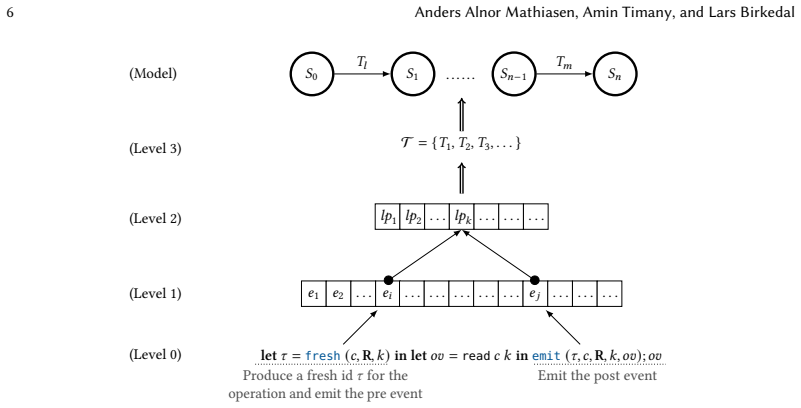
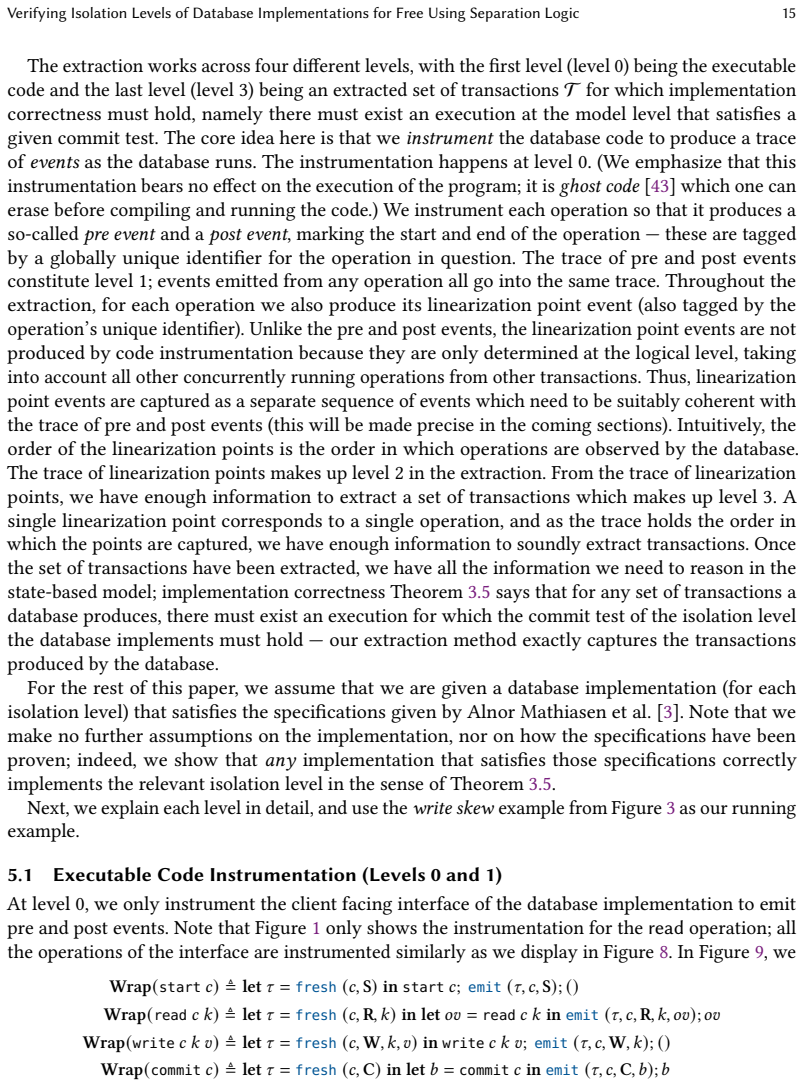
The load-bearing mechanism is a four-level trace extraction. Level 0 is instrumented executable code; ghost operations emit pre and post events into a global trace with fresh tags (level 1). From that trace, a sequence of linearization points is constructed (level 2), constrained to be coherent with the trace in the standard linearizability sense. The linearization points are chopped into transactions per connection (level 3), requiring each transaction to read its own most recent write, have ordered operations, and end with a single commit. At the top, the transactions must admit an execution of the state-based model whose commit test holds. The global proof invariant ValidTrace(I,t) packag
What would settle it
One disqualifying observation would be a database implementation that provably satisfies the snapshot-isolation separation-logic specification yet has a committed execution whose transactions cannot be ordered into any state-based execution satisfying the snapshot-isolation commit test. A second would be an execution accepted by the amended state-based commit test but rejected by the dependency-graph definition of the same isolation level, which would refute the claimed equivalence between the two models.
Extended reading notes
Core claim
The paper proves an adequacy theorem: for an isolation level I with its separation-logic specification specI, any implementation libI satisfying specI, wrapped with the ghost instrumentation, produces only valid traces under arbitrary verified clients, and no thread crashes. A valid trace is one for which a sequence of linearization points, a set of transactions, and a state-based execution exist such that the isolation level's commit test holds for all committed transactions. This is exactly implementation correctness in the state-based consistency model, and, via the model's established equivalence, in the dependency-graph formulation used by the database community. The proof is uniform: i
Load-bearing premise
The result inherits correctness of the separation-logic specifications: if those specifications permit a behavior that violates the intended isolation guarantee, the free theorem still holds formally but offers no real guarantee.
Editorial extensions
If this is right
- Verifying a database's isolation level reduces to proving per-operation separation-logic specifications; the consistency-model guarantee follows automatically for all possible client programs.
- The guarantee holds for every transaction workload, not just a fixed workload, so it is strictly stronger than model-checking approaches that enumerate interleavings.
- The result is a free theorem: new database implementations acquire the model-level guarantee without re-proving the connection, as long as they satisfy the specifications.
- Clients can be verified against the same modular per-operation specifications, so correctness composes with other libraries and verified components.
- Because the proof is machine-checked, the link between executable code and the isolation-level model is mechanized end to end.
Reading between the lines
- Editorial inference: the same extraction pipeline should extend to stronger and additional isolation levels (such as serializability or parallel snapshot isolation) once separation-logic specifications exist; the main friction is designing the per-level commit test and the corresponding resource wrapping, not the trace machinery.
- Editorial inference: the method's practical power depends on the cost of proving the underlying per-operation specifications for a real database; for high-performance engines this is a substantial verification effort, though it is paid once per implementation rather than per workload.
- Editorial inference: a testable extension would be to instantiate the pipeline for a small distributed database and show that the extracted transactions satisfy the commit test on all interleavings, providing a concrete end-to-end case against which this paper's machinery can be checked.
- Editorial inference: because the equivalence between the amended state-based model and the dependency-graph model is cited rather than proven in this paper, a rigorous independent check of that equivalence for the modified NoConf test would close the only remaining semantic gap.
Editorial analysis
A structured set of objections, weighed in public.
Referee Report
Summary. The paper presents a method for proving that any database implementation satisfying the separation-logic specifications of Alnor Mathiasen et al. [3] implements the corresponding isolation level in the state-based model of Crooks et al. [16]. The method instruments database operations with ghost pre/post events, enforces a global trace invariant ValidTrace(I,t), extracts linearization points and transactions, and proves a free theorem (Theorem 5.1): for any verified clients, all reachable traces satisfy the commit test of I. Proofs are mechanized in Rocq/Iris/Aneris (13,000+ lines). The paper covers read uncommitted, read committed, and snapshot isolation, with a detailed proof sketch for snapshot isolation.
Significance. If the central claims hold, this is a significant step: it avoids workload-specific model checking and gives a modular, machine-checked bridge from executable code to abstract consistency models. The paper is commendable for shipping a large Rocq formalization and for stating the theorem parametrically in the prior specifications, making the result a genuine free theorem. However, the significance depends on the amended Section 3 model preserving the Crooks--Adya equivalence; this is currently asserted rather than proved.
major comments (2)
- [§3, Definition 3.3 and Figure 5] The amended NoConf leaves the snapshot index i unconstrained for blind writes. A transaction T with no NoPriorWrite read of k may set i = j-1, so an execution [T1={W(k,1),C} at index 1, T2={W(k,2),C} at index 2] is accepted. If T1 and T2 overlap in the source execution, Adya's write-write conflict rule forbids both commits. The paper cites Crooks et al. [16] for equivalence but explicitly states that this model has been amended (removed unique-value and one-write-per-key assumptions, changed NoConf). No proof is supplied that the amended model remains equivalent to the dependency-graph model. This is load-bearing: Theorem 5.1 is stated for the amended model and the intro/conclusion claim Adya as the endpoint. Please either prove the equivalence for the amended model or scope the claims to the amended model and state which standard guarantees are lost.
- [Theorem 5.1 / §4–§5] The Adequacy theorem inherits the separation-logic specifications specI from the authors' own prior work [3]. ValidTrace(I,t) establishes the amended state-based commit test, but nothing in the paper proves that specI captures the intended isolation level beyond the write-skew example in Section A. Since the headline claim is that isolation levels are derived from the structure of specifications, an explicit statement that the result is only as strong as specI -- together with a summary of the phenomena checked for each level in [3] -- would make the dependency visible. This is a premise concern, not an internal inconsistency, but it is central to the advertised guarantee.
minor comments (5)
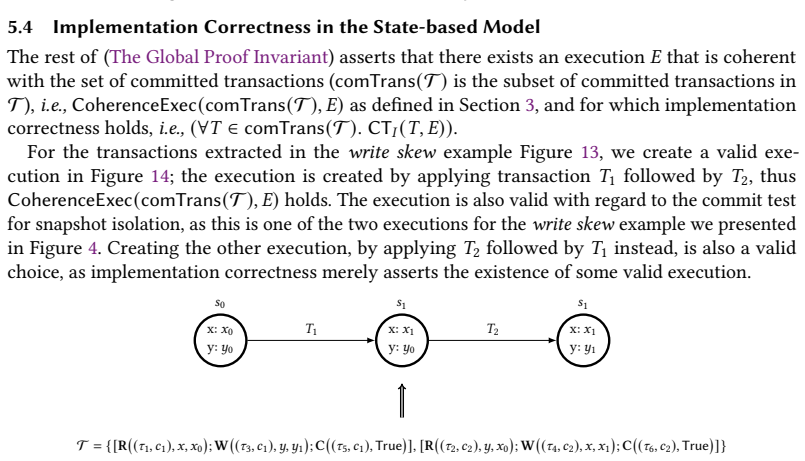
- [§3, Figure 5] CT_SI(T,E) is written with NoConf(E,T,s), while Definition 3.3 defines NoConf(E,T,i). The third argument should be an index, not a state; the notation should be made consistent.
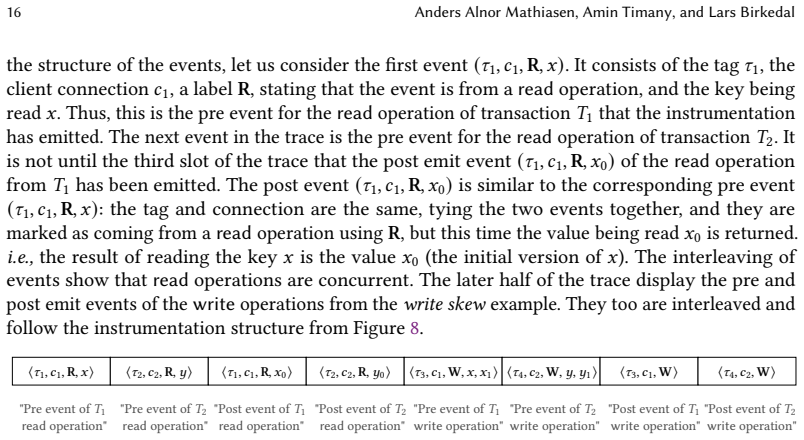
- [§5.3, Figure 13] The second transaction's read is rendered as R((τ2,c2),y,x0); from the trace in Figure 9 it should be y,y0.
- [§3, §5.4] Definition 3.5 and the text around it refer to 'Theorem 3.5'; it is a definition. Similarly, the commit tests in Figure 5 are called 'Theorem 3.3/3.4' but are definitions.
- [§5, The Global Proof Invariant] The same symbol t is used for the event trace and for the linearization-point sequence. This is easy to confuse; distinct symbols (e.g., t and ℓ) would improve readability.
- [Mechanization] The paper claims that all proofs are mechanized but gives no artifact description (location of the Rocq development, key theorem names). A short reproducibility note would help readers and reviewers.
Circularity Check
No significant circularity: the free theorem is an explicit conditional whose premise (specI) is machine-checked prior work; the proof connects two distinct formalisms rather than reducing to its input.
full rationale
The derivation chain is: assume specI(lib) from Alnor Mathiasen et al. [3]; prove specI(Wrap(lib)) by instantiating the existentially quantified resources and maintaining the trace invariant; conclude ValidTrace(I,t) via the adequacy theorem. The conclusion contains the state-based commit test (Complete/NoConf, Preread, or True), which is not identical to the input separation-logic specification. The input is a set of per-operation atomic Hoare triples with CanCommit; the output is an existential execution E satisfying the commit test. To get from one to the other the proof must construct linearization points, group them into transactions, build an execution, and show coherence at every level. That is a substantive translation, not a re-definition. The reliance on [3] is an explicit premise, and the paper states that the specifications from [3] are machine-checked; under the review rules, machine-checked prior work counts as independent support and does not make the conditional circular. The amended state-based model and the citation of Crooks et al. [16] for equivalence to the dependency-graph model is a correctness/verification gap (the amended NoConf is not re-proven equivalent), but a missing external equivalence proof is not internal circularity: the Adya target is not encoded into the separation-logic specifications by construction. There are no fitted parameters, no prediction of a fitted quantity, and no uniqueness theorem imported from the same authors. Accordingly, the paper receives score 0.
Assumptions & free parameters
assumptions (5)
- domain assumption specI from Alnor Mathiasen et al. [3] correctly characterizes weak isolation levels at the program-execution level.
- domain assumption The state-based model of Crooks et al. [16] is equivalent to the Adya dependency-graph model, including the amended snapshot-isolation commit test.
- standard math Soundness of Iris/Aneris and of the fresh/emit ghost-code operational semantics (Birkedal et al. [8], Aneris [36]).
- domain assumption Clients under consideration are verified against the universal Hoare triple ∀lib.{specI(lib)} e⊕lib {True}.
- domain assumption Databases are AnerisLang programs matching the key-value API init/start/read/write/commit.
invented entities (3)
-
Global event trace t with pre/post events and fresh/emit ghost operations
-
Linearization-point sequence (level 2) with PermissionLin/PermissionPost ghost resources
-
LatestWrite(k, ov, c) wrapping resource
Cite this review
Pith. "Pith review of Verifying Isolation Levels of Database Implementations for Free Using Separation Logic." pith.science (2026). https://pith.science/paper/7NR6CDQZ
@misc{pith2026260715877,
  author       = {Pith},
  title        = {Pith review of: Verifying Isolation Levels of Database Implementations for Free Using Separation Logic},
  year         = {2026},
  howpublished = {\url{https://pith.science/paper/7NR6CDQZ}},
  note         = {Machine review of arXiv:2607.15877}
}
read the original abstract
Modern databases are highly concurrent and provide transactions as a mean of grouping several database operations into atomically applied units. Database vendors and software engineers use isolation levels to describe the consistency guarantees of transactions. The popular isolation levels give weak guarantees, with intricate semantics, to optimize performance of applications. The problem of assuring that database implementations actually implement the isolation level guarantees that application developers build their systems upon has received a great deal of attention from the testing community. But until now, there exists no method for formally verifying that a database implementation actually implements the isolation level that database vendors says it provides. In this paper, we present a method for verifying that a database implements an isolation level: we derive isolation levels directly, as formalized in transactional consistency models by the database community, from the structure of separation logic specifications. By doing so, we consider all program executions that a database and arbitrary clients of the database could produce. The result is a so-called free theorem meaning that any database implementation, whose operations are verified against a specific set of separation logic specifications, actually implements its isolation level. As all proofs in this paper are mechanized in the Rocq proof assistant and build upon a detailed semantic model of program execution, we believe this contribution raises the bar for the achievable robustness of databases.
Figures


Figures from the paper (13 more)






Reference graph
Works this paper leans on
-
[3]
Anders Alnor Mathiasen, Léon Gondelman, Léon Ducruet, Amin Timany, and Lars Birkedal. 2025. Reasoning about Weak Isolation Levels in Separation Logic.Proceedings of the ACM on Programming Languages9, ICFP (2025), 306–340
2025
-
[16]
Natacha Crooks, Youer Pu, Lorenzo Alvisi, and Allen Clement. 2017. Seeing is Believing: A Client-Centric Specification of Database Isolation. InProceedings of the ACM Symposium on Principles of Distributed Computing(Washington, DC, USA)(PODC ’17). Association for Computing Machinery, New York, NY, USA, 73–82. doi:10.1145/3087801.3087802
arXiv 2017
-
[1]
A. Adya. 1999.Weak Consistency: A Generalized Theory and Optimistic Implementations for Distributed Transactions. Technical Report. USA
1999
-
[2]
A. Adya, B. Liskov, and P. O’Neil. 2000. Generalized isolation level definitions. InProceedings of 16th International Conference on Data Engineering (Cat. No.00CB37073). 67–78. doi:10.1109/ICDE.2000.839388
arXiv 2000
-
[4]
Aneris-Team. 2023. https://github.com/logsem/aneris/blob/master/documentation.pdf
2023
-
[5]
Hagit Attiya, Alexey Gotsman, Sandeep Hans, and Noam Rinetzky. 2013. A programming language perspective on transactional memory consistency. InProceedings of the 2013 ACM Symposium on Principles of Distributed Computing (Montréal, Québec, Canada)(PODC ’13). Association for Computing Machinery, New York, NY, USA, 309–318. doi:10. 1145/2484239.2484267
arXiv 2013
-
[6]
Hagit Attiya, Alexey Gotsman, Sandeep Hans, and Noam Rinetzky. 2017. Characterizing transactional memory consistency conditions using observational refinement.Journal of the ACM (JACM)65, 1 (2017), 1–44
2017
-
[7]
Hal Berenson, Phil Bernstein, Jim Gray, Jim Melton, Elizabeth O’Neil, and Patrick O’Neil. 1995. A Critique of ANSI SQL Isolation Levels.SIGMOD Rec.24, 2 (may 1995), 1–10. doi:10.1145/568271.223785
arXiv 1995
Show all 62 references
-
[8]
Lars Birkedal, Thomas Dinsdale-Young, Armaël Guéneau, Guilhem Jaber, Kasper Svendsen, and Nikos Tzevelekos
-
[9]
Ranadeep Biswas and Constantin Enea. 2019. On the complexity of checking transactional consistency.Proc. ACM Program. Lang.3, OOPSLA, Article 165 (Oct. 2019), 28 pages. doi:10.1145/3360591
2019 doi
-
[10]
Sebastian Burckhardt, Daan Leijen, Manuel Fähndrich, and Mooly Sagiv. 2012. Eventually Consistent Transactions. In Programming Languages and Systems, Helmut Seidl (Ed.). Springer Berlin Heidelberg, Berlin, Heidelberg, 67–86
2012
-
[11]
Andrea Cerone, Giovanni Bernardi, and Alexey Gotsman. 2015. A Framework for Transactional Consistency Models with Atomic Visibility. In26th International Conference on Concurrency Theory (CONCUR 2015) (Leibniz International Proceedings in Informatics (LIPIcs), Vol. 42), Luca A...
2015 doi
-
[12]
Andrea Cerone, Giovanni Bernardi, and Alexey Gotsman. 2015. A framework for transactional consistency models with atomic visibility. In26th International Conference on Concurrency Theory (CONCUR 2015). Schloss Dagstuhl– Leibniz-Zentrum für Informatik, 58–71
2015
-
[13]
Andrea Cerone and Alexey Gotsman. 2018. Analysing Snapshot Isolation.J. ACM65, 2, Article 11 (Jan. 2018), 41 pages. doi:10.1145/3152396
2018 doi
-
[14]
Chandra, Robert Griesemer, and Joshua Redstone
Tushar D. Chandra, Robert Griesemer, and Joshua Redstone. 2007. Paxos made live: an engineering perspective. In Proceedings of the Twenty-Sixth Annual ACM Symposium on Principles of Distributed Computing(Portland, Oregon, USA)(PODC ’07). Association for Computing Machinery, Ne...
2007
-
[15]
Frans Kaashoek, and Nickolai Zeldovich
Yun-Sheng Chang, Ralf Jung, Upamanyu Sharma, Joseph Tassarotti, M. Frans Kaashoek, and Nickolai Zeldovich. 2023. Verifying vMVCC, a high-performance transaction library using multi-version concurrency control. In17th USENIX Symposium on Operating Systems Design and Implementat...
2023
-
[17]
Pedro da Rocha Pinto, Thomas Dinsdale-Young, and Philippa Gardner. 2014. TaDA: A Logic for Time and Data Abstraction. InECOOP 2014 – Object-Oriented Programming, Richard Jones (Ed.). Springer Berlin Heidelberg, Berlin, Heidelberg, 207–231
2014
-
[18]
Luke Dalessandro, Dave Dice, Michael Scott, Nir Shavit, and Michael Spear. 2010. Transactional mutex locks. In European Conference on Parallel Processing. Springer, 2–13
2010
-
[19]
Simon Doherty, Lindsay Groves, Victor Luchangco, and Mark Moir. 2013. Towards formally specifying and verifying transactional memory.Formal Aspects of Computing25, 5 (2013), 769–799
2013
-
[20]
Seth Gilbert and Nancy Lynch. 2002. Brewer’s Conjecture and the Feasibility of Consistent, Available, Partition-Tolerant Web Services.SIGACT News33, 2 (jun 2002), 51–59. doi:10.1145/564585.564601
2002
-
[21]
Léon Gondelman, Simon Oddershede Gregersen, Abel Nieto, Amin Timany, and Lars Birkedal. 2021. Distributed causal memory: modular specification and verification in higher-order distributed separation logic.Proc. ACM Program. Lang. 5, POPL (2021), 1–29. doi:10.1145/3434323
2021 doi
-
[22]
Léon Gondelman, Jonas Kastberg Hinrichsen, Mário Pereira, Amin Timany, and Lars Birkedal. 2023. Verifying Reliable Network Components in a Distributed Separation Logic with Dependent Separation Protocols.Proc. ACM Program. Lang.7, ICFP, Article 217 (aug 2023), 31 pages. doi:10...
2023 doi
-
[23]
Long Gu, Si Liu, Tiancheng Xing, Hengfeng Wei, Yuxing Chen, and David Basin. 2024. IsoVista: Black-box checking database isolation guarantees.Proceedings of the VLDB Endowment17, 12 (2024), 4325–4328
2024
-
[24]
Rachid Guerraoui and Michal Kapalka. 2008. On the correctness of transactional memory. InProceedings of the 13th ACM SIGPLAN Symposium on Principles and practice of parallel programming. 175–184
2008
-
[25]
Herlihy and Jeannette M
Maurice P. Herlihy and Jeannette M. Wing. 1990. Linearizability: A Correctness Condition for Concurrent Objects. ACM Trans. Program. Lang. Syst.12, 3 (jul 1990), 463–492. doi:10.1145/78969.78972
1990
-
[26]
C. A. R. Hoare. 1969. An Axiomatic Basis for Computer Programming.Commun. ACM12, 10 (1969), 576–580. doi:10.1145/363235.363259
1969
-
[27]
Kaile Huang, Si Liu, Zhenge Chen, Hengfeng Wei, David Basin, Haixiang Li, and Anqun Pan. 2023. Efficient Black-Box Checking of Snapshot Isolation in Databases.Proc. VLDB Endow.16, 6 (Feb. 2023), 1264–1276. doi:10.14778/3583140. 3583145
2023 doi
-
[28]
Damien Imbs and Michel Raynal. 2012. Virtual world consistency: A condition for STM systems (with a versatile protocol with invisible read operations).Theoretical Computer Science444 (2012), 113–127
2012
-
[29]
Ralf Jung, Robbert Krebbers, Lars Birkedal, and Derek Dreyer. 2016. Higher-order ghost state. InProceedings of the 21st ACM SIGPLAN International Conference on Functional Programming, ICFP 2016, Nara, Japan, September 18-22, 2016. 256–269. doi:10.1145/2951913.2951943
2016
-
[30]
Ralf Jung, Robbert Krebbers, Jacques-Henri Jourdan, Ales Bizjak, Lars Birkedal, and Derek Dreyer. 2018. Iris from the ground up: A modular foundation for higher-order concurrent separation logic.J. Funct. Program.28 (2018), e20. doi:10.1017/S0956796818000151
2018 doi
-
[31]
Ralf Jung, David Swasey, Filip Sieczkowski, Kasper Svendsen, Aaron Turon, Lars Birkedal, and Derek Dreyer. 2015. Iris: Monoids and Invariants as an Orthogonal Basis for Concurrent Reasoning. InProceedings of the 42nd Annual ACM SIGPLAN-SIGACT Symposium on Principles of Program...
2015
-
[32]
Gowtham Kaki, Kartik Nagar, Mahsa Najafzadeh, and Suresh Jagannathan. 2017. Alone together: compositional reasoning and inference for weak isolation.Proceedings of the ACM on Programming Languages2, POPL (Dec. 2017), 1–34. doi:10.1145/3158115
2017 doi
-
[33]
Bas Ketsman, Christoph Koch, Frank Neven, and Brecht Vandevoort. 2023. Concurrency control for database theorists. SIGMOD Rec.51, 4 (jan 2023), 6–17. doi:10.1145/3582302.3582304
2023
-
[34]
Kyle Kingsbury and Peter Alvaro. 2020. Elle: inferring isolation anomalies from experimental observations.Proc. VLDB Endow.14, 3 (Nov. 2020), 268–280. doi:10.14778/3430915.3430918
2020
-
[35]
Robbert Krebbers, Ralf Jung, Ales Bizjak, Jacques-Henri Jourdan, Derek Dreyer, and Lars Birkedal. 2017. The Essence of Higher-Order Concurrent Separation Logic. InProgramming Languages and Systems - 26th European Symposium on Programming, ESOP 2017, Held as Part of the Europea...
2017 doi
-
[36]
Morten Krogh-Jespersen, Amin Timany, Marit Edna Ohlenbusch, Simon Oddershede Gregersen, and Lars Birkedal
-
[37]
Mohsen Lesani, Victor Luchangco, and Mark Moir. 2012. A framework for formally verifying software transactional memory algorithms. InInternational Conference on Concurrency Theory. Springer, 516–530
2012
-
[38]
Mohsen Lesani, Li-yao Xia, Anders Kaseorg, Christian J Bell, Adam Chlipala, Benjamin C Pierce, and Steve Zdancewic
-
[39]
Si Liu, Long Gu, Hengfeng Wei, and David Basin. 2024. Plume: Efficient and Complete Black-Box Checking of Weak Isolation Levels.Proc. ACM Program. Lang.8, OOPSLA2, Article 302 (Oct. 2024), 29 pages. doi:10.1145/3689742
2024 doi
-
[40]
Lasse Møldrup and Andreas Pavlogiannis. 2025. AWDIT: An Optimal Weak Database Isolation Tester.Proceedings of the ACM on Programming Languages9, PLDI (2025), 1540–1564
2025
-
[41]
Abel Nieto, Arnaud Daby-Seesaram, Léon Gondelman, Amin Timany, and Lars Birkedal. 2023. Modular Verification of State-Based CRDTs in Separation Logic. In37th European Conference on Object-Oriented Programming (ECOOP 2023) (Leibniz International Proceedings in Informatics (LIPI...
2023 doi
-
[42]
Abel Nieto, Léon Gondelman, Alban Reynaud, and Lars Birkedal. 2022. Modular Verification of Op-Based CRDTs in Separation Logic.Proc. ACM Program. Lang.OOPSLA (2022). Accepted for publication
2022
-
[43]
Susan Owicki and David Gries. 1976. Verifying properties of parallel programs: an axiomatic approach.Commun. ACM19, 5 (May 1976), 279–285. doi:10.1145/360051.360224
1976
-
[44]
Papadimitriou
Christos H. Papadimitriou. 1979. The Serializability of Concurrent Database Updates.J. ACM26, 4 (oct 1979), 631–653. doi:10.1145/322154.322158 28 Anders Alnor Mathiasen, Amin Timany, and Lars Birkedal
1979
-
[45]
Lauren Pick, Amanda Xu, Ankush Desai, Sanjit A Seshia, and Aws Albarghouthi. 2025. Checking Observational Correctness of Database Systems.Proceedings of the ACM on Programming Languages9, OOPSLA1 (2025), 1661–1688
2025
-
[46]
Azalea Raad, Ori Lahav, and Viktor Vafeiadis. 2018. On Parallel Snapshot Isolation and Release/Acquire Consistency. InProgramming Languages and Systems, Amal Ahmed (Ed.). Springer International Publishing, Cham, 940–967
2018
-
[47]
Azalea Raad, Ori Lahav, and Viktor Vafeiadis. 2018. On the Semantics of Snapshot Isolation. arXiv:1805.06196 [cs.LO] https://arxiv.org/abs/1805.06196
2018 arXiv
-
[48]
Reynolds
J.C. Reynolds. 2002. Separation logic: a logic for shared mutable data structures. InProceedings 17th Annual IEEE Symposium on Logic in Computer Science. 55–74. doi:10.1109/LICS.2002.1029817
2002 arXiv
-
[49]
Gerhard Schellhorn, Stefan Bodenmüller, and Wolfgang Reif. 2025. Verification of forward simulations with thread-local, step-local proof obligations.Science of Computer Programming241 (2025), 103227
2025
-
[50]
Upamanyu Sharma, Ralf Jung, Joseph Tassarotti, Frans Kaashoek, and Nickolai Zeldovich. 2023. Grove: A Separation- Logic Library for Verifying Distributed Systems. InProceedings of the 29th Symposium on Operating Systems Principles (Koblenz, Germany)(SOSP ’23). Association for ...
2023
-
[51]
Tim Soethout, Tijs van der Storm, and Jurgen J. Vinju. 2021. Automated Validation of State-Based Client-Centric Isolation with TLA+. InSoftware Engineering and Formal Methods. SEFM 2020 Collocated Workshops, Loek Cleophas and Mieke Massink (Eds.). Springer International Publis...
2021
-
[52]
Yair Sovran, Russell Power, Marcos K Aguilera, and Jinyang Li. 2011. Transactional storage for geo-replicated systems. InProceedings of the Twenty-Third ACM Symposium on Operating Systems Principles. 385–400
2011
-
[53]
Amin Timany, Simon Oddershede Gregersen, Léo Stefanesco, Jonas Kastberg Hinrichsen, Léon Gondelman, Abel Nieto, and Lars Birkedal. 2024. Trillium: Higher-Order Concurrent and Distributed Separation Logic for Intensional Refinement.Proc. ACM Program. Lang.8, POPL, Article 9 (ja...
2024 doi
-
[54]
Pierce, and Steve Zdancewic
Li-yao Xia, Yannick Zakowski, Paul He, Chung-Kil Hur, Gregory Malecha, Benjamin C. Pierce, and Steve Zdancewic
-
[55]
Yu Xia, Xiangyao Yu, Matthew Butrovich, Andrew Pavlo, and Srinivas Devadas. 2022. Litmus: Towards a practical database management system with verifiable acid properties and transaction correctness. InProceedings of the 2022 international conference on management of data. 1478–1492
2022
-
[56]
2020.Parametric Operational Semantics for Consistency Models
Shale Xiong. 2020.Parametric Operational Semantics for Consistency Models. PhD thesis. Imperial College London
2020
-
[57]
Jian Zhang, Ye Ji, Shuai Mu, and Cheng Tan. 2023. Viper: A Fast Snapshot Isolation Checker. InProceedings of the Eighteenth European Conference on Computer Systems(Rome, Italy)(EuroSys ’23). Association for Computing Machinery, New York, NY, USA, 654–671. doi:10.1145/3552326.3567492
2023
-
[58]
Zhanhao Zhao, Hexiang Pan, Gang Chen, Xiaoyong Du, Wei Lu, and Beng Chin Ooi. 2023. VeriTxn: Verifiable transactions for cloud-native databases with storage disaggregation.Proceedings of the ACM on Management of Data1, 4 (2023), 1–27. Verifying Isolation Levels of Database Imp...
2023
-
[2019]
ACM Program
Interaction trees: representing recursive and impure programs in Coq.Proc. ACM Program. Lang.4, POPL, Article 51 (Dec. 2019), 32 pages. doi:10.1145/3371119
2019 doi
-
[2020]
Aneris: A Mechanised Logic for Modular Reasoning about Distributed Systems. InProgramming Languages and Systems - 29th European Symposium on Programming, ESOP 2020, Held as Part of the European Joint Conferences on Theory and Practice of Software, ETAPS 2020, Dublin, Ireland, ...
2020 doi
-
[2021]
ACM Program
Theorems for Free from Separation Logic Specifications.Proc. ACM Program. Lang.5, ICFP, Article 81 (aug 2021), 29 pages. doi:10.1145/3473586
2021 doi
-
[2022]
C4: verified transactional objects.Proceedings of the ACM on Programming Languages6, OOPSLA1 (2022), 1–31
2022
Reviewed August 1, 2026 · model on record in the stance chip above.
Discussion (0). Continue with ORCID to comment.