REVIEW 3 minor 35 references
A gap theorem for non-trivial maximal intersecting families and an exact weighted asymptotic
T0 review · 0 major / 3 minor · reviewed 2026-08-01 · deepseek-v4-flash
Pith's one-line read A second-level spectral gap forces the kernel-free weighted count of intersecting families to have the exact prefactor (3/4+o(1)) n · 2^{3^{n-1}-2^{n-1}+2}, with the near-extremal systems classified exactly.
desk verdict Second-level gap and exact prefactor are genuine and sound; the paper is honest about the known first level and deserves a real referee. read the letter →
The pith
A machine-rendered reading of the paper's core claim, the machinery that carries it, and where it could break.
The reading
What carries the argument
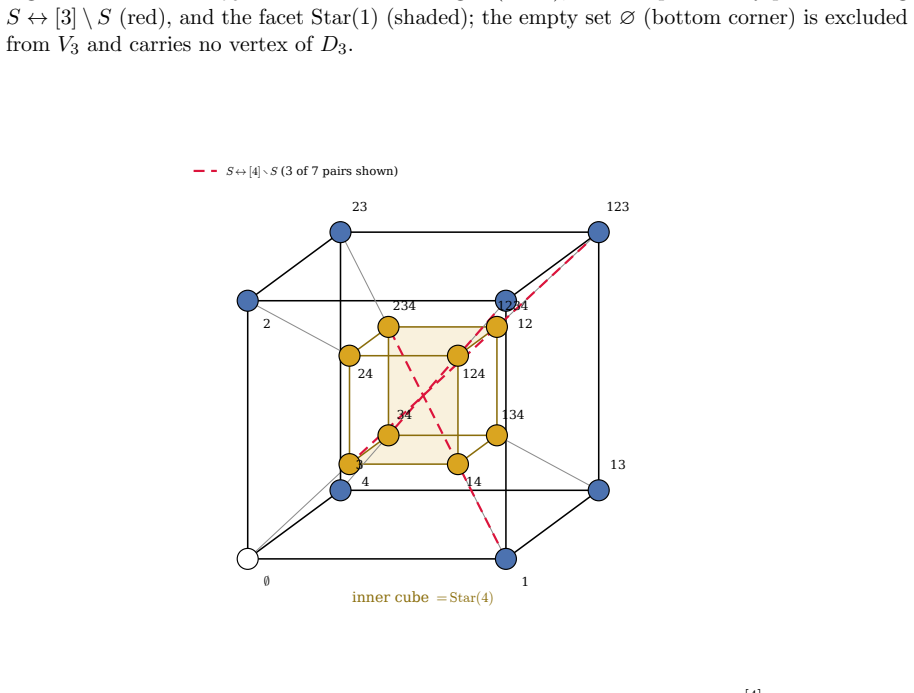
The carrying object is the weight exponent Λ(M), which reduces the product of doubly exponential weights over an MLS to an additive layer-profile sum via the identity Λ(M)=A(n)+Σ_{k<n/2} f_k(2^{n-k}-2^k). The argument turns on a layer-two rigidity lemma: a kernel-free MLS with f_2=n-1 must be one of the one-flip stars, so any non-star is forced to drop at least one 2-set and incur the coefficient 2^{n-2}-4. A reconstruction lemma then shows that the remaining star-shaped 2-graph uniquely determines the whole system as U_{a,B}, closing the gap classification.
What would settle it
Enumerate all kernel-free maximal linked systems on [7] (or construct one by hand): the second-level gap claims that every system other than the seven one-flip stars has exponent at most 3^6 − 3·2^5 + 6 = 639; any system with exponent strictly between 639 and the maximum 3^6 − 2^6 + 2 = 667 would falsify the gap theorem, as would any system with f_2 = 5 that is not one of the U_{a,B} systems.
Extended reading notes
Core claim
The central discovery is the second-level gap theorem. On the weighted exponent Λ(M)=Σ_{S∈M} 2^{n-|S|}, the n one-flip stars F*_a attain the maximum M*_n = 3^{n-1}-2^{n-1}+2; the theorem shows that every other kernel-free maximal linked system has Λ(M) ≤ 3^{n-1} - 3·2^{n-2} + 6, exactly 2^{n-2}-4 below the maximum, with equality precisely for the n(n-1) one-defect systems U_{a,B} (B of size n-2) and, at n=5 only, the ten Ahlswede–Khachatrian balls A_T. This spectral gap forces the exact prefactor R(n)=(3/4+o(1))n·2^{M*_n}. The paper also proves that the extremiser classification is not a function of the layer profile: at n=5 a single profile hosts two non-isomorphic family types, so no profi
Load-bearing premise
The prefactor proof assumes the number λ(n) of kernel-free maximal linked systems is only exponentially small — log2 λ(n) = O(2^n / √n), from a Dedekind-number bound — so that the fixed gap 2^{n-2}-4 cannot be swamped by multiplicity; if λ(n) grew faster, the union bound over near-extremal systems would not vanish and the constant 3/4 could change.
Editorial extensions
If this is right
- The Gibbs distribution over intersecting families is sharply condensed: a random independent set of the disjointness graph lies inside some Star(i) with probability 1 - (3+o(1)) 2^{-2^{n-1}}, with the exact constant now determined.
- The log-ratio log2(Z_cap(n)/R(n)) = 2^{n-1}-2+log2(4/3)+o(1) sharpens the earlier leading-order suppression exponent to an additive o(1).
- For every integer base B≥2 with weight B^{B^{n-|S|}}-1, the same extremal value (B+1)^{n-1}-B^{n-1}+B, the same gap B^{n-2}-B^2, and the prefactor 1-B^{-B} all hold.
- At n=5 the two non-isomorphic extremal types share one layer profile, so the classification provably cannot be recovered from profile-level data alone.
Reading between the lines
- Extension: the genuine o(1) correction to the prefactor is likely to depend on the full Λ-spectrum of non-extremal MLS and on overlaps between near-extremal sectors; computing the third spectral level for general n would be a natural test of whether the spectral gaps stay uniformly bounded.
- Extension: the layer-two rigidity suggests a quantitative stability version of the p-biased extremal theorem — families with μ_p close to M_2(n,p) should be geometrically close to a one-flip star — which would in turn sharpen the enumerative constant.
- Extension: because the equality classification for B≥3 matches the Boolean case of the known signed-set Hilton–Milner theorem, the second-level gap may port to the product lattice [Q]^n, giving an analogous exact second-level statement and prefactor in that setting.
Signed reviews
Editorial analysis
A structured set of objections, weighed in public.
Referee Report
Summary. The paper studies the weighted independent-set polynomial of the disjointness graph on nonempty subsets of [n], with doubly exponential weights w(S)=2^{2^{n-|S|}}-1, and splits it into a kernel-bearing part Z_cap(n) and a kernel-free remainder R(n). Three results are proved. First (Theorem 1.2), a self-contained p-biased extremal theorem for non-trivial intersecting families: M_2(n,p)=p-pq^{n-1}+qp^{n-1} for 0<p<=1/2, with equality classification (one-flip stars for n>=5, additional triangles for n=4). Second (Theorem 5.5), a second-level gap theorem: for n>=5 every kernel-free maximal linked system other than the n one-flip stars has weight exponent at most M*_n-(2^{n-2}-4), with equality exactly for the n(n-1) punctured-star systems U_{a,B} (|B|=n-2) and, when n=5, the ten Ahlswede-Khachatrian balls A_T. Third (Theorem 5.8), this gap yields the exact prefactor R(n)=(3/4+o(1)) n 2^{M*_n}, hence log_2(Z_cap(n)/R(n))=2^{n-1}-2+log_2(4/3)+o(1). The same chain is extended to weights B^{B^{n-|S|}}-1 for every integer B>=2, with prefactor 1-B^{-B}.
Significance. If the proofs are correct, this is a substantial and clean contribution. It determines the second level of the kernel-free MLS spectrum exactly, proves a genuine spectral gap, and upgrades a previously leading-order suppression exponent to an additive constant. The proof strategy is transparent: a profile identity, layer-two rigidity extracted from the EKR proof, classification of 2-set families, and a union bound over MLS whose entropy is controlled by Kleitman's theorem on Dedekind numbers. The paper is careful to attribute the first-level extremal theorem to Borg and to Peleg-Wool, and claims novelty only at the second level and in the prefactor, which appears justified. Strengths include the reproducible exhaustive-verification scripts in Appendix C, the explicit n=5 example showing that the second-level classification cannot be read off the layer profile, and the B-parameter family showing that the constants are structural rather than base-2 artefacts. I found no circularity: the known first level is re-derived, not assumed.
minor comments (3)
- [§1.1] The dependency list for main result A contains an unresolved pointer 'Remark??' ('the division of labour ... is made precise in Proposition 5.6 and Remark??'). This should be replaced by a numbered remark or deleted; Proposition 5.6 is the intended target.
- [§5.3, proof of Theorem 5.11(iii)] The sentence 'the members of F*_a \ {A} containing a fixed j≠a carry Λ_B-total Σ_{S⊇{a,j}} B^{n-|S|}=(B+1)^{n-2}' refers to sets containing j, whereas the subsequent error estimate corresponds to the bad event of avoiding j. The stated bound is correct and conservative, but the wording is confusing and should be adjusted.
- [Appendix B / Table 1] The caption calls the last column an 'exponent benchmark'; it would be clearer to say explicitly that this is the asymptotic benchmark without the multiplicity correction, since the table is otherwise about exact small-n values.
Circularity Check
No significant circularity: the main theorems are proved from external standard theorems and explicit counting, with no fitted input or load-bearing self-citation.
full rationale
The paper's dependency C⇒A⇒B is internally proved: Theorem 1.2 (the first-level extremal input) is derived self-contained from Erdős–Ko–Rado with uniqueness at k=2 rather than assumed; Corollary 1.3 follows by substitution; Lemma 4.2 uses Kleitman's theorem on Dedekind numbers as an external, parameter-free bound, so the entropy control over λ(n) is not an input assumption equivalent to the target. The second-level gap Theorem 5.5 is obtained from the layer-profile identity (Lemma 5.2), EKR layerwise bounds, and the forced f2≤n−2 rigidity (Lemma 5.3, itself a reuse of the proof of Theorem 1.2), followed by the explicit punctured-star/triangle classification—no quantity is fitted and no near-extremal value is assumed. The exact prefactor Theorem 5.8 splits the remainder into top sectors, bounded by the explicit single-sector constant 3/4, and non-top sectors, suppressed by the proved gap; both bounds are direct calculations. The only self-citations (Kalimulina [25], [12], [13]) occur in Appendix A, and the paper explicitly says 'nothing in the present paper depends on it,' so they are not load-bearing. Known first-level results are cited as context (Borg, Peleg–Wool, Gerbner) but the proof does not rely on them. In short, no step reduces to its own conclusion.
Assumptions & free parameters
assumptions (4)
- standard math Erdos-Ko-Rado theorem, including the uniqueness of the extremal family at k=2
- standard math Kleitman's theorem on the number of antichains (Dedekind numbers): log_2 D(n) = (1+o(1)) binom(n, floor(n/2))
- standard math Classification of pairwise-intersecting families of 2-sets: every such family is a star or a triangle
- standard math Inclusion-exclusion and the Bonferroni inequalities
Cite this review
Pith. "Pith review of A gap theorem for non-trivial maximal intersecting families and an exact weighted asymptotic." pith.science (2026). https://pith.science/paper/PJVR45DK
@misc{pith2026260716040,
  author       = {Pith},
  title        = {Pith review of: A gap theorem for non-trivial maximal intersecting families and an exact weighted asymptotic},
  year         = {2026},
  howpublished = {\url{https://pith.science/paper/PJVR45DK}},
  note         = {Machine review of arXiv:2607.16040}
}
abstract
Let $D_n$ be the disjointness graph on the nonempty subsets of $[n]$, whose independent sets are exactly the intersecting families on $[n]$. We study the weighted independent-set polynomial $W(n)=\sum_F\prod_{S\in F}w(S)$, the sum running over these families, for the doubly exponential weight $w(S)=2^{2^{n-|S|}}-1$. The kernel-bearing (trivial) part $Z_\cap(n)$ is exact by inclusion-exclusion and satisfies $Z_\cap(n)\sim n\cdot 2^{3^{n-1}}$. For the kernel-free remainder we prove the exact prefactor $R(n)=(3/4+o(1))n\cdot 2^{3^{n-1}-2^{n-1}+2}$, whence $\log_2(Z_\cap(n)/R(n))=2^{n-1}-2+\log_2(4/3)+o(1)$, an additive $o(1)$, not merely a leading-order one. The engine is a second-level extremal theorem: among kernel-free maximal linked systems other than the $n$ one-flip stars, the largest weight exponent is $3^{n-1}-3\cdot 2^{n-2}+6$, a fixed gap $2^{n-2}-4$ below the maximum, with the extremisers classified exactly. None of this is special to the weight: for $w_B(S)=B^{B^{n-|S|}}-1$ with integer $B\ge 2$ the same stars dominate, the near-extremal families sit a gap $B^{n-2}-B^2$ below, and the prefactor is $1-B^{-B}$. The combinatorial input is the $p$-biased extremal problem for non-trivial intersecting families: $M_2(n,p)=p-pq^{n-1}+qp^{n-1}$ for all $n\ge 3$, $0<p\le 1/2$, $q=1-p$. This first level is essentially known: the extremal family is the Wheel coterie of Peleg and Wool, and at $p=1/Q$ the statement, with its maximiser classification, is the case $r=n$ of Borg's Hilton-Milner theorem for signed sets (2013). We give a short self-contained Erd\H{o}s-Ko-Rado proof, uniform in real $p\in(0,1/2]$, whose layer-two rigidity feeds the second level. The novelty claimed lies at the second level and in the prefactor, where the classification cannot be read off the layer profile alone: at $n=5$ one profile carries two non-isomorphic types of extremisers.
Figures


Reference graph
Works this paper leans on
-
[1]
Ahlswede, L
R. Ahlswede, L. H. Khachatrian, The complete nontrivial-intersection theorem for systems of finite sets,J. Combin. Theory Ser. A76(1996), 121–138
1996
-
[2]
Y. Bai, H. Gu, W. J. T. Zang, Typical intersecting families are trivial, arXiv preprint (2026), not yet refereed.arXiv:2606.17679
arXiv 2026
-
[3]
Balogh, S
J. Balogh, S. Das, M. Delcourt, H. Liu, M. Sharifzadeh, Intersecting families of discrete structures are typically trivial,J. Combin. Theory Ser. A132(2015), 224–245
2015
-
[4]
Balogh, R
J. Balogh, R. I. Garcia, L. Li, A. Z. Wagner, Intersecting families of sets are typically trivial,J. Combin. Theory Ser. B164(2024), 44–67
2024
-
[5]
C. Bey, K. Engel, Old and new results for the weightedt-intersection problem via AK- methods, in:Numbers, Information and Complexity(I. Alth¨ ofer et al., eds.), Kluwer Aca- demic Publishers, Boston, 2000, pp. 45–74
2000
-
[6]
Borg, A Hilton–Milner-type theorem and an intersection conjecture for signed sets, Discrete Math.313(2013), 1805–1815
P. Borg, A Hilton–Milner-type theorem and an intersection conjecture for signed sets, Discrete Math.313(2013), 1805–1815
2013
-
[7]
Brace, D
A. Brace, D. E. Daykin, A finite set covering theorem,Bull. Austral. Math. Soc.5(1971), 197–202
1971
-
[8]
A. E. Brouwer, C. F. Mills, W. H. Mills, A. Verbeek, Counting families of mutually inter- secting sets,Electron. J. Combin.20(2) (2013), Paper 8
2013
Show all 35 references
-
[9]
Erd˝ os, C
P. Erd˝ os, C. Ko, R. Rado, Intersection theorems for systems of finite sets,Quart. J. Math. Oxford Ser. (2)12(1961), 313–320
1961
-
[10]
P. L. Erd˝ os, P. Frankl, G. O. H. Katona, Extremal hypergraph problems and convex hulls, Combinatorica5(1985), 11–26
1985
-
[11]
P. L. Erd˝ os,´A. Seress, L. A. Sz´ ekely, Non-trivialt-intersection in the function lattice,Ann. Comb.9(2005), 177–187
2005
-
[12]
A. A. Esin, On function classes inP 3 precomplete with respect to a strengthened closure operator,Mathematical Notes83(5) (2008), 594–603
2008
-
[13]
A. A. Esin, Structural analysis of precomplete classes and closure diagrams in multi-valued logic,Iranian Journal of Fuzzy Systems21(6) (2024), 127–145. doi:10.22111/ijfs.2025.49256.8688
2024
-
[14]
Filmus, The weighted complete intersection theorem,J
Y. Filmus, The weighted complete intersection theorem,J. Combin. Theory Ser. A151 (2017), 84–101. 21
2017
-
[15]
Flower, R
A. Flower, R. Mycroft, Two new results on maximal left-compressed intersecting families, arXiv preprint (2025), not yet refereed.arXiv:2511.10592
2025
-
[16]
Frankl, A
P. Frankl, A. Kupavskii, Counting intersecting and pairs of cross-intersecting families, Combin. Probab. Comput.27(2018), 60–68
2018
-
[17]
Frankl, N
P. Frankl, N. Tokushige, Weighted multiply intersecting families,Studia Sci. Math. Hungar. 40(2003), 287–291
2003
-
[18]
Frankl, N
P. Frankl, N. Tokushige, Weighted non-trivial multiply intersecting families,Combinatorica 26(2006), 37–46
2006
-
[19]
Frankl, J
P. Frankl, J. Nie, Matching and intersection problems for non-trivialr-partiter-uniform hypergraphs, arXiv preprint (2026), not yet refereed.arXiv:2604.10928
2026 arXiv
-
[20]
Friedgut, On the measure of intersecting families, uniqueness and stability,Combina- torica28(2008), 503–528
E. Friedgut, On the measure of intersecting families, uniqueness and stability,Combina- torica28(2008), 503–528
2008
-
[21]
Gerbner, The profile polytope of non-trivial intersecting families,SIAM J
D. Gerbner, The profile polytope of non-trivial intersecting families,SIAM J. Discrete Math.37(4) (2023), 2265–2275.arXiv:2109.05615
2023 arXiv
-
[22]
Gupta, Y
P. Gupta, Y. Mogge, S. Piga, B. Sch¨ ulke,r-crosst-intersecting families via necessary inter- section points,Bull. Lond. Math. Soc.55(3) (2023), 1447–1458.doi:10.1112/blms.12803; arXiv:2010.11928
2023 arXiv
-
[23]
A. J. W. Hilton, E. C. Milner, Some intersection theorems for systems of finite sets,Quart. J. Math. Oxford Ser. (2)18(1967), 369–384
1967
-
[24]
J. Hou, C. Hu, Non-trivial intersection problems for multi-part hypergraphs, arXiv preprint (2026), not yet refereed.arXiv:2606.06208
2026 arXiv
-
[25]
E. Yu. Kalimulina, Lattice structure of some closed classes for three-valued logic and its applications,Mathematics10(1) (2022), Art. 94
2022
-
[26]
Kleitman, On Dedekind’s problem: the number of monotone Boolean functions,Proc
D. Kleitman, On Dedekind’s problem: the number of monotone Boolean functions,Proc. Amer. Math. Soc.21(1969), 677–682
1969
-
[27]
A. D. Korshunov, On the number of monotone Boolean functions,Probl. Kibern.38(1981), 5–108. (in Russian)
1981
-
[28]
M. Kwan, B. Sudakov, P. Vieira, Non-trivially intersecting multi-part families,J. Combin. Theory Ser. A156(2018), 44–60
2018
-
[29]
O’Neill, J
J. O’Neill, J. Verstra¨ ete, Non-triviald-wise intersecting families,J. Combin. Theory Ser. A178(2021), 105369
2021
-
[30]
Pawelski, A
B. Pawelski, A. Szepietowski, Counting self-dual monotone Boolean functions,J. Integer Seq.28(2025), Article 25.6.5.arXiv:2310.12637
2025 arXiv
-
[31]
Peleg, A
D. Peleg, A. Wool, The availability of quorum systems,Inform. and Comput.123(1995), 210–223
1995
-
[32]
Tokushige, Brace–Daykin type inequalities for intersecting families,European J
N. Tokushige, Brace–Daykin type inequalities for intersecting families,European J. Com- bin.29(2008), 273–285
2008
-
[33]
Tokushige, The maximum measure of non-trivial 3-wise intersecting families,Math
N. Tokushige, The maximum measure of non-trivial 3-wise intersecting families,Math. Program.204(1) (2024), 643–676.doi:10.1007/s10107-023-01969-x 22
2024 doi
-
[34]
Y. Wu, L. Feng, Random partition for Tokushige’sr-wise intersecting conjecture, arXiv preprint (2026), not yet refereed.arXiv:2606.31075
2026 arXiv
-
[35]
fault-support
Y. Wu, L. Feng, The Suda–Tanaka–Tokushige conjecture forp-biased intersecting families, arXiv preprint (2026), not yet refereed.arXiv:2606.26521 A A remark on the origin of the weight The specific weightw(S) = 2 2n−|S| −1 in (5) ismotivatedby an enumeration problem in three- v...
2026 arXiv
Reviewed August 1, 2026 · model on record in the stance chip above.
Discussion (0). Continue with ORCID to comment.