REVIEW 3 major objections 5 minor 63 references
ExpertPlex: A High-Goodput Disaggregated Serving System for MoE LLMs with Adaptive Persistent Kernels
T0 review · 3 major / 5 minor · reviewed 2026-08-01 · deepseek-v4-flash
Pith's one-line read ExpertPlex claims that sharing MoE experts between prefill and decode — while keeping attention separate — lifts SLO-meeting throughput by up to 2.01x over instance-level phase disaggregation and 1.66x over SM-partitioned colocation.
desk verdict A strong systems paper with a genuinely new hybrid architecture and plausible goodput gains, but the memory-efficiency argument rests on an unquantified buffer preallocation and a not-fully-matched multi-node comparison. read the letter →
The pith
A machine-rendered reading of the paper's core claim, the machinery that carries it, and where it could break.
The reading
What carries the argument
The load-bearing mechanism is the Adaptive Persistent Kernel (APK): a long-lived GPU kernel on each MoE server that schedules MoE grouped GEMMs at tile boundaries, where a tile is the smallest independently completable unit of a GEMM and lasts only a few microseconds regardless of total input length. APK provides bounded preemption (decode can cut in within one tile plus a local check epoch), spatial and temporal multiplexing, and SM reallocation without CPU intervention or kernel relaunch, while preserving compatibility with pre-captured GPU execution graphs. It is paired with attention-initiated one-sided dispatch and combine, which removes receiver-side coordination and ring buffers, and
What would settle it
Run the system on a cluster and measure the GPU memory consumed by APK's preallocated worst-case routed-token buffers; if that reservation approaches or exceeds the memory freed by eliminating duplicated expert weights, or if decode tail latency grows with prefill sequence length despite tile-level preemption, the central efficiency claim fails.
Extended reading notes
Core claim
The central discovery claim is that the granularity and boundary of phase separation, not just its existence, determine MoE serving efficiency. The paper asserts that by moving the phase boundary to the attention/expert split — one shared expert pool, attention disaggregated by phase — a serving system can avoid duplicating over 95% of model weights, let sparse expert loads from both phases multiplex on the same GPUs, preserve per-phase local compute because each phase owns whole attention GPUs, and scale in single-GPU units instead of large model replicas. It reports that this architecture, combined with tile-scheduled persistent kernels and attention-initiated one-sided transfers, lifts go
Load-bearing premise
The design requires each MoE operation's buffers and communication descriptors to be preallocated for its maximum routed-token volume before runtime; if that worst-case reservation consumes enough GPU memory, the memory savings from sharing expert weights could be cancelled, and the paper does not quantify this overhead.
Editorial extensions
If this is right
- Prefill-decode disaggregation no longer needs complete per-phase model replicas: expert weights are stored once, freeing GPU memory for KV cache and making per-phase scaling as fine as single attention GPUs.
- Decode SLOs no longer depend on prefill kernel length, because preemption is bounded by one tile of a few microseconds rather than the full duration of a long prefill operation.
- One-sided, attention-initiated MoE traffic removes a class of cross-phase deadlocks and lets dispatch/combine from one phase overlap expert computation from the other, improving GPU occupancy.
- Deployment units shrink, narrowing the failure blast radius of hierarchical all-to-all communication and enabling elastic scaling in smaller steps.
- The reported goodput gains transfer to any MoE LLM whose expert weights dominate memory and whose routing is dynamic, since the mechanisms target those two properties directly.
Reading between the lines
- Beyond the paper: tile-boundary scheduling with bounded preemption could generalize beyond two phases of one model to other latency-critical mixed workloads on shared GPUs, wherever operations have natural tile boundaries and job-length-independent preemption bounds.
- Beyond the paper: if attention disaggregation and expert sharing are independent axes, future systems could resize the two pools separately based on measured phase demand, turning today's rigid prefill-to-decode ratio problem into a dynamic pool-sizing problem.
- Beyond the paper: a directly testable extension is to sweep input-length mix; the paper's larger gains on long-request workloads suggest the advantage should grow with request length, which a workload sweep could confirm.
Editorial analysis
A structured set of objections, weighed in public.
Referee Report
Summary. ExpertPlex proposes a hybrid prefill/decode serving architecture for MoE LLMs: attention modules are disaggregated onto separate prefill and decode servers, while the large expert weights are hosted once on shared MoE servers executed by Adaptive Persistent Kernels (APKs). The paper claims this removes roughly 95% of duplicated MoE weights, enables tile-granular preemption and reallocation between phases, avoids cross-phase network interference via attention-initiated one-sided MoE communication, and uses a cross-stack optimizer to choose layouts, parallelism, overlap strategies, and SM budgets. Evaluations on MiniMax-M2.7 and GLM-5.1-FP8 report P90 goodput improvements up to 2.01x over instance-level prefill-decode disaggregation and 1.66x over Green-Context-based colocation.
Significance. If correct, ExpertPlex addresses a real scalability limitation of instance-level PDD and static GPU partitioning for MoE models. The central idea of sharing the memory-heavy experts while disaggregating the memory-light attention modules is well motivated, and the APK design, one-sided communication, and joint optimization are concrete and non-trivially implemented. The paper uses direct SLO-attainment experiments rather than relying only on the latency model, and it includes useful microbenchmarks for APK overhead and communication. However, the headline quantitative claims currently rest on two unverified premises: the memory cost of APK's maximum-volume buffer preallocation is never quantified, and the GLM multi-node comparison normalizes across unequal resource counts. Both weaken the empirical support for the central claims as written.
major comments (3)
- [§5.2, §7.1] APK 'already preallocates each operation's buffers for its maximum routed-token volume' because operation templates, tensor addresses, and communication descriptors must be fixed before runtime scheduling. The paper never quantifies this memory cost. With roughly 60 MoE layers and large prefill batches, the sum of per-operation dispatch/combine buffers could be substantial and would directly reduce the KV-cache headroom that motivates sharing experts. Since the PDD goodput advantage is attributed to freed memory for KV cache, the absence of buffer-size accounting or a memory-breakdown table leaves the central memory-efficiency claim unverified. Please report total preallocated buffers per MoE server, compare it with the duplicated expert weights saved, and show how it scales with batch size.
- [§7.1, Figures 9–10] The GLM-5.1-FP8 evaluation runs ExpertPlex on a 24-GPU layout (e.g., 3P6D15E) while baselines run on the largest compatible 16-GPU layout, with results reported per node. Per-node normalization is not a resource-equivalent comparison: it implicitly assumes linear scaling and gives ExpertPlex a 1.5x hardware advantage. This is load-bearing for the GLM numbers, including the 1.66x claim over PDMux on LooGLE. Please provide matched-resource absolute goodput or per-GPU rates, or a direct argument that per-node scaling is linear in this regime. Also note that PDD is not reported for GLM because of OOM, so the 2.01x PDD claim rests on MiniMax alone.
- [§7.2–§7.6] The SLO-attainment curves and goodput numbers are reported without repeated trials, confidence intervals, or sensitivity analysis. Since goodput is defined as the highest arrival rate at which at least 90% of requests meet SLOs under Poisson arrivals, single-run curves are sensitive to noise and workload sampling. The 'up to 2.01x/1.66x' claims would be substantially strengthened by multiple seeds or an explicit statement of variability. This is a validation concern for the main empirical claims, even though the end-to-end measurements are direct rather than model-generated.
minor comments (5)
- [§4.3] The preemption bound is stated as 'one tile execution time plus one local cluster check epoch,' but 'check epoch' is never defined. Please specify its duration and how it relates to tile boundaries.
- [§6.2, Eq. (2)] The per-component latency model has four free parameters (alpha, beta, gamma, delta) fitted from a 'small set of input samples.' Please report the number/profile points used and the fitting error. A goodness-of-fit measure would help assess the optimizer's reliability, even though the end-to-end results are measured directly.
- [§7.1] The workload section says sequence lengths are capped at PDD KV-cache capacity, but the cap value is not stated. Please quantify this cap and its effect on the workload distribution.
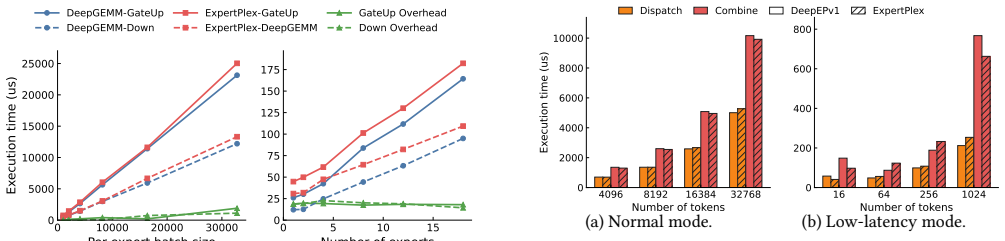
- [Figure 13] The legend in Figure 13(b) is confusing: it includes 'DeepGEMM-Down' and 'ExpertPlex-DeepGEMM' but the text refers to masked versus contiguous layouts. Please align the labels with the two layouts and clarify what each curve represents.
- [§7.1] The baseline descriptions state that SGLang-PDD uses '1P1D' and that GLM PDD runs out of memory. Please clarify the exact GPU counts consumed by each baseline in each figure, since the per-node normalization makes this information essential for interpretation.
Circularity Check
No significant circularity: the headline goodput gains are directly measured against external SGLang-based baselines; the fitted latency model and self-citations are not load-bearing.
full rationale
The paper's central claims — up to 2.01× over instance-level prefill-decode disaggregation and 1.66× over Green Context-based colocation — are end-to-end measurements on real workloads, not outputs of the latency model. Equation (2) is a polynomial fit to profiled kernels used only to prune the configuration search; the search objective in Equation (1) is a definition of modeled goodput, and the final SLO-attainment curves are measured experimentally. The 'over 95% duplicate weight elimination' statement is an accounting identity following from the architecture (MoE weights shared, attention replicated) and from the cited model parameter breakdowns; it is motivation, not a derived prediction. The tile-level preemption bound is a definitional property of scheduling at tile boundaries, supported by the measured tile intervals in Figure 15. Self-citations ([47], [48], [58], [60]) support background claims and are accompanied by external citations; none is invoked as a uniqueness theorem or as the sole justification for a central result. The only notable weakness is §5.2's unquantified max-routed-token buffer preallocation, which could erode the memory-efficiency motivation; this is a correctness/measurement gap, not a circular reduction, since no equation or fitted parameter makes the goodput claim true by construction.
Assumptions & free parameters
free parameters (2)
- Per-component latency model coefficients α_c, β_c, γ_c, δ_c (Eq. 2) =
not reported numerically
- GEMM/data tile sizes (incl. CTA tile height M_t) =
e.g., 128×192 output tile on SM90
assumptions (5)
- domain assumption MoE weights dominate model footprint (>95% in the evaluated models).
- domain assumption Attention modules hold under 5% of parameters and are more compute-intensive, so per-phase attention disaggregation is cheaper than MoE disaggregation.
- domain assumption Green Context / MPS / MIG cannot repartition SMs at fine granularity during a kernel.
- domain assumption Concurrent two-sided MoE dispatch/combine can deadlock when different ranks serve different phases.
- domain assumption Tile-boundary phase switches with cooperative memory-hierarchy propagation (P, p_i, DSMEM, mbarrier) are deadlock-free and bounded by one tile plus check epoch.
Cite this review
Pith. "Pith review of ExpertPlex: A High-Goodput Disaggregated Serving System for MoE LLMs with Adaptive Persistent Kernels." pith.science (2026). https://pith.science/paper/EAT6X7GX
@misc{pith2026260718002,
  author       = {Pith},
  title        = {Pith review of: ExpertPlex: A High-Goodput Disaggregated Serving System for MoE LLMs with Adaptive Persistent Kernels},
  year         = {2026},
  howpublished = {\url{https://pith.science/paper/EAT6X7GX}},
  note         = {Machine review of arXiv:2607.18002}
}
abstract
LLMs scale Mixture-of-Experts (MoE) parameters for superior intelligence, but massive weights and dynamic computation impede efficient serving. Existing instance-level prefill-decode disaggregation isolates the phases on separate full-model replicas. As MoE weights grow, each instance may span tens to hundreds of GPUs, making resource allocation increasingly coarse. Configured prefill-to-decode ratios thus often mismatch demand, overprovisioning one phase while overloading the other. Prefill-decode colocation avoids this duplication, but existing Green Context solutions partition each GPU by phase and fix phase resources during a kernel. They cannot track resource changes across operations or layerwise variation in routed expert load, causing head-of-line blocking or idle reserved resources. Partitioning every GPU also leaves each phase with fewer local resources, forces wider parallelism and more communication, and lets prefill and decode traffic interfere on the shared network. We present ExpertPlex, which shares massive MoE experts across phases while disaggregating lightweight attention modules. Expert sharing eliminates over 95% of duplicate model weights and multiplexes dynamically sparse computation, while attention disaggregation reduces attention communication cost. ExpertPlex further uses (1) adaptive persistent kernels to schedule dynamic expert computation at tile granularity for efficient, isolated execution; (2) attention-initiated MoE communication to avoid network interference and enable cross-phase communication-computation overlap; and (3) a tile-to-cluster model to optimize these mechanisms for maximum goodput. Experiments serving MiniMax-M2.7 and GLM-5.1-FP8 show that ExpertPlex improves goodput by up to 2.01$\times$ over instance-level prefill-decode disaggregation and 1.66$\times$ over prefill-decode colocation.
Figures


Figures from the paper (10 more)



Reference graph
Works this paper leans on
-
[1]
CUDA Multi-Process Service
2025. CUDA Multi-Process Service. (2025).https://docs.nvidia.com/ deploy/pdf/CUDA_Multi_Process_Service_Overview.pdf
2025
-
[2]
Amey Agrawal, Nitin Kedia, Ashish Panwar, Jayashree Mohan, Nipun Kwatra, Bhargav Gulavani, Alexey Tumanov, and Ramachandran Ram- jee. 2024. Taming Throughput-Latency tradeoff in LLM inference with Sarathi-Serve. InUSENIX OSDI
2024
-
[3]
DeepSeek AI. 2026. Deepseek-v4: Towards highly efficient million- token context intelligence.arXiv(2026)
2026
-
[4]
DeepSeek AI. 2026. Revealing the challenges of attention-ffn disaggre- gation for modern moe models and hardware systems.arXiv(2026)
2026
-
[5]
Minimax AI. 2026. The minimax-m2 series: Mini activations unleashing max real-world intelligence.arXiv(2026)
2026
-
[6]
Zhipu AI. 2026. Glm-5: from vibe coding to agentic engineering.arXiv (2026)
2026
-
[7]
Zhihao Bai, Zhen Zhang, Yibo Zhu, and Xin Jin. 2020. Pipeswitch: Fast pipelined context switching for deep learning applications. InUSENIX OSDI
2020
-
[8]
Tom B. Brown, Benjamin Mann, Nick Ryder, Melanie Subbiah, Jared Kaplan, Prafulla Dhariwal, Arvind Neelakantan, Pranav Shyam, Girish Sastry, Amanda Askell, Sandhini Agarwal, Ariel Herbert-Voss, Gretchen Krueger, Tom Henighan, Rewon Child, Aditya Ramesh, Daniel M. Ziegler, Jeffrey Wu, Clemens Winter, Christopher Hesse, Mark Chen, Eric Sigler, Mateusz Litwin...
2020
Show all 63 references
-
[9]
Li-Wen Chang, Wenlei Bao, Qi Hou, Chengquan Jiang, Ningxin Zheng, Yinmin Zhong, Xuanrun Zhang, Zuquan Song, Chengji Yao, Ziheng Jiang, Haibin Lin, Xin Jin, and Xin Liu. 2024. FLUX: Fast Software- based Communication Overlap On GPUs Through Kernel Fusion. In arXiv
2024
-
[10]
Yukang Chen, Weihao Cui, Han Zhao, Ziyi Xu, Xiaoze Fan, Xusheng Chen, Yangjie Zhou, Shixuan Sun, Bingsheng He, and Quan Chen. 2026. Towards High-Goodput LLM Serving with Prefill-decode Multiplexing. InACM ASPLOS
2026
-
[11]
Xinhao Cheng, Zhihao Zhang, Yu Zhou, Jianan Ji, Jinchen Jiang, Zepeng Zhao, Ziruo Xiao, Zihao Ye, Yingyi Huang, Ruihang Lai, Hongyi Jin, Bohan Hou, Mengdi Wu, Yixin Dong, Anthony Yip, Zihao Ye, Songting Wang, Wenqin Yang, Xupeng Miao, Tianqi Chen, and Zhihao Jia. 2026. MPK: A ...
2026
-
[12]
Coppock, Brian Zhang, Eliot H
Patrick H. Coppock, Brian Zhang, Eliot H. Solomon, Vasilis Kypriotis, Leon Yang, Bikash Sharma, Dan Schatzberg, Todd C. Mowry, and Dimitrios Skarlatos. 2025. LithOS: An Operating System for Efficient Machine Learning on GPUs. InACM SOSP
2025
-
[13]
DeepSeek-AI. 2024. DeepSeek-V3 Technical Report. InarXiv
2024
-
[14]
DeepSeek-AI. 2025. Day 6: One More Thing, DeepSeek-V3/R1 Inference System Overview.https://github.com/deepseek-ai/open- infra-index/blob/main/202502OpenSourceWeek/day_6_one_more_ thing_deepseekV3R1_inference_system_overview.md. (2025)
2025
-
[15]
DeepSeek-AI. 2025. DeepEP: an efficient expert-parallel communica- tion library.https://github.com/deepseek-ai/DeepEP. (2025)
2025
-
[16]
Ruwen Fan, Tingxu Ren, Minhui Xie, Shiwei Gao, Jiwu Shu, and Youyou Lu. 2025. GPREEMPT: GPU Preemptive Scheduling Made General and Efficient. InUSENIX ATC
2025
-
[17]
GLM-4.5 Team. 2025. GLM-4.5: Agentic, Reasoning, and Coding (ARC) Foundation Models. InarXiv
2025
-
[18]
Wentao Guo, Mayank Mishra, Xinle Cheng, Ion Stoica, and Tri Dao
-
[19]
Mingcong Han, Hanze Zhang, Rong Chen, and Haibo Chen. 2022. Microsecond-scale Preemption for Concurrent GPU-accelerated DNN Inferences. InUSENIX OSDI
2022
-
[20]
Jiaao He, Jiezhong Qiu, Aohan Zeng, Zhilin Yang, Jidong Zhai, and Jie Tang. 2021. Fastmoe: A fast mixture-of-expert training system.arXiv (2021)
2021
-
[21]
Jiaao He, Jidong Zhai, Tiago Antunes, Haojie Wang, Fuwen Luo, Shangfeng Shi, and Qin Li. 2022. Fastermoe: modeling and optimizing training of large-scale dynamic pre-trained models. InACM PPoPP
2022
-
[22]
Ke Hong, Lufang Chen, Zhong Wang, Xiuhong Li, Qiuli Mao, Jianping Ma, Chao Xiong, Guanyu Wu, Buhe Han, Guohao Dai, Yun Liang, and Yu Wang. 2025. semi-PD: Towards Efficient LLM Serving via Phase-Wise Disaggregated Computation and Unified Storage.arXiv (2025)
2025
-
[23]
Cunchen Hu, Heyang Huang, Liangliang Xu, Xusheng Chen, Jiang Xu, Shuang Chen, Hao Feng, Chenxi Wang, Sa Wang, Yungang Bao, Ninghui Sun, and Yizhou Shan. 2024. Inference without Interference: Disaggregate LLM Inference for Mixed Downstream Workloads. In arXiv
2024
-
[24]
Mowry, Zhihao Jia, and Tianqi Chen
Hongyi Jin, Bohan Hou, Guanjie Wang, Ruihang Lai, Jinqi Chen, Zihao Ye, Yaxing Cai, Yixin Dong, Xinhao Cheng, Zhihao Zhang, Yilong Zhao, Yingyi Huang, Lijie Yang, Jinchen Jiang, Gabriele Oliaro, Jianan Ji, Xu- peng Miao, Vinod Grover, Todd C. Mowry, Zhihao Jia, and Tianqi Chen
-
[25]
Kamath, Ramya Prabhu, Jayashree Mohan, Simon Peter, Ramachandran Ramjee, and Ashish Panwar
Aditya K. Kamath, Ramya Prabhu, Jayashree Mohan, Simon Peter, Ramachandran Ramjee, and Ashish Panwar. 2024. POD-Attention: Unlocking Full Prefill-Decode Overlap for Faster LLM Inference. In arXiv
2024
-
[26]
Brown, Ben- jamin Chess, Rewon Child, Scott Gray, Alec Radford, Jeffrey Wu, and Dario Amodei
Jared Kaplan, Sam McCandlish, Tom Henighan, Tom B. Brown, Ben- jamin Chess, Rewon Child, Scott Gray, Alec Radford, Jeffrey Wu, and Dario Amodei. 2020. Scaling Laws for Neural Language Models. (2020)
2020
-
[27]
Kimi Team. 2025. Kimi K2: Open Agentic Intelligence. InarXiv
2025
-
[28]
Jiamin Li, Yimin Jiang, Yibo Zhu, Cong Wang, and Hong Xu. 2023. Accelerating Distributed MoE Training and Inference with Lina. In USENIX ATC
2023
-
[29]
Yunkai Liang, Zhangyu Chen, Pengfei Zuo, Zhi Zhou, Xu Chen, and Zhou Yu. 2025. Injecting Adrenaline into LLM Serving: Boosting Resource Utilization and Throughput via Attention Disaggregation. arXiv(2025)
2025
-
[30]
Bin Lin, Tao Peng, Chen Zhang, Minmin Sun, Lanbo Li, Hanyu Zhao, Wencong Xiao, Qi Xu, Xiafei Qiu, Shen Li, Zhigang Ji, Yong Li, and Wei Lin. 2024. Infinite-LLM: Efficient LLM Service for Long Context with DistAttention and Distributed KVCache. InarXiv
2024
-
[31]
Zejia Lin, Hongxin Xu, Guanyi Chen, Xianwei Zhang, and Yutong Lu
-
[32]
Lingxiao Ma, Zhiqiang Xie, Zhi Yang, Jilong Xue, Youshan Miao, Wei Cui, Wenxiang Hu, Fan Yang, Lintao Zhang, and Lidong Zhou. 2020. Rammer: Enabling Holistic Deep Learning Compiler Optimizations with rTasks. InUSENIX OSDI
2020
-
[33]
MiniMax. 2025. MiniMax-M1: Scaling Test-Time Compute Efficiently with Lightning Attention. InarXiv
2025
-
[34]
Bullet: Boosting GPU Utilization for LLM Serving via Dynamic Spatial-Temporal Orchestration.arXiv(2025)
2025
-
[35]
NVIDIA. 2025. CUDA Programming Guide.https://docs.nvidia.com/ cuda/cuda-c-programming-guide. (2025)
2025
-
[36]
NVIDIA. 2026. Green Contexts.https://docs.nvidia.com/cuda/cuda- programming-guide/04-special-topics/green-contexts.html. (2026)
2026
-
[37]
Mooncake Team. 2025. Deploying Kimi K2 with PD Disaggregation and Large-Scale Expert Parallelism on 128 H200 GPUs.https://www. lmsys.org/blog/2025-07-20-k2-large-scale-ep/. (2025)
2025
-
[38]
Pratyush Patel, Esha Choukse, Chaojie Zhang, Íñigo Goiri, Aashaka Shah, Saeed Maleki, and Ricardo Bianchini. 2023. Splitwise: Efficient generative LLM inference using phase splitting. InarXiv
2023
-
[39]
Ruoyu Qin, Zheming Li, Weiran He, Jialei Cui, Heyi Tang, Feng Ren, Teng Ma, Shangming Cai, Yineng Zhang, Mingxing Zhang, Yongwei 13 Wu, Weimin Zheng, and Xinran Xu. 2025. Mooncake: A KVCache- centric Disaggregated Architecture for LLM Serving.ACM Trans. Storage(2025)
2025
-
[40]
NVIDIA Corporation. 2024. NVIDIA Multi-Instance GPU User Guide. https://docs.nvidia.com/datacenter/tesla/mig-user-guide/. (2024)
2024
-
[41]
Xiaoxiang Shi, Colin Cai, Junjia Du, Zhanda Zhu, Xingda Wei, and Zhihao Jia. 2025. Nexus: Taming Throughput-Latency Tradeoff in LLM Serving via Efficient GPU Sharing.arXiv(2025)
2025
-
[42]
Benjamin Spector, Jordan Juravsky, Stuart Sul, Owen Dugan, Dylan Lim, Dan Fu, Simran Arora, and Christopher Re. 2025. Look Ma, No Bubbles! Designing a Low-Latency Megakernel for Llama-1B.https: //hazyresearch.stanford.edu/blog/2025-05-27-no-bubbles. (2025)
2025
-
[43]
Qwen Team. 2025. Qwen3 Technical Report. InarXiv
2025
-
[44]
Xun Sun, Shaoyuan Chen, Pingchuan Ma, Yue Chen, Ziwei Yuan, Zhanhao Cao, Han Han, Shangming Cai, Teng Ma, Xuchun Shang, et al. 2026. Surviving Partial Rank Failures in Wide Expert-Parallel MoE Inference.arXiv(2026)
2026
-
[45]
Tile-AI. 2025. TileRT: Tile-Based Runtime for Ultra-Low-Latency LLM Inference.https://github.com/tile-ai/TileRT. (2025)
2025
-
[46]
StepFun. 2025. Step-3 is Large yet Affordable: Model-system Co-design for Cost-effective Decoding. InarXiv
2025
-
[47]
Xinming Wei, Chao Jin, Tuo Dai, Yinmin Zhong, Shan Yu, Chengxu Yang, Bingyang Wu, Zili Zhang, Jing Mai, Qianchao Zhu, et al. 2026. UltraEP: Unleash MoE Training and Inference on Rack-Scale Nodes with Near-Optimal Load Balancing.arXiv(2026)
2026
-
[48]
Bingyang Wu, Shengyu Liu, Yinmin Zhong, Peng Sun, Xuanzhe Liu, and Xin Jin. 2024. Loongserve: Efficiently serving long-context large language models with elastic sequence parallelism. InACM SOSP
2024
-
[49]
Chao Wang, Pengfei Zuo, Zhangyu Chen, Yunkai Liang, Zhou Yu, and Ming-Chang Yang. 2025. Prefill-Decode Aggregation or Disaggre- gation? Unifying Both for Goodput-Optimized LLM Serving.arXiv (2025)
2025
-
[50]
Bingyang Wu, Zili Zhang, Yinmin Zhong, Guanzhe Huang, Yibo Zhu, Xuanzhe Liu, and Xin Jin. 2025. TokenLake: A Unified Segment-level Prefix Cache Pool for Fine-grained Elastic Long-Context LLM Serving. arXiv(2025)
2025
-
[51]
Xiaomi LLM-Core Team. 2026. MiMo-V2-Flash Technical Report. In arXiv
2026
-
[52]
Bingyang Wu, Zili Zhang, Zhihao Bai, Xuanzhe Liu, and Xin Jin. 2023. Transparent GPU Sharing in Container Clouds for Deep Learning Workloads. InUSENIX NSDI
2023
-
[53]
Shulai Zhang, Quan Chen, Weihao Cui, Han Zhao, Chunyu Xue, Zhen Zheng, Wei Lin, and Minyi Guo. 2025. Improving GPU Sharing Per- formance through Adaptive Bubbleless Spatial-Temporal Sharing. In EuroSys
2025
-
[54]
Shulai Zhang, Ningxin Zheng, Haibin Lin, Ziheng Jiang, Wenlei Bao, Chengquan Jiang, Qi Hou, Weihao Cui, Size Zheng, Li-Wen Chang, Quan Chen, and Xin Liu. 2025. Comet: Fine-grained Computation- communication Overlapping for Mixture-of-Experts. InarXiv
2025
-
[55]
Mingshu Zhai, Jiaao He, Zixuan Ma, Zan Zong, Runqing Zhang, and Jidong Zhai. 2023. SmartMoE: Efficiently Training Sparsely-Activated Models through Combining Offline and Online Parallelization. In USENIX ATC
2023
-
[56]
Chenggang Zhao, Zhean Xu, Liang Zhao, Jiashi Li, Chenhao Xu, Anyi Xu, Shengyu Liu, Kexing Zhou, and Kuai Yu. 2025. Deep- GEMM: clean and efficient BLAS kernel library on GPU.https: //github.com/deepseek-ai/DeepGEMM. (2025)
2025
-
[57]
Gonzalez, Clark Barrett, and Ying Sheng
Lianmin Zheng, Liangsheng Yin, Zhiqiang Xie, Chuyue Sun, Jeff Huang, Cody Hao Yu, Shiyi Cao, Christos Kozyrakis, Ion Stoica, Joseph E. Gonzalez, Clark Barrett, and Ying Sheng. 2024. SGLang: Efficient Execution of Structured Language Model Programs. InNeural Information Process...
2024
-
[58]
Toosi, Yin Chen, and Minchen Yu
Zhexiang Zhang, Ye Wang, Yumiao Zhao, Jiayu Xiao, Qianjing Yang, Xiangyu Wang, Jingzhe Jiang, Qizhen Weng, Ruichuan Chen, Shao- huai Shi, Adel N. Toosi, Yin Chen, and Minchen Yu. 2026. Janus: Disaggregating Attention and Experts for Scalable MoE Inference. In arXiv
2026
-
[59]
Kan Zhu, Yufei Gao, Yilong Zhao, Liangyu Zhao, Gefei Zuo, Yile Gu, Dedong Xie, Tian Tang, Qinyu Xu, Zihao Ye, Keisuke Kamahori, Chien- Yu Lin, Ziren Wang, Stephanie Wang, Arvind Krishnamurthy, and Baris Kasikci. 2025. NanoFlow: Towards Optimal Large Language Model Serving Thro...
2025
-
[60]
Ruidong Zhu, Ziheng Jiang, Chao Jin, Peng Wu, Cesar A. Stuardo, Dongyang Wang, Xinlei Zhang, Huaping Zhou, Haoran Wei, Yang Cheng, Jianzhe Xiao, Xinyi Zhang, Lingjun Liu, Haibin Lin, Li-Wen Chang, Jianxi Ye, Xiao Yu, Xuanzhe Liu, Xin Jin, and Xin Liu. 2025. MegaScale-Infer: Se...
2025
-
[61]
Yinmin Zhong, Shengyu Liu, Junda Chen, Jianbo Hu, Yibo Zhu, Xu- anzhe Liu, Xin Jin, and Hao Zhang. 2024. DistServe: Disaggregating Prefill and Decoding for Goodput-optimized Large Language Model Serving. InUSENIX OSDI
2024
-
[2025]
SonicMoE: Accelerating MoE with IO and Tile-aware Optimiza- tions. InarXiv
-
[2026]
InConference on Machine Learning and Systems
Event Tensor: A Unified Abstraction for Compiling Dynamic Megakernel. InConference on Machine Learning and Systems
Reviewed August 1, 2026 · model on record in the stance chip above.
Discussion (0). Sign in to comment.