REVIEW 4 major objections 4 minor 35 references
Physics-Guided Spectral Parametric Reduced-Order Modeling for Transient Prediction of Controlled Dynamical Systems
T0 review · 4 major / 4 minor · reviewed 2026-08-01 · deepseek-v4-flash
Pith's one-line read A physics-guided reduced-order framework predicts transients at unseen parameters with sub-1% error.
desk verdict A credible extrapolation claim built on an underspecified alignment step; worth reviewing, but only with code. read the letter →
The pith
A machine-rendered reading of the paper's core claim, the machinery that carries it, and where it could break.
The reading
What carries the argument
The central object is the set of aligned reduced spectral quantities — eigenvalues Ω, eigenvectors Φ, mode amplitudes b, and the factorized control operator B = U_B Σ_B V_B^T — extracted by DMDc from transient snapshots. The framework's key step is the physics-guided parameter transformation µ' = f(µ) (e.g., 1/J for inertia ratio, Reynolds number for viscosity) that makes these quantities vary more linearly along the parameter axis. Once ordered, the training samples become a pseudo-temporal sequence, and a Secondary DMD learns a propagation operator in parameter space. This lets the reduced operator be reconstructed at target parameters, even outside the sampled range, and then advanced in
What would settle it
Take a controlled dynamical system whose parameter interval contains a supercritical Hopf bifurcation, train on three sampling points on one side, and extrapolate to a point on the other side. If the predicted transient does not exhibit the new oscillatory regime (e.g., amplitude or frequency misses by more than 5%), the coherence assumption behind secondary-DMD extrapolation is falsified.
Extended reading notes
Core claim
The paper's central claim is that parameter-dependent reduced-order operators for controlled systems can be transferred across parameter values by treating the parameter direction as a pseudo-time axis. After extracting intrinsic dynamics (A) and control effects (B) from transient snapshots via DMDc, the authors align eigenvalues, eigenvectors, and amplitudes across training conditions using a physics-guided coordinate transformation µ' = f(µ). The aligned spectral quantities then evolve coherently along this axis, so a secondary DMD can propagate them to unseen parameters, including extrapolation beyond the sampled interval. Baseline regularization (subtracting steady offsets) removes opera
Load-bearing premise
The method assumes that once the parameter is rescaled in a physics-informed way, the reduced model's eigenvalues, modes, and amplitudes evolve smoothly enough along the parameter axis that extrapolating that evolution predicts new conditions; a sudden change in the system's dominant behavior (like a mode onset) in the extrapolation interval would break this.
Editorial extensions
If this is right
- For controlled linear and nonlinear transient systems, extrapolative transient prediction at unseen parameter values can be achieved with relative norm errors below 1%, avoiding repeated high-fidelity simulations.
- Parameter-domain Secondary DMD gives more accurate extrapolation than linear or radial-basis-function regression because it models the structured evolution of spectral quantities rather than pointwise fitting.
- Including measured auxiliary inputs (e.g., controller outputs) in the control channel keeps intrinsic dynamics in the state operator, improving prediction under closed-loop operating scenarios.
- Baseline regularization is necessary for extrapolation; without subtracting steady offsets, error grows substantially in the Brayton-cycle extrapolation.
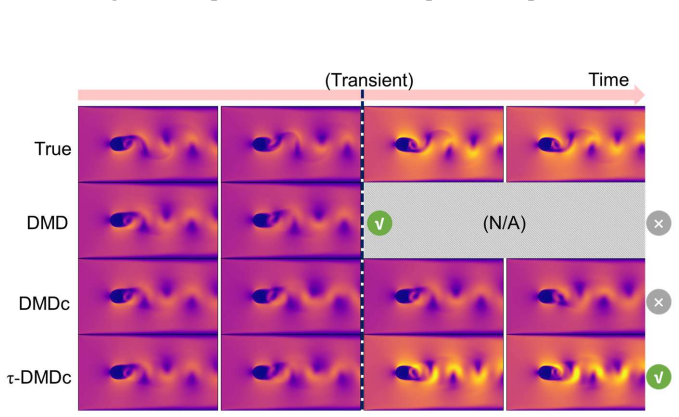
- For nonlinear periodic systems, a nondimensional time coordinate based on Strouhal number lets one reduced operator represent vortex-shedding transients across Reynolds numbers.
Reading between the lines
- The reliance on a hand-crafted parameter transformation suggests that automated discovery of such coordinates (e.g., via neural networks or manifold learning) could broaden the framework to systems where physics intuition is lacking; the authors hint at this as future work.
- The reported sub-1% errors are averaged over system-level variables; local field errors (as in the vortex-street case) may be larger, so users should carry out the paper's confidence-assessment procedure before trusting pointwise quantities.
- Because Secondary DMD extrapolates spectral evolution, the method will likely struggle near bifurcations or regime changes; a natural test is to apply it to a system whose dominant mode changes sign within the extrapolation interval.
- The separation of intrinsic dynamics from control via DMDc could be combined with other input-output techniques, such as balanced truncation or resolvent analysis, to extend the extrapolation claim to frequency-domain responses.
Editorial analysis
A structured set of objections, weighed in public.
Referee Report
Summary. The paper proposes a physics-guided spectral parametric reduced-order modeling (pROM) framework for controlled dynamical systems. Reduced operators are identified with DMDc from transient snapshots, then spectral quantities (eigenvalues, eigenvectors, amplitudes, and factorized control operators) are aligned across parameter samples and propagated along a physics-guided parameter coordinate μ'=f(μ) by a Secondary DMD regression. The method is tested on three systems: a mechanical transmission, a Helium–Xenon closed Brayton cycle, and a Kármán vortex street. For the mechanical and Brayton cases the authors report relative norm errors below 1% for extrapolative prediction at unseen parameter values and new operating conditions; for the vortex street the method preserves dominant shedding structures. Additional comparisons with LSTM and an auxiliary error-prediction model are provided.
Significance. If the central claim holds, the paper would be a valuable step beyond interpolation-focused pROM: it explicitly targets extrapolative transient prediction by treating parameter-domain evolution of aligned spectral operators as a pseudo-temporal sequence. The paper is honest in using held-out targets, reporting rank-sensitivity analyses, and comparing with an LSTM baseline. The main risk is that the extrapolation claim rests on a spectral-alignment procedure and a low-dimensional-coherence assumption that are not fully specified or independently validated. Given the potential impact, the paper deserves revision rather than rejection, but the underspecified alignment step and the unstated treatment of steady-state offsets at target parameters are load-bearing and must be clarified.
major comments (4)
- [§2.2.2] The alignment step—'eigenvalue matching, phase correction, and normalization'—is described in a single sentence without an algorithm, tolerance, or treatment of ambiguous cases such as eigenvalue crossings or near-degenerate modes. Because the Secondary DMD step in §2.2.3 operates on the aligned sequence, any mismatch in this step directly corrupts the extrapolated operators. Please provide a precise algorithmic specification (or a pointer to code) for the alignment, and demonstrate its behavior on the test cases, e.g., by showing mode trajectories across the parameter axis.
- [§2.2.3] The core extrapolation claim requires that after the transformation μ'=f(μ), the aligned spectral quantities evolve as 'a coherent, low-dimensional sequence' along the parameter axis so that Secondary DMD can propagate them beyond the sampled interval. For the mechanical case this is supported by the M⁻¹K and 1/J structure. For the Brayton and vortex cases it is asserted from results. This assumption is load-bearing for the headline sub-1% extrapolation errors. The paper should supply a diagnostic test for coherence (e.g., evaluation of the Secondary DMD residual or a mode-tracking plot) and explicitly state what happens if a regime change or mode crossing occurs between the last training point and the farthest target, such as T_min = 400 K in §3.2.
- [§2.2.2 and §3.2] The baseline regularization in Eq. (3) removes steady-state offsets X_ss and β_ss, which are said to be 'regressed separately.' The paper never states how X_ss and β_ss are obtained for unseen target parameters. For the mechanical case the offsets may be trivial, but for the Brayton cycle the steady-state offsets depend on the minimum-cycle temperature and the operating scenario. If these offsets are predicted using the same Secondary DMD/regression, then the reported 'below 1%' errors include that regression, and its contribution should be reported separately. If they are known exactly, that should be stated. This is necessary to interpret the extrapolation error.
- [§3.1 and §3.2] The text repeatedly states that relative norm errors remain 'below 1%' in extrapolation, but the exact numerical values are not given in the body; only figures and pointwise ±3% errors at the farthest Brayton target are shown. Please provide a table with the exact relative norm errors for every target point, interpolation and extrapolation, in both scenarios, so that the sub-1% claim can be verified without reading values off plots.
minor comments (4)
- [§3.4.2] The LSTM comparison lacks essential details: architecture, number of layers/units, sequence length, training/validation split, and the hyperparameter search space. Without these, the comparison is difficult to reproduce and the claim of 'more accurate predictions than LSTM' should be interpreted cautiously.
- [§3.4.3] The confidence-assessment surrogate is described as requiring 'a few additional extrapolation points' as test points. This is a reasonable post-hoc validation approach, but it is not a deployable confidence bound for a scenario in which no test points exist. The paper should distinguish between 'validation-based error estimation' and 'online confidence estimation'; the current wording overstates the latter.
- [§2.3.2] The Brayton-cycle reference model is validated in previous work (Zhang and Wang, 2024; Zhang et al., 2025a). Since the current paper's sub-1% claim depends on that reference data, the paper should either summarize the validation in an appendix or state that the governing equations and validation are available only in the cited references, which limits self-containedness.
- [Nomenclature] Several subscripts and symbols appear garbled in the extracted text (e.g., 'X', '𝛽', '𝜇௪'). This may be a formatting artifact, but the final version should be carefully typeset. Also, the Kármán street is called 'nonlinear transient and periodic' in the abstract but 'nonlinear periodic' in §2.2.1; please make the terminology consistent.
Circularity Check
No significant circularity found; extrapolation targets are genuine holdouts, and self-citations are limited to benchmark infrastructure and ancillary guidance.
full rationale
Circularity would require a predicted quantity to be reused as its own fitting input, or a load-bearing appeal to a self-cited uniqueness/validity result. No such reduction is present. The three validation cases use reserved target parameters and operating scenarios: Section 3.1 states that 'target points are reserved for prediction'; Section 3.2 uses 'target points in both the original and new scenarios' to evaluate prediction under unseen parameter values and operating conditions; Section 3.3 extrapolates in Reynolds number. The self-citations (Zhang and Wang 2024; Zhang et al. 2025a) provide the Brayton reference model and prior DMD/noise discussion, i.e., benchmark infrastructure and ancillary guidance, not the pROM's fitted outputs and not a prohibition of alternatives. The physics-guided coordinate mu'=f(mu) (Eq. 6) is an assumed modeling ansatz with physical motivation; Secondary DMD (Section 2.2.3) is learned from training samples only and is genuinely extrapolative. The main risks — unspecified alignment tolerances, assumed coherent spectral evolution beyond the training interval, and steady-offset regression details — are correctness/transparency risks, not definitional circularity, because they concern extrapolative robustness rather than identity between input and output. Therefore no significant circularity is found.
Assumptions & free parameters
free parameters (4)
- temporal reduced rank r_t =
r_t=3 (mechanical), r_t=2 (Brayton, vortex)
- parametric reduced rank r_p =
r_p=2
- steady-state offsets X_ss, beta_ss =
regressed from training data
- Strouhal number St and amplitude envelope
assumptions (4)
- domain assumption A finite-dimensional linear reduced operator (A,B) identified by DMDc captures the dominant dynamics of the nonlinear systems, including beyond the training window.
- domain assumption After physics-guided transformation mu'=f(mu), aligned spectral quantities and operator components evolve as a coherent low-dimensional pseudo-temporal sequence that Secondary DMD can propagate beyond the sampled interval.
- domain assumption Eigenvalue matching, phase correction, and normalization yield correct modal correspondences across training conditions.
- domain assumption The reference simulation models are valid: mechanical model matches the Modelica Standard Library example; the He-Xe Brayton model is validated in self-cited prior work; the LBM solver matches CFDBench (St=0.2188 vs 0.2219 at Re=640).
Cite this review
Pith. "Pith review of Physics-Guided Spectral Parametric Reduced-Order Modeling for Transient Prediction of Controlled Dynamical Systems." pith.science (2026). https://pith.science/paper/S55PBUVZ
@misc{pith2026260718133,
  author       = {Pith},
  title        = {Pith review of: Physics-Guided Spectral Parametric Reduced-Order Modeling for Transient Prediction of Controlled Dynamical Systems},
  year         = {2026},
  howpublished = {\url{https://pith.science/paper/S55PBUVZ}},
  note         = {Machine review of arXiv:2607.18133}
}
read the original abstract
Efficient parametric transient prediction at unseen parameter values and under new operating conditions remains challenging because repeated high-fidelity simulations are computationally prohibitive. Existing data-driven surrogates and parametric reduced-order models perform well within sampled ranges but often lose reliability beyond them. This study proposes a physics-guided spectral parametric reduced-order modeling framework for controlled dynamical systems. Parameter-dependent reduced spectral operators are identified from transient snapshots using Dynamic Mode Decomposition with control, separating intrinsic dynamics from external control effects. After physics-guided parameter transformation, aligned spectral quantities and reduced operator components are propagated across parameter conditions using Secondary Dynamic Mode Decomposition, with linear and radial basis function regressions as baselines. Baseline regularization and nondimensional time mapping improve robustness. Validation uses a mechanical transmission system, a Helium-Xenon closed Brayton cycle, and a Karman vortex street, covering linear transient, nonlinear transient, and nonlinear periodic dynamics. For the mechanical and Brayton systems, system-level multivariable responses at unseen parameter values and under new operating conditions are predicted with relative norm errors below 1%. For the vortex-street system, nondimensional time mapping preserves dominant vortex-shedding structures across Reynolds numbers. Further analyses compare the framework with an LSTM surrogate and assess extrapolation confidence using an auxiliary error-prediction model. Overall, the framework extends parametric reduced-order modeling from in-domain approximation toward extrapolative transient prediction of controlled dynamical systems under unseen conditions.
Figures


Figures from the paper (17 more)




Reference graph
Works this paper leans on
-
[8]
The OpenModelica Integrated Modeling, Simulation, and Optimization Environment. Presented at the The American Modelica Conference 2018, October 9-10, Somberg Conference Center, Cambridge MA, USA, pp. 206–219. https://doi.org/10.3384/ecp18154206 Gabbai, R.D., Benaroya, H.,
-
[11]
Progress in Nuclear Energy 183, 105684
Fast prediction and inverse modeling for parameterized depressurization from a CO2 vessel using POD-BPNN reduced-order method. Progress in Nuclear Energy 183, 105684. https://doi.org/10.1016/j.pnucene.2025.105684 Krüger, T., Kusumaatmaja, H., Kuzmin, A., Shardt, O., Silva, G., Viggen, E.M.,
arXiv 2025
-
[12]
Springer International Publishing, Cham
The Lattice Boltzmann Method: Principles and Practice, Graduate Texts in Physics. Springer International Publishing, Cham. https://doi.org/10.1007/978-3-319-44649-3 Ljung, L., Andersson, C., Tiels, K., Schön, T.B.,
-
[13]
IFAC-PapersOnLine 53, 1175–1181
Deep Learning and System Identification. IFAC-PapersOnLine 53, 1175–1181. https://doi.org/10.1016/j.ifacol.2020.12.1329 Luo, Y ., Chen, Y ., Zhang, Z.,
-
[14]
https://doi.org/10.48550/arXiv.2310.05963 Lusch, B., Kutz, J.N., Brunton, S.L.,
CFDBench: A Large-Scale Benchmark for Machine Learning Methods in Fluid Dynamics. https://doi.org/10.48550/arXiv.2310.05963 Lusch, B., Kutz, J.N., Brunton, S.L.,
-
[16]
Progress in Nuclear Energy 191, 106032
A novel reduced-order model and two-stage optimization strategy for high-efficiency predicting thermal-hydraulic behavior in a 6×6 fuel bundle. Progress in Nuclear Energy 191, 106032. https://doi.org/10.1016/j.pnucene.2025.106032 Mo, J., Dong, X., Xu, Y ., Xu, A., Yu, Y ., Yang, M.,
arXiv 2025
-
[17]
Progress in Nuclear Energy 184, 105723
Research on fast prediction of boiling flow parameters in rod bundle of NPP based on efficient CFD-ROM methods. Progress in Nuclear Energy 184, 105723. https://doi.org/10.1016/j.pnucene.2025.105723 Muñoz, M.C., Peñalba, M.A., González, A.E.S.,
arXiv 2025
-
[18]
Analysis of aggregated load consumption forecasting in short, medium and long term horizons using Dynamic Mode Decomposition. Energy Reports 12, 1000–1013. https://doi.org/10.1016/j.egyr.2024.06.040 Proctor, J.L., Brunton, S.L., Kutz, J.N.,
Show all 35 references
-
[20]
Energy Conversion and Management 326, 119462
Review of system design and operation control technology of supercritical CO2 power cycle. Energy Conversion and Management 326, 119462. https://doi.org/10.1016/j.enconman.2024.119462 Riva, S., Missaglia, A., Introini, C., Bang, I.C., Cammi, A.,
2024
-
[21]
Nuclear Technology 1–25
A Comparative Study of Parametric Dynamic Mode Decomposition Algorithms on Thermal-Hydraulics Case Studies. Nuclear Technology 1–25. https://doi.org/10.1080/00295450.2025.2575701 Sayadi, T., Schmid, P.J., Richecoeur, F., Durox, D.,
2025
-
[22]
Physics of Fluids 27, 037102
Parametrized data-driven decomposition for bifurcation analysis, with application to thermo-acoustically unstable systems. Physics of Fluids 27, 037102. https://doi.org/10.1063/1.4913868 Schmid, P.J.,
-
[28]
Sci Rep 15, 23489
Dynamic mode decomposition for analysis and prediction of metabolic oscillations from time-lapse imaging of cellular autofluorescence. Sci Rep 15, 23489. https://doi.org/10.1038/s41598-025-07255-4 Xie, H.-R., Hua, Y ., Li, Y .-B., Aubry, N., Wu, W.-T., He, Y ., Peng, J.-Z.,
-
[29]
Ocean Engineering 293, 116684
Estimation of sequential transient flow around cylinders using recurrent neural network coupled graph convolutional network. Ocean Engineering 293, 116684. https://doi.org/10.1016/j.oceaneng.2024.116684 Yu, Y ., Zhang, Y ., Qian, S., Wang, S., Hu, Y ., Yin, B.,
2024
-
[31]
Progress in Nuclear Energy 172, 105205
Development of Modelica-based one-dimensional thermodynamic cycle library and its application in simulation and multi-objective optimization of a He–Xe closed- Brayton-cycle system. Progress in Nuclear Energy 172, 105205. https://doi.org/10.1016/j.pnucene.2024.105205 Zhang, K....
2024
-
[32]
Applied Thermal Engineering 289, 129763
Surrogate-assisted dynamic response prediction and intelligent fault management for gas–cooled reactor–Brayton energy systems. Applied Thermal Engineering 289, 129763. https://doi.org/10.1016/j.applthermaleng.2026.129763 Zhang, Y ., Li, H., Li, K., Yang, Y ., Zhou, Y ., Zhang,...
2026
-
[33]
Applied Energy 328, 120190
Dynamic characteristics and control strategies of the supercritical CO2 Brayton cycle tailored for the new generation concentrating solar power. Applied Energy 328, 120190. https://doi.org/10.1016/j.apenergy.2022.120190 Zhang, Y ., Li, P., Qiao, H., 2025b. Fast prediction of t...
2022
-
[34]
Energy 275, 127525
High-fidelity wind turbine wake velocity prediction by surrogate model based on d-POD and LSTM. Energy 275, 127525. https://doi.org/10.1016/j.energy.2023.127525 Zhu, M., Zhang, H., Jiao, A., Karniadakis, G.E., Lu, L.,
2023
-
[35]
Computer Methods in Applied Mechanics and Engineering 412, 116064
Reliable extrapolation of deep neural operators informed by physics or sparse observations. Computer Methods in Applied Mechanics and Engineering 412, 116064. https://doi.org/10.1016/j.cma.2023.116064
2023
-
[254]
https://doi.org/10.1146/annurev-fluid-030121-015835 Schmid, P.J.,
-
[2005]
Journal of Sound and Vibration 282, 575–616
An overview of modeling and experiments of vortex-induced vibration of circular cylinders. Journal of Sound and Vibration 282, 575–616. https://doi.org/10.1016/j.jsv.2004.04.017 Huhn, Q.A., Tano, M.E., Ragusa, J.C., Choi, Y .,
2004 doi
-
[2010]
Dynamic mode decomposition of numerical and experimental data. J. Fluid Mech. 656, 5–28. https://doi.org/10.1017/S0022112010001217 Sutton, C., Boley, M., Ghiringhelli, L.M., Rupp, M., Vreeken, J., Scheffler, M.,
-
[2015]
SIAM Rev
A Survey of Projection-Based Model Reduction Methods for Parametric Dynamical Systems. SIAM Rev. 57, 483–531. https://doi.org/10.1137/130932715 Brunton, S.L., Kutz, J.N.,
-
[2016]
Dynamic Mode Decomposition with Control. SIAM J. Appl. Dyn. Syst. 15, 142–161. https://doi.org/10.1137/15M1013857 Qin, T., Yan, X., Yuan, C., Sun, Y .,
-
[2017]
Energy 125, 643–653
Multi-objective optimization of the design and operating point of a new external axis wind turbine. Energy 125, 643–653. https://doi.org/10.1016/j.energy.2017.01.070 Fritzson, P., Pop, A., Asghar, A., Bachmann, B., Braun, W., Braun, R., Buffoni, L., Casella, F., Castro, R., Da...
2017 doi
-
[2018]
Applied Energy 212, 109–121
A systematic comparison of different S-CO2 Brayton cycle layouts based on multi-objective optimization for applications in solar power tower plants. Applied Energy 212, 109–121. https://doi.org/10.1016/j.apenergy.2017.12.031 Wüstner, D., Gundestrup, H.H., Thaysen, K.,
2017 doi
-
[2019]
Cambridge University Press
Data-Driven Science and Engineering: Machine Learning, Dynamical Systems, and Control, 1st ed. Cambridge University Press. https://doi.org/10.1017/9781108380690 Brunton, S.L., Noack, B.R., Koumoutsakos, P.,
-
[2020]
Annual Review of Fluid Mechanics
Machine Learning for Fluid Mechanics. Annual Review of Fluid Mechanics. https://doi.org/10.1146/annurev-fluid-010719-060214 Chen, G., Qi, B., Hu, W., Zhang, Y ., Wei, J.,
-
[2021]
IEEE Trans
A Low Rank Dynamic Mode Decomposition Model for Short-Term Traffic Flow Prediction. IEEE Trans. Intell. Transport. Syst. 22, 6547–6560. https://doi.org/10.1109/TITS.2020.2994910 Zhang, A., Cammi, A., Wang, X., 2025a. System-level data-driven identification of complex closed Br...
2020
-
[2022]
IEEE Trans
Developing a Ball Screw Drive System of High-Speed Machine Tool Considering Dynamics. IEEE Trans. Ind. Electron. 69, 4966–4976. https://doi.org/10.1109/TIE.2021.3083200 Wang, K., Li, M.-J., Guo, J.-Q., Li, P., Liu, Z.-B.,
2021
-
[2023]
Journal of Computational Physics 475, 111852
Parametric dynamic mode decomposition for reduced order modeling. Journal of Computational Physics 475, 111852. https://doi.org/10.1016/j.jcp.2022.111852 Kang, Y ., Tian, G., Huang, Y ., Qin, S., Huang, Q., Yuan, Y ., Zhou, Y .,
2022
-
[2024]
International Journal of Hydrogen Energy 49, 1391–1404
A fast POD prediction method for hydrogen leakage at different pressures. International Journal of Hydrogen Energy 49, 1391–1404. https://doi.org/10.1016/j.ijhydene.2023.09.282 Du, L., Zhang, Shengqi, Zhang, R., Zhang, Shibin,
2023 doi
-
[2025]
Energy 335, 138047
Data-driven modeling and prediction of PEM fuel cell voltage response to load transients for energy applications. Energy 335, 138047. https://doi.org/10.1016/j.energy.2025.138047 Ferdoues, M.S., Ebrahimi, S., Vijayaraghavan, K.,
2025
-
[2026]
Journal of Computational Physics 544, 114436
Interpolation-based parametric reduced-order models with dynamic mode decomposition. Journal of Computational Physics 544, 114436. https://doi.org/10.1016/j.jcp.2025.114436 Elkholy, M., Boureima, A., Kim, J., Aziz, M.,
2025
-
[4428]
https://doi.org/10.1038/s41467-020-17112-9 Wang, D., Zhang, S., Wang, L., Liu, Y .,
-
[4950]
https://doi.org/10.1038/s41467-018-07210-0 Min, G., Shen, X., Wang, L., Jiang, N.,
Reviewed August 1, 2026 · model on record in the stance chip above.
Discussion (0). Sign in to comment.