REVIEW 4 major objections 5 minor 40 references
Semantic-Aware Data-Aided Channel Estimation with Large Language Models for MIMO Systems
T0 review · 4 major / 5 minor · reviewed 2026-08-01 · deepseek-v4-flash
Pith's one-line read This paper claims that LLM-corrected symbols, after physical-layer validation, reduce MIMO channel-estimation error more per symbol than already-correctly-decoded symbols, and that a two-layer semantic pilot built this way approaches oracle
desk verdict Clever and plausible system; the proof of the headline theorem has a hole because selection uses the same noise the proof conditions on. read the letter →
The pith
A machine-rendered reading of the paper's core claim, the machinery that carries it, and where it could break.
The reading
What carries the argument
The load-bearing object is the realized error alignment R(x;E)=||Ex||², the squared channel-estimation error at the pilot-only estimate along the direction of a candidate reference symbol x. Lemma 1 shows the NMSE reduction from adding x as a pilot is a strictly increasing affine function of E[R(x;E)|x]; Proposition 1 shows this expected alignment is larger for corrected than for correctly decoded symbols because large alignment is what caused the initial misdetection; Theorem 1 combines them. The pipeline machinery is the two-layer gate: Layer 1 semantic verification (decoded and corrected characters agree) plus Layer 2 physical-layer cross-validation via the residual ratio d_ratio = ||y −
What would settle it
Record the received signals of symbols admitted by Layer 2 and estimate the conditional distribution of the noise vector given 'corrected' status; if its mean or variance deviates materially from CN(0, σ²I), the Appendix A independence assumption fails and the per-symbol Δ(x_C) bound in Lemma 1 does not apply to the actually selected pilots. Alternatively, compare per-symbol NMSE reduction of corrected vs verified symbols on the test set; if corrected symbols do not show a strictly larger average reduction, Theorem 1's conclusion is not reproduced.
Extended reading notes
Core claim
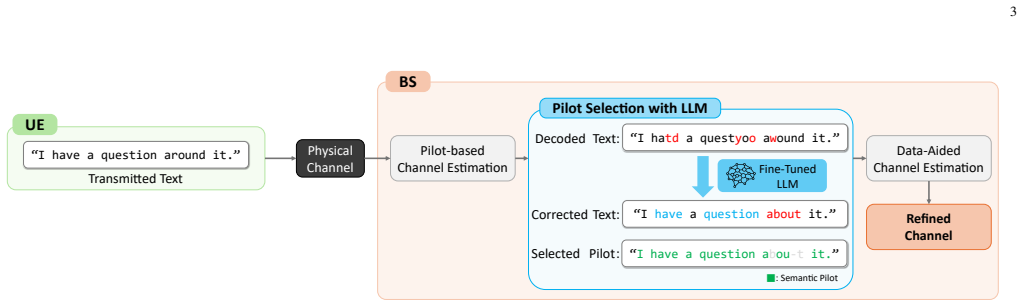
The paper's central claim is that payload semantics can be mined to produce better channel estimates than physical-layer statistics alone. At the receiver, the initially decoded text is fed to a fine-tuned LLM that corrects typographical errors; a Needleman-Wunsch alignment maps the LLM's token-level output back to characters. Layer 1 marks positions where decoded and corrected text agree as reliable; Layer 2 takes positions where the LLM changed a character and admits the corrected symbol only if a residual-ratio test on the received signal confirms it. The refined LMMSE estimator then uses these semantic pilots. The central theoretical result, Theorem 1, proves a corrected reference yields
Load-bearing premise
The load-bearing premise is that the noise on a symbol used as an additional pilot is independent of the detection outcome that decides whether it counts as 'corrected'—a premise stated in Appendix A that the actual pipeline likely violates, since a symbol becomes corrected precisely because its noise caused a misdetection and Layer 2 reuses that same received signal; the proof additionally relies on a standard nearest-neighbor approximation that collapses the 16-candidate MA
Editorial extensions
If this is right
- Data-aided channel estimation need not be limited to picking reliable detections; actively recovering misdetected symbols via semantic correction gives a strictly larger per-symbol error reduction (Theorem 1).
- The proposed semantic pilot, combining original pilots with Layer 1 verified and Layer 2 validated corrections, outperforms conventional data-aided schemes in NMSE and BER and approaches the MAP-oracle at high SNR.
- A physical-layer validation gate is essential: using all LLM corrections without filtering performs worse than pilot-only estimation, confirming that LLM hallucinations must be screened.
- The Needleman-Wunsch alignment is necessary for the two-layer selection to work when LLM tokenization changes text length; removing it degrades performance.
- Fine-tuning the LLM on channel-corrupted text is what makes Layer 2 viable; without fine-tuning, corrections largely fail the d_ratio validation and the advantage disappears.
Reading between the lines
- The selection-bias mechanism behind Theorem 1 is not specific to LLMs: any reference acquisition rule that conditions on large estimation error should yield oversized per-symbol gains, so other side-information sources (structured code, checksums, generative priors) could be plugged into the same two-layer gate.
- Because Layer 2's d_ratio test reuses the same received signal that caused the misdetection and an intermediate estimate built from Layer 1 symbols, the validation noise is not independent of the correction event; the paper's Appendix A independence assumption is therefore likely violated in the actual pipeline, and the theoretical guarantee should be re-derived under the true conditional distribu
- The framework's advantage concentrates at low SNR (Layer 2 contributes up to 18.2% of pilots at 1 dB and shrinks at high SNR); a testable extension is SNR-adaptive τ_d scheduling, since the paper fixes τ_d=2 across all SNR.
- One could test the same architecture with a smaller LLM or a masked language model to see how much of the gain comes from correction accuracy versus the selection gate; the paper's ablation with an unfine-tuned model suggests correction accuracy is the bottleneck.
Editorial analysis
A structured set of objections, weighed in public.
Referee Report
Summary. The manuscript proposes a semantic-aware data-aided channel estimation framework for MIMO systems. An LLM is fine-tuned to correct typographical errors in the decoded text; a Needleman–Wunsch alignment module maps corrected characters to symbol slots; and a two-layer selection mechanism admits verified and corrected symbols as additional pilots for LMMSE channel refinement. The central theoretical claim (Theorem 1) is that a corrected symbol—one initially misdecoded but then corrected—yields a strictly larger expected reduction in channel estimation error than an initially correctly decoded symbol. Simulations on a 2x2 QPSK system compare the proposed method against pilot-only, reinforcement-learning-based data-aided, LLM-all-corrected, Layer-1-only, MAP-oracle, and perfect-CSI baselines in terms of NMSE, BER, and pilot-selection quality.
Significance. The idea of using LLM-based semantic correction as a source of side information for channel estimation is novel and timely. If the theoretical and empirical claims hold, the paper would demonstrate a genuinely new mechanism for data-aided estimation that goes beyond physical-layer statistics. The manuscript is clearly structured, describes the full pipeline in detail, and includes appropriate oracle baselines (MAP Oracle, Perfect CSI) that help quantify the achievable gain. The authors also make a serious attempt at a formal proof of the proposed advantage, which is valuable even if incomplete. The main weaknesses are the selection-bias gap in the proof, the idealization that corrected symbols equal the true transmitted symbols, and the absence of statistical confidence measures in the simulations.
major comments (4)
- [Appendix A, Lemma 1 (Eqs. (37)–(43))] The proof explicitly assumes that n is independent of the detection outcome that determines the reference type of x. This is not true in the actual pipeline: a Layer-2 corrected pilot is accepted only if (a) the MAP detector made an error on y[n]=Hx+n (so n contributed to the error event) and (b) the LLM-corrected vector passes the d_ratio test (22), which is computed from the same y[n]. Both events depend on n, so E[n | x_C selected] ≠ 0 and E[n n^H | selected] ≠ σ² I. Consequently the cancellation of the nx^H/D term in (37) and the noise power term in (38) are not valid for actually selected symbols, and (43) is not the true expected reduction. Please re-derive the conditional moments under the selection rule, or clearly separate an idealized theorem (reference provided independently of n) from the engineered selection mechanism.
- [Section IV-A and Theorem 1] The theorem assumes both reference types equal the true transmitted symbol. However, Table IV and Fig. 10 report a Layer-2 precision of only 70.7% at 5 dB on the tuning set (78.7% on the test set), so a substantial fraction of accepted corrections are wrong. The proof does not analyze the contribution of erroneous pilots to the refined estimate; the strict inequality (33) therefore does not follow for the actual X_C. Please extend the analysis to a mixed model that includes incorrect corrections (e.g., parametrized by precision), or explicitly present Theorem 1 as an ideal-case result and explain why the empirical gain persists despite imperfect precision.
- [Appendix B, Step 2 (Eq. (51))] The proof reduces the K=16 MAP decision to a single pairwise comparison with the minimum-margin competitor, calling it a standard nearest-neighbor approximation, but gives no justification or validation for this reduction in the considered QPSK 2x2 setting. The strict monotonicity p'(r)<0 in (55) is derived under this approximation. If the approximation is not accurate, Proposition 1 is not established. Please justify the approximation (e.g., via a union bound over the 15 competitors) or provide numerical verification that it is tight in the SNR range used.
- [Section VI (Figs. 7–11, Table III)] All simulation results are point estimates; the number of Monte Carlo runs is not reported, and no confidence intervals or error bars are given. Many reported differences are small (e.g., BER at 5 dB: Proposed .0505 vs. MAP Oracle .0504; at 8 dB .0190 vs .0190), so it is difficult to assess whether the claimed advantages are statistically significant. Please report the number of trials and standard errors or confidence intervals for the key NMSE/BER comparisons, especially where the proposed method is said to outperform the MAP Oracle.
minor comments (5)
- [Section VI-B, Table IV] The threshold τ_d is selected on a tuning set at 5 dB and then applied across all SNRs. Please quantify the sensitivity of the results to τ_d across the full SNR range, since Fig. 10 is only at 5 dB.
- [Section II-C] The notation \bar t(i)_LLM is used in the text before the alignment output is formally defined in (9); consider reordering the definitions to avoid confusion.
- [Fig. 4] The alignment example shows 'awound' versus 'abou-t', but the traceback path in the score matrix is not shown; a small arrow or highlighted path would clarify the gap placement.
- [Fig. 9] The legend 'Layer 1Layer 2' appears without colors in the caption; please add a legend with clearly labeled colors or patterns.
- [Abstract and Conclusion] The statement 'closely approaching the performance of an oracle estimator' should be qualified by the SNR range and by the fact that at some SNRs the BER is identical to MAP Oracle (e.g., 8 dB and 10 dB in Table III).
Circularity Check
No significant circularity: Theorem 1 is derived from explicit statistical assumptions rather than assumed by construction.
full rationale
The paper's central theoretical claim (Theorem 1) is not circular. It is derived from Lemma 1, which computes the expected NMSE reduction of an additional reference pilot, and Proposition 1, which proves via a correlation inequality that a corrected reference has larger expected error alignment than a correctly decoded one. The derivation is self-contained: it starts from the stated system model (orthogonal pilots, AWGN, LMMSE estimation, MAP detection) and does not use any fitted parameter or simulation output as an input. The LLM correction and two-layer selection appear in the system design and simulations, but the theorem itself is stated in terms of generic 'correctly decoded' and 'initially misdecoded but corrected' reference symbols, not in terms of the specific LLM model or the d_ratio threshold. No 'prediction' is a renamed fit: the threshold tau_d = 2 is selected on a tuning set for engineering performance, not used to derive the theorem. Self-citations (e.g., the preliminary ICASSP paper [1]) are used only as a baseline comparison ('Layer 1 w/o NW [1]') and as background; they are not load-bearing for the theorem. The main caveat is a soundness gap, not circularity: Appendix A explicitly assumes 'n is independent of the detection outcome that determines the reference type of x,' while in the actual Layer 2 pipeline the selection depends on the received signal y[n] containing that same noise. If this assumption fails for the selected pilots, the proof of Lemma 1 may not apply to the implemented selection mechanism. That is a concern about whether the theorem's hypotheses match the system, not a case where the conclusion is equivalent to its inputs by construction. Therefore the circularity score is 0.
Assumptions & free parameters
free parameters (3)
- Layer 2 threshold τ_d =
2
- NW alignment scores (s_match, s_mis, g_o, g_e) =
+2, -1, -2, -0.5
- LLM fine-tuning hyperparameters =
LoRA rank 16, scaling 32, 20k samples, 3 epochs, batch 32, LR 2e-4
assumptions (6)
- domain assumption Orthogonal pilot sequences: X_p X_p^H = L_p I_Nt
- domain assumption Flat Rayleigh fading with i.i.d. CN(0,1) entries, AWGN, known noise variance σ²
- domain assumption MAP detector with equal priors and minimum-distance decision (Eq. 4)
- ad hoc to paper Nearest-neighbor approximation: error event dominated by the single minimum-margin competitor
- ad hoc to paper Noise n on an additional pilot is independent of the detection outcome that determines the reference type
- ad hoc to paper Corrected reference x_C equals the true transmitted symbol
Cite this review
Pith. "Pith review of Semantic-Aware Data-Aided Channel Estimation with Large Language Models for MIMO Systems." pith.science (2026). https://pith.science/paper/MPUQHBCA
@misc{pith2026260718640,
  author       = {Pith},
  title        = {Pith review of: Semantic-Aware Data-Aided Channel Estimation with Large Language Models for MIMO Systems},
  year         = {2026},
  howpublished = {\url{https://pith.science/paper/MPUQHBCA}},
  note         = {Machine review of arXiv:2607.18640}
}
read the original abstract
Data-aided channel estimation enhances spectral efficiency by reusing detected symbols as virtual pilots. In this process, selecting only reliable symbols is crucial to prevent misdetected symbols from corrupting the channel estimate. However, conventional methods rely exclusively on physical-layer statistics. Beyond physical-layer information, transmitted payloads possess inherent semantic structures that can be exploited to resolve detection errors. In this paper, we propose a novel semantic-aware channel estimation framework for multiple-input multiple-output (MIMO) systems that utilizes a fine-tuned large language model (LLM) to perform reliable symbol selection and correction based on semantic information. The framework employs a two-layer mechanism: one layer selects reliable decoded symbols through semantic verification, while the other selects accurately LLM-corrected symbols by cross-validating them against the received signal using physical-layer information. We prove that corrected symbols yield a strictly larger expected reduction in estimation error than initially correctly decoded symbols. Extensive simulations demonstrate that the proposed framework significantly outperforms conventional data-aided schemes in both normalized mean squared error and bit error rate, closely approaching the performance of an oracle estimator.
Figures


Figures from the paper (7 more)


Reference graph
Works this paper leans on
-
[1]
Semantic pilot design for data-aided channel estimation using a large language model,
S. Park and H. J. Yang, “Semantic pilot design for data-aided channel estimation using a large language model,” inProc. IEEE Int. Conf. Acoust., Speech Signal Process. (ICASSP), 2026, pp. 21 531–21 535
2026
-
[2]
A survey of large language models,
W. X. Zhaoet al., “A survey of large language models,”arXiv preprint arXiv:2303.18223, 2023
arXiv 2023
-
[3]
A survey on large language models for code generation,
J. Jiang, F. Wang, J. Shen, S. Kim, and S. Kim, “A survey on large language models for code generation,”ACM Trans. Softw. Eng. Methodol., vol. 35, no. 2, pp. 1–72, 2026
2026
-
[4]
A survey on large language model based autonomous agents,
L. Wanget al., “A survey on large language model based autonomous agents,”Front. Comput. Sci., vol. 18, no. 6, p. 186345, 2024
2024
-
[5]
Training language models to follow instructions with human feedback,
L. Ouyanget al., “Training language models to follow instructions with human feedback,” inProc. Adv. Neural Inf. Process. Syst. (NeurIPS), 2022
2022
-
[6]
Pushing large language models to the 6G edge: Vision, challenges, and opportunities,
Z. Lin, G. Qu, Q. Chen, X. Chen, Z. Chen, and K. Huang, “Pushing large language models to the 6G edge: Vision, challenges, and opportunities,” IEEE Commun. Mag., vol. 63, no. 9, pp. 52–59, 2025
2025
-
[7]
Enabling mobile AI agent in 6G era: Architecture and key technologies,
Z. Chen, Q. Sun, N. Li, X. Li, Y . Wang, and C.-L. I, “Enabling mobile AI agent in 6G era: Architecture and key technologies,”IEEE Netw., vol. 38, no. 5, pp. 66–75, 2024
2024
-
[8]
Beyond transmitting bits: Context, semantics, and task-oriented communications,
D. G ¨und¨uzet al., “Beyond transmitting bits: Context, semantics, and task-oriented communications,”IEEE J. Sel. Areas Commun., vol. 41, no. 1, pp. 5–41, 2023
2023
Show all 40 references
-
[9]
Semantic communications for future internet: Funda- mentals, applications, and challenges,
W. Yanget al., “Semantic communications for future internet: Funda- mentals, applications, and challenges,”IEEE Commun. Surveys Tuts., vol. 25, no. 1, pp. 213–250, 2023. 13
2023
-
[10]
Less data, more knowledge: Building next-generation semantic communica- tion networks,
C. Chaccour, W. Saad, M. Debbah, Z. Han, and H. Vincent Poor, “Less data, more knowledge: Building next-generation semantic communica- tion networks,”IEEE Commun. Surveys Tuts., vol. 27, no. 1, pp. 37–76, 2025
2025
-
[11]
Deep learning enabled semantic communication systems,
H. Xie, Z. Qin, G. Y . Li, and B.-H. Juang, “Deep learning enabled semantic communication systems,”IEEE Trans. Signal Process., vol. 69, pp. 2663–2675, 2021
2021
-
[12]
Deep joint source- channel coding for wireless image transmission,
E. Bourtsoulatze, D. Burth Kurka, and D. G ¨und¨uz, “Deep joint source- channel coding for wireless image transmission,”IEEE Trans. Cogn. Commun. Netw., vol. 5, no. 3, pp. 567–579, 2019
2019
-
[13]
Semantic communication systems for speech transmission,
Z. Weng and Z. Qin, “Semantic communication systems for speech transmission,”IEEE J. Sel. Areas Commun., vol. 39, no. 8, pp. 2434– 2444, 2021
2021
-
[14]
Wireless semantic communi- cations for video conferencing,
P. Jiang, C.-K. Wen, S. Jin, and G. Y . Li, “Wireless semantic communi- cations for video conferencing,”IEEE J. Sel. Areas Commun., vol. 41, no. 1, pp. 230–244, 2023
2023
-
[15]
Generative AI-enabled semantic communication: State-of-the-art, applications, and the way ahead,
C. Liang and D. Li, “Generative AI-enabled semantic communication: State-of-the-art, applications, and the way ahead,”IEEE Commun. Surveys Tuts., vol. 28, pp. 3976–4015, 2026
2026
-
[16]
Generative AI meets 6G and beyond: Diffusion models for semantic communications,
H.-L. Qinet al., “Generative AI meets 6G and beyond: Diffusion models for semantic communications,”IEEE Commun. Surveys Tuts., vol. 28, pp. 6241–6281, 2026
2026
-
[17]
Robust transmission of punctured text with large language model-based recovery,
S. Park, H. Noh, and H. J. Yang, “Robust transmission of punctured text with large language model-based recovery,”IEEE Trans. Veh. Technol., vol. 75, no. 1, pp. 1737–1742, 2026
2026
-
[18]
LLM-Viterbi: Semantic-aware decoding for convolutional codes,
Z. Li, C. Yue, J. Hao, B. Vucetic, and Y . Li, “LLM-Viterbi: Semantic-aware decoding for convolutional codes,”arXiv preprint arXiv:2604.19035, 2026
2026 arXiv
-
[19]
Semantic error correction and decoding for short block channel codes,
J. Hao, C. Yue, W. Liu, Y . Li, and B. Vucetic, “Semantic error correction and decoding for short block channel codes,”arXiv preprint arXiv:2604.22269, 2026
2026 arXiv
-
[20]
Pilot optimization and channel estimation scheme for semantic com- munication: A framework for edge intelligence,
K. Kim, Y . K. Tun, M. Shirajum Munir, W. Saad, and C. S. Hong, “Pilot optimization and channel estimation scheme for semantic com- munication: A framework for edge intelligence,” inProc. IEEE/IFIP Netw. Oper. Manag. Symp. (NOMS), 2024, pp. 1–7
2024
-
[21]
LLM4CP: Adapting large language models for channel prediction,
B. Liu, X. Liu, S. Gao, X. Cheng, and L. Yang, “LLM4CP: Adapting large language models for channel prediction,”J. Commun. Inf. Netw., vol. 9, no. 2, pp. 113–125, 2024
2024
-
[22]
Beam prediction based on large language models,
Y . Sheng, K. Huang, L. Liang, P. Liu, S. Jin, and G. Ye Li, “Beam prediction based on large language models,”IEEE Wireless Commun. Lett., vol. 14, no. 5, pp. 1406–1410, 2025
2025
-
[23]
Exploring the potential of large language models for massive MIMO CSI feedback,
Y . Cui, J. Guo, C.-K. Wen, S. Jin, and E. Tong, “Exploring the potential of large language models for massive MIMO CSI feedback,” inProc. IEEE Glob. Commun. Conf. (GLOBECOM), 2025, pp. 3511–3516
2025
-
[24]
Large language model enabled multi-task physical layer network,
T. Zheng and L. Dai, “Large language model enabled multi-task physical layer network,”IEEE Trans. Commun., vol. 74, pp. 307–321, 2026
2026
-
[25]
LLM4WM: Adapting LLM for wireless multi-tasking,
X. Liu, S. Gao, B. Liu, X. Cheng, and L. Yang, “LLM4WM: Adapting LLM for wireless multi-tasking,”IEEE Trans. Mach. Learn. Commun. Netw., vol. 3, pp. 835–847, 2025
2025
-
[26]
WirelessLLM: Empowering large language models towards wireless intelligence,
J. Shaoet al., “WirelessLLM: Empowering large language models towards wireless intelligence,”J. Commun. Inf. Netw., vol. 9, no. 2, pp. 99–112, 2024
2024
-
[27]
Adaptive resource allocation optimization using large language models in dynamic wireless environ- ments,
H. Noh, B. Shim, and H. J. Yang, “Adaptive resource allocation optimization using large language models in dynamic wireless environ- ments,”IEEE Trans. Veh. Technol., vol. 74, no. 10, pp. 16 630–16 635, 2025
2025
-
[28]
Deep learning-based channel estimation,
M. Soltani, V . Pourahmadi, A. Mirzaei, and H. Sheikhzadeh, “Deep learning-based channel estimation,”IEEE Commun. Lett., vol. 23, no. 4, pp. 652–655, 2019
2019
-
[29]
Deep learning for channel estimation: Interpretation, performance, and comparison,
Q. Hu, F. Gao, H. Zhang, S. Jin, and G. Y . Li, “Deep learning for channel estimation: Interpretation, performance, and comparison,”IEEE Trans. Wireless Commun., vol. 20, no. 4, pp. 2398–2412, 2021
2021
-
[30]
Iterative turbo channel estimation for ofdm system over rapid dispersive fading channel,
M. Zhao, Z. Shi, and M. C. Reed, “Iterative turbo channel estimation for ofdm system over rapid dispersive fading channel,”IEEE Trans. Wireless Commun., vol. 7, no. 8, pp. 3174–3184, 2008
2008
-
[31]
Model-driven deep learning for mimo detection,
H. He, C.-K. Wen, S. Jin, and G. Y . Li, “Model-driven deep learning for mimo detection,”IEEE Trans. Signal Process., vol. 68, pp. 1702–1715, 2020
2020
-
[32]
Iterative channel estimation using virtual pilot signals for MIMO-OFDM systems,
S. Park, B. Shim, and J. W. Choi, “Iterative channel estimation using virtual pilot signals for MIMO-OFDM systems,”IEEE Trans. Signal Process., vol. 63, no. 12, pp. 3032–3045, 2015
2015
-
[33]
Data-aided channel estimation utilizing gaussian mixture models,
F. Weißer, N. Turan, D. Semmler, and W. Utschick, “Data-aided channel estimation utilizing gaussian mixture models,” inProc. IEEE Int. Conf. Acoust., Speech, Signal Process. (ICASSP), 2024, pp. 8886–8890
2024
-
[34]
Semi-data- aided channel estimation for MIMO systems via reinforcement learning,
T.-K. Kim, Y .-S. Jeon, J. Li, N. Tavangaran, and H. V . Poor, “Semi-data- aided channel estimation for MIMO systems via reinforcement learning,” IEEE Trans. Wireless Commun., vol. 22, no. 7, pp. 4565–4579, 2023
2023
-
[35]
Deep learning-based data-assisted chan- nel estimation and detection,
H. Hashempoor and W. Choi, “Deep learning-based data-assisted chan- nel estimation and detection,”IEEE Trans. Mach. Learn. Commun. Netw., vol. 3, pp. 534–551, 2025
2025
-
[36]
A general method applicable to the search for similarities in the amino acid sequence of two proteins,
S. B. Needleman and C. D. Wunsch, “A general method applicable to the search for similarities in the amino acid sequence of two proteins,” J. Mol. Biol., vol. 48, no. 3, pp. 443–453, 1970
1970
-
[37]
Qwen3 technical report,
A. Yanget al., “Qwen3 technical report,”arXiv preprint arXiv:2505.09388, 2025
2025 arXiv
-
[38]
LoRA: Low-rank adaptation of large language models,
E. J. Huet al., “LoRA: Low-rank adaptation of large language models,” inProc. Int. Conf. Learn. Represent. (ICLR), 2022
2022
-
[39]
QLoRA: Efficient finetuning of quantized LLMs,
T. Dettmers, A. Pagnoni, A. Holtzman, and L. Zettlemoyer, “QLoRA: Efficient finetuning of quantized LLMs,” inProc. Adv. Neural Inf. Process. Syst. (NeurIPS), 2023
2023
-
[40]
Europarl: A parallel corpus for statistical machine transla- tion,
P. Koehn, “Europarl: A parallel corpus for statistical machine transla- tion,” inMT summit, 2005, pp. 79–86
2005
Reviewed August 1, 2026 · model on record in the stance chip above.
Discussion (0). Continue with ORCID to comment.