REVIEW 3 major objections 4 minor 54 references
Efficient strain-space hyperreduction in large-deformation solid mechanics
T0 review · 3 major / 4 minor · reviewed 2026-08-01 · deepseek-v4-flash
Pith's one-line read This paper claims that strain-space hyperreduction, previously limited to periodic-cell homogenisation, can be lifted to general large-deformation solid problems with arbitrary Dirichlet boundary conditions, delivering speedups up to 100,00
desk verdict A credible, well-executed extension of strain-space hyperreduction beyond RVEs, but the 'arbitrary Dirichlet BC' claim outruns the validation: only scalar and proportional loads are tested. read the letter →
The pith
A machine-rendered reading of the paper's core claim, the machinery that carries it, and where it could break.
The reading
What carries the argument
The load-bearing machinery is the lifting-field split: for each Dirichlet boundary, a unit boundary-value solution is computed offline at reference material parameters, then arbitrary boundary values scale and superpose these fields, and the solver works on the fluctuation field, which is zero on all boundaries. This converts all inhomogeneous Dirichlet conditions into homogeneous ones, so POD modes can be built from integration-point strain snapshots and reduced models operate directly on displacement-gradient values, bypassing element-level assembly entirely. On top of this split, hyperreduction is performed either by selecting sparse integration points with optimised weights (strain-space
What would settle it
Run the same reduced models on a large-deformation problem with pronounced strain localisation (e.g., a nearly incompressible block, a necking bar, or a structure with multiple interacting nonzero Dirichlet boundaries under large relative displacements) and measure whether the fluctuation field remains low-rank; if the scaled lifting fails to absorb boundary effects, the reduced-model error will rise sharply even at high integration-point counts, while the full-order model stays accurate.
Extended reading notes
Core claim
The central discovery is that the whole machinery of strain-space hyperreduction transfers from periodic unit-cell problems to general solids once the displacement-gradient field is split into a boundary-consistent lifting field and a fluctuation field. With this split, Dirichlet boundary conditions are satisfied by construction, strain-space POD modes vanish on the boundary, and reduced cubature methods (ECM, E3C) as well as cluster-wise material-linearisation methods (EMSL) become directly applicable. In the reported experiments, strain-space methods need far fewer integration points than displacement-space ECSW for a given accuracy; for example, in the second benchmark E3C reaches below 0
Load-bearing premise
The precomputed lifting fields are computed once at a central material parameter set and simply scaled by boundary values, relying on linear superposition of boundary effects to remain a good approximation across the full parameter and deformation range of a nonlinear problem.
Editorial extensions
If this is right
- Strain-space hyperreduction now applies to general 3D solid-mechanics problems with arbitrarily prescribed Dirichlet boundary values, not just periodic unit cells.
- Because the reduced models operate on strains and stresses at integration points, training requires only displacement, strain, and stress snapshots plus a material routine, making deployment with black-box solvers practical.
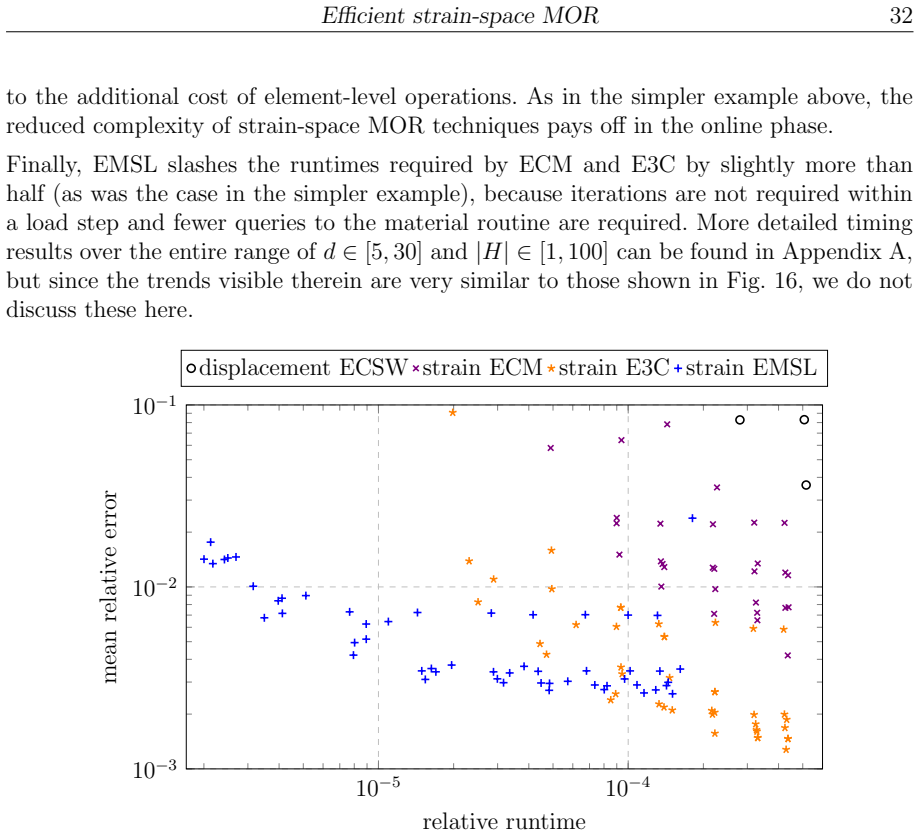
- On the two hyperelastic benchmarks, strain-space methods Pareto-dominate displacement-space ECSW: EMSL is the best choice when online and offline runtimes are extremely limited, while E3C yields the highest accuracy when a moderate runtime budget is acceptable.
- The reported 10,000- and 100,000-fold speedups point toward making inverse parameter estimation, optimisation, and repeated simulation of large-deformation components computationally feasible.
- Offline costs differ significantly across the methods, with E3C requiring the most expensive training (around three and a half hours in the second example) and EMSL the cheapest (about 30 seconds), which matters when reduced models must be built quickly.
Reading between the lines
- The lifting approach is linear by construction, so for strongly nonlinear, path-dependent problems the precomputed boundary-consistent fields may need to be supplemented or recomputed during the simulation; the paper notes alternative lifting strategies are deferred to future work.
- The very large speedups are demonstrated on moderately nonlinear hyperelastic problems whose solution manifold is low-dimensional (roughly 10-15 POD modes suffice); on more strongly nonlinear or history-dependent problems the advantage over displacement-space ECSW is likely smaller but may remain substantial.
- Because the reduced solver never touches element-level details, a natural testable extension is to transplant the same reduced operators across different element types, mesh resolutions, or FE codes without retraining the core POD basis.
- The authors note that a material model could be inferred from stress-strain pairs; if combined with the lifting approach, this would yield a fully non-intrusive pipeline that only needs simulation data, which could broaden the applicability to legacy or industrial solvers.
Editorial analysis
A structured set of objections, weighed in public.
Referee Report
Summary. The paper generalises strain-space model order reduction (MOR) techniques, previously developed for computational homogenisation, to general large-deformation hyperelastic problems with non-periodic geometries. The key ingredient is a lifting strategy: BC-consistent displacement-gradient fields are computed offline at unit boundary values and then scaled/superposed to satisfy arbitrary Dirichlet boundary values, so that the reduced solve is performed on a homogeneous fluctuation field. On this basis the authors formulate strain-space versions of ECM, E3C, and EMSL, and compare them with displacement-space ECSW on two hyperelastic plate-with-two-holes benchmarks with parameterised material behaviour and loading. They report that the strain-space methods dominate ECSW in the accuracy/runtime tradeoff, with EMSL and E3C achieving very large speedups (up to ~10^4-10^5).
Significance. If the numerical results are taken at face value, the paper makes a useful methodological contribution: it broadens the applicability of strain-space hyperreduction from RVE/periodic settings to ordinary solid-mechanical boundary value problems, and it does so in a relatively non-intrusive manner. The derivations in Sections 4-5 are clear, and the validation protocol is above average for this literature: 25 independent training and 25 validation material samples, 750 validation snapshots in the harder benchmark, and systematic sweeps over basis size d and integration-point count |H|. The paper also reports offline costs, which is commendable. The main weakness is that the central claim of handling 'arbitrary-valued, parameterised Dirichlet BCs' is not actually exercised by the numerical experiments, because the load paths are fixed curves in the boundary-value space.
major comments (3)
- [Abstract and §6.2] The abstract claims 'arbitrary-valued, parameterised Dirichlet boundary conditions are satisfied by construction'. The construction in Eq. (12)-(13)/(27)-(29) indeed satisfies the BCs kinematically for any boundary values, but the accuracy of the reduced model for arbitrary combinations of boundary values is not demonstrated. In §6.2 the three load cases are: tension d1∈[0,50], shear d2∈[0,25], and a single proportional mixed path d1∈[0,35], d2∈[0,20]. The two Dirichlet values are never varied independently, so the claim that the method handles multiple nonzero, independently valued Dirichlet BCs is untested. This is a load-bearing gap for the paper's central generalization claim.
- [§2.3, Eq. (12)-(13), footnote 1] The lifting fields are computed once at reference material parameters and at unit boundary values, then scaled linearly with d_j. For finite-deformation hyperelasticity, linear scaling and superposition of these fields is not an equilibrium solution for arbitrary d_j; all nonlinear coupling must be absorbed by the fluctuation field. The authors acknowledge this (footnote 1, §3.1) and defer a detailed study, but no experiment in §6 actually probes a regime where the linear-superposition assumption is stressed, e.g., d1=50,d2=0 versus d1=0,d2=25 versus d1=50,d2=25, or random combinations within the ranges. A validation set with independently varied d1,d2 would confirm that the fluctuation manifold remains low-rank across the intended BC parameter space.
- [§5, Eq. (42)-(43)] The EMSL predictor M is a linear map fitted to training snapshots along the specific load paths used in training. For the method to be said to generalise to 'arbitrary-valued' Dirichlet BCs, one should test M on boundary-value combinations not lying on those paths. As written, M may extrapolate poorly for new (d1,d2) pairs, and the paper explicitly leaves more advanced inference to future work. This is not a flaw in the EMSL derivation, but it means the scope of the numerical claim should be stated more narrowly, or an additional experiment with unseen BC combinations should be included.
minor comments (4)
- [Tables 1-8] The symbol '×' appears in many table entries but is never defined. If it denotes failed/non-converged training or simulation runs, this should be stated; if it denotes parameter combinations that were not attempted, that should also be explicit.
- [§6.1/§6.2] The reported speedups are relative to a Python FE implementation on laptop hardware, and the authors appropriately caution about absolute runtimes. It would be helpful to state the total online runtime of the full-order model per snapshot (or per load step) so that the speedup numbers can be interpreted independently of the particular Python implementation.
- [Fig. 18] The offline costs are reported, but the Pareto plots in Figs. 13 and 17 include only online runtime. Since the paper discusses 'method of choice when online and offline runtime budgets are very limited', it would be clearer to also mark offline cost on the Pareto plots or discuss the offline/online tradeoff explicitly in the text.
- [Throughout] There are occasional typos and formatting artefacts (e.g., 'displacment' in Fig. 11, 'UMPACK' in §6.1, inconsistent spacing around 'd' in tables). A careful proofread would improve presentation.
Circularity Check
No significant circularity: strain-space ROM derivation is self-contained and validated against independent full-order simulations.
full rationale
The paper's derivation chain does not reduce to its inputs. The lifting split u = \bar U d + \tilde u (Eqs. 12-13) and H_g = \bar H_g d + \tilde H_g (Eqs. 27-29) is a kinematically exact change of variables; BC-consistent fields are computed once at reference parameters, and the fluctuation field is solved from the projected weak form (Eqs. 30-31). The hyperreduction weights (ECM NNLS, E3C L-BFGS, EMSL cluster preprocessing) are fitted to training snapshots, but all accuracy claims are evaluated on independent validation samples against the full-order model, with error metric Eq. (55). EMSL's predictor M in Eq. (42) is a least-squares fit from training snapshots, but it is only used to select the linearisation point; the final reduced solution is obtained by solving the affine residual equation r + T y + s = 0, not by the fit itself. Self-citations to [16,17,38] are historical and methodological; EMSL is fully re-derived in Section 5, and the numerical benchmarks are self-contained. The limitations the paper acknowledges (footnote 1 on scaling lifting fields, Section 3.1 and Section 5 deferring alternative lifting/inference strategies, and the untested case of independently varied Dirichlet values in Section 6.2) concern approximation quality and generalisation, not circularity: no equation or fitted parameter is renamed as a prediction.
Assumptions & free parameters
free parameters (6)
- Reference material parameters for BC-consistent lifting fields (c̄1, c̄2, λ̄) =
Center of sampled range: c1,c2 ∈ [100,1000], λ ∈ [400,10000] (exact values not given)
- EMSL parameter-to-reduced-variable map M =
Least-squares matrix from Eq. (42): M = Y p_sᵀ (p_s p_sᵀ)⁻¹
- ECM integration weights ξ_c =
Nonnegative weights selected by sparse NNLS (Eq. 36) with volume constraint (Eq. 37)
- E3C integration point modes φ_c and weights ξ_c =
Cluster centroids (Eqs. 39-40) plus L-BFGS-optimized positions/weights
- EMSL cluster assignments and centroids φ_c =
Lloyd's algorithm on Gauss-point mode vectors (Eq. 41)
- Reduced basis size d and reduced integration point count |H| =
Scanned over d∈[5,30], |H|∈[1,100] for strain-space methods; |E_m|∈[1,100] for ECSW
assumptions (6)
- domain assumption Mooney-Rivlin hyperelastic model (Eq. 2) faithfully represents the materials in the target problem class.
- domain assumption The solution manifold of the parameterized problem is close to a low-dimensional linear subspace, so d≤30 POD modes suffice.
- domain assumption The fluctuation strain field (after subtracting scaled lifting fields) is well-represented by the POD subspace and vanishes on all Dirichlet boundaries.
- ad hoc to paper The lifting decomposition Eq. (12)-(13) and (27)-(29) (linear superposition and scaling of BC-consistent fields) is valid in finite deformation.
- domain assumption Cluster-wise linearization of the material law (Eq. 46) leaves a small second-order remainder over the whole load path.
- standard math Newton-Raphson and reduced solvers converge for all validation parameters (except acknowledged outlier).
Cite this review
Pith. "Pith review of Efficient strain-space hyperreduction in large-deformation solid mechanics." pith.science (2026). https://pith.science/paper/JILYK3IX
@misc{pith2026260719330,
  author       = {Pith},
  title        = {Pith review of: Efficient strain-space hyperreduction in large-deformation solid mechanics},
  year         = {2026},
  howpublished = {\url{https://pith.science/paper/JILYK3IX}},
  note         = {Machine review of arXiv:2607.19330}
}
read the original abstract
Strain-space model order reduction (MOR) techniques have recently been shown to achieve exceptional performance in terms of the tradeoff between runtime and accuracy achieved in computational homogenisation problems. In this article, we generalise such techniques to problems in large-deformation solid mechanics beyond the context of computational homogenisation. Arbitrary-valued, parameterised Dirichlet boundary conditions are satisfied by construction using a lifting with boundary-consistent fields computed offline. This allows us to pose a version of the Empirical Cubature Method (ECM) [24,25] in strain space and generalise the Empirically Corrected Cluster Cubature (E3C) [46,48,49] as well as Empirical Material Sampling and Linearisation (EMSL) [17] beyond computational homogenisation problems. The strain-space versions of EMSL, ECM, and E3C are compared against each other and a standard displacement-space formulation of Energy Conserving Weighting and Sampling (ECSW) [15]. On two hyperelastic example problems with parameterised material behaviour and deformation, the strain-space methods outperform the displacement-space alternative in the tradeoff between runtime and accuracy. E3C and EMSL in particular facilitate 10,000 and 100,000-fold speedups, respectively, while retaining high levels of accuracy. EMSL is shown to be the method of choice when online and offline runtime budgets are very limited, while E3C yields exceptional levels of accuracy when slightly more runtime is acceptable.
Figures


Figures from the paper (16 more)



Reference graph
Works this paper leans on
-
[1]
Abdulaziz Y. Alkayas, Anup Teejo Mathew, Daniel Feliu-Talegon, Ping Deng, Thomas George Thuruthel, and Federico Renda. Soft synergies: Model order re- duction of hybrid soft-rigid robots via optimal strain parameterization.IEEE Trans- actions on Robotics, 41:1118–1137, 2025. doi: 10.1109/TRO.2024.3522182
arXiv 2025
-
[2]
Steven S An, Theodore Kim, and Doug L James. Optimizing cubature for efficient integration of subspace deformations.ACM transactions on graphics (TOG), 27(5): 1–10, 2008. doi: 10.1145/1409060.1409118
arXiv 2008
-
[3]
Joshua Barnett, Charbel Farhat, and Yvon Maday. Neural-network-augmented projection-based model order reduction for mitigating the Kolmogorov barrier to reducibility.Journal of Computational Physics, 492:112420, November 2023. ISSN 00219991. doi: 10.1016/j.jcp.2023.112420
arXiv 2023
-
[4]
Peter Benner, Serkan Gugercin, and Karen Willcox. A Survey of Projection-Based Model Reduction Methods for Parametric Dynamical Systems.SIAM Review, 57(4): 483–531, January 2015. ISSN 0036-1445, 1095-7200. doi: 10.1137/130932715
-
[5]
Pod– galerkin reduced order methods for combined navier–stokes transport equations based on a hybrid fv-fe solver.Computers & Mathematics with Applications, 79(2):256–273, 2020
Saray Busto, Giovanni Stabile, Gianluigi Rozza, and M Elena V´ azquez-Cend´ on. Pod– galerkin reduced order methods for combined navier–stokes transport equations based on a hybrid fv-fe solver.Computers & Mathematics with Applications, 79(2):256–273, 2020
2020
-
[6]
Kevin Carlberg, Matthew Barone, and Harbir Antil. Galerkin v. least-squares Petrov– Galerkin projection in nonlinear model reduction.Journal of Computational Physics, 330:693–734, February 2017. ISSN 00219991. doi: 10.1016/j.jcp.2016.10.033
-
[7]
Saifon Chaturantabut and Danny C. Sorensen. Nonlinear Model Reduction via Dis- crete Empirical Interpolation.SIAM Journal on Scientific Computing, 32(5):2737– 2764, January 2010. ISSN 1064-8275, 1095-7197. doi: 10.1137/090766498
-
[8]
L1-Based Reduced Over Collo- cation and Hyper Reduction for Steady State and Time-Dependent Nonlinear Equa- tions.Journal of Scientific Computing, 87(1):10, April 2021
Yanlai Chen, Lijie Ji, Akil Narayan, and Zhenli Xu. L1-Based Reduced Over Collo- cation and Hyper Reduction for Steady State and Time-Dependent Nonlinear Equa- tions.Journal of Scientific Computing, 87(1):10, April 2021. ISSN 0885-7474, 1573-
2021
Show all 54 references
-
[9]
Model order reduction assisted by deep neural networks (ROM-net).Advanced Modeling and Simulation in Engineering Sciences, 7(1):16, December 2020
Thomas Daniel, Fabien Casenave, Nissrine Akkari, and David Ryckelynck. Model order reduction assisted by deep neural networks (ROM-net).Advanced Modeling and Simulation in Engineering Sciences, 7(1):16, December 2020. ISSN 2213-7467. doi: 10.1186/s40323-020-00153-6
2020 doi
-
[10]
Physics-informed cluster analysis and a priori efficiency criterion for the construction of local reduced-order bases.Journal of Computational Physics, 458: 111120, June 2022
Thomas Daniel, Fabien Casenave, Nissrine Akkari, Ali Ketata, and David Ryck- elynck. Physics-informed cluster analysis and a priori efficiency criterion for the construction of local reduced-order bases.Journal of Computational Physics, 458: 111120, June 2022. ISSN 00219991. d...
2022
-
[11]
Algorithm 832: Umfpack v4
Timothy A Davis. Algorithm 832: Umfpack v4. 3—an unsymmetric-pattern mul- tifrontal method.ACM Transactions on Mathematical Software (TOMS), 30(2): 196–199, 2004
2004
-
[12]
Nonlinear finite element analysis of solids and structures
Ren´ e De Borst, Mike A Crisfield, Joris JC Remmers, and Clemens V Verhoosel. Nonlinear finite element analysis of solids and structures. John Wiley & Sons, 2012
2012
-
[13]
Everson and L
R. Everson and L. Sirovich. Karhunen–Lo` eve procedure for gappy data.Journal of the Optical Society of America A, 12(8):1657, August 1995. ISSN 1084-7529, 1520-
1995
-
[14]
Mostafa Faghih Shojaei and Arash Yavari. Compatible-strain mixed finite ele- ment methods for 3d compressible and incompressible nonlinear elasticity.Com- puter Methods in Applied Mechanics and Engineering, 357:112610, 2019. ISSN 0045-7825. doi: https://doi.org/10.1016/j.cma.2...
2019
-
[15]
Charbel Farhat, Philip Avery, Todd Chapman, and Julien Cortial. Dimensional re- duction of nonlinear finite element dynamic models with finite rotations and energy- based mesh sampling and weighting for computational efficiency.International Jour- nal for Numerical Methods in ...
2014 doi
-
[16]
A hyperreduced manifold learning approach to nonlinear model order reduction for the homogenisation of hyperelastic rves.arXiv preprint arXiv:2508.21527, 2025
Erik Faust and Lisa Scheunemann. A hyperreduced manifold learning approach to nonlinear model order reduction for the homogenisation of hyperelastic rves.arXiv preprint arXiv:2508.21527, 2025
2025 arXiv
- [17]
-
[18]
Discovering plasticity models without stress data.npj Computational Materials, 8(1):91, 2022
Moritz Flaschel, Siddhant Kumar, and Laura De Lorenzis. Discovering plasticity models without stress data.npj Computational Materials, 8(1):91, 2022
2022
-
[19]
Automated discovery of generalized standard material models with euclid.Computer Methods in Applied Mechanics and Engineering, 405:115867, 2023
Moritz Flaschel, Siddhant Kumar, and Laura De Lorenzis. Automated discovery of generalized standard material models with euclid.Computer Methods in Applied Mechanics and Engineering, 405:115867, 2023
2023
-
[20]
Two-stage data-driven homogenization for nonlinear solids using a reduced order model.European Journal of Mechanics - A/Solids, 69: 201–220, May 2018
Felix Fritzen and Oliver Kunc. Two-stage data-driven homogenization for nonlinear solids using a reduced order model.European Journal of Mechanics - A/Solids, 69: 201–220, May 2018. ISSN 09977538. doi: 10.1016/j.euromechsol.2017.11.007. Efficient strain-space MOR38
2018 doi
-
[21]
Reduced basis hybrid computational homog- enization based on a mixed incremental formulation.Computer Methods in Ap- plied Mechanics and Engineering, 260:143–154, June 2013
Felix Fritzen and Matthias Leuschner. Reduced basis hybrid computational homog- enization based on a mixed incremental formulation.Computer Methods in Ap- plied Mechanics and Engineering, 260:143–154, June 2013. ISSN 00457825. doi: 10.1016/j.cma.2013.03.007
2013 doi
-
[22]
A pod-galerkin reduced order model for a les filtering approach.Journal of Computational Physics, 436: 110260, 2021
Michele Girfoglio, Annalisa Quaini, and Gianluigi Rozza. A pod-galerkin reduced order model for a les filtering approach.Journal of Computational Physics, 436: 110260, 2021
2021
-
[23]
Sequential subspace mode adaptation for the reduced-order homogenization of dissipative microstructures using e3c hyper- reduction.arXiv preprint arXiv:2606.02089, 2026
Hauke Goldbeck and Stephan Wulfinghoff. Sequential subspace mode adaptation for the reduced-order homogenization of dissipative microstructures using e3c hyper- reduction.arXiv preprint arXiv:2606.02089, 2026
2026 arXiv
-
[24]
A multiscale method for periodic structures using domain decompo- sition and ecm-hyperreduction.Computer Methods in Applied Mechanics and Engi- neering, 368:113192, 2020
JA Hern´ andez. A multiscale method for periodic structures using domain decompo- sition and ecm-hyperreduction.Computer Methods in Applied Mechanics and Engi- neering, 368:113192, 2020
2020
-
[25]
Hern´ andez, M.A
J.A. Hern´ andez, M.A. Caicedo, and A. Ferrer. Dimensional hyper-reduction of nonlinear finite element models via empirical cubature.Computer Methods in Ap- plied Mechanics and Engineering, 313:687–722, January 2017. ISSN 00457825. doi: 10.1016/j.cma.2016.10.022
2017 doi
-
[26]
JA Hern´ andez, JR Bravo, and S Ares de Parga. Cecm: A continuous empirical cu- bature method with application to the dimensional hyperreduction of parameterized finite element models.Computer Methods in Applied Mechanics and Engineering, 418:116552, 2024
2024
-
[27]
A complement to neural networks for anisotropic inelasticity at finite strains.Computer Methods in Applied Mechanics and Engineer- ing, 450:118612, 2026
Hagen Holthusen and Ellen Kuhl. A complement to neural networks for anisotropic inelasticity at finite strains.Computer Methods in Applied Mechanics and Engineer- ing, 450:118612, 2026
2026
-
[28]
Holzapfel
Gerhard A. Holzapfel. Nonlinear Solid Mechanics: A Continuum Approach for En- gineering Science.Meccanica, 37(4):489–490, July 2002. ISSN 1572-9648. doi: 10.1023/A:1020843529530
2002 doi
-
[29]
Finite Strain Homogenization Using a Reduced Basis and Efficient Sampling.Mathematical and Computational Applications, 24(2):56, May 2019
Oliver Kunc and Felix Fritzen. Finite Strain Homogenization Using a Reduced Basis and Efficient Sampling.Mathematical and Computational Applications, 24(2):56, May 2019. ISSN 2297-8747. doi: 10.3390/mca24020056
2019 doi
-
[30]
Bessa, and Wing Kam Liu
Zeliang Liu, M.A. Bessa, and Wing Kam Liu. Self-consistent clustering analysis: An efficient multi-scale scheme for inelastic heterogeneous materials.Computer Methods in Applied Mechanics and Engineering, 306:319–341, July 2016. ISSN 00457825. doi: 10.1016/j.cma.2016.04.004
2016 doi
-
[31]
An efficient mixed variational reduced-order model formulation for nonlinear analyses of elastic shells
D Magisano, Ke Liang, G Garcea, L Leonetti, and Martin Ruess. An efficient mixed variational reduced-order model formulation for nonlinear analyses of elastic shells. International Journal for Numerical Methods in Engineering, 113(4):634–655, 2018
2018
-
[32]
Michel and P
J.C. Michel and P. Suquet. Nonuniform transformation field analysis.International Journal of Solids and Structures, 40(25):6937–6955, December 2003. ISSN 00207683. doi: 10.1016/S0020-7683(03)00346-9. Erik Faust & Lisa Scheunemann39
2003 doi
-
[33]
Karl Pearson. LIII.On lines and planes of closest fit to systems of points in space.The London, Edinburgh, and Dublin Philosophical Magazine and Jour- nal of Science, 2(11):559–572, November 1901. ISSN 1941-5982, 1941-5990. doi: 10.1080/14786440109462720
1901 doi
-
[34]
Breaking the Kolmogorov Barrier with Nonlinear Model Reduction.Notices of the American Mathematical Society, 69(05):1, May 2022
Benjamin Peherstorfer. Breaking the Kolmogorov Barrier with Nonlinear Model Reduction.Notices of the American Mathematical Society, 69(05):1, May 2022. ISSN 0002-9920, 1088-9477. doi: 10.1090/noti2475
2022 doi
-
[35]
Model reduction in elastoplasticity: Proper orthogonal decomposition combined with adaptive sub-structuring.Computational Mechanics, 54(3):677–687, September 2014
Annika Radermacher and Stefanie Reese. Model reduction in elastoplasticity: Proper orthogonal decomposition combined with adaptive sub-structuring.Computational Mechanics, 54(3):677–687, September 2014. ISSN 0178-7675, 1432-0924. doi: 10. 1007/s00466-014-1020-6
2014
-
[36]
A clustering-enhanced potential-based reduced order homogenization framework for nonlinear heterogeneous materials.European Journal of Mechanics - A/Solids, 103:105190, 2024
Hongshi Ruan, Xiaozhe Ju, Junjun Chen, Lihua Liang, and Yangjian Xu. A clustering-enhanced potential-based reduced order homogenization framework for nonlinear heterogeneous materials.European Journal of Mechanics - A/Solids, 103:105190, 2024. ISSN 0997-7538. doi: https://doi....
2024
-
[37]
Aspects of Computational Homoge- nization at Finite Deformations: A Unifying Review From Reuss’ to Voigt’s Bound
Saba Saeb, Paul Steinmann, and Ali Javili. Aspects of Computational Homoge- nization at Finite Deformations: A Unifying Review From Reuss’ to Voigt’s Bound. Applied Mechanics Reviews, 68(5):050801, September 2016. ISSN 0003-6900, 2379-
2016
-
[38]
Lisa Scheunemann and Erik Faust. A manifold learning approach to nonlinear model order reduction of quasi-static problems in solid mechanics: proof of concept and parameter study.Computational Mechanics, pages 1–41, 2025
2025
-
[39]
Habilitation, Universit¨ at Stuffgart, 2000
J¨ org Schr¨ oder.Homogenisierungsmethoden Der Nichtlinearen Kontinuumsmechanik Unter Beachtung von Stabilit¨ atsproblemen. Habilitation, Universit¨ at Stuffgart, 2000
2000
-
[40]
A Numerical Two-Scale Homogenization Scheme: The FE2-Method
J¨ org Schr¨ oder. A Numerical Two-Scale Homogenization Scheme: The FE2-Method. InPlasticity and beyond: Microstructures, Crystal-Plasticity and Phase Transitions, number Vol. 550 in Courses and Lectures, pages 1–64. Springer, Wien, 2014. ISBN 978-3-7091-1624-1
2014
-
[41]
Giovanni Stabile, Saddam Hijazi, Andrea Mola, Stefano Lorenzi, Gianluigi Rozza, et al. Pod-galerkin reduced order methods for cfd using finite volume discretisa- tion: vortex shedding around a circular cylinder.Communications in Applied and Industrial Mathematics, 8(1):210–236, 2017
2017
-
[42]
Prakash Thakolkaran, Yaqi Guo, Shivam Saini, Mathias Peirlinck, Benjamin Al- heit, and Siddhant Kumar. Can kan cans? input-convex kolmogorov-arnold networks (kans) as hyperelastic constitutive artificial neural networks (cans).Computer Meth- ods in Applied Mechanics and Engine...
2025
-
[43]
A Tutorial on the Proper Orthogonal Decomposition
Julien Weiss. A Tutorial on the Proper Orthogonal Decomposition. InAIAA Aviation 2019 Forum, page 21, Dallas, Texas, June 2019. American Institute of Aeronautics and Astronautics. ISBN 978-1-62410-589-0. doi: 10.2514/6.2019-3333. Efficient strain-space MOR40
2019 doi
-
[44]
Unsteady flow sensing and estimation via the gappy proper orthogonal decomposition
K Willcox. Unsteady flow sensing and estimation via the gappy proper orthogonal decomposition. 2006
2006
-
[45]
Wriggers.Nonlinear Finite Element Methods
P. Wriggers.Nonlinear Finite Element Methods. Springer, Berlin, 2008. ISBN 978- 3-540-71000-4 978-3-540-71001-1
2008
-
[46]
Empirically corrected cluster cubature (e3c).Computer Meth- ods in Applied Mechanics and Engineering, 437:117779, 2025
Stephan Wulfinghoff. Empirically corrected cluster cubature (e3c).Computer Meth- ods in Applied Mechanics and Engineering, 437:117779, 2025
2025
-
[47]
Stephan Wulfinghoff. Computational crystal plasticity homogenization using empiri- cally corrected cluster cubature (e3c) hyper-reduction.Computer Methods in Applied Mechanics and Engineering, 452:118681, 2026
2026
-
[48]
E3c hyper-reduction for computational ho- mogenization in nonlinear mechanics.Computational Mechanics, 76(6):1563–1572, 2025
Stephan Wulfinghoff and Jan Hauck. E3c hyper-reduction for computational ho- mogenization in nonlinear mechanics.Computational Mechanics, 76(6):1563–1572, 2025
2025
-
[49]
E3C for Computational Homogenization in Nonlinear Mechanics, January 2025
Stephan Wulfinghoff and Jan Hauck. E3C for Computational Homogenization in Nonlinear Mechanics, January 2025
2025
-
[50]
Kafka, and Wing Kam Liu
Cheng Yu, Orion L. Kafka, and Wing Kam Liu. Self-consistent clustering analysis for multiscale modeling at finite strains.Computer Methods in Applied Mechanics and Engineering, 349:339–359, 2019. ISSN 0045-7825. doi: https://doi.org/10.1016/j. cma.2019.02.027. URLhttps://www.s...
2019 doi
-
[51]
Springer, 2018
Tarek Zohdi.Finite element primer for beginners. Springer, 2018. A Timing data |Em| 1 2 5 10 20 30 50 75 100 d 5 0.006084× ×0.05071 0.1004 0.1509 0.2502 0.3671 0.4881 7× ×0.02802 0.05159 0.1002 0.1511 0.2508 0.3752 0.4965 10× ×0.02735 0.05216 0.1021 0.1515 0.2504 0.3752 0.5421...
2018
-
[407]
doi: 10.1115/1.4034024
-
[7691]
Erik Faust & Lisa Scheunemann37
doi: 10.1007/s10915-021-01416-z. Erik Faust & Lisa Scheunemann37
-
[8532]
doi: 10.1364/JOSAA.12.001657
Reviewed August 1, 2026 · model on record in the stance chip above.
Discussion (0). Continue with ORCID to comment.